Cargo

C-17 Cargo Jets Flowing To Caribbean For Venezuela Earthquake Relief Effort

U.S. Air Force C-17 Globemaster III cargo jets have arrived in Venezuela, packed with personnel and equipment for the ongoing earthquake relief efforts. The aircraft are joining U.S. forces already in the country as well as on the amphibious transport ship USS Fort Lauderdale, the littoral combat ship USS Billings and at American bases around the region.

The flights are part of a growing U.S. military presence being run by U.S. Southern Command (SOUTHCOM) in support of the U.S. State Department. The movements are in response to 7.2- and 7.5-magnitude earthquakes Wednesday night that Venezuelan authorities say devastated much of the northern part of the country and have killed more than 900

The first C-17 arrived in Venezuela this morning. Online flight trackers show that at least four of the cargo jets have left the U.S.

“The first air shipment of equipment has arrived to support the two specialized U.S. search and rescue teams, which are arriving in Venezuela to join ground operations as soon as possible,” the U.S. Embassy in Caracas said in a post on X. “With nearly 80 experts per team—firefighters, doctors, structural engineers—12 canines trained for detection in rubble, these groups bring advanced capabilities to locate survivors and assist in complex emergencies. Their personnel and specialized equipment are being positioned to head to the hardest-hit areas and begin operations when conditions allow.”

A second one reportedly landed in the stricken nation as well.

“A C-17 Globemaster III was loaded overnight at Dover AFB with Urban Search and Rescue personnel and equipment for transport to Venezuela in support of State Department-led humanitarian response efforts,” SOUTHCOM said in a post on X Friday morning. “America’s military is delivering the people and capabilities needed to save lives.”

A C-17 Globemaster loaded specialized U.S. search and rescue teams overnight bound for Venezuela. (SOUTHCOM)

Another C-17 landed in Curaçao. The island is serving as one staging area for international efforts to search for survivors and victims and bring in much-needed humanitarian aid.

U.S. Marine Corps Maj. Gen. Kevin J. Jarrard arrived in Caracas on Thursday to oversee the Pentagon’s Venezuela earthquake relief efforts, SOUTHCOM stated. 

“Jarrard is serving as the senior U.S. Southern Command (SOUTHCOM) official on the ground and is working closely with partners to plan, coordinate, and direct the U.S. military’s unparalleled logistical and operational capabilities to support the rapid, life-saving movement of response personnel, equipment, and humanitarian assistance into affected areas,” the command said in a media release.

In another post on X, SOUTHCOM included a photograph of a USMC MV-22B Osprey tiltrotor aircraft. The Osprey is part of an array of fixed- and rotary-wing assets deployed for the relief effort around the region.

A U.S. Marine Corps MV-22 Osprey tiltrotor aircraft landed in Venezuela Thursday as part of U.S. humanitarian relief efforts. (SOUTHCOM)

Jarrard is leading SOUTHCOM Commander Gen. Francis L. Donovan’s deployment of “significant forces to the effort,” according to the command. This includes the aforementioned cargo jets and Navy vessels, as well as C-130 Hercules transports, unspecified reconnaissance platforms and rotary-wing aircraft.

“These forces will provide specialized mobility services and support to U.S. government personnel, search and rescue teams, and U.S. interagency partners as they assess damage, locate the injured, and deliver critical, life-saving assistance,” SOUTHCOM said in a statement.

The Pentagon released images of a U.S. Army CH-47 Chinook transport helicopter loading up personnel and supplies in Honduras for potential participation in this mission.

A 1st Battalion 228th Aviation Regiment CH-47 Chinook is prepped for potential support for Venezuela's disaster relief response at Soto Cano Air Base, Honduras, June 25, 2026. At the direction of U.S. Southern Command, assigned U.S. military forces are supporting Department of State-led U.S. disaster assistance to the people of Venezuela in the aftermath of the June 24, 2026, earthquakes. (U.S. Air Force photo by Staff Sgt. Ethan Sherwood)
A 1st Battalion 228th Aviation Regiment CH-47 Chinook is prepped for potential support for Venezuela’s disaster relief response at Soto Cano Air Base, Honduras, June 25, 2026. (U.S. Air Force photo by Staff Sgt. Ethan Sherwood) Staff Sgt. Ethan Sherwood
Members of Joint Task Force-Bravo load equipment into a CH-47 Chinook in preparation for potential support to Venezuela's disaster relief response at Soto Cano Air Base, Honduras, June 25, 2026. At the direction of U.S. Southern Command, assigned U.S. military forces are supporting Department of State-led U.S. disaster assistance to the people of Venezuela in the aftermath of the June 24, 2026, earthquakes. (U.S. Air Force photo by Staff Sgt. Ethan Sherwood)
Members of Joint Task Force-Bravo load equipment into a CH-47 Chinook in preparation for potential support to Venezuela’s disaster relief response at Soto Cano Air Base, Honduras, June 25, 2026. (U.S. Air Force photo by Staff Sgt. Ethan Sherwood) Staff Sgt. Ethan Sherwood

All this is being anchored by the two Navy vessels, which have been in the region for months.

Of the two, Fort Lauderdale has been in the Caribbean the longest and took part in the counternarcotics operation that led to the capture of former Venezuelan dictator Nicolás Maduro, now in custody in the U.S. The rest of the ships assigned to that mission left the region months ago.

Fort Lauderdale can embark multiple types of rotary wing aircraft, including Marine MV-22B Ospreys and UH-1Y Venoms. Other helicopters can use their large deck area for resupply and refueling, as well. The vessel could be used as a staging area to deliver aid and extract wounded from a nearby port or off the coast of Venezuela. Hundreds of sailors and Marines aboard could assist with humanitarian efforts, from the ship or on the ground. 

ATLANTIC OCEAN (June 29, 2025) The San Antonio-class amphibious transport dock USS Fort Lauderdale (LPD 28) sails during a strait transit exercise. The Iwo Jima Amphibious Ready Group (ARG) and embarked 22nd are underway executing Composite Training Unit Exercise (COMPTUEX), which tests the amphibious ready group’s ability to deliver combat power wherever the nation’s leadership requires, and is informed by U.S. Navy Fleet Commander requirements and assessment of ongoing operations around the globe. COMPTUEX is the Department of the Navy’s commitment to deliver highly capable, integrated naval forces to promote our nation’s prosperity and security, deter aggression and provide tailorable options to our nation’s leaders. COMPTUEX also allows the Navy to assess all aspects of prior readiness generation activities, which provides leaders information needed for process and resource allocation decisions for future warfighting development. (U.S. Navy photo by Mass Communication Specialist 2nd Class Savannah L. Hardesty)
The San Antonio class amphibious transport dock USS Fort Lauderdale (LPD 28) is taking part in the U.S. military’s humanitarian aid response to the Venezuelan earthquakes. (U.S. Navy photo by Mass Communication Specialist 2nd Class Savannah L. Hardesty) Petty Officer 2nd Class Savannah Hardesty

The flight deck of Billings, which arrived in the Caribbean in March, is much smaller and supports the ship’s MH-60 Seahawk helicopter and drones. It can also be used by other helicopters.

If needed, there are additional Navy assets operating off the East Coast that could be re-tasked to SOUTHCOM. 

The amphibious assault ship USS Iwo Jima recently returned to Norfolk from a 10-month deployment in the Caribbean. If it has not yet entered its planned maintenance availability, the vessel could be redeployed if called upon. 

ATLANTIC OCEAN (Aug. 17, 2025) The Wasp-class amphibious assault ship USS Iwo Jima (LHD 7) conducts an anchoring evolution. Sailors and Marines of the Iwo Jima Amphibious Ready Group (IWO ARG) – 22nd MEU(SOC) departed Norfolk and Camp Lejeune, North Carolina after completing a comprehensive, nine-month training program. (U.S. Navy photo by Mass Communication Specialist Seaman Logan Goins)
The Wasp class amphibious assault ship USS Iwo Jima (LHD 7). (U.S. Navy photo by Mass Communication Specialist Seaman Logan Goins) Seaman Logan Goins

Much less likely is moving the aircraft carrier USS Nimitz. The fleet’s oldest carrier left Mayport, FL, on Wednesday and is now participating in large-scale FLEETEX before a planned transit to New York for America 250 events. 

Meanwhile, America’s unique array of ISR assets can be critical to Venezuela’s relief efforts.

Platforms like MQ-9 Reaper and MQ-4C Triton drones and piloted aircraft like P-8 Poseidon maritime patrol craft and even U-2 Dragon Lady spy planes could bring a lot of sensor power to bear to help with search and rescue, mapping and provide other geospatial intelligence benefits to develop a clearer picture of the situation.

U.S. Navy P-8 Posiedon martime patrol jet. (USN)

This relief effort is still unfolding and the full extent of the damage is still coming to light. As we previously noted, the disaster offers an opportunity for the U.S. military to foster improving relations with Venezuela almost half a year after Maduro was snatched out of Caracas.

U.S. President Donald Trump appears to have seized on this chance, at least to some degree, announcing America would play a key role in helping Venezuela in a post on his Truth Social site.

“The two major earthquakes that just hit the great people of Venezuela are both massive in scale and have left a devastating number of deaths,” Trump proclaimed. “The U.S.A. stands ready, willing, and able to help! I have instructed all agencies of our government to get ready to move quickly. We will be there for our new and great friends. Early reports are not good!!!”

It is unclear how much larger the U.S. military presence will grow for this mission. Several other countries are taking part as well and China has pledged to. Trump has made keeping the Caribbean under the control of the U.S. a major part of his administration’s plans and a top reason for removing Maduro was to stem the influence of China and Russia there.

We will continue to monitor the situation and provide updates when warranted.

UPDATE: 3:28 PM EDT –

SOUTHCOM provided an update on the assets being deployed:

  • Two U.S. Air Force C-17 Globemaster aircraft are transporting U.S. Urban Search and Rescue teams based in Los Angeles and Fairfax, Virginia, and one U.S. Air Force C-17 will deliver load-movement equipment to Caracas.
  • U.S. Marine Corps MV-22 Ospreys will transport an airfield assessment team to Venezuela to support airport operations that were impacted near the earthquake epicenter.
  • The U.S. Navy’s San Antonio-class amphibious transport dock USS Fort Lauderdale (LPD 28) and Freedom-variant littoral combat ship USS Billings (LCS 15) have arrived in waters near Venezuela and will begin supporting relief and live-saving efforts.
  • Three U.S. Army CH-47 Chinooks and crews from Joint Task Force-Bravo will depart Soto Cano Air Base in Honduras en route to support the transport of key personnel and supplies aiding impacted Venezuelan communities.
  • The command’s U.S. Space Force component is providing satellite imagery of devastated areas to disaster relief planners in Venezuela to aid them in assessing where immediate live-saving and aid efforts are needed most and identifying what capability requests to prioritize.

Contact the author: howard@twz.com

Howard is a Senior Staff Writer for TWZ. He writes frequently about conflict, focusing heavily on the Middle East and Ukraine, and interviews with military and intelligence officials and industry leaders from around the globe. He lives near Tampa, Florida, home of U.S. Central Command, U.S. Special Operations Command.


Ian executes TWZ’s full-spectrum social media strategy, brings his interpretive graphics skills to our editorial team as an OSINT analyst and researcher, and maintains the weekly carrier tracker and newsletter.


Source link

Plan To Move Ships Through Strait Of Hormuz Paused After Iran Strikes Cargo Vessel

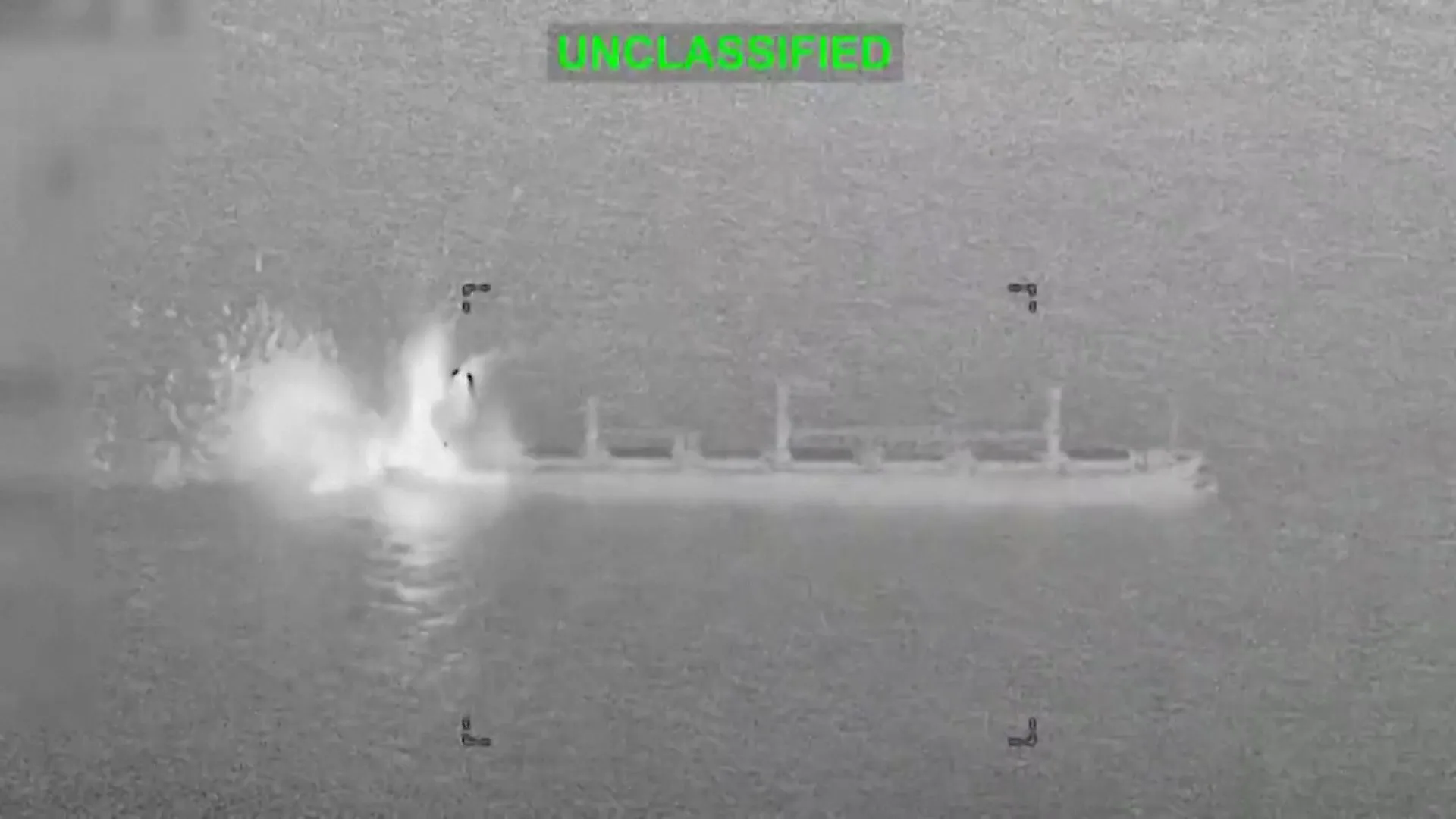
The U.N. International Maritime Organization (IMO) paused its plan to evacuate hundreds of ships stuck in the Persian Gulf after a vessel was attacked in the Strait of Hormuz on Thursday. A U.S. official told us the attack was carried out by an Iranian drone, which was confirmed by Iranian officials.

The evacuation plan, which IMO developed with Oman, was designed to provide safe passage to vessels in the Persian Gulf that are still unable to transit the Strait, which has been largely closed since Iran was attacked by the U.S. and Israel. The announcement came as traffic was beginning to move through the Strait again amid ongoing, albeit tense peace talks between the U.S. and Iran. However, these transits represent a tiny fraction of what took place before the war.

The IMO decision today also came after a warning earlier on Thursday by the Islamic Revolutionary Guard Corps Navy (IRGC-N) that safe passage through the Strait was limited to routes designated by Tehran and that other routes were “unacceptable and completely dangerous,” according to The Washington Post. The publication cited Iranian state-run media. The IRGC-N also claimed it turned back several ships trying to transit the Strait through the southern route suggested by IMO. There is also a northern route, near the Iranian coastline while concerns remain about mines in the main route, down the middle of the Strait.

IMO said it is pausing its evacuation plan even though the ship that was attacked was not taking part in that nascent effort.

“Following the launch of the IMO’s evacuation plan, through which several vessels have already been successfully evacuated, I have decided to temporarily pause its implementation in order to reconfirm that the necessary safety guarantees continue to be in place for the ships on our evacuation list and all those in the region,” IMO Secretary-General Mr. Arsenio Dominguez said in a statement. “I have been informed of an attack today in the Gulf of Oman on a vessel which passed through the Strait of Hormuz. This vessel did not transit under IMO’s evacuation framework. I have always reiterated that the safety of the seafarers remains paramount. Therefore, to ensure a coordinated approach and navigational safety, the evacuation plan will be paused until further clarity is obtained.”

“Today marks the Day of the Seafarer, underlining the importance of ensuring that the continued evacuation of the thousands of seafarers stranded in the Persian Gulf can proceed without the risk of them becoming collateral victims in this geopolitical conflict,” Dominguez added.

A maritime security official told us the ship that was attacked was the Ever Lovely, a Singapore-flagged cargo ship, according to MarineTraffic. The incident occurred about 7.5 nautical miles southeast of Dahit, Oman, according to the United Kingdom Maritime Trade Operations (UKMTO) center.

“A cargo vessel has been hit on the starboard side by an unknown projectile, causing damage to the bridge,” UKMTO stated on X. “Master has reported no casualties and no environmental impact. Authorities are investigating. Vessels are advised to transit with caution and report any suspicious activity to UKMTO.”

As we reported yesterday, IMO along with Oman devised a plan to allow vessels to leave the Persian Gulf through a southern route along the Omani coastline. The southern route is clear of mines and is the preferred route, according to the Joint Maritime Information Center.

A second route, to the north along the Iranian coastline, is controlled by the Islamic Republic.

In its initial unveiling of the evacuation plan, IMO said “this large-scale operation will be carried out in close cooperation with Iran, Oman, all other coastal States in the region, the United States and the maritime industry.”

We reached out to IMO for more information given that the IRGC-N is apparently not cooperating.

As we noted earlier in this story, there has been a spike in traffic through the Strait since last week’s signing of the Memorandum of Understanding (MoU) between Washington and Tehran.

However, the IRGC-N’s new stance “marks a reversal in the normalization trajectory building since the MoU signing,” the Windward maritime intelligence firm warned on Thursday. 

“The IRGC published a claim on its official Telegram channel that three tankers transiting the southern corridor had been ordered to turn back. Windward identified five vessels exhibiting behavior consistent with that claim, with a sixth losing AIS signal during the incident,” the intelligence firm noted.

“A VHF Channel 16 broadcast warned all vessels that transit without AIS or IRGC permission would be at their own risk,” Windward added. “The southern corridor, previously described as not requiring Iranian approval, is now subject to active IRGC enforcement, eliminating the only route operators believed to be free of Iranian control.”

It remains to be seen how or if this latest turn of events will alter what has been a positive trajectory for commercial shipping in the Strait. Simmering frictions between the IRGC and Iranian government that have emerged in recent months make it difficult to assess just who is in control in Iran and who has the final say in operations on this strategic waterway. Regardless, a pause in the evacuation plan and a new kinetic strike on shipping are not good omens.

Contact the author: howard@twz.com

Howard is a Senior Staff Writer for TWZ. He writes frequently about conflict, focusing heavily on the Middle East and Ukraine, and interviews with military and intelligence officials and industry leaders from around the globe. He lives near Tampa, Florida, home of U.S. Central Command, U.S. Special Operations Command.


Source link

5 killed in Indian Air Force cargo plane crash during training

Five people died Saturday when an Indian Air Force cargo plane crashed during training. Image courtesy of UPI

June 13 (UPI) — Five Indian Air Force personnel are dead after a transport plane crashed during training in Assam, officials said Saturday.

“The Indian Air Force deeply regrets the loss of five personnel in the An-32 accident at Jorhat, Assam. Sqn Ldr Prashant Singh, Flt Lt Shubham Kumar, Sgt Jitendra Sharma, Agniveervayu Khemaram Kumawat and Agniveervayu Danish Alam made the supreme sacrifice in the line of duty. IAF extends its deepest condolences to the bereaved families and stands firmly with them in this hour of grief,” the Indian Air Force posted on X.

Assam is in the northeastern part of the country.

“Crash site management and initial enquiries are on at this time,” the Air Force said. It added that an investigation to find the cause of the crash is underway.

India’s air force operates a fleet of about 105 AN-32 aircraft, Al Jazeera reported.

President Donald Trump speaks to reporters about restoring commercial fishing access to areas of the Pacific during a signing ceremony in the Oval Office of the White House on Thursday. Photo by Jim Lo Scalzo/UPI | License Photo

Source link

Airbus Unveils U145 Uncrewed Cargo Helicopter

In a significant development, Airbus has announced that its H145 twin-engine light helicopter is being developed in an uncrewed version, the U145. The move continues and expands the manufacturer’s work in the uncrewed helicopter space and reflects similar developments around the globe — most notably, an uncrewed version of the UH-72 Lakota, which is the U.S. Army’s variant of the H145.

The U145 was officially revealed today, ahead of the ILA Berlin airshow, starting this week, during which a full-scale mock-up will be displayed. Airbus says it is planning a first flight of the U145 — with a safety pilot onboard — before the end of this year, and is aiming for entry into service at the beginning of the next decade. 

“With the U145, we are offering our customers an autonomous, uncrewed version of our H145 helicopter — combining the proven airframe, power and useful load of the H145 with the autonomy of a UAS,” said Matthieu Louvot, CEO of Airbus Helicopters, in a company media release. “To develop the U145 and its capabilities as a multi-mission UAS, we will be teaming up with leading autonomous mission partners to further expand the UAS ecosystem in Europe,” he added. 

The U145 will have a maximum takeoff weight of around 8,400 pounds, and is described as a “mission-agnostic solution for civil and military applications, primarily high-volume cargo supply.” Airbus has announced the payload will be up to 2,600 pounds. In comparison, the uncrewed version of the Lakota, the MQ-72C Lakota Connector, will carry a maximum payload of around 4,000 pounds, although this includes slung loads. With that in mind, the U145 and MQ-72C will likely end up offering very similar payload capacities.

A model of the uncrewed version of the Lakota, now known as the MQ-72C, on display at the 2024 Sea Air Space convention. Jamie Hunter

The MQ-72C is expected to be able to cruise at speeds of 135 knots out to ranges of at least 350 nautical miles, according to the Airbus website.

Already at this stage, the company is pitching the U145 for specific military roles, including armed scouting and surveillance. Airbus is also planning to adapt the U145 as a “drone mothership” that will carry “launched effects,” on which the company is partnering with European missile house MBDA. A similar concept is currently being pitched by Sikorsky, with its uncrewed version of the Black Hawk helicopter, dubbed the U-Hawk, which is also intended to be able to fire dozens of launched effects such as surveillance and reconnaissance drones and loitering munitions.

Airbus also envisages the U145 operating in conjunction with conventional helicopters as part of crewed-uncrewed teaming. 

German air force special forces members take off from Lechfeld Air Base, Germany aboard an H145M Airbus aircraft during exercise Air Defender 2023 (AD23), June 14, 2023. Exercise AD23 integrates both U.S. and allied air-power to defend shared values, while leveraging and strengthening vital partnerships to deter aggression around the world. (U.S. Air National Guard photo by Staff Sgt. Joseph R. Morgan)
German special forces members take off from Lechfeld Air Base, Germany, aboard a pair of H145Ms during Exercise Air Defender 2023. U.S. Air National Guard photo by Staff Sgt. Joseph R. Morgan Tech. Sgt. Joseph Morgan

The U145 will offer full autonomy, Airbus says, being equipped with a specialized sensor suite and artificial intelligence. For an uncrewed logistics aircraft, the ability to autonomously navigate along a predetermined route using programmed waypoints would provide a practical foundation for autonomous operations. However, more advanced capabilities — such as dynamically adjusting flight paths and responding in real time to emerging threats or unexpected obstacles — would also be very valuable, especially when conducting resupply missions in contested or high-risk environments.

The U145 will have no physical cockpit, so it cannot be flown with human pilots onboard. Other significant changes include adaptations for cargo missions, including a clamshell nose door, a loading platform, and a dedicated cargo floor. The existing rear clamshell doors are retained, as are the cabin side doors. The same configuration has been adopted for the MQ-72C, and a pass-through cargo hold is a big advantage that other crewed helicopters in this class cannot match.

A look in through the rear of a UH-72 in a medical evacuation configuration. The H145 is essentially similar. U.S. Army National Guard

Other features of the new uncrewed helicopter will be carried directly over from the H145, more than 1,800 of which are currently in service.

These features include a powerplant of two Safran Arriel 2E engines equipped with a full-authority digital engine control (FADEC) and a fenestron tail rotor.

The U145 is the next step in the manufacturer’s development of uncrewed helicopters. As such, it follows on from the smaller VSR700, a rotary-wing uncrewed air system which was derived from the crewed Cabri G2 light helicopter.

A VSR700 completes a test flight, accompanied by an H145. Airbus

It is unclear what elements might be ported across from the MQ-72C, also called the Unmanned Logistics Connector (ULC), which is being developed separately by Airbus U.S. Space and Defense, together with its partners Shield AI, L3 Harris, and Parry Lab. Based on the U.S.-made UH-72B Lakota, the MQ-72C is similarly autonomous and is primarily aimed at the U.S. Marine Corps. You can read more about the MQ-72C in our previous coverage of the aircraft, here and here.

Airbus’s UH-72 Unmanned Logistics Connector Sets Its Sights On The USMC’s Future Fleet Requirements thumbnail

Airbus’s UH-72 Unmanned Logistics Connector Sets Its Sights On The USMC’s Future Fleet Requirements


In the context of the MQ-72C, we have previously looked at how this platform fits with the U.S. Marine Corps’ vision for future fleets of cargo-carrying drones. The Marines see uncrewed logistics ‘connectors’ in the air and down below as essential for supporting future expeditionary and distributed operations, especially in the context of a possible future high-end fight with China in the Pacific.

Other U.S. efforts in this space include optionally crewed and uncrewed versions of the larger H-60 Black Hawk series. The U-Hawk demonstrator, a fully uncrewed version of the Black Hawk helicopter, is intended to carry cargo and deliver launched effects and similarly features clamshell doors in the nose. At the heavier end of the scale, Boeing has said its future plans for the H-47 Chinook include creating a path toward an uncrewed version of the aircraft.

Introducing the S-70UAS™ U-Hawk™ thumbnail

Introducing the S-70UAS™ U-Hawk™


However, these kinds of capabilities are increasingly being eyed by other services around the world, too.

With this in mind, Airbus is hoping to leverage the existing customer base for the H145, which has footprints on six continents. The H145 is already in service, or on order, with a growing number of international military operators for utility and light-attack missions. The uncrewed version maintains significant commonality, which will bring down support and maintenance costs.

At the same time, the U145 has obvious commercial applications. Airbus highlights its suitability for roles like disaster management and firefighting, although it would also be ideal for cargo conveyance, especially remote resupply work and logistics support to offshore platforms and remote areas on land, for example.

A standard H145 demonstrates its capabilities for offshore missions. Airbus

An Airbus spokesperson told Breaking Defense that the U145 has not been developed for any specific national or European acquisition.

Undoubtedly, there is growing recognition in Europe, in particular, that changes in the geopolitical landscape mean that the continent cannot necessarily rely on the United States to meet its defense needs. Developing the U145 in addition to the MQ-72C aligns with Europe’s ambition to strengthen its sovereign capabilities.

With the U145, Airbus is betting that autonomous rotorcraft will become an increasingly important part of military operations. By leveraging a proven helicopter platform, it should accelerate the transition to uncrewed operations, but the drone helicopter will be entering an increasingly competitive marketplace.

Contact the author: thomas@thewarzone.com

Thomas is a defense writer and editor with over 20 years of experience covering military aerospace topics and conflicts. He’s written a number of books, edited many more, and has contributed to many of the world’s leading aviation publications. Before joining The War Zone in 2020, he was the editor of AirForces Monthly.


Source link

Light Uncrewed Cargo Helicopters Based On Robinson R66 And Bell 505 Compete For USMC Contract

The U.S. Marine Corps is set to test at least two new autonomous cargo helicopters, as it seeks to field platforms that can rapidly resupply Marines in contested environments. The service recently awarded contracts for two such platforms, one being the R66 Turbinetruck that inserts Sikorsky’s MATRIX autonomy system in the proven Robinson R66 airframe. The second is the Uncrewed 505, a development of the Bell 505 in a program led by Near Earth Autonomy, in collaboration with Bell Textron, Moog Inc., and XP Services.

This is all part of ongoing efforts to develop uncrewed logistics platforms that the Marines can use in contested environments, something that is of particular relevance as the branch looks to the requirements for a future conflict with China in the Pacific.

The R66 Turbinetruck that combines the Robinson R66 airframe with Sikorsky’s MATRIX autonomy system. Robinson Unmanned

Lockheed Martin announced yesterday that its Sikorsky subsidiary and Robinson Unmanned had received a contract for the Turbinetruck from the Marine Corps. This comes under the Marines’ new-look Autonomous Aerial Logistics Program Medium Aerial Resupply Vehicle — Expeditionary Logistics (MARV-EL). The contract is worth $15.5 million and covers Increment 2 of MARV-EL.

“As we expand the MATRIX family, we also extend the reach of uncrewed solutions for both civil and military customers,” said Rich Benton, vice president and general manager of Sikorsky. “The commercially developed R66 Turbinetruck is simple, economical, and re-configurable; ideal for high-risk, hard-to-reach environments, where keeping personnel out of harm’s way is essential.”

“Our partnership with Sikorsky brings the trusted performance and reliability of the R66 platform into the unmanned logistics arena,” added David Smith, president and CEO of Robinson Helicopter Company. “The R66 Turbinetruck represents a significant step forward in expanding proven rotorcraft into scalable, autonomous cargo solutions for demanding operational environments. Together, we are delivering a game‑changing capability that will enhance warfighter readiness and open new opportunities for safe, reliable, and affordable autonomous transport.”

Robinson Unmanned | The Future of Autonomous Rotorcraft is Here thumbnail

Robinson Unmanned | The Future of Autonomous Rotorcraft is Here


The R66 Turbinetruck puts together the R66 airframe from the Robinson Helicopter Company, a single-turbine engine design that is best known as a five-seat light rotorcraft on the commercial market. The R66 was selected for the Turbinetruck application primarily on account of its reliability, low maintenance demands, and high level of versatility. The aircraft is currently in widespread civilian service as a trainer, passenger, and utility helicopter.

Combining the R66 airframe with Sikorsky’s MATRIX system provides the ability to perform autonomous uncrewed operations. MATRIX has previously been proven in a U.S. Army UH-60M helicopter, giving it a ‘robotic brain,’ and the culmination of a series of tests stretching back years now that have been steadily working on ever-greater pilot-optional capabilities for the Black Hawk family. As we have noted in the past, the same technology could easily find its way onto other aircraft, as evidenced by the Turbinetruck.

Sikorsky and DARPA Autonomous Black Hawk Flies Logistics and Rescue Missions Without Pilots on Board thumbnail

Sikorsky and DARPA Autonomous Black Hawk Flies Logistics and Rescue Missions Without Pilots on Board


Lockheed Martin says the Turbinetruck is intended to give the Marines “flexible, affordable and rapid combat sustainment,” with its primary roles including the delivery of ammunition, medical supplies, and other essential equipment directly to the troops that need it. These critical loads need to be supplied “regardless of terrain, weather, or enemy threat,” the company adds.

According to Robinson Helicopter, the Turbinetruck can carry a load of 1,300 pounds internally, or external loads supported via a cargo hook. The internal cargo compartment is accessed via front clamshell doors and a right-hand baggage door. A total useful load of 1,500 pounds can be transported, and the aircraft has a range of more than 325 nautical miles.

The Turbinetruck features two clamshell doors in its nose, allowing a forklift truck to place loads directly in it. Robinson Unmanned

When it comes to MARV-EL, this now stipulates an uncrewed aircraft that can carry a logistic payload of between 1,300 and 2,500 pounds to a combat radius of 100 nautical miles, operating through a common digital handheld device.

In an operational scenario, the mission objectives would be entered into the Turbinetruck using a digital tablet. The system would then automatically create a flight plan, using sensors and algorithms to guide the helicopter safely to the target location.

The Turbinetruck would allow the Marines to conduct critical logistics missions without having to put any additional personnel at risk, as would be the case if crewed rotorcraft were employed at the tactical edge of the battlefield. Crewed rotorcraft also come with increased demands on maintenance and availability. Meanwhile, crew-rest cycles might mean that the aircraft have to stay on the ground during high-tempo operations, while these assets will inevitably be in heavy demand for all kinds of other missions in any kind of high-end fight.

A video outlining the Robinson R66 Army Trainer, a crewed version of the helicopter offered to the U.S. Army schoolhouse:

Robinson R66 Army Trainer Helicopter | Press Conference & Official Reveal | AAAA in Nashville thumbnail

Robinson R66 Army Trainer Helicopter | Press Conference & Official Reveal | AAAA in Nashville


At the same time, the MARV-EL concept is especially tailored for the Indo-Pacific theater, in which Marines and other U.S. military forces would be expected to fight from and around austere forward operating bases — a concept known as Expeditionary Advanced Base Operations — as well as unimproved landing zones, and from the decks of ships.

In this context, the Turbinetruck, and the MARV-EL program, more generally, hope to fill a notable capability gap between small tactical drones and larger crewed airlifters. This is something that Lockheed Martin describes as a “middleweight” uncrewed logistics platform capable.

Another view of the Turbinetruck with the nose cargo doors open. Robinson Unmanned

Robinson Unmanned will deliver the first R66 Turbinetruck to Sikorsky for integration, test and evaluation, and demonstration. At that point, the aircraft will undertake capability demonstrations to prove out the MATRIX system in the R66 airframe.

Since MATRIX is platform-agnostic and has an open architecture design, it is intended to be easily integrated into various airframes.

As for the rival Uncrewed 505, this takes the Bell 505 Jet Ranger X helicopter and combines it with Near Earth’s Captain autonomous system, and Moog’s Genesys avionics. The 505 is also a single-turbine helicopter that is in use in similar training, passenger, and utility roles as the R66.

A rendering of the Uncrewed 505. Near Earth Autonomy

The MARV-EL Increment 2 program will also see the Uncrewed 505 prototype developed for the Marine Corps. Near Earth says it will spend the next 36 months integrating and flight-testing the autonomous flight system in the Uncrewed 505, before progressing from early demonstrations to full mission capability.

“The program is to develop an uncrewed aerial logistics aircraft for where the risk and need are highest,” said Lyle Chamberlain, CTO of Near Earth. “We are combining our Captain autonomy architecture with a proven Bell 505 platform to move cargo without putting Marines in harm’s way. To be as intuitive as possible, we are designing the aircraft around existing Marine Corps workflows. Operators will be able to request, dispatch, and manage missions through familiar command-and-control pathways, including MAGTAB and MANGL integration. At the same time, cargo can be loaded with standard pallet jacks and forklifts. This approach reduces infrastructure burden and helps make autonomous resupply practical for expeditionary operations.”

A diagram shows the basic operating concept for the Uncrewed 505. Near Earth Autonomy

Near Earth says the Uncrewed 505 is optimized for efficient transportability, with two aircraft fitting inside a C-130 cargo aircraft with minimal disassembly.

Other aircraft have previously emerged out of the MARV-EL program.

These included the Kargo UAV, a rotary-wing drone from the Kaman Corporation, which previously developed an optionally crewed version of its K-Max helicopter.

KARGO UAV | Transforming Expeditionary Logistics thumbnail

KARGO UAV | Transforming Expeditionary Logistics


Notably, Kaman partnered with Near Earth Autonomy for the autonomy system for both the Kargo UAV and the optionally crewed K-Max.

Another competitor for MARV-EL was the SeaOnyx from Leidos. In 2023, it was announced that Leidos had won a Marine Corps contract to develop a prototype of this autonomous resupply vehicle under the Medium Unmanned Logistics Systems — Air (MULS-A) program, which later became MARV-EL.

The SeaOnyx from Leidos. Leidos

However, neither of these platforms met Marine Corps requirements, leading to MARV-EL being recompeted. At the same time, the previous requirements (including delivering a logistics payload of 300-600 pounds within a radius of 25 to 100 nautical miles to a combat area) were made more ambitious, increasing cargo payload and range.

Overall, MARV-EL again highlights the Marines’ growing focus on expeditionary warfare in contested environments, in the Pacific theater especially. With their versatile airframes, the R66 Turbinetruck and the Uncrewed 505 could be adapted for other missions, including intelligence, surveillance, and reconnaissance (ISR), electronic warfare (EW), communications relay, and search and rescue. All of these are growth areas for the Marines specifically and the U.S. military more generally.

A video outlining the Bell 505, as offered for the U.S. Army Flight School Next requirement:

Bell 505: Ideal Trainer thumbnail

Bell 505: Ideal Trainer


At the same time, the R66 already has a foothold with the U.S. military, with TH-66 Sage used to train U.S. Army and Navy helicopter operators, under contract. The Army is also now looking at both the R66 and the Bell 505 for its Flight School Next training helicopter program.

Whichever design or designs are ultimately selected for the MARV-EL requirement, the Marines can expect a new medium-weight logistics platform that bridges the gap between smaller drones and larger crewed aircraft currently in use. At the same time, it will help reduce risk by keeping more fixed-wing and helicopter crews out of harm’s way.

Contact the author: thomas@thewarzone.com

Thomas is a defense writer and editor with over 20 years of experience covering military aerospace topics and conflicts. He’s written a number of books, edited many more, and has contributed to many of the world’s leading aviation publications. Before joining The War Zone in 2020, he was the editor of AirForces Monthly.


Source link