career

GOP Sen. Bob Packwood of Oregon dies

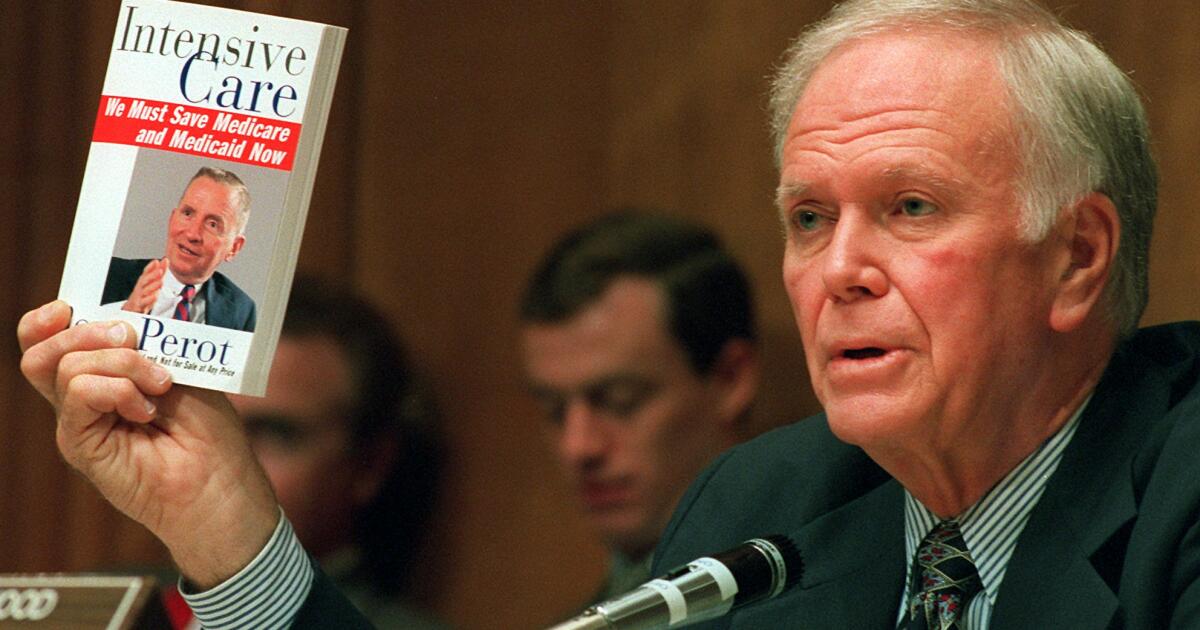
Former Sen. Bob Packwood, a moderate Oregon Republican whose reputation as a champion of women’s rights was tainted late in his career by a sexual harassment scandal, has died. He was 93.

Packwood’s death Saturday was announced in an obituary sent to media outlets by his family. The release didn’t include additional details.

As the scandal unfolded, Packwood initially refused to quit the chamber in which he had served for 27 years, saying he didn’t want to be remembered only for that.

Before the #MeToo era, Packwood stood out as an example of private behavior undermining a man’s public image. He previously had been praised by Planned Parenthood and others.

The great-grandson of a member of the 1857 Oregon Constitutional Convention, Packwood established himself as a social moderate and fiscal conservative who often voted across party lines. He considered running for president in 1980.

Elected to the Senate in 1968, Packwood was best known as the leading Republican advocate of abortion rights — at a time when the position had bipartisan support — and was widely admired by women’s groups throughout the country until the Senate Ethics Committee launched an investigation into the allegations of sexual and official misconduct in 1993.

More than two dozen women, former employees and acquaintances, accused him of making unwanted or uninvited sexual advances.

The allegations remained the target of an ethics inquiry that widened to include other alleged acts of official misconduct. He resigned in September 1995, and went on to start a lucrative lobbying business in Washington.

Democratic Sen. Ron Wyden, who replaced Packwood in 1996, said that although he should be praised for his record on abortion rights and tax reform, how Packwood treated women overshadows it all.

“His horrible history as documented in his own diaries will forever overshadow that public record. Simply put, historians’ first line about Bob Packwood must include those women who he abused and assaulted for years and years,” Wyden said in a statement.

As chair and then ranking Republican on the Senate Finance Committee, Packwood was a master of cutting deals and forging compromises needed to pass tax legislation through Congress. He was most proud of the lead role he played in a sweeping tax reform of 1986 that lowered the top income tax bracket and eliminated many itemized deductions.

Over his career, he was described as a blunt, independent, outspoken politician who was a boat-rocker, loose cannon, skilled partisan, and — for most of his career — political survivor.

“I think they probably all ring true,” Packwood told the Associated Press in December 1992.

“I would like to think that I am nobody’s lackey. I try to reach conclusions independently and then I’m willing to fight for those conclusions; if necessary, having to fight against my party or my party’s president,” he said.

Packwood won his first Senate election at age 36, narrowly defeating Democratic Sen. Wayne L. Morse, an Oregon legend who had held the seat for 23 years. He quickly grabbed attention as a rising star in the GOP. By 1980, he was elected chairman of the National Republican Senatorial Committee.

But he lost the seat when the White House backed a competitor after Packwood publicly accused President Reagan of alienating women, African Americans and Jews.

Just two weeks after Packwood’s reelection in 1992, the Washington Post printed allegations from former female employees and acquaintances that the senator had subjected them to uninvited sexual advances.

The Senate Ethics Committee also investigated allegations that Packwood solicited jobs from lobbyists for his ex-wife, used his staff to try to threaten the female accusers into keeping quiet and obstructed the investigation by altering his personal diaries.

The Senate held two days of extraordinary debate in 1993 over whether Packwood should have to comply with an Ethics Committee subpoena for his diaries, in which he reportedly made entries relevant to the investigation. The Senate voted 94 to 6 to enforce the subpoena.

Packwood took the case to federal court and lost, ending when Supreme Court Chief Justice William Rehnquist refused the senator’s request for the high court to intercede.

Packwood launched his lobbying business, Sunrise Research Corp., in 1997. By 1999, the firm was grossing $1.5 million a year. His business slowed in later years, but he told a City Club of Portland audience in 2010 that he was still spending about half his time in Washington lobbying for a number of clients.

It was interesting work, Packwood told the audience, according to the Oregonian, but “it is not as much fun as being in the Senate.”

As Congress became increasingly partisan after his departure, Packwood continued to advocate a centrist tack and in his 2010 City Club speech called for Oregon to create nonpartisan elections.


Source link

Female Navy officers say they fear a career cap

After Defense Secretary Pete Hegseth cut nine Navy officers, including all the women, from a promotion list, several female officers say they see the unusual intervention as a sign that their careers now have a ceiling and worry for the future generation of female military leaders.

The Navy had selected 31 sailors to promote from the rank of captain to one-star admiral, but Hegseth recently intervened to strike nine people from the list, including three women and two Black men, according to a Defense official who spoke on condition of anonymity to discuss information not permitted to be released publicly.

As a result, the Navy is not promoting a single woman to the one-star admiral rank this year even though women make up about one-quarter of all Navy officers and nearly one-third of the sea service’s midgrade ranks, according to military data from 2024.

The Associated Press spoke with eight female Navy officers of varying ranks and time in service after Hegseth’s cuts, which were reported earlier by the New York Times, became public. They spoke on condition of anonymity out of fear of retribution from their superiors.

The more junior officers said they saw the development as a sign that their careers would become politicized if they rose too far in the ranks, and some said they felt they now had a limit on how far they could be promoted. Some said it made them feel less valued within the military and wondered whether that wasn’t part of the intent.

The Pentagon has not offered any rationale on why the women, or any of the other six people, were removed from the promotion list.

Sean Parnell, the Pentagon’s top spokesman, said on social media last week that “military promotions are given to those who have earned them” and that the Pentagon “will never consider the color of a service member’s skin or their gender as a factor in promotions.” The Pentagon did not immediately respond to a request seeking further comment.

The Navy’s process for choosing which officers to promote to the one-star rank has been relatively constant and transparent over the years. The service convenes a group of officers, called a promotion board, that examines the records of eligible officers and chooses those deemed to be the most qualified.

The board that selected the initial slate of 31 officers for promotion was directed by then-Navy Secretary John Phelan, an appointee of President Trump, to “recommend for promotion the best qualified officers within their respective competitive category.”

The order from Phelan, who abruptly departed his post in April, said the board should consider an officer’s performance, competence and character, among other traits, as part of those qualifications.

It also said that given China’s prominence in the Trump administration’s National Defense Strategy, “special consideration shall be given to officers who have excelled in their knowledge of the political military affairs and U.S. strategic interests in the Indo-Pacific region, and operational contingency planning for Indo-Pacific war plans.”

Hegseth has long argued, without offering evidence, that women in the military benefit from preferential treatment and are not suited for combat roles.

“For too long, we’ve promoted too many uniformed leaders for the wrong reasons based on their race, based on gender quotas, based on historic so-called firsts,” Hegseth told hundreds of military leaders in September.

The approach, he asserted, made the Pentagon “less capable and less lethal.”

‘A break from tradition’

Phelan’s order said the Navy cannot discriminate based on criteria such as race and sex, and it specifically noted that “this guidance shall not be interpreted as requiring or permitting preferential treatment of any officer or group of officers on the grounds of race, religion, color, sex.”

The full list of 31 people to be promoted was approved by Phelan, other Navy leaders and the chairman of the Joint Chiefs of Staff, Gen. Dan Caine, before it reached Hegseth, who chose to make the changes, the Defense official said.

While Hegseth is within his rights to intervene in the list, “it’s just not the norm” and is “a break from tradition,” said Katherine Kuzminski, a researcher specializing in military recruiting and retention at the Center for New American Security think tank. She said that promotions historically have been seen as “the services’ business.”

Kuzminski noted that “this is a decision that’s not being made by the Navy — it’s being made by the secretary of Defense,” and she said Hegseth’s growing interference in operational aspects of the military services such as promotions is creating “tension” about what “normal” will look like going forward.

Some of the more senior Navy officers who spoke with the AP expressed concerns about the message it sends to the next generation of young sailors.

In addition to pulling the recent promotions of three women to admiral, Hegseth shortly after he took office fired Adm. Lisa Franchetti, the service’s top officer and the first woman to hold the job. He never explained his rationale.

Since then, he also has fired two other female three-star admirals without explanation.

Some of the officers who spoke to the AP said that while they were encouraging female sailors to stick with the Navy, they acknowledged that message is coming at a difficult time.

Kuzminski said the rhetoric and actions surrounding women in the military “affects individual service member decision-making and it also affects family unit decision-making,” including whether people make a career of the military.

Kuzminski said that following the months-long hold on military promotions by Sen. Tommy Tuberville (R-Ala.) during the Biden administration, surveys showed that partisan politics spilling into the day-to-day lives of troops affected their decision-making.

One officer said this impact was not confined to women.

In conversations with other sailors in her unit, she said that male sailors were hesitant to deal with what appears to be a growing politicization of simply following the orders of previous administrations.

Toropin writes for the Associated Press.

Source link

Jared Grindlinger caps off Huntington Beach High career with a title

Jared Grindlinger was right where he wanted to be Saturday afternoon at the end of his last high school baseball game — on the mound with a chance to clinch a championship for the orange and black.

Huntington Beach had a 5-0 lead with two outs and the bases loaded in the top of the seventh inning when the Oilers’ highly touted left-hander came in to relieve Jared Marchbank. The cushion was narrowed to two with runs scored on an error, an uncaught third strike and a wild pitch, but Grindlinger struck out the fourth batter to tie the bow on his team’s 5-3 victory over San Diego Cathedral in the Southern California Regional Division I final.

“I knew I’d be facing the top of their lineup and those guys are all great players but I was ready for it,” Grindlinger said. “To do this with my best friends who I’ve grown up with my entire life means everything to me.”

Grindlinger graduates Wednesday with plenty to be proud of and much to look forward to. The 6-1, 170-pound pitcher/outfielder reclassified in February to make himself eligible for next month’s Major League draft and is a potential first-round pick. Having just turned 17, the University of Tennessee commit has a bright future, but he wants to savor his final days on campus following in the footsteps of older siblings Bradley and Trent, who were back at their alma mater Saturday to cheer on Jared.

“I’ve known him since he was in second grade and he has two brothers who played for me too,” Oilers coach Benji Medure said upon wrapping up his 26th season. “Jared loves to compete and he fell in love with the culture and the family aspect of our program.”

In the first round of regionals on Tuesday, Grindlinger went four for four at the plate with a double, a home run, two singles and a run batted in plus he pitched three scoreless innings with five strikeouts in a 10-3 victory over Patrick Henry in San Diego. Two days later, he singled, tripled and scored two runs in an 11-3 semifinal victory at Corona.

Grindlinger blasted the fourth pitch he saw over the right-field fence to put the Oilers up 2-0 in the first inning Saturday — a lead they held until tacking on three more in the bottom of the sixth. He also patrolled left field and snared a line drive to end the top of the fourth.

“He came with two really good fastballs but then he hung a changeup and I knew I got it,” Grindlinger said of his 41st hit and second homer this season. “I’ve been working on discipline to look for my pitch.”

Medure noted Jared’s similarities to Bradley, the oldest, and Trent, whom he may soon be playing with in Knoxville.

“Bradley was a terrific pitcher and Trent was a super hitter and they’re all very close,” Medure said. “I think Jared picked Tennessee because he wants to be with his brother.”

He could be a Volunteer with his brother Trent next season.

“Jared’s got the best traits from both me and Bradley,” said Trent, who just completed his first season in Knoxville, where he made the SEC All-Freshman team as a catcher. “He has an aura about him and I’m super proud of him.”

“Jared’s a lot better than I was at his age,” admitted Bradley, a 2023 Huntington Beach alum who played at Long Beach State but is entering the transfer portal. “He’s barely 17 and getting to the upper 90s. He’s more polished, plus he’s a lefty.”

The hardest part about skipping his senior year to graduate early was not the extra classes he had to take but knowing he would be missing out on a chance to see his coach reach another milestone.

“He was a freshman and the second game that season I got my 400th win and Jared said, ‘I’m gonna be part of 400 and 500,’” added Medure, who is 28 wins away. “That year, we won 23 and 25 the next year. We had it all planned that 500 would be for the CIF title. When he decided to reclass to make millions of dollars he told him, ‘I feel bad I can’t win that 500th game for you.’ That’s the kind of kid he is.”

Grindlinger credits his mom for helping him meet all of his academic requirements and his brothers for teaching him everything he knows about the sport they all play.

“Whatever happens — whether it’s the draft or college — I’m good,” he said.

Medure is thrilled how the season ended considering he did not believe his team would even be in the regional bracket after losing early in the section playoffs. He is grateful for the three seasons he got to coach his superstar.

“Jared came in to let us know that scenario was on the table and every coach in that room said, ‘Awesome!’” Medure recalled. “He was scared to tell us because he thought we’d be upset. Usually it’s done to buy another year, not to lose one. Of course I’d like to coach one of the best players in America for four years, but ultimately I want him to do what’s best for him.”

Source link