Cardiff Airport

New July 8 UK airport rule will affect British families – ‘get through quicker’

Travel could be about to get faster for some families this summer at dozens of UK airports

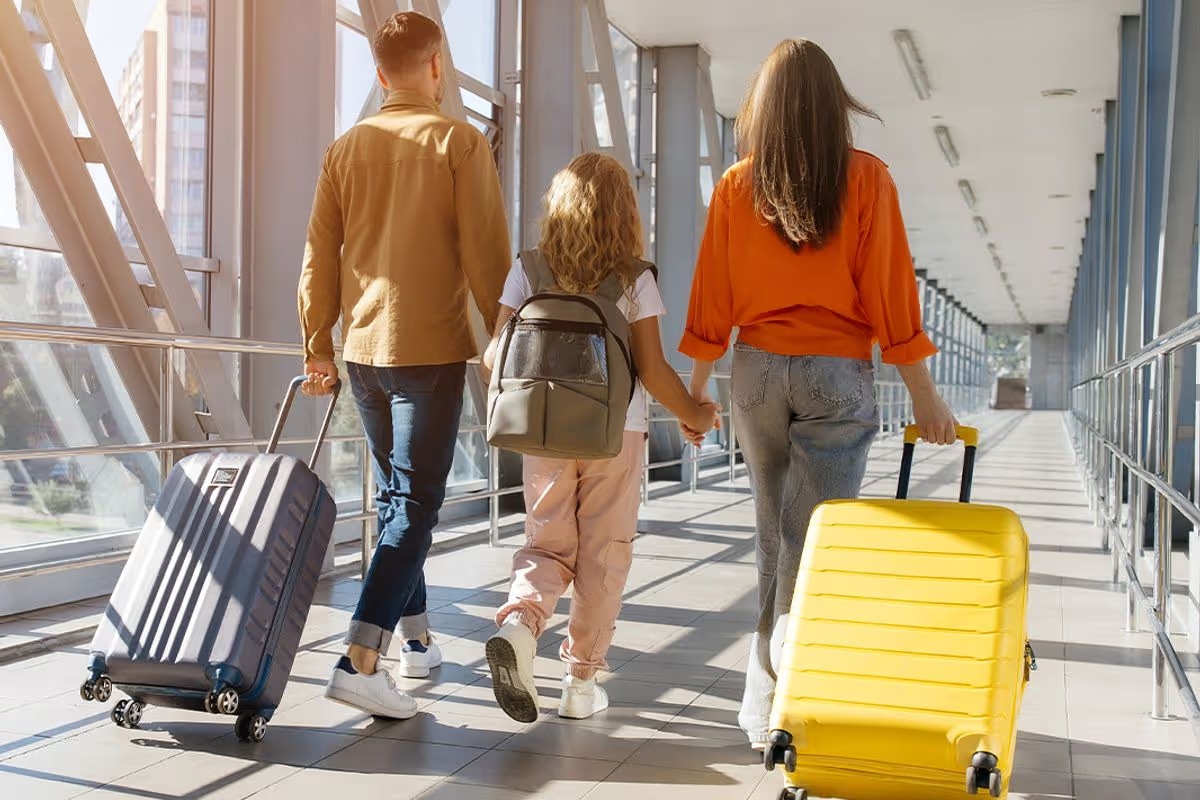
Families are being reminded that a major change to a key rule across more than a dozen UK airports will come into effect this summer. From next week, on July 8, a security rule will be eased for certain primary school-age children.

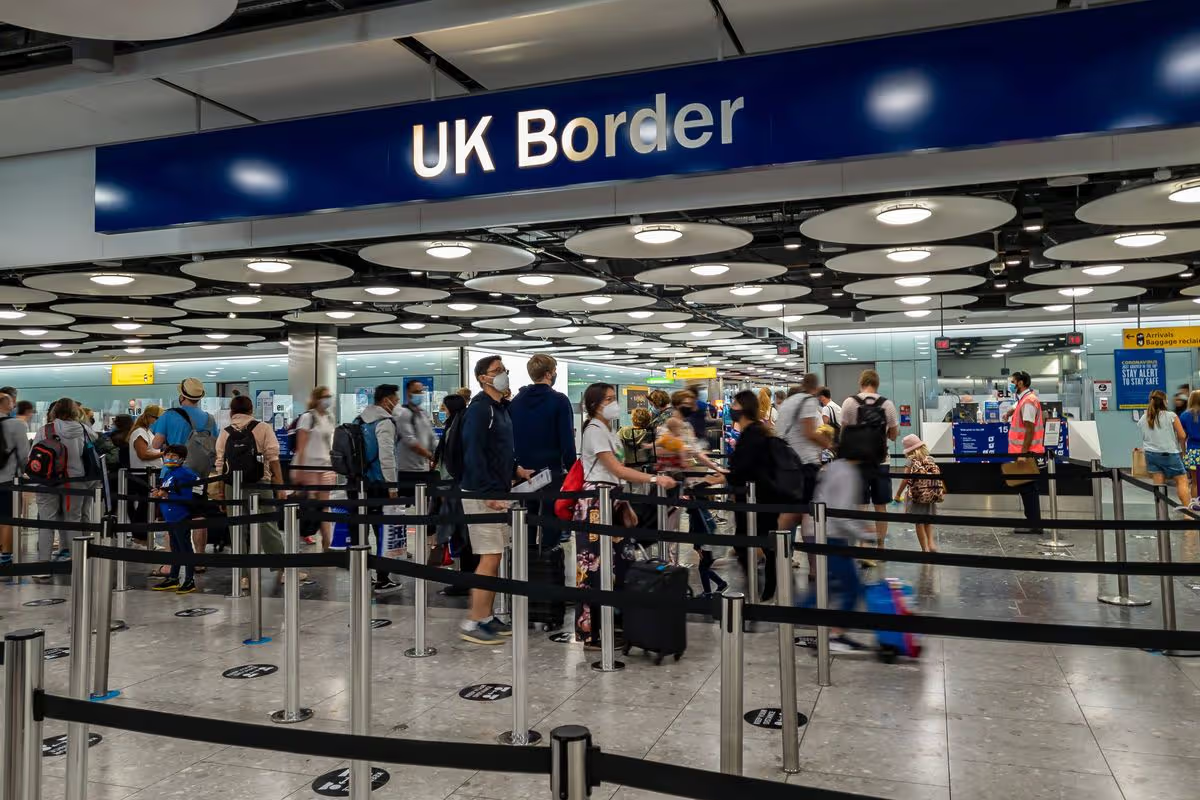
Back in May, the UK Government announced that up to 1.5 million more children would soon be able to use UK eGates, helping to speed up the process for them and their families during the summer holidays. Children aged eight and nine, who are at least 120cm (3ft 11in) tall and travelling with an adult, will become eligible under the new measures that come into force on Wednesday, July 8.

Officials say the change to the age threshold will be a welcome relief for families returning home from their holidays with young children in tow. The government claims that passing through an eGate typically takes just a matter of minutes.

With greater numbers of passengers making use of eGates, waiting times at passport control are also anticipated to fall. Prior to 8 July, eGates were generally available to those aged 10 and above, though children under 17 were required to (and must still be) accompanied by an adult, reports the Express.

Passengers are eligible to use an eGate if they have a biometric symbol on the front cover of their passport and are either:

  • a British citizen
  • a national of an EU country, Australia, Canada, Iceland, Japan, Liechtenstein, New Zealand, Norway, Singapore, South Korea, Switzerland or the USA
  • a member of the Registered Traveller Service
Content cannot be displayed without consent

Minister for Migration and Citizenship, Mike Tapp said: “Travel with young children can be stressful for parents. By expanding eGate access, more families can experience a swifter and smoother journey home – freeing up precious time this summer holiday season. We are delivering continued improvement to the passenger experience, while keeping our borders safe and secure.”

Border Force Director General, Phil Douglas said: “eGates are an essential part of keeping our border secure. Expanding access for families will deliver safe, smooth journeys whilst freeing up highly-skilled officers to focus on intercepting those who pose a threat to the UK.”

Karen Dee, Chief executive of AirportsUK, the trade body for UK airports, said: “This is a welcome development as it will give more families the ability to take advantage of this technology, speeding up the border process and reducing waiting times for many. Airports work very hard with border authorities to ensure the UK’s front door is both secure and welcoming, with those coming home and visiting enjoying a smooth experience.”

The UK first introduced ePassport gates at airports in 2008, with the very first gate going live at Manchester Airport. Initially, the automated gates were limited to UK, EU, and Swiss citizens but have since expanded to include eligible travellers from dozens of countries, including the US, Canada, Australia, and New Zealand.

Full list of UK airports with eGates (as of July 2026):

  1. London Heathrow
  2. London Gatwick
  3. London Stansted
  4. London Luton
  5. London City
  6. Manchester
  7. Birmingham
  8. Edinburgh
  9. Glasgow
  10. Bristol
  11. Newcastle
  12. Cardiff
  13. East Midlands
  14. Southampton
  15. Southend

Source link

Which UK airports still have the 100ml restrictions in place – full list

We’ve all got used to packing tiny shampoos and shower gels into our hand luggage when we fly, but new technology means some major airports are scrapping the 100ml rule making going through security so much easier

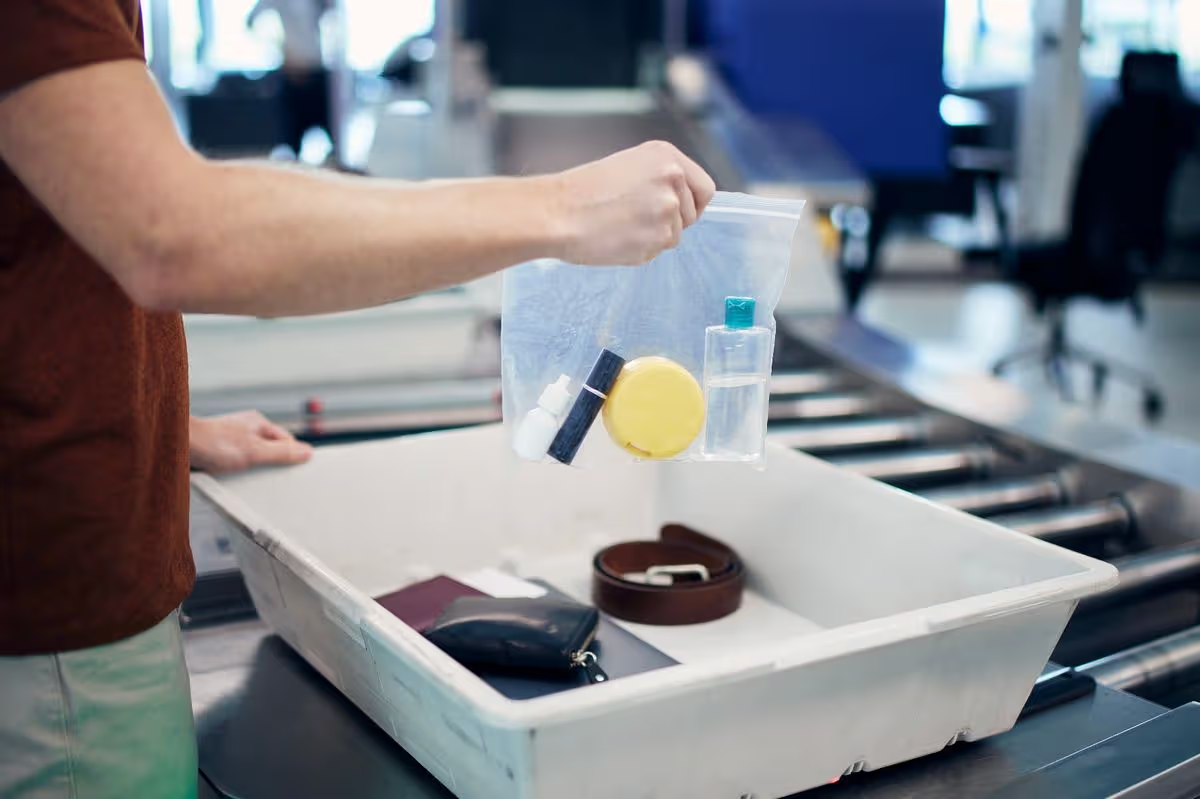
It’s hard to believe that the airline liquid rules have been in place for nearly two decades. Since a terror plot was foiled in 2006, air passengers in the UK have been limited to taking containers of under 100ml on planes, and made to keep them in a clear, resealable 20cm x 20cm plastic bag.

Over the years, technology has improved, meaning restrictions have slowly been eased. In many airports, you no longer need to use a clear plastic bag for your liquids and can simply leave them in your hand luggage. However, in the majority of airports, the 100ml rule still stands all these years later.

A small number of airports have now scrapped the 100ml rule – allowing Brits to fly out with liquids in containers of up to two litres in volume. This means most standard-sized bottles of water, creams, gels, sprays, and aerosols can be taken through as hand luggage.

Whatever the allowed liquid size at your departure airport, holidaymakers should make sure they avoid using metal or double-walled bottles, such as a Thermos flask, when they carry liquids on board, as the scanners cannot penetrate the insulated layers.

Another thing travellers should keep in mind is that the rules at their return airport might be different. The vast majority of European airports still enforce the 100ml rule. So while you may be able to take a big bottle of suncream in your hand luggage going out, you may need to put it in your checked luggage coming back.

The GOV.UK website has a list of items considered liquids. Many travellers still get caught out by the 100ml rule as they don’t realise items such as semi-liquid foods such as soup, jam, honey, or syrups need to be within the restricted size.

Nut butters and soft cheeses also come under the category of liquids. In the USA, the Transportation Security Administration (TSA) use a rule that: if you can spill it, spread it, spray it, pump it, or pour it, it counts as a liquid. While this isn’t an official rule in the UK, it’s a good way to determine whether an item you’re taking onboard is going to need to follow liquid size rules.

Liquid rules at airports can be updated with little notice, so always check your departure airport’s official website before you fly.

Full list of airports still enforcing the 100ml rule

  • Manchester Airport (MAN)
  • London Stansted (STN)
  • London Luton (LTN)
  • Glasgow Airport (GLA)
  • Glasgow Prestwick Airport (PIK)
  • Liverpool John Lennon Airport (LPL)
  • Newcastle International Airport (NCL)
  • Leeds Bradford Airport (LBA)
  • East Midlands Airport (EMA)
  • London City Airport (LCY)
  • Aberdeen International Airport (ABZ)
  • Jersey Airport (JER)
  • Cardiff International Airport (CWL)
  • Southampton Airport (SOU)
  • Inverness Airport (INV)
  • Cornwall Airport Newquay (NQY)

Full list of airports that have scrapped 100ml rule

  • London Heathrow (LHR)
  • London Gatwick (LGW)
  • Edinburgh Airport (EDI)
  • Birmingham Airport (BHX)
  • Bristol Airport (BRS)
  • Belfast International Airport (BFS)
  • George Best Belfast City Airport (BHD)
  • Bournemouth Airport (BOH)

Have a story you want to share? Email us at webtravel@reachplc.com

Source link

Jet2 clarifies luggage allowance rules that apply to all customers

There are several Jet2 rules to note when planning your trip

Jet2 has clarified its baggage allowances after an enquiry from a holidaymaker. The customer asked for help as they got ready for their summer getaway.

The person contacted the provider over social media on June 23. The traveller had booked their journey through Jet2holidays, and was due to jet off the following week.

They posed a question about their luggage entitlement. The customer wrote: “We have 3 x 22kg baggage allowance. Assume we are good to check in just two bags provided weight doesn’t exceed allowance?”

They went on to ask if they could check in one suitcase weighing 23kg and another at 25kg while remaining within their total allocation. Jet2 replied to set out the options available to the customer.

Combining your baggage allowance

The airline confirmed: “You can pool your luggage into two suitcases as opposed to three, as long as this doesn’t exceed your combined allowance of 66kg, and that no single article of luggage exceeds 32kg. I hope this helps.”

State Pensioners to face major tax change

According to Jet2’s official guidance: “Any baggage that exceeds your total weight allowance will be carried subject to availability and at our discretion. You’ll also need to pay an excess baggage fee, which is £12 per kg. Please note that no single item of baggage can weigh more than 32kg.”

You can add extra luggage when you book or through the Manage My Booking facility. Simply enter your booking reference, surname and departure date, then navigate to ‘Add Holiday Essentials’.

Query over 10kg allowance

Jet2 was also recently asked another question about its baggage weight rules after a passenger reported receiving contradictory information. The person had a booking for two adults and a six-month-old infant.

They explained: “Told we get two extra carry ons such as a buggy and travel cot that will be checked into the hold at the gate.”

They said they had two 22kg checked bags and that on a prior Jet2 holiday they had been told they qualified for “an extra 10kg for the baby”. According to Jet2’s official website guidance for bookings with children, passengers receive “an extra 10kg allowance for infants” plus “up to two items per child or infant free of charge”.

The passenger asked whether the additional 10kg could be combined with one of the 22kg cases, creating a 32kg allowance. They described receiving mixed messages on their last Jet2 journey. The customer recalled: “On the way out with you we were told it’s fine to have a 32kg case (22kg + the 10kg).

“On the way back we were told the 10kg should be a separate small checked case. Please can you clarify which it is and what the rules are because on our last holiday with you we were told different things.”

Setting the record straight, Jet2 responded to the passenger: “The additional 10kg is applied to one adult’s baggage, allowing for a total of one bag at 32kg and one bag at 22kg.”

Source link

EasyJet urges passengers to ‘switch off’ item on board or risk lifetime ban

easyJet passengers are being warned they could face serious consequences if they don’t completely switch off certain electronic devices

Holidaymakers travelling with easyJet this summer are being warned that they could unknowingly fall foul of strict cabin rules unless they fully switch off a commonly used electronic device before stepping on board. The trouble is that many passengers only discover the rule once they’ve already reached the airport or are on the verge of boarding, where last-minute slip-ups could spell serious problems.

According to EasyJet, the warning relates to e-cigarettes and vaping devices, which must be carried in hand luggage only and are strictly forbidden from being stowed in hold baggage under any circumstances. The airline’s official policy states: “All electronic cigarettes and vaping devices must be carried in the cabin, re-charging is strictly prohibited and the device must be completely switched off.”

It also advises passengers to keep their devices on their person where they can be kept an eye on throughout the flight, reducing the risk of accidental activation. These rules are in place due to concerns over lithium-ion batteries, which are used to power vaping devices and are well known for posing a fire risk if they become damaged or overheat.

The UK Civil Aviation Authority categorises lithium batteries as a significant safety risk in aviation due to their potential for ‘thermal runaway’, producing intense heat and flames that are notoriously difficult to extinguish in confined spaces. The International Air Transport Association has highlighted a worldwide rise in lithium battery-related incidents, which has gone hand in hand with the increasing prevalence of portable electronic devices, prompting airlines across the globe to tighten their rules considerably.

EasyJet also warns that passengers must take precautions to prevent their vaping devices from being switched on accidentally during flights, including ensuring they are fully powered down before boarding. The airline stipulates that travellers may carry no more than two spare batteries in their hand luggage, and that these must be properly protected to prevent them from coming into contact with metal objects.

Under UK aviation rules, vaping devices must be kept in hand luggage at all times. Official government guidance states that e-cigarettes are strictly prohibited from hold baggage.

Industry experts point out that confusion often arises because rules can vary between airlines and destinations, which can leave passengers unknowingly packing the wrong items before they even reach airport security. Aviation safety specialists also warn that using or charging vaping devices while on board flights is strictly prohibited by all major airlines, with penalties ranging from confiscation to fines or even travel bans in severe cases.

As summer travel demand picks up, holidaymakers are being urged to check airline regulations before they set off to avoid delays, confiscations, or being refused entry at the boarding gate.

Source link