Crowds cheered and waved national flags as two Shahed drones were paraded through Tehran. Iranian-made, low-cost Shahed drones have become a major feature of modern warfare, used in attacks across the Gulf and extensively by Russia in its war in Ukraine.
Normally we stay around Plaka, so Anana is the coffee shop I go to most often. There’s also Behold The Man in Exarchia, which is one of the coolest coffee shops I’ve been to. Exarchia has a really rebellious, anti-establishment feel and this place completely fits that – it has great music, great coffee and it’s just very cool. I don’t think there’s a coffee shop in London that’s quite like it. DC
‘Casual and low-key’: Anäna Cafe, Plaka, Athens.
My favourite is also Anana; It’s casual and low-key, with somewhere to sit down and relax. I’ll have a freddo espresso (espresso shaken over ice), which is basically the Greek national coffee now. NM
For pastries, Akra is one of the best places in Athens. The food itself is rustic, simple and delicious, and the pastries are unbelievably technical. There’s something almost incongruous about it – you eat very simple savoury food and then a dessert arrives that’s incredibly elaborate. It shouldn’t necessarily work, but it does. DC
Roll up! No Crumbs bakery.
No Crumbs opened this year and I’ve already been a few times. It’s a little outside the centre, but it’s where I’d go for breakfast or something to eat on the move. In central Athens, I also like Fillo, which specialises in traditional pies from around Greece. Last time I went, they had three different spanakopitas from three different regions. NM
Breakfast
I don’t really do breakfast in Athens. We’ll normally get coffee, then at about 11am go to Diporto, which is usually our first proper stop. It’s this incredible, old, rundown restaurant near the market: cash only, orders taken with a pen, massive wine barrels in the room, no choice of wine. They just put wine and water on the table. The food is incredibly simple: chickpeas, beans, vegetables cooked down slowly, sometimes grilled sardines or fish from the market. You could recreate a Greek taverna in London, but you could never recreate Diporto. There’s such magic in it. DC
If I want to start the day properly, I go to Ipiros inside the meat market, at about 10.30am. It’s not really breakfast; it’s a proper meal. They serve slow-cooked dishes in huge pots and we usually get the tripe soup, which is good for a hangover, with loads of bread. Then we walk around the corner to Diporto and have the opposite: braised beans, chickpeas, salad and, whatever time it is, wine. NM
Traditional tavernas
Whenever we fly into Athens, we try to go straight to Taverna To Trigono in Kalyvia, out by the airport. It’s as magic as a taverna gets. One side of the menu is salads, tzatziki, cheeses and breads; the other is grilled meat such as sausage, spit-roast lamb, offal, lamb chops, sheep chops. Everything is cooked to order and served with incredible abundance and generosity. It’s very simple: good produce, salt, oregano and lemon; nothing is over-embellished. I wouldn’t go to Athens without going there. DC
Chop-chop! Manári restaurant, Athens.
Manári is a proper meat chop house in central Athens. It’s relatively new, but it feels as traditional as possible, and you don’t need to travel into the mountains outside the city to find meat that good. I order the lamb chops, pasta with meat juices and tomato salad. The lamb chops are as good as – if not better than – a good dry-aged steak. Another favourite is Tavern Spanos in Kato Patisia, for lamb chops and meats cooked slowly on the spit. Once they run out, they run out. NM
New-wave restaurants
Linou Soumpasis & Sia is probably the most forward-thinking restaurant in Athens right now, and probably one of the best in Greece. It takes quite humble, seafood-led food and gives it a fine edge without losing its simplicity. The room is incredibly simple and every detail is really considered. Last time I went, they served a version of kakavia, the traditional fish soup, which was essentially a beautiful fish and vegetable broth with olive oil. Something that simple, done that well, is incredible. DC
‘Restrained and modern’: Linou Soumpasis and Sia restaurant, Athens.
Linou is one of my go-tos, too. It reminds me a bit of Lyle’s meets Brat. It has a restrained approach to food that still feels very modern. I’d also go to Pharaoh, particularly for the vegetables and whatever they’re doing with fermented wheat, and Ateno, which we went to twice in two days on my last trip. Get the Greek salad, stuffed vegetables and fries with mushrooms and eggs. I also really like Ex Machina: their saganaki is fried cheese but served cold, and I always want to see what [the chef] Adam Kodovas is doing with the seafood broth because the dish changes every few months, while the formula remains the same. I go to Akra for lunch because they serve smaller portions and I can order as many dishes as possible. NM
Seafood
Travolta is banging; it’s old-school and a bit like Bentley’s in London. You get huge plates of crudo and whole fish, and they have an amazing prawn and squid skewer with squid ink and olive oil that they mix at the table. It can get expensive (fish is incredibly expensive in Greece), but if you’re really into seafood it’s very cool. Phita is another good seafood place, a little further out. DC
Travolta would be my choice for more classic seafood, too. If you want something more elevated, I’d go to Iodio near Kolonaki. There’s one dish I’ll always remember, which is raw fish served cold with a crisp sheet of rice paper on top and a warm avgolemono sauce – a classic Greek sauce made with egg and lemon. You grab everything together in one bite and it’s great. NM
Cheap eats
For souvlaki, the best is often at little roadside or market stalls. Last time we were in Exarchia, we found a tiny souvlaki stall mainly serving the market vendors. For souvla, the bigger rotisserie-style meats, we go to Psitopoleio Peloponnhsos. They serve huge pieces of meat, lamb heads; all sorts of pretty gnarly stuff cooking on the rotisserie. DC
Gyros are a dangerous subject for Greeks because everyone has their favourite. Achilleas in Neos Kosmos is one of the few places that still makes their own [meat rotisserie] (rather than buying it ready-made). In the centre, I really like Hoocut. They aren’t technically gyros because they slice the meat raw, cook it and then chop it again into small strips, but the mentality is similar. For a late-night version, go to Mandraki in Kaisariani. They’re open until about 2am and cook meat on spits late into the night. Their gyros are huge and often sell out. It’s cheap, traditional and the sort of thing people actually eat every day. NM
Wine and cocktails
Wine is Fine is really good for a pre-dinner drink, and I also love Epta Martyres, from the people behind Loggia [on Sifnos]; I’d been to both loads of times before I even realised they were connected. In Greece, I tend to want wines that are light and bright. Assyrtiko is the obvious one; in that climate you want something really zippy. DC
Baba Au Rum, Athens.
Pharaoh has a great wine list, and Tanini Agapi Mou is an amazing wine bar. A Greek grape I discovered this year is Vidiano. Vidiano can lean quite dry but still feels really pleasant and crisp; depending on where it’s grown, the fruit and minerality change a lot. It’s easygoing but complex at the same time. NM
Line Athens is quite molecular and it’s the kind of place you stay for the night. The cocktails are some of the best I’ve ever had in my life, let alone Athens. Baba au Rum is right in the mix, too. There’s also Rumble in the Jungle behind The Bar in Front of the Bar. The first is a bar where you walk in and think, “This is cool,” then go through another door into the second, even cooler bar hidden behind it. It’s very Athens. DC
You have to mention Line and The Bar in Front of the Bar. At Bar in Front, they’re trying to be as zero waste as possible, and you basically order through a window in a wall and sit drinking in the street. I choose what to drink according to the weather – last time I had a frozen martini that was almost like a slushie. At Line, the Paloma is usually my go-to, although on my last two visits I had one of their punches, which changes regularly. NM
We always go to Athens’ central fish and meat markets. I particularly recommend being in Athens on a Saturday because that’s when you find all these farmers’ markets around the city. Some of my best times in Athens have been wandering around those. DC
Preparing fish ahead of a busy day at the central fish market. Photograph: Image Professionals GmbH/Alamy
Near Diporto there’s Miran, a charcuterie shop with a huge range of cheeses and cured meats that they make themselves. Buy something there, pick up some bread and take it home. There’s also a huge farmers’ market every Saturday around Exarchia with outstanding produce. NM
Out of town
I really like Vouliagmeni, down on the coast where the Four Seasons is. We used to drive down there in the morning for sunrise, or chase the sunset if we were filming. Lake Vouliagmeni is there, too. It’s much more suburban, with huge houses and tree-lined boulevards, and it’s absolutely beautiful. You probably need a car. I don’t have one particular restaurant to send you to; for me it’s the area itself. DC
Lake Vouliagmeni, near Athens. Photograph: Nito/Shutterstock
For meat, go out towards the airport to Kalyvia. There are two enormous tavernas, Christoforos and To Trigono. During the week they can be completely empty, but at the weekend you’ll struggle to get a table. People tend to swear allegiance to one or the other; I don’t have a favourite. It normally depends on who’s driving me and where they want to go. Although the last few times I’ve been to Christoforos. NM
WHAT makes a city the best in the world? Well, there are lots of factors that go into it, according to Oxford Economics which has just named the top 100.
Looking at subjects like governance and quality of life, it has created the Global Cities Index 2026 and four UK cities have made the cut, with one coming in second place.
London has been revealed as the second best city in the worldCredit: Getty New York City came in first place according to Oxford EconomicsCredit: Getty
It might be a surprise to some, but London was named second best city in the world – only beaten by New York City.
Oxford Economics made their decision on the factors of economics, human capital, quality of life, environment and governance.
Sign up for the Travel newsletter
Thank you!
Talking about the city, Oxford Economics said: “London remains one of the clearest examples of a truly global city.
“Its influence extends across business, science and technology, education, and the arts, giving it a reach that few other cities can equal.”
It named its top strengths with its universities, large GDP size and low emissions.
It’s not the first time London has been named one of the world’s best cities – earlier this year it was named THE best city by Tripadvisor.
Almost as many as 80,000 people visit every day to see its historic landmarks like Big Ben, the Tower of London, St. Paul’s Cathedral and Tower Bridge.
Or its more modern ones like the London Eye, The Shard and the Sky Garden.
And if you want some ideas on what to do in the capital for all ages, Sun Travel has some recommendations for you from its attractions to rooftop bars and free things to do.
The next UK city in the top 100 is Edinburgh in Scotland which came 71st on the list.
Edinburgh came in 71st place – it has a huge castle and cobbled streetsCredit: Getty Images
The historic city has cobbled streets – one of which being the Royal Mile which is considered one of the most beautiful in the world.
Edinburgh also has around 385 pubs, plenty of cafes, independent shops and of course it’s hilltop castle.
Another activity that lots of visitors embark on during a trip to Edinburgh is the hike up to Arthur’s Seat.
The extinct volcano is the highest peak in Holyrood Park just east of the city and you can see across the whole city from above.
Coming in at number 90 on the list is the city of Manchester – it was also named one of the world’s up-and-coming cities.
The publication described the city as “booming” thanks to its “productivity growth”.
It was also praised for its “thriving cultural scene” thanks to its two football clubs, Manchester City and Manchester United – as well as Co Op Live and AO Arena which both hold live events.
For more on what to do in Manchester, one local has lots of recommendations like exploring Warehouse Project for seeing live bands or DJs and stopping by the bars on Canal Street.
Dublin, known for its lively nightlife, came in sixth positionCredit: GettyEuropean cities like Stockholm took up 44 positions in the top 100Credit: Getty
Just about making the list is the city of Cambridge which placed in 100th position.
The city in the East of England is most famous for its prestigious university which is often ranked as being one of the best in the world.
Popular activities include exploring the historic colleges, punting along the River Cam and exploring the shops and its many pubs.
One of which, The Eagle, is where Francis Crick and James Watson burst in to announce they discovered the DNA.
Other cities that deserve a mention are Dublin in Ireland which came in at number six.
It’s is largely known around the world for its lively nightlife, but it also has world-class museums, restaurants and historical sites.
Also in the top 10 were Paris and Zurich, as well as Tokyo in Japan and American cities, Seattle, San Francisco and San Jose.
Within the top 100, Europe represents almost half with 44 cities, a lot also belong in North America with its 34 cities making the list.
There are the top 100 cities according to Oxford Economics…
Jeld-Wen Holding (JELD) and its creditors are discussing a debt transaction that could extend upcoming maturities, raise new capital and give some unsecured bondholders a stronger position in the company’s capital structure.
Under the proposal, holders of Jeld-Wen’s first-lien loan due
Iran-backed Houthi militants in Yemen say they carried out drone and ballistic missile attacks on the Saudi capital Riyadh, as well as energy sites on the country’s Red Sea coast.
Saudi authorities said they intercepted and destroyed a ballistic missile fired at Riyadh earlier that day, without confirming any further strikes or causalities.
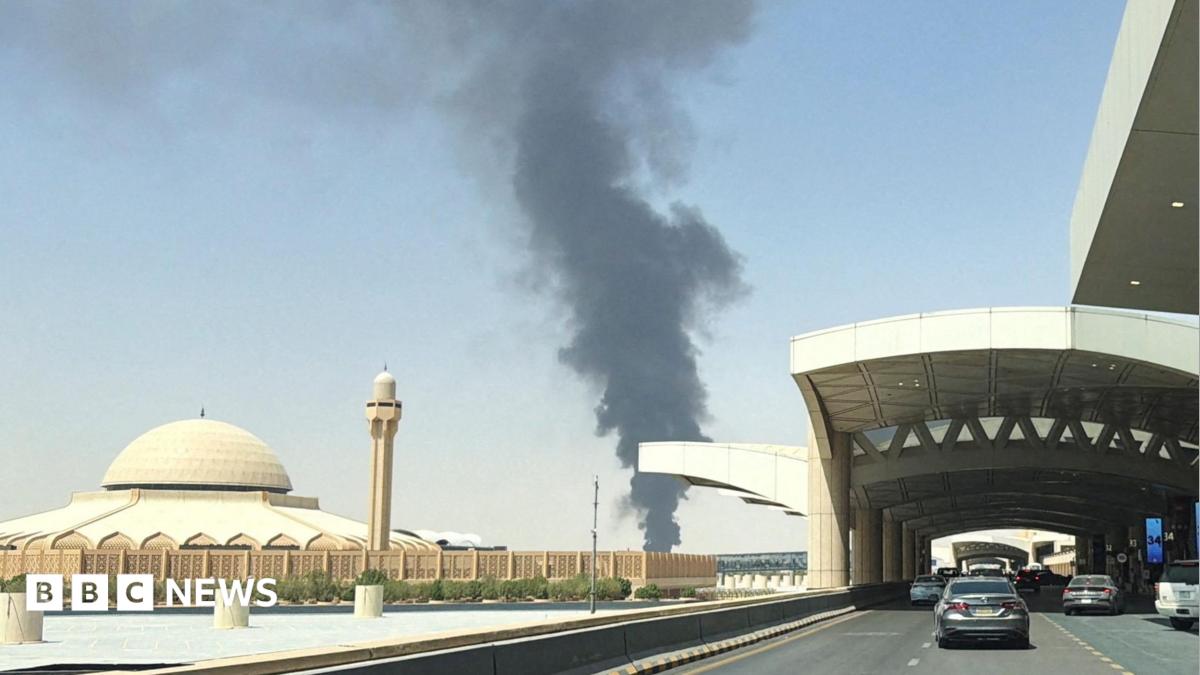
Earlier, a column of black smoke was seen rising from fuel tanks near the Saudi capital’s international airport, where flights were disrupted temporarily on Saturday.
Air raid alerts had sounded in the capital for the first time since the Iran-backed Houthis increased their attacks on Saudi Arabia in July.
Air defences also stopped “hostile attempts to target civilians” in the cities of Bish, Taif, Farasan and Yanbu, an official spokesperson for the Saudi-led coalition said in a statement.
In a statement posted online, Houthi military spokesman Yahya al-Sarea said a “large number of ballistic and cruise missiles and drones” had been used to attack “sensitive sites” in Riyadh and Aramco state oil and gas company facilities in Yanbu on the coast.
He added that the attacks were “in response to the Saudi enemy’s criminal attempts” to target the Yemeni capital Sanaa.
Earlier, Sarea had accused Saudi Arabia of carrying out 300 strikes across Yemen during the past week.
The Houthis are locked in a civil war with Yemen’s internationally recognised government, which is backed by Saudi Arabia.
They have attacked targets inside Saudi Arabia on several occasions in recent months, and said this week that they were responsible for downing a Saudi fighter jet over Yemen.
According to an unconfirmed report from AFP news agency, quoting military sources on both sides of Yemen’s civil war, fighting between the Houthis and Saudi-backed government forces claimed 48 lives on Saturday.
The Houthis said 31 of their fighters had been killed while government sources said their side had lost 17 soldiers, according to the news agency.
Recurring floods disrupt daily life in Tunis, raising questions about drainage, transport and flood preparedness.
Published On 18 Sep 202618 Sep 2026
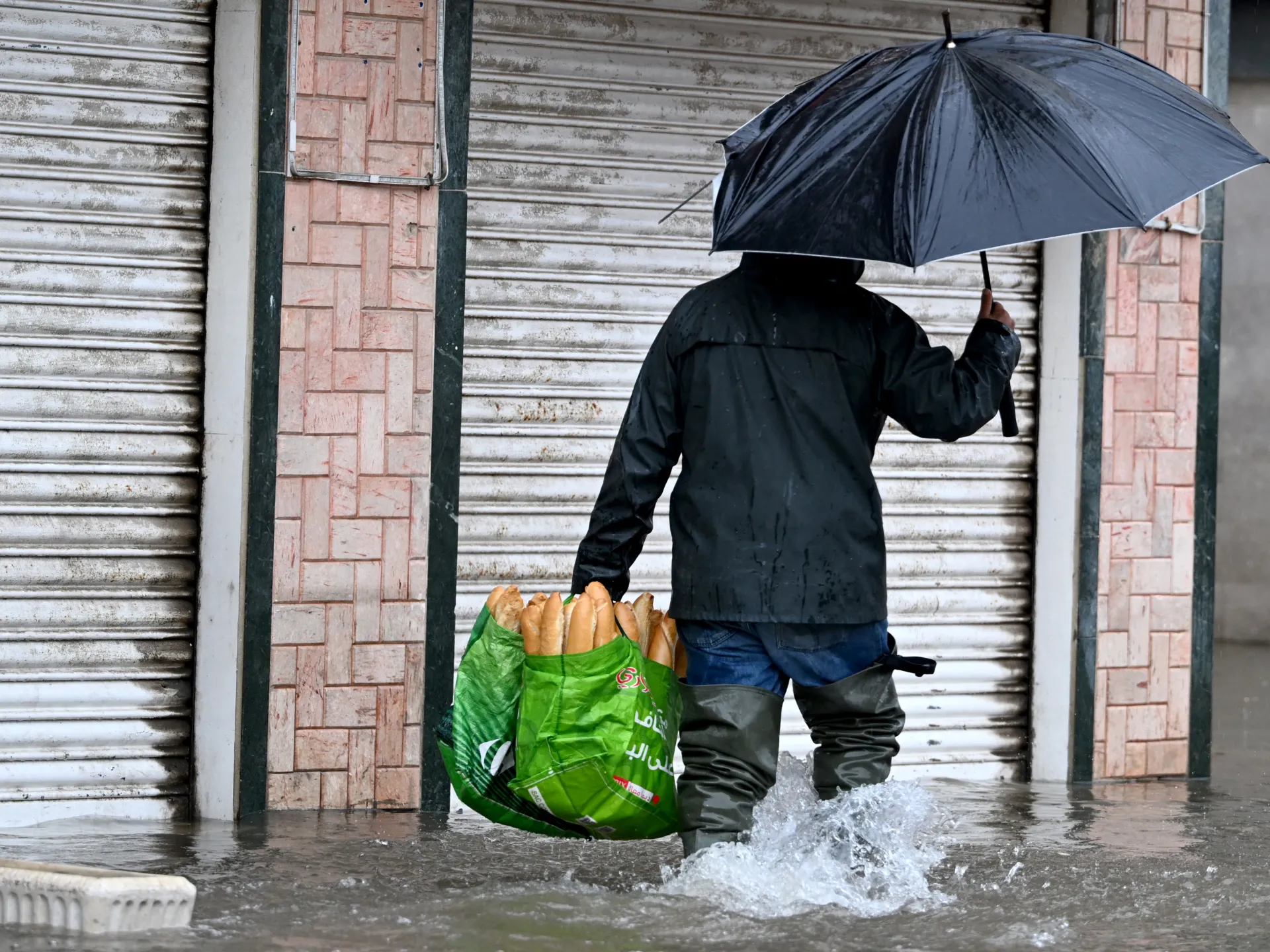
Tunis, Tunisia – Heavy rain brought parts of Tunisia’s capital to a standstill on Thursday, flooding roads and homes, trapping people in cars and disrupting electricity and internet services.
Home to nearly three million people, the Greater Tunis region has faced repeated flooding in recent years. Thursday’s flooding came only months after severe January rains caused widespread disruption across the capital and other parts of the country, leaving several people dead and causing significant damage.
Weather warnings had been issued in advance, but the decision to suspend classes in Tunis was announced only shortly before it took effect. Parents rushed to schools to collect their children as the rain intensified and traffic backed up across the capital.
Videos shared online showed flooded streets, cars stranded in rising water and what appeared to be power lines catching fire. Residents also reported power and internet cuts and water entering homes.
‘The road became almost unrecognisable’
Fatma, a 35-year-old employee in Tunis, said the situation deteriorated quickly as she struggled to get home safely.
“At about 4pm, the road became almost unrecognisable. The tunnel leading to Bab Saadoun was completely closed because of the rain,” she told Al Jazeera.
“Most people were stranded by the roadside for hours, waiting for public transport that never came. I saw three cars that filled with water and broke down, and people carrying their children on their shoulders.”
“Every season, the same thing happens. Roads close and traffic comes to a complete standstill. All the drains start overflowing with waste,” she said.
The National Institute of Meteorology had warned of locally heavy thunderstorms on Thursday, including heavy rain over short periods that could cause flooding, disrupt traffic and overwhelm drainage networks. It also warned of potential power cuts.
Residents question flood preparedness
“Tunisia has become used to these disasters. Every year, we end up flooded even when there is little rain,” said Intissar, 33, from the Lafayette area of Tunis.
She blamed local authorities for failing to carry out preventive work before the rainy season.
“This is work that should have been done during the summer,” she said.
But she also acknowledged the role of residents.
“We cannot deny the responsibility of citizens who dump waste that blocks drainage channels,” she said.
At a government meeting in August, officials called for drainage networks and waterways to be cleaned and flood-protection work to be accelerated. The government said 29 flood-protection projects were under way across the country.
The flooding comes as Tunisia prepares for a national march in Tunis on Saturday, with organisers calling for the release of four activists detained in connection with the Al-Soumoud Flotilla. The march is scheduled for 5pm, as rain is forecast to continue through Saturday.
A struggle to get home
Fatma said the lack of reliable public transport, combined with repeated flooding, was making it increasingly difficult for people to manage without cars.
“The problem makes people look for their own solutions. That is why most people are trying to find a way to buy a car, because it has become difficult to live without one with these recurring problems,” she said.
The flooding also came as students returned to schools and universities this week, adding pressure to roads and public transport.
For Fatma, the disruption is becoming a familiar pattern.
“This shows that the state has no vision. It is caught off-guard just like citizens are,” she said.
Chelsea chairman Todd Boehly and director Mark Walter have sold their stakes in the club to majority owner Clearlake Capital.
Swiss billionaire Hansjorg Wyss has also sold his stake, meaning Clearlake – led by co-founders Behdad Eghbali and Jose E. Feliciano – have now acquired full control of the club.
Boehly, Walter and Wyss each had a 12.8% stake, with Clearlake previously owning 61.5% of the Blues.
American Boehly will leave his role as chairman, a position he has held since 2022, when the consortium bought the club for £2.3bn from Roman Abramovich, who was sanctioned by the UK government in March 2022 over alleged links to Russian president Vladimir Putin – something he has denied.
Multiple sources said talks started within Chelsea‘s ownership group after a rift, first apparent in 2024, led both sides to explore buying each other out.
Boehly, who is a co-owner of baseball franchise the Los Angeles Dodgers, said it had been an “honour” to serve as Chelsea chairman.
“I would like to thank the many who helped secure a bright future for the club, including the English Premier League, the coaches and players, the talented leadership and staff at Chelsea, and the legions of dedicated fans,” he added.
“I have valued my partnership with Clearlake and the wider ownership group, and the collective decisions and investment we have made to support the immediate and long-term success of the club. I am confident that Chelsea is well positioned for continued success under Clearlake’s leadership.”
SAN FRANCISCO: Saudi Arabia is building an integrated model to attract leading artificial intelligence companies and help them expand globally, Communications and Information Technology Minister Abdullah Al-Swaha said in Silicon Valley on Friday.
Speaking at the fourth edition of the Frontier Leaders Forum 2026, held under the theme “AI Forward: A Global Frontier,” Al-Swaha said the Kingdom’s approach was centered on providing AI companies with three key resources: computing capacity, capital and access to customers.
Al-Swaha said the Kingdom aimed to build on that experience and attract more global AI companies. (SPA)
He cited Grok as an example of this approach, highlighting Saudi Arabia’s partnership with US AI company xAI and Saudi AI company Humain to deploy Grok in the Kingdom and develop large-scale AI computing infrastructure.
Al-Swaha said the Kingdom aimed to build on that experience and attract more global AI companies, the Saudi Press Agency reported.
Saudi Arabia is working with the private sector to develop more than 14 gigawatts of computing capacity, he said, providing infrastructure for advanced AI companies while helping reduce operating costs and improve efficiency.
Al-Swaha also highlighted the Kingdom’s expanding use of generative AI, AI agents and augmented-reality applications across sectors including healthcare, government services, transportation and logistics. (SPA)
Humain is developing a range of AI infrastructure and platforms in the Kingdom, including AI cloud and high-performance computing services designed to support training, fine-tuning, inference and other AI workloads.
Al-Swaha also highlighted the Kingdom’s expanding use of generative AI, AI agents and augmented-reality applications across sectors including healthcare, government services, transportation and logistics.
He said Saudi Arabia would continue working with Silicon Valley around talent, technology and trust while providing the computing capacity, customers and capital needed to help the next generation of AI companies scale internationally.
Al-Swaha held a series of meetings during his visit with technology and investment executives to discuss expanding AI investment in the Kingdom, developing advanced models and applications and integrating them with infrastructure and computing capabilities being developed by Humain.
He met General Catalyst’s CEO Hemant Taneja to discuss expanding the investment firm’s AI and advanced-technology activities in Saudi Arabia, enabling its portfolio companies to develop and deploy applied AI solutions and using Humain’s computing capabilities to accelerate implementation in priority sectors.
A further meeting with Velaura AI’s co-founder and CEO Rajiv Khemani focused on integrating energy-efficient computing technologies. (SPA)
Al-Swaha also met Arcee AI’s founder and CEO Mark McQuade to discuss expanding the use of the company’s Trinity open and enterprise models and deploying them across Humain’s infrastructure.
He held talks with Engramme’s co-founder and CEO Gabriel Kreiman on AI memory and continuous-learning applications designed to allow organizations to build models that learn from their own data, knowledge and operating environments.
Infrastructure was another focus of the meetings. Al-Swaha met Supermicro’s founder and CEO Charles Liang to discuss AI factory solutions, including integrated systems, liquid cooling and high-density architectures aimed at improving energy efficiency and supporting large-scale AI data centers.
He also met Upscale AI’s CEO Barun Kar to discuss high-performance AI networking and improving connectivity between computing accelerators, memory and storage to maximize the use of computing resources.
A further meeting with Velaura AI’s co-founder and CEO Rajiv Khemani focused on integrating energy-efficient computing technologies into Humain’s infrastructure and supporting the expansion of AI applications and autonomous systems.
Sometimes travel delivers a real shock. I’m moving along the boulevards in the Polish city of Łódź, enjoying the excellent cafes and warm sunshine, when I spot the vans. They are parked up on the verge, with racks of clothing and heavily laden tables behind. I can’t resist a Sunday morning market and walk towards a group of men huddled around a car that is covered in blankets. And then it happens. They turn – and I see they are weighing pistols in their hands. I recognise the lean profile of a German Luger, and then the bulkier Colt 45.
There is a second of doubt. I hesitate. They replace the weapons on the display and walk away laughing. I approach. On the car roof is a row of dusty soldiers’ helmets. “We were repairing a pavement in the centre of town,” says the seller cheerfully, handing me a badge to inspect. “Imagine! For 80 years, all this stuff was just under our feet.”
It’s a Wehrmacht shoulder badge from Kuban 1943, a last-ditch post-Stalingrad action on the Crimean peninsula. Who wore this, I wonder? A veteran of the Russian front who almost made it home? Nothing is clear, except that in Łódź, the past is never far away.
Illustration: Guardian Graphics
I arrive the previous night, a little disoriented, whizzing past unlit buildings, huge brick structures like Victorian factories. “Are we in the city yet?” I ask.
The taxi driver gives me a quizzical look. “Yes, this is Łódź.” I note the pronunciation, like “wudge”. I glimpse five-storey blocks, tree-lined streets, a tramline. “I could never live anywhere else,” he adds. A huge blue graffito is caught in the headlights, like a monstrous alien creature.
“Why?” I ask, but we are already pulling up outside an immense red-brick building, my hotel, and he never answers my question. The reception area is huge, with a strange scalloped ceiling in red brick that hints at a previous incarnation as a factory.
Paweł Pawlikowski’s Oscar for the film Ida on display at the Museum of Cinematography.
This is my first visit to Łódź, a city about 75 miles (120km) south-west of Warsaw. My interest has been piqued by a list of notable people associated with the place. It features an astonishing number of Oscar-winning or nominated film directors connected to the city: Andrzej Wajda (The Promised Land), Roman Polanski (The Pianist), Paweł Pawlikowski (Ida), Agnieszka Holland (Europa Europa), Krzysztof Kieślowski (Three Colours trilogy) and Zbigniew Rybczyński (Tango).
But under the bonnet there is a vast array of talent in acting, production and technical excellence. The city’s film school is responsible, of course, but Łódź itself features as a setting, too, notably in David Lynch’s Inland Empire and Wajda’s masterpiece The Promised Land.
Łódź, I had decided, must be fascinating. Any visit starts with Piotrkowska Street, the longest shopping street in Europe at about 2½ miles. My guide, Anna, takes me through Plac Wolności (Freedom Square), where a dance festival is in progress, with hooded hip‑hoppers rubbing shoulders with troupes of line dancers and girls in colourfully embroidered traditional dress. This is a city where music and dance are never far away. We dodge down a side alley and emerge in a striking art installation – an entire street, Pasaż Róży (Rosa’s Passage), covered in mirrors by the artist Joanna Rajkowska. Back on the main pedestrianised route, the mix of ancient and modern continues: 19th‑century porticoed palaces adorned with colourful graffiti.
I ask Anna how Łódź fared in the second world war. “It was not too badly damaged,” she says. “Both the Germans and the Russians wanted the industry intact.”
There is no medieval heart, no ornate houses like in Wrocław or Kraków. What Łódź possesses is an impressive array of 19th-century factories, mostly textiles, built to show off their owners’ power, wealth and architectural aspirations. Now, this heritage has become a stunning example of urban regeneration.
OFF Piotrkowska, where the old mills host a hive of small businesses. Photograph: Paweł Augustyniak
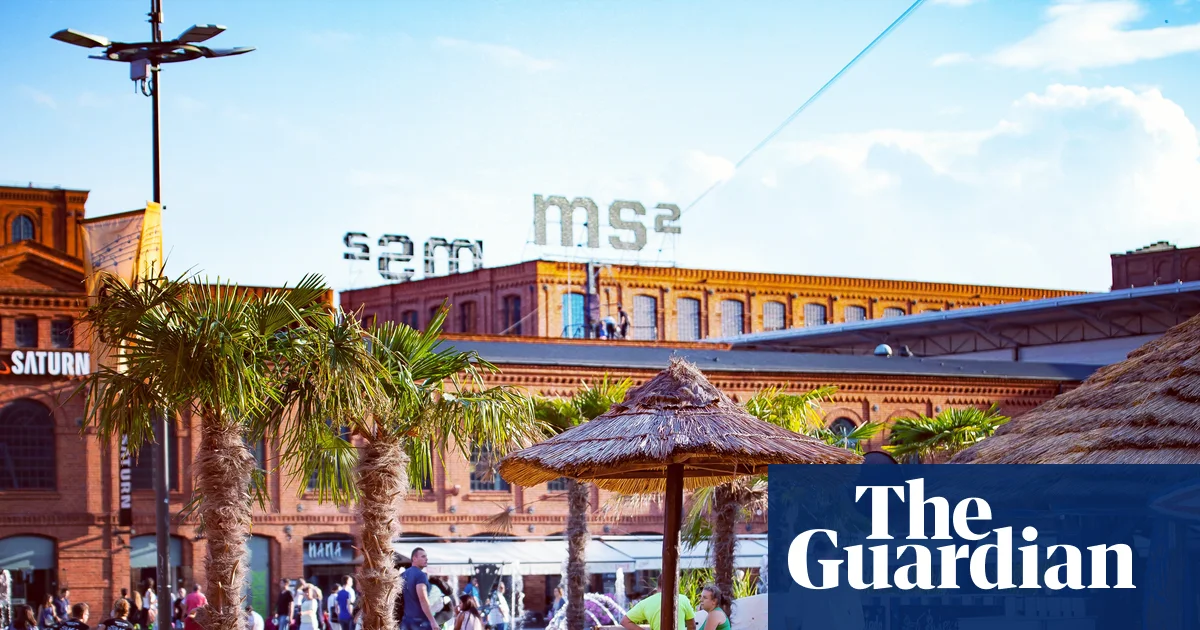
We turn into OFF Piotrkowska, a complex of beautiful old textile mills reborn as a hive of small businesses. There are lots of vibrant restaurants and bars, but Anna wants to show me a shop that she likes: Pan Tu Nie Stał. “It was a saying in communist times: ‘You’re not in the queue.’ We said it to people trying to push in,” Anna says.
This is the spot to pick up a T-shirt featuring Soviet combine harvesters or some Czas Pokaże (Time Will Tell) socks. The shop says a lot about the Polish attitude to communist times: none of the maudlin ostalgie of East Germany; this nostalgia comes with healthy dashes of colour and humour.
It did all start, however, with a disaster. The old mills had survived two world wars, but died in the economic collapse after communism ended in 1989. “Everything closed down,” says Anna. “We call that time the transformacja. It was very hard.”
We stroll into the Manufaktura area, once the site of a vast textile business started by a local scrap metal dealer, Izrael Poznański, in 1872, and now another beautifully restored collection of red-brick buildings housing restaurants, bars, shops and the fascinating Museum of the Factory. Next door is the palace that Poznański built, a neo-baroque monstrosity of bulging wealth, now the city museum.
After the Congress of Vienna in 1815, Łódź became part of the Russian empire, a melting pot of German, Jewish, Polish and Russian influences. In the 1870s, Poznański was one of a group of men who saw the potential of steam power. They imported looms from England and were soon amassing unimaginable wealth, constructing a city of handsome red-brick factories, the core of which still remains.
The Museum of the Factory houses a collection of working looms that date back to the 1880s. Only four machines are ever turned on due to noise pollution laws – in the old days, one factory might have had hundreds. This was the city of the deaf, but the deafest of all were the bosses, oblivious to the terrible hardships of their workforce, from the founders through to their communist successors. When Wajda came to these mills in the early 1970s, planning The Promised Land, he needed to make only minor adjustments to start filming. The tired faces, the crashing looms, the heat and the dust – it was all very much like 1880.
Is that your favourite film, I ask Anna? She shakes her head. “Cold War by Pawlikowski,” she says. “I love that film.”
The Museum of the Factory has a collection of working looms dating to the 1880s. Photograph: Picasa
This 2018 masterpiece is the story of a tragic love affair conducted across the Iron Curtain in the years following the second world war. Based on the lives of Pawlikowski’s parents, it is dark and sensuous, full of great music and dance. Pawlikowski has used Łodż as a location.
We move on to the Museum of Cinematography, a tour de force that warrants some preparation (watch films by Polish directors). They have everything from early working equipment to props from the most recent Oscar triumphs. By the time I get to the end, I have only a few minutes to rush to the Central Museum of Textiles.
There I find a technician, Przemysław, about to start up a 1893 Greenwood loom. He’s a former policeman with a few tales to tell, but right now one question is bothering me. “Why did film-making succeed so brilliantly in this city of textiles?” I ask him.
He taps the cast iron loom and chuckles. “I’ll show you.”
With the flick of a switch, the loom begins to clank and turn. The noise is incredible. Przemysław is moving around, adjusting and calibrating, his face concentrated. I see the spools of thread begin to unwind, the shuttle dashing back and forth, the warp and weft rhythmically rising and falling. The different colours, each no more than a thin line, but magically coming together. And from the lip of the machine spills a beautiful multicoloured cloth.
Przemysław looks at me and raises a questioning eyebrow. “Like weaving a story, right?”