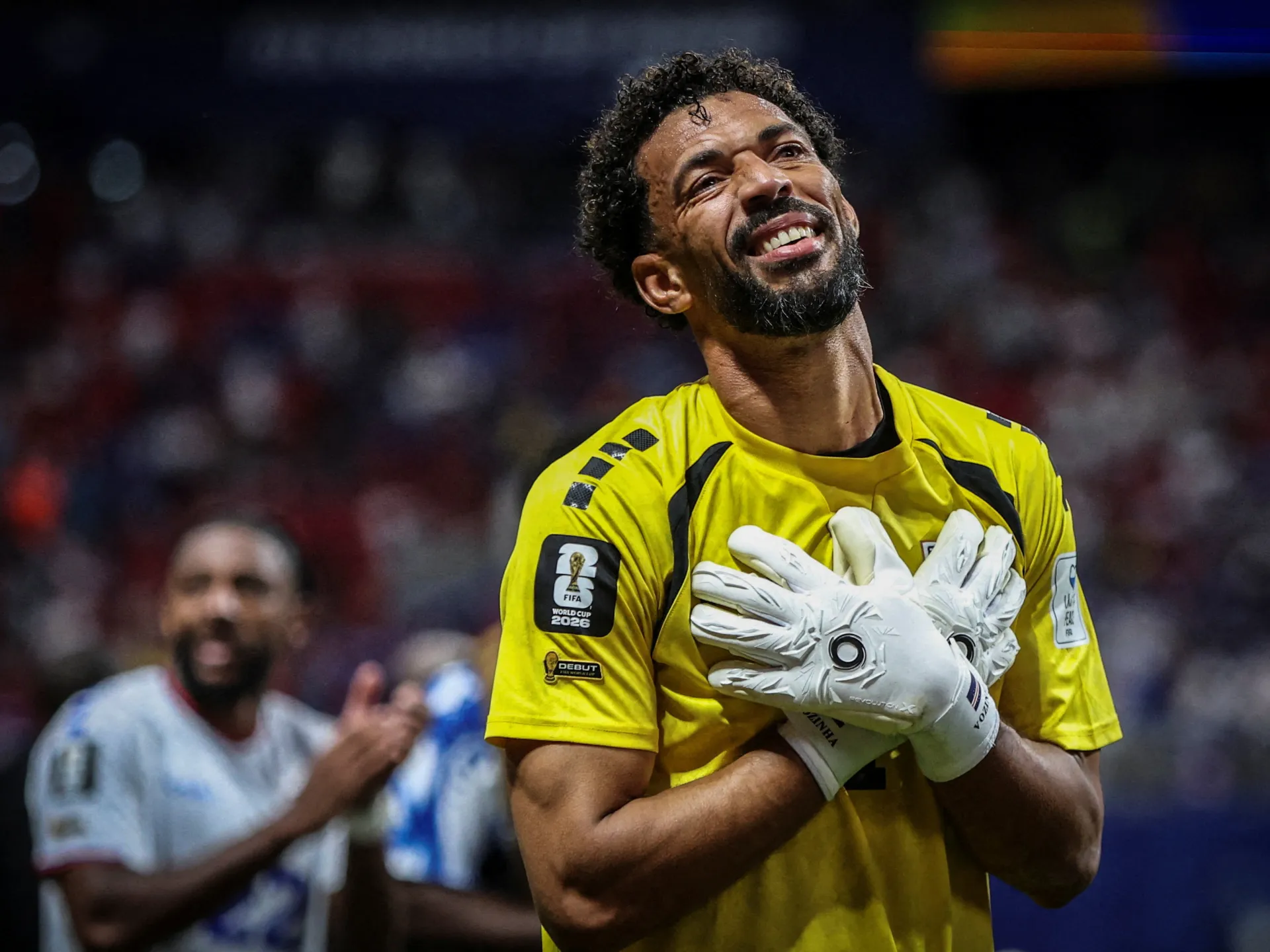
The 40-year-old goalkeeper made headlines around the world after starring in Cape Verde’s goalless draw with Spain.
By AFP, Reuters and The Associated Press
Published On 26 Jul 202626 Jul 2026
Cape Verde’s heroic World Cup goalkeeper, Vozinha, has reached an agreement to join Chilean club side Colo Colo.
The 40-year-old stopper, who made headlines around the world after starring in a goalless draw with Spain, will travel to Chile for a medical before being unveiled, Colo Colo’s president, Anibal Mosa, announced on Saturday.
Recommended Stories
list of 3 itemsend of list
Vozinha became one of the most talked-about players at the World Cup with a string of remarkable saves against top teams, including defending champions Argentina.
The goalkeeper, who left Portuguese second-tier side Chaves before the summer, was voted into FIFA’s fan-selected World Cup dream team.
“Vozinha will be a Colo Colo player. In the coming days, he will travel to Chile, undergo the usual medical examinations and then be presented here at the Estadio Monumental,” Mosa said.
He added that Vozinha’s World Cup performance showed he deserved the move, while acknowledging the signing also carried marketing appeal for the Chilean side.
Colo Colo teased the signing on social media with an image appearing to show the veteran goalkeeper’s trademark curly hair.
Vozinha, whose full name is Josimar Jose Evora Dias, has also become a social media star, with help from Brazilian influencer Casimiro. The goalkeeper’s Instagram following has soared from 50,000 to nearly 30 million.
He also made headlines after revealing that his mother, Ana Candida Evora, was unable to travel to watch her son due to the cost of a bond payment for a visa to enter the US.
Lionel Messi opens scoring but Argentina taken to extra time by Cape Verde, which threatened greatest World Cup upset.
Published On 4 Jul 20264 Jul 2026
Reigning champions Argentina needed an extra-time own goal to overcome a Cape Verde side with incredible levels of resilience 3-2 in a thrilling contest and secure their spot in the last 16 of the World Cup.
The Africans, playing in their first World Cup, had twice come from a goal down on Friday to silence the vast majority of the crowd of 64,478 packed into a hot and humid Miami Stadium.
Recommended Stories
list of 4 itemsend of list
Six minutes into the second period of extra time, Lionel Messi swung a corner into the box, and Cristian Romero rose to head home off the arm of Cape Verde centre-back Diney Borges and finally set up a date with Egypt in Atlanta next Tuesday.
Messi had, almost inevitably, given Argentina the lead in the 29th minute with his seventh goal of the tournament, but Deroy Duarte equalised just before the hour mark.
The Blue Sharks held on to send the match into an additional half hour before Lisandro Martinez lashed a sumptuous shot into the roof of the net in the second minute of the first period of extra time to put Argentina ahead again.
Cape Verde were not done yet, however, and left back Sidny Lopes Cabral curled a beautiful shot into the top corner of the net in the 103rd minute of the contest to put the scores back on level terms at 2-2.
Lopes Cabral could have equalised again after Romero’s goal, but his finely struck free kick was saved by Argentina goalkeeper Emiliano Martinez, who had to be at his best to deny Cape Verde in the dying minutes.
Cape Verde were beaten but far from outclassed by the three-times world champions as they put in a fourth magnificent display of teamwork and grit at their first World Cup.
The only one of the four World Cup debutants to make it to the last 32 and ranked 67th in the world coming into the tournament, Cape Verde had hoped to frustrate Argentina as they did Spain, Uruguay and Saudi Arabia in group-stage draws.
They succeeded, while showing no shortage of quality of their own, for much of the game with a never-say-die desperation and a neat pass-and-move game.
Cape Verde’s Sidny Lopes Cabral scores their second goal past Argentina’s Emiliano Martinez [Paul Childs/Reuters]
Messi aside, Argentina were largely bereft of ideas against an obdurate defence and Cape Verde libero Kevin Pina was the most impressive player on the park for long periods of the contest.
It was Argentina who made the breakthrough in the 29th minute, however, when Lisandro Martinez lofted a long ball over the top of the defence to the feet of Messi.
The 39-year-old maestro took a touch with the outside of his left boot and buried it in the roof of Vozinha’s net for his 20th goal over six editions of football’s global showpiece.
Cape Verde knew they would need to score to keep their World Cup campaign alive and Duarte fired a shot at goal soon after half-time that drew a diving save out of Martinez.
Just before the hour mark, captain Ryan Mendes was freed down the right, and his pass into the box found the Dutch-born midfielder, who controlled the ball with his left foot before drilling it past Martinez with his right.
Messi had a chance to put Argentina back in front four minutes later when he was played through on goal, but Vozinha stood up well to keep his shot out of the net.
One of Messi’s trademark free kicks was tipped away by Vozinha in the 72nd minute, and Cape Verde defender Pico Lopes had to intervene to prevent Enzo Fernandez from scoring 10 minutes later.
Cape Verde held on to force the dramatic period of extra time, and they will now return home heroes having put their tiny island-nation firmly on the footballing map.
By The Associated Press and Al Jazeera staff and The Associated Press
Published On 27 Jun 202627 Jun 2026
Tiny Cape Verde have become the history makers of World Cup 2026 by defying all odds to become the smallest country to earn a spot in the knockout stages of the competition.
Their improbable run through the group stage, with a third straight World Cup draw, was completed with a 0-0 draw against Saudi Arabia on Friday night to advance in the tournament.
Recommended Stories
list of 4 itemsend of list
Keeping goal for Cape Verde throughout has been Vozinha, 40, who has embodied the grit of his nation.
“We are small, but we have big hearts and we are fighters,” said the goalkeeper, who last season played for Chaves in Portugal’s second tier.
The island nation off the western coast of Africa, which is making its debut on football’s grandest stage, already held 2010 champion Spain to a 0-0 draw – a shock in itself to begin their campaign.
They then came from behind to get a 2-2 result against Uruguay – the winners of the inaugural World Cup in 1930.
“The team was very eager to show this to the whole world,” Cape Verde coach Bubista said while draped in his country’s flag after the Saudi Arabia game.
“We are proud of having arrived at this stage. We have shown that we are a small country, but that we fight for the things that we want to achieve.”
Cape Verde’s three points put the team in second place behind Spain, which beat Uruguay on Friday night and won the group.
Cape Verde will play reigning World Cup champion Argentina in Miami on July 3.
Drawing all three group matches doesn’t guarantee advancement at major football tournaments, but several teams have done it in the past. Those include: Wales in 1958, Ireland and the Netherlands in 1990, and Chile in 1998. New Zealand, however, also got three draws at the 2010 World Cup and were eliminated.
On the eve of the match, Bubista mused, “Everyone is entitled to dream and nothing is impossible.”
The Blue Sharks proved him right, overcoming seemingly insurmountable odds as this country of just 530,000 reached the round of 32.
A woman, her face painted with a flag of the archipelago, held a sign that read: “Small Islands, Big Dreams,” a dream that these underdogs have made reality as they continue their charmed run on the world stage.
They did it with another strong game from Vozinha, whose tournament success has helped him amass more than 16 million Instagram followers.
He had a save in first-half stoppage time, grabbing a header from Mohamed Kanno to keep Saudi Arabia scoreless. Another save came in the 66th minute when he leaped to deflect a shot from Mohammed Abu al-Shamat.
A third came in the 92nd minute when he stopped a shot by Abdullah al-Hamdan.
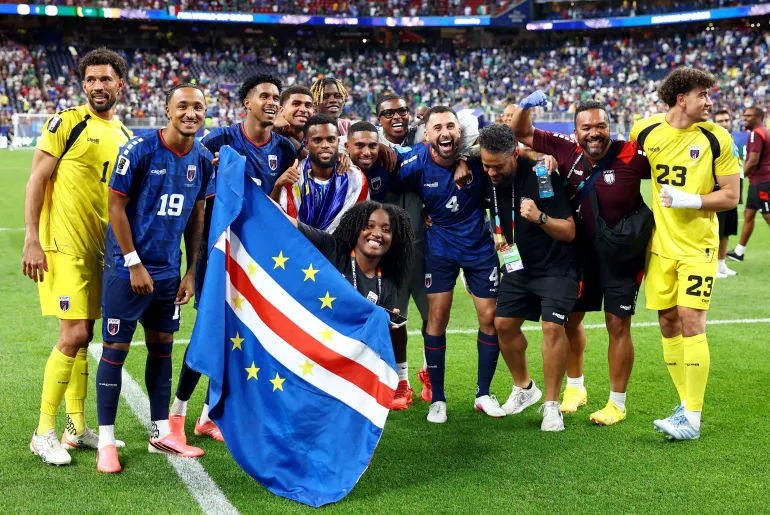
Cape Verde players and staff celebrate after the Saudi Arabia match [Phil Noble/Reuters]
“There is a lot of quality in our national team,” Vozinha said. “Maybe for many of you, you think the Cape Verdean player is not good enough. But we came here to show that we have a lot of quality and we are here to compete and our players can play everywhere in the big competition, in the big leagues.”
A group of shirtless men in the crowd each painted one letter of his name on their chests as they cheered Cape Verde.
But Vozinha had a much bigger fan among the crowd of 68,278 as his mother Ana Candida Evora watched from a luxury suite, waving a tiny Cape Verde flag. It was her second match of the tournament after missing Vozinha’s epic seven-save performance against Spain because of visa issues.
Cape Verde had a chance to score in the 50th minute, but Kevin Pina’s shot from distance was just above the crossbar. Another chance came in the 74th minute when Laros Duarte’s shot from the middle of the box was stopped by goalkeeper Mohammed al-Owais.
A last chance to score came in the final seconds when Nuno da Costa sent a shot from the middle of the box wide left.
But it didn’t matter because a couple of minutes after the final whistle, Spain completed its victory over Uruguay and set off a joyous celebration among Cape Verde’s players and fans, many of whom cried as they rejoiced.
Having led his squad to new heights, Bubista was asked if he could have imagined such a run entering the tournament.
“I’ve always said that sooner or later Cape Verde would be on such a stage,” he said. “Of course, it’s hard to have such a forecast, but I always knew.”
Saudi Arabia were eliminated after finishing with two points in the group stage.
“We were very poor in terms of creating things, controlling the game and creating actions,” coach Georgios Donis said. “And one cannot win a game this way. It would be very difficult.”
It’s crunch time at the 2026 FIFA World Cup with teams throughout the 48-strong field looking to stay in contention for the knockout stage or improve their placing in the round of 32.
The U.S., Mexico, Argentina, Germany, Brazil and Switzerland have already clinched spots in the round of 32 by winning their respective groups. France, Norway, Canada, Colombia, Morocco, Bosnia-Herzegovina and South Africa also are advancing. Haiti, Tunisia, Turkey, Jordan, Uzbekistan, Panama and Czechia, however, have been eliminated from knockout-round contention.
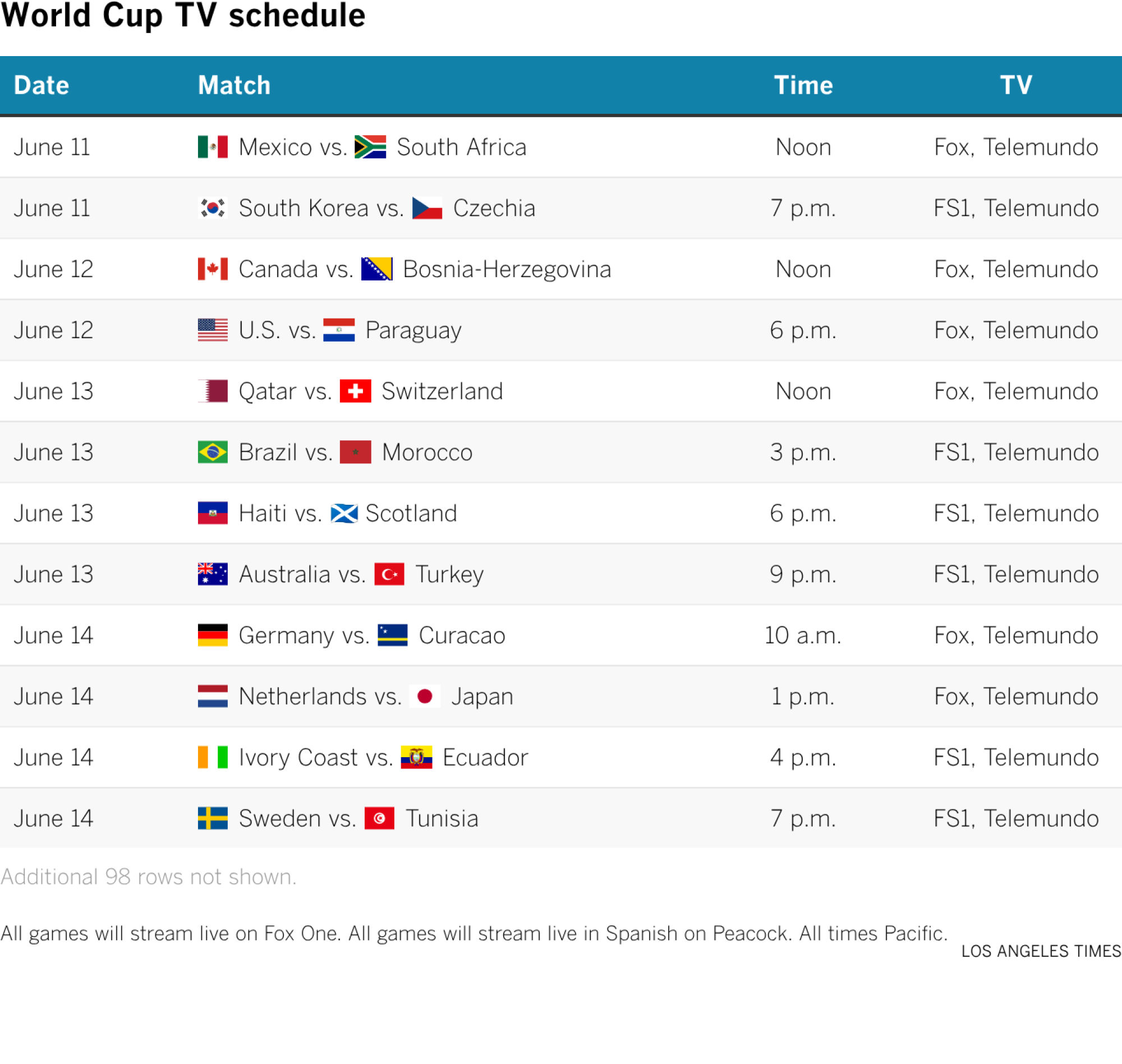
Here’s everything you need to know about World Cup matches being played Thursday and Friday across the U.S., Mexico and Canada (all times Pacific).
Thursday’s Group D matchups:
U.S. vs. Turkey
U.S. coach Mauricio Pochettino instructs his players during a 4-1 win over Paraguay at SoFi Stadium on June 12.
The buzz: There’s not much at stake since the U.S. has won the group and Turkey has been eliminated. Expect the U.S. to rest many of its regulars, especially those with yellow cards, while Turkey will be chasing its first World Cup win since 2002, when it finished third.
Paraguay vs. Australia
Paraguay midfielder Matias Galarza controls the ball against Turkey on June 19.
The buzz: The winner finishes second in the group and will go through to the elimination rounds. Australia, with an edge in goal differential, would get the second spot in the event of a draw. It’s not a do-or-die game for either team since three points could be enough to advance.
Thursday’s Group E matchups:
Ecuador vs. Germany
Germany’s Nadiem Amiri celebrates a goal against Ivory Coast on June 20.
The buzz: Germany is already through to the knockout stages while Ecuador could finish second and clinch a spot in the round of 32 with a win coupled with an Ivory Coast loss or draw. However, that would require Ivory Coast losing or drawing. A victory could send Ecuador on as a third-place team no matter what Ivory Coast does, but that path is less certain.
Curaçao vs. Ivory Coast
Curaçao’s Livano Comenencia shoots against Germany on June 14.
(Eric Gay / Associated Press)
Where: Lincoln Financial Field, Philadelphia Time: 1 p.m. TV: FS1, Universo
The buzz: Ivory Coast is all but through to the knockout round, at least as a third-place team. But a draw would give it the No. 2 spot in the group and an easier route through the knockout stages. Curaçao still has a chance of advancing despite having been outscored 7-1, and it could finish second with a win and an Ecuador loss.
Thursday’s Group F matchups:
Tunisia vs. Netherlands
Netherlands’ Crysencio Summerville celebrates after scoring against Sweden on June 20.
The buzz: Tunisia has lost two games under two coaches — getting outscored 9-1 in the process — and can’t advance. But there’s much at stake for the Dutch, who can finish anywhere from first to third depending on the results of the final group-stage games. The Netherlands and Japan are tied on points, wins and goal differential and played to a draw in their head-to-head match, so whoever does better on the final day wins the group.
Japan vs. Sweden
Japan’s Ayase Ueda celebrates after scoring against Tunisia on June 20.
The buzz: Both teams are assured of a top-three finish and a likely spot in the next round, but a win could secure first in the group. Although Japan and the Netherlands are the favorites to win the group, Sweden could overtake both with a win, provided the Dutch do no better than a draw.
Friday’s Group G matchups:
New Zealand vs. Belgium
Belgium midfielder Kevin De Bruyne (7), left, kicks the ball in front of Iran defender Hossein Kanaanizadegan on June 21 at SoFi Stadium.
(Robert Gauthier / Los Angeles Times)
Where: BC Place, Vancouver Time: 8 p.m. TV: FS1, NBC Univserso
The buzz: If New Zealand earns its first-ever World Cup win, it’s mathematically possible the Kiwis could win the group. The same scenario holds for winless Belgium, however, it is still looking for its first goal of the tournament.
Iran vs. Egypt
Iran forward Alireza Jahanbakhsh, left, battles Belgium defender Maxim De Cuyper for the ball during a World Cup match at SoFi Stadium on June 21.
The buzz: Egypt entered the final day of group play atop the group and with a firm hold on a spot in the round of 32. It would win the group with a victory, although a draw could also be enough, depending on the score of the Belgium-New Zealand match. Unbeaten Iran can also win the group with a victory; a draw probably will get it to the knockout stage.
Friday’s Group H matchups:
Cape Verde vs. Saudi Arabia
Cape Verde’s Helio Varela celebrates after scoring against Uruguay at the World Cup on June 21.
The buzz: With a win here, Cape Verde would not only go through to the knockout stage, but it could win the group depending on the result of the Spain-Uruguay game. The island nation of about 530,000 people, the third-smallest country to qualify for a World Cup, is unbeaten after draws with Spain and Uruguay. Saudi Arabia is looking for its first World Cup win since upsetting eventual champion Argentina in its 2022 opener.
Uruguay vs. Spain
Spain’s Mikel Oyarzabal celebrates after a goal against Saudi Arabia in the World Cup on June 21.
The buzz: Spain will take the group with a win or draw, provided it maintains its goal-differential advantage over Cape Verde. Uruguay, however, needs a victory to finish atop the table. A third straight draw, which would leave it unbeaten, would probably be enough to see it through to the next round, but a loss will likely send Uruguay home.
Friday’s Group I matchups:
Norway vs. France
France’s Kylian Mbappé controls the ball during a win over Iraq at the World Cup on June 22.
The buzz: This game will not only decide the group winner but it could affect who wins the Golden Boot as the tournament’s top scorer. Both teams won their first two games and are on to the round of 32, and Norway’s Erling Haaland and France’s Kylian Mbappé each have scored four goals. Mbappe, whose eight goals led the tournament four years ago, already has 16 World Cup goals for his career, tied for second all-time.
Senegal vs. Iraq
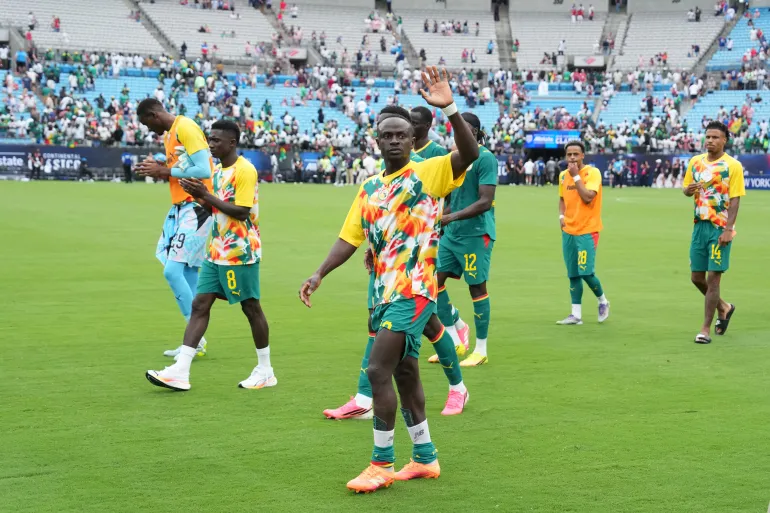
Senegal’s Sadio Mane play against France in a World Cup match on June 16.
(Steve Luciano / Associated Press)
Where: BMO Field, Toronto Time: Noon TV: FS1, Universo
The buzz: Senegal and Iraq, both losers in their first two games, have a chance of advancing as a third-place team, but they need a win to make that happen. For Iraq, a victory would be its first in World Cup competition while Senegal, a quarterfinalist in 2002, would like to get a win for Sadio Mane, one of Africa’s most iconic players, who may be playing in his final World Cup.
The 2026 FIFA World Cup is well into the second run of group play, with every team still eager to post wins and most looking to secure a place in the knockout stage.
Here’s everything you need to know about matches being played Sunday, Monday and Tuesday in the 48-team tournament across the U.S., Mexico and Canada (all times Pacific). Tuesday’s matches will conclude the first two games of group play for every team at the World Cup.
Sunday’s Group G matchups:
Belgium vs. Iran
Belgium’s Romelu Lukaku, right, is challenged by Egypt’s Ramy Rabia during a World Cup Group G match on June 15.
(Alex Grimm / Getty Images)
Where: SoFi Stadium Time: noon TV: FS1, Telemundo
The buzz: Iran twice rallied from deficits to draw with New Zealand in its first game, while Belgium, outplayed by Egypt in its opener, was lucky to escape with a point on an own goal early in the second half. Belgium’s aging golden generation of Romelu Lukaku, Kevin De Bruyne, Thibaut Courtois, Thomas Meunier and Axel Witsel is going to need to do much better if they hope to avoid another early World Cup exit.
New Zealand vs. Egypt
New Zealand’s Callan Elliot, left, and Iran’s Mehdi Ghayedi battle for the ball during a World Cup Group G match on June 15.
(Andre Penner / Associated Press)
Where: BC Place, Vancouver Time: 6 p.m. TV: FS1, Telemundo
The buzz: One of these teams could make history since neither has ever won a World Cup game. New Zealand earned its first point in the World Cup since 2010 with a draw against Iran. The winner likely advances to the next round.
Sunday’s Group H matchups:
Spain vs. Saudi Arabia
Spain’s Mikel Oyarzabal, top, challenges for the ball during a draw with Cape Verde on June 15.
(Mattia Ozbot / Getty Images)
Where: Mercedes-Benz Stadium, Atlanta Time: 9 a.m. TV: Fox, Telemundo
The buzz: Both teams opened the World Cup with surprising results. Second-ranked Spain was unable to score in a draw with No. 67 Cape Verde. Saudi Arabia was 10 minutes away from upsetting Uruguay, only to settle for a tie. Spain desperately needs a win to get its World Cup back on track, while another good performance from Saudi Arabia — unbeaten in its last three games — would have the Arabian Falcons in position to reach the knockout stage.
Uruguay vs. Cape Verde
Cape Verde goalkeeper Vozinha holds the nation’s flag after a draw with Spain on June 15.
(Buda Mendes / Getty Images)
Where: Hard Rock Stadium, Miami Gardens, Fla. Time: 3 p.m. TV: FS1, Telemundo
The buzz: With all four teams playing to draws in their openers, the group is wide open. That creates a rare opportunity for tournament debutant Cape Verde, the second-smallest country to qualify for a World Cup. Vozinha, Cape Verde’s goalkeeper, made seven saves to shut out Spain. If he can frustrate Uruguay the same way, Cape Verde could be through to the round of 32.
Monday’s Group J matchups:
Argentina vs. Austria
Argentina’s Lionel Messi reacts after scoring his third goal against Algeria at the World Cup on June 16.
The buzz: Argentina opened its World Cup title defense with a 3-0 win over Algeria on a hat trick from Lionel Messi. The Argentina captain, playing in his record sixth World Cup, is tied with Germany’s Miroslav Klose for the most career World Cup goals (16). Austria, meanwhile, would all but assure itself of a spot in the knockout round with a point.
Jordan vs. Algeria
Algeria’s Zineddine Belaïd kicks the ball during a World Cup loss to Argentina on June 16.
The buzz: Little was expected of Jordan, making its first appearance in the World Cup. And it delivered little in a 3-1 loss to Austria. But Algeria, ranked 28th in the world, entered the tournament with high hopes and one of African soccer’s most potent attacks. However, it had only one shot on goal in its loss to Argentina and needs a big rebound to avoid an early trip home.
Monday’s Group I matches:
France vs. Iraq
France’s Kylian Mbappé celebrates after scoring against Senegal on June 16.
(Adam Hunger / Ap Photo/adam Hunger)
Where: Lincoln Financial Field, Philadelphia Time: 2 p.m. TV: Fox, Telemundo
The buzz: Kylian Mbappé proved his fitness with a brace in France’s opening win over Senegal, giving him 14 World Cup goals, tied for fourth on the all-time list. He has a great chance to pad that total against an Iraq team that gave up four goals to Norway. Iraq still is looking for its first-ever World Cup point.
Norway vs. Senegal
Norway’s Erling Haaland celebrates after scoring against Iraq on June 16.
The buzz: Norway, playing in its first World Cup this century, made up for lost time with a 4-1 win in its opener, getting two goals from Erling Haaland. Norway probably will move on to the next round no matter what happens, but a point would lock down a spot. Senegal and Sadio Mané, on the other hand, desperately need a win.
Tuesday’s Group K matchups:
Portugal vs. Uzbekistan
Portugal’s Cristiano Ronaldo walks on the field during a match against the Democratic Republic of the Congo on June 17.
The buzz: Cristiano Ronaldo entered this World Cup with visions of winning his first title. But he’ll go home early and empty-handed unless fifth-ranked Portugal improves on the listless performance it had in a draw with the Democratic Republic of the Congo. Uzbekistan, playing in its first World Cup, was not intimidated by the big stage, weathering a withering Colombia attack in a 3-1 loss. Expect it to bunker in again against Portugal.
Colombia vs. DR Congo
Yoane Wissa, left, celebrates with teammates after scoring for the Democratic Republic of the Congo against Portugal on June 17.
The buzz: The Democratic Republic of the Congo’s only other World Cup appearance came in 1974, when the country was known as Zaire; it lost all three games and didn’t score a goal. It’s already done better with Yoane Wissa’s score in first-half stoppage time giving the team a point against Portugal. A win here and it’s through to the knockout phase. The same is true of Colombia, which got a 65th-minute goal from Luis Díaz and another from substitute Jáminton Campaz deep in stoppage time to beat stubborn Uzbekistan.
Tuesday’s Group L matchups:
England vs. Ghana
England’s Harry Kane celebrates after scoring against Croatia on June 17.
The buzz: England opened its World Cup with a surprisingly comfortable win over Croatia behind two goals from captain Harry Kane. But the Three Lions are only equal atop the table with Ghana, which got a goal deep in stoppage time from Caleb Yirenkyi to beat Panama. If there’s a winner here, it probably will decide the group. A point likely sends both teams through.
Panama vs. Croatia
Where: BMO Stadium, Toronto Time: 4 p.m. TV: Fox, Telemundo
Panama’s Ismael Díaz attempts a shot against Ghana on June 17.
(Kevin C. Cox / Getty Images)
The buzz: Croatia has played in two straight World Cup semifinals, but that streak is in jeopardy after a 4-2 loss to England. Panama outshot, outpassed and outpossessed Ghana in its first game but came away with nothing after conceding a goal in stoppage time, leaving the Central Americans still looking for their first World Cup win.
Lamine Yamal comes off the bench but cannot help Spain overcome World Cup debutants Cape Verde in 0-0 draw.
Published On 15 Jun 202615 Jun 2026
Spain’s ghosts of recent World Cup horror shows reappeared in Atlanta as the European champions were held 0-0 by debutants Cape Verde in their opening game.
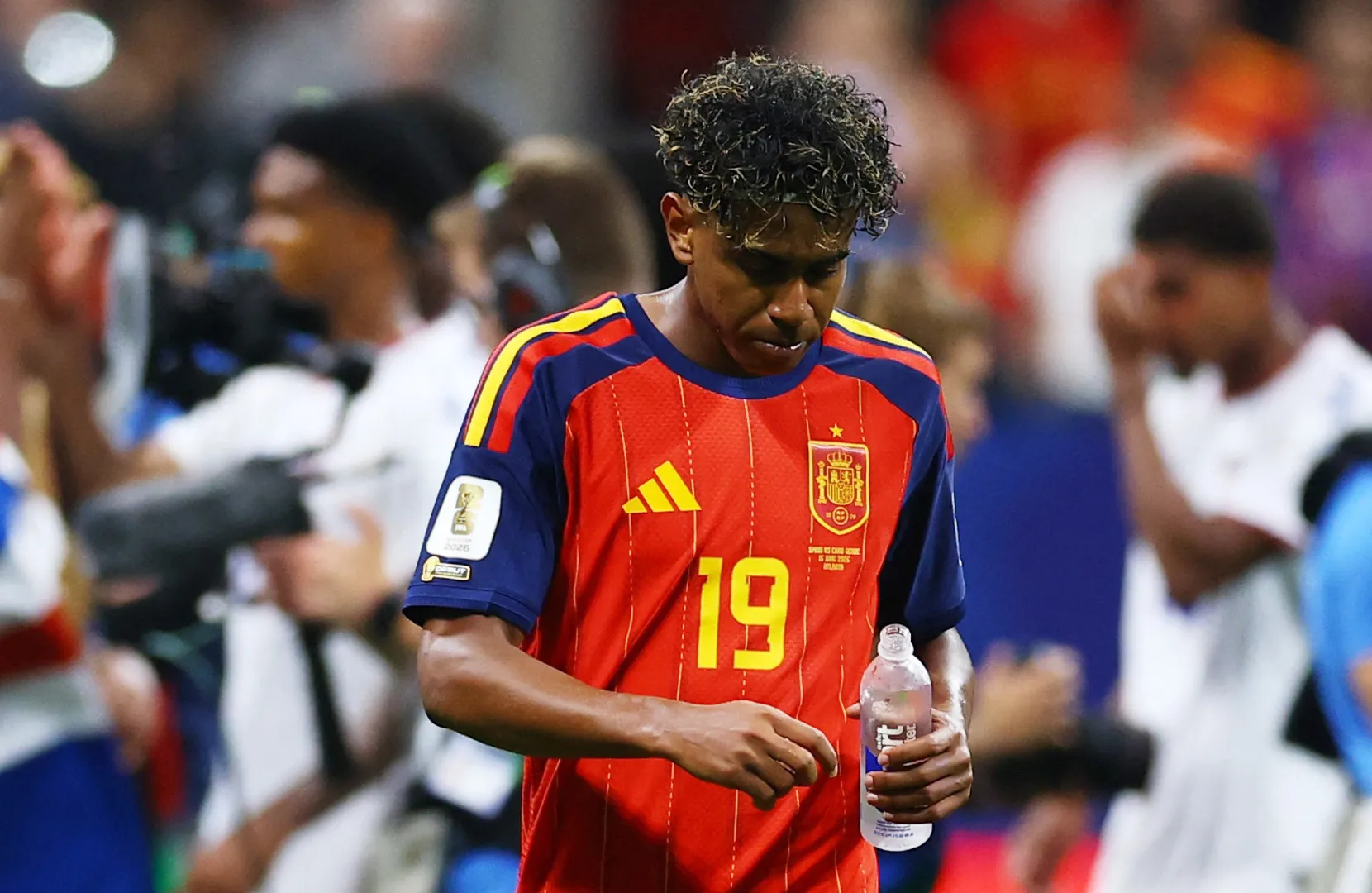
Lamine Yamal was left on the bench as the Barcelona superstar is eased back to fitness after nearly two months out with a hamstring injury and even his appearance as a second-half substitute failed to break down Cape Verde’s dogged defence.
Recommended Stories
list of 4 itemsend of list
Since winning the World Cup for the first time in 2010, Spain have not won a knockout game and their inability to make dominance of possession count was reminiscent of their meek exits in 2018 and 2022.
Blessed with what coach Luis de la Fuente claimed is the best squad in the competition, Spain were considered among the pre-tournament favourites to go all the way and lift the World Cup on July 19.
But the importance of Yamal and Nico Williams to their chances of success was underlined by a flat performance.
Williams also had an injury-disrupted season at Athletic Bilbao and was not introduced until the 87th minute.
Ranked 67 in the world, Cape Verde were making their debut on the global stage and did a nation of just over 500,000 people proud.
In stark contrast to the searing temperatures faced by some other sides, Atlanta’s state-of-the-art air conditioned stadium meant there was no excuses for the slow tempo of Spain’s build-up.
Indeed the mid-half hydration break was met by boos with fans frustrated at the break in play despite the cool conditions.
It took until six minutes before half-time for Spain to seriously threaten.
Marc Cucurella, fresh for sealing his move from Chelsea to Real Madrid, sent over a teasing cross that Ferran Torres turned onto the crossbar and Cape Verde goalkeeper Vozinha got back on his feet to turn Mikel Oyarzabal’s looping header over the bar.
Torres tested Vozinho again moments later before Aymeric Laporte’s header from a corner was also clawed away by the Cape Verde number one just before half-time.
The break came at a good time for the Blue Sharks and they comfortably held out in the second period until Yamal’s entrance after the second hydration break.
Billed as one of the stars of the tournament, Yamal’s appearance instantly lifted the crowd and injected life into the pedestrian Spanish attack.
His first involvement set up a decent opening for fellow substitute Mikel Merino which was too close to Vozinha.
Yamal also began the move that saw Oyarzabal’s effort deflected over with Spain’s best chance of the second half.
Cape Verde nearly snatched a famous victory in the final minute of the 90 when Dani Borges planted a header too close to Unai Simon.
Spain’s road to victory in 2010 also began disappointingly with defeat to Switzerland, but they have much to work on ahead of facing Saudi Arabia in Atlanta once more on Sunday.
The World Cup group stage continues on Monday, with four more matches taking place across the United States.
Spain begin their campaign against World Cup newcomers Cape Verde, Belgium face Egypt in what could be one of the day’s closest games, Saudi Arabia take on Uruguay in Miami, and Iran meet New Zealand in Los Angeles.
Recommended Stories
list of 4 itemsend of list
Away from the football, Uruguay’s disrupted travel plans, divisions within Los Angeles’s Iranian American community before Iran’s opener, and Haiti’s inspiring return to the World Cup are all drawing attention beyond the pitch.
Belgium face Egypt at Seattle Stadium in Seattle at the same time, with the Group G rivals also getting under way at 12pm local time (19:00 GMT).
Later, Saudi Arabia meet Uruguay at Miami Stadium in Miami Gardens, Florida. That match starts at 6pm local time (22:00 GMT).
The day’s final fixture sees Iran face New Zealand at Los Angeles Stadium in Inglewood, California. Kickoff is at 6pm local time (01:00 GMT on June 16).
What do the predictions say for Spain vs Cape Verde?
Spain are the clear favourites to win, but Cape Verde have already made history by reaching the World Cup for the first time.
The teams have never played each other. Spain’s last two World Cup matches against African opponents came against Morocco, drawing 2-2 in 2018 before losing on penalties after a 0-0 draw in the 2022 quarterfinals.
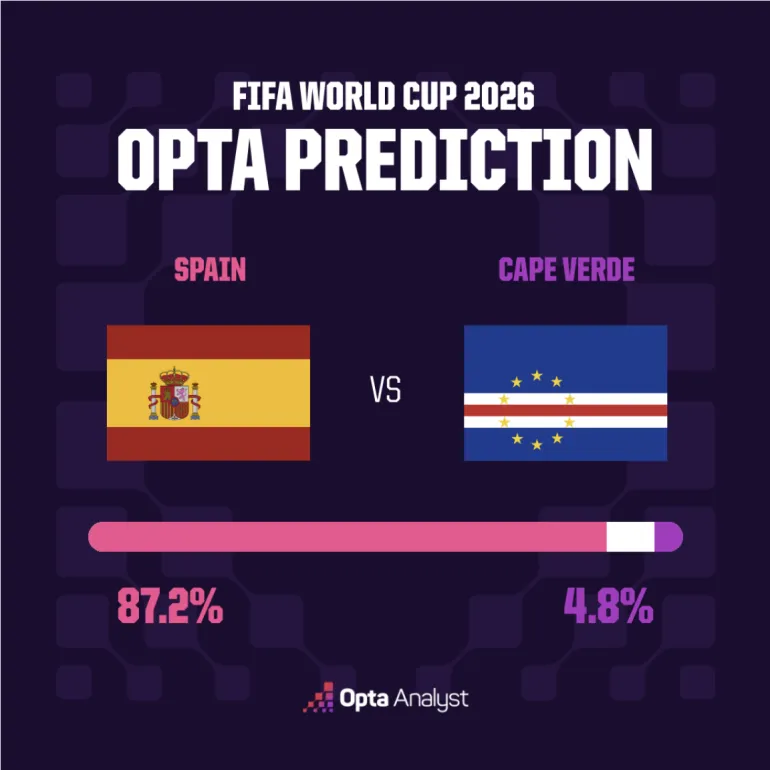
Opta’s predictions strongly favour Spain. After running 25,000 simulations, the statistics company gave Spain an 87.2 percent chance of winning the Group H opener. A draw was predicted in 8.1 percent of the outcomes, while Cape Verde were given a 4.8 percent chance of causing an upset.
Only one African team has ever beaten Spain at a World Cup: Nigeria, who won 3-2 in the group stage in 1998.
Spain vs Cape Verde
What do the predictions say for Belgium vs Egypt?
This one could be much closer than many people expect.
Opta’s predictions suggest there is very little separating the sides. In 25,000 match simulations, Belgium won 37.2 percent of the time, while Egypt came out on top in 35.5 percent. A draw happened in 27.3 percent of the simulations.
Belgium are slight favourites. It could end up being one of the closest games of the day, with a single goal potentially making the difference.
Belgium face pressure to avoid repeating their performance in 2022 in Qatar, when they did not advance beyond the group stage. The Belgians finished third in 2018 in Russia.
Belgium vs Egypt – World Cup
What do the predictions say for Saudi Arabia vs Uruguay?
Saudi Arabia and Uruguay have met only once before at a World Cup. Uruguay won that match 1-0 in 2018.
The teams have also faced each other in a friendly match. That game, played in Saudi Arabia in 2014, ended in a 1-1 draw.
The predictions favour Uruguay. In 25,000 simulations run by Opta, Uruguay won 64.7 percent of the time. Saudi Arabia won 13.9 percent of the simulations, while 21.4 percent ended in a draw.
Saudi Arabia vs Uruguay – World Cup
What do the predictions say for Iran vs New Zealand?
Iran and New Zealand have only played each other twice before, and this will be their first meeting in a competitive match.
Their first game ended in a 0-0 draw in New Zealand in 1973. Thirty years later, Iran won 3-0 in Tehran, with Ali Karimi scoring twice before Hossein Kaebi added a third goal.
The predictions give Iran the edge. In 25,000 simulations run by Opta, Iran won 53.8 percent of the time. New Zealand won 20.4 percent of the simulations, while 25.8 percent ended in a draw.
Iran vs New Zealand – World Cup
What else is shaping the World Cup?
Uruguay’s travel plans hit by delays before World Cup opener
Uruguay’s preparations for their World Cup opener have been disrupted after travel problems delayed the team’s arrival in the US.
The squad had been due to fly from Cancun, Mexico, before Monday’s Group D match against Saudi Arabia in Miami. However, reports in Uruguay said the charter flight was not cleared to enter the US, forcing the team to make alternative arrangements.
The Uruguayan Football Association (AUF) said the delay was outside its control. A replacement plane was eventually organised, with the team expected to reach South Florida only about a day before kickoff.
“Due to problems beyond the control of the AUF, the departure from Mexico has been delayed,” the association said in a statement. “The squad is resting at the hotel. The new departure time set by FIFA is 4:15pm [21:15 GMT].”
Japan fans continue World Cup cleanup tradition after Netherlands draw
The blue bags Japanese fans waved while celebrating their team’s goals, and then stayed behind for something else after the match ended.
Following Japan’s 2-2 draw with the Netherlands, supporters stayed behind to collect rubbish from the stands before leaving the stadium, continuing a tradition that has become a familiar part of the World Cup.
The cleanup effort first caught global attention at the 1998 tournament in France, and Japanese fans have kept it going at every World Cup since.
Iranian Americans divided over Team Melli
As Iran prepare to begin their World Cup campaign in Los Angeles, members of the Iranian American community in Westwood, or “Tehrangeles”, remain split over how to respond.
While some opposition activists plan protests against the team, others are setting politics aside to support the football. Business owner Roozbeh Farahanipour told Al Jazeera’s reporter Ali Harb that “the community is divided” and there is no consensus on whether to boo the national team or back the US-Israel war against Iran.
Trudeau defends attending US match instead of Canada’s opener
Former Canadian Prime Minister Justin Trudeau attended the US World Cup opener against Paraguay in California instead of Canada’s game against Bosnia and Herzegovina in Toronto.
Trudeau said he chose to be at the game in Inglewood because his girlfriend, singer Katy Perry, was performing in the pre-match show at SoFi Stadium.
“Sometimes supportive boyfriend duties call. But you know who I’m rooting for to take the Cup,” he wrote on X.
Canada’s opener in Toronto and the US match in Los Angeles were played just hours apart, prompting some fans to question why the former prime minister was not supporting the home team.
Trudeau served as Canada’s prime minister from 2015 to 2025.
After returning to the World Cup for the first time since 1974, Haiti’s campaign has given people a rare reason to celebrate.
For Olivier Woodensky Pierre, the World Cup is a dream come true. He is the only player in Haiti’s squad who still lives in the country. Born in Cite Soleil, one of the poorest areas in the capital, Port-au-Prince, Pierre hopes the team’s achievement will inspire young people back home.
“Every player always wishes to play in the World Cup. That was my dream. That’s why I’m fighting to be here. I got the chance to be selected to play in the World Cup. I am advising the youth not to be discouraged. Keep fighting, work, and be disciplined,” Pierre told Al Jazeera’s Teresa Bo.
Haiti’s qualification has brought a sense of hope to a country going through one of the most difficult periods in its recent history. Gangs control large parts of the capital, violence has displaced hundreds of thousands of people, and many Haitians have taken to the streets to demand peace while also celebrating the team’s return to football’s biggest stage.
The journey to the World Cup was far from straightforward. Because of the ongoing political crisis, Haiti had to play its home qualifiers abroad. There was also a lack of funding.
“It was really difficult before because there were no sponsors to finance the team. You know, since we qualified for the World Cup, FIFA provided money for preparation, and the government provided $4m that were crucial to help us prepare,” Thecieux Jeanty of the Haitian Football Federation told Al Jazeera.
Pastor Winston Noel also voiced disappointment over US visa restrictions affecting Haitians.
“FIFA must talk to the Trump administration to tell them that this cannot be the case because it is the World Cup. All countries that qualify must have their fans to come and support their teams,” he said.
“The World Cup is something special for us Haitians. Many children here in Haiti will participate in the World Cup, even though this generation doesn’t know the names of all the players. But we are very happy because it’s a great achievement for us,” Noel said.
Haiti eventually opened their World Cup campaign with a 2-0 defeat to Scotland, but for many supporters the tournament is about more than results. It remains a rare moment of pride, unity and hope for a country that has endured years of hardship.
Pre-tournament favourites Spain open their Group H campaign with a match against World Cup debutants Cape Verde.
Published On 14 Jun 202614 Jun 2026
The 2026 World Cup will have 13 different kickoff times. You can use the Al Jazeera Sport widget to find out exactly when your team is playing in your local time.
Who: Spain vs Cape Verde What: FIFA World Cup 2026 Group H match Where: Mercedes-Benz Stadium, Atlanta, United States When: Monday, 12pm local time (16:00 GMT) How to follow: Catch all live updates on Al Jazeera Sport
Recommended Stories
list of 4 itemsend of list
Spain, the reigning European champions and strong favourites for the 2026 World Cup, begin their title bid on Monday by facing minnows Cape Verde in Atlanta.
Since winning their maiden world title in 2010, Spain have endured a dismal run in the following three campaigns, bowing out in the group stage in 2014 and exiting in the round of 16 in 2018 and 2022.
But their Euro 2024 success and a new golden generation of Lamine Yamal, Pedri, Gavi, Ferran Torres and others have prompted bookmakers to keep Spain at the top of the potential winners‘ list.
La Roja – known for playing entertaining, attacking football – have become unshakeable over the last four years, going 30 matches unbeaten since a 1-0 friendly loss to Colombia at Wembley in March 2024.
Spain will arguably be the team to beat in North America, with Opta’s supercomputer handing them a 15.94 percent probability to lift the title, and France a close second at 13.62 percent odds.
Spain’s Lamine Yamal, Ferran Torres and Gavi during training [Brett Davis/Imagn Images via Reuters]
Will Yamal play in Spain vs Cape Verde?
Yamal single-handedly stole the show in Germany two years ago en route to their Euro title, and will hope to repeat that form at the June 11 – July 19 tournament.
But the teen sensation may have to wait a little longer to make his World Cup debut.
Spain could take a cautious approach for the Cape Verde opener with winger Yamal and young forward Nico Williams in the final stages of recovery from hamstring injuries sustained in April.
Both returned to training with their teammates on Thursday, but De la Fuente could opt to name them on the bench or keep them out of the matchday squad until they reach full fitness.
Lamine Yamal will make his World Cup debut at the 2026 tournament [Florencia Tan Jun/Getty Images]
Cape Verde to break new ground in North America
Known for its crystal-clear waters and sandy white beaches, Cape Verde will make noise for different reasons this North American summer.
The archipelago of 10 islands in the Atlantic Ocean will make its World Cup debut on Monday, arriving at the global showpiece as one of 10 African representatives.
After their fairytale qualification, which coincided with its 50th anniversary of independence from Portugal, Cape Verde – with fewer than 600,000 inhabitants – became the third smallest country by population to reach the tournament after Iceland in 2018 and Curacao, also in 2026.
The team has slowly built credibility in recent years. Their international breakthrough came in 2013 when they qualified for their first Africa Cup of Nations (AFCON) and reached the quarterfinal stage.
Cape Verde has spread the national team net wide with starters based in several countries, including Portugal, the Netherlands, and the United States.
Cape Verde beat record African World Cup qualifiers Cameroon to seal their spot in the finals [File: Cristiano Barbosa/AP]
Spain vs Cape Verde prediction
Spain are strong favourites to win this match, having an 87.2 percent probability of walking away with three points. Cape Verde have a slim 4.8 percent chance of victory, while a draw has an 8.15 percent chance.
Overall, Spain have a 76.53 percent probability to win Group H, which also includes Saudi Arabia and Uruguay.
How to watch Spain vs Cape Verde?
The following is the list of broadcasters and platforms to watch the game in these countries:
Spain: LA 1, DAZN Mundial, RTVE Play
Cape Verde: New World TV, SuperSport
United Kingdom: ITVX, ITV1, STV Player, STV
USA: FOX, FOX One, Telemundo App, Telemundo Network, Peacock
Africa’s performance at World Cups peaked at Qatar 2022 when Morocco became the first side from the continent to reach the semifinal stage.
Even their quarterfinal appearance was noteworthy – the Atlas Lions were only the fourth African nation to get there.
Recommended Stories
list of 4 itemsend of list
Although Cameroon, Senegal and Ghana are the three other African teams to reach the quarterfinals, North Africa has dominated the continent’s success overall at the World Cup and at the Africa Cup of Nations.
Egypt are the record seven-time winners of AFCON, while three of the top five African qualifiers for World Cup finals are Morocco, Tunisia and Algeria.
Al Jazeera breaks down the chances of the sub-Saharan nations looking to outshine their neighbours from the north at the tournament which kicks off on June 11:
SENEGAL
World Cup Appearances: Four – 2002, 2018, 2022 and 2026 Best finish: Quarterfinals Overall record: P12 W5 D3 L4 F16 A17 FIFA ranking: 14 Prediction: Eliminated at quarterfinal stage
Senegal head to World Cup 2026 with a burning sense of injustice firing their campaign. The Lions of Teranga were stripped of the Africa Cup of Nations (AFCON) title by the Confederation of African Football (CAF), which decided the mid-game walk-off by the Senegalese players and staff voided January’s final – which was later awarded to Morocco, along with the trophy, as a 3-0 win.
In 2002, Senegal upset the odds and reached the quarter-finals in their World Cup debut at the tournament co-hosted by Japan and South Korea.
More than two decades later, expectations are running high – perhaps carrying the greatest expectation on all African teams, including Morocco.
The depth of the 26-man squad is seen as their greatest strength over continental neighbours, but their star power is also envied by rivals.
Sadio Mane remains the country’s greatest export. Although midfield kingpin Pape Gueye, goalkeeper Edouard Mendy and captain Kalidou Koulibaly would grace almost any side at the tournament.
All three are French-born and another shot at the two-time winners of the competition is in their sights.
A 1-0 win against then defending champions France at the 2002 edition announced Senegal as a rising footballing powerhouse. Their first Group I encounter this time around is against Didier Deschamps side in New York on June 16.
“It’s always a pleasure to play against France. It’s a country we know well,” said Senegal coach Pape Bouna Thiaw, who moved to France aged 17.
“If I lose even a second of my belief that I can win the World Cup with Senegal, I will step down,” he added.
Senegal’s group is completed by Iraq and Norway.
Sadio Mane remains the star name for Senegal [Bob Donnan/Reuters]
GHANA
World Cup Appearances: Five – 2006, 2010, 2014, 2022 and 2026 Best finish: Quarterfinals Overall record: P15 W5 D3 L7 F18 A23 FIFA ranking: 74 Prediction: Eliminated at quarterfinal stage
Ghana have only missed one World Cup since their 2006 debut.
Four years after their global bow they became the third African side to reach the quarterfinal stage at Germany 2010.
Their run-up to this tournament has not been smooth, with a late change of coach as veteran Portuguese Carlos Queiroz replaced Otto Addo following a run of poor results.
The German-born former Ghana international led his nation at Qatar 2022, but the failure to qualify for the last AFCON and comprehensive losses in their four high-profile games in November and March saw him fired in early April.
It will be a fifth successive World Cup for the 73-year-old Queiroz, whose past African experience has been with South Africa and Egypt, and who managed Real Madrid, and was Alex Ferguson’s right-hand man at Manchester United.
Group L, against Panama, England and Croatia, appears to be the ‘group of death’ in the opening stage of the competition, but with Manchester City’s Antoine Semenyo leading a strong attack, Ghana will fully expect to progress.
“I think that this country has a huge, enormous potential. This is a country of footballers,” Queiroz said.
The Black Stars will, however, be without the injured Tottenham forward Mohammed Kudus, who has become the team’s talisman and key factor in their last two successful qualifying campaigns.
Ghana have only missed one World Cup since their 2006 debut [Paul Childs/Reuters]
IVORY COAST
World Cup Appearances: Four – 2006, 2010, 2014 and 2026 Best finish: Group Stage Overall record: P9 W3 D1 L5 F13 A14 FIFA ranking: 34 Prediction: Eliminated at quarterfinal stage
The Ivory Coast return to the global stage after a 12-year absence – one that was hard-felt following the retirement of some of their greatest players in Yaya Toure and Didier Drogba.
It has been a long rebuild for the Ivorians, but they have won two AFCON titles since their last World Cup appearance.
Their youthful attack led by teenager attacker Yan Diomande, alongside Simon Adingra and Amad Diallo of Manchester United, will be key to their chances.
When hosting AFCON two years ago, Ivory Coast were nearly eliminated in the group stage, but they promoted Emerse Fae from assistant manager for their final game of the opening phase and went on to win the title.
“I believe Ivory Coast has the potential to achieve something exceptional – why not aim for the final?” Fae said ahead of the tournament, that will begin with matches against Curacao, Ecuador and former world champions Germany.
Manchester United’s Amad Diallo has become one of Ivory Coast’s stars [Jason Cairnduff/Reuters]
CAPE VERDE
World Cup Appearances: One – 2026 Best finish: NA Overall record: NA FIFA ranking: 69 Prediction: Eliminated at group stage
One of the debutants, Cape Verde – with a population of about 600,000 – is the third smallest nation to qualify in the tournament’s long history.
They only debuted at AFCON in 2013, but did go on to reach the quarterfinals – a feat repeated in 2023.
The task before them now – which will be led by their diaspora of players in the main – is daunting, with Uruguay, Saudi Arabia and European champions Spain, lying in wait in the group stage.
“We’ve always been aware of our talent but we haven’t always believed that it could take us much further than we had achieved up to that point,” said manager Bubista, named African Coach of the Year in 2025.
“Therefore, it took courage to face any opponent. The first step in our success was truly believing in our potential. In other words, we changed the players’ mindset.”
Cape Verde’s Benchimol celebrates scoring in a pre-World Cup friendly against Serbia [Rodrigo Antunes/Reuters]
SOUTH AFRICA
World Cup Appearances: Four – 1998, 2002, 2010 and 2026 Best finish: Group stage Overall record: P9 W2 D4 L3 F11 A16 FIFA ranking: 60 Prediction: Eliminated at round of 32 stage
After a burgeoning beginning to their return to the international fold, with qualification for the 1998 World Cup, South Africa’s fortunes have taken a downtown in the last 16 years.
A first appearance in the finals since 2010 feels long overdue for a nation hoping to reap the rewards of strong domestic growth as they head to North America.
South African club Mamelodi Sundowns are the newly crowned African Champions League winners and eight of their players are in Bafana Bafana’s squad. There are also eight players from Orlando Pirates – the domestic league champions, who pipped Sundowns to the title by a point.
“We can say that we have players of the best teams of the season. Those guys have much experience at a high level,” South Africa’s Belgian-born coach Hugo Broos said of his 26-man selection.
“I’m certainly happy that Sundowns won the Champions League, because I was afraid that if they should lose, I would get players who would be very disappointed. So now they all have that boost of confidence, and that helps a lot.”
South Africa are in the other so-called ‘group of death’ as they take on Czech Republic, South Korea and co-hosts Mexico, who they face in the opening game of the tournament
South Africa’s squad includes eight players who won this season’s African Champions League [Siphiwe Sibeko/Reuters]
DR CONGO
World Cup Appearances: Two – 1974 and 2026 Best finish: Group stage Overall record: P3 W0 D0 L3 F0 A14 FIFA ranking: 46 Prediction: Eliminated at quarterfinal stage
DRC’s only previous appearance was when it was still known as Zaire, competing at the 1974 finals in West Germany – the first African side from south of the Sahara to go to the World Cup.
As reigning continental champions, their 9-0 thumping by Yugoslavia did little to raise the flag for Africa at the time.
Much has changed since then for the continent and in its second-largest country. The Congolese players will arrive in North America with a FIFA ranking that outstrips three of the other five sub-Saharan qualifiers.
It did take two playoffs to reach this edition – the African legs saw the Congolese eliminate Cameroon and Nigeria, before edging Jamaica in extra time in their intercontinental playoff
Most of the squad are European-born, either in Belgium, France or Switzerland, plus the London-born Aaron Wan-Bissaka, previously called up by England but who missed out on a cap through injury.
“We are extremely proud because a whole generation hasn’t been able to see its national team in the World Cup but now they will see them there,” said their French coach, Sebastien Desabre.
Democratic Republic of Congo return to the World Cup after 52 years [Nicolas Economou/Reuters]








![Cape Verde beat record African World Cup qualifiers Cameroon to seal their spot in the finals [File: Cristiano Barbosa/AP]](https://i0.wp.com/www.aljazeera.com/wp-content/uploads/2026/03/AP25286764425321-1774510671.jpg?w=640&ssl=1)