


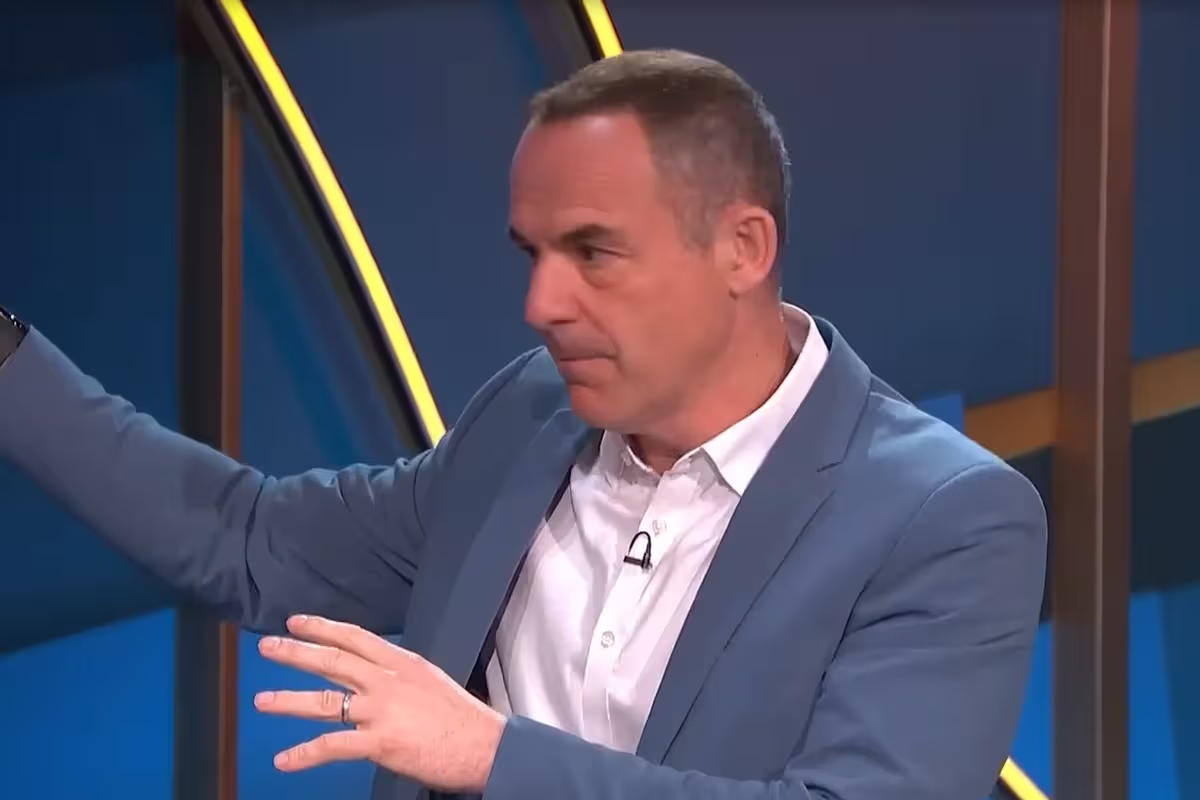
The money-saving guru has urged those who have paid for trips with major holiday firms and airlines to avoid the DIY approach

Martin Lewis gave advice for anyone booking holidays amid the Iran conflict(Image: ITV)
Martin Lewis has delivered a stark warning to anyone who has already booked a holiday for this summer – and explained why people could be making a big mistake getting flights and hotels separately. In a recent update, the money-saving guru has urged those who have paid for trips with major holiday firms and airlines, including TUI, Jet2, Ryanair, Wizz, easyJet and British Airways, to pay close attention.
It was suggested this week that the UK could be worst hit by jet fuel shortages because it has ‘critically low levels’ of supplies and poor refining tools, by Goldman Sachs. The giant investment bank Goldman Sachs said in a research note to clients: “The UK is the largest net importer of jet fuel in Europe, and it holds no strategic reserves, leaving commercial inventories as the primary buffer.”
During his Money Show Live on ITV, the financial expert responded to an audience member who asked: ‘If my flight’s cancelled due to no jet fuel will you definitely receive at the moment package holidays give you a certain as well.’ Mr Lewis explained that holidaymakers would lose their hotel booking costs if they had arranged accommodation independently from flights reserved with airlines such as Jet2, TUI, Wizz, Ryanair or easyJet – as they would not be protected under consumer regulations.
He said: “No. And I think this is what people need to be very aware of. If you booked a package holiday where you booked everything in one, then under the package holiday regulations and rules and protections generally if your flight went you would get everything back.”
He added: “And so actually at the moment package holidays give you a certain level of extra security that you wouldn’t get if you did a DIY booking where you bought your hotel and flight separately.” The reason for this, he explained, stems from the fact that the hotel reservation itself remains entirely valid: “Because the point is if you lose your flight and you’ve DIY booked, there’s nothing wrong with your hotel.
“The issue is you can’t get there. Your hotel is still there. It’s not faulty. It’s not cancelling. So, you don’t have those consumer rights.” If the accommodation provider hasn’t violated any terms, then guests might examine how they’ve paid for their booking – but that route offers no solution either. He said: “So, you would then say, ‘What about using a credit card or debit card protection?’ It won’t work because there’s nothing faulty. And that’s just giving you the same replica rights that you would have with the retailer.”
For those still seeking a solution, travel insurance may seem like the next logical port of call. Mr Lewis revealed: “So, you’ then say, ‘What about travel insurance?’ This is the bad bit. We were checking 40 travel insurance policies. Of those, only a few would have covered you for the knock-on eventuality of your flight being cancelled due to jet fuel and then your hotel costs.
“Only about three or four and most of those were package bank accounts where it’s linked to your bank account. Only one standalone provider. So we need to be blunt at the moment. There is a big risk in those circumstances. If you’re booking, you want something with free or limited cancellation quite short before. So you could just cancel it. You should always talk to the provider.
“Government are saying there isn’t one at the moment and they’re working on consolidating flights and doing things so there won’t be one, but people’s hotel costs if they book separately and other knock-on costs are potentially at risk.”
Speaking on his ITV programme, he also cautioned that neglecting to take one vital step after booking could leave holidaymakers with absolutely nothing if their plans fall through. With the ongoing turmoil in the Middle East sparking serious worries over jet fuel supplies, Mr Lewis warned that those who book a holiday and put off arranging insurance could risk losing everything should something go wrong in the interim.
Mr Lewis emphasised that travel insurance ought to be bought the instant a holiday is booked: “The reason you do that is because half of the cover you’re paying for is in case something happens that stops you going before the trip. And if you don’t have the travel insurance place, you’ve got no cover. So, you may as well have it in place. But at this time of year when many people have already booked, I have a slight adaptation, which is this. If you’ve booked and you don’t have it yet, just get it now.
“Get it done as soon as possible.” A Money Show Live viewer named David said: “I booked flights to Australia for a family group of seven to travel in March next year. I took out insurance immediately. One of our group is now pregnant and can’t travel on the dates planned. It costs £5,000 to reschedule, which I’m happy to report the insurance covered.”
Mr Lewis also commented on the complexities facing larger groups: “Very quick aside on that, think of who you’re booking for. So, if it’s a family group and one can’t go, they’ll often cover you. But if there’s a large group of friends going, you often all get independent travel insurance. Well, then if one can’t go or and you can’t all go on the trip, it’s only the person who’s who’s got that cover. So, you’d need a group insurance policy so that if one can’t go, you all can’t go.”
Jet2 today said now people choosing a package holiday as their preferred method of booking is up 5% to 51% since February. In the same period, the number of people preferring to book through different providers has dropped by six percentage points to 20%. Those choosing ‘accommodation only’ has dropped to 2%.
The primary reasons for choosing a package holiday have remained steady, with value (36%) and ease (36%) the main drivers, however the benefit of ‘added security with one provider, ATOL/ABTA protection’ has increased by four percentage points since February to 26% the poll said.
This protection means that customers are covered should any changes happen to their bookings, including the option of receiving refunds if their travel plans are cancelled, and that those holidays are held to the highest standards when it comes to customer service, changes to bookings, and health & safety.
Jet2 has confirmed it will not introduce surcharges on any booked flights or holidays to cover cost increases, for example jet fuel, assuring customers that the price they book with Jet2 is the price they will pay.
Steve Heapy, CEO of Jet2 said: “Consumers want assurance during times of uncertainty and package holidays provide that assurance. On top of all the protection that our package holidays guarantee, Jet2 is well known as being a consumer champion that goes above and beyond to look after customers. Ahead of a busy summer season, this means new and existing customers know that their well-deserved holidays are in the very best hands with us, and we are very excited about welcoming everyone onboard and taking them on their breaks.”