Anida Yoeu Ali is ‘The Buddhist Bug’ in a compelling exhibit at VPMA
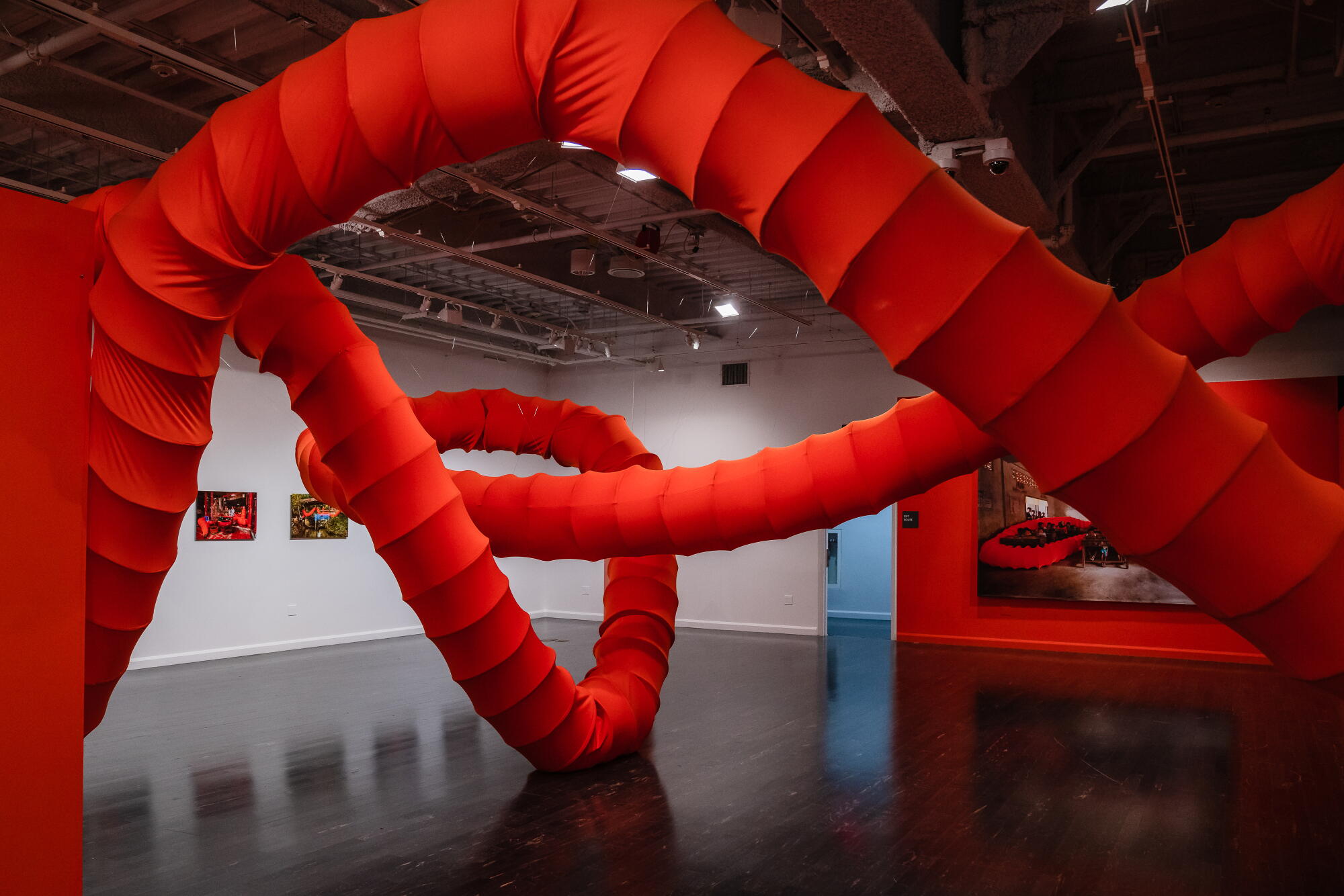
At the opening of “The Buddhist Bug” at the Vincent Price Art Museum on Saturday, guests will see a 328-foot-long orange insect. Its body will coil around the museum’s gallery, lobby and atrium, and poke through the walls. The bug’s head, covered in a hijab, will be in one room, and its feet, which some might be tempted to tickle, will be in another.
The creature is occupied and controlled by Anida Yoeu Ali, a Cambodian-born artist who lives in Tacoma, Wash. Ali’s numerous performance-based exhibits explore her Cambodian-American identity and Buddhist and Muslim religions. The bug is her “totally humorous take on hybridity.”
As the bug, Ali doesn’t speak. She mostly stands or kneels and makes facial expressions in reaction to her surroundings and passersby. But she likes to engage with visitors, who can either touch her elaborate garment, talk to her, take pictures of her or simply observe her.

Artist Anida Yoeu Ali’s exhibit, “Anida Yoeu Ali: The Buddhist Bug,” features a 328-foot-long performance installation at the Vincent Price Art Museum in Monterey Park.
(Ariana Drehsler / For The Times)
“I get a lot of people who ask for a photo or they’ll ask for a hug,” says Ali. “There’s so many stories that get whispered into my ear. A lot happens when you can hold someone’s attention with just your eyes. There’s a vulnerability that happens when you make eye-to-eye contact without any words involved.”
Ali likes to use expansive spaces and incorporate fabrics and textiles, whether it’s a red, sequin-covered chador or a tubular-looking worm made out of polyester, Lycra and spandex. Such things make the petite artist feel “taller and larger than life.”
Ali will appear in the suit for only two hours during the show’s first and last days. But for the rest of the exhibit’s run, the museum will display the bug in its entirety, in addition to sculpture, photographs and video that document how Ali has spent the last 15 years becoming her creature alter ego.
Born in Battambang, Ali, 52, is of mixed Malay, Khmer, Thai and Cham ethnicity, and was raised Muslim in a country that’s 96% Buddhist. She and her family left Cambodia in 1979 to escape the genocide committed by the brutal Khmer Rouge regime and settled in Chicago. Ali studied at the University of Illinois Urbana-Champaign and the Art Institute of Chicago. She’s currently a senior artist-in-residence at the University of Washington Bothell.

Director of the Vincent Price Art Museum Steven Wong and Executive Director Sonia Mak of Asian Arts Initiative.
(Ariana Drehsler / For The Times)
Ali conceived one of her best-known performance-based works, “The Red Chador,” in 2014 after relocating to Cambodia for a few years. She wanted to address the rise of Islamophobia in the wake of major events happening at the time, including France’s ban on facial coverings (the country had already banned the hijab years prior) and the terrorist attacks on the French satirical magazine Charlie Hebdo. Ali also wanted to confront the politicization of Muslim women’s dress and contradict the “imagery of Muslim women as joyless and depressed.”
“It was an opportunity to put on a chador, but one of my choosing and one of my designs,” Ali says. “It was to also honor the Muslim women in my background. My mother, grandmother, aunties and cousins all covered and did so joyfully. That was never an issue for them.”
Ali wore the red sequin chador in 15 cities, including at the Palais de Tokyo in Paris in 2015, where, during a 12-hour performance, she threatened to chop off 99 baguettes. The installation was meant to challenge Muslim stereotypes while making a subversive nod to the bread as a famous French symbol. “The Red Chador” also made a stop earlier this year at the W. Keith and Janet Kellogg University Art Gallery at Cal Poly Pomona.
“The Buddhist Bug” was created in 2011, a few years before “The Red Chador,” and inspired by the pervasiveness of the saffron-colored robes worn by monks in Cambodia. The piece not only drew on the color orange but was also influenced by a collapsible play tunnel she received as a gift after giving birth to her first child.

A photo titled “Into Dreamland, The Buddhist Bug, 2015,” (photographed by Masahiro Sugano), and featured at the Vincent Price Art Museum as part of the exhibit, “Anida Yoeu Ali: The Buddhist Bug.”
(Ariana Drehsler / For The Times)
Ali wears a hijab while in the suit and uses a second person, usually a model or intern, to provide the bug’s feet — though she insists that those are the “bug’s feet.” It’s a fun, childlike interpretation of the complexities of coming from two cultures and religions.
“I wanted to do something that was tapping into my diasporic identity or what I call the ‘diasporic dilemma,’” says Ali. “This notion of going back and forth and constantly feeling like you’re not enough in one country or one culture. The bug is the result of that. You look at it and it’s a big orange creature. But for me it’s more of a tunnel structure that can double as a bridge, an entity that can connect two points or two locations. That’s the poetic part of the project.”
Sonia Mak, who co-curated the exhibit at VPAM with museum director Steve Wong, invited Ali to show in L.A. after catching one of her performances at the Seattle Asian Art Museum in 2024.
Photographs in the installation — some taken by Ali’s husband, Masahiro Sugano — capture Ali dressed as the bug in cities all over the world. Some are placed on a sculpture resembling the Rub el Hizb, an Islamic star shaped like an octagram. The rest are mounted on the walls and show the bug in places like Battambang and the Cambodian capital, Phnom Penh, at a restaurant, in a classroom, on a boat and a bridge.
In one image, Ali rides in a bicycle carriage. In others she stands outside a mosque while kids play with the bug’s feet and sits in an abandoned movie theater, her tail wrapped around the seats. (Angelina Jolie, whose adopted son Maddox is from Cambodia, was recently photographed visiting these cinemas and is reportedly renovating the theaters.)
Ali envisions someday performing as the bug in the desert in the Middle East and maybe building a children’s public playground as a “fun manifestation” of the project.
“I come from a country with an awful, violent history,” she says. “I have a unique set of identities and perspectives that aren’t easily explainable, which is why I make art. I want people to think about how weird and strange the bug looks, but I want them to feel happy looking at the orange. I love it when the grotesque and the beautiful sit side by side. It makes for some magical artistic moments.”
‘Anida Yoeu Ali: The Buddhist Bug’
Where: Vincent Price Art Museum, East Los Angeles College, 1301 Avenida Cesar Chavez, Monterey Park
When: Sept. 26 to May 22, see website for times
Cost: free
Info: vpam.org.