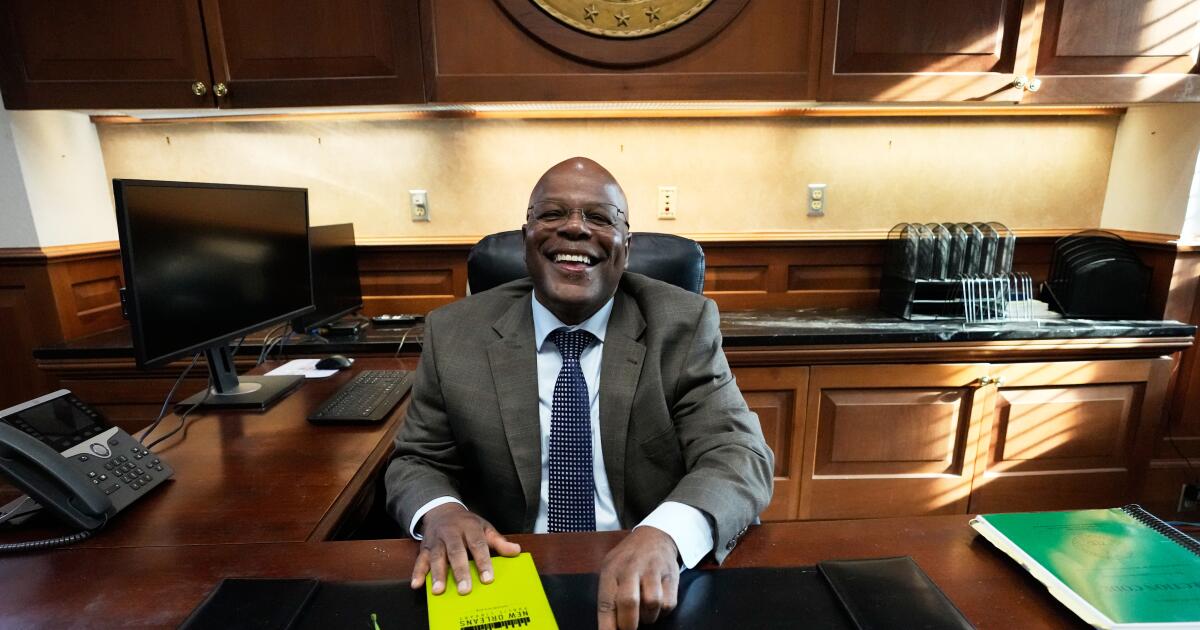
calvin duncan

A grand jury indicts Louisiana’s attorney general in a fight over changes to New Orleans courts

Louisiana’s attorney general has been indicted over accusations she threatened the jobs of New Orleans leaders who fought a Republican-led overhaul of local courts in the heavily Democratic city.

The 16-count indictment against Republican Liz Murrill, handed up Thursday by a New Orleans grand jury, charges Louisiana’s first female attorney general with intimidation and malfeasance.

At the center of the case are deepening rifts between state leaders in Louisiana, which is heavily Republican, and Democrats who control the state’s most prominent city.

Republican Gov. Jeff Landry promised a swift pardon, saying Murrill would not have her reputation tarnished by an “Orleans kangaroo court.” Mayor Helena Moreno, a Democrat, was among those who had accused the state’s top law enforcement official in May of making threats against public officials.

Murrill called the case against her “retaliatory, meritless, and unconstitutional.” Late Thursday, Murrill said she had filed for an emergency stay with the Louisiana Supreme Court.

“I will not back down. I will continue enforcing the law, fighting corruption, and doing the job the people of Louisiana elected me to do,” she wrote on X.

For months, political tensions intensified between Louisiana Republicans and New Orleans officials over a new law that abolished a court clerk office won by an exoneree, Calvin Duncan, who spent nearly three decades in prison. The change consolidated that job with another clerk’s office, which Republican supporters said would make the local judicial system more efficient.

The change was staunchly opposed by New Orleans leaders, and in May, the City Council set a special election that would have given Duncan a chance to win the newly combined job. Murrill responded by warning local officials in letters that they could lose their offices for violating state “usurper” laws, which forbid support for an unauthorized officeholder.

“We’re very interested in elected officials in New Orleans not being intimidated or threatened by letter or any other way,” special prosecutor Laurie White told reporters.

Bond for Murrill was set at $400,000 on Thursday, according to court records.

Landry said he was ordering state police to investigate what he called “alleged improprieties” of the grand jury and those who ran it.

“The criminal justice system is a circus at its finest in Orleans and we will not have any of that!” he wrote on X.

The Republican Attorneys General Assn. said that making statements to local officials — in writing — was simply “issuing a legal opinion and warning public officials about the law” as part of her official duties. It called the indictment “as outrageous as it is dangerous.”

Moreno, who was elected in January and was defiant after Murrill sent the letters, on Thursday called it a “matter for the courts” and did not directly address the allegations.

“My focus, as always, remains on fulfilling the responsibilities the people of New Orleans elected me to carry out,” Moreno said.

Duncan has said he believes state officials were retaliating against him in eliminating the job he won with 68% of the vote. Murrill and Landry have long refused to acknowledge his innocence, though he’s listed on the National Registry of Exonerations.

Republicans have said the change was not personal and supporters have noted that the offices of criminal and civil clerks of courts are combined in other parishes.

Duncan was a jailhouse lawyer who later graduated from law school. He founded a nonprofit dedicated to expanding incarcerated people’s access to the court system and was the driving force behind a 2020 U.S. Supreme Court decision that ended nonunanimous jury convictions.

Duncan spent more than 28 years in prison over a fatal shooting during a robbery in 1981.

The night before a 2011 hearing to consider new evidence, prosecutors offered to reduce Duncan’s sentence to the time he’d already served in prison if he pleaded guilty to manslaughter and armed robbery. Duncan took the deal and was freed but didn’t give up on clearing his name.

In 2021, a judge agreed that Duncan had been unjustly convicted and vacated his sentence altogether. Landry and Murrill have pointed to the 2011 plea deal in objecting to Duncan calling himself exonerated.

Riddle and Hanna write for the Associated Press. Associated Press reporter Jack Brook in New Orleans contributed.
Source link

Louisiana Supreme Court rules against exoneree whose office was abolished

A sharply divided Louisiana Supreme Court on Monday signed off on abolishing an elected office won by a New Orleans exoneree who had spent nearly 30 years in prison for murder before his conviction was vacated.

The 4-3 decision leaves Calvin Duncan with little path forward to try assuming the role of Orleans Parish clerk of criminal court, a job he won in a landmark election last year before Republican lawmakers raced to eliminate the office this spring.

In a blistering dissent, the court’s Democratic justices said the ruling opened the door to allowing Louisiana lawmakers to subvert the will of voters. The court’s conservative majority disagreed, writing that “this change was entirely within the authority of the Legislature.”

The court also rejected the New Orleans City Council’s attempt to hold a special election, which would have given Duncan the option to run again.

“At a time when our voting rights are under unprecedented attack, this decision clarifies that if we want to live in a democracy, we have to fight for it with every tool our system of government provides,” Duncan said in a statement.

Signed by Republican Gov. Jeff Landry, the bill eliminating the New Orleans clerk’s office was championed by GOP lawmakers as a necessary step toward government efficiency. Supporters denied that it had anything to do with Duncan or his past.

Democrats blasted the change as overreach from a largely white, conservative Legislature that they accused of seeking to thwart the will of a predominantly Black city. Those tensions surfaced again last month when Landry signed a new congressional map that eliminated one of the state’s two majority-Black House districts.

Duncan was convicted of a 1981 murder and was released from prison in 2011. In 2021, an Orleans Parish district judge vacated Duncan’s sentence, finding he had been unjustly convicted and the charges against him were dropped. Duncan is listed on the National Registry of Exonerations.

Brook writes for the Associated Press.

Source link

Louisiana Republicans eliminate Democrat’s elected position

Louisiana Republicans eliminated an elected position days before an exonerated man who overwhelmingly won the New Orleans-based clerk seat was set to take office.

Republican Gov. Jeff Landry on Thursday quietly signed into law legislation abolishing the long-standing Orleans Parish clerk of criminal court position, according to Louisiana Secretary of State spokesperson Trey Williams.

Republicans say wiping away the office is a consolidation effort meant to make the local judicial system more efficient and cut costs. But Democrats condemn the change as government overreach, arguing that it infringes on a predominantly Black parish’s decision at the polls.

Calvin Duncan, who spent nearly 30 years behind bars for a crime he did not commit, easily won election to the criminal court clerk position in November, beating the incumbent and earning more than two-thirds of the vote. He had been set to take office Monday and has asked a federal judge to allow him to take office as scheduled.

“It’s a sad thing to see the state government repeating what happened to Black public officials during Reconstruction,” Duncan said. “They will do what they do, and I will do whatever I have to do to vindicate the voters of New Orleans and make sure that what happened to me never happens to anybody else.”

Landry did not immediately respond to requests for comment.

Duncan, a Democrat whose murder conviction was vacated in 2021 after evidence emerged that police officers lied in court, has vowed to help fix the system that once failed him.

Duncan, 63, and his supporters say he is being targeted by the most powerful Republicans in the state, including those who have denied his innocence, even though Duncan’s name is listed on the National Registry of Exonerations.

“We’re doing something because powerful people don’t like him,” Rep. Mandie Landry, a New Orleans Democrat, told lawmakers during a legislative committee hearing in April. Landry, who is not related to the governor, described the Republican efforts as “atrocious” and worries what they could mean for other elected positions in the state.

Law consolidates two court clerk positions

Republicans say the legislation consolidates the civil and criminal court clerks’ offices in Orleans Parish, putting it in line with all other parishes in the state, which have a single clerk’s office. The civil clerk position would remain and absorb the criminal clerk’s role.

Eliminating the clerk position saves the state about $27,000 and the city $233,000, according to the office of the legislative auditor, which added that the long-term costs of consolidation are “unknown.” The legislation also shifts about $1.17 million in state expenditures to the parish. The civil and criminal court clerks have separate physical offices and different case management systems.

The governor told the Associated Press that eliminating Duncan’s elected office was about improving government efficiency and “cleaning up a system in Orleans Parish that has been plagued by dysfunction and corruption for years.”

The consolidation is part of a broader GOP effort during the ongoing legislative session to overhaul the judiciary in New Orleans — including bills that propose abolishing several other elected judicial positions in the parish. However, those jobs would be eliminated further down the line, allowing officials to serve out their terms.

The bill’s Republican author, Sen. Jay Morris, who represents a district several hours from New Orleans, said the goal was to implement the clerk consolidation before Duncan takes office, preventing him from starting a four-year term. Morris acknowledged that he expects lawsuits to be filed because of this law but believes the change to be constitutional.

“It’s unfortunate for Mr. Duncan, I concede that,” Morris told lawmakers in April. “He seems very nice, but we don’t make policy around here for just one person.”

Concerns of disenfranchisement

Although conversations have revolved around Duncan, many also raise concerns about how the change potentially could disenfranchise voters — a heightened worry in a deeply red state that has been central to efforts to weaken the Voting Rights Act, including the case at issue in a landmark Supreme Court ruling last week. Orleans Parish is a Democratic hub with a predominantly Black electorate.

“Mr. Duncan was elected by 68% of the vote in a city that’s majority African American. This is the will of the people, and what your bill attempts to do is usurp the will of the people,” Rep. Edmond Jordan, a Democrat, told Morris.

Well before the legislation reached the governor’s desk, Duncan said he could see the writing on the wall. Ahead of the outcome, Duncan’s advocates held a ceremonial swearing-in for him. Hundreds of people gathered on the steps of the Orleans Parish criminal courthouse to support him.

Duncan told lawmakers that along the campaign trail last year, he spoke with many people who told him they typically abstain from voting in elections. “Now, this bill tells people exactly what they had believed — that their vote doesn’t count,” he said.

Cline and Brook write for the Associated Press and reported from Baton Rouge, La., and New Orleans, respectively.

Source link