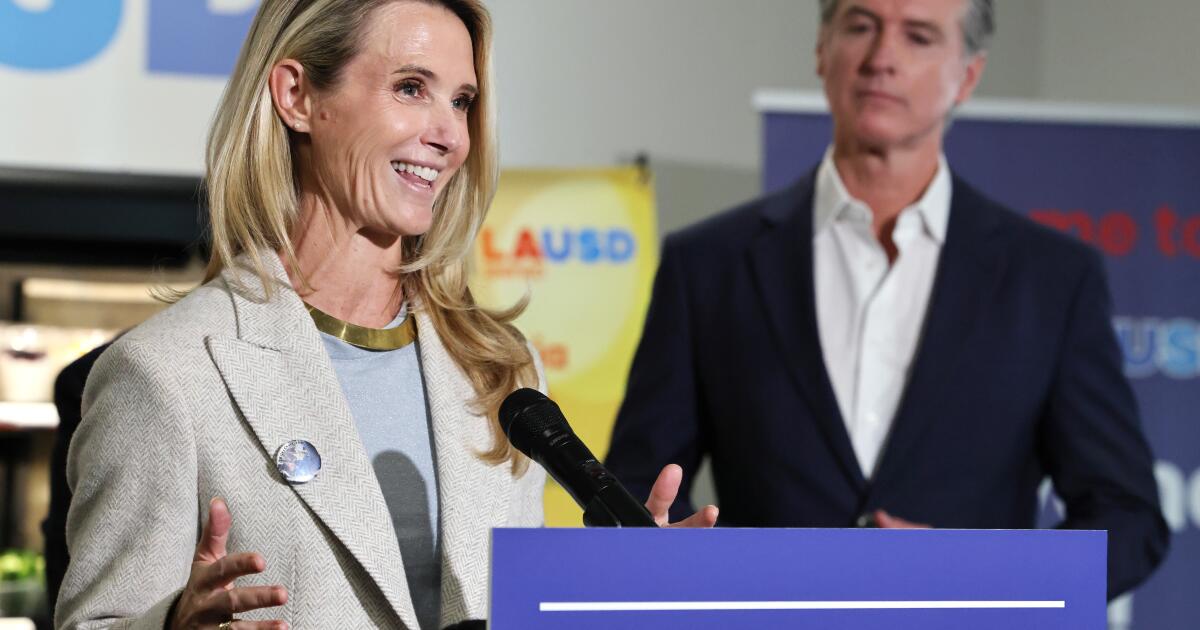
Authoritarians target wives and children because it works. Trump is no different
The Trump Department of Justice going after people who make the president mad or even sad is nothing new, in this dangerous age when the presidency is increasingly about placating the desires of the old man in the Oval Office.
Leticia James, James Comey, Adam Schiff. Most recently, E. Jean Carroll, who sued President Trump personally and won a huge settlement on her claim that he sexually assaulted her. Now, the Department of Justice is investigating her for potential perjury.
It would be easy to think of Gov. Gavin Newsom’s announcement Monday that the U.S. Department of Justice is now targeting his wife, Jennifer Siebel Newsom, as just another addition to that list.
But this attack on Siebel Newsom (alleged attack, anyway — the Department of Justice has not confirmed she is a target) is something much darker in our slide into authoritarianism. While the details of what is being investigated are murky and the president hasn’t chimed in yet, it has all the appearances of the Trump administration seeking to stop a political rival who has a real shot at knocking MAGA out of the top office.
“It’s not just random or accidental that the wife of a major presidential candidate is being investigated,” Steven Levitsky, a professor of politics at Harvard University, told me Monday. “That’s the nature of selective prosecution and that is a pillar of authoritarian rule.”
Levitsky is an expert on authoritarian regimes, and how they take and keep power. His point that Newsom is a viable challenger may seem obvious — Newsom himself is already fundraising off of it. But this particular alleged investigation bears a moment of pause because it is not the regular decline of justice we have been witnessing to this moment.
“This is different,” he said. “This is forward-looking persecution.”
Until now, Levistky points out, Trump has screamed and hollered for the prosecution of those who have wronged him in the past, sometimes even the distant past. Yes, he’s disgraced the Department of Justice with the demand it function as his own personal hammer of retribution, even putting his own personal attorney, Todd Blanche, in charge when Pam Bondi wasn’t accommodating or successful enough at stomping perceived enemies and quashing the Epstein files.
But those prosecutions have largely been grievance-based, not aimed at keeping power.
Going after Siebel Newsom seems more like a forward-looking, preemptive strike targeting Newsom ahead of the 2028 election through every decent man’s Achilles’ heel, his family.
In fact, the right-wing media — which is closely tied to the whims of the White House — has been targeting Siebel Newsom for months.
In particular, Siebel Newsom has been attacked for her work as a documentary filmmaker who focuses on female empowerment and parsing how and why we have the gender norms that we do when it comes to masculinity and femininity. I’ll let you figure out how popular that is in MAGA world, where real women make sandwiches.
Conservative commentator Sean Hannity has gone after Siebel Newsom for saying she sometimes changes the gender of a book’s character from “he” to “she” when she’s reading to her children. Fox News has attacked her for daring to give her boys dolls to play with, leading some MAGA influencers to label her “psychotic” or “abusive.” Right-wing icon Megyn Kelly called her a “nutcase” for sharing the tragic story of her sister’s death when Siebel Newsom was 6.
And other media have focused on the fact that some of the films she has been involved with have been approved for use in California schools, leading to conspiracies that Newsom used his influence to force his wife’s “woke” agenda on kids, by which we are apparently talking about the liberal plagues of decency and inclusion.
Newsom’s office said that in recent weeks, relatives, friends and business associates of the family have been contacted by investigators from the FBI and IRS. Siebel Newsom also does work around online safety for children, but it seems likely that any attention would focus on these films, and related nonprofits, and the perennially popular MAGA boogeyman of schools forcing ideologies on kids. Throw in Siebel Newsom’s company making even a dollar, and the way the IRS can find problems with any tax return, and you’ve got about 10,000 hours of right-wing propaganda.
So whether the pressure to target Siebel Newsom came from the White House or not, Newsom’s announcement raises the troubling specter that this administration is getting more serious about remaining in control by kneecapping potential replacements before they grow too strong.
In his Monday video, Newsom urged Trump with mano a mano bravado to come after him as much as he wanted, but to leave his wife and family out of it. But I would not underestimate Siebel Newsom, who showed her strength when she testified against disgraced Hollywood mogul Harvey Weinstein, laying out publicly a private, painful tale.
Siebel Newsom’s office told me she’s fine being part of any fight against Trump.
“There are clearly no boundaries to what Donald Trump will do to get his way or to challenge those who get in his way,” Siebel Newsom said in a statement.
The “governor and I will continue to speak truth to power because the American people deserve so much more.”
By coming out in advance of any official announcement of an investigation by the Department of Justice, Siebel Newsom and her husband may be able to take control of the narrative, something Trump detests.
That pushback, Levitsky said, is critical, not just for them, but more importantly for all of us. After last year, when so many institutions and individuals crumbled in the face of Trump’s power, the strength of our democracy increasingly depends on those with political capital standing up to him.
Coming out punching first does just that.