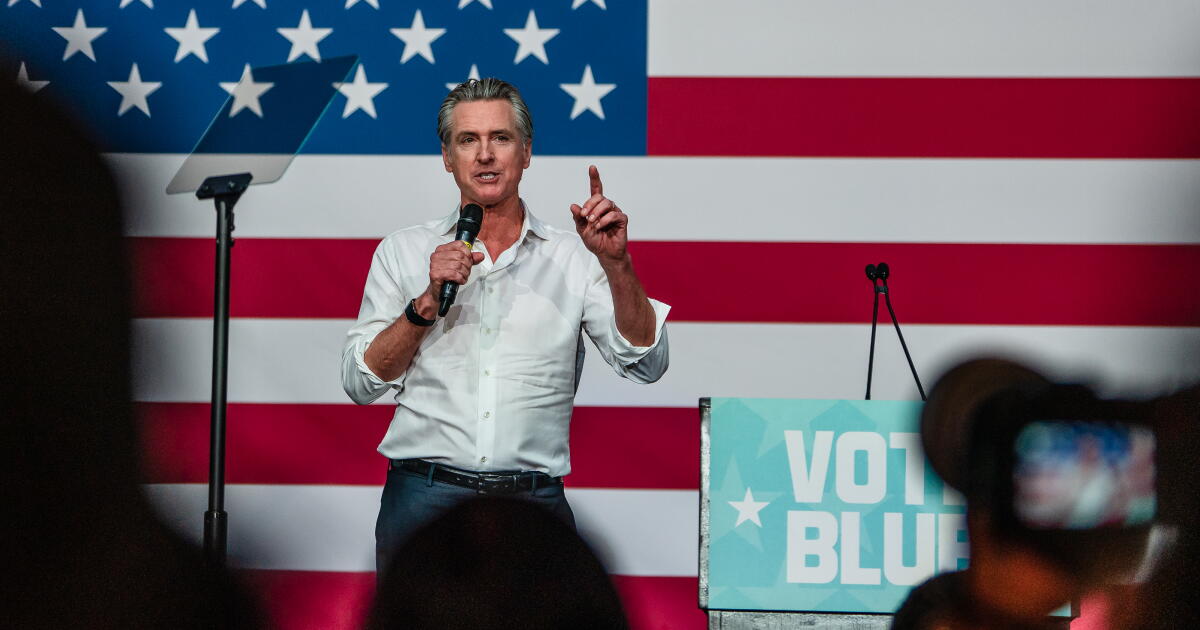
Newsom moves to commute California death sentences to life in prison
Gov. Gavin Newsom told the California Supreme Court Thursday that he will commute the death sentences of all 548 state prisoners awaiting execution, reducing their punishments to life in prison without parole.
Newsom can commute about 40% of the death sentences with the stroke of a pen, but the rest will require the high court’s approval in order to be finalized.
The mass commutation would apply to inmates convicted of some of the most heinous acts in the state’s history. Newsom and other opponents of capital punishment have long argued that the process is costly, cruel and discriminatory, with death sentences disproportionately handed down to defendants of color.
“I take this action because I firmly believe that state-sanctioned killing is incompatible with California’s values, undermines the foundation of our legal system, and diminishes each of us,” Newsom wrote in a letter to Californians explaining his decision. “I know we cannot execute people in our imperfect legal system and remain true to our core values, first among them justice and human decency.”
The move comes in Newsom’s final months as governor and as he considers a run for president. Reducing the death sentences could help him in a primary with a Democratic base of like-minded liberal voters, but potentially hurt him in a general election with a national electorate that supports capital punishment.
The decision to officially spare the condemned inmates is largely symbolic in a state that has not executed a prisoner since 2006, though experts say it could save millions of dollars in court costs every year. Only 13 inmates have been killed since voters reinstated the death penalty in 1978. The state’s electorate reaffirmed its support a decade ago, voting down a ballot initiative that would have abolished capital punishment. Polls show its popularity has waned in the years since.
Despite his outspoken opposition to state-sanctioned executions, the governor has declined to use his political influence with voters to pursue a ballot measure that would amend the state Constitution to align with his position and officially end the death penalty. Without changing state law, criminals can continue to be sentenced to death in California.
“California voters have voted to keep the death penalty on the books and I respect that,” Newsom wrote in the letter to Californians. “But the constitution also gave every governor clemency authority, and that power exists for moments when law as applied cannot be squared with justice. For me, this is that moment.”
Newsom made national headlines two months after his inauguration in 2019 when he issued a temporary moratorium on executions and vowed to dismantle the death chamber at San Quentin State Prison, now called San Quentin Rehabilitation Center.
Calling the death penalty system a “failure,” Newsom said the punishment is also often reserved for poor people who cannot afford expensive legal representation, fails to deter crime and wastes taxpayer money.
Careful to avoid elevating a death penalty debate in the midterm elections, Newsom intentionally waited until after the general election on Tuesday to go a step further and launch the process of commuting all California death penalty sentences.
The decision is another bold signature Newsom move that sits well with his base of support in California and wealthy, white and college-educated national voters who would be crucial to his success in a Democratic presidential primary, said Mike Madrid, a Republican political consultant.
However, his liberal stance on government executions could also create a vulnerability for him if he advances in the 2028 presidential election as the party’s nominee.
“Gavin’s exactly right with that base Democratic voter on that position,” Madrid said. “One hundred percent. It makes him a champion.”
But more moderate blue-collar voters who helped the party flip Congress in the midterms, Madrid added, are “not in line with him on this.”
A poll conducted in August by the Pew Research Center found that about two-thirds of voters nationally favor the death penalty for people convicted or murder.
Those numbers could shift following the botched lethal injection of Christa Pike in Tennessee in September and Defense Secretary Pete Hegseth’s now-scuttled plan to livestream the execution of Ft. Hood shooter Nidal Hasan by firing squad.
“Those events have really ripped the veneer off the death penalty in this country,” said attorney Natasha Minsker of the California Anti-Death Penalty Coalition. “The death penalty is an act of violence. It’s taking another life. I think that’s become clear to the entire country.”
The state spends more than $200 million a year to adjudicate automatic death penalty appeals and habeas corpus petitions for inmates who, in all likelihood, will never be executed, according to a 2025 report by the Habeas Corpus Resource Center.
The case of Clarence Ray Allen, the last inmate killed by lethal injection in California 20 years ago, is emblematic of how the law has failed, death penalty opponents say.
Allen was 76, making him the second-oldest person ever executed in the United States. He had been on death row for 23 years and his appeals cost the state more than $750,000. Many current condemned inmates are even older — some in their 80s and 90s — and their appeals even more drawn out and expensive.
“It’s just a broken system,” said Michael Hersek, former executive director of Habeas Corpus Resource Center and an ex-state public defender.
Taxpayers foot the bill for both the defense and the prosecution in post-conviction capital cases, as well as the administrative judicial costs associated with years of complicated appeals in state and federal court.
The existing appeal requirements were instituted to counter long-standing racial bias in capital sentencing. Attempts to reform and expedite the appeals process over the years have further gummed up the system.
“There is no indication that the situation has improved, and … [there are] data indicating that it has worsened,” Justice Leondra R. Kruger wrote for the California Supreme Court in 2024.
It’s estimated that death penalty appeals alone constitute about a quarter of the work of the California Supreme Court.
“It’s ludicrous, the amount of time, resources and energy put into these cases,” Hersek said.
Some victims’ families agree.
“The death penalty is this promise to people who are angry and broken that you’re somehow going to make them feel better by executing this person,” said Bethany Webb, whose sister Laura was among eight people killed in a mass shooting in Seal Beach in 2011.
Their mother was also shot and badly injured in the attack.
“It is brutalizing to family members, the whole system,” Webb said.
Others say Newsom’s latest move is a betrayal of the justice they were promised.
“It’s total disrespect for the victims. It’s a slap in the face,” said Sandy Friend, whose 8-year-old son Michael Lyons was abducted, raped and murdered in 1996.
She and other relatives stressed the unique brutality of many capital crimes, saying Newsom did not consider victims’ suffering when commuting their killers’ sentences.
The commutations would go to inmates such as Charles Ng, who was convicted of killing six men, three women and two infant boys in Northern California in 1984 and 1985. Also in line to benefit is Richard Allen Davis, who abducted and murdered 12-year-old Polly Klaas of Petaluma in 1993, sparking a months-long search that gripped the nation. Another condemned inmate, Christopher Cheary, was convicted of murdering, raping and torturing his girlfriend’s 3-year-old daughter, Sophia Acosta, in Tulare County.
Gov.-elect Xavier Becerra also opposes the death penalty. If state leaders wanted to resume executions, experts say it would take the better part of a decade and millions of dollars in new spending for the state to design and approve a workable protocol for lethal injections, rebuild a death chamber and secure the gray-market drugs necessary to perform executions.
Legal experts believe the end of the death penalty is likely inevitable in California, with or without Newsom’s involvement.
In 2024, the Office of the State Public Defender sued California Atty. Gen. Rob Bonta’s office, arguing “persistent and pervasive racial disparities infect California’s death penalty system.”
This spring, the California Supreme Court ordered Bonta’s California Department of Justice to show cause why it should not declare the death penalty unconstitutional — a move widely read as signaling the justices’ ultimate intent to end it.
“The statistical findings in the studies invoked by petitioners are extraordinarily disturbing,” Bonta wrote in his reply to the order in August. “Evidence of pervasive racial disparities in the administration of the death penalty could show that California’s capital punishment system gives rise to a constitutionally intolerable risk of arbitrariness.”
Around 60% of the inmates in line for commutations would require review and approval by the California Supreme Court before Newsom’s term ends in January. Those cases involve prisoners who had a felony conviction on their record prior to receiving a death sentence, or racked up additional crimes while awaiting execution.
The high court previously rejected 10 clemency cases without much clarification when Gov. Jerry Brown submitted them in 2018 months before he left office.
If approved by the California Supreme Court, the immediate effect could be relatively muted. The death chamber was taken down and all but a handful of the remaining condemned inmates were relocated from segregated housing in San Quentin to other facilities across the state after Newsom’s 2019 moratorium.
The decision to formally pause executions drew support from the late Pope Francis during Newsom’s 2024 trip to the Vatican, according to the governor’s retelling of a brief conversation between the two men.
In a subsequent interview, the governor said his Catholic background and the inequities in the criminal justice system influenced his refusal to sign off on executions. His father, the late William Newsom, also opposed the death penalty.
His father and grandfather were involved in the case of Pete Pianezzi, a friend who was wrongfully convicted of first-degree murder in the shooting and killing of a gambler and busboy in Los Angeles in 1937.
Pianezzi escaped the death penalty by a single vote and served 13 years in prison. He was later exonerated.
Even if it were possible to limit inequity and wrongful convictions in the criminal justice system, Newsom has said he would still be against the death penalty.
“The decision is among the most difficult in my career, not because I doubt its necessity for our state but because I know its announcement may surface excruciating memories for victims’ families,” Newsom wrote in the letter to Californians. “Today I am acting on my long and deeply held conviction that individually and collectively we are stronger as a society when we reject state-sanctioned killing.”