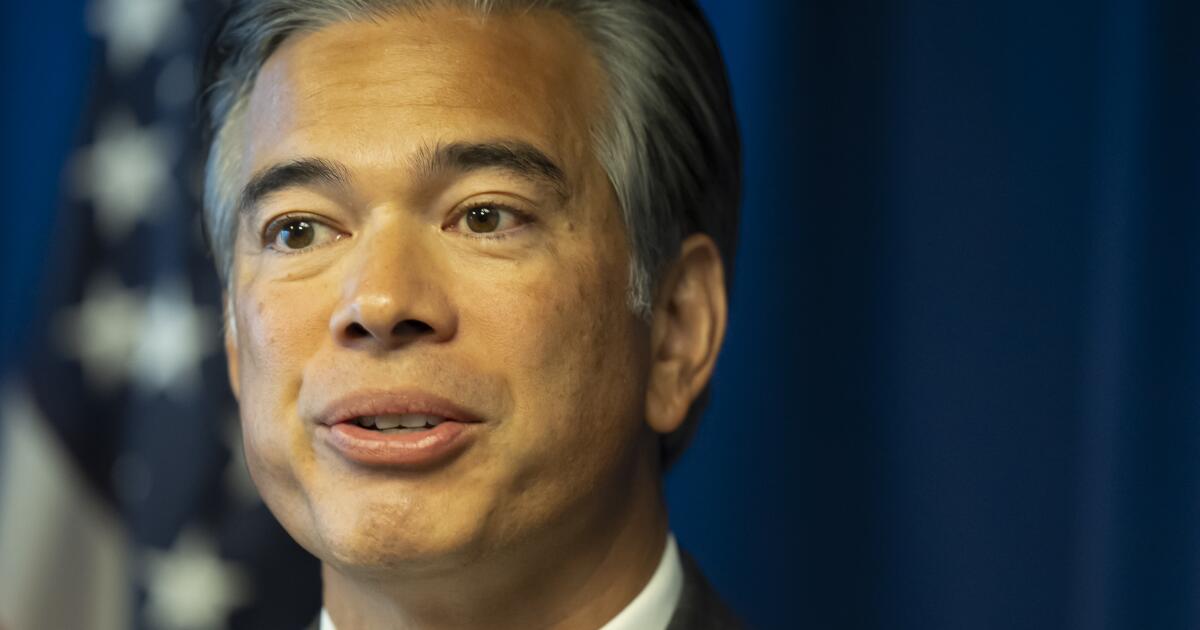
california attorney general

Judge rejects challenge to California attorney general’s description of voter ID measure

A state judge Thursday rejected a challenge to how California Atty. Gen. Rob Bonta’s office summarized a strict new voter ID measure on November ballots — ruling that the summary language accurately describes the measure’s effects were it to pass.

Another judge dealt the backers of the measure a second loss by tentatively finding that their description of the measure, submitted for the official state voter’s guide, was misleading. They had claimed that Proposition 39 would make voting easier.

In the first case, Sacramento Superior Court Judge Jennifer K. Rockwell ruled that the label, title and summary of the certified ballot measure accurately describe Proposition 39 as a measure that “prohibits citizens from voting” — language the measure’s backers specifically objected to — unless they provide a government-issued ID.

According to minutes from a Thursday hearing on the matter, Rockwell concluded that, to the extent the measure’s backers object to that language, they are objecting to “the provisions of the measure itself.”

Rockwell rejected the argument put forth by the measure’s backers that it would not prevent people without ID from voting, only their votes from being counted — a distinction the judge found lacking.

Both parties had asked the court to move quickly ahead of printing deadlines for November ballots.

The attorney general’s office is responsible for preparing titles and summaries for ballot measures, and is not required by law to use the same language as a measure’s proponents when gathering the necessary voter signatures to place the measure on the ballot.

Bonta’s office had argued in court that his office applied the same standard of review to the voter ID measure as every other ballot measure that has come before his office.

Bonta praised Rockwell’s decision on social media Thursday, writing that it “confirms what we have said from the start: the ballot materials at issue — the ballot title and summary and ballot label — give a true and impartial statement of Proposition 39’s chief purpose and points.”

“My office followed the law and fulfilled its duty to provide California voters with clear, accessible, and accurate information,” he wrote. “We’re pleased that the court agreed with us.”

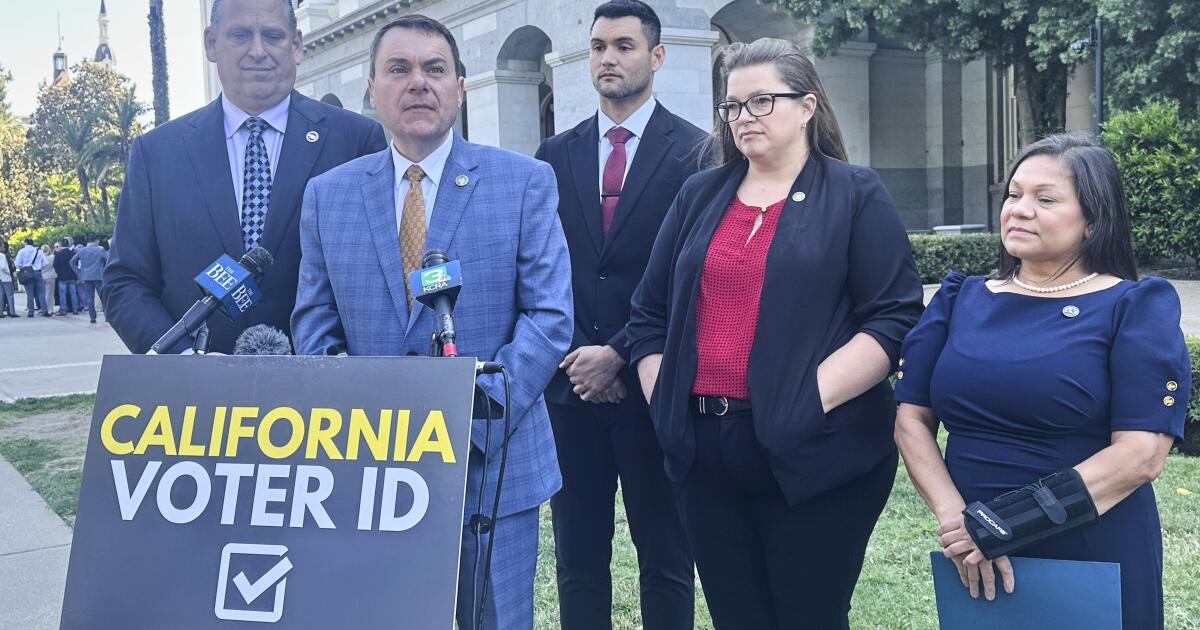
California Assemblymember Carl DeMaio (R-San Diego), the chief backer of the court challenge and chairman of the group Reform California, responded to the ruling with a video post to social media, writing that it was “expected” but nonetheless “disappointing.”

DeMaio accused Bonta of trying to “manipulate the vote” with “rigged” language, and Rockwell of being a “liberal judge” who had unsurprisingly decided that Bonta “gets to do corruptly what he wants to do.”

“It’s pissing me off,” DeMaio said in his video post.

DeMaio predicted that Proposition 39 will still pass, but that it will take “all of us spreading the word that the attorney general has tried to manipulate the title on the ballot measure.”

Voter ID requirements are being pushed by Republicans across the country — from President Trump down — as necessary to prevent voter fraud, including by noncitizens, despite elections experts saying that such fraud is exceedingly rare and that there is no evidence that it exists in volumes large enough to swing elections.

Democrats, including in California, have argued that states already have robust measures to ensure that only eligible voters cast ballots, including through existing security measures such as signature verification. They said stricter voter ID requirements would lead to eligible voters without ready access to documents being denied access to voting — including poorer, elderly and rural voters and married women who have changed their names.

A majority of California voters back stricter voter ID requirements, according to recent polls.

The Trump administration has been pressing for new voter ID requirements nationwide, including in Congress, without success.

Passage of Proposition 39 in liberal California would represent a massive win for the administration and a setback for California’s Democratic leaders. It would require substantial reforms to how the state accepts ballots both in person and through the mail — the latter being the preferred option for the vast majority of voters in recent California elections.

Backers of Proposition 39 also took a hit in a separate court proceeding Thursday, where another judge — siding with top Democratic lawmakers — issued a tentative finding that the measure’s backers were misleading voters by claiming in voter guide language that the measure would make voting easier in the state were it to pass.

“It is hard to conceive how it would be ‘easy’ or ‘easier’ to vote if a voter has to take the extra step of either bringing government-issued identification when voting in person or search for their government-issued identification and supply the last four digits if they vote by mail,” wrote Sacramento Superior Court Judge Shelleyanne Chang.

The voter guide language will need to change as a result.

California leaders who brought the challenge — including State Senate President Pro Tempore Monique Limón (D-Goleta) and Assembly Speaker Robert Rivas (D-Hollister) — praised the decision.

“Prop 39 is a MAGA-backed power grab by Donald Trump’s closest allies,” Rivas said in a statement. “As today’s ruling underscores, Prop 39 isn’t about election security or fair elections — the real goal of the MAGA activists who wrote Prop 39 is to make it harder for Californians to vote.”

DeMaio denounced the decision, accusing Chang of having “sided with the politicians” in California to “strike legitimate arguments on why Voter ID is needed to improve election integrity.”
Source link

Voter ID backers sue California attorney general over ballot description

Backers of a November ballot measure that would require Californians to verify their identity when voting sued state officials on Monday, alleging bias in how the ballot’s summary is written.

A group led by California State Assemblymember Carl DeMaio (R-San Diego) allege in a 10-page lawsuit filed in Sacramento Superior Court that Atty. Gen. Rob Bonta violated election laws that require the “impartial” labeling of a measure’s purpose.

DeMaio accused Bonta of trying “to rig the vote” against the measure with “a false title claiming it prohibits citizens from voting” in California elections.

He also said the measure, which will appear as Proposition 39 on the November ballot, is “a bipartisan solution to Voter ID and is supported by a supermajority of Democratic, independent, and Republican voters.”

“We take our duty to prepare a title and summary and ballot label seriously, and we are confident the court will agree we have faithfully executed that duty here,” said a spokesperson for Bonta.

Proposition 39 would require voters to present government-issued identification, such as a state driver’s license, every time they vote in person.

Voters who use mail-in ballots — by far the most popular method of voting in California — would be required to write a four-digit number, essentially a PIN, on their ballot envelopes. The PIN would come from ID such as a driver’s license or could be generated from the county.

The measure also requires that the secretary of state and county elections officials to maintain accurate voter registration lists, verify citizenship, and report annually the percentage of each county’s voter roll that have been citizenship-verified.

Under current law, Californians are required to provide identification when registering to vote and must swear under penalty of perjury, a felony, that they are eligible to vote and are U.S. citizens.

They are not required to show or provide identification when casting a ballot in person or by mail.

The lawsuit, filed by Californians for Voter ID, Yes on 39 and Donald DiCostanzo, a registered voter who lives Orange County, argues that the attorney general office’s summary “is not a true and impartial statement of the measure’s purpose” and violates California Elections Code 9051, which requires neutrality.

The suit claims the language used for the summary during the signature-gathering process — a required step to get the measure on the ballot — was “neutral” and named both of the measure’s chief purposes.

The final language omits the measure’s mandate to maintain accurate voter rolls and and verify citizenship, and describes the measure in “prohibitive terms,” according to the suit.

The original language said the measure “establishes additional voters identification and citizenship verification requirements.”

“This measure would amend the California Constitution to further require that voters present government-issued identification at the polls or the last four digits of a government-issued identification number when voting by mail; the State provide voter identification cards on request; and elections officials annually report percentage of each county’s voters whose citizenship they have verified.”

The summary language now states that the measure: “Prohibits citizens from voting unless they present government-issued identification.”

“Invalidates mail ballots that do not have last four digits of designated government-issued identification number written on envelope. Prohibits in-person voting without presenting government-issued identification.”

Election law expert Fred Woocher said that the law allows the ballot measure summary to be different than the description of the measure in circulation.

UCLA law professor Rick Hasen declined to weigh in on the arguments in the lawsuit, but said that “it’s common practice for the AG to write things in ways that that align with the political interests of the Attorney General.”

Hasen previously called the ballot measure a “disaster,” writing in a blog post that its requirements are vague and it would be costly and difficult for agencies to verify citizenship.

Proponents of an initiative to repeal gas tax increases in California sued then-Atty. Gen. Xavier Becerra, now a candidate for governor, in 2017 over a state-drafted title and summary which they argued was misleading and negative.

A judge sided with proponents, but an appellate court later rule in Becerra’s favor.

Source link

Los Angeles Rep. Xavier Becerra poised to become California’s first Latino attorney general

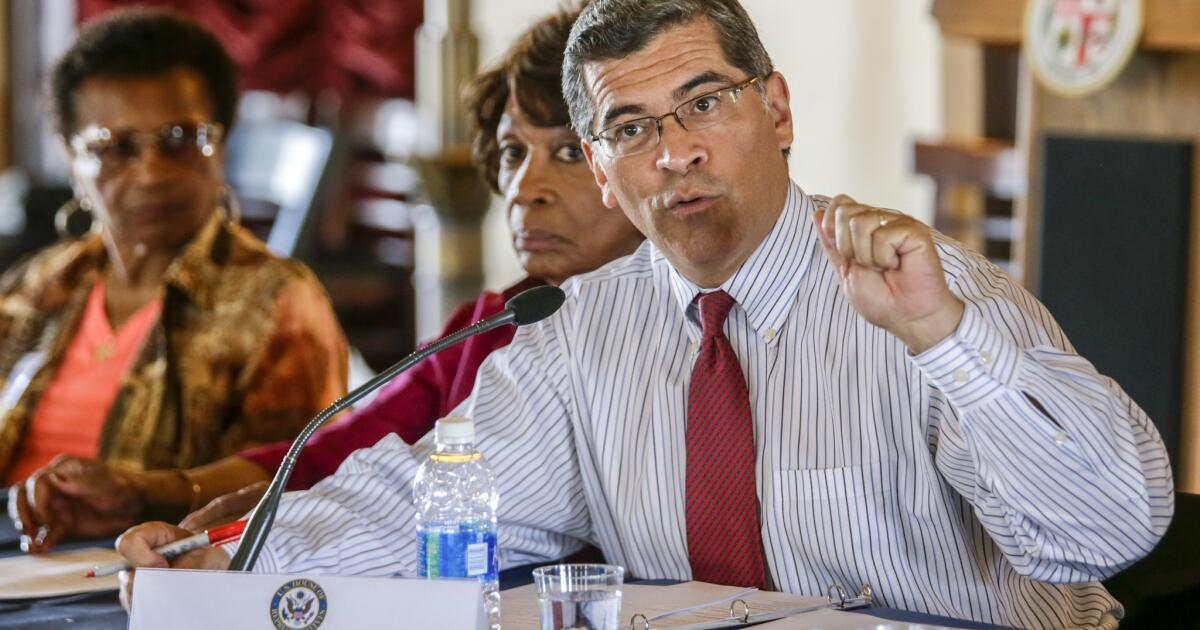
In a move that suggests a sharp battle to come with the administration of President-elect Donald Trump and upends conventional wisdom about who will emerge as the next generation of statewide elected officials, Gov. Jerry Brown picked House Democratic Caucus Chairman Xavier Becerra (D-Los Angeles) on Thursday to be California’s next attorney general.

If confirmed by both houses of the Legislature, he will succeed Kamala Harris, who was elected to the U.S. Senate in November.

Becerra, 58, has served 12 terms in Congress. Just days before the appointment, he had announced a bid to become the ranking Democrat on the powerful House Ways and Means Committee.

“It’s a phenomenal opportunity,” Becerra said. “It means I get to be home a lot more.”

Few statewide offices are as powerful, or prominent, as that of attorney general. The role has often been referred to as the state’s top lawyer and its top law enforcement officer, a nod to the breadth of responsibilities vested in the office and its leadership of the California Department of Justice.

Attorneys general not only must pursue cases of criminal and civil wrongdoing, they oversee criminal forensic work for most counties and make the final choice about defending state laws — even crafting the language that summarizes ballot measures for voters.

Becerra was beaming during an interview in his House office Thursday morning shortly after Brown offered him the job.

“I’m still processing,” Becerra said with a laugh. “I didn’t expect it.”

Becerra would be the state’s first Latino attorney general. The son of Mexican immigrants, he was the first member of his family to attend college, earning a law degree from Stanford Law School and a bachelor’s degree in economics from Stanford University. Elected to a two-year term in the state Assembly and then to the House in 1992, he rose through the ranks to become the highest-ranking Latino in Congress.

Becerra worked in the civil division of the state attorney general’s office, writing advisory opinions for former Gov. George Deukmejian, a Republican, and defending the state’s constitutional officers from 1987 to 1990 before entering the Assembly. He said he had always wanted to return to the office.

“It was a great place to be,” he said.

Brown’s pick was so sudden that Becerra has not yet had time to reactivate his state law license, though he would not be the first attorney general to have to do so. Inactive status allows attorneys to hold on to their licenses when they are not actively practicing law.

Becerra would also be the first attorney general appointed by a governor since Thomas Lynch, who was chosen by former Gov. Pat Brown in 1964. Few political appointments are likely to be as personal to the current governor as this one, given his own four-year stint as attorney general starting in 2006 and the fact that his father used the office as a steppingstone to governor more than five decades ago.

“Xavier has been an outstanding public servant — in the state Legislature, the U.S. Congress and as a deputy attorney general,” Brown said in a statement. “I’m confident he will be a champion for all Californians and help our state aggressively combat climate change.”

The choice sent political shock waves through California, in large part because Becerra was not on any of the widely circulated lists of potential picks. Brown had offered no details on whom he would pick or when.

Many suspected that he might choose a caretaker, perhaps even a career staffer who would simply carry out the office’s functions through the 2018 election. Virtually no Democrats who heard the news on Thursday believed that Becerra would be that kind of officeholder.

“He has the smarts, political experience and ambitions to run and win reelection,” said state Sen. Steve Glazer (D-Orinda), a former top political adviser to Brown.

If Becerra serves less than two years of Harris’ existing term, he could be eligible to run for up to two additional terms — eight years — as attorney general. Harris has said she plans to hold the position until she is sworn in to the Senate on Jan. 3, and at that point Brown could officially nominate Becerra.

Becerra said Thursday he’s thinking about the confirmation process at this point and not whether he’ll run for a full term as attorney general or another office in 2018. He must be confirmed by the state Senate and Assembly, both controlled by Democrats. Becerra said he hasn’t been told when a confirmation vote might happen.

Earlier, Becerra had flirted with a bid for U.S. Senate when Sen. Barbara Boxer (D-Calif.) announced plans to retire, but Harris’ quick entry into the race kept him and other California Democrats from running.

Holding such a prominent statewide post would raise Becerra’s profile as the Golden State’s foil to Trump, potentially setting him up to run for governor or U.S. Senate in the future. The attorney general, by virtue of the office’s broad power, will likely be a key player alongside Brown in pushing back against Trump’s proposed efforts on issues important to California, including immigration and climate change. In Texas, a state that has its own experience fighting the federal government, attorneys general have been a major force in the battle over states’ rights.

“He has great tenacity and he respects the rights of all Californians — much-needed qualities for an attorney general given the troubling times ahead,” Assembly Speaker Anthony Rendon (D-Paramount) said Thursday.

Several congressional colleagues echoed that sentiment.

“Many of the values that we stand by in California will be under attack in the next few years, and Chairman Becerra is the fighter I want in our corner,” Rep. Tony Cardenas (D-Los Angeles) said in a statement.

Becerra said that with Trump headed to the White House, he’s prepared to protect California’s progressive policies on immigration, the Affordable Care Act, energy and criminal justice. As California politicians embrace their roles in guarding the state against Trump’s policies, Becerra threw down his own gauntlet Thursday.

“If you want to take on a forward-leaning state that is prepared to defend its rights and interests, then come at us,” Becerra said.

A vocal advocate for Hillary Clinton’s presidential bid, Becerra was briefly floated as a potential pick for vice president or a Cabinet position. With Clinton’s loss Nov. 8 and no upward mobility available in House leadership, Becerra’s future political career was unclear.

He’d reached the time limit on serving as caucus chairman, the fourth highest-ranking House Democratic leadership position, and with House Minority Leader Nancy Pelosi (D-San Francisco) and the other two Democrats above him in leadership staying put, there was no path up the ladder headed into the next Congress.

Becerra serves on the powerful House Ways and Means Committee, and made a play as recently as Tuesday to be the committee’s ranking Democrat. He was quickly endorsed by the current ranking member, Rep. Sandy Levin (D-Mich.), who said in a statement Thursday that he respects that Becerra “feels a special responsibility during these difficult times to look after vital legal interests in his home state.”

Democrats across California reacted Thursday with effusive praise for Becerra. Lt. Gov. Gavin Newsom called him “a thoughtful and effective leader, with a keen legal mind and a passion for giving a voice to the voiceless.”

In particular, some pointed out the importance of elevating a Latino politician to statewide office, alongside both Latino leaders of the Legislature and Secretary of State Alex Padilla.

“It’s good for the state’s future,” said Bill Lockyer, who served as attorney general from 1999 to 2007.

The announcement also meant early guessing as to who would replace Becerra in representing downtown Los Angeles and communities to the west and north in Congress. Becerra won reelection in November in the solidly Democratic district. A special election to fill the seat would probably take place in late spring of 2017, though the law gives Brown wide discretion on the precise schedule.

John A. Pérez, the former Assembly speaker and current University of California regent, announced his bid less than an hour after Brown’s announcement, and more contenders may follow.

sarah.wire@latimes.com; john.myers@latimes.com

Follow @sarahdwire and @johnmyers on Twitter

Read more about the 55 members of California’s delegation at latimes.com/politics

ALSO

After beating back rival for House leadership post, Nancy Pelosi says Democrats are ready for Trump

Trump seems ready to fight the world on climate change. But he’s likely to meet resistance

Updates on California politics


Source link