Calder

Iran war – Simon Calder explains rules to Brits with holidays booked to Turkey or Cyprus

Simon Calder gave his thoughts on when travel disruption will start to ease following the strikes on Iran

A travel expert has shared his views on when ‘people will be able to travel again’ as the Middle East conflict continues to escalate. Journalist Simon Calder, who specialises in travel, discussed the crisis and its impact on worldwide travel.

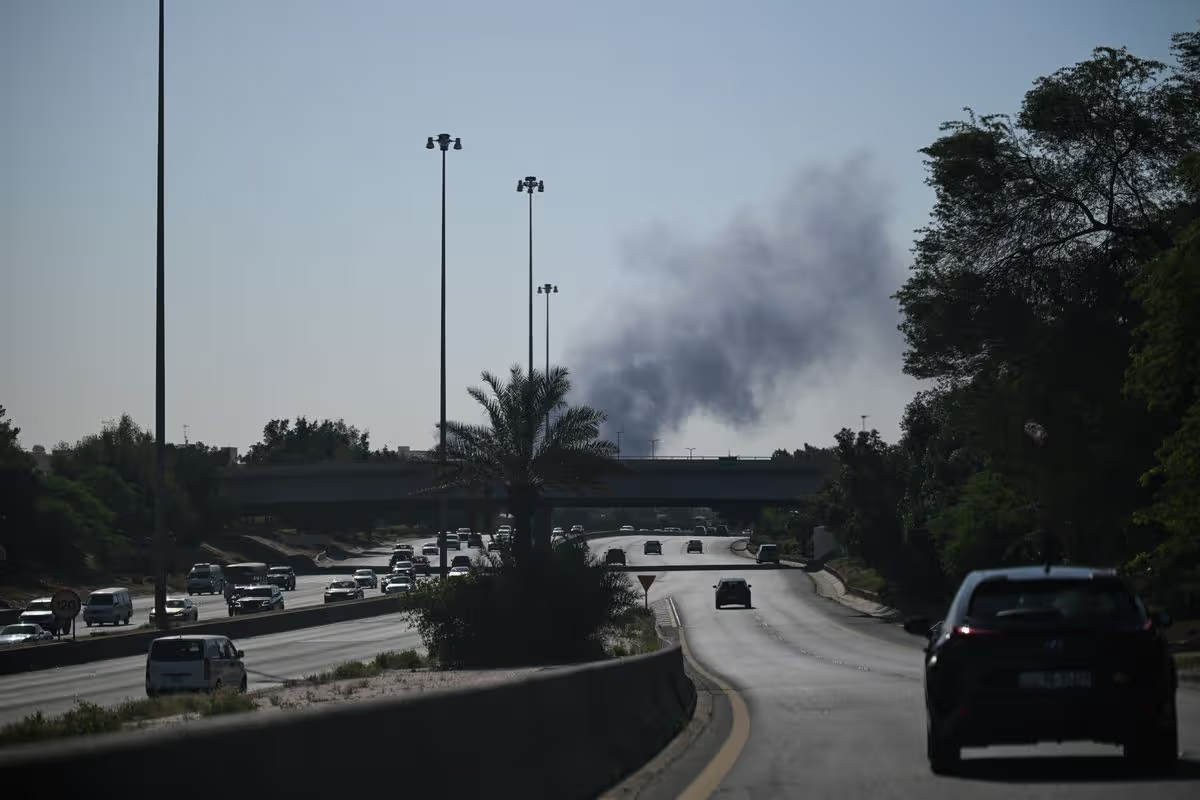
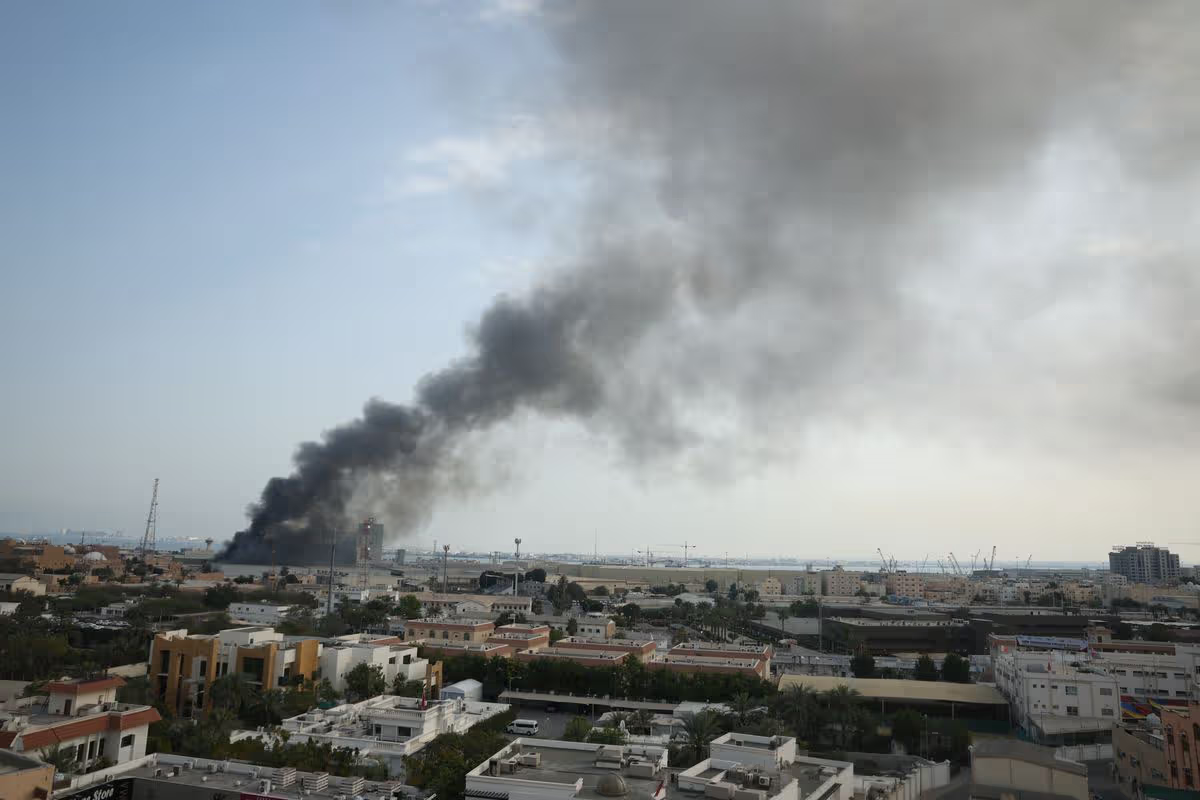
American and Israeli strikes on Iran are approaching the end of their second week, with no resolution in sight. Travel to the Middle East remains limited, with airlines cutting back on the number of flights to and from the area.

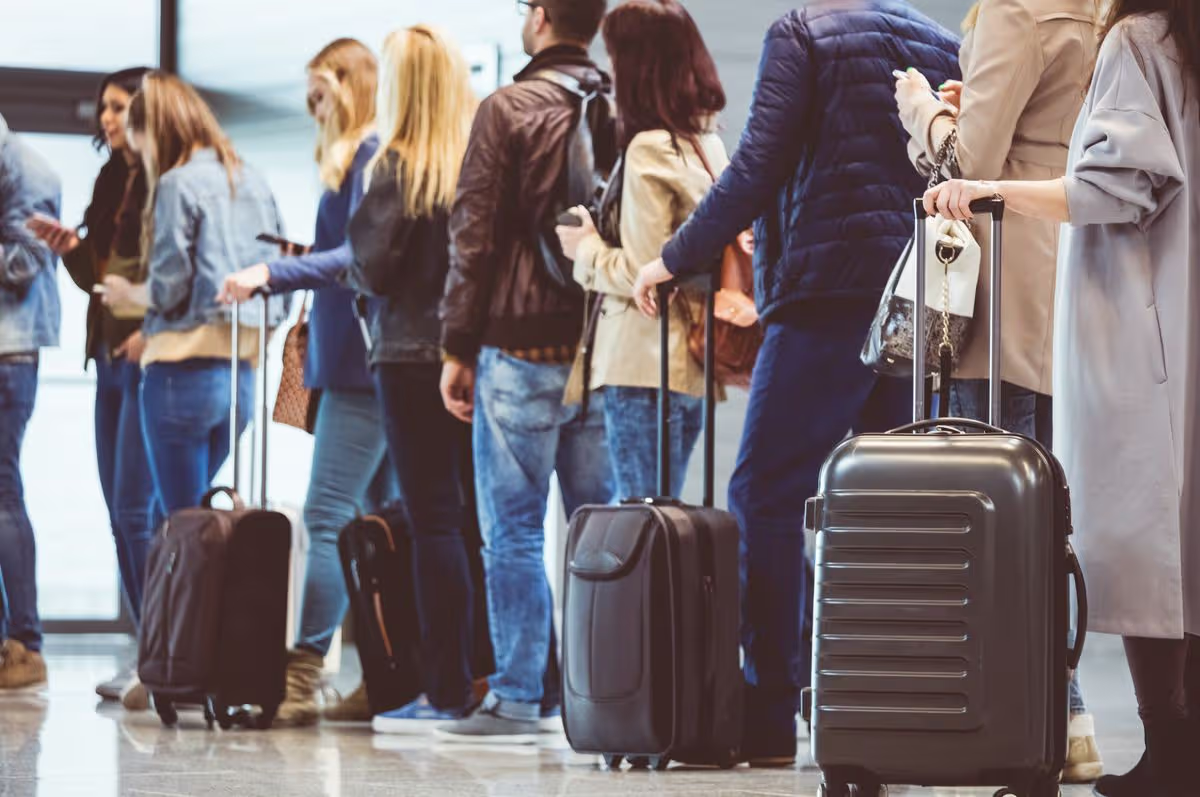
Countries such as Oman, Qatar, and the United Arab Emirates serve as vital transport hubs for destinations including Asia and Australasia. The outbreak of hostilities has left hundreds of thousands of travellers stuck.

Speaking to Sky News, Mr Calder offered his perspective on when travel might become more straightforward. He said: “We’ve already seen missiles sent to Turkey and attacks on Cyprus. Now, personally, I think the chances of anything happening to a tourist in Turkey or Cyprus are microscopically low, but I also know that people are rebooking away. They’re going to the western Mediterranean – typically Spain and Portugal – because they believe they will be safer there.

Content cannot be displayed without consent

“If you’re flying from the UK to a holiday spot such as Turkey or Cyprus and that flight is cancelled, then, fortunately, air passenger rights rules are squarely on your side. The airline that cancels the flight has to get you to your destination as soon as possible, regardless of the cost. And if you can’t get there immediately, the airline has to provide meals and accommodation, if necessary, before you are able to get to your destination.

“The Foreign Office warns against travel to Kuwait, to Bahrain, to Qatar and, crucially, to the UAE, home to the busiest hub in the world: Dubai International Airport. But I’m also predicting that, actually, that ruling is going to lift fairly quickly, and people will be able to travel again.”

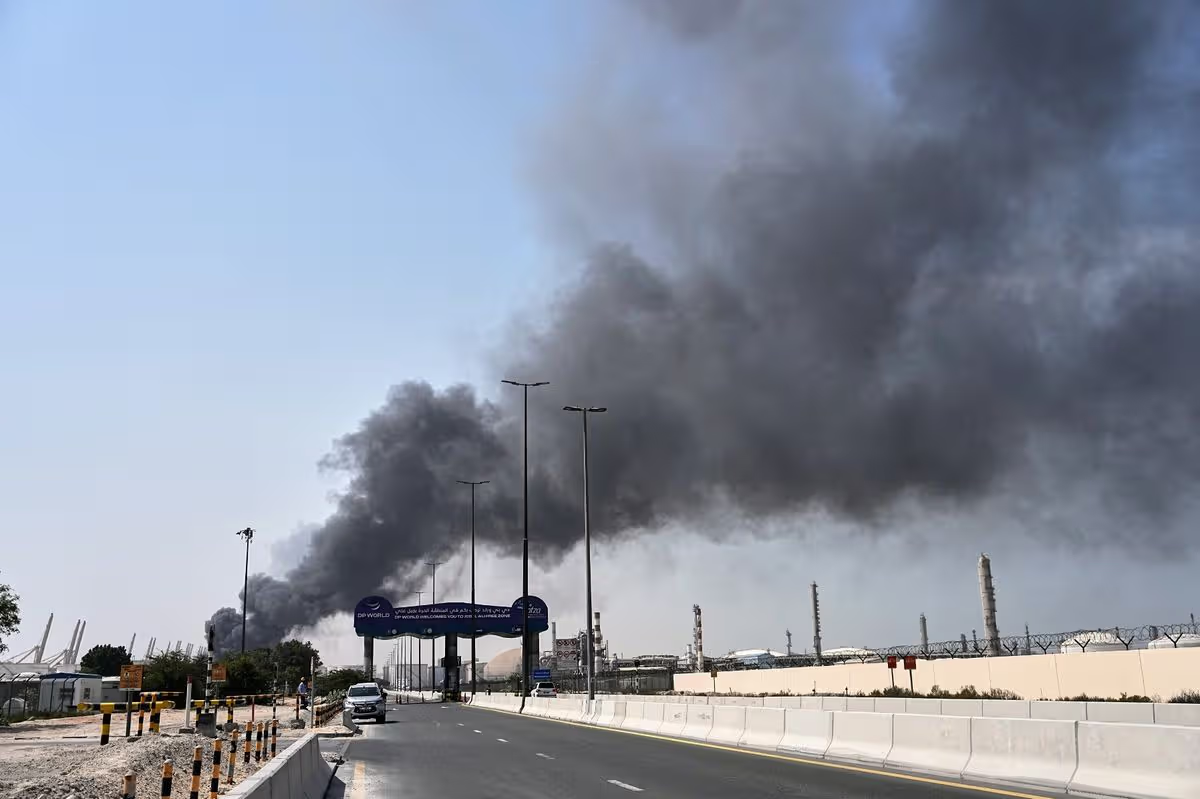
Flights are still operating through Dubai International Airport, despite two Iranian drones injuring four people after exploding at the facility. The Dubai Media Office, which releases statements on behalf of the city-state’s government, confirmed flights are continuing, and that the attack caused ‘minor injuries to two Ghanaian nationals and one Bangladeshi national, and moderate injuries to one Indian national’.

Officials have been attempting to restore its flight schedule, though the airport has been targeted amid the conflict. The war has created uncertainty for travellers with flights booked in the coming weeks, prompting Mr Calder to offer his guidance on what passengers should do.

READ MORE: Iran war travel expert Simon Calder issues Emirates ‘flights will be resuming’ updateREAD MORE: Martin Lewis explains ‘safe thing to do’ ahead of April 1 price change

“If your flight is due to go, I’d say, a week or more from now, well, all you can do is just hope that it goes ahead,” he stated. “If you’re going imminently and you do not know if your trip is running, well, the basic news is that if you go to Abu Dhabi, to Dubai, to Doha, you will be going against Foreign Office advice. So, be aware of that; your travel insurance will be invalidated.

“I’ve got some skin in the game. I am booked to fly out on Saturday night from Jakarta, the Indonesian capital, through to Abu Dhabi and connect onwards to London. Now, at the moment, along with many, many other travellers, I’m absolutely promised the flight will go ahead as normal, and I trust that it will. But I simply do not know.

“At the moment, I’m definitely not cancelling my flight because, well, bluntly, if you cancel the flight – which is what the airlines would really like you to do – you will simply be removing yourself from the problem. If, like me, you’re booked in a few days’ time and you do have a bit of flexibility, then absolutely keep your booking open.

“If you go for a refund, first of all, the airline will be delighted because you’ll be a problem that’s removed from their cares and, secondly, you could find yourself paying three times, five times, 10 times as much to get back. Much better to remain a problem for the airline; they’ve got to get you where you need to be.”
Source link

Iran war – travel expert Simon Calder issues Dubai, Qatar and Abu Dhabi flights update

Travel in the region continues to be severely disrupted

Travel expert Simon Calder has shared his thoughts on the prospect of ‘normality’ returning to airports in the Middle East. Flights to and from the region continue to be severely disrupted in the wake of the US-Israeli attacks on Iran.

A multitude of flights to and from Dubai, Qatar, and Abu Dhabi – all three being vital transport hubs for individuals travelling to and from the Gulf and Asia – have been cancelled. Approximately half a million passengers typically utilise these airports daily.

More than 37,000 Brits have made their way back to the UK from the Middle East since the crisis response commenced, with it believed that tens of thousands more remain stranded.

Mr Calder has been regularly updating on the crisis, which began on February 28. He stated that whilst he anticipates an increase in the number of flights departing from the region, there’s no definitive end to the disruption in sight.

Content cannot be displayed without consent

“There are tickets now being sold by Etihad out of Abu Dhabi,” he revealed. “Which is an interesting development. On top of that, I expect there to be a ramp-up in flights out of Doha and out of Dubai, but at the moment we are still a long way away from anything that could be described as normality, whatever that looks like.

“You know, the idea that you have half a million people flying to, through, and from the three big hubs of Dubai, Doha, and Abu Dhabi every day. And it’s an interesting question as to what on earth happens when, of course, the war is finally over, which cannot come soon enough. But anyway, so I hope that people will be able to get out.”

READ MORE: ‘Iran war means we’re stuck in the Maldives – it’s costing us thousands’READ MORE: Dr Amir Khan message for people on lansoprazole, omeprazole, or pantoprazole

On Monday, 16 out of the 18 scheduled flights from the UK to Qatar were cancelled due to ongoing airspace closures, according to aviation analytics firm Cirium.

Eleven out of 33 flights from the UK to the United Arab Emirates – encompassing Dubai and Abu Dhabi – were also scrapped. It’s anticipated that clearing the backlog of stranded passengers caused by the conflict will take weeks.

“British Airways has taken the view that we’re not going into Dubai or Abu Dhabi or Doha,” Mr Calder explained. “If you want to fly out, we’re happy to do that, but we’re going to be arranging flights from Muscat and looking at Friday night’s Virgin Atlantic flight to Dubai, that was arguably a good call because the effect was that the flight got to within maybe a couple of hundred miles of Dubai over Saudi Arabia and then turned around because of the attack on Dubai airport.

“It flew back, couldn’t get all the way back, went to Budapest to refuel and then continued to Heathrow. So it was roughly, I think, something like an 18-hour flight to nowhere.”

Source link

Simon Calder shares ‘absolutely magical’ seaside town perfect for pensioners

Travel expert Simon Calder has shared one of his favourite destinations for an autumn escape and it’s perfect for pensioners

Travel expert Simon Calder revealed one of his top picks for an autumn getaway: the picturesque seaside town of Cassis, located in the south of France. Simon highlighted that there are numerous budget-friendly flights from UK airports and mild temperatures in spring and autumn.

Cassis is also an extremely walkable town, making it ideal for pensioners seeking an inexpensive destination that’s also straightforward to explore.

The travel expert stated: “I just came back from Côte d’Azur on Friday, and it was absolutely magical, particularly the lovely town of Cassis. Beautiful port, very close to St Tropez. It’s just a gorgeous place, the food is great!”

“You can even take a bus from Marseille that costs £3 and takes you around one of the greatest drives in the world.”

Travel expert Sam wrote on her blog theblondescout that Cassis was “one of the nicest surprises” during her time living in France.

“This small fishing town is colourful, quaint and next to one of the most extraordinary landscapes I have ever witnessed: the dramatic limestone inlets that make up the Calanques between Cassis and Marseille.”

She noted that Cassis is a compact town, so it is “very walkable and easy to get around”.

“All of the streets are picture-perfect and have that colourful French Riviera vibe! Our favourite little square was at the bougainvillaea-filled Place Baragnon.”

Other locations suggested by travel expert Simon Calder include the Algarve, in southern Portugal, a stunning and “very affordable” coastal destination that’s not overly busy at this time of year.

Source link

Travel expert Simon Calder issues Emirates, Etihad and Qatar Airways latest ‘development’ update

Simon Calder said it ‘possibly points the way forward’ but there was still a long way to go

A travel expert has provided an update on when flights to and from the Middle East might resume normal service. Flights continue to be severely disrupted due to the US-Israeli strikes on Iran, which started over the weekend.

It is estimated that around 300,000 Brits are currently in the Gulf region. Airspace closures in the Middle East have led to numerous commercial flights being grounded, with over a third of today’s (Monday, March 2) scheduled flights to the area cancelled.

Major airlines such as British Airways, Virgin Atlantic, Qatar Airways, Etihad, and Emirates are among those to have cancelled flights. The Foreign, Commonwealth and Development Office is presently advising against all but essential travel to the United Arab Emirates.

Travel journalist Simon Calder gave an update on the Independent’s Instagram page about how the situation might unfold. He stated: “Day three of the crisis in the Gulf, which has seen all air operations cease at the key hubs of Dubai, Doha, and Abu Dhabi, and tens of thousands of passengers stranded as a result trying to head back to the UK.

Content cannot be displayed without consent

“The latest news is not encouraging from the airlines; Qatar Airways has just said we’re not going to tell you any more updates until Tuesday morning. Emirates says we will not be flying anything before 3:00 on Monday-I think it’s extremely unlikely that that will happen; similar story from Etihad, who are based in Abu Dhabi.

“At the moment, though, obey the Foreign Office advice, and if you are booked to travel on one of those airlines-Emirates, Etihad, or Qatar Airways-your flight will not be operating today, and I fear that it might be some time before we see those planes back in the sky.”

READ MORE: Aviation expert Alex Macheras predicts when Emirates, BA, and Qatar Airways flights might resumeREAD MORE: Travel expert Simon Calder explains when Dubai, Emirates and Qatar flights could resume

It is believed that out of the 300,000 Brits in the region, approximately 100,000 may require evacuation back to the UK. British citizens are being advised to heed the instructions of local authorities and keep a close eye on the Foreign Office’s travel advice, which officials anticipate will change rapidly.

One current proposal is that individuals may be transported overland to countries such as Oman and Saudi Arabia, before catching flights back from there. At present, these countries do not have any travel warnings against them.

Mr Calder added: “One development overnight, though, I think possibly points the way forward. A British Airways Boeing 787 flew out overnight from London Heathrow to Oman and landed at Muscat-that is the airport where there is no Foreign Office warning at the moment.

“It took on board pilots and cabin crew from British Airways who were stranded in the UAE when airspace was closed. Now, you might be thinking, ‘well, why didn’t they bring back any passengers?’ but there’s a good reason for that..

“The Foreign Office says, ‘no, you should not travel anywhere if you are in the UAE”. However, if the crisis drags on-and unfortunately, it shows every sign of doing that-then I fear we are going to be in a situation where the best option is to organise an airlift from Muscat, possibly another one also from Saudi Arabia for people travelling overland from Qatar.”

Source link

Travel expert Simon Calder explains when Dubai, Emirates and Qatar flights could resume

Simon Calder warned that, even if the major airports reopen, it will take some time for normal service to resume

A travel expert claims international airports currently shut due to military action in Iran could reopen earlier than many anticipate. Journalist Simon Calder shared his forecast whilst boarding a flight from Istanbul, Turkey.

One individual has died and 11 others have been wounded at airports in Dubai and Abu Dhabi. Over 3,400 flights have been scrapped and airports in Dubai and Abu Dhabi in the United Arab Emirates (UAE), along with Qatar’s capital, Doha, and Manama in Bahrain were among those shuttered.

The Foreign Office is advising British nationals against all but essential travel to Bahrain, Kuwait, Qatar and the UAE. This means hundreds of thousands of travellers are stranded in the region, many of whom are believed to be either British or those attempting to fly to the UK.

In an Instagram video, Mr Calder stated: “The main question is when is the disruption going to stop?”.

“Dubai indefinitely closed; Emirates is kind of saying that sometime on Monday it might start up again. Doha, they’re going to give an update at 6 o’clock British time tomorrow. And Etihad and Abu Dhabi airport, they’re saying, well actually, yeah, we might be opening before that.

Content cannot be displayed without consent

“And I hope that the flight ban and also the travel advice from the Foreign Office saying do not go to these places will be lifted as soon as possible so that people can come back.

“I’m going to say, if you twisted my arm, we will probably see flights start up in the next couple of days but in a small way because, of course, planes and pilots and cabin crew and passengers are all out of position. So it’s going to take some time to get this back to normal and I simply hope that it is done with the maximum energy and indeed money just to try to make sure that people are back when they need to be as soon as possible.”

Mr Calder explained that – aside from the Covid-19 pandemic – disruption on the scale witnessed over the weekend hadn’t been seen since the 2010 Eyjafjallajökull volcano eruption and resulting ash cloud in Iceland.

READ MORE: Travel expert Simon Calder issues three-word advice for Brits caught up in Iran attacksREAD MORE: Travel expert Simon Calder predicts when BA, Etihad and Emirates flights will resume after Iran attack

During that week-long episode, approximately 20 countries shut their airspace to commercial aircraft, affecting roughly 10 million passengers. Mr Calder suggested things weren’t quite that severe ‘yet’ but described these as extraordinary circumstances and warned matters were ‘definitely heading in that direction’.

He also noted that, given the sheer scale of the airports affected and the extent of the chaos, it would require a substantial amount of time for the situation to resolve itself even once flights restarted.

He added: “Just bear in mind that every day that there are no flights going in and out of the world’s busiest international airport, Dubai, and Doha, and Abu Dhabi, that is two and a half thousand flights and about half a million people. The numbers are really staggering.

“Every hour generally, on average, 20,000 people land and depart from those airports, and so you have a massive problem building up. And certainly the numbers haven’t been added to because, of course, people are there, but what’s happening is that people’s holidays are ending and so they are being added to the back of the queue at the airport. It’s a desperate position for them to be in.

“It is going to be quite interesting to see how it is done, because you’ve got to remember that the numbers in Dubai rather exceed the current capacity of them.

“So let’s take a case of an expat who’s booked on the 5th of March, and let’s hope very much that flights are back on the 5th of March. That expat is expected to take her or his seat, and the fact that somebody’s been there for five days and really wants to get home isn’t relevant; it’s whoever’s got the booking in.

“And so I think there may well be shuttle services operated. They might even go to somewhere like Cyprus; they might just take people back and forth to a relatively short-haul destination from where people can board relatively short-haul flights. That would seem to cause the least amount of problem. I

” don’t know if this is going to happen, but I do know that there’s an awful lot of people out there who really want to be somewhere else and heavens, just imagine the stress and upset if you know that there’s somebody across the Gulf who is sending drones and missiles in your direction. A horrible situation for everybody.”

Source link

Travel expert Simon Calder issues three-word advice for Brits caught up in Iran attacks

Thousands of Brits are thought to be stranded in the Middle East after US and Israeli airstrikes on Iran

A travel expert has issued three words of crucial advice for people stranded in the Middle East following US and Israeli air strikes on Iran. Simon Calder made the remarks after hundreds of thousands of travellers found themselves stuck in destinations such as Qatar and Abu Dhabi in the wake of the attacks.

Numerous airlines, including British Airways, Emirates, and Qatar Airways, grounded flights following Iranian retaliatory strikes throughout the region. When flights will resume normal service remains unclear, with thousands of Britons believed to be stranded.

Speaking on Radio 5 Live, Mr Calder had three key words he urged travellers to follow: “At the moment, the best advice I have for anyone who is stuck in various parts of the world is: just be patient.”

The situation will be resolved – I hope, very much sooner rather than later,” he added. “What we have seen is the extraordinary sight of the big three of Middle Eastern hubs – Dubai International, Doha, and Abu Dhabi – all closing because of the retaliatory strikes from Iran. We have never seen that. The last thing of this scale we saw in this area like that here was the Covid pandemic.

READ MORE: Travel expert Simon Calder predicts when BA, Etihad and Emirates flights will resume after Iran attackREAD MORE: Nationwide customers’ three steps needed to qualify for free £100 payout

“Consider this. More than a quarter of a million passengers were due (on Saturday) to fly to and through Dubai International Airport alone. It is bigger than Heathrow Airport, handles more passengers, and everyone is desperate to get where they need to be.

“I have been speaking to people who were about to take off, they had the ‘boarding complete’ announcement, and suddenly the captain said, ‘Sorry, airspace closed, we are staying here’. It took them three hours to get off the aircraft because they all had to be processed through immigration, leaving them in a place where they really didn’t want to be. Many of them were just off a previous flight a few hours before and were waiting to travel on to their final destination of London Heathrow.”

It was subsequently confirmed that Iranian Supreme Leader Ayatollah Ali Khamenei was killed in the strikes, casting serious doubt over the future of the Islamic Republic. The death of Mr Khamenei, following decades in power, has triggered furious scenes across other parts of the Middle East and beyond, heightening the threat of potential regional instability.

Dubai International ranks as the world’s busiest airport, processing roughly 250,000 passengers daily. Doha Airport in Qatar handles approximately 150,000 travellers each day, meaning enormous travel chaos as both airports continue to be affected.

Doha holds particular significance for British passengers flying to and from the Middle East, Asia and the UK. Mr Calder went on to say: “Some people are in the difficult position of being stranded on the wrong side, and they are trying to get back to the UK but finding that air passenger rights rules – which are great when you are flying from Europe – don’t work the same way when you are flying to Europe on a non-UK or non-EU airline.

“They can basically just say, ‘well, good luck, we’ll try and get you there in a week or you can take a refund’. It’s really, really difficult Airlines like Emirates, Etihad, Qatar Airways, they are not legally obliged to find hotel accommodation for all these stranded passengers and get them back as soon as possible but hopefully they will do so.

“The other problem for people whose flights have been cancelled, when flights resume, they go to the back of the queue. If flights resume on Monday, anybody who has a flight booked on Monday will fly on Monday, and people whose flights were cancelled over the weekend – and we are talking hundreds of thousands now – they are going to be finding that they are at the back of the queue, scrabbling for whatever available seats there are.”

Source link

Travel expert Simon Calder predicts when BA, Etihad and Emirates flights will resume after Iran attack

Major airlines including British Airways, Emirates and Qatar Airways have cancelled flights following joint US-Israeli strikes on Iran

Travel expert Simon Calder has forecasted when flights between the UK and the Middle East might recommence. Several leading airlines, including British Airways, Emirates, and Qatar Airways, have suspended flights in the wake of joint US-Israeli attacks on Iran.

It is estimated that hundreds of thousands of travellers are stuck in the region, with no immediate hope of return flights due to the unstable situation. Airports in Dubai and Doha have halted all operations after US bases in Bahrain, Qatar, the UAE and Kuwait were hit by Iranian retaliatory strikes.

British Airways has called off all flights to Tel Aviv and Bahrain until 3 March. Speaking on Radio 5 Live, Mr Calder admitted it was difficult to predict when flights would start again.

He stated: “It’s possible that flights will resume tomorrow (Sunday). Looking at what Emirates are saying in Dubai, it is possible there will not be any more flights until 3pm on Sunday afternoon – that is 11am GMT – with the implication that flights may well resume again then.

READ MORE: Nationwide customers’ three steps needed to qualify for free £100 payoutREAD MORE: ‘I’m a doctor and there are three things I always do when flying’

“Etihad, just down the road in Abu Dhabi, are saying that flights will be resuming at 2pm local time, so 10am tomorrow morning GMT. We will see if that happens. Quite a lot would need to be said and done to make the airlines confident that the airspace was safe.

“At the moment though, if I had a flight booked back from Doha then, my goodness me, my absolute sympathy with anybody who is stuck in a war zone with missiles coming in, it is unbelievable and I am so, so sorry it is happening, but I would think March 5 is not a bad day to have planned your escape.”

Airports across London and Manchester have reported disruptions, with one British Airways flight from London to Doha forced to turn back to Heathrow after three hours in the air.

Leading global carriers including Delta, Lufthansa, Cathay Pacific and Turkish Airlines have suspended services to the Middle East, alongside certain routes traversing the region.

The UK Foreign Office (FCDO) urged British nationals in affected nations to “immediately shelter in place” and steer clear of travel to Israel and Palestine. “Remain indoors in a secure location, avoid all travel and follow instructions from the local authorities,” the FCDO stated.

The department confirmed it was working tirelessly to bring home thousands of stranded Britons following the attacks. UK citizens are being encouraged to register via Register Your Presence and sign up for travel advisory emails to receive the most current updates from the Foreign Office.

Source link

Expert Simon Calder issues airport advice ahead of massive travel rules change next week

Travel expert Simon Calder warns that dual British citizens with expired UK passports could face £589 certificate fees as new electronic travel authorisation rules come into force from February 25

Travel expert Simon Calder has issued advice to Brits travelling to and from Europe. The alert comes as a significant change affecting UK-bound travellers takes effect on February 25.

From that date, anyone wishing to visit the UK who isn’t British or Irish must register for an electronic travel authorisation (ETA). The Government describes it as delivering ‘a more streamlined, digital immigration system which will be quicker and more secure‘.

An ETA serves as digital travel permission – it’s neither a visa nor a tax and doesn’t guarantee UK entry – rather, it authorises someone to journey to Britain. However, Mr Calder highlighted another aspect that could trip people up.

Speaking to the Independent, he warned that British citizens holding out-of-date passports might encounter problems. He explained: “There’s growing confusion and concern about electronic borders. The first change that’s going to be happening is on the 25th of February.

Content cannot be displayed without consent

“It’s going to be mandatory for everyone who is not a British or Irish citizen and who wants to travel to the UK to register for the electronic travel authorisation. This is the online permit that increasingly many countries are demanding.

“That is clear, except that it also means that dual citizens who have the right to live in the UK have to enter on a British passport or have a certificate of entitlement to live in the UK. British passports cost £94.50. That certificate of entitlement is £589. And there is concern that a lot of people who are British citizens but don’t have a valid passport for all sorts of reasons-they’ve never needed one, they had one but it lapsed, they’ve got a perfectly good passport from somewhere else-they are going to have to have either that passport or the certificate of entitlement if they want to come to the UK.

“Again, this does not apply to anybody with the immense wisdom and good fortune to have an Irish passport, because that is the passport with superpowers that will get you in and out of the UK and indeed the European Union without any problems at all.”

READ MORE: Doctor explains ‘really apparent’ problem levothyroxine users need to ‘speak to medical professional’ aboutREAD MORE: AA says ‘more than 10,000’ drivers caught by high-tech AI cameras that spot offences a mile away

According to the 2021 Census, approximately 1.26 million usual residents across England and Wales held multiple passports. The Home Office has cautioned that airlines will be verifying passengers have the correct documentation.

The right of abode that Mr Calder references permits you to live or work in the UK without any immigration restrictions whatsoever. If you possess the right of abode, you do not require a visa or ETA to enter the UK.

There’s no cap on how long you can remain in the country. Concerns have also emerged regarding Europe’s new biometric border system currently being introduced.

Several airports have allegedly experienced delays stretching up to six hours, prompting warnings of potential travel ‘chaos’.

The European Commission indicated it might be feasible to suspend the new system during busy periods until September. Mr Calder explained: “The European Union’s entry-exit system started to be rolled out in October. By the 9th of April, it is supposed to be in a position where everybody is able to enter or exit through those Schengen area frontiers, just being fingerprinted on the first occasion and having a facial biometric taken. After that, it’s going to be the facial biometric all the way.

“Now, the airports and the airlines are saying it’s a terrible thing, it’s not working properly. We’ve already seen two-hour queues; they’re warning of four-hour queues in the summer. They want it to be suspended. No sense that it will be or not at the moment. Europe says it is going well, but don’t be surprised if it is.

“The only advice I can offer, because this is simply something that’s done to you-you don’t need to prepare for it-is when you’re coming back from the Schengen area, I would turn up at the airport really early just to make sure you make your plane, because it applies on the way out as well as on the way in to the Schengen area.”

Source link