A bloke moaned that his full English breakfast at a cafe in Benidorm, which was under five pounds, was too expensive, and it led to a brutal response from the owner
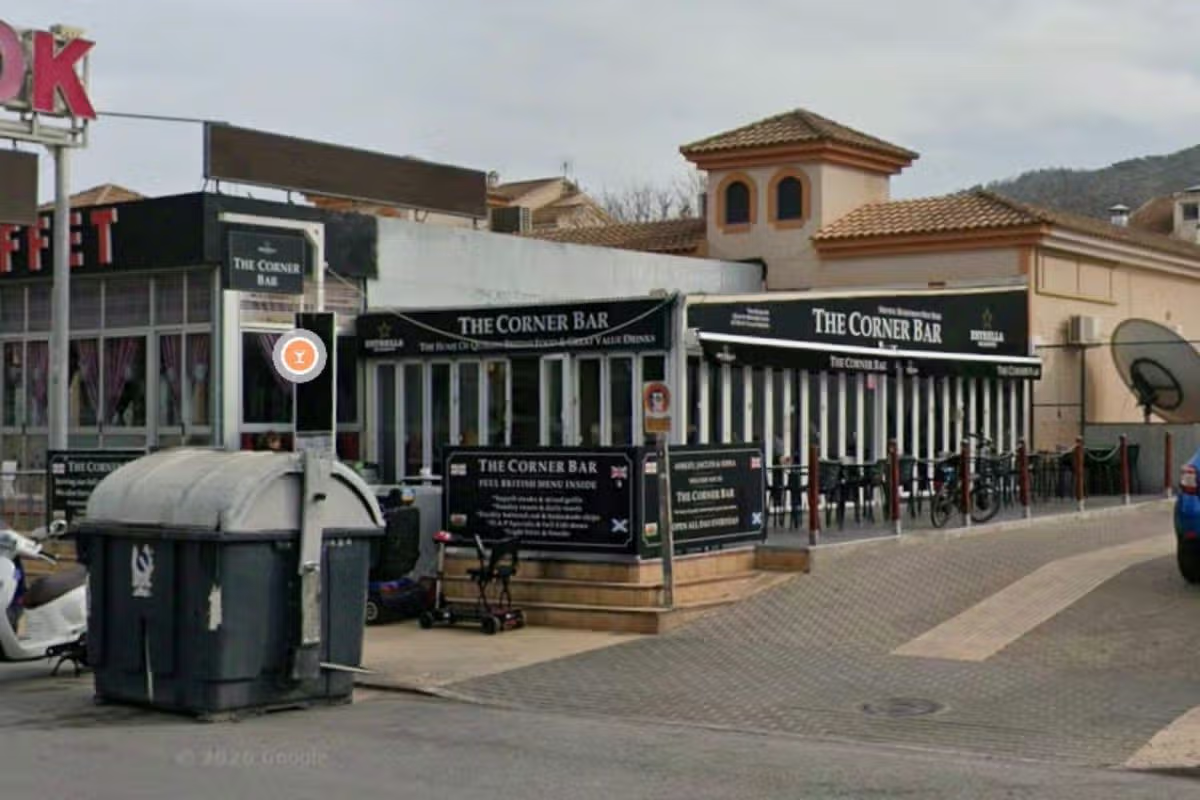
The Corner Bar Benidorm (Image: GoogleMaps)
The family behind a British-owned restaurant in Benidorm have hit back at a customer’s damning one-star review — after being floored by the price of his full English breakfast.
The Corner Bar is a favourite for both expats and holidaymakers looking for a taste of home but one customer, Peter Jones, recently shared his disapproval. He wrote: “Careful of the OAP discounts, especially at breakfast (€5.50). You can get a full English breakfast elsewhere for €4.50 (£3.86) or less.”
However, Ashley, who runs the cafe, shared the review online, before telling Peter to “have a day off” because she was “not having that” about the cost.
Defending her business in a Facebook post, she wrote: “I’m sure Peter is “fishing” here…surely he’s got to be…and I’m gonna be honest…he’s caught me. I mean. You can maybe not like our food. Not like our service. Not like us… maybe all 3, and honestly, I don’t mind, we try our best, every day, and that’s all you can do…
“But to give us a 1 Star Review on our prices…to suggest to the public you need to be careful of our prices. Nah, not having that. The breakfast in question…a No4 (pictured below).
“That’s 1 English Bacon, 1 Irish Sausage, 1 Black Pudding, 1 Fried Egg, 1 Roberts Bread Toast, Heinz Beans, Fresh Mushrooms & Tinned Tomatoes…and it’s €5.50.
“Cooked Fresh to Order by the Owner or the same 2 British Cooks who have been on The Corner for years…And apparently you need to be careful of our prices! Have a day off, Peter!”
The post soon took off and led to hundreds of comments from loyal customers who also defended the prices. One man, who has had the €5.50 (approx £4.70) full English before, wrote: “You cannot beat a No 4 at the Corner for value.”
Another person added: “Peter needs to give his head a shake! He wants €4.50 then bye bye mate! It will certainly not be as good.”
One person sarcastically said “wow a whole €1 less” before Ashley wrote another post in the comments thanking everyone for the support.
She said: “Cheers Everyone. Some lovely comments. We know we’re well supported and it’s massively appreciated. Just sometimes them review sites after a hard days work can be hard to read. We’re a small family business, currently have 5 WORKING members of staff plus us. We do our best. Thankfully, clearly the majority appreciate what we do.”
The Corner Bar has received 585 reviews on TripAdvisor with an average score of 4.2 out of five. They’ve also had 1,170 reviews on Google with an average score of 4.5 out of five.
And after the viral post, Michelle Baker, who has lived in Benidorm for more than 40 years, also shared it to her Benidormforever Facebook page. She said: “LOVE that Ashley from The Corner Bar Benidorm called this chap out… there’s just no pleasing some people!”
NEWBERRY SPRINGS, Calif. — Four decades ago, the cult hit “Bagdad Cafe” was filmed at a ramshackle diner in the Mojave Desert.
The tale of two women in the lonely landscape — a hardworking, rifle-wielding cafe owner and a stranded German tourist with a suitcase full of lederhosen — captivated viewers, particularly in Europe and Japan.
Busloads of international tourists rolled up to the actual Bagdad Cafe on a cracked, sunbaked stretch of Route 66.
Real-life proprietor Andrea Pruett, a sweet but steely Southerner who kept her own gun behind the counter, greeted them in French and German, then fed them buffalo burgers and omelets.
A memorial announcement for owner Andrea Pruett is seen at the Bagdad Cafe on Route 66 in the Mojave Desert.
As Pruett aged, her grip on reality loosened. But she refused to leave.
Now, the Bagdad Cafe is in limbo. Though T-shirts and tchotchkes are still for sale, the kitchen is closed. And Pruett’s family is figuring out what comes next.
Buses full of Europeans still come. So, too, do the roadtrippers celebrating Route 66, which turns 100 this year.
“We don’t get any locals, and we don’t cook any food right now,” said Mark Bradley, the cafe’s gruff but genial manager. “But we’re definitely on the map to see … it’s magic that takes place here.”
The cafe is a cacophony of color in an expanse of desert brown. Flags from all over — France, Brazil, Japan, New Zealand, Canada — hang from low ceilings. The walls are covered floor to ceiling by visitors’ passport photos and dollar bills with Sharpie signatures. “We’ve been here three times!” an Italian visitor raved in a guest book.
Pruett is still there, too. An urn holding her ashes sits by the front door.
A drone image shows the remote Bagdad Cafe on Route 66 in Newberry Springs.
In 1995, eight years after the movie’s European premiere, Pruett and her husband, Harold, stopped for burgers at what was then called the Sidewinder Cafe in Newberry Springs, 20 miles east of Barstow. They had just bought 640 acres for an ostrich ranch, which ultimately didn’t work out, though they kept some of the birds as pets.
The owner told them the A-frame, wood-shingled diner was for sale. “My husband looked at me and I said, ‘Don’t even think about it,’ ” Pruett told The Times in 2003.
But their son, actor Harold P. Pruett II — who was 26 and starring that year in a campy erotic horror flick called “Embrace of the Vampire” — declared the cafe “cool,” and that was that.
The Pruetts promptly rechristened it Bagdad Cafe, following German filmmaker Percy Adlon’s lead.
The exterior of the Bagdad Cafe.
Nearby Bagdad was a railroad town named in the 1880s by Southern Pacific Railroad officials after the Middle Eastern metropolis — without the H — because of the desert terrain.
Bagdad became a stop for steam-powered trains whose engines needed more water every eight miles or so in the desert climate, said Scott Piotrowski, past president of the California Historic Route 66 Assn.
The bustling little town was also a hub for gold, silver and copper mining camps.
Mining eventually faded, but cars on Route 66 overheated easily and often limped into town for water. A restaurant named, naturally, Bagdad Cafe, owned by a woman named Alice Lawrence, was the only place for miles with a dance floor and jukebox.
When Interstate 40 opened in 1972 about 10 miles north — taking most traffic and tourists away from Route 66 — it was the death knell for Bagdad, where all that remains today is a single scruffy cedar tree.
Thierry Farion, left, from France, and Aziz Khechine, right, from Tunisia, look at memorabilia inside the Bagdad Cafe.
At Pruett’s Bagdad Cafe, she embraced the movie. The two female characters, initially wary of each other, are both on a hiatus from their husbands, and the German tourist eventually draws big crowds by performing magic tricks.
“When people came in, it was like a director saying, ‘Action!’ ” said Pruett’s grandson, Greg Landers, 47, of Glassell Park. “She would just go right into welcoming people and telling them to sit down, answering their questions.”
A petite bottle-blonde who spoke with the laid-back drawl of her native Arkansas, Pruett showed off memorabilia signed by the “Bagdad Cafe” director. She got a yellow thermos like the one in the film, which, miraculously, never seems to run out of java, even when the coffee pot is busted.
A guest book displays messages at the Bagdad Cafe.
A desert road from Vegas to nowhere Some place better than where you’ve been A coffee machine that needs some fixing In a little café just around the bend
Pruett’s place drew desert eccentrics, including a gravelly-voiced man dubbed General Bob who sniped at customers who doubted his claims that he designed the Pentagon, built the Golden Gate Bridge, was a brain surgeon and was 109. (“Actually, he’s 83 years old, and if he wants to be older, I let him,” Pruett told NPR in 2003.)
Monaco’s Prince Albert II stopped in once. So did actress Renée Zellweger, who told Jay Leno on “The Tonight Show” that there was a “little old guy, he’s been sitting there for, I think, maybe 45 years on the same barstool. We had chicken fried steak together.”
When Huell Howser popped in unannounced for a 2001 episode of his California road trip show, General Bob, perched at the bar with a fedora atop his long silver hair, proclaimed he was 98 years old and “a real general, not a f—up.”
Marian Box, left, works the counter and talks to visitor Jaelene Kleckner.
For all the joy, desert life brought plenty of hardship.
One night in the 1990s, not long after Pruett bought the place, she was closing out the cash register when a man walked in, slammed a wooden 2-by-4 on the counter and ordered her to put all the money in a bag.
“She actually had a shotgun under the counter, and she pulled it out and said, ‘Stop,’ and cocked it,” said Landers, her grandson.
The man threw his hands up and said his family was in the car. They had been traveling and ran out of money. Pruett ushered them inside, fed them and sent them away with some cash — after making them wash their own dishes.
Pruett, who gave birth to Landers’ father, Corky, at 15, had a tough and impoverished youth. But she was “kind almost to a fault,” said Landers, a contractor who lived with her for a spell in his 20s and worked in the cafe. People who just about everyone else had given up on — she’d give them a place to stay and work to do.
In February 2002, the younger of Pruett’s two sons, Harold the actor, died of an accidental drug overdose. Her husband died two months later.
Pruett’s love for her customers kept her going, said Bradley, who has been around the cafe for 26 years as a frequent visitor and employee.
“She would have them crying as they left, but happy crying,” he said. “She could do that to people by giving them a hug and in just the few minutes that they were here. She had a magic to her.”
In 2016, Sarah Jane Woodall — a former nude model who posts popular desert travelogues on YouTube under the moniker Wonderhussy — stopped for breakfast and shot a video.
The cafe was quiet and grimy. She loved it.
“It was just, like, a lovable hot mess,” said Woodall, an Army kid who lived for a time in Germany, where people were obsessed with the movie.
The COVID-19 pandemic lockdowns devastated the Bagdad Cafe — and Pruett, who turned 80 in the summer of 2020.
The Europeans disappeared. Vandals busted the windows. Pruett let go of her waiters. Her kitchen closed and never reopened.
A sign for a former motel next to the Bagdad Cafe on Route 66 in Newberry Springs.
In 2021, her house burned down. She slept in the cafe, her thin frame curled up in a red vinyl booth.
That summer, Léa De Carmo, an aspiring actress, was driving back to Los Angeles from Las Vegas with a friend and, after a night of partying, craved a cup of coffee. They pulled into the Bagdad Cafe, where — as in the movie — the coffee pot was broken.
De Carmo, a native of Paris who had never seen the film, was stunned when she opened the door and “saw French flags and soccer team stuff everywhere.”
“It seems like all the French are led there for one reason or another,” said De Carmo, 29, who talked to Pruett that day for over two hours.
“She had essentially lost everything — her business, her house — but she just had this incredible energy and warmth and humor,” De Carmo said. “There was also this very deep loneliness.”
For the next four years, De Carmo drove from L.A. to Newberry Springs dozens of times, filming Pruett for a just-finished documentary called “The Keeper of Bagdad Cafe,” about her final years in the crumbling diner.
In the film, friends help Pruett move into an RV in the parking lot. As a woman gently washes her white hair with bottled water behind the cafe counter, Pruett says she can’t remember where she’s from.
“One thing she never forgot was the cafe,” De Carmo said. “She always knew where she was and that it was the place she wanted to be.”
Landers said his father, who died in 2022, asked her to move in with him in L.A., but she didn’t want to leave the Bagdad.
“It was just hard,” said Landers, who added that she might have fared better, physically, at least, in a dementia care facility. But she repeatedly said, “No, this is my place. This is where I want to be.”
Pruett’s friends in the desert stepped up. Bradley took care of her and the cafe, opening it each day for tourists to come in and take photos.
Woodall returned at the cafe’s request, filming the stained, decaying ceiling and the water-catching buckets and coffee pots on the floor. The YouTuber’s fans raised more than $25,000 — enough for a new roof.
In the video, Pruett stood by, smiling, quiet, a little confused.
For the next three years, she stayed at the Bagdad, even as her memory continued to fade. She died this January at 85.
On a Friday morning this summer, with the outside temperature already 115 degrees, Matt Parker stood behind the worn green Formica counter, setting a smart TV to the movie and preparing to make Nescafé instant coffee — a favorite of Europeans.
On a good day, they get three tour buses, he said.
Parker, 53, moved from L.A. County to Newberry Springs — where he used to camp with his dad and ride dirt bikes as a kid — a few years ago and fell in love with the cafe.
“You can’t recreate this,” he said. “We’re just caretakers of it. It’s a museum and church, in a sense, with all this stuff. Mrs. Pruett really focused on protecting it, protecting these people’s stuff — their mark.”
Andrea Pruett’s urn near the entrance of the Bagdad Cafe, which she ran for three decades.She died in January.
Landers said that, while the family figures out what to do with the cafe, he asked Bradley to keep it open like his grandma did.
Though her urn remains in the place she loved most, Landers hopes, someday, to bury her ashes in the Hollywood Forever Cemetery next to her youngest son.
Since her death, he can’t help but think of a scene from the movie. The German woman — forced to leave after her tourist visa expires — is gone and the bustling restaurant quiet again. A customer walks in and asks where the magic shows went.
A snoozing employee sits up and says: “The magic? It’s gone.”
In the end, the German returns to the Bagdad Cafe. And so do the crowds.
If you find yourself in need of a snack while wandering around Riyadh’s King Abdullah Financial District, consider heading over to the ultra-popular South African eatery, Tashas Cafe — without the apostrophe.
Tucked within the financial district, this international lifestyle cafe and casual dining restaurant chain is the first Tashas Cafe in Saudi Arabia.
Founded in 2005 by Natasha “Tasha” Sideris in Johannesburg, South Africa, it arrived in the Kingdom exactly 20 years later, in late 2025, after partnering with local food investment company Janiya.
Foodies in the UAE already know that it has been a popular spot in the Emirates since 2014, with several branches spread throughout.
The first thing I wanted to point out is that Tashas still uses real physical paper menus, which I love as someone who is not a fan of the QR code versions.
While many of the staples are the same — I went most recently to Tashas in Abu Dhabi — the Riyadh branch has some customized menu items catered specifically to this location, including a curated Night Menu and the largest cake display of any of their outlets worldwide.
It was quite noisy upon arrival, but I still managed to find a relatively quiet table near the bakery display area.
I started with the orchard drink for SR38 ($10), a revitalizing combination of green apple, lime and ginger.
I also got the Tashas sarmie, packed with goodies, including sauteed black mushrooms, grilled chicken breast, fresh avocado, and feta cheese served on toasted sourdough with a tiny side salad, for SR82. Delicious but a bit steep for a sandwich.
The surprising standout for me was the plate of asparagus, for SR36. It was legitimately better than any side I’ve had recently: crunchy, bright green, not at all overcooked or limp, and perfectly seasoned.
I asked the South African waiter to recommend a hot beverage to end the night and received a cup of warm spiced milk latte for SR32, which came with swirls of cinnamon, ginger, and cardamom and two orange peels floating within. It might have been the highlight of the meal.
Note that the cafe is located in Building 5.05 on Discovery Boulevard, so you will likely either need to walk a bit or use the valet option if you drive there. I opted to use a ride-share service as it was rush hour, which was a wise move.
For updates, check out their Instagram @tashascafeksa.
JEDDAH: More than five decades after the greatest heavyweight boxer of all time, Muhammad Ali, visited Al-Balad in Jeddah, the memory lives on through a small family business.
It was 1972 and Mohammed Ba Zaraah was sitting in his cafe, The Bird Shop, when in walked the legendary American fighter and sampled the traditional Hijazi drink, sobia.
It was during Ali’s first visit to the Kingdom to perform Hajj.
Ba Zaraah’s son, Khalid Najee, told Arab News that he was only 12 in 1972 and not in the cafe when the great man came to visit.
“But the story was passed down to me by my father and the shop has remained with the family for more than five decades,” he said.
“My father told me that Muhammad Ali suddenly entered his small shop. He described him as a big man with a nice smile.”
Khalid Najee stands in front of The Bird Shop.
Ali was accompanied by high-ranking Saudi officials and neighbors soon realized that a famous visitor had entered the shop.
Ba Zaraah responded to the unexpected encounter with a gesture of traditional hospitality.
“He immediately offered him sobia,” Najee said. Sobia is a cold drink often made using barley, brown bread or oats soaked in water, with sugar and spices such as cinnamon and cardamom.
For Ba Zaraah, serving Ali a traditional beverage was an instinctive act of hospitality. But after the boxing legend left the visit took on a life of its own in the neighborhood.
“The neighbors started calling my father ‘Clay’ after Muhammad Ali,” Najee said. Ali was born Cassius Marcellus Clay Jr., before adopting the name Muhammad Ali after converting to Islam.
His 1972 pilgrimage to Makkah is well documented, including photographs taken during Hajj.
Asked if he has a photo of the historical visit, Najee said: “Unfortunately, there is no photograph of Ali with my father.”
“There was no camera in the tiny shop that day and the encounter was never expected to become a piece of family history. Instead it survived through memory.”
The old cafe still exists and is currently undergoing restoration as part of the wider preservation and regeneration of Jeddah’s historic district.
For Najee, the restoration project represents an opportunity to carry his father’s story into the future.
“I want to name (it) Clay Sobia,” he said. “It is a tribute to my father and to a moment that connected a small Jeddah shop with one of the world’s greatest sporting legends.”