Weekly insights and analysis on the latest developments in military technology, strategy, and foreign policy.
After reportedly losing dozens of MQ-9 Reaper drones while battling Iran, the Air Force on Friday confirmed to TWZ that it is planning to purchase an undisclosed number of unused ones from General Atomics, who made the aircraft. The company, however, said it has less than 10 of these drones to offer, and it remains unclear where else the Air Force can find more.
All of this continues to raise serious questions about the Air Force’s near-term ability to plug gaps left by the losses fighting against Iran and in other recent operations in and around the Middle East. The downed Reapers have a reported combined value of about $1 billion.
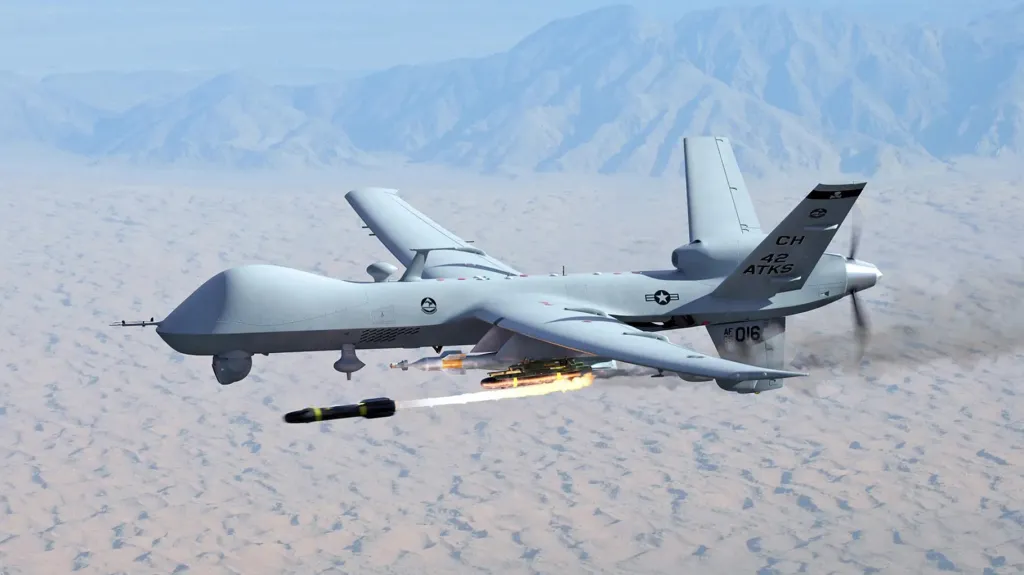
The Air Force has reportedly lost dozens of MQ-9 Reaper drones. (USAF)
Furthermore, despite the top Air Force officer recently praising Reaper as “perhaps the most valuable player” in the air war against Iran, the aircraft have been in the crosshairs of service officials. They have openly questioned the drone’s survivability and, by extension, general value in future operations. The Air Force has made several half-hearted efforts, without success, to find a successor. It is now in the early stages of a new attempt at acquiring an “MQ-9 Next.” You can read more about that effort in our story here.
An MQ-9 Reaper. (USAF)
It will be years, if ever, before “MQ-9 Next” comes online. Meanwhile, the search is on for existing replacements.
“The USAF intends to purchase several unused MQ-9A Block 5 from GA-ASI [General Atomics Aeronautical Systems, Inc.],” a spokesperson for the service told TWZ today. “A number of MQ-9A Block 5 aircraft were manufactured based on forecasted purchases for other customers but are no longer needed. The available aircraft are currently GA-ASI owned aircraft.”
“The USAF has received funds to begin the acquisition process,” they added.
A U.S. Air Force service member assigned to the 46th Expeditionary Attack Squadron, conducts pre-flight checks on an MQ-9 aircraft in preparation for an Operation Agile Spartan mission departing from Ali Al Salem Air Base, Kuwait, August 21, 2023. (U.S. Air Force photo by Tech. Sgt. Isaac Garden) Tech. Sgt. Isaac Garden
The Air Force was responding to our questions about congressional testimony from a top officer highlighting the service’s plans to backfill the combat losses.
“We’re looking at options to buy back as many of the MQ-9As as we possibly can right now,” Air Force Lt. Gen. David Tabor, Deputy Chief of Staff for Plans and Programs, had told members of Congress at a hearing back on May 13. “So there’s a bit of a short-term effort to buy back things immediately, in this fiscal year.”
Tabor also said at that time that the Air Force’s total MQ-9A fleet had shrunk to 135 aircraft. Official budget documents say the Air Force had 165 Reapers in inventory as of the start of Fiscal Year 2026, which began on October 1 of last year. This had already marked a significant year-over-year decrease, down from 231 MQ-9As at the beginning of Fiscal Year 2025.
Despite Air Force needs, General Atomics told us the number of available Reapers is in short supply.
“Between parts in stock for new builds, and company-owned Reapers with some number of flight hours on them, there are less than 10 total ‘new’ MQ-9As available to any customers anywhere in the world,” General Atomics spokesperson C. Mark Brinkley told TWZ earlier this week. “There are some number of decommissioned Reapers out there, and some number of those could potentially be brought back into service.”
MQ-9A Reaper in flight. (General Atomics)
One place the Air Force won’t be able to find any Reapers is in storage.
The MQ-9A is out of production. General Atomics has moved on to the MQ-9B, and currently offers those drones in multiple configurations. Though an evolution of the original Reaper, the core B model design differs in significant ways from its predecessor. Any new Air Force purchases of drones in this broader family would have to be of the B model and worked into the existing production schedule.
How many MQ-9As the Air Force has lost in operations in and around the Middle East since January 2025 is unclear, but is understood to be substantial. As of May, “nearly 30 MQ-9 Reapers have been lost in the course” of Operation Epic Fury against Iran, Air & Space Forces Magazine reported, citing “people familiar with the matter.” This is on top of dozens of Reapers reportedly downed while conducting operations targeting Iranian-backed Houthi militants in Yemen in the past year or so.
At the hearing last month, Tabor did not provide any official accounting of Reaper losses, but did acknowledge that “we are concerned about how they’ve attrited.”
In another effort to bolster the supply of operational Reapers, the Air Force told us that while it never regenerated MQ-1 Predator drones back into service, it was repurposing parts from these aircraft that the service stopped using in 2020. There were dozens on hand after they were retired.
An MQ-1 Predator flies above the flightline during launch and recovery training at Creech Air Force Base, Nev. Aircrew will fly the MQ-1 for the final time at Creech on March 9, 2018, before it is officially retired from the Air Force inventory. (U.S. Air Force photo by Senior Master Sgt. Cecilio Ricardo) Senior Master Sgt. Cecilio Ricardo
Questions about the status of the MQ-1 fleet arose last week after U.S. Central Command (CENTCOM) acknowledged the loss of an “MQ-1” drone to Iranian fire. This has led many to question whether American forces are flying the venerable Predator again as a result of the Reaper losses.
At the time, the Air Force declined to say if it lost any of theirs and referred us to CENTCOM, which declined comment. However, on Friday, the Air Force told us that in addition to the Predators being used for parts, 20 had been transferred to the Navy. We reached out to them for comment.
As we previously noted, it is also very possible, if not likely, that the uncrewed aircraft in question was an MQ-1C Gray Eagle, a related but different design still in active U.S. Army service. You can read more about this event in our original story here.
A U.S. Army MQ-1C seen being prepared for a mission somewhere in the Middle East on April 18, 2026. The official caption for this picture erroneously says the drone is an MQ-1 Predator. USAF/Master Sgt. James Cason
At the time of the incident, CENTCOM declined to tell us which variant of the MQ-1 was lost.
Regardless, the Air Force’s mad scramble to find additional Reapers highlights the value of having a high-flying, long-loitering drone that can gather intelligence and fire off munitions, no matter how slow it flies.
Earnings Call Insights: Best Buy (BBY) Q1 fiscal 2027
Management View
“Today, we are pleased to report better-than-expected results for the first quarter” (CEO & Director Corie Barry). Barry said Q1 included “positive comps across the majority of our major product categories” and that the company “also drove
Seeking Alpha’s Disclaimer:This article was automatically generated by an AI tool based on content available on the Seeking Alpha website, and has not been curated or reviewed by humans. Due to inherent limitations in using AI-based tools, the accuracy, completeness, or timeliness of such articles cannot be guaranteed. This article is intended for informational purposes only. Seeking Alpha does not take account of your objectives or your financial situation and does not offer any personalized investment advice. Seeking Alpha is not a licensed securities dealer, broker or US investment adviser or investment bank.
On Wednesday, the US Department of War confirmed it had awarded Dell Federal Systems, the government-focused unit of Dell Technologies, a five-year, $9.7 billion (€8.3bn) contract to supply the Pentagon.
ADVERTISEMENT
ADVERTISEMENT
As part of the Core Enterprise Technology Agreement (CETA), a Pentagon-wide Microsoft licensing and software procurement framework, the company will provide and manage Microsoft software licences, cloud subscriptions and on-premises software licensing across the US military, intelligence agencies and the US Coast Guard.
Dell Technologies’ shares were up around 5% in pre-market to $320 due to the announcement after closing Wednesday’s session at roughly $305.
The company is set to report its earnings for the first quarter of this year on Thursday, with analysts from Zacks Investment Research forecasting revenues of approximately $35 billion (€30bn), representing annual growth of about 50%.
According to US DoW Chief Information Officer Kirsten Davies, who briefed reporters at the Pentagon, the CETA is expected to save the department roughly $422 million (€360.9mn) annually by consolidating fragmented technology budgets from across the military services into a single purchasing structure.
The contract was granted less than three weeks after US President Donald Trump stood at a White House event and urged Americans to “go out and buy a Dell. They’re great.”
Davies and acting US Navy Chief Information Officer Barry Tanner were both clear that the award followed a competitive process.
“The vendors were all evaluated based on competition, comparison to GSA schedule pricing and overall chain of value to the department,” Tanner noted.
Dell holds a long-standing commercial partnership with Microsoft and is one of its major buyers of Windows licences. Nonetheless, the contract arrives at the culmination of a period of visible alignment between CEO Michael Dell and the Trump administration.
In December 2025, Dell and his wife Susan appeared alongside Trump at the White House to announce a $6.25 billion (€5.3bn) donation to “Trump Accounts,” a tax-advantaged investment programme for children created under the “One Big Beautiful Bill”.
The pledge will provide $250 (€214) to roughly 25 million American children aged 10 and under from households with a median income below $150,000 (€129,000) and was described by Invest America, the nonprofit organisation spearheading the initiative, as the largest ever private commitment devoted to American children.
Michael Dell also sits on Trump’s Council of Advisors on Science and Technology, informing public policy regarding the economy, public health, national security, energy and emerging technologies.
The convergence of public presidential endorsements and subsequent federal contract awards is attracting scrutiny beyond Dell.
Financial disclosures released this month by the US Office of Government Ethics showed that investment accounts associated with President Donald Trump held Dell Technologies shares during the first quarter of 2026. The disclosures indicate some purchases were made before Trump publicly praised the company at a White House event.
The Trump Organisation has said the accounts are managed independently by third-party financial institutions and that neither Trump nor his family directs individual trades.
Last week, responding to questions about Trump’s financial disclosures at a White House briefing, Vice President JD Vance said the president’s investments are handled by independent wealth advisers and rejected suggestions that Trump personally directs individual stock trades. “He’s not making these stock trades himself,” Vance said.
Commentators and ethics critics have also pointed to trading activity involving companies such as Intel and Palantir, whose shares have at times moved sharply following public comments by Trump or announcements linked to government technology spending.
The Pentagon has said Dell’s selection followed a competitive procurement process.
Even so, the timing of the award alongside Trump’s public praise of the company and financial disclosures showing investments linked to Dell is likely to draw renewed scrutiny from ethics observers and political critics.
David Ellison’s media company appears to be girding for a big battle with California Atty. Gen. Rob Bonta and fellow state attorneys general who may team up to file a lawsuit aiming to block Paramount’s proposed $111-billion takeover of Warner Bros. Discovery.
Last week, Paramount hired powerhouse antitrust attorney Jeffrey Kessler to help defend its proposed takeover of Warner, which owns CNN, TBS, HBO and the prestigious Burbank film and television studios.
Now Kessler may be on the opposite side, potentially going after the government to help Paramount build a behemoth that would include CNN and CBS News, two historic film studios and four streaming services.
The states have not indicated whether they plan to go to court to block Paramount’s takeover of Warner, but Bonta has said Ellison’s proposed consolidation, which is widely expected to lead to layoffs, is problematic.
Paramount declined Tuesday to discuss Kessler’s remit. Kessler was not immediately available for comment.
Hiring an attorney who is more commonly aligned against big companies prompted at least one observer to postulate that Paramount could be angling to remove a big name from the legal chessboard to prevent him from joining the other side, in the vein of TV mob boss Tony Soprano.
During the HBO show’s fifth season, Soprano spent months consulting with top divorce attorneys, creating a potential conflict of interest that prevented those lawyers from representing his wife Carmela in the dispute.
Attorney Jeffrey Kessler arrives at federal court in Oakland in a file photo.
(Noah Berger/Associated Press)
Kessler also knows the ins and outs of a courtroom as well as antitrust settlements, which could benefit Paramount as it seeks to avoid a bruising court challenge.
More than 5,000 artists and other entertainment industry workers already have signed an open letter that urges Bonta to take action to upend the Paramount and Warner Bros. deal.
Ellison and his team have vowed to make $6 billion in cuts following the merger. The combined company would have to contend with $79 billion in deal debt.
Trump favors Paramount’s takeover of CNN and other Warner properties.
Paramount Chief Legal Officer Makan Delrahim has made several savvy tactical moves since joining Ellison’s Melrose Avenue firm last fall.
Delrahim, who was Trump’s antitrust chief during his first term, filed paperwork to win the U.S. Justice Department’s blessing in December — soon after Netflix had clinched the bidding war for Warner Bros.
Netflix ultimately bowed out of the auction in late February. And Delrahim’s move gave Ellison’s Paramount a head start in the regulatory approval process.
The company is waiting for confirmation that the Justice Department will consent to its Warner Bros. purchase. It is separately responding to issues raised by regulators in Europe.
It’s not clear when Bonta or his fellow attorneys general might decide whether to bring a case against Paramount, although the deadline is approaching because Ellison wants to get his deal wrapped up by September.
Attorneys general also could opt for negotiating a settlement agreement with Paramount, which might be willing to bend to concessions to get the deal approved.
Bonta is leading a challenge against another big merger — TV station owner Nexstar Media Group’s $6.2-billion purchase of rival company Tegna Inc. Nexstar owns KTLA-TV Channel 5 in Los Angeles and more than 100 other stations.
Nexstar initially argued that Bonta’s action came too late — after Nexstar had gained its federal approvals for the deal. Nexstar also was in the process of consolidating Tegna’s operations and top Tegna executives had cashed out.
The move backfired on Nexstar as a federal judge in Northern California issued a preliminary injunction, ordering Nexstar to halt the Tegna consolidation.
U.S. District Judge Troy Nunley ruled Tegna must be managed as a separate company pending the outcome of a trial.
On Tuesday, Tegna announced that it hired a former Fox TV station executive, Patrick Paolini, as its chief executive. Beginning next week, Paolini will be responsible for “Tegna’s daily operations, revenue-generating business strategies, local journalism and production, and growth initiatives,” according to a corporate statement.
Paolini will report to Tegna’s board — not Nexstar.