Bureau

Raman’s role in tackling homelessness comes under scrutiny in L.A. mayor’s race

Nithya Raman has made Los Angeles’ struggle to combat homelessness a key plank in her mayoral campaign, yet her own record on the matter has itself become an issue with her ouster as head of the City Council committee seeking solutions to the crisis.

Mayor Karen Bass is at the helm of the city’s battle against homelessness, but since 2023 Raman has been the second-most powerful official as chair of the City Council’s Housing and Homelessness Committee. That changed this month, when council President Marqueece Harris-Dawson, a key Bass ally, split the committee in two and removed Raman as its chair, effective Sept. 1.

Raman claims that politics were at play, casting her removal as a hit job for her decision to challenge Bass. Harris-Dawson disputes that, saying Raman failed to lead the committee with the urgency needed to combat L.A.’s enduring homelessness crisis.

“The committee is behind in excess of more than 100 issues,” said Harris-Dawson in an interview. “There are very serious decisions to make over what happens with homelessness. We needed someone who could focus on that and get it done and get it done quickly and show ability to build consensus.”

Beyond the dispute over Raman’s leadership of the committee, there are clear policy disagreements between the mayor and the council member over the best way to combat the crisis.

A Metro bus passes by a man sleeping on the sidewalk.

A Metro bus passes by a man sleeping on the sidewalk on North Spring Street in downtown Friday.

(Christina House / Los Angeles Times)

Raman contends that Bass’ signature program Inside Safe, which dismantles encampments and moves people living there into motels, hotels and interim housing, is overly expensive and unsustainable. On average, the cost of housing these individuals runs about $82,000 a year, according to city reports.

Raman has repeatedly signed off on funding for the program, but has become more critical of it in the last year.

Despite the city’s efforts, L.A.’s unsheltered homeless population — those living outdoors or in their vehicles — went up by 7.9% after two consecutive years of decreases, the Los Angeles Homeless Services Authority reported last month.

“The approach to homelessness that Mayor Bass has led and defended has brought us here,” Raman said after LAHSA’s report was released.

Raman has called for the use of time-limited subsidies, or rental vouchers, to house homeless Angelenos in private residences — at a city-estimated cost of $30,000, less than half the price of an average Inside Safe bed. Raman says she would “significantly expand” the city’s investment in the vouchers if she became mayor.

“For the same amount of money, we could rent three apartments using a short-term rental voucher and provide intensive services — housing more people in a program that has delivered much better outcomes,” Raman says in her mayoral policy platform on homelessness.

Even so, the more than $60-million voucher program Raman has already pushed through her committee has so far struggled to get off the ground under a tight timeline, and Raman’s critics have seized on the delay as evidence of the council member’s ineffectiveness.

Pedestrians pass by a homeless encampment along the 101 northbound offramp, at right, near City Hall.

Pedestrians pass by a homeless encampment along the 101 northbound offramp, at right, near City Hall Friday.

(Christina House / Los Angeles Times)

A city consultant on the program set a goal of having 600 households moved into leases by July 1 of this year, and 2,000 households moved in by next April. But as of that July 1 date, only three households had moved into homes via the vouchers, housing officials said in a report.

By Aug. 13, however, the number had jumped to 54 households, “with new move ins happening nearly every day,” the housing department said in a report.

Bass’ campaign spokesperson, Alex Stack, cited the sluggish start to the program and said subsidies are only a small part of the fight against homelessness.

“It’s not the silver bullet Raman’s selling,” Stack said.

In an interview, Raman said that the contracting process slowed the start of the program, but that time-limited subsidies are a great way to free up space in city shelters by moving those people into private housing.

“This is a cost-effective program that has very good outcomes in the past in terms of percentage of people moving on to permanent housing,” she said.

Nithya Rama listens to a question at a mayoral debate.

Nithya Rama listens to a question at the mayoral debate hosted by the Sherman Oaks Homeowners Assn.

(David Butow / For The Times)

Raman added that the council will continue to monitor data from the program and make fixes as needed if it doesn’t move fast enough.

Homeless services providers working with the city on the program said part of the challenge has been getting a completely new program off the ground.

“It’s definitely been slower than I think most people anticipated,” said Sasha Morozov, the regional director of supportive services for PATH, a nonprofit contracting with the city for the program.

But Morozov said the program is speeding up now and she believed the 2,000 slots will be filled on time.

A key plank in Raman’s platform

Raman said she ran for council largely to take on the homelessness crisis in Los Angeles. She says she is running for mayor for the same reason.

She’s cited a 49% drop in street homelessness in her district over the past year as a clear sign that she is equipped to bring down homelessness citywide. Bass counters it was her efforts through Inside Safe that brought homelessness down in Raman’s district.

People living on the street gather cardboard for shelter.

People living on the street in downtown L.A. gather cardboard for shelter during a heat wave last month.

(Gina Ferazzi / Los Angeles Times)

While chair of the Housing and Homelessness Committee, Raman established monitoring of all the city’s spending on homelessness and tracking of 35 key performance metrics to see how effective the city’s investments are. She also stewarded the creation of a Bureau of Homelessness Oversight within the city’s Housing Department that is responsible for coordinating and overseeing the city’s homelessness system.

Her critics say that Raman’s tenure atop the committee hasn’t adequately met the moment facing the city of Los Angeles — with the Trump administration and county both moving to cut funding from LAHSA, the joint city-county authority responsible for homeless services. Meanwhile, the city is still managing a landmark federal lawsuit settlement, which requires it to invest in thousands of new shelter beds in its response to homelessness.

“She’s been in this building … longer than Karen Bass,” said Councilmember Monica Rodriguez, who served on the committee under Raman. “It’s convenient now for her to saddle all blame on the mayor when she rubber-stamped Inside Safe and stood in lockstep with the mayor.”

Mayor Karen Bass, left, looks on as Los Angeles City Council member Monica Rodriguez speaks.

Mayor Karen Bass, left, and City Council member Monica Rodriguez at City Hall.

(Genaro Molina / Los Angeles Times)

Rodriguez has specifically accused Raman — as chair of the committee — of slow-walking Rodriguez’s proposal from 2024 for the city to study a plan to separate itself from LAHSA and form its own department that would directly contract with homeless services providers.

Rodriguez said it took Raman months to schedule her motion in committee and that, while it was pending, the county removed most of its funding from LAHSA.

“The city has been left flatfooted because she wouldn’t lead our conversation. She wouldn’t schedule our items. She set us up for failure,” Rodriguez said.

Raman tried until the last minute to get the county to remain in LAHSA.

While Rodriguez’s motion was waiting on a report, Raman made her own proposal to create a Bureau of Homelessness Oversight within the Los Angeles Housing Department to keep track of the city’s more than $1-billion annual investment in homelessness response.

The council moved that bureau forward last year, and a spokesperson for the Housing Department said that seven positions have been hired within the bureau handling contracts and data oversight.

Harris-Dawson said a seven-person bureau isn’t adequate.

Raman said the bureau was a starting point that could one day lead to a department, which she said would be expensive and take a long time to stand up.

“This was not precluding [the creation of a department],” Raman told The Times. “This was trying to speed up that staffing faster than the departmental process normally takes in this city.”

Raman said she talked to Bass about creating a department for homelessness in late 2023 or early 2024, but the mayor told her to move ahead with the bureau instead. Bass representatives didn’t immediately respond to a request for comment.

Paige Sterling, a spokesperson for the mayor, said that Bass and Raman discussed the bureau in 2025, during the budget process. The mayor opposed a standalone department at the time because it “would add to the bureaucracy,” and the bureau was a compromise, Sterling said.

“The mayor signed a budget with funding and positions for the bureau, which begins to give the city the capacity it needs to start overseeing homelessness as we evaluate what the future governance of this issue looks like,” Sterling said.

Raman has touted the bureau as a success that provides clear oversight of how the city spends its money, but has also claimed that the mayor’s office has moved too slowly to staff the bureau. The Housing Department still hasn’t hired an assistant general manager to oversee it.

The rotunda at L.A. City Hall.

The rotunda at L.A. City Hall.

(Genaro Molina / Los Angeles Times)

Canceled meetings and frustrated colleagues

Raman hasn’t been endorsed for mayor by any of her colleagues on the council, and some of those who served on her homelessness and housing panel say she did a shoddy job as its chair. They complain that she frequently canceled meetings and allowed hundreds of motions to pile up without getting moved through council.

“It had started to feel less like a policymaking body and more like a scholastic seminar — a lot of philosophizing, a lot of talk about feelings, but not enough substantive questions or direction on policy to present to staff,” Councilmember Imelda Padilla said in a statement to The Times.

In response, Raman said her committee focused on data to make sure the city’s investment in fighting homelessness is paying off.

“That doesn’t feel scholarly to me, that feels like oversight and accountability — exactly what the public is asking for for one of our largest investments as a city,” she said.

The full council, meanwhile, has agreed to review its relationship with LAHSA and the county, and to study creating a new department to centralize homelessness oversight.

“This conversation that we’re having about this … is long overdue,” said Councilmember John Lee.

Raman will have a seat on the new homelessness committee, but it will be chaired by Councilmember Ysabel Jurado. Padilla was named chair of the new Housing Committee.

Raman’s final meeting as committee chair was supposed to be Wednesday.

She didn’t show up.

Source link

Japan launches intelligence bureau but lacks overseas network

The photo shows the Prime Minister’s Office (Kantei) in Japan. The Japanese government launched the National Intelligence Bureau on Friday as an organization reporting directly to Prime Minister Sanae Takaichi. Photo by Asia Today

July 31 (Asia Today) — Japan launched its National Intelligence Bureau on Friday, creating a central command to collect government intelligence, coordinate analysis and determine national intelligence priorities.

The bureau reports directly to Prime Minister Sanae Takaichi and was created by upgrading the Cabinet Intelligence and Research Office.

It has about 730 personnel and is headed by Kazuya Hara, a former National Police Agency official who served as director of Cabinet intelligence.

Hara’s career has included assignments at Japanese embassies in Russia and the United States as well as positions in the Defense Intelligence Headquarters and the National Police Agency’s foreign affairs division.

Japan also launched a National Intelligence Council chaired by Takaichi. Its members include Chief Cabinet Secretary Minoru Kihara, the foreign and defense ministers, the chair of the National Public Safety Commission and other relevant Cabinet members.

The National Intelligence Bureau will serve as the council’s secretariat.

The government is expected to begin drafting Japan’s first national intelligence strategy, setting basic principles and priorities for intelligence activities. It is also considering legislation intended to counter foreign espionage.

The council will deliberate on foreign intelligence operations and information considered important to national security.

A coordinator, not an overseas spy agency

Despite its name, the National Intelligence Bureau is not designed to operate like the U.S. Central Intelligence Agency.

Its central function is to ensure that ministries and agencies provide information in a timely manner and to integrate that material into assessments for policymakers.

The bureau will coordinate the government’s intelligence activities and provide analysis to the prime minister. It has not been granted new authority to establish independent overseas stations, recruit and manage foreign agents or conduct covert operations.

Japan already possesses extensive intelligence capabilities, but they remain divided among several government organizations.

The Foreign Ministry gathers diplomatic intelligence through Japanese missions overseas. The Defense Intelligence Headquarters handles signals, satellite and imagery intelligence.

The Public Security Intelligence Agency and the National Police Agency monitor international terrorism, foreign intelligence services and counterintelligence threats.

The new bureau will bring information collected by those organizations together, but it will not operate its own overseas human intelligence network.

Its role is therefore closer to that of the U.S. Office of the Director of National Intelligence than the CIA.

The U.S. intelligence director’s office coordinates multiple intelligence agencies and provides national intelligence assessments to the president. The CIA collects foreign human intelligence, conducts analysis and may carry out covert operations under presidential authorization.

Separate foreign intelligence service planned

The governing Liberal Democratic Party and the Japan Innovation Party have proposed establishing a separate foreign intelligence agency by the end of fiscal 2027.

That proposal underscores the operational limitations of the National Intelligence Bureau.

A second agency would not be necessary if the new bureau already possessed capabilities comparable to those of the CIA or Britain’s Secret Intelligence Service, commonly known as MI6.

What Japan established Friday was essentially an intelligence command center.

Combining diplomatic reports, satellite and signals intelligence, information supplied by allies and publicly available material could improve the speed and accuracy of government assessments.

However, detecting changes in the intentions of foreign leaders before they become visible often requires human sources inside foreign governments and institutions.

Japan’s existing ministries and agencies will continue to supply most of the information analyzed by the bureau until the government creates an organization capable of independently collecting intelligence overseas.

Oversight remains a concern

The bureau’s expanded authority has also raised questions about oversight.

During legislative deliberations, lawmakers raised concerns about privacy, political neutrality and mechanisms allowing the Diet or independent institutions to review intelligence activities after they occur.

Those questions will become more significant if Japan adopts anti-espionage legislation or establishes a foreign intelligence service.

The government would need to define who may be monitored, what information may be collected and how citizens’ rights will be protected.

The launch of the National Intelligence Bureau strengthens the central leadership of Japan’s intelligence system.

Its effectiveness, however, will still depend largely on information collected by existing ministries, agencies and allied countries.

Japan has created a larger brain for its intelligence system, but it has not yet given that system independent arms and legs capable of gathering secrets overseas.

— Reported by Asia Today; translated by UPI

© Asia Today. Unauthorized reproduction or redistribution prohibited.

Original Korean report: https://www.asiatoday.co.kr/kn/view.php?key=20260731010011670

Source link

Top FBI agent in Chicago abruptly leaving post after being pushed to retire, AP sources say

The head of the FBI’s Chicago field office is abruptly leaving his position, according to a resignation message he sent to colleagues and multiple people familiar with the situation who said he was told to retire.

Douglas DePodesta has served as special agent in charge in Chicago, one of the FBI’s largest offices, for nearly two years and has been with the bureau since 2002.

He told colleagues that his last day would be Monday, according to a message seen by the Associated Press. Multiple people familiar with the matter, speaking on condition of anonymity to discuss a personnel move, said DePodesta had been pushed to retire.

The events leading up to his departure were not immediately clear, but DePodesta alluded in his farewell note to a conflict that he suggested had precipitated it.

“I’ve never backed down from a fight, as long as it meant our personnel could continue serving the FBI’s mission,” DePodesta wrote in the message. “Unfortunately, that has proved unpopular over time and my departure is a consequence of that.”

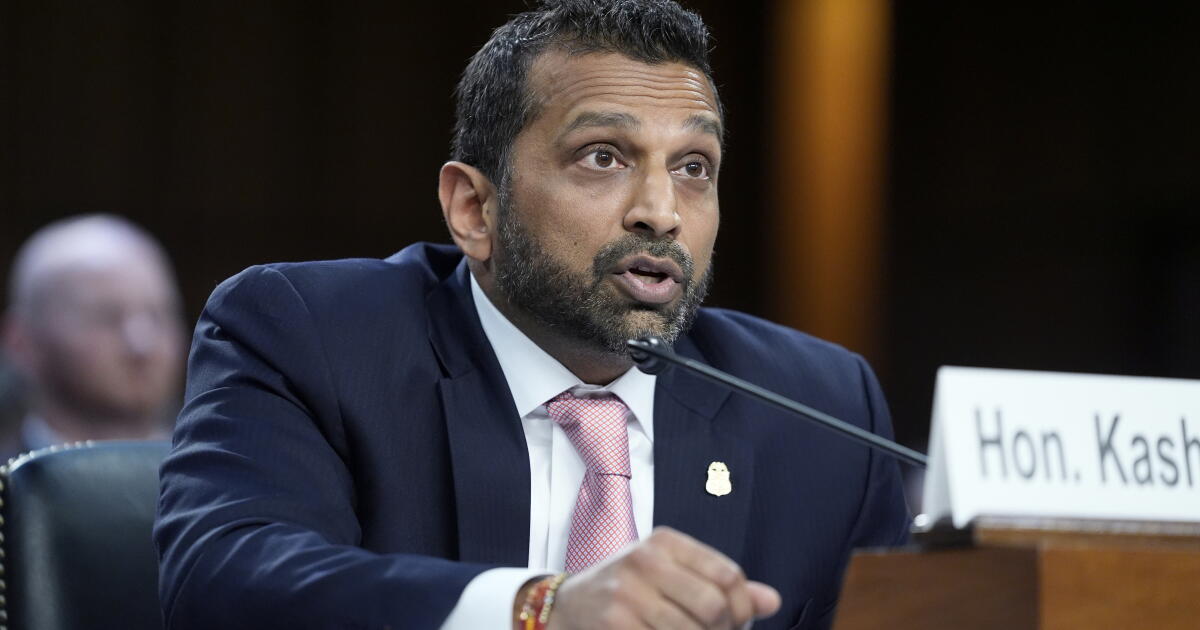
The move is part of a broader upheaval in the FBI’s workforce as Director Kash Patel has sought to force out line agents and supervisors alike who are perceived as not supporting the Trump administration’s agenda. It also comes amid prolonged tumult in the law enforcement community in Chicago, whose top federal prosecutor, Andrew Boutros, described this week a sweeping review of more than 1,000 grand jury presentations made by Illinois prosecutors following the dismissal of a high-profile case over misconduct.

The FBI declined to comment Thursday, but the bureau’s “rapid response” social media account on X responded to a separate post about DePodesta’s departure by saying: “It’s simple: Anyone who is not on board with THIS FBI under the leadership of President Trump — which has achieved the lowest murder rate ever — is free to leave.”

DePodesta also quoted in his note from a farewell message from Patel’s predecessor, former Director Chris Wray, who reminded the workforce that “you have been who the American people have turned to in their darkest moments” and praised them for having “stayed true to the values that define who we are, and to the qualities for which we stand: Fidelity, Bravery and Integrity.”

DePodesta joined the FBI in Chicago in 2002 and worked drug investigations. He later held senior roles at FBI headquarters in Washington and in Detroit and Memphis before being named top agent in Chicago in August 2024.

Tucker and Richer write for the Associated Press.

Source link

L.A. property owners reject $80 million streetlight funding increase

Los Angeles property owners voted against an increase in an assessment for maintaining streetlights that would have collected an additional $80 million a year, as the city faces a backlog of broken streetlights due to stagnant funding and a rise in vandalism.

The assessment has not changed since 1996. Property owners had until June 2 to submit their votes, which were weighted by the amount of their parcel’s proposed assessment. According to results released Thursday, nearly 80% of the weighted vote went against raising the assessment, which currently generates about $45 million a year.

For the average single-family home, which make up the majority of parcels, the current payment is $58 annually, or about $5 a month, according to Miguel Sangalang, executive director and general manager of the Bureau of Street Lighting. The increase would have brought the average annual bill to $117, or about $10 a month.

The proposed increase would have brought the total amount collected by the assessment to $125 million a year.

In a joint statement Thursday, Mayor Karen Bass, Council President Marqueece Harris-Dawson and City Councilmembers Eunisses Hernandez and Katy Yaroslavsky said that despite the result, the “critical work will continue” to address the broken streetlights that have plunged neighborhoods into darkness across the city.

“Despite this outcome, the City remains committed to improving streetlight reliability, repairing outages faster, and building a sustainable funding path for streetlight operations and maintenance,” the group statement said. “Every Angeleno deserves to feel safe walking their dogs, returning home from work, and parking their cars at night, and the City is committed to delivering the reliable street lighting that makes that a reality.”

The Bureau of Street Lighting owns and operates nearly 225,000 streetlights across the city, which have historically been covered by the assessment. The average repair time for a streetlight was one year, bureau officials said in February.

Without more revenue from the assessment, city officials have been looking for alternative funding. The City Council has said it will finance $65 million for solar-powered streetlights.

Bass recently announced an initiative to repair and replace 60,000 streetlights over the next two years, and several council members have turned to their district’s discretionary funding to fix broken streetlights in their districts.

Hernandez, who chairs the council’s Public Works Committee, said in a statement that the result doesn’t change the fact that the city is trying to maintain a 21st century lighting system with an outdated funding model.

“If this assessment isn’t the path forward, then it’s our responsibility to build one through better leveraging City assets like light poles, exploring new revenue opportunities, and pursuing reforms to outdated state laws like Proposition 218 that make it extraordinarily difficult for cities as large as Los Angeles to maintain basic public infrastructure,” she said.

Broken streetlights have emerged as an issue in the mayoral election, with Councilmember Nithya Raman citing broken lights as an example of how the city “can’t seem to manage the basics.” Raman is facing Bass in a Nov. 2 runoff.

In February, city council members announced a plan to replace streetlights with solar-powered versions, in an attempt to deter copper wire theft. About 1 in 10 streetlights are out of service because of disrepair or copper wire theft, according to the city.

A well-known example is the Sixth Street Bridge, where thieves stole seven miles’ worth of wire.

Source link

Push to install Flock Safety devices targeted L.A. agency, emails show

Since its creation more than a century ago, the Los Angeles Bureau of Street Lighting has been in the lamppost business and little else.

But in recent months, the little-known city agency has found itself pulled into a fierce debate over L.A.’s relationship with Flock Safety, a surveillance technology company that has been criticized for supplying data used to enable the Trump administration’s immigration crackdown.

In L.A., Flock operates dozens of automated license plate readers, which allow authorities to scan for vehicles that have been reported stolen or are registered to known fugitives, tracking their movements throughout the city.

The devices are often mounted on municipal light poles, which makes the Bureau of Street Lighting responsible for their installation.

Reports that Flock has shared license plate data with federal authorities, including U.S. Immigration and Customs Enforcement, have prompted dozens of mostly smaller cities across the country to end their relationship with the company. But in L.A. it still has found willing customers, including the LAPD.

Hundreds of emails obtained by The Times through public records requests reveal how LAPD boosters, homeowner associations and elected officials have engaged in a months-long campaign to pressure the Bureau of Street Lighting to speed up installations of the plate readers.

Flock, headquartered in Atlanta, said that it contracts with roughly 5,000 U.S. law enforcement agencies nationwide, and that its technology complies with a California law that limits what information can be shared with federal authorities. A company spokesperson said that Flock’s technology is “built around transparency, accountability, and local control.”

“Our customers own and control their data, which is deleted after 30 days by default,” the spokesperson, MoMo Zhou, said in a statement to The Times. “Our platform includes safeguards like audit trails to help ensure accountability at every step. Every day, Flock supports communities across the country in addressing crime and locating missing people.”

The Bureau of Street Lighting, with 177 employees and a relatively modest budget of $49.4 million, would seem an unlikely player in the broader debate over police surveillance. It is primarily tasked with repairing and fortifying the city’s more than 210,000 streetlamps — a frequent target of copper wire thieves — and maintaining its network of electrical vehicle charging stations.

The push to put up more plate readers has come amid calls for greater transparency around the Los Angeles Police Department’s dealings with Flock. In March, the Police Commission asked the department to report back on what information the company’s scanners collect and share. In recent months, the commission declined to approve donations of Flock cameras.

People holding large signs outside a building

Members of the Stop LAPD Spying Coalition held a news conference to express opposition to Flock Safety, a license plate reader, ahead of a Los Angeles Board of Police Commissioners meeting on March 3, 2026.

(Genaro Molina / Los Angeles Times)

The commission ordered its inspector general to conduct an audit of the LAPD’s use of license plate reader technology, with the findings expected to be released in the summer.

Recently, Councilmember Ysabel Jurado introduced a motion urging the commission to “refrain from entering into any new Memoranda of Understanding, Contracts, or other Agreements, or implement any pilot programs with Flock Safety or its affiliates.” LAPD officials said last month that the city attorney’s office has been working on drawing up a formal contract with Flock.

Behind the scenes, though, the pressure to work with Flock has been ratcheting up from other council offices and community groups.

When a representative from Councilmember Katy Yaroslavsky’s office emailed the streetlighting bureau urging speed, she received a response that said the installation process shouldn’t be rushed because some city light poles can’t support the weight of a Flock reader, which is normally powered by a solar panel.

“The last thing we need is to have a pole fall onto someone or something if there are high winds,” the bureau’s Clinton Tsurui wrote in the June 4, 2025, email.

In another exchange, Tsurui expressed frustration with a colleague who had offered what he thought was an overly optimistic timetable for installing new plate readers.

He wrote: “smh, promising things we can’t do is going to catch up with us one day.”

The Los Angeles Police Foundation, a nonprofit group that has long bankrolled equipment for the LAPD and offered other support, has criticized delays in installing the Flock devices. Last year, the foundation facilitated the donation of dozens of Flock cameras, most of which ended up in affluent neighborhoods on the city’s Westside and in the San Fernando Valley.

Records show that in May 2025, Dana Katz, the foundation’s executive director, reached out to the mayor’s office with a request to waive permit and rental fees associated with installing the new readers. Katz wrote in an email that the extra expense of around $2,000 per device were “cost prohibitive and detrimental to public safety.”

Katz also pointed out that in some places, there are no city-owned poles on which to mount the devices — but offered a possible solution.

“Flock has its own pole that has been accepted by the County of Los Angeles for these situations, and we would like the City to accept the use of them, too,” she wrote to Robert Clark, the city’s then-deputy mayor of public safety.

Three different styles of streetlamps: Two have double bulbs and one features a single bulb

A few of L.A.’s historic streetlights stand outside the Bureau of Street Lighting’s office near Virgil Avenue and Santa Monica Boulevard.

(Jason Armond / Los Angeles Times)

Katz wrote Clark again on Aug. 6 to ask why officials were estimating a six-to-12-month wait for approval of new Flock readers on public property in the neighborhoods of Cheviot Hills and Brentwood Park, where there were no existing city poles to mount them. She noted that the county’s engineering department had already approved the company’s poles, and asked Clark whether there was a way for the city to “piggyback on these other entities’ approvals in order to speed this up so that these neighborhoods don’t have to wait so long for help in preventing these home invasions?”

In the following weeks, Katz’s emails took on an increasingly urgent tone. In one of her last messages, email records show, she told an aide she expected more help than the mayor’s office was offering.

“With all due respect, the answers you have provided are completely generic and do not provide any guidance and direction as to how we can expedite this process,” she wrote.

She added: “I’ve said it before, and I will say it again — these delays are harmful to public safety.”

A spokesperson for the mayor’s office told The Times that ultimately neither Clark nor the aide intervened on the Los Angeles Police Foundation’s behalf.

Email records show Flock’s courtship of the bureau dates at least to spring 2024, when the company agreed to donate two of its plate readers to help combat copper thefts.

Tsurui emailed LAPD Capt. Celina Robles to say that the company’s executives had requested an in-person meeting with the bureau and the LAPD “to discuss the benefits of this product and how it can benefit the city moving forward.”

On June 24, 2024, a lobbyist from the D.C. firm Modern Fortis emailed Bureau of Street Lighting Executive Director Miguel Sangalang seeking to “explore a public-private partnership” between Flock and the city. Sangalang took another meeting to discuss Flock a few months later with former City Councilmember Joe Buscaino, who after leaving City Hall had gone to work for Ballard Partners, a powerful Florida-based lobbying firm.

In January 2025, after wildfires devastated Pacific Palisades, Altadena and other areas, Flock stepped in again. The company agreed to donate more than 50 plate readers, free of charge for six months, to the wealthy Palisades area, where residents and law enforcement officials were on high alert about potential theft.

A device consisting of a flat panel on a pole and a camera

A Flock Safety automated license plate reader in Costa Mesa.

(Courtesy of the city of Costa Mesa)

In the days and weeks that followed, city and police officials continued to pepper the bureau about speeding up the approval process.

On Jan. 21, 2025, records show, Cmdr. Randall “Randy” Goddard of the LAPD’s Information Technology Bureau wrote streetlighting officials to say that the Palisades community “could use a big favor from your department.”

LAPD Chief Jim McDonnell “fully supports this and has been working with the City Attorney’s office to finalize the terms,” Goddard wrote.

Source link

Treasury Secretary Bessent confirms steps for a Donald Trump $250 bill

Treasury Secretary Scott Bessent said Thursday that his department has prepared the design for a $250 bill featuring President Trump, anticipating the passage of stalled legislation in Congress to put the president on a new denomination of legal tender.

Bessent said at the White House that authorizing the currency will be up to lawmakers on Capitol Hill, but that “we’ve created the bill” because “we have to be prepared.”

The secretary downplayed the idea that the administration is pushing the matter, despite Trump’s penchant for infusing his name and likeness across the nation’s capital and into the observances of the 250th anniversary of the Declaration of Independence. Bessent also insisted there is nothing inappropriate about Trump’s visage being part of the seminal national celebration.

“The president doesn’t do it; the House and the Senate have to do it,” Bessent said at the White House, referring to legislation, introduced by Rep. Joe Wilson (R-S.C.), that would direct the Treasury Department’s Bureau of Engraving and Printing to put Trump’s face on the new bill to mark the 250th anniversary of the nation’s founding.

A Treasury Department spokeswoman said the agency carried out “appropriate planning and due diligence” to implement a potential congressional mandate “to produce a $250 commemorative note which will appropriately recognize the 250th Anniversary of our great nation.” The spokeswoman did not mention Trump.

If passed and signed into law by Trump, Wilson’s bill would mark an extraordinary recognition for a sitting U.S. leader and comes as Trump has sought to place himself at the center of Independence Day commemorations. The Department’s preparation for the languishing legislation suggests some enthusiasm for the idea on the part of the Trump administration.

Report: Trump ally has pushed to expedite new currency

The agency’s explanation follows a Washington Post report stating that U.S. Treasurer Brandon Beach, a Trump appointee, has been pushing the Bureau of Engraving and Printing to expedite the process for a new currency note. The paper also reported that the former BEP chief, Patricia Solimene, was reassigned after pushing back.

The Treasury spokesperson declined to comment on Solimene’s status but confirmed that Michael Brown, a top Beach aide, became acting director of engraving and printing May 18.

Beach did not respond to an Associated Press request for comment.

Wilson’s legislation, which so far has languished in Congress, is intended to create an exception to existing law that bars any living person from appearing on U.S. currency; the bill would allow current and former presidents to be featured.

Bessent confirmed the measure is designed for one person.

“Donald J. Trump,” he said emphatically, repeating the full name that the president himself often uses in the third person.

According to the Post report, Beach last fall provided the Bureau of Engraving and Printing with the design for the new bill. It featured Trump’s portrait — the same one that adorns banners hanging on some federal buildings in Washington — and a 250th anniversary logo. Trump’s signature also was included, a design element that would differ from other paper money.

British artist Iain Alexander told the Post he designed the bill and said he’d discussed it with the president. Alexander did not respond to an AP request for comment.

The newspaper also reported that Solimene resisted pressure from Beach and Brown and stressed to them the lengthy legal and procedural process required to issue new currency. Solimene was reassigned against her will, the Post reported, paving the way for Brown to oversee the bureau.

Trump has aggressively spread his name and likeness

A new currency note would be the latest example of Trump expanding his personal brand in his official capacity since returning to the White House last year.

Beach and Bessent already streamlined approval of a commemorative 250th anniversary coin featuring Trump. The Treasury Department has asserted that those special coins fall outside the prohibition on living presidents appearing on money. In 1926, the nation’s 150th anniversary, then-President Calvin Coolidge appeared on a commemorative half-dollar coin that was official legal tender.

The Trump administration has had banners featuring his portrait hung on the Department of Justice and other federal buildings. And his slate of appointees to the Kennedy Center governing board added his name to the national performing arts facility that Congress originally designated as a memorial to assassinated President John F. Kennedy. That renaming is being challenged in court because of the federal law establishing the center as the official memorial to the 35th president.

Bessent noted that unless Wilson’s exception passes, current law sets just two conditions for him to consider on currency: that “In God We Trust” is printed somewhere on it, and that only deceased individuals be depicted, with their names described below their portraits.

“It’s all up to Capitol Hill,” Bessent said. “We will stick to the law.”

Barrow writes for the Associated Press.

Source link