Bullet

America’s first ‘bullet train’ revealed as high-speed rail track promises to cut LA to San Francisco trip in half

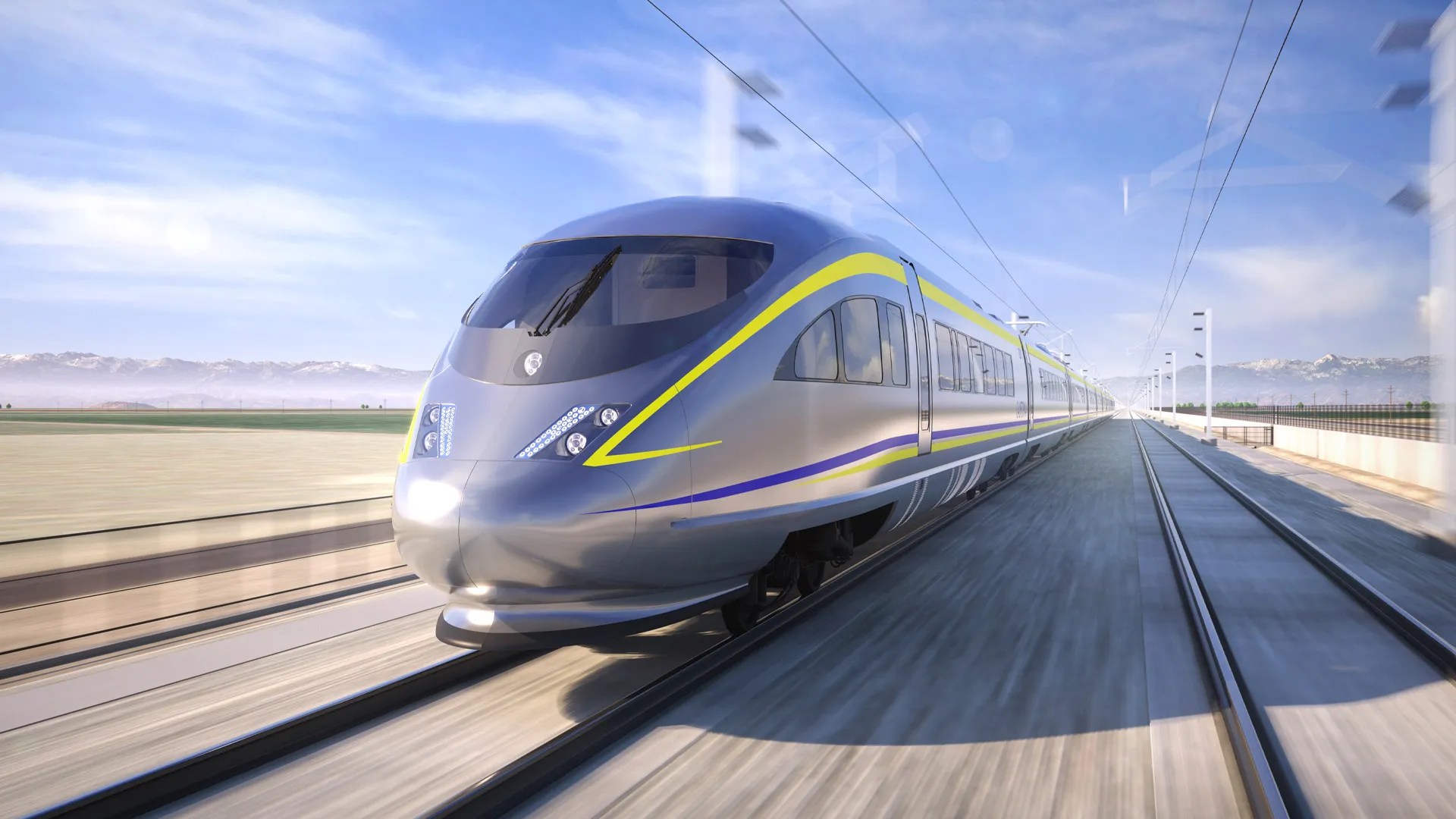
AMERICA’S first bullet train which will slash travel time between Los Angeles and San Francisco has been revealed.

The highly anticipated rail project will make the trip just two hours and 40 minutes – compared to nearly six hours by car.

California High Speed Rail Authority has released renderings of its new high-speed bullet trainCredit: California High Speed Rail Authority
A rendering of the interior of one of the stations along the routeCredit: California High Speed Rail Authority
California High Speed Rail Authority has released a rendering of the proposed new Fresno stationCredit: California High Speed Rail Authority

Once completed, the bullet train scheme will provide speedy trips between the Bay Area and the Los Angeles region.

It will also connect the communities in between — Gilroy, Merced, Fresno, Bakersfield, Palmdale, and others — to the state’s largest job centers and innovation hub, said the California High Speed Rail Authority on February 28.

Many have been awaiting the project to be completed, as the past decade of construction has been focused on an initial segment in Central Valley.

There are five planned stations in the Central Valley: Bakersfield, Fresno, Merced, Madera and Kings/Tulare.

Newly-released renderings show the stations will feature plenty of modern twists, with spacious canopies and open concourses.

The stations’ architectural designs are set to incorporate natural materials like stone and wood.

If plans go according to schedule, the area could open as soon as 2032.

The Central Valley’s initial operating segment is expected to transition from civil construction to laying out tracks and installing systems later this year.

California’s ambitious but long delayed high-speed rail line is on track, say bossesCredit: California High Speed Rail Authority
If work proceeds as scheduled, the first phase could be operating in the Central Valley by 2032Credit: California High Speed Rail Authority
The project is designed to eventually shuttle riders across nearly 500 miles between San Francisco and Los AngelesCredit: California High Speed Rail Authority

But there has yet to be a confirmed project opened date for the route between San Francisco and Los Angeles due to delays in planning and funding.

The overall projected cost for Phase 1 delivery, between San Francisco and Los Angeles/Anaheim, dropped by $1.7 billion.

The High-Speed Rail Authority has just released its Draft 2026 Business Plan for public review and comment.

“The authority has entered a new era of construction: laying track across the Central Valley and electrifying the corridor,” the plan said.

“With the southern railhead in Kern County ready ahead of schedule, deliveries of steel, concrete ties, and ballast material can begin, and work can commence.

“The authority has set construction milestones for the 119-mile Central Valley segment and developed a procurement schedule to keep the project on pace for completion of the Merced – Bakersfield early operating segment in 2032.”

The project has created thousands of jobs, with rail bosses partnering with California colleges and universities to build a skilled local workforce, it added.

There is 119 miles of construction underway in the Central ValleyCredit: California High Speed Rail Authority
The California high-speed rail will deliver fast, reliable, zero-emission train service connecting the state’s major economic regions and the Central ValleyCredit: California High Speed Rail Authority

President Donald Trump has previously slammed the project as a “train to nowhere.”

“The Railroad we were promised still does not exist, and never will,” Trump warned on Truth Social last July.

“This project was Severely Overpriced, Overregulated, and NEVER DELIVERED.”

Democratic Gov. Gavin Newsom wants lawmakers to reauthorize the state’s cap-and-trade program through 2045.

He also wants to ensure that high-speed rail receives $1 billion a year from it.

Last December, California dropped a lawsuit officials filed against the Trump administration over the federal government’s withdrawing of $4 billion for the project.

The U.S. Transportation Department slashed funds for the bullet train.

Gov. Newsom slammed the federal government’s decision as “a political stunt to punish California.”
Source link

Tapes Show LBJ Doubted Same Bullet Hit Kennedy, Connally

Even while the Warren Commission was preparing its report on the assassination of President John F. Kennedy, there were disagreements over whether the same bullet had struck Kennedy and John B. Connally. Among the dissenters: President Lyndon B. Johnson.

Besides, Johnson asked Warren Commission member Sen. Richard Russell (D-Ga.), “what difference does it make which bullet got Connally?”

Arguments over the same-bullet theory continue more than 30 years after the attack in which Kennedy was killed and Connally, then the governor of Texas, was wounded.

Johnson’s conversation with Russell was included among tapes released Friday by the National Archives and the Lyndon Baines Johnson Library in Austin, Tex.

The tapes reviewed in Austin disclosed that Connally called Johnson on March 2, 1967, to discuss claims that Cuba was involved in the assassination. In other phone conversations, Johnson told aides to keep up with New Orleans prosecutor Jim Garrison’s investigation into the slaying.

Garrison’s theories and writings about the assassination formed the basis for Oliver Stone’s 1991 movie, “JFK.”

Johnson, however, said he did not believe the CIA-Cuba theory. In a Feb. 18, 1967, conversation with then-acting Atty. Gen. Ramsey Clark, Johnson said the Cuban theory was as preposterous as if he were told that his wife, Lady Bird Johnson, “was taking dope.”

Johnson’s conversation with Russell, about the bullet that hit Connally, occurred on Sept. 18, 1964. They discussed progress in preparing the report on Kennedy’s slaying.

The senator noted some members of the commission headed by Chief Justice Earl Warren believed that “the same bullet that hit Kennedy first is the one that hit Connally.”

Responding to Johnson’s musing, Russell said, “Well, it don’t make much difference.” He added: “Well, I don’t believe it. . . .”

“I don’t either,” Johnson responded.

Russell said the differences among the commission members were to be noted in the report.

Connally, riding in the front seat of the presidential limousine, was wounded when Kennedy, in the back seat, was slain in Dallas on Nov. 22, 1963.

Investigators agree that three shots were fired, but through the years conspiracy arguments have turned on whether the same bullet could have passed through Kennedy’s upper back and hit Connally.

The two were struck almost at the same instant. If the same bullet could not have wounded both men, there had to have been a second bullet–and therefore a second gunman, according to those who believe in a conspiracy.

When Connally died last summer, researchers asked to recover bullet fragments from his body to help resolve the issue, but the request was turned down.

Source link