building

A small plane crashes into building in Brazil, killing three | Newsfeed

NewsFeed

A small plane carrying five people crashed into a residential building in Belo Horizonte, Brazil, shortly after takeoff, killing three and leaving two others hospitalised. The aircraft went down minutes after departing Pampulha Airport, with no injuries reported among residents on the ground.

Source link

John Williams returns to North Hollywood High, which honors him with new performing arts center

“Curly” Williams returned to his old high school campus last week for the first time in 76 years, but did so under his given name — the same name emblazoned on North Hollywood High’s newest attraction: the John Williams Performing Arts Center.

Williams, 94, attended the ribbon-cutting ceremony last Wednesday, which commenced with the composer’s rousing “Raiders March” played by the school’s marching band and accompanied by its blue-clad cheerleaders.

For the record:

9:37 a.m. May 4, 2026A previous version of this article said Michael Stebbins designed the John Williams Performing Arts Center. The center was designed by CO Architects. Stebbins served as project manager

“I think you played that better than we could have,” Williams said, speaking from a wheelchair under the sign of his namesake venue in front of other accomplished alumni and friends, including producer Kathleen Kennedy. “That’s a hard piece.”

The ambitious construction project, initiated in 2015 and designed by CO Architects occupies 35,000 square feet and seats 800. Michael Stebbins, project manager for the BroadStage in Santa Monica, served as project manager. The center is equipped with state-of-the-art amenities to host student performances and school assemblies, but also to train the next generation of theater technicians. Besides an enormous stage, blue velvet curtains, a mixing console and safe catwalks, the building also features new classrooms and rehearsal spaces.

A crowd in a theater.

Students, faculty and guests stand for the national anthem before a concert inside the new John Williams Performing Arts Center, named for one of North Hollywood High’s most famous alumni.

(Genaro Molina / Los Angeles Times)

A 75-foot hand-painted mural in the lobby, still in the works by artist Ian Robertson-Salt, is inspired by Williams’ formidable filmography, which serves “as a daily reminder to every student who walks these halls that greatness can begin right here,” remarked Andrés Chait, acting superintendent of Los Angeles Unified School District.

Due to health complications, Williams has made few public appearances in the last two years. He last conducted a concert in February 2024 — and he has also consistently turned down requests to name buildings after him, including at his beloved Tanglewood in Massachusetts, although the Hollywood Bowl did recently name its stage for Williams. It’s a testament to his affection for his time at North Hollywood High, and his regard for the next generation of students, that he not only blessed this dedication but showed up and spoke to a gathered crowd of hundreds.

“I’m sort of silly happy to be here,” he said, calling the dedication “a singular honor in my life.”

Other showbiz alumni on hand included “Beauty and the Beast” producer Don Hahn (class of ’73), “Independence Day” writer-producer Dean Devlin (’80), and Rob Friedman (’81), CEO of Ascendant Entertainment. Partly due to its proximity to the entertainment industry, North Hollywood High has produced a host of famous artists over the decades, including the late Michael Tilson Thomas, who attended in the early 1960s.

A man claps.

John Williams smiles while applauding a performance by the North Hollywood High School band at the dedication ceremony of the John Williams Performing Arts Center on campus.

(Genaro Molina / Los Angeles Times)

“At some point you have to stop calling that a coincidence,” said Kennedy, a longtime collaborator of Williams who gave brief remarks before handing him the microphone. “Something happened here, and something can happen again.”

Williams moved to North Hollywood with his family in 1947, having grown up in Queens. He transferred to North Hollywood High as a 15-year-old sophomore, and joined the band and orchestra as a jazz-loving trombonist. His classmates included Susan Sontag (“I remember her teaching a class in civics, when the teacher would sit down and listen to her,” he told me in 2023) and many future actors, including Barbara Ruick, who played Carrie Pipperidge in “Carousel.” But his best friends were all music-inclined guys whose dads, like his, were famous musicians.

A poster board featuring a young John Williams.

A poster board featured yearbook photos of John Williams, left, performing with the North Hollywood High School Band, class of 1950, in the lobby of the new John Williams Performing Arts Center on the North Hollywood High School campus.

(Genaro Molina / Los Angeles Times)

Williams embraced the nickname “Curly,” given to him by a fellow student in response to his curly red hair, and quickly created his own jazz band with classmates. Ruick sang with them at school events and dances, and they became the house band at a new teens-only venue in Van Nuys called the Dri-Nite Club. Broadcast on local radio, they caught the attention of Time magazine, which ran a story on “Curly’s” band in October 1949.

An old newspaper story.

A newspaper story about John Williams’ high school band from the Los Angeles Unified School District’s archives.

(Los Angeles Unified School District)

Williams has said he fondly remembers his civics and French classes at North Hollywood High, but his time and passion were almost exclusively devoted to music. He rigorously practiced the piano at home, studying with a local concert pianist and MGM arranger named Robert Van Eps; on Wednesday nights he played in jam sessions with his father (Johnny Sr., a drummer) and the Columbia Pictures orchestra. He bopped around clubs in L.A. listening to jazz greats like Oscar Peterson (whose style influenced Williams’ recent piano concerto), and started making a name of his own as a wunderkind performer and arranger.

Long before he scored “Star Wars” or “Harry Potter,” Williams did his earliest arranging and orchestrating for theater productions at North Hollywood High. The impact of his time at North Hollywood High cannot be overstated.

John Williams featured with members of the class of 1950 in the North Hollywood High School Yearbook.

John Williams featured with members of the class of 1950 in the North Hollywood High School Yearbook.

(Los Angeles Unified School District)

During his remarks about the performing arts center on Wednesday, Williams said he felt particularly overwhelmed because the school was “formative in my thinking and my professional work … This is a great, magical place, North Hollywood.”

Williams eventually married Ruick, his high school sweetheart and mother of his three children. Ruick was instrumental in making many of Williams’ earliest career connections. She died from a brain aneurysm in 1974, at the age of 41, just one year before Williams’ career catapulted with “Jaws.” The couple’s youngest son, Joseph, lead singer of Toto, stood proudly behind Williams during the theater’s dedication.

The John Williams Performing Arts Center (JWPAC) is the crescendo of a $319.5 million modernization project at North Hollywood High, which also includes modern classrooms and athletic facilities. It’s a reflection of the diverse public school’s commitment to the arts; students here can play in the orchestra, marching band or modern band, and study drama or modern dance.

“As I think about what else I might say to all of you younger people, students here,” Williams said at his homecoming Wednesday, “two words about this beautiful building: simply use it. Make sure you all use the place.”

Tim Greiving is the author of “John Williams: A Composer’s Life.”

Source link

U.S. will issue commemorative passports with Trump’s picture for America’s 250th birthday

The State Department said that it is preparing a limited release of commemorative U.S. passports celebrating America’s 250th birthday that feature a picture of President Trump, who would be the first living president to be featured in the travel document.

The concept for the special passport, including a rendering of Trump’s stern-looking visage, had been under consideration for months before finally being approved late Monday and publicly announced Tuesday. Between 25,000 and 30,000 of the new passports will be available to applicants at the Washington passport office beginning shortly before July 4.

It’s the latest instance of Trump having his name and likeness added to buildings, documents and other highly visible tributes. There are efforts to put Trump’s signature on all new U.S. paper currency, also a first for a sitting president, as well as to include his image on a gold commemorative coin to celebrate the country’s founding.

The commemorative passport will be the default document for people applying in person at the Washington office, although those who want a standard passport will be able to get one by applying online or outside Washington, officials said.

“As the United States celebrates America’s 250th anniversary in July, the State Department is preparing to release a limited number of specially designed U.S. passports to commemorate this historic occasion,” State Department spokesman Tommy Pigott said.

“These passports will feature customized artwork and enhanced imagery while maintaining the same security features that make the U.S. passport the most secure documents in the world,” he said.

The limited release passport will feature Trump’s picture over a gold imprimatur of his signature to an interior page, while the cover will feature the words “United States of America” in bold gold print at the top and “Passport” at the bottom — a reversal of the standard cover.

In addition, a small gold laminate American flag, with the number 250 encircled by stars, will be at the bottom of the back cover.

The Bulwark reported earlier on the commemorative passports.

The only presidents featured in current U.S. passports are in a double-page depiction of Mount Rushmore in South Dakota — George Washington, Thomas Jefferson, Theodore Roosevelt and Abraham Lincoln.

Other depictions include the Statue of Liberty, the Liberty Bell and Independence Hall in Philadelphia, and scenes of the Great Plains, mountains and islands. Current passports also contain quotations from Martin Luther King Jr. as well as Presidents Washington, Jefferson, Roosevelt, John F. Kennedy and Dwight Eisenhower.

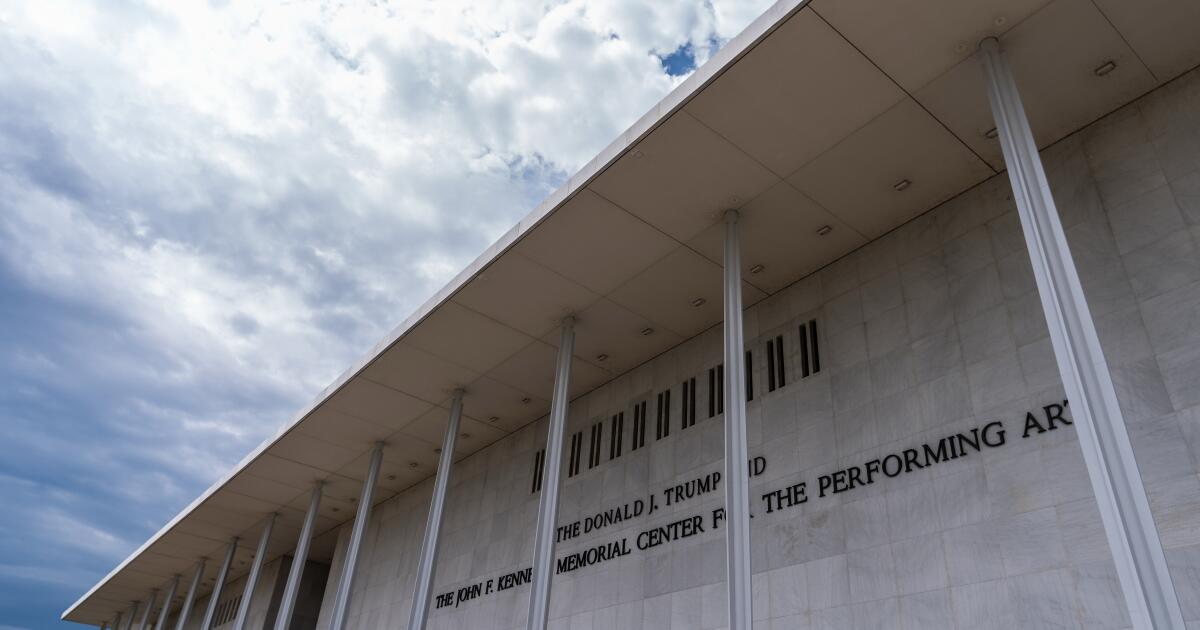
The addition of Trump’s picture and signature to the passport book is the newest step his aides have taken to increase the president’s visibility, including adding his name to the U.S. Institute of Peace building and the Kennedy Center performing arts venue.

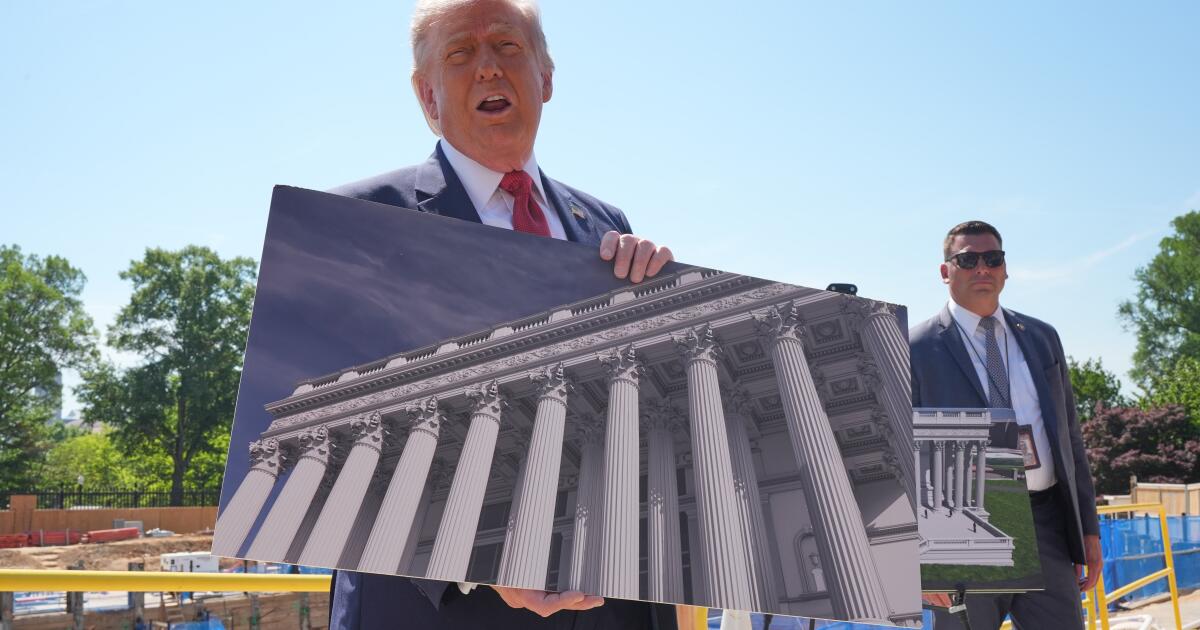
Trump also has made waves with his plans for a new White House ballroom and a massive arch to be built at one of the entrances to Washington from Virginia.

Lee writes for the Associated Press.

Source link

How L.A., LACMA’s David Geffen Galleries changed architect Peter Zumthor

During a recent Zoom interview from his studio in Switzerland, Peter Zumthor offered a candid look at the making of the Los Angeles County Museum of Art’s new David Geffen Galleries.

The Pritzker Prize-winning architect addressed long-standing criticisms of the building and answered questions about his craft. He noted that the structure is a rejection of the overly “slick” architecture he believes defines the present moment, and shed light on the building’s early development, describing a contained process in which the concept was shaped before being presented to the public.

Finally, he discussed the broader ambition of the endeavor: dissolving traditional circulation and prioritizing emotional experience over institutional order.

The following interview excerpts have been edited and condensed for length and clarity.

You are wellknown as both an architect and a craftsman. I think the biggest place for that focus was the concrete. I’m curious about how you formed it. It’s not the typical museum concrete.

I work like an artist in building. This means I custom-make buildings. I can use a few standard details or products, like in the basement. But where the building has an identity, becomes visible, it’s almost all handmade. I have an image of what I want to do, what the building should do, how it should look. So I need people who can help me make custom-made products.

The people who did the formwork — the concrete pouring — [worked in] groups of 100 or more. They were fantastic. They loved their work. At the beginning, formwork leaked on a door, and it looked terrible. They said, “Peter, we’re sorry. We made a mistake. We can fix this. You will not see this afterwards.” But if you make a mistake, you cannot mend it, because what you’re doing here is a concrete sculpture. Sculptures are never mended.

It’s not a perfectly smooth concrete. I’m assuming that’s on purpose?

I love this kind of rawness. This was what I gladly learned. Michael [Govan] in a very friendly, careful way let me know that he would like more “American details” and fewer “European details.” OK, my European details, they stand. That’s what I did 20, 30 years ago. My background as a furniture maker shows, and I can do this. But the challenge in this museum is to get the right “American” roughness. And I think I pretty much succeeded.

What I learned in California [came] back to Europe, and many times we now say in the office, “Let’s do this more L.A.-style.” Because we have too many slick magazines in the world. We have this corporate architecture which doesn’t want to see any touch of a hand. No mistakes. What we need is not refinement. We need wholehearted directness. This is what I take back from America. There’s a certain freshness. It’s not overly refined. I’m proud of that. The roughness has to do with our times. Because our time is slick and glossy, right? The time to make refined, slick architecture is over.

A concrete museum gallery.

Horizontal light enters from floor-to-ceiling windows around the perimeter of LACMA’s new David Geffen Galleries, which use concrete as a kind of living building material.

(Iwan Baan)

In a 2023 interview with [architecture critic] Christopher Hawthorne, you said there were no “Zumthor details” left in the building. Do you think there are any Zumthor details now?

Of course there are Zumthor details. And I love them. They are not Swiss details. I think Christopher got this wrong. I was actually proudly speaking of how I learned a new way of looking at details. It doesn’t have to be refined all the time.

[Editor’s note: Zumthor told Hawthorne verbatim, “There are no Zumthor details any more,” in the 2023 interview with the New York Times.]

There’s always a tension with every building when it comes to value engineering. Were there any other places where you would want [David Geffen Galleries] to be different?

Basically, I say no. I’m very proud of this building. This is what I wanted to do, and this is what Michael helped me to do. This is exactly it. It’s one of my children and I love it.

Do you see this approach as an evolution in your work? Or is it more specifically for L.A.?

L.A. has changed me. And it’s in a good way. I would [not] have changed and reacted to our slick times the same way without L.A.

There were complaints that the project, and the process, were not as public as some people thought they should be. What is your reaction to that criticism?

I think I can say this: Michael said, “We cannot make a competition or anything like it, because competitions in the U.S. always end up with a winner who doesn’t build because he found out his own way of staging this whole procedure. The first, the most important thing, is that we start on a small budget, just the two of us.” That’s what we did. So when we started to talk about this museum, it was him and me, basically, and he gave me a little bit of money. And he said, “There will come a time when we will have to show something to the public. Let’s see whether people say yes.” They could have said no, but I think what they saw at that point was already too convincing.

Architect Peter Zumthor speaks at the press preview for the David Geffen Galleries at Los Angeles County Museum of Art.

Architect Peter Zumthor speaks at the press preview for the David Geffen Galleries at Los Angeles County Museum of Art.

(LACMA/ Museum Associates / Gary Leonard)

Because the museum’s not organized in a traditional way, it might be harder than normal to navigate for some people. It might be a little confusing. What do you say to that concern?

This will take some time, to see the benefits of this new type of museum. I think if you start to like this building in one corner or in another, or you get lost, you start to understand what it is all about. When something new comes, you have to learn, right? But I hope you can see this building never looks down on you. This building is, in a way, deeply human. And it lets you have your opinion.

There are people who have said, very loudly, this space shouldn’t have lost square footage. What is your response to that?

Small museums are beautiful, big museums tend to be really difficult. And the bigger the museum gets, the more difficult it is to make it easily accessible. So I’m very glad that this is not bigger. But it feels bigger.

What is this with bigness? What kind of a hang-up is this? You don’t have to be big. It has the right scale. We were often asked, “Can you experience this building and this collection in one day?” And we said, “Maybe. But maybe it will be better to come back.” Start from the other end. You have your own personal path. And then you research a little bit further. I think these are the beautiful ideas of how to experience the building. And I think it’s endless.

The interior of a concrete museum.

The interior of LACMA’s new David Geffen Galleries encourages guests to wander and make their own connections rather than follow a linear path.

(Eric Thayer / Los Angeles Times)

Can you go back to the beginning and talk about the core concept for the museum?

There are three major things that I always have to answer, whatever I do. What does the building do with the place? Does it help the place? Does it interpret the place? And then, what is the content of the building? What does the building have to do? Why are we building this?

To start out, there was a museum here which was modeled a bit after Lincoln Center. Later, it got clogged up with new buildings and you didn’t recognize the initial idea anymore. These things we took away. Whenever a building is there, whether it’s beautiful or ugly, it will always have grown into the soul of somebody. There will always be people saying, “No, no, I want to keep it.” This is part of my life. I understand this kind of thing always comes up.

The place was rather difficult because I couldn’t see any big urbanistic concept in L.A. L.A. [is] not urban in the European sense with, for instance, the market square.

There was a master plan, which was made by Renzo Piano. And this presented a long axis, and I tried to follow it. It just did not feel right. So I started to react in a more organic way, inspired by the tar pits. This whole area, which to me, is the ancient part of the site, became the starting point.

There was more: like the idea that side light is the most human light. Yeah, no skylights. And another thing was the museum had to be open to its surroundings. So contemporary L.A. should be present at all times. It should come in, whenever you can look out.

Another important thing … was to create or enlarge the public space that Michael [Govan] had started to create between his buildings. Friday evenings, Saturday, you saw so many families there. There is a desire here, a wish, for public space. This is not exactly the strength of L.A. So I think it was amazing that we were allowed to lift up the building and have the whole ground free for people.

Also, let’s do the museum on one level only. Classical museums have a main level, then they have a second level and a third level, a south wing and north wing and so on. And then, as an artist, you can have your work on the main level in the most beautiful spot. But as an artist, you can also land top left, third level near to the attic. So let’s make a building type which treats everybody equal.

A lofted museum building.

LACMA’s David Geffen Galleries are hoisted above the ground on discrete piers, allowing for ample public space below.

(Eric Thayer / Los Angeles Times)

And then we started to think about how we wanted something open for wandering, experiencing and dreaming. This is always difficult to explain — let’s have the knowledge of art, of the history of art, coming second. It’s not because I think this is a secondary thing. It’s just because our experience should come first.

As a boy, I saw the opposite. There’s a tour and there’s a guide, and the guide starts to tell you what you should think. And I never liked this. We thought we should lay out things on a big plane where you can stroll and wander and develop your interest in art. Follow your own path.

You’re overturning a lot of unspoken rules in the art world. And I guess that’s the point in a lot of ways?

This is our point. You see other rules. For instance, if you do a new museum, the conservators say art can be exposed to less daylight. I told them as a joke, “If it goes on like this, soon the art will be in the basement, locked away.”

We have a building wide and long enough that within the building, you can find strong daylight for, let’s say, china or pottery, which love daylight. Then you can go deep into the building where it gets darker, and you can put pieces you don’t want to expose too much to the light. All without having to flip a switch.

Source link

Inside LACMA’s David Geffen Galleries lavish opening gala

Finding a revolutionary artist during cocktail hour at the opening gala of Los Angeles County Museum of Art’s new David Geffen Galleries was like shooting fish in a barrel.

Gaze over the rim of your glass to notice Jeff Koons and Ed Ruscha talking closely beside the DJ booth. Mark Bradford strides by with a beneficent smile — towering over everyone, including AI art maker Refik Anadol. Todd Gray, whose 27-foot-long photo sculpture “Octavia’s Gaze” graces the hallway near the building’s south entrance, chats with Wim Wenders, who is making a documentary about architect Peter Zumthor’s controversial new $724 million concrete behemoth. Zumthor is there too — in bright red sneakers — talking to LACMA director and chief executive Michael Govan before Govan turns to take a selfie with immersive installation artist Do Ho Suh.

Jeff Koons talks with Ed Ruscha.

Jeff Koons, left, talks with Ed Ruscha at the opening gala for LACMA’s new David Geffen Galleries on Thursday.

(Jessica Gelt / Los Angeles Times)

Lauren Halsey walks by in her distinctive white shirt, long shorts and ball cap, beset on all sides by friends and admirers.

“It’s beautiful, it’s fantastic,” she said of Zumthor’s creation.

It’s an artist’s world on this breezy evening, as the sun sets golden over the looming gray concrete of the building, and the lights that gird the structure’s underbelly flicker on and twinkle like stars overhead. In this milieu, Hollywood A-listers like Will Ferrell and Sharon Stone, who occupy separate cliques nearby, pale in comparison to the mingling artistic luminaries.

Peter Zumthor and Michael Govan chat.

Architect Peter Zumthor, left, and Michael Govan attend LACMA’s opening gala for the David Geffen Galleries. Govan said he hopes the building lasts 500 years.

(Gina Ferazzi / Los Angeles Times)

“It’s ready for us,” Bradford said of the building. “It’s ready for artists. I walked in and I was overwhelmed with a space that was made for us, and I can’t wait for everything I can do.”

“Snazzy. Does the job,” said Ruscha, looking bemused and speaking in short bursts of headline-style phrases like one of his famous paintings.

Gray said he was glad to see his art during “magic hour,” noting how the setting sun shone warm through the building’s glass windows — diffused by textile designer Reiko Sudo’s chromium spattered curtains — to imbue his photo installation with a distinctive warmth.

“I’ve never seen it at dusk,” Gray said with a smile. “It was a totally different experience to see it at that time of day. And [the light was] actually yellow, so the piece changed … and the concrete warmed up because of that warmer light. It was a lovely chromatic experience, which is wonderful because then you’re aware that you’re experiencing something in a very particular space and time.”

James Goldstein, the owner of architect John Lautner’s famed Sheats-Goldstein Residence, which he promised as a gift to LACMA in 2016, agreed with Gray that the gloaming light was lovely.

“If it were up to me the curtains wouldn’t be closed,” Goldstein said, noting that the curtains in his home — which is also made of concrete and glass — are never closed, and that the views from the Geffen Galleries are extraordinary and worth leaning into.

Koons said the building, and the moment in time that defines its unveiling, has the potential to bring the world together.

“It’s an amazing evening for all these people that love and believe in the value of art and humanity to be together and to celebrate architecture,” said Koons, noting that he looks forward to showing his art inside the new galleries. “LACMA is a place that’s here for future generations and Peter’s building is amazing.”

Will Ferrell and Viveca Paulin pose in front of a building.

Will Ferrell and Viveca Paulin were among the major Hollywood stars at the gala.

(Gina Ferazzi / Los Angeles Times)

Chatter about the building could be heard in every cluster of guests. One group talked about how striking it was to see ancient Greek sculptures juxtaposed against the rush of traffic along Wilshire Boulevard; another discussed their hope for more landscaping, noting that the concrete ground and concrete building begged for some lush greenery.

Govan basked in the limelight nearby, shaking hands and doling out hugs and back pats. His vision for the building has been 20 years in the making, and he’s faced an enormous amount of pushback, but the structure is here and his enthusiasm for it has not waned.

“I’ve just always imagined people in the building — it’s for people,” Govan said. “And I want it to last 500 years, I want those little drill marks to accumulate, I want change. I want this to be something that generations will care for.”

Zumthor also seemed deeply pleased with the moment, saying, “I’ve always been happy,” and emphasized that working in L.A. taught him to embrace a certain frontier-like lack of refinement.

LACMA’s staff was elated, especially those who have been watching the project develop for decades and absorbing the large amounts of criticism that have accompanied its manifestation.

Stephanie Barron, LACMA’s senior curator and modern art department head, said, “This is the first night with our art world colleagues and donors, and it’s thrilling to see how they are responding, and how they are a little confused, at first, about where to go. Then they realize, that’s the point of this — and they are just going with the flow and they are smiling and happy and looking at the art. It’s a game changer.”

“I’ve been here nearly 20 years and seeing this going from concept to reality has been the greatest thing,” said Tiffany August, associate vice president of LACMA’s people and culture department, which oversees human resources. “So much soul and heart and effort went into this.”

Arun Mathai, budget officer and head of finance, has also been with the museum for 20 years and said it’s exciting to finally be on the other side of the project. “To see it happen in such a beautiful way is very gratifying. The notion of no hierarchy, of wandering around and seeing art from all over the world, from all time periods beautifully juxtaposed, it’s just so enlightening,” Mathai said.

A group pf people talk and smile.

Michael Govan, left, Peter Zumthor, Holly J. Mitchell and Mayor Karen Bass attend the opening gala.

(Gina Ferazzi / Los Angeles Times)

Later, during a four-course meal of broiled oysters, tuna tostadas, braised Wagyu short ribs and berry meringue, various LACMA supporters, including board co-chair Tony Ressler; life trustee and major donor Lynda Resnick; and L.A. County Supervisor Holly J. Mitchell, whose district houses LACMA, took to the stage in a tent set up west of the new building to sing the praises of the Geffen Galleries — and to note that the evening’s dinner raised a record-setting $11.5 million. (The Geffen Galleries’ ongoing fundraising campaign now stands at $869 million.)

“This is a great, great example of what can be achieved when government and philanthropy work hand in hand for the public good,” Ressler said before thanking Govan for “taking bold risks.” “Your legacy is now permanently etched in the stunning galleries that will open to the public very soon.”

Mitchell was full of praise for Govan and Zumthor.

“The Geffen Galleries didn’t come to fruition overnight. And frankly, nothing that changes the status quo ever does,” Mitchell said. “To Michael, Peter, David [Geffen] and our dear Elaine [Wynn], thank you for your patience, because visionaries like yourselves often have to wait for the rest of the world to catch up with you.”

Resnick got a big laugh when she described her first meeting with Govan and his wife 21 years ago.

“An exquisite couple walked into [vice chair of the board] Bobby Kotick’s house. There was Michael Govan, a true intellectual, Zen thinker, movie star handsome, and under consideration to run LACMA. By the end of the evening, I was sitting on his lap feeding him peeled grapes.”

She concluded on a more serious note, calling the Geffen Galleries a “masterpiece of public art.” “Only one person in the world could have done all this with the signature elegance and his provocative style,” she said of Govan. “Generations will cross that bridge and watch the cars stream below, and feel the power of being embraced by art above all the gorgeous chaos of our city.”

After a standing ovation, Govan introduced musicians Sean Watkins, Gabe Witcher and T Bone Burnett, who sang — quite fittingly — “The Times They Are A-Changin.’”

Source link

Prosecutors sought access to Federal Reserve building as Trump threatens to fire Powell

Federal prosecutors made an unannounced visit this week to a construction site at Federal Reserve headquarters that is the focus of an investigation into a $2.5-billion renovation project, according to two people familiar with the visit.

Two prosecutors and an investigator from U.S. Atty. Jeanine Pirro’s office were turned away on Tuesday by a building contractor and referred to Fed attorneys, one of the people said. The two people familiar with the visit spoke on condition of anonymity because they weren’t authorized to publicly discuss an ongoing investigation.

The visit underscores that the Trump administration is not backing down from its investigation of the Fed and its chair, Jerome Powell, even though the probe has delayed the confirmation of a new chair nominated by President Trump. The investigation is focused on cost overruns and brief testimony about the project last summer by Powell. Trump confirmed in an interview that aired Wednesday on Fox Business that he wants to continue the probe.

Last month, during a closed-door hearing before a federal judge, a top deputy from Pirro’s office conceded that they hadn’t found any evidence of a crime in their investigation of the headquarters project.

Robert Hur, an attorney for the Federal Reserve board of governors, sent an email to Pirro’s prosecutors about their visit and their request for a “tour” to “check on progress” at the construction site. Hur’s email, which the Associated Press has viewed, noted that U.S. District Judge James Boasberg concluded that their interest in the Federal Reserve’s renovation project was “pretextual.”

“Should you wish to challenge that finding, the courts provide an avenue for you; it is not appropriate for you to try to circumvent it,” Hur wrote.

Republican Tillis is key vote

Sen. Thom Tillis, a North Carolina Republican who is a key member of the Senate Banking Committee, has vowed to vote against Kevin Warsh, Trump’s nominee to replace Powell as Fed chair, until the investigation is dropped. With the committee closely divided on partisan lines, Tillis’ opposition is enough to block Warsh.

The Banking panel said Tuesday that it will hold a hearing on Warsh’s nomination April 21. Powell’s term as Fed chair ends May 15, but Powell said last month he would remain as chair until a replacement is named.

Powell is serving a separate term as a member of the Fed’s governing board that lasts until January 2028. Chairs typically leave their posts as governor when their terms as chair end, but they can remain on the board if they choose.

Last month, Powell said, “I have no intention of leaving the Board until the investigation is well and truly over, with transparency and finality.” If he remains in his seat, even after Warsh is confirmed, it would deny Trump the oppotunity to fill a seat on the seven-member board.

Late Tuesday, Tillis posted a link on social media to the Wall Street Journal’s article on the visit below an image of the Three Stooges and wrote, “The U.S. Attorney’s Office for D.C. at the crime scene.”

Investigation centers on building renovations

The investigation by Pirro’s office centers on an appearance by Powell before the Senate Banking Committee last June, when he was asked about cost overruns on the Fed’s extensive building renovations. The most recent estimates from the Fed suggest the current estimated cost of $2.5 billion is about $600 million higher than a 2022 estimate of $1.9 billion.

“It is probably corrupt, but what it really is, is incompetent,” Trump said on Fox Business. “Don’t you think we have to find out what happened there?”

The president’s support for the investigation threatens a time frame set out by Sen. Tim Scott, a South Carolina Republican who chairs the Banking Committee. Scott said Tuesday on Fox Business that he believed the investigation would be “wrapped up in the next few weeks,” allowing Warsh to be confirmed soon after.

Threat to fire Powell

News of the unannounced visit by prosecutors comes as Trump has again threatened to fire Powell, if the Federal Reserve chair decides to stay on the central bank’s governing board after his term as chair expires next month.

“Well then I’ll have to fire him, OK?” Trump said when reminded that Powell has said he won’t leave the Fed while the Justice Department investigates a $2.5-billion renovation project at the bank. Powell has also said he will remain as chair of the Fed’s rate-setting committee until a replacement is confirmed by the Senate, following the precedent of previous chairs.

Trump has for months wanted to remove Powell as chair of the Fed, saying he has been too slow in orchestrating interest rate cuts that would give the U.S. economy a quick boost. Powell has said the investigation is a pretext to undermine the Fed’s independence to set rates.

Supreme Court weighing another Trump removal

Trump’s threat to fire Powell comes as the Supreme Court is weighing the president’s effort to remove another central bank governor, Lisa Cook. Lower courts have so far allowed Cook to remain in her job while her legal challenge to the firing continues. The Supreme Court also seemed likely to keep her on the Fed when the court heard arguments in January. A decision could come any time.

The issue in Cook’s case is whether allegations of mortgage fraud, which she has denied, is a sufficient reason to fire her or a mere pretext masking Trump’s desire to exert more control over U.S. interest rate policy.

The Supreme Court has allowed the firings of the heads of other governmental agencies at the president’s discretion, with no claim that they did anything wrong, while also signaling that it is approaching the independence of the nation’s central bank more cautiously, calling the Fed “a uniquely structured, quasi-private entity.”

Kunzelman and Rugaber write for the Associated Press. AP Writer Mark Sherman contributed to this report.

Source link