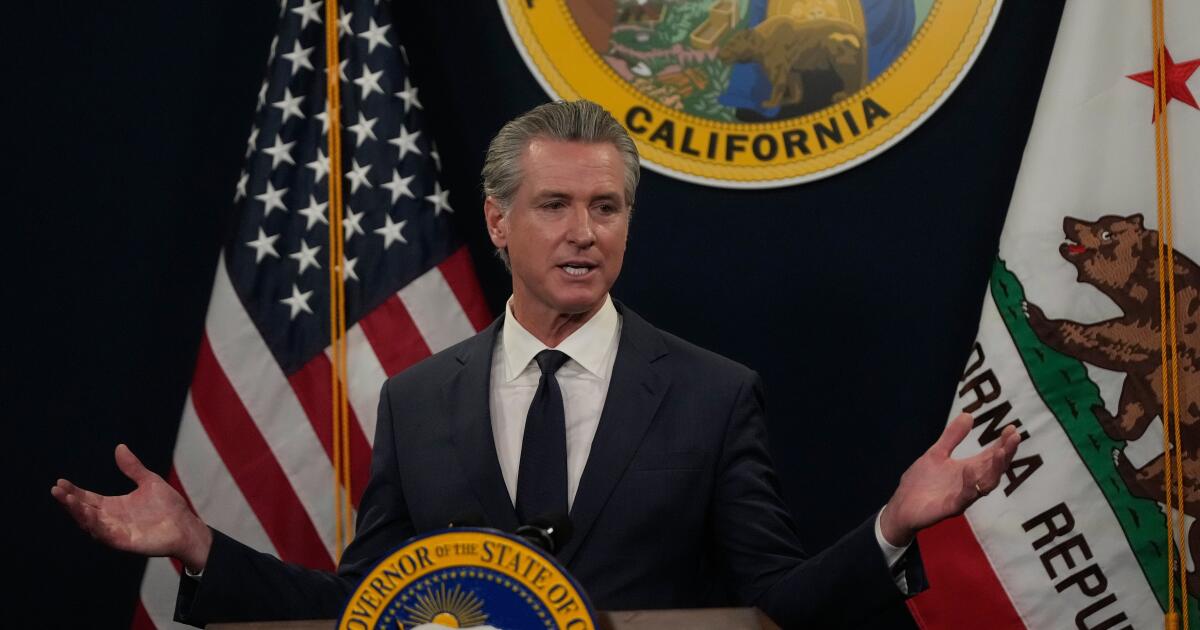
SACRAMENTO — One of Gavin Newsom’s top goals as he winds down his final year as California governor is to leave the state with a balanced budget.
After years of the state spending more money than it brings in, it’s Newsom’s last opportunity to fix a chronic deficit or dump the problem on the next governor.
How far he goes to solve the state’s structural spending imbalance will define his legacy as a steward of trillions in taxpayer dollars. As a potential candidate for president in 2028, he could also have a political incentive to do as little as possible.
“Any cuts you make are going to cause people to scream,” said Darry Sragow, a veteran Democratic strategist. “Any increases in taxes are going to cause people to scream and in terms of what’s best for a presidential run, it would be nice if people weren’t screaming.”
As California’s 40th governor, Newsom expanded publicly funded healthcare to income-eligible undocumented immigrants, increased state-subsidized child-care slots and provided free meals for schoolchildren among a wishlist of progressive wins since he took office in 2019.
His achievements have helped struggling Californians live in an increasingly unaffordable state and given him bona fides to tout to voters if he launches a bid for the White House.
But the state could never afford to pay for existing services and the new programs that Newsom and Democratic lawmakers enacted, according to an analysis of ongoing state spending since before the pandemic released by the Legislative Analyst’s Office last week.
Spending from the state’s principal operating fund has grown about $100 billion since Newsom’s first full fiscal year in office in 2019-20, mostly due to the growing cost of existing programs that he inherited. State spending has outpaced California’s strong revenue growth by about 10%, creating a perennial budget shortfall — a structural deficit — that Newsom and the Democratic-led Legislature solve with largely temporary fixes each year.
Instead of making across-the-board program cuts or raising taxes to align spending with revenue, Democrats have tapped into reserves designed to preserve social services for the state’s most disadvantaged communities during economic downturns.
While the California economy remains stable and state revenue has increased, Newsom and lawmakers have taken $12.2 billion from the rainy day fund. Democrats have borrowed $28 billion more from other state funds to cover their spending in recent years, according to the LAO.
“Taken together, these trends raise serious concerns about the state’s fiscal sustainability,” Legislative Analyst Gabriel Petek wrote in a review of Newsom’s January budget proposal.
Fiscal watchdogs have warned that the spending trends will leave California in a precarious position if the stock market tanks and tax receipts bottom out.
Personal income taxes are driving higher-than-expected revenue now, which analysts attribute to an artificial intelligence boom on Wall Street, and suggest the state could have no deficit in the upcoming year. In January, the Newsom administration anticipated significant operating deficits in the years ahead: $27 billion in 2027-28, $22 billion in 2028-29 and $23 billion in 2029-30.
The LAO, the Legislature’s nonpartisan fiscal advisor, said the state has already solved $125 billion in budget problems over the last three years with mostly short-term solutions.
“This issue is really whether they’re going to take seriously the structural deficit that is several years in the making now, where the spending has outpaced revenue, and to address that, they’re going to either have to make some fairly deep cuts or raise revenue and or both,” said former state Controller Betty Yee, who worked as a budget aide under Gov. Gray Davis and recently dropped her own campaign for governor. “But they have to be real. I think resorting to these one-time solutions has really exacerbated the problem.”
How Newsom wants to address the state’s financial challenges will be revealed on May 14 when he is expected to present his revised budget plan in Sacramento. His January budget proposal did not include any significant reductions or cuts to programs.
H.D. Palmer, a spokesperson for the California Department of Finance, said the governor is looking to solve the budget problem with more than a temporary fix.
“Although he is still finalizing his proposal that he’ll put forth to the Legislature, as he has said, he wants those solutions to be durable, and he wants them to have an impact beyond a single fiscal year,” Palmer said.
To stabilize California’s budget, Democrats will probably have to raise taxes or fees to generate new revenue and cut programs, according to the LAO. At least 40 cents for every dollar in revenue is dedicated to education under the state Constitution, requiring policymakers to find between $30 billion and $60 billion annually in additional revenue to cover projected shortfalls in 2027-28 and beyond if relying on new taxes alone.
President Trump’s cuts to healthcare are adding to the problem.
HR 1 will add $1.4 billion in state costs to the general fund. Newsom’s January budget proposal did not include a plan to help millions of low-income Californians who are expected to lose access to healthcare under the federal cuts.
To temper those cuts in California, other groups proposed a new tax on billionaires that appears poised to qualify for the November ballot.
Spearheaded by Service Employees International Union-United Healthcare Workers West, the initiative would apply a one-time 5% tax on taxpayers with assets exceeding $1 billion. If approved by voters, the tax would generate roughly $100 billion, which would fund healthcare programs.
The measure has divided unions and Democrats at the state Capitol.
Newsom has criticized the initiative, citing concerns that increasing taxes on the wealthy will have the opposite intended effect and drive the highest earners out of California. Under a progressive tax structure, the state budget is dependent on income taxes paid by the ultra-rich on earnings largely from capital gains.
Larry Page and Sergey Brin, the co-founders of Google, have already purchased residences in Florida, along with others looking to escape the tax if it goes through in November. Billionaires launched their own ballot measure campaign to undercut the tax proposal.
State lawmakers are also considering avenues to raise revenue, which include repealing a “water’s edge” tax break. Under the change, multinational companies would no longer be allowed to shield the income of their foreign subsidiaries from state taxes. California loses about $3 billion in revenue from the tax break each year.
In its budget plan released in April, the state Senate proposed a new fee on the largest corporations in the state to provide $5 billion to $8 billion annually for Medi-Cal.
The upper house said 42% of Medi-Cal enrollees are full-time workers who are not enrolled in their company’s healthcare plan because their wages are low enough to qualify for state-subsidized healthcare. As a result, corporations aren’t paying for healthcare for many of their employees and instead taxpayers are picking up the bill through Medi-Cal.
SEIU California, the powerful state union council representing over 700,000 workers, endorsed the plan. The union said Trump’s tax policy will reduce corporate taxes by $900 billion, while 3 million Californians lose healthcare.
“In this urgent moment, California’s workers need to see our leaders show us what they’re made of,” said Tia Orr, executive director of SEIU California. “The Senate is showing the courage to demand corporations pay their fair share, rather than making working people pay with their lives.”
The change is being described as a more politically palatable “fee” and not a tax.
“We explored multiple revenue options, and this was the one that felt more narrow, it felt more focused, and it also felt like it was directly going for the subsidy that’s being lost because of the Trump HR 1 cuts,” said Senate President Pro Tem Monique Limón (D-Goleta), who leads the upper house of the Legislature.
Limón said her caucus believes it’s important to address potential revenue streams because of the depth of federal healthcare reductions.
“If we don’t address the structural deficit, we are looking at severe cuts,” she said. “You are looking at people without health insurance. You are looking at hospitals closing down. You are looking at medical providers not being able to take more patients. You are looking at our emergency rooms over capacity, with not enough medical providers. I mean, you’re looking at a place that’s really, really, really difficult, and we feel like we have to, at least, look at what are viable options that are conditional on these cuts coming.”
Newsom has not commented publicly on the Senate’s plan. As governor, he’s been reluctant to embrace new taxes and fees.
Newsom could reject all the proposals for new taxes or fees and continue what he’s done before: take advantage of higher-than-expected tax collections, shift funds around, delay program implementation and borrow money to knock the deficit down to zero, or forecast a surplus, for his last budget year that begins July 1.
If he doesn’t take on California’s larger budget imbalance, then the problem would be the next governor’s to solve. A stock market crash, or economic recession, could force his successor to make drastic cuts across the board with limited reserves to support programs.
Kicking the can again would cement Newsom’s fiscal legacy as a governor who championed bold headline-making policies that bolstered the safety net for low-income Californians, but who failed to provide a solution to pay for his agenda.
“Not only has he not come up with a plan, he has pretended we don’t need one,” said Patrick Murphy, a professor of public affairs at the University of San Francisco.
Newsom’s interest in running for president could seemingly discourage him from slashing the budget and raising attention to the state’s financial woes, Sragow said. Newsom is setting himself up as a potential front-runner for his party. He has said he remains undecided about officially launching a 2028 campaign.
As a Democrat from California, his opponents would automatically label him as financially irresponsible and tax-happy. Calling out the massive budget problem on the horizon, raising taxes and making painful cuts will give them ammunition.
“There’s a long list of things that he’s going to be charged with, and this is likely to be one more,” Sragow said. “But I guess the question is, is he going to be charged with a political misdemeanor or a political felony?”
Former state Sen. Steve Glazer said Newsom is standing on political quicksand either way. State budget projections are based on assumptions about the future that often don’t bear out, leaving his choices exposed to criticism that he went too far, didn’t do enough, and everything in between.
“Whatever the governor decides to do in his May revise and in his final budget, it’s fraught with political risks, because it can be manipulated so easily by all sides,” Glazer said.
If Newsom ignores the spending problem, his successor could blame him for California’s financial woes when they take office in January and provide their own outlook of the state’s fiscal future. At the time, Newsom could be trying to convince America to make him the nation’s next president.
Murphy said Newsom has championed major policies and been reluctant to back off them later when revenue doesn’t pencil out.
In terms of spending, he’s governed similarly to the men who led California before him, with the exception of Jerry Brown, who cut programs to reduce a deficit he inherited in his second stint in the governor’s office and left Newsom with a surplus.
“It’s not all that different than most of the governors have done, which is finding it very hard to say no and finding it very hard to take on a tough choice of going to the ballot to ask for more money or raise taxes,” Murphy said.
On taxation, Newsom is perhaps most similar to former Gov. George Deukmejian, who opposed general tax increases for most of his administration.
Deukmejian left a budget disaster for his successor, Gov. Pete Wilson. Deukmejian publicly claimed he passed a balanced budget in his final year and blamed an economic downturn for the problems Wilson encountered.
When Wilson announced a record $13-billion budget deficit early in his first year in office in 1991, he said the Persian Gulf War, an economic downturn and natural disasters added to a structural deficit in the budget.
The Legislature and Deukmejian, Wilson said, had “papered over” the problem.