Budapest

My search for the perfect ruin bar in Budapest | Budapest holidays

‘Many ruin bars seem to be just tourist traps now,” says artist István, standing outside Instant-Fogas complex, which calls itself Europe’s biggest ruin pub, but looks more like a mammoth nightclub with several dancefloors.

“These bars were a hot topic 20 years ago, but many have become really commercial now,’ says István. “Ruin bars being expensive actually ruins their purpose. I’m a student, I like beers that are under 1,000 forints [about £2.50], and the big commercial ruin bars are typically much more expensive.”

Ruin bars (or romkocsmák) emerged mainly in Budapest’s historic Jewish Quarter (District VII) in the early 2000s when abandoned, prewar buildings and empty courtyards were transformed by young entrepreneurs into cheap bohemian art spaces that flaunted their dilapidation. They were typically peppered with fairy lights and mismatching secondhand furniture and artefacts.

Many have since lost their ruin bar essence and aesthetic, and simply host punters on the lash and a stream of guided pub crawls, stag and hen parties. But some proper ruin bars do still exist.

Photograph: Hemis/Alamy

Szimpla Kert (or Simple Garden) is considered the pioneer of Budapest’s ruin bars and can feel overwhelming of an evening on your first visit; it’s much calmer in the day. Gigantic, buzzing, with multiple rooms on two levels, lots of colourful lights and pulsating music, it is undeniably a bit touristy, yet not unpleasantly so.

It has become a community centre, too, with film showings, an art gallery, a farmers’ market, flea market and other regular activities.

Suitably decrepit, with graffitied walls, rough wooden benches, concrete floors, a huge disco ball and plants lining the ceilings, it certainly has character. Nights may have live music and there are DJs, with small bars serving craft beers, cocktails and more. Prices are high for a Budapest bar – about 2,000 forints (£5) for a half litre of lager. Yet with a tatty bar space on such a huge scale completely assaulting your senses, there really is nowhere else like it.
9/10

The perfect example of a ruin bar being ruined. The night I visited, the clientele was 90% male, a high proportion of them out to get drunk.

It’s the kind of mainstream sports bar you’d find anywhere, with football screens and arcade games, but also some rather dilapidated areas (perhaps as a nod to the ruin bar concept, possibly through neglect) and a tree in the middle of an open courtyard.

A £1 charge is added to each relatively expensive drink as a deposit for the ugly plastic cup it’s served in – and that I have no interest in taking away. Of course, many people don’t realise this and don’t get their deposit back, and it is a difficult process if you do: customers are typically directed to another bar with a sizeable queue to get the money returned.

Unsurprisingly, there are critical reviews of Füge Udvar online.
0/10

Photograph: Ben West

With a collection of shabby bar stools and tables inside and out, a chaotic mishmash of artworks on the walls and windows covered in stickers, Fekete Kutya (or Black Dog) certainly cultivates the ruin bar vibe.

“It’s been here since 2013 and used to be a ruin bar for local people,” says student Milan Keleti while serving me a Postřižinské Francin lager (£2.10). “Initially, this was a place for artists, for people that couldn’t afford expensive bars. But, as this area has become more touristy, about half the custom is now from tourists. But it still has the atmosphere, the music, the decor that is fit for ruin bars.”

Although Fekete Kutya is becoming popular with tourists, it has noticeably lower prices than the big, commercial bars. It also has live music.
8/10

While this sizeable District IX space has elements of the ruin bar formula – rooms centred on a courtyard, worn plaster walls, exposed brick, industrial chic, rustic wooden tables and a tree in situ – it has more of the vibe of an east London craft beer bar.

Indeed, it focuses on beers for discerning drinkers – Hungarian and international – with more than 20 on draught each day. Beers from the nearby Fehér Nyúl brewery are particularly popular.
7/10

skip past newsletter promotion


Consisting of a large room with a high ceiling and a vintage cafe look, packed with artwork, graffiti, stickers, fairy lights, mannequins, toys, chandeliers and carpets scattered across the worn floorboards, this very much has the ruin bar vibe. Around two Roman-style pillars – presumably holding up the place – are lots of colourful, rickety little chairs and tables, where locals and visitors chat away, creating a laid-back atmosphere.

Originally a grand late-19th century coffee house frequented by Budapest’s intellectuals and writers, this is still a place to conduct a conversation (Csendes Létterem means “quiet restaurant” in Hungarian), something you might struggle with in some of the larger ruin bars pumping out loud music. Sometimes Csendes hosts events, such as live acoustic music and cinema nights.

A block away from Astoria or Calvin Square, you could perhaps try an Edelweiss wheat beer (half litre £5.70) or maybe a tequila (£4.45).
9/10

Photograph: Ben West

It is heavenly to walk down the steps into this little, off-the-beaten-track basement venue as a six-piece band is playing Hungarian folk songs with gusto, encircled by audience members dancing energetically – and everyone appears to be local.

The true spirit of the ruin bar is alive and well here.

Although, once again, the exact definition of a ruin bar seems to be rather elusive. “It’s not really a ruin bar – but then I suppose, come to think of it, it is a ruin bar,” says bartender Anna Horváth, serving me a gin and tonic in an old jam jar.

While ruin bars were “traditionally” located in District VII, this is very much a scaled-down version of the concept, in District VIII. Also known as Fővárosi Kulipintyó, it is suitably shabby, with a semicircular wooden slatted roof, a worn cream and brown tiled floor, antique posters, plates and, curiously, old boots on display, with beer barrels stacked up by the entrance.

“It’s like being in a second world war Anderson shelter,” says my son Jethro. Although, at 27 years of age, I’m not sure he’d really know what that would be like.

Zsír has live music most nights – which could be klezmer (instrumental Ashkenazi Jewish music), Balkan, Romanian or Latin.

“I come here every night for the live music,” says regular Gyula Márky, straight from the dancefloor. “It’s fantastic. It’s like you’re in a novel or something; it’s really, really special. Dancers, singers and musicians all together: that’s the best thing I can imagine.”
10/10

Accommodation was provided by Up Hotel Budapest, which has doubles from €92, room-only
Source link

Paris Saint-Germain successfully defends its Champions League title

Winning the Champions League was so nice, Paris Saint-Germain had to do it twice.

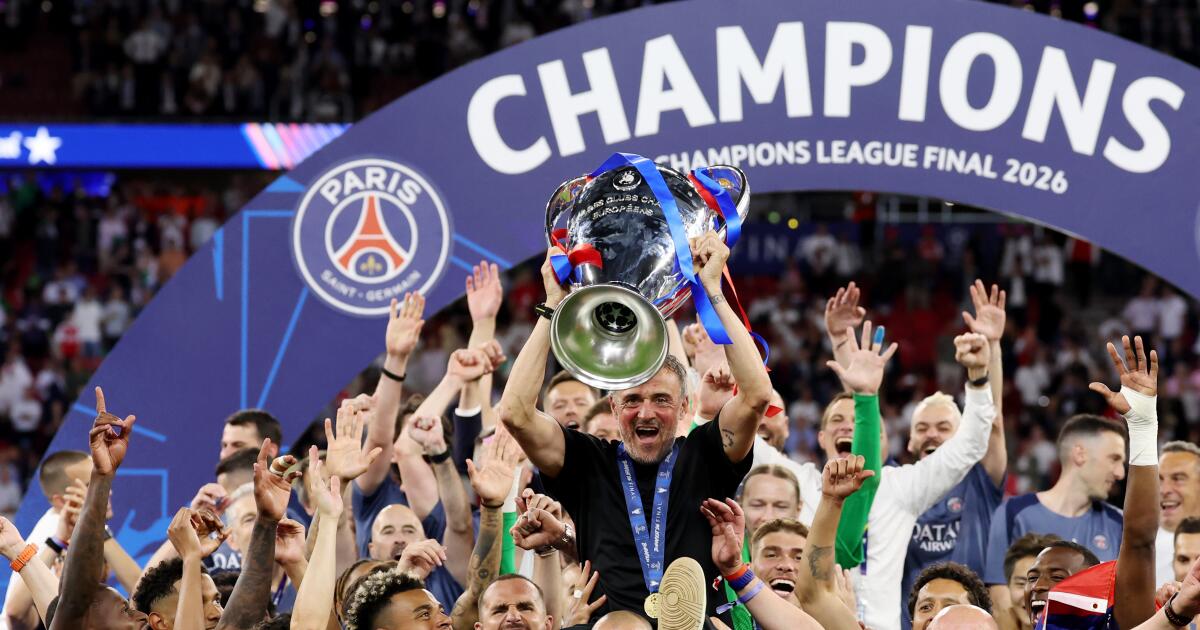
PSG became back-to-back European champion by beating Arsenal 4-3 on penalties in a dramatic final in Budapest that ended 1-1 after extra time on Saturday.

“It’s incredible,” captain Marquinhos said. “From the very first day of this season, the coach said it’s hard to win, and winning twice is even more difficult. So we all had to get back to work. That was the mentality.”

Arsenal defender Gabriel Magalhaes fired the last of his team’s penalties over the bar to hand PSG the shootout win.

The French giant is only the second team to retain the trophy in the modern era after all-time king of Europe Real Madrid.

Luis Enrique became a three-time winner as a coach and has molded a team that is simply too good even for the best the continent has to offer. That includes an Arsenal team that won the Premier League last week and topped the first stage of the Champions League with a perfect winning record, finishing 10 points and 10 places ahead of PSG.

That mattered little in Puskas Arena as PSG reaffirmed its status as the dominant force in European soccer.

“It’s even more special because we knew before the match how difficult it would be,” Luis Enrique said. “I think it’s deserved over the course of the whole season, even if the final was very closely contested.”

After demolishing Inter Milan 5-0 in last year’s final, PSG endured a tougher foe as Arsenal sat deep and relied on the best defense in the competition.

PSG dominated possession but created little after going behind to a Kai Havertz goal in the sixth minute. It took an Ousmane Dembélé penalty in the 65th to level the score and take the final to extra time for the first time in 10 years.

PSG coach in elite company

By going back to back, Luis Enrique achieved what his good friend Pep Guardiola could not after winning Champions Leagues at Barcelona and Manchester City. Luis Enrique joined Carlo Ancelotti, Bob Paisley, Zinedine Zidane and Guardiola in an elite group of coaches with at least three European Cups.

The next target will be to emulate Madrid’s three in a row under Zidane from 2016-18. And with a starting lineup in Budapest with an average age of less than 24, Luis Enrique has built a team that has the potential to dominate for years.

“It’s crazy, it’s crazy. We’re going to enjoy it first, and after we’re going to work and work again because we want more. We are really hungry. We are a young team, and we know we are really ambitious. So next season we have to go again,” Désiré Doué told broadcaster TNT Sports.

Having waited 22 years to get its hands back on the Premier League trophy, Arsenal’s wait in Europe goes on.

This was its 226th game in the European Cup or Champions League without lifting the trophy. No other team has played so many without being champion.

“First of all you have to go through that pain, digest it and then turn it into fuel and improve and reach a different level because it will demand a different level with the quality that is around Europe,” manager Mikel Arteta said.

“I want to congratulate PSG because they are, in my opinion, the best team in the world. What they are able to do with the ball, individual actions, I haven’t seen it (before).”

Robson writes for the Associated Press.

Source link

Champions League final: Arrests in Budapest and investigation into fan brawl

Police in Budapest are studying camera footage to identify supporters fighting before Saturday’s Champions League final between Arsenal and Paris St-Germain.

A police statement said the incident occurred in the early hours of Saturday morning.

Footage emerged on social media showing what was said to be about 30 supporters of each club brawling and lighting flares.

“Several fans got into a fight on May 30, 2026, at around 00:20 in Budapest’s 7th district, on Kiraly Street,” a police statement said.

“The BRFK 7th District Police Department has initiated proceedings against unknown perpetrators for the crime of gang violence, within the framework of which the camera recordings are also being analysed.”

Nearly 4,000 police officers will be deployed across the Hungarian capital for the Champions League final, with tens of thousands of fans expected to travel to Budapest without tickets.

On Tuesday, Hungary’s deputy national police chief Zoltan Janos Kuczik said: “This will be the largest single-day police deployment in Hungary’s history.”

It was described as a “high-risk event” with security preparations beginning more than a year ago.

Two Portuguese and a British man were arrested on Friday following a fight at the Champions League fan festival site and charged with disorderly conduct.

Police said a British man who climbed on to the roof of a parked car and damaged the vehicle was also arrested.

Source link

Champions League: Why Paris St-Germain pose ultimate test for Arsenal in Budapest final

Their Spanish coach is the mastermind of this new PSG, built from the ashes of the superstar era which saw Lionel Messi, Kylian Mbappe and Neymar the centrepieces of a dysfunctional, ego-ridden outfit who never resembled a team.

Luis Enrique, who also won the Champions League with Barcelona in 2015, ordered his players to park egos at the door – or jettisoned those who would not.

In their place is the perfect combination of brilliant individual skill bolted on to a savage work ethic and defensive solidity that will make them a formidable hurdle for Arsenal to overcome.

And the leader is Marquinhos.

The Brazil centre-half arrived at PSG from Roma in 2013, surviving Luis Enrique’s cull of big names because the coach is wise enough to see a consummate professional and world-class defender when he sees one.

He has formed a superb partnership with the formidable Willian Pacho, who played a key role in keeping Kane under wraps until the England captain’s strike in the dying seconds.

Kvaratskhelia and Dembele combined for the game’s defining moment, while 20-year-old Desire Doue – the young face of the new PSG – tormented Vincent Kompany’s side, coming close on several occasions in the second half.

And yet the glue that held it all together was Marquinhos, still peerless at 31, and with the uncanny knack of being in the right place at the right time while exuding calm authority.

To complete the picture, PSG’s midfield of Vitinha, Fabian Ruiz and Joao Neves is the well-oiled engine room linking it all together.

Ruiz’s pass in the build-up to Dembele’s goal was a thing of beauty – but he then reverted to doing the defensive dirty work Luis Enrique demands and which his team seems only too happy to deliver.

Source link