How Israel’s genocide in Gaza pulled Britons into the Palestine movement | Israel-Palestine conflict News
London, United Kingdom – Claire, 52, lives in the Scottish countryside, not far from Edinburgh.
She describes her work as “low-level administration” and does not use social media. She lives a quiet life with her dog, reading and baking in her spare time. Until three years ago, she did not consider herself political.
Recommended Stories
list of 4 itemsend of list
Now, she faces 14 years in prison for her suspected show of support for Palestine Action.
Claire, who requested Al Jazeera withhold her surname, is one of the many people in the United Kingdom who, until three years ago, did not consider themselves activists.
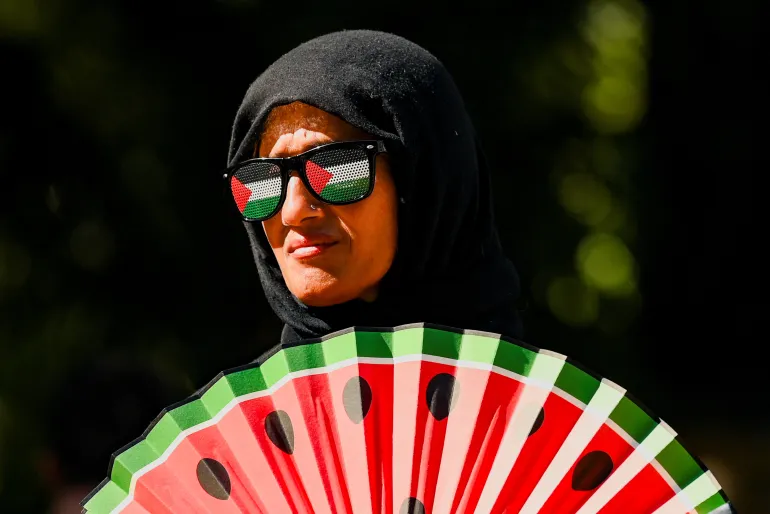
But as the genocide in Gaza was livestreamed, many have rallied around the cause of Palestinian solidarity.
Organisations like Defend Our Juries, Artists for Free Palestine, Workers for Free Palestine, and virtually every other insert-profession-here for Palestine have cropped up across the UK.
In the summer of 2023, Claire read I Shall Not Hate by Dr Izzeldin Abuelaish, a Palestinian physician in Gaza who lost his three daughters to Israeli tank fire. Not long after finishing the book, Claire watched the aftermath of October 7 unfold online.
“For me, there wasn’t a delay between ‘Israel has a right to defend itself’ and then lies,” she told Al Jazeera.
She went to a pro-Palestine rally on Armistice Day, calling for a ceasefire, and “was horrified” by then Home Secretary Suella Braverman, who called the protests “hate marches”.
“I was determined not to ignore [Palestine],” she says.

She continued to march, writing letters to lawmakers and fundraising for various Palestinian aid programmes.
In August 2025, she began publicly protesting against the proscription of Palestine Action with Defend Our Juries, the group behind a campaign of civil disobedience aimed at lifting the ban. To date, more than 3,000 people have been arrested for showing support for the pressure group that was banned in 2025.
Earlier this year, police arrived at her door to arrest Claire under Sections 11 and 12 of the Terrorism Act: “Being a member of a proscribed organisation and encouraging others to join a proscribed organisation.”
“I’ve never been in trouble before,” she says. “I’m not backing down.”

Marji, 70, lives in Colchester and had a similar feeling after hearing Braverman’s words.
“I had never been to a protest in my life,” she says, until she carried a “Ceasefire Now” sign at an Armistice Day march in 2023.
“I knew it wasn’t a ‘hate march’.”
Marji’s father served in the British Army, and her father-in-law was in the Royal Air Force and taken as a prisoner-of-war in Japan during World War II.
“Our parents’ generation fought fascism,” she says. “Now Britain is breaking British law.”
Marji, who also requested to be identified only by her first name, had a successful career in financial services, while her husband held an executive-level role.
They are now retired grandparents.
In July, they were arrested in Westminster under Section 12 of the Terrorism Act and are now waiting to see if charges will be laid.
“We’ve had to decide … is it safe to have grandchildren here? When the police could come to the door?”
Her children remain supportive.
“I think they’re proud of us, even if there’s been fear on their part.”

Across sectors, from the arts to railways, financial services and administration, Britons have risked professional and legal repercussions for the sake of Palestinian solidarity.
Hundreds of thousands have taken to the streets to protest against Israel’s genocidal campaign in Gaza and what they see as the UK’s role in the conflict. They have urged the UK government to cease all arms sales to Israel and cut diplomatic and trade ties as the genocide goes on in Gaza and violence escalates in the occupied West Bank.
This week, tensions have flared again as the Metropolitan Police warned pro-Palestine protesters against rallying on the three-year anniversary of October 7. The force said on Wednesday that five people were arrested outside the Board of Deputies of British Jews in north London for “inciting racial hatred, involving allegedly shouting or chanting slogans calling for Intifada”.
Israel’s latest war on the Gaza Strip – it has waged several since 1948 – began after Hamas, the group that governs Gaza, attacked southern Israel. About 1,200 people were killed that day, while more than 240 were taken captive, including Israeli soldiers, citizens and some foreign nationals.
Since October 7, 2023, Israel’s relentless bombardment has killed more than 74,000 people and devastated Gaza, making life for survivors nearly impossible. The small territory is now home to the largest group of child amputees in modern history.
“The narrative that we had grown up with was wrong – that the people who were there and living peacefully have been cast as ‘terrorists’, when they have suffered terrorism,” Marji says.

Both Marji and Claire spoke about their belief that the UK government is “complicit” in the genocide.
“The government participation, complicity, and their lies. Their gaslighting makes people more determined,” says Claire.
As the legal dangers and rhetorical backlash mount against pro-Palestine protesters, Marji, whose maternal grandmother was Jewish, is only more resolved: “We knew that saying ‘stop the genocide’ doesn’t mean you’re an anti-Semite. We’re not stupid, we can differentiate between Jewish people and people who support illegal occupation.”
Workers for Free Palestine, which includes a range of trade unions, formed in late 2023 and soon began holding protests.
“Many people oppose how their labour is used to prop up an apartheid state, but have been told there is nothing they can do as individuals,” a spokesperson told Al Jazeera.
Many workers are nervous to speak out against their workplace’s role in producing weapons, their investments in Israel, or other ways of enabling Israel’s war.
“Many are unfamiliar with their rights as workers and are afraid of the repercussions of speaking up – and these repercussions can be very real,” the spokesperson said.
Still, for some, there is not just resolve but optimism.
“Doing nothing makes us feel sick, angry and powerless,” says Marji. “I hope people will wake up and see how our own civil liberties … are being eroded to protect the interests of Israel.”