Britain

Trump Kidnapped Venezuela’s President. Now Britain Looks to Profit

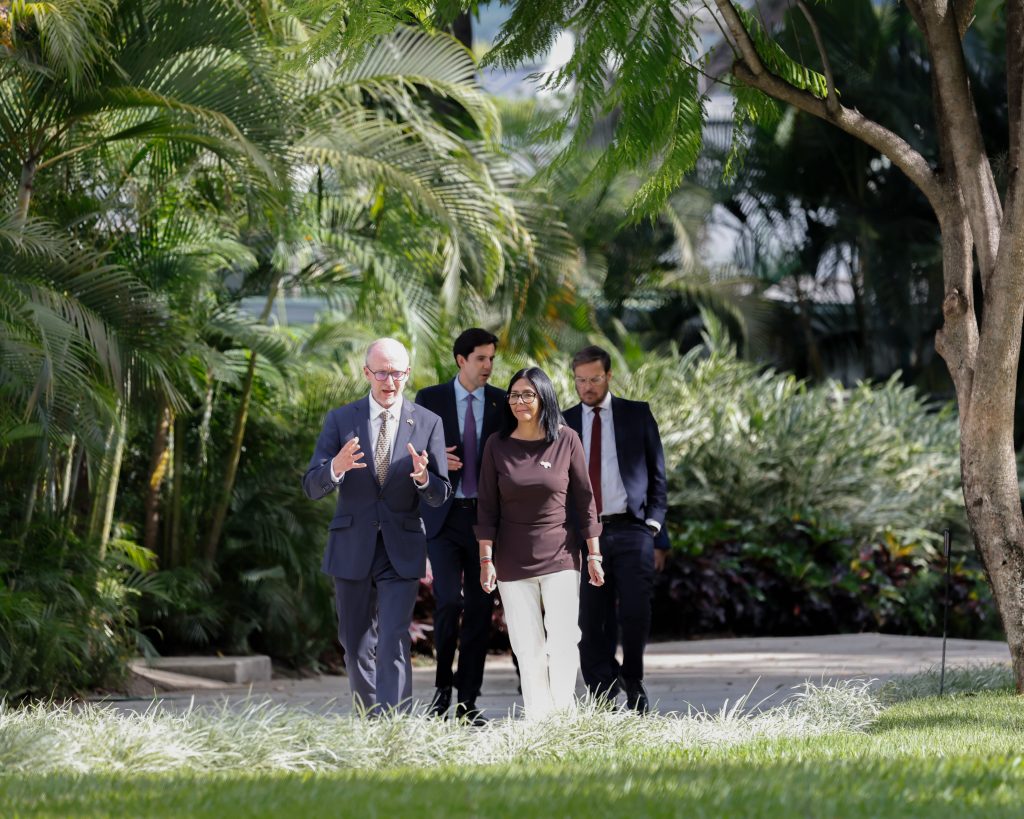
Rodríguez hosted UK Chargé d’Affaires Colin Dick on September 18 in Caracas. (Presidential Press)

Britain’s energy giants stand to make huge profits in Venezuela amid a major diplomatic rapprochement between London and Caracas, it can be revealed.

It comes in the wake of the kidnapping of Nicolás Maduro earlier this year in a move described by UN experts as a “deliberate violation of the most fundamental principles of international law”.

Donald Trump has repeatedly emphasised how the US intervention was motivated by oil interests, even telling the UN General Assembly last week: “To the victor belong the spoils”.

Hours after Maduro’s seizure, Keir Starmer said Britain was “not involved”, but refused to be drawn on whether it was unlawful. “We shed no tears about the end of the regime,” he declared.

The kidnapping is already resulting in a boon for Britain’s energy giants, with interim president Delcy Rodríguez welcoming foreign companies back to Venezuela and softening the country’s hydrocarbon legislation.

Since January 2026, BP and Shell have signed major agreements with the Venezuelan government as it appears to be operating under duress from the Trump administration.

Documents obtained by Declassified indicate how Britain’s Foreign Office has helped facilitate their return, with an influx of high-level meetings between executives and officials taking place in the weeks and months after Maduro’s removal.

The opening of Venezuela’s economy has also paved the way for the normalisation of relations between London and Caracas. Plans were made earlier this month to upgrade diplomatic representation to ambassadorial level.

But serious questions surround benefitting from the kidnapping of a head of state amid a broader assault on Venezuela’s sovereignty.

“US coercive control over Venezuela’s oil revenues may have involved violations of Venezuela’s sovereignty”, said UN special rapporteur Ben Saul.

That includes breaches of “the duty of non-intervention, the right of economic self-determination, and the principle of permanent sovereignty over natural resources”.

Professor Francisco Rodríguez, a leading Venezuelan economist who has advised its national assembly, told Declassified that “deals of this type are much more likely to survive when there is a broad consensus not only on their legal validity but on their desirability for the nation.

“At present, I see many more sectors of Venezuelan society that do not consider these agreements either legal or convenient for the nation, and some of them see them as outright exploitative”.

Rodríguez added: “It is hard to see any truly autonomous Venezuelan leaders signing these deals were a gun not pointed at their head”.

Firesale

Venezuela’s economy has been restructured under Delcy Rodríguez, who assumed power in January and was pictured with Trump earlier this month in New York, just miles from Maduro’s prison cell.

The country’s hydrocarbon legislation has been modified to make the terms more favourable for foreign firms, and its energy revenues are now being diverted through the US Treasury, with Washington taking a major cut.

By July, the US government had collected more than $13 billion in revenues from Venezuelan oil sales, according to the Financial Times.

In August, Trump also announced a “historic oil agreement” with Venezuela which would give the US control of more than 65 billion barrels of oil reserves for 100 years.

The deal would secure “our energy dominance for the next century”, Trump declared, “all at zero cost to the United States”. 

Remarkably, the company at the forefront of that agreement, North American Blue Energy Partners (NABEP), hired three lawyers who had previously worked for the UK’s Serious Fraud Office.

It is within this context that Shell and BP have returned to Venezuela.

Shell has been granted concessions to develop and operate two offshore gas fields, named Loran and Dragon, which are projected to contain vast amounts of recoverable gas.

The company also signed a preliminary deal to develop two onshore oil fields known as Carito and Pirital in Monagas State, one of the country’s most oil-rich regions. 

After signing a memorandum of understanding (MoU) in Caracas in March, Shell’s regional manager Adam Lowmass recalled the company’s “long history in Venezuela, dating from 1912”. He declared: “I could not be prouder of our team”.

BP signed its own MoU with the Venezuelan government in April to develop the Cocuina-Manakin gas field which sits on the maritime border with Trinidad and Tobago.

The company was also granted a licence for the second phase of operations on the Loran field in partnership with Emirati XRG and Qatari UCC Oil and Gas, and has started trading oil in the US.

Shell and BP plan to process Venezuela’s natural gas using the Atlantic LNG plant and export terminal in Trinidad and Tobago, in which they are both major shareholders.

This cross-border presence will give the firms significant control over the supply chain of natural gas in the Caribbean, a large portion of which will be destined for Europe.

Meetings and lobbying

Data obtained by Declassified through the Freedom of Information Act indicates how the Foreign Office has facilitated Shell and BP’s return to Venezuela.

Executives from the companies met with Colin Dick, Britain’s chargé d’affaires in Caracas, eight times in the two months following Maduro’s kidnapping, compared with eight meetings for all of 2025.

While the Foreign Office has refused to disclose what was discussed beyond a few heavily redacted emails, the frequency of the meetings might be seen as implicit endorsement for the energy giants’ new ventures in Venezuela.

Oil has been guiding British foreign policy in Venezuela for over a century. Former foreign minister for the Americas Alan Duncan declared in 2018: “The revival of the oil industry will be an essential element in any recovery, and I can imagine that British companies like Shell and BP will want to be part of it”.

Britain’s current director for the Americas Harriet Thompson was in Caracas in early March 2026 as Shell was gearing up to sign major new energy deals.

Thompson “conducted a productive visit that included meetings at the Venezuelan Foreign Ministry and engagements with representatives of British companies to explore growth opportunities for both countries”, the embassy said.

When asked in parliament whether those talks involved British natural resource companies, the Foreign Office said the question had already been answered in January – two months before the meetings had even taken place.

In its own write-up, the Venezuelan government said the delegation was the first of its kind for years, and opened new routes for “trade exchange” within a broader goal of “strengthening cooperation in strategic sectors”.

Earlier this month, Venezuela’s foreign minister and former ambassador to the UK Félix Plasencia and National Assembly president Jorge Rodríguez, Delcy’s brother, were in London for another high-level diplomatic exchange.

Standing outside the Foreign Office, Rodríguez noted how the meetings with British diplomats had covered “oil and gas investments” and the “rapid economic growth of Venezuela”. 

The views expressed in this article are the authors’ own and do not necessarily reflect those of the Venezuelanalysis editorial staff.

Source: Declassified UK
Source link

Can Britain Secure a Role in the EU’s Made in Europe Plan?

Britain is seeking a closer economic relationship with the European Union by asking to participate in the bloc’s “Made in Europe” industrial strategy, as Prime Minister Andy Burnham argues that the UK and EU face many of the same economic and industrial challenges.

Travelling to New York for his first United Nations General Assembly as prime minister, Burnham said Britain would seek to become a “trusted partner” in the initiative, which is intended to strengthen European production and reduce dependence on Chinese components.

“Europe’s argument is not with us,” Burnham told reporters on Monday. He said Britain and the EU faced similar pressures, particularly in industries such as steel, and argued that the UK should not face unintended consequences from a policy aimed at addressing dependence on China.

The British government has warned that excluding UK companies could disrupt established supply chains and create additional trade barriers between Britain and EU member states.

Stay ahead of the geopolitical week.

MD Briefing delivers expert analysis across five global fronts — the Indo-Pacific, energy, geoeconomics, European security, and the Middle East — every Monday morning. Free.

Why Britain wants access

The EU’s Made in Europe initiative is part of a broader effort to increase domestic industrial capacity and reduce reliance on overseas supply chains, particularly those involving China.

For Britain, exclusion could have consequences for sectors that remain closely integrated with European markets. The automotive industry, for example, relies on supply chains that cross the English Channel in both directions. Industry representatives have warned that excluding British manufacturers from European incentives and procurement opportunities could affect the competitiveness of both British and European companies.

British officials therefore want the EU to treat the UK as a partner in the initiative rather than as an external supplier.

Burnham has argued that British participation would reflect the practical connections that remain between the UK and European economies despite Brexit.

A wider attempt to rebuild UK EU ties

The dispute over Made in Europe is taking place as Burnham’s government seeks to deepen Britain’s relationship with the EU.

The UK government has already been pursuing closer cooperation with European countries in areas including defence, technology and manufacturing. Finance Minister John Healey recently urged EU counterparts not to exclude Britain from the bloc’s industrial strategy.

The government has also been seeking greater cooperation on European security. However, negotiations over British participation in the EU’s SAFE defence fund broke down, creating another obstacle to the government’s efforts to expand cooperation with Brussels.

Burnham has said he wants to move further and faster in rebuilding ties with the EU. His government has also been working toward a UK EU summit that was delayed following the change in prime minister.

The challenge inside Europe

Britain’s request for access is not simply a matter of negotiating with EU institutions. Member states also have different interests in how far the bloc’s industrial policies should extend to non member countries.

The proposed policy is intended to direct European economic activity toward European production and strengthen industrial resilience. Extending its benefits to British companies could therefore raise questions about what obligations Britain would have in return and how EU based businesses would compete with UK firms.

There are also broader questions about the meaning of the UK’s post Brexit relationship with the bloc. The British government is seeking closer economic and security cooperation without reversing the country’s decision to leave the EU.

That creates a difficult balance. London wants greater access to European programmes and markets, while Brussels must determine the conditions under which a non member state can participate in policies designed partly to strengthen the EU’s own industrial base.

What comes next?

Burnham’s immediate objective is to secure British participation in the Made in Europe framework while avoiding new barriers for industries whose supply chains remain closely connected to the continent.

The issue could become part of wider negotiations over the future of UK EU relations. Burnham has said his focus is on a renewed summit with European leaders, which he hopes can take place before the end of the year.

The outcome will indicate how far Britain and the EU can move toward closer economic cooperation without reopening the fundamental question of Britain’s membership.

For London, the argument is that Britain and Europe face shared challenges from global supply chain disruption and dependence on foreign production. For the EU, the question is how to strengthen European industrial capacity while determining the appropriate role for a neighbouring non member economy.

The debate over Made in Europe therefore reflects a broader post Brexit question: how closely can Britain integrate with European economic and security structures while remaining outside the bloc?

With information from Reuters.

Source link

Billie Jean King Cup 2026: Great Britain out as Sonay Kartal and Katie Boulter lose to Czech Republic

Sonay Kartal and Katie Boulter lost their respective singles matches as Great Britain were beaten by a strong Czech Republic side in the Billie Jean King Cup quarter-finals.

Anne Keothavong’s team headed into the tie as underdogs, with all five Czech players placed higher in the singles rankings than any of the British squad.

Sonay Kartal produced a gritty performance as she returned to tennis after six months out with a lower back injury, but fell to a narrow 7-6 (7-2) 4-6 6-4 defeat in a marathon three-hour encounter with Marie Bouzkova.

Boulter could do little to get Britain back into the best-of-three tie as she was outplayed 6-2 7-6 (7-3) by Wimbledon champion Linda Noskova.

It was a second successive loss for Boulter at the hands of a Czech player, coming just three weeks after a 58-minute demolition by Karolina Muchova at the US Open.

It is the first time since 2023 that Britain have failed to reach the semi-finals at the Billie Jean King Cup and their wait for a maiden title will go on for another year.

The Czech Republic, who are 11-time winners of the tournament and the only team boasting two top-10 players at the Finals, will face either Kazakhstan or Spain in Friday’s semi-finals.

Source link

Davis Cup 2026: Henry Patten & Neal Skupski win as Great Britain beat Ecuador to reach ‘Final Eight’

Great Britain will play in November’s Davis Cup Finals as Henry Patten and Neal Skuspki won their doubles match to give the nation an unassailable 3-0 lead in their qualifying tie against Ecuador.

Toby Samuel and Arthur Fery both triumphed in their singles matches at a sold-out Copper Box Arena in London on Saturday to get Britain off to a winning start in the best-of-five tie.

Patten and Skupski then took to the court on Sunday and booked Britain’s ticket to the ‘Final Eight’ event in Bologna at the earliest opportunity with a 6-3 6-4 win over Gonzalo Escobar and Diego Hidalgo.

“We’re feeling great,” said Patten in his on-court interview.

“[Captain] Leon [Smith] was giving us the team talk and saying we needed to be ready for the singles so we’re very, very happy to get it done on the first match.”

Great Britain had not reached the knockout stage of the Davis Cup since 2023 and, even against underdogs Ecuador, there were doubts if captain Leon Smith could end that run given his inexperienced team in London.

Jack Draper ended his difficult season early, while Jan Choinski and Jacob Fearnley were both unavailable through injury.

Smith was then dealt a late blow when British number two Cameron Norrie pulled out on Friday after feeling pain in his arm during a practice session.

However, Samuel – after a breakthrough season that has seen him rise from outside the world’s top 250 to 95th in the rankings – stepped up on his Davis Cup debut.

Just weeks after winning his first Grand Slam match at the US Open, the 24-year-old overcame nerves and fought back from a set down to beat Andres Andrade 4-6 6-4 6-1.

Fery, meanwhile, was making just his second Davis Cup appearance as the British number one claimed an assured 7-5 6-0 win over Alvaro Guillen Meza.

And with world number one Patten and new US Open champion Skupski to call upon for Sunday’s doubles rubber, victory seemed to be well within Britain’s grasp.

The pair, despite not playing together on the ATP Tour, combined effortlessly and did not face a single break point against the Ecuadorians.

“I made my debut in 2019 with all the other guys like Jamie Murray, Andy Murray, Evo [Dan Evans] and now I guess I am the oldest in the team,” said 36-year-old Skupsi, who was making his 16th Davis Cup appearance.

“It’s been amazing to be back with the team, it’s been a big 18 months and it’s such an honour to play for your county, especially in front of a home crowd like you guys coming out to support – it’s been amazing.”

Source link

World Team Cup: Alfie Hewett and Gordon Reid win fifth title for Great Britain

Great Britain became World Team Cup champions for the fifth time as Alfie Hewett and Gordon Reid joined forces to secure a 2-1 victory over Japan in Florida.

Japan were the defending champions of the competition, which is the wheelchair tennis equivalent to the Davis Cup and Billie Jean King Cup.

However, Hewett and Reid ensured Britain got their hands back on the trophy with a 6-1 6-2 win in the deciding doubles match against Tokito Oda and Daisuke Arai.

“We’re really happy to get the title back,” said Reid, who was also part of the World Team Cup-winning squad alongside Hewett in 2015, 2019, 2023 and 2024.

Hewett added: “It’s the first time it’s come down to the deciding doubles for us, so I’m just really happy that we got over the line.

“It’s always a privilege to play for your country and there’s been a great atmosphere and team spirit again this week between all the lads.”

Reid got Britain off to a winning start on Saturday with a commanding 6-2 6-2 victory over world number 21 Arai, who he has now beaten in all five encounters between the pair.

The start of the second singles match was then delayed because of extreme heat in Orlando, with Hewett and Oda returning to court six hours later when temperatures had cooled.

Just a week after beating the world number one in the singles final of the US Open, Hewett was unable to repeat his feat as he fell to a narrow 6-4 7-5 loss.

“I’m a bit disappointed that it wasn’t a 100% day after my loss in the singles, but it was a really high-level match and just came down to a few points in both sets that could have gone either way,” he said.

However, Hewett bounced back in the doubles alongside Reid as Britain, who also had 21-year-old Ben Bartram in the team and were captained by Martyn Whait, backed up their wins against South Korea and the Netherlands earlier this week.

Source link

Top 10 places in Britain to have a cuppa with a view revealed

IT’S NO secret that Brits love a cuppa – and what better way to enjoy your hot drink than with a view?

As autumn sets in, it’s time to pack up the flash and head off to some of the country’s most scenic spots.

The best plkaces to enjoy a cuppa while enjoying a view have been revealed Credit: Alamy

According to new research from coffee roaster, Taylors of Harrogate, which is known for the UK’s best-selling coffee bags, more than half of Brits opt for a weekly coffee break with an outdoor view.

Nearly a quarter drink coffee with a scenic outdoor view at least every other day.

Win one of five incredible holidays to Turkey, the Norwegian fjords and Spain by voting in The Sun’s Travel Awards – enter here to win.

And it’s not just about taking a moment to yourself – the science says that a cup of coffee or tea actually tastes better if you drink it outdoors.

Read more on travel inspo

TRAVEL TIP

The £2.99 SIM hack that can save Brits HUNDREDS abroad


SO FLY

Our fave beach hols under 5 hours from UK with Caribbean dupes & £2 bottles of wine

Coffee flavour is influenced by aroma, so when you’re in fresh air then the coffee is competing with less additional smells and will taste more intense.

Your brain also links the hot drink to a reward if you enjoy it at the end of a long walk, which makes it taste better too.

If you’re feeling inspired to combine your flash of tea or coffee with an autumn hike soon, here are the best spots with a view to enjoy your tipple across the UK:

#10 Quiraing, Skye

Quiraing on the Isle of Skye is an imposing rocky area with dramatic cliffs Credit: Alamy

Found on the Isle of Skye in Scotland, Quiraing comes in as the 10th best spot for enjoying a cuppa with a view.

It is a massive rocky area with dramatic, towering cliffs covered in vibrant green grass.

Head on a circular walk around the area or simply sit and admire the landscape.

Key spots to visit include The Prison which is a towering slab of rock that looks like a medieval fort and The Needle, which is a huge 37-metre rock.

#9 White Cliffs of Dover, Kent

You can see France on clear days from the White Cliffs of Dover Credit: Alamy

The White Cliffs of Dover in Kent are famous for a reason – and come in as the ninth best spot.

These 110 to 150-metre tall natural chalk cliffs are the ideal spot to enjoy a walk with a cuppa.

On clear days you can see all the way to France.

While enjoying the view, look out for birdlife as well as Exmoor ponies grazing on the grass.

#8 Buachaille Etive Mòr viewpoint, Glencoe

Buachaille Etive Mòr in the Scottish Highlands is one of the country’s most photographed spots Credit: Alamy

Buachaille Etive Mòr Viewpoint in Glencoe in the Scottish Highlands is known for being one of the country’s most photographed spots.

With a cup of coffee in hand, admire the imposing mountains often topped with snow.

There is also a short walk from the main viewing areas to second spot that overlooks a river with a number of small waterfalls.

The area was also used as a filming spot in Skyfall.

#7 Surprise View Derwentwater, Lake District

Alternatively, in the Lake District, you could head to Surprise View Credit: Alamy

Surprise View is exactly what it sounds like on the tin – a elevated clifftop viewpoint that has a surprisingly stunning view of Derwentwater and the surrounding mountain fells of the Lake District National Park.

Sit and enjoy the view or head on The Watendlath Loop to explore the hamlet of Watendlath.

If you forgot your Thermos, grab a hot drink at a traditional cash-only tearoom in the hamlet.

Alternatively, sit on the hillside and admire the calm, mirror-like water.

#6 Whitby Abbey, North Yorkshire

The ruins of Whitby abbey ruins is known for being the backdrop of Bram Stoker’s Dracula Credit: Alamy

Sat on a hilltop on North Yorkshire, Whitby Abbey is a 13th-century Gothic abbey looked after by English Heritage.

The ruined abbey has inspired many famous writers over the years too including Bram Stoker who used key facts about the abbey including the windswept headland, bat populations and the 1999 steps leading up to the ruins as the backdrop for Dracula.

#5 Three Cliffs Bay, Gower

Three Cliffs Bay is know for its sprawling beach Credit: Alamy

Three Cliffs Bay in Gower, Wales, is known for its pretty shoreline which is framed by three limestone cliffs.

The beach features a mix of sand dunes and salt marshes, and the Pennard Pill stream.

While not great for swimming, the beach is nice for taking in the salty, fresh breeze with a cuppa in hand – dogs are allowed on the beach all year round too.

Spot Pennard Castle at one end of the beach – the ruins date back to the medieval period.

#4 Llanddwyn Island, Anglesey

Llanddwyn Island is a tidal island on the coast of Anglesey Credit: Alamy

Also in Wales, Llanddwyn Island is a tidal island on the coast of Anglesey.

It features a sprawling beach, lighthouses and a hidden connection to the Welsh patron saint of lovers.

Sit with a warm cup of coffee and look out at the Tŵr Mawr lighthouse which was built in 1845 and is shaped like a windmill and the older Tŵr Bach tower.

Also catch a glimpse of Eryri National Park (Snowdonia).

#3 Old Man of Storr, Skye

On the Isle of Skye, you could also enjoy your hot drink while look out at the Old Man of Storr Credit: Getty

Having featured in several films including The Wicker Man and Snow White and The Huntsman, the Old Man of Storr looks like something out of folklore.

The tower rock on the Isle of Skye towers 55-etres into the sky and is a basalt rock that dates back 2,800-mllion-yers.

Marvel at the rock with your cuppa or head on the Storr trail which takes about an hour and 15 minutes.

#2 Calton Hill, Edinburgh

Not too far from Edinburgh Waverley Station, you can wander around Calton Hill with a cup of coffee in hand Credit: Getty

In the Scottish capital, Calton Hill takes second place among the best spots to have a cuppa and a view.

The park has 360-degree views of the city skyline, including Arthur’s Seat and Edinburgh Castle.

And what makes it even better is that you don’t have to hike there as it is only a five to 10-minute walk from Edinburgh Waverley Train Station.

In the park you will find the Nelson Monument, which is a telescope-shaped tower with a public viewing gallery at the top.

There’s also the Dugald Stewart Monument – a circular neoclassical temple that is one of the city’s most photographed landmarks.

Make sure to visit at sunset as well to capture orange-yellow skies above the city.

#1 Giant’s Causeway, Belfast

And taking the top spot was Giant’s Causeway, Belfast Credit: Getty

Coming out as the best place to enjoy a cuppa with a view is Giant’s Causeway in Belfast.

The natural phenomena boasts 40,000 hexagonal basalt columns and was caused by violent volcanic activity.

The UNESCO World Heritage site managed by the National Trust genuinely looks like something out of a fairytale.

Head along one of the trails, where you can see views of Scotland on clear days.

A visitor centre features exhibitions on local geological history and folklore.

Source link

Travel chaos in U.K. as more than 400 flights are canceled due to air traffic control issue

More than 400 flights were canceled Tuesday due to a technical issue in Britain’s air traffic control system, reported the flight monitoring website Flightradar24.

Britain’s National Air Traffic Services said a problem had been identified in its flight processing system and engineers were urgently working on the issue, which affected flights across the U.K.

In an update, it said it had “implemented a fix and our flight system is starting to recover.”

About 425 flights to and from U.K. airports, including Heathrow, were canceled, affecting services operated by multiple airlines including British Airways, EasyJet, KLM and Lufthansa.

The affected airports, which also included Stansted and City in London, as well as airports in Manchester, Birmingham and Scotland, said the technical issue caused disruptions. They warned passengers to check the status of their flight with their airline.

Budget airline EasyJet said some of its flights were “unable to operate” and that the system failure caused “delays to flights across Europe.”

Some passengers took to social media to complain about being stuck on the tarmac for hours. Many expressed frustration about a lack of communication from airlines.

Heathrow’s website showed that many short-haul flights departing for European destinations had been canceled or delayed.

Arriving flights did not appear to be affected. It was not immediately clear what caused the technical problem.

Source link

The 7 Up kids ahead of final ever episode as they reflect on changing Britain

EXCLUSIVE: There were arguments aplenty and several walkouts – but Jackie Bassett and Peter Davies say they’d still do it all over again, given the choice

In 1964, 14 children aged seven were plucked from obscurity to take part in the TV experiment Seven Up!, which would follow them every seven years to see how their different starts in life would affect them.

The nation has long been fascinated by these kids, who have now (mostly) reached the grand age of 70. Two of them have died, along with the show’s long-term director Michael Apted, who went on to have a career making films in Hollywood.

Two of the most outspoken were Jackie Bassett and Peter Davies – and both say that, despite everything they didn’t like over the decades, they’d do it all again.

Left-wing Peter, from Liverpool, was working as a teacher at a comprehensive in 1984 when 28 Up aired. He was vilified by the right-wing press for calling the Thatcher government “the most incompetent, uncaring bloody shower we’ve ever had” and pulled out for many years after that, not returning until 56 Up, when he realised it was a good way to promote the music he was releasing.

“I think for a long time I felt cynical about the programme and the way in which individual stories were shaped,” he says now. “I’m thinking particularly back to when I did 28 Up – I think one of the headlines was, ‘Would you let this man teach your children?’

“At the time I was quite shocked because I’d never experienced anything like that – the sheer level of vitriol involved in some of the comments. I was quite taken aback.”

He held Michael partly responsible for the way in which he was portrayed. “I actually spoke to Michael and said, ‘You know, you’ve really condensed me there almost to a caricature – the angry young man from the North of England.’”

But “on balance” he’d still do it all again, because of how it turned out. “It’s not a decision I’d have taken lightly because there has been a downside as well.” This downside, in turns out, is the fame that the show has inevitably brought the participants. “I’ve found that intrusion difficult at times,” he admits.

Jackie has now left Scotland, where she brought up her three sons, and moved to the Norfolk coast. “I love my children, I love my grandchildren, but it was time for me to have a life and that’s what I’m doing now,” she declares. “It only took me 65 years to get there, but I’m finally pleasing myself.” She agrees that sometimes the public’s reaction to the show can feel a bit much. “The thing is, they see you for 15 minutes on that screen and suddenly believe they know everything about you. And that’s ridiculous, as most normal people would understand.”

Peter feels the show’s aim of showing the class system evolved into “something much bigger” but still didn’t explore certain areas enough. “I think something they missed was the emergence of a new lower middle class perhaps – people like myself whose parents were working class, but who were able, by virtue of a properly resourced welfare state and state education system, to move out of that background, go to university, change our lives.”

Prior to film-maker Michael’s death in 2021, Jackie enjoyed sometimes putting him in his place, famously challenging him on camera in 2005 for asking the women about marriage and children rather than anything else.

Later, she would point blank refuse to speak about certain topics. “He never saw us, never had contact with us. So he’d come back from America to do a film with me, or Peter, or whoever, and he just sat down and started throwing questions at you. And sometimes he didn’t like the fact that we didn’t want to answer them. I was not going to talk about something that would affect my family, my children – so I basically just told him no. He didn’t like it, but there wasn’t much he could do about it.”

That said, she also had warm feelings for him, and knew he gave her opportunities she wouldn’t otherwise have had. “I probably would do it all over again yes,” she confesses. “Because Michael opened up a whole different world to me with the screenings of his films and things like that. Obviously there’s points on the programme that I’ve not enjoyed, usually because I sort of opened my mouth without engaging my brain, but I think I would do it.”

She thinks it was outrageous to only have four girls alongside ten boys – comprised of herself and two friends Lynn and Sue, all from the same primary school in working class East London, along with solo upper-class Suzy, who liked ballet and thought she’d probably hire a nanny one day.

“The quote wasn’t ‘show me the boy and I’ll give you the man,’ it just says ‘give me the child at seven’,” Jackie points out. “I think it was partly because at that time women were mostly at home looking after children. Women didn’t have careers – you may have had one or two, but they were few and far between. It was just, ‘well, we’ll keep it to a minimum because they’re not going to go very far and they’re not going to do very much.’ But they knew they made a mistake. They really did.”

Peter says Michael actually admitted he’d got that wrong. “It was outrageously sexist, but this was the early 60s and people behaved in outrageously sexist ways all the time.”

They have not yet seen the final films and know that watching themselves for a final time is going to feel emotional. “I’ve been told to take plenty of tissues. I have no idea what to expect, and it’s probably going to feel strange,” Jackie says. Peter believes it will be “momentous”, reasoning: “It’s just the culmination of so much, isn’t it?”

The pair of them enormously enjoyed making the double-bill 70Up finale, with new director Asif Kapadia. “I think it had become a little formulaic,” Peter says. “So having someone new on board was going to shake things up a bit. And I think he did. Some of the questions he asked were difficult to answer, but they were interesting and made me work a bit harder.”

Jackie concurs. “I’ll second that. I think it had got very staid and in its box, and Asif came in like a breath of fresh air. It was far more relaxed, nowhere near as formal. I think it actually should have worked pretty well, fingers crossed.”

They feel that now is the right time to pull the plug. “The last thing we want is us all walking in with Zimmer frames or in wheelchairs or whatever age does to us. I think it’s very appropriate to end on 70,” Jackie says., laughing: “I have no idea why it fascinates people, not really.”

“It can’t go on forever,” Peter agrees. “Two of the cast members have gone, Michael’s gone. So yeah, this feels like the right time to end it.”

Seven Up! launched in 1964 with 14 participants – 10 boys and four girls – picked to represent different elements of the UK’s class structure. They are:

  • Andrew Brackfield – Upper class schoolboy who read the Financial Times aged 7, went to Oxford and became a solicitor
  • Bruce Balden – Schoolteacher who attended a prestigious boarding school and wanted to be a missionary
  • Charles Furneaux – Kensington prep school boy who became a documentary producer and left after 21 Up, returns this time – but only in audio
  • Jackie Bassett – Working class schoolgirl from East London who moved to Scotland and had three sons
  • John Brisby – Upper class schoolboy whose father died when he was nine, he became a barrister and is angry over his portrayal
  • Lynn Johnson – Jackie and Sue’s friend Lynn died from a brain condition in 2013. She thought she would work in Woolworths but was a children’s librarian
  • Nick Hitchon – Yorkshire farm boy who became a nuclear scientist and moved to the US in 1982. He is featured despite his death, from throat cancer, in 2023
  • Paul Kligerman – A carehome resident who moved to Australia and settled in to family life
  • Peter Davies – A middle-class lawyer and musician from Liverpool who dropped out after 28 Up but returned for 56 Up
  • Neil Hughes – Peter’s classmate, wanted to be an astronaut but became a local politician and preacher and has experienced homelessness
  • Sue Davis – Jackie’s schoolfriend who was a single mum in 42 Up and became a university administrator who has remarried
  • Suzy Lusk– Upper class schoolgirl who dropped out of education at 16 and later became a bereavement counsellor
  • Symon Basterfield – Brought up in a Barnardo’s children’s home, he has fostered more than 120 children.
  • Tony Walker – Working class “cheeky chappie” from Essex who dreamed of being a jockey but became a London cabbie.

– 70 Up: The Final Chapter, 15 & 22 September, 9pm, ITV and ITVX

Source link