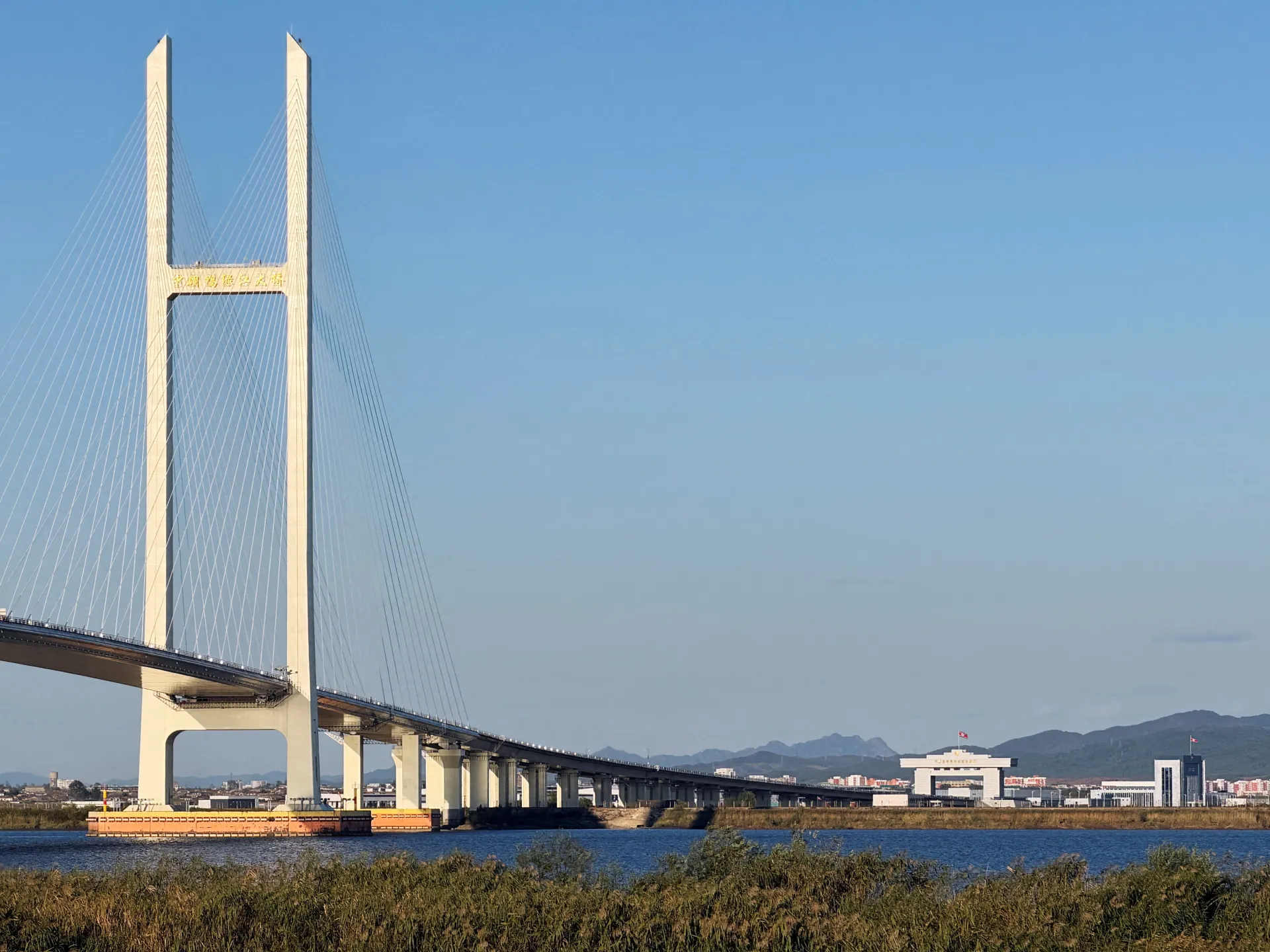
The long-delayed bridge will formally open on Thursday, according to China’s state-run Xinhua news agency.
Published On 14 Oct 202614 Oct 2026
China and North Korea will officially open the New Yalu River Bridge to traffic on Thursday, China’s state-run Xinhua news agency reports.
China completed its side of the bridge in 2014, hoping to boost trade ties. However, North Korea left its side unfinished for years as relations soured after Beijing supported United Nations sanctions over Pyongyang’s nuclear tests.
Recommended Stories
list of 4 itemsend of list
The first bridge connecting Russia and North Korea also opened earlier this month.
China-North Korea Relations
China’s exports to North Korea rose to a six-year high of $2.3bn last year, a 25 percent increase from the previous year. Chinese President Xi Jinping was welcomed in Pyongyang in June for the first time since 2019.
Since 2018, Beijing has tried to repair ties with Pyongyang, which also briefly began improving relations with Washington around the same time.
The China-North Korea relationship was forged during the Korean War. In 1961, the two countries signed the Treaty of Friendship, Cooperation and Mutual Assistance, which remains China’s only formal military alliance.
The treaty contains a mutual defence clause committing either side to assist the other if one comes under armed attack.
Although China was North Korea’s main diplomatic partner and protector for decades, relations strained after Beijing in 2017 supported tightening sanctions on Pyongyang for its nuclear weapons programme.
Analysts say North Korea’s recent growing relationship with Russia may have changed the balance of Pyongyang’s diplomatic dependence, reducing its reliance on Beijing.
North Korea and Russia signed a comprehensive strategic partnership treaty in 2024, including a mutual defence provision. Military and political ties between the two countries have grown considerably stronger, with North Korea deploying thousands of troops to fight in Russia’s war on Ukraine.
United States President Donald Trump also signalled an interest in repairing relations with Pyongyang last month, after his talks with North Korean leader Kim Jong Un abruptly ended in 2019. In his second term, Trump has floated meeting Kim again, though no official meeting has been set.
North Korea has not yet resumed issuing tourism visas to Chinese citizens, who once made up the bulk of its overseas visitors.
While North Korea’s trade with Russia largely involves military supplies, exchanges with China could arguably involve goods North Korea needs to develop its civilian economy, analysts have said.
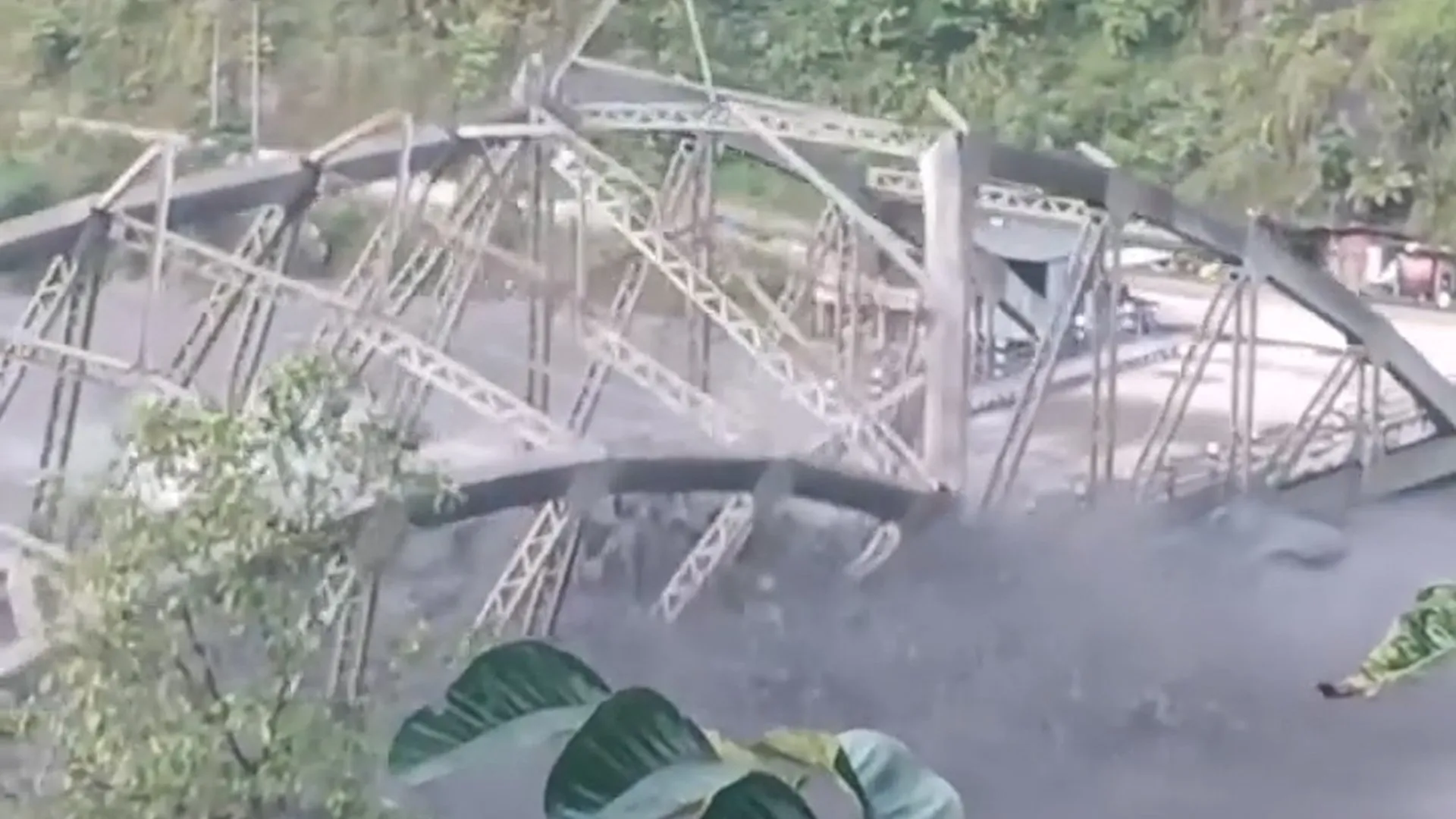
Flash floods along Nepal’s Budhi Gandaki River swept away homes and bridges, forcing residents to flee to higher ground. Five people are missing, and six have been rescued, authorities said.
Frankie Bridge was forced to pull out of Paris Fashion Week last-minute after a brutal anxiety spiral left her bed-bound and unable to function properly.
The Saturdays singer, 37, revealed she had a “dark day” last week that left her in floods of tears before collapsing into bed for the entire rest of the day.
Frankie Bridge was forced to pull out of Paris Fashion Week after she was left bed boundCredit: YouTube/Frankie BridgeThe Loose Women star said her anxiety spiralled and she was unable to function properlyCredit: Getty
Frankie also said she has been suffering anxiety-related heart palpitations for the last six months and admitted she had not been eating or sleeping enough.
The mum-of-two had been due to travel to Paris for Fashion Week, which ends on Tuesday, but had to cancel the trip after it began triggering health issues.
Sign up for the Showbiz newsletter
Thank you!
Speaking in her YouTube vlog on Monday, Frankie explained: “Paris is like my favourite place, and it’s like my favourite part of fashion week, but it was just giving me anxiety.
The singer, who was due to attend one of the shows as a guest, said she spoke to her agent, who told her the trip was “just not worth it”.
The mum-of-two had been due to travel to Paris for Fashion WeekCredit: Shutterstock EditorialFrankie said she has been suffering anxiety-related heart palpitations for the last six monthsCredit: YouTube/Frankie Bridge
She added: “At the same time, I feel relieved, but also so disappointed and annoyed.”
Her decision came after a punishing few weeks including a trip to New York and her Faves Live runway event during London Fashion Week.
Frankie said sons Parker, 12, and Carter, 11 – her kids with her husband, ex-footballer Wayne Bridge, 46 – had returned to school, while a family member was “really really sick”.
She admitted: “I think I just didn’t realise how stressed I was and how tired and overwhelmed I was. And I just haven’t had a break or a moment to stop and think about any of it.”
The Loose Women star said: “I was really scared this week that I was heading towards burnout.
“On the way home from filming something on Wednesday, I basically cried the whole way home. I just haven’t been able to function. I think it just finished me off. That was a really dark day.”
Frankie said she had kept turning up for work but felt other parts of her life were slipping.
She revealed Carter went to school at the wrong time one day, adding: “I try and be the best mum that I can be, best friend, best wife, whatever.”
Frankie also revealed her physical health had taken a knock after falling ill. Describing the exhaustion, she said it felt like she had been “hit by a bus”.
She added: “I’ve had heart palpitations all day today, which is like a new thing for me like the last six months if I’m anxious or anything.”
Frankie also admitted stress had affected her appetite. She said: “I think I’ve just not been looking after myself.
“I think I’ve been really stressed, really busy, which I love. I thrive under pressure and stress, but it kind of came with not being hungry.
“So, I probably haven’t been eating enough. I haven’t been sleeping enough.”
Frankie has previously spoken openly about depression and anxiety and spending time in a psychiatric hospital aged 21.
She has also undergone ketamine-assisted therapy for her mental health.
She added: “This is just the reality of trying to do it all. You just can’t. And sometimes something’s got to give. And this week, that something was me.”
Major bridges in Kyiv have been hit by Russian drone strikes for four consecutive days, as Moscow ramps up attacks on critical infrastructure in Ukraine’s capital.
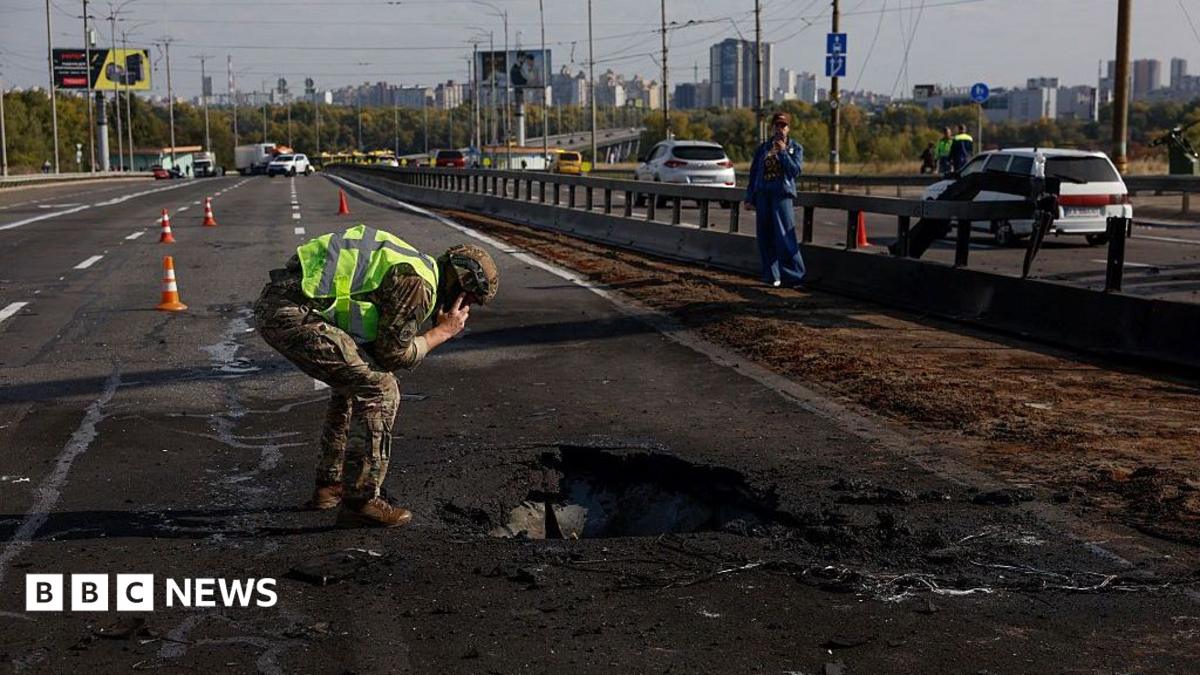
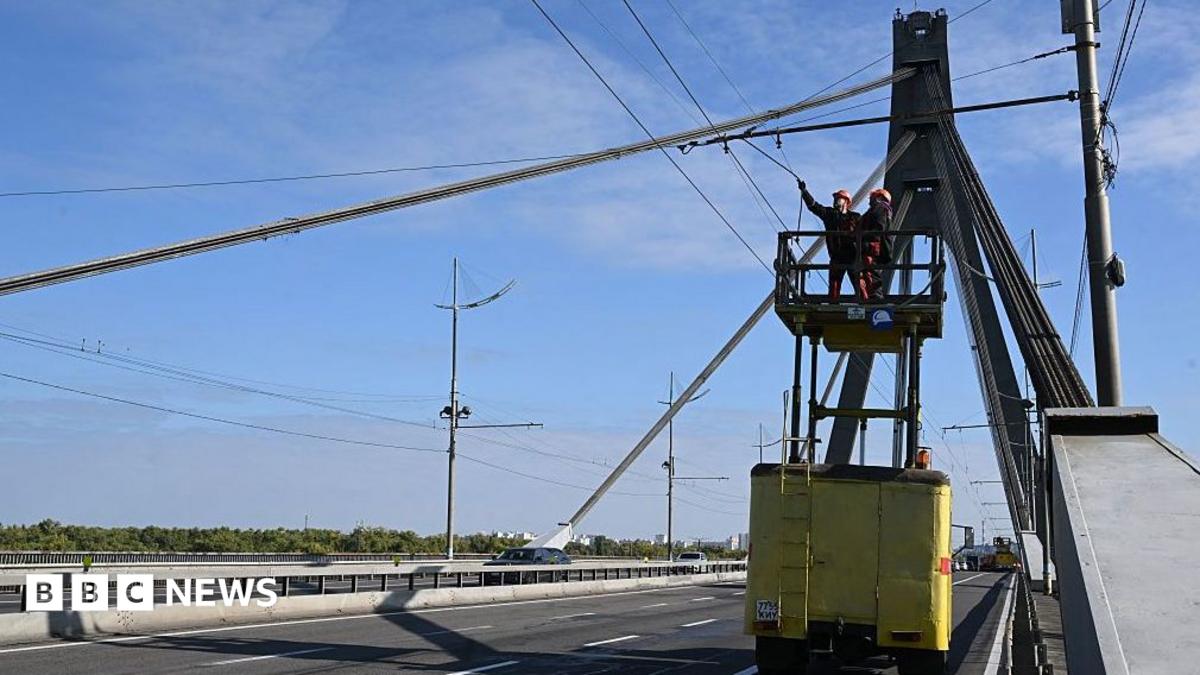
Two people were injuredwhen the Pivnichnyi (Northern) Bridge was struck on Sunday morning for the second day in a row, while the Pivdennyi (Southern) Bridge was hit multiple timesearlier in the week.
The latest attack came as German Chancellor Friedrich Merz made a surprise visit to Kyiv in a show of support against Russia’s continuing full-scale invasion.
Russia’s military said it would be intensifying strikes on Kyiv and other Ukrainian regions. It earlier said it had hit the two bridges used to transfer Ukrainian troops.
Video footage of Sunday’s strike, verified by the BBC, shows cars moving on Pivnichnyi Bridge as a drone crashes into it before exploding, creating a ball of fire. A cloud of black smoke can be seen rising above the bridge.
Other videos and pictures have emerged on social media showing a gaping hole in the middle of a traffic lane on the bridge.
Kyiv Mayor Vitali Klitschko said two people were injured in the latest Russian attack. He earlier said that the Pivnichnyi Bridge’s roadway was hit.
Kyiv’s eightbridges across the wide Dnipro River link the western (right) and eastern(left) parts, and many of the capital’s estimated three million residents rely heavily on the metro lines and trains to travel across the city.
Some 500,000 vehicles use the bridges every day.
The two struck bridges are still standing – but the damage and restrictions to traffic and public transport have caused gridlock in parts of the capital at times.
“To get from the left bank to the right one and back – it’s just hell,” Kyiv resident Roman told the BBC on Sunday.
Large numbers of commuters cross the river, especially on weekdays. Repair teams are working to fix the damage and officials say they are planning temporary pontoon bridges, ferry services and even a tunnel under the river to keep Kyiv connected.
Klitschko also said a separate Russian drone strike had damaged a heating main, adding that there would be a temporary lack of hot water in the north-eastern Desnyanskyi district as a result.
Ukrainian President Volodymyr Zelenksy said on Sunday morning Russian drones had also attacked a warehouse in the north-eastern region ofSumy, killing one person.
Meanwhile, in the central city of Dnipro, six people were injured after a communications facility was struck, he said.
Ukraine’s Air Force said that overnight Russia had launched 135 drones, including 52 jet-powered ones. It said that 125 projectiles had been shot down.
As emergency services responded to the incidents, Germany’s Merz met Zelenksy in Kyiv. They laid wreaths to Ukrainian soldiers who have been killed in the war.
Merz reaffirmed his country’s support for Ukraine, writing on X: “Ukraine is facing decisive weeks. That is why I travelled to Kyiv today with the message: You can rely on us.
“Germany’s security also depends on the outcome of this war. That is why we are helping out of our own self-interest as well.”
German chancellor visits Kyiv amid air raid sirens, pledging strong support as Russian strikes disrupt the capital.
Published On 4 Oct 20264 Oct 2026
Russia has struck a key bridge in Kyiv just as German Chancellor Friedrich Merz arrived in the Ukrainian capital to meet President Volodymyr Zelenskyy.
The unannounced visit, marked by the sound of air sirens and explosions, came on Sunday to underscore Germany’s support for the nation at a time when Russian attacks on Ukrainian cities are increasing.
Recommended Stories
list of 3 itemsend of list
In a written statement, Merz said he “travelled to Kyiv today because Ukraine needs all our support in the coming weeks”.
“If Russia is not stopped, its war machine will sooner or later turn against us,” he said.
Ukraine’s President Volodymyr Zelenskyy meets German Chancellor Friedrich Merz at the memorial of fallen Ukrainian soldiers at Independence Square in Kyiv, October 4, 2026 [Dan Bashakov/AP Photo]
Merz and Zelenskyy met at the National Academy of Sciences, which was struck by a Russian drone on September 28.
Zelenskyy told Merz that Kyiv’s citizens are going through “terrible nights and days” due to the ongoing Russian attacks.
Merz was accompanied by his economy minister, as well as executives from several large German companies, such as Siemens Energy and Diehl Defence.
Ukraine and Germany are also expected to finalise a deal to produce drones and other weapons together that can travel more than 600 miles (965.6km) in an effort to strike deeper into Russia.
Germany has been one of Ukraine’s staunchest supporters. In April, the two countries signed a military pact worth more than $4bn. On Sunday, a $1.1bn military aid package is set to be announced, alongside $394m to repair damage to Ukraine’s energy sector.
Merz’s visit comes a day after Russia warned foreign diplomats and nationals to leave the capital to avoid getting hurt.
Russia’s Ministry of Defence promised to intensify strikes on Ukraine after Zelenskyy said in an interview with the Reuters news agency that it is doubling down on targeting Russian oil refineries after several civilians were killed and wounded over the weekend.
The strike that hit the Northern Bridge over the Dnipro River on Sunday also damaged a road and the supply of hot water in the area, according to a social media statement from Kyiv Mayor Vitali Klitschko. It is the second bridge in the capital to be hit this weekend.
Russia’s all-out war on Ukraine is in its fifth year. Both sides have increased the number of drone and missile attacks on infrastructure, logistics and military sites in recent months.
After the Pivdennyi Bridge was attacked, passengers described how dust from a blast wave entered their carriage through the ventilation system.
Ukrainian President Volodymyr Zelensky said Putin had decided that there were “no rules now” when attacking Ukraine.
In an interview with the Financial Times, he said: “The Russians have failed to occupy us. So now they are carrying out massive attacks and mass killings.”
He added: “They want to destroy our bridges… our data centres, the internet, mobile networks, hospitals, kindergartens, schools, universities – everything. They want people to flee their cities.”
Putin on Thursday insisted that Russia’s attacks on Ukrainian economic targets were a direct response to Ukraine’s strikes on Russia’s oil refineries and its ships in the Black Sea.
“Now from every direction we’re receiving calls ‘let’s stop’. But they started it,” Putin said after a wide-ranging speech at the Valdai foreign policy forum.
The Kremlin leader admitted Kyiv had “got some results” from its refinery attacks and Russia had lost about 1% of its GDP. Ukraine maintains it began attacking Russian oil infrastructure because it helps the Kremlin finance the war.
Russia has targeted Ukrainian energy infrastructure, ramping up attacks every winter since Putin launched a full-scale invasion in February 2022.
It takes between 15 and 20 minutes to drive across
15:15, 02 Oct 2026Updated 15:45, 02 Oct 2026
Europe’s longest submerged road disappears under the sea twice a day
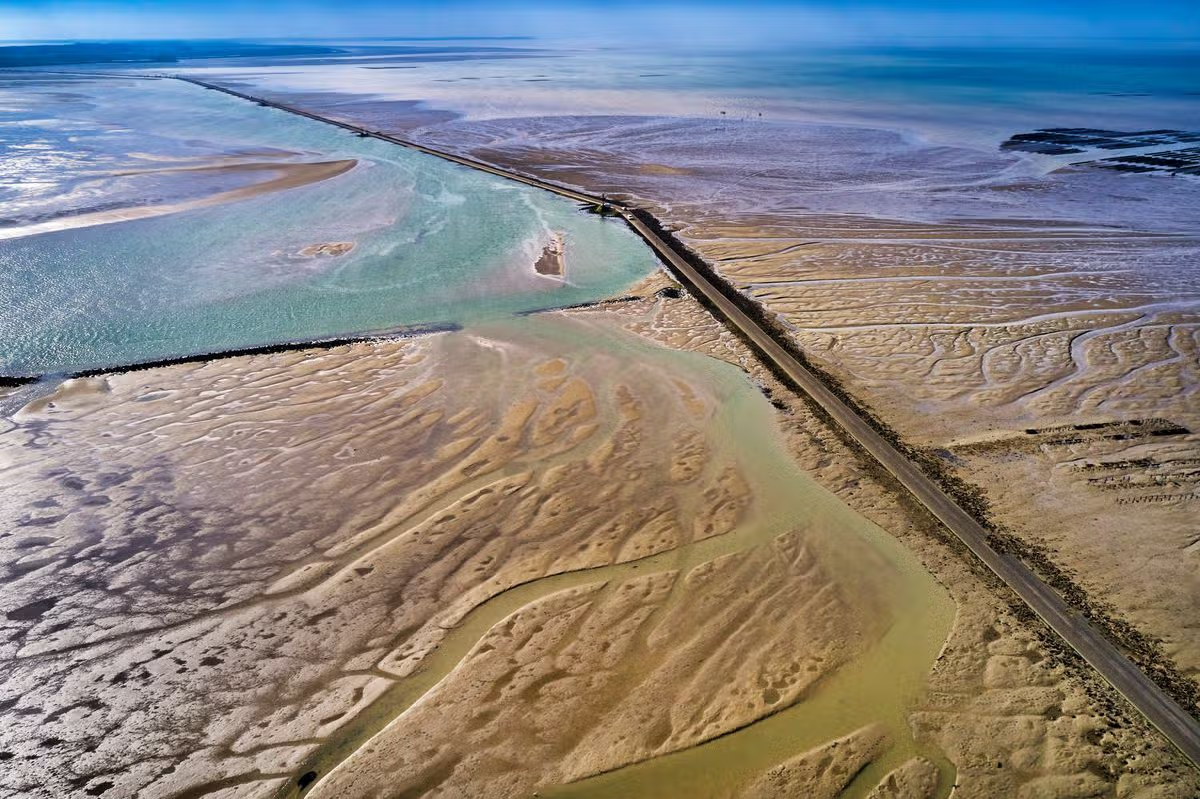
The Passage du Gois, in France, is one of the most popular underwater roads connecting the Île de Noirmoutier to the French mainland. The 2.6 miles road vanishes under the sea twice every day, turning a scenic drive into a journey that must be timed around the tide.
High tides submerge the Passage du Gois under 1.5 to four meters (five to 13 feet) of Atlantic Ocean water most of the day. Drivers have to carefully plan their journey as they can only cross during a short window of about three hours.
Nine raised refuge markers stand along the Gois for people caught by rising water. Officials warn that the road should never be treated as passable when it’s flooded, just because another vehicle has entered it.
Alternatively, visitors can use the Noirmoutier bridge to reach Île de Noirmoutier, located 5.3 miles from the Passage du Gois.
Travel experts at Lapland Famille warned drivers and holidaymakers to plan their trips carefully. Alex Dyer, managing director at Lapland Famille, said: “A tide window can look generous until a meal stop runs late or a child needs an unexpected break.
“I’d keep the bridge route ready and treat the Gois as a bonus, because that removes the pressure to race the final minutes with the sea already on its way back in.”
On TripAdvisor, a visitor described the road as “absolutely unique”. They said: “I have known the Passage du Gois since I was a little girl; it is absolutely incredible and unique in the world.
“This road is revealed every six hours, depending on the tide. Of course, you absolutely must know the tide times and coefficients to know how much time you have to be able to cross it and not be caught off guard by the sea.
“The island of Noirmoutier was connected for years only by this passage before the bridge in 1971.
“Many people stop there for shore fishing. Magnificent photos can be taken, and every year, there is a race organised against the clock on the Passage du Gois.”
Other famous underwater roads in Europe are the Lindisfarne Causeway and the Strood, both in England.
The Lindisfarne Causeway is a three-mile paved road connecting the Northumberland mainland to the Holy Island of Lindisfarne, as the North Sea tides cover the road twice daily. The Strood, in Essex, is covered by water during high spring tides, temporarily cutting access to Mersea Island.
There is no love like municipal infrastructure love.
It was late in the 20th century when my wife, Mary Frances, and I moved into Los Feliz. Quickly we learned that our corner of the neighborhood was known as Franklin Hills, and that just about every eastward outing would take us across a funny little bridge with eight pointy turrets. That bridge was the Shakespeare Bridge.
As a teacher at nearby Ivanhoe Elementary, Mary Frances crossed the bridge twice every school day for more than 20 years. As a student there, our daughter Grace crossed it for six years, usually with me as chauffeur.
We’ve crossed it at all hours in every kind of weather, on foot, on bikes and in cars, talking about school, work, family and, lately, the fractured state of the nation and world.
Now that bridge on Franklin Avenue at St. George Street is near its 100th anniversary and an Oct. 10 neighborhood celebration is in the works, complete with a street party and procession. As the day approaches, I keep thinking about how large a funny little bridge can become in the lives of its neighbors.
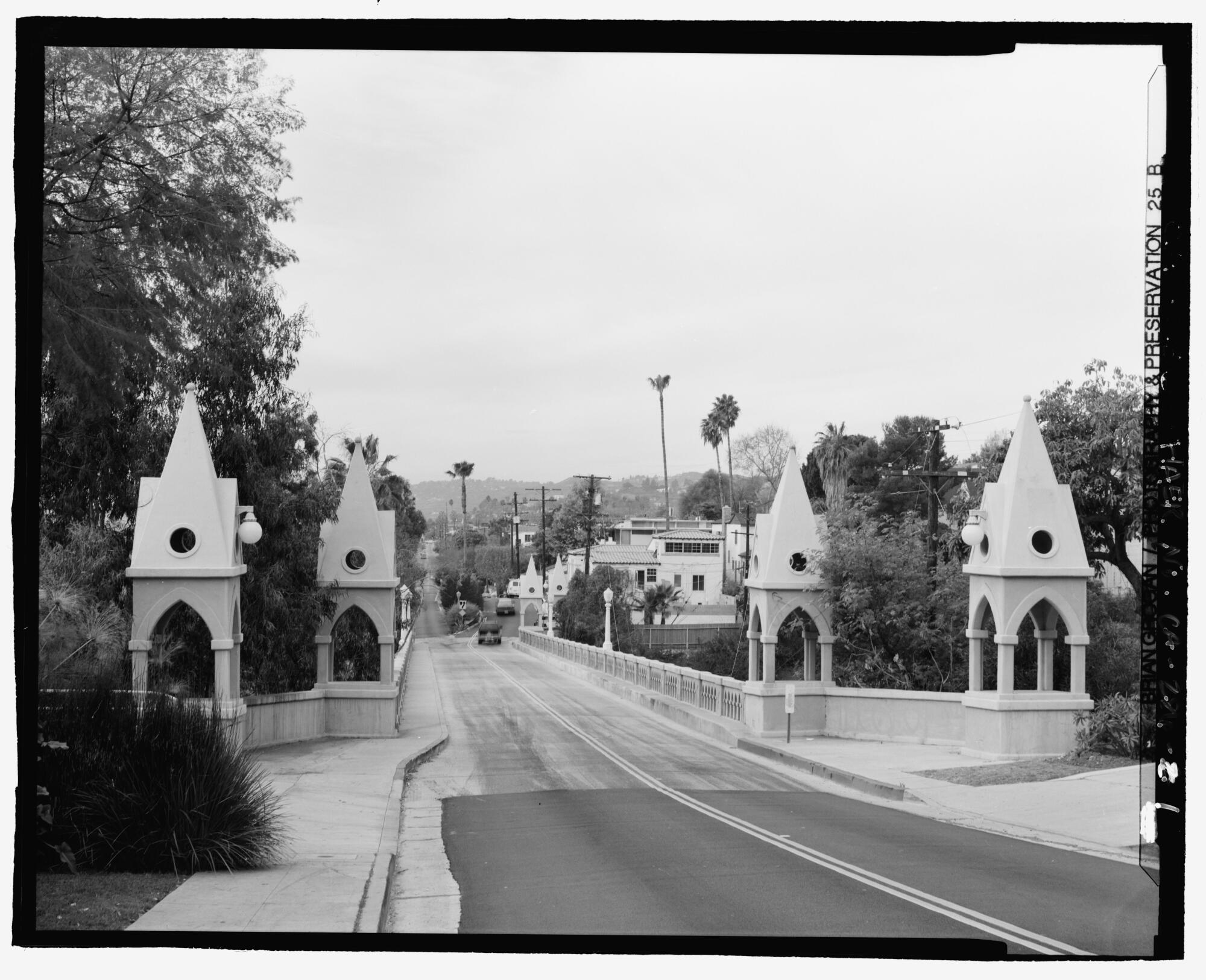
This view looks westward across L.A.’s Franklin Avenue Bridge, also known as the Shakespeare Bridge.
(Library of Congress)
Originally it was the Franklin Avenue Bridge, designed by J.C. Wright of the city’s civil engineering department in the mid-1920s, when a twenty-something cartoonist named Walt Disney was new to the neighborhood and the Vitagraph Studios, a block away, were transitioning from silent films to talkies.
Paid for by a controversial city assessment of neighbors, the bridge is 262 feet long and 30 feet wide — a pipsqueak compared with landmarks like Pasadena’s Colorado Street Bridge or the 6th Street Bridge between Boyle Heights and downtown L.A.’s Arts District. Its three open-spandrel arches were made using Portland cement.
Nobody knows where the Shakespeare nickname came from, but city officials designated the bridge as L.A.’s Historic-Cultural Monument No. 126 in 1974 and retrofitted it in the 1990s to better withstand earthquakes. Crucially, city staffers preserved those charming and entirely unnecessary turrets, which deserve their own sonnet, if you ask me.
“Back then, people put some thought into these things,” City Council aide Tom LaBonge told this newspaper in 1988, years before he became councilman (2001-15) for the district that includes the bridge.
Since 2017, neighbors have tended a Shakespeare Bridge Garden beneath the span. The neighbors (a.k.a. the Franklin Hills Residents Assn.) also pay to keep up the landscaping on the nearby traffic island.
When the bridge went up, L.A. “was becoming a city,” said Alison Wallace, president of the FHRA. “We were trying to look legit, and people were adding all of these amazing public works.”
The result, Wallace said, was a span that eased connections between neighborhoods and “helped us become a community.”
This view looks from below the Franklin Avenue Bridge, also known as the Shakespeare Bridge.
(Library of Congress)
Many architectural sources call its style Gothic Revival. Some see Moorish influence. Researcher Tiger Shankman has hailed its “perky, anachronistic beauty.” In “An Architectural Guidebook to Los Angeles,” authors David Gebhard and Robert Winter suggest that the ornate ends of the bridge “cry out for sculptured saints.”
Instead of saints, however, the bridge has seen a lot of actors and film crews. The bridge turns up in the movies “Dead Again” (1991) and “I Love You, Man” (2009), the Netflix series “Nobody Wants This” (in 2025) and the HBO series “I Love L.A.” (also 2025). My favorite clip is a chase sequence from a 1971 “Mannix” episode — excruciatingly slow-paced by 2026 standards, and shot long before the FHRA tore out the city’s blacktop median and planted greenery.
Given all of its neighborhood fame, it surprised me to hear how few Angelenos know about the bridge. When Charlie Ryan and Thom Vest started offering LA Explained walking tours early this year, they expected the Disney history would be a popular part of their Los Feliz itinerary, but the bridge quickly emerged as another central element.
Because most of those who sign up for the Los Feliz tour live elsewhere, they have never crossed the bridge “and don’t know it’s there,” Ryan said. “Out of all the tours that I do, it’s the one that brings the most surprise to people.”
An aerial view of the Shakespeare Bridge, formally known as the Franklin Avenue Bridge, in the Franklin Hills area of Los Feliz.
(Allen J. Schaben / Los Angeles Times)
But plenty of those who live nearby have deep connections with the bridge, including Charley and Shirley Mims, who got married there on Oct. 21, 2000.
To open the ceremony, Shirley strolled from the west end of the bridge to the east, where Charley was waiting. (They still live in the neighborhood and plan to be at the centennial party.)
“When you see the bridge and cross it,” my neighbor Dave McDonald said the other day, “you feel like you’re home. It’s like a welcoming beacon.”
“It’s a real local’s way of getting around,” said Matteo Chizzola, who moved to Los Angeles four years ago and settled in Los Feliz two years ago. Last year, when Chizzola decided to start selling matcha from a sort of grown-up street-corner lemonade stand, he chose a patch of sidewalk at Franklin Avenue and Talmadge Street, two blocks from the bridge.
A jogger crosses the Shakespeare Bridge.
(Allen J. Schaben / Los Angeles Times)
“It is beautiful and it’s weird. If you go at the right time of day, at sunset, it’s an incredible view,” he said.
Chizzola said he isn’t getting rich running the stand, Fridays through Sundays, but “it has become something that puts a huge smile on my face.”
He’ll be on hand for the bridge’s centennial parade, along with invited local luminaries including Victor the fruit guy (who worked a corner near Marshall High School for more than a decade) and Dora Herrera of the much-loved Yuca’s restaurant on Hillhurst Avenue.
A pedestrian crosses the Shakespeare Bridge,which was completed in 1926.
(Allen J. Schaben/Los Angeles Times)
Sometimes, when Mary Frances and I are on a neighborhood walk, we stop mid-span. In the distance to the south, you see the downtown skyline. In the arroyo below the bridge (officially the Arroyo de Sacatela) you see the private homes and yards along Monon Street and Myra Avenue. You also see the Los Feliz campus of the International School of Los Angeles (1960), the only school designed by modernist architect John Lautner.
Then there are the decorations. Every few months, in a tradition started by departed neighbor Chris Boutelle, Mary Frances joins a team of FHRA board members and other volunteers who put up hearts for Valentine’s Day, shamrocks for St. Patrick’s Day, Pride and Juneteenth flags in June, American flags and bunting in the lead-up to July 4, and so on.
Most of these costume changes are seamless. But in June 2023, someone tore down the Pride flags. Neighbors quickly replaced them. They came down again. Neighbors replaced them again. The back-and-forth went on for weeks. A suspect was arrested, released, then re-arrested.
Shakespeare Bridge in Los Feliz was the site of controversy in June 2023, when someone repeatedly stole Pride flags from a bridge display. Neighbors replaced the flags and police made an arrest.
(Gary Coronado / Los Angeles Times)
“It was almost every day for a month. People really came together,” said Wallace. The vandal surely didn’t mean to, but Wallace contends that he wound up uniting the neighborhood as never before.
The Oct. 10 bridge celebration, organized by the FHRA, will begin with a noon procession to the bridge from Marshall High School (another neighborhood Gothic Revival landmark), featuring a marching band, several vintage cars and a costumed dog parade.
At the end of that short walk, there’s a party planned from 1-5 p.m. at the end of Monon Street , right under the bridge. There will be snacks, drinks, live music, kid crafts, a bouncy house, a handful of actors in Shakespearean garb and scads of neighbors being neighborly.
I’ll be there for all of it. In times like these, every bridge needs celebrating.
Shakespeare Bridge, formally known as the Franklin Avenue Bridge, spans a ravine in the Franklin Hills with downtown Los Angeles in the background.