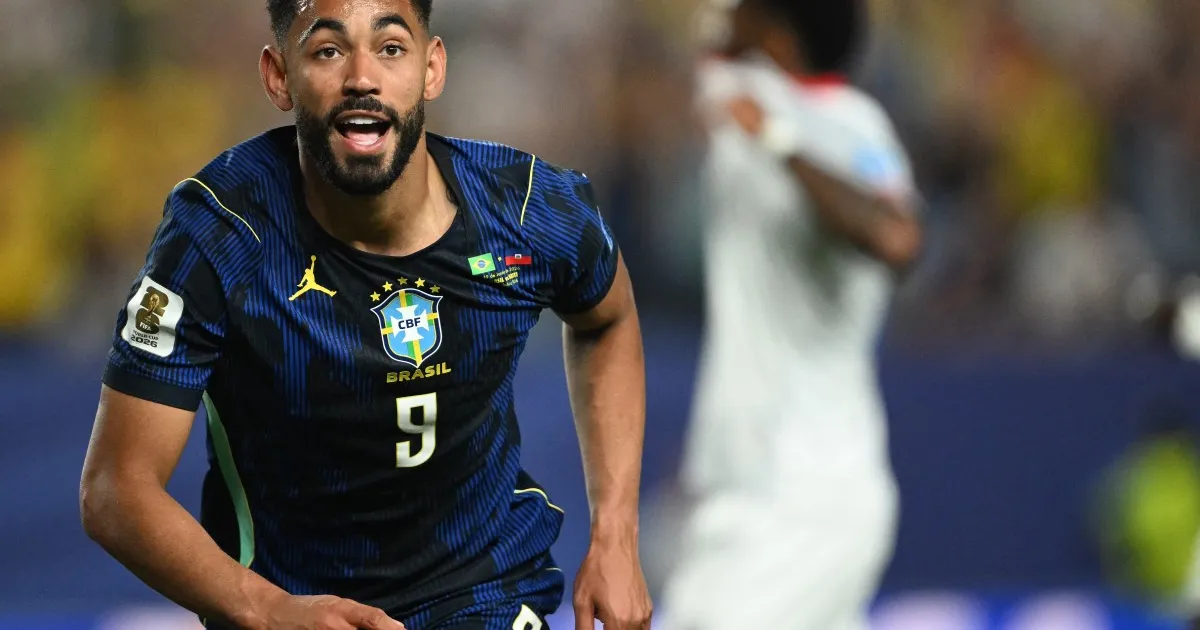
Manchester United’s Matheus Cunha scores Brazil’s first two goals in 3-0 win against Haiti as FIFA event progress nears.
Published On 20 Jun 202620 Jun 2026
Vinícius Junior scored and assisted on one of Matheus Cunha’s two goals as five-time champion Brazil eliminated Haiti from the World Cup with a 3-0 victory.
Haiti, the Western Hemisphere’s poorest nation that qualified for the World Cup for the first time since 1974, became the first team guaranteed not to reach the knockout round. Meanwhile, the Selecao got the decisive performance they needed on Friday.
Recommended Stories
list of 4 itemsend of list
Cunha, the Manchester United standout, got the start and showed with every surf-and-slide goal celebration why he should have been in the starting lineup in Brazil’s listless 1-1 draw against Morocco. Brazil coach Carlo Ancelotti made the surprising decision in the opener to instead insert Cunha as a late substitute.
Cunha thrilled the Brazilian fans who made up the bulk of the 68,324 spectators at Philadelphia Stadium when he tapped in a rebound for his first career World Cup goal. He then sent a left-footed strike into the upper left corner for a 2-0 lead in the first half against the overmatched Haitians.
Brazil forward Raphinha, who was subbed out with an injury in the first half, had an early goal disallowed on an offside call that only temporarily muted the yellow-clad Seleção fans in an otherwise festive atmosphere at the home of the two-time Super Bowl champion Philadelphia Eagles — whose cheerleaders did their part to rally the crowd.
Haitian fans danced and sang “Grenadye Alaso” (“Grenadiers to the Attack”), the traditional battle cry of the national team. Brazilians chanted back, reminding them their country is the five-time World Cup champion and the home of the king of soccer: “A thousand goals, a thousand goals, a thousand goals, a thousand goals, a thousand goals! Only Pele, only Pele!”
Cunha added to the frivolity in Philadelphia, home to nearly 6,000 Brazilian immigrants, when he flashed his familiar surfing celebration.
Vinícius, whose 32nd-minute goal helped Brazil earn the tie against Morocco, helped Brazil get on the board when his shot was stopped by goalkeeper Johny Placide and Cunha was there to slam home the rebound to make it 1-0. Cunha extended both arms as if trying to catch some tasty waves and was mobbed his teammates.
Vinícius slid a pass through the defense to find Cunha and he powered one high into the net that Placide never had a chance to stop to make it 2-0. Cunha slid on his stomach and mimicked a swimming motion that all but put Haiti in the drink — and validate the Brazilians’ fans decision not to tempt fate and dress the Rocky statue in team gear for bad luck.
Vinícius closed the half with a goal and that was enough to keep Brazil — seeking its first World Cup title since 2002 — happy before it closes Group C play against Scotland on Wednesday in Miami Gardens, Florida.
Neymar was ruled out of Brazil’s second straight match because of a lingering calf injury.
The 2026 World Cup will have 13 different kickoff times. You can use the Al Jazeera Sport widget to find out exactly when your team is playing in your local time.
Who: Brazil vs Haiti What: FIFA World Cup 2026 Group C match Where: Lincoln Financial Field, Philadelphia When: Friday, 6:30pm local time (00:30 GMT Saturday) How to follow: We’ll have all the build-up on Al Jazeera Sport from 21:00 GMT in advance of our live text commentary stream.
Recommended Stories
list of 3 itemsend of list
Brazil’s draw with Morocco in their opening match left fans with more doubts than belief, with millions wondering if the record five-time champions are still among the world’s best teams.
Having slipped to third in a group that they were expected to dominate, Brazil now face minnows Haiti in their second group game, needing a World Cup reset.
Head coach Carlo Ancelotti will need to address several shortcomings with his team if he wants to avoid another disappointing performance during the group stage.
Here is all to know before Brazil vs Haiti kicks off:
No need to panic yet, suggests Brazil
While Brazil’s weak showing in the first game has raised questions about the team’s odds of a deep run, Ancelotti believes it is no cause for concern just yet.
Against Morocco, Brazil showed signs of nerves during the early stages and struggled to cope with the AFCON champions’ attack. Some players also struggled to cope with the intensity of the encounter.
The Italian coach, who has been in charge for just over a year, said the upcoming match with Haiti offers his side an opportunity to address their weak points.
“You don’t win the World Cup in the first match,” Ancelotti told reporters in Philadelphia on Thursday.
“The players’ self-criticism was very positive. I think we’ll sort out the problems; I remain confident that we’ll be competitive.”
Critics have argued that Brazil lacks an identity under Ancelotti, but the 67-year-old – nicknamed “Don Carlo” – believes adapting his tactics according to gametime situations is more important.
“I don’t want a single identity,” he said. “I want my team to have multiple identities.”
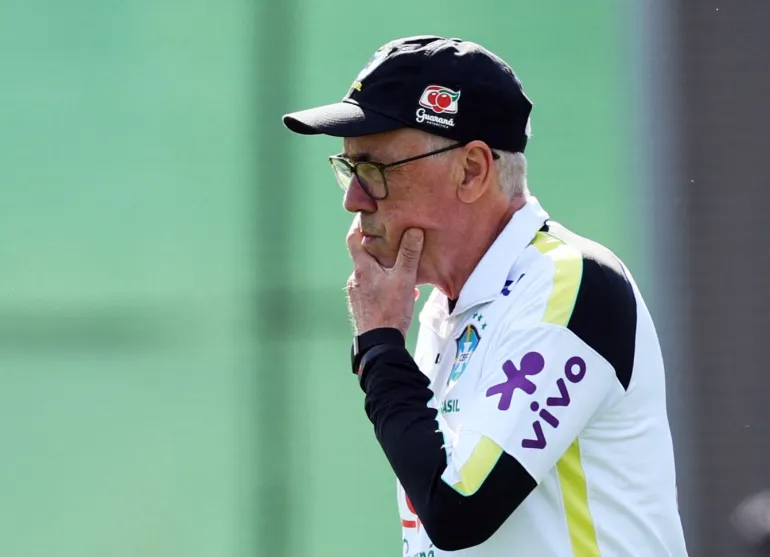
Former Real Madrid coach Carlo Ancelotti took over the team in May 2025 [Caean Couto/Imagn Images via Reuters]
Haiti want to make their people proud
It took Haiti more than half a century to return to the World Cup, and the Caribbean underdogs have somewhat of a cruel challenge at hand, being grouped alongside world-class Brazil, African giants Morocco, and Scotland.
While their 1-0 defeat to Scotland in the opening game did not dampen their spirit, Haiti know they face a far more difficult task against Brazil, who have no shortage of talent in their squad.
The odds are stacked against Haiti, but in a tournament where upsets have not been uncommon, their fans are daring to dream.
“Tomorrow [Friday], we’ve got everything to gain in a match like this. It’s been 52 years since we last featured in a World Cup, and now we’re up against Brazil – we’ve got to live up to our fans’ expectations,” coach Sebastien Migne said.
“It’s a privilege to be here, and I hope we can make the Haitian people proud of us.
“It would be absolute madness in Haiti if we won this match,” he added.
World No 85 Haiti, still looking for their first goal of this World Cup campaign, enter the match 80 spots below Brazil on the FIFA rankings.
Haiti coach Sebastien Migne gives instructions to his players during a hydration break [Brian Snyder/Reuters]
Brazil vs Haiti prediction
Stats provider Opta’s supercomputer has handed Brazil a whopping 87.3 percent probability of winning against Haiti, who have a mere 4.3 percent chance of winning. There is an 8.4 percent probability of a draw.
Overall, Brazil are seventh in the list of title favourites – with a 5.2 percent probability – behind a bunch of teams including France, Argentina and England, who make up the top three.
Haiti: TNH, Tele Haiti (8:30 pm Eastern Daylight Time)
United Kingdom: STV, STV Player ITV1, ITVX (01:30 Saturday, British Summer Time)
United States: FOX, FOX One, Telemundo App, Telemundo Network, Peacock (7:30pm Eastern Daylight Time)
To check the TV listings for your country, head to FIFA’s TV listing schedule here.
How does the group stage work?
Brazil, Haiti, Morocco and Scotland are in Group C.
Scotland lead the group with three points, followed by Morocco in second spot with one point. Brazil is in third place, also on a point, while Haiti is at the bottom with no points so far.
The top two teams from each of the 12 groups – along with the eight best third-placed teams – proceed to the next phase, the round of 32, which has been introduced at the World Cup for the first time.
(Al Jazeera)
Form guide
(Last five games, latest first)
Brazil: D-W-W-W-L
Haiti: L-L-W-D-L
Brazil have performed significantly better than Haiti in their last five matches.
They started their campaign in North America with a 1-1 draw with Morocco. Before the World Cup, Brazil registered victories over Egypt and Panama in friendlies and beat Croatia in March. But they lost to France in March.
Haiti suffered a defeat to Scotland in their opening World Cup game. They lost to Peru and beat New Zealand in pre-World Cup friendlies earlier this month, while they drew with Iceland and lost to Tunisia in friendlies in March.
Brazil vs Haiti: Head-to-head
Brazil have faced Haiti three times, winning on all occasions. Their last meeting dates back to a 2016 Copa America group game, in which Brazil thrashed Haiti 7-1.
Friday’s meeting between Brazil and Haiti will be their first at a World Cup.
Brazil vs Haiti: Team news
Just as in their opening match, Brazil’s oft-injured star Neymar Jr has been ruled out of the Haiti game.
A lingering calf strain will keep the veteran forward – Brazil’s all-time leading scorer with 79 goals – sidelined with the team hoping he recovers in time to feature in their final group game on June 24 against Scotland. He has not played for Brazil since October 2023.
Neymar was diagnosed in late May with the injury and has featured in just half of the games for his club side Santos this year due to various fitness issues.
For Haiti, striker Nazon – who was on the bench last time – is doubtful.
Neymar has not travelled with the rest of the Brazil team for their second World Cup game [Caean Couto/Imagn Images via Reuters]
Brazil predicted XI
Ancelotti is expected to make changes following criticism over his decision to start striker Igor Thiago and right-back Roger Ibanez against Morocco. Danilo and Cunha are widely tipped to replace them in the lineup against Haiti.
Brazilian President Luiz Inacio Lula da Silva has warned that the United States should not interfere in his country’s upcoming presidential race, which is being held in October.
Wednesday’s remarks came after both Lula and his US counterpart, Donald Trump, attended the Group of 7 (G7) conference in Evian-les-Bains, France.
Recommended Stories
list of 3 itemsend of list
During a news conference, Lula said Trump was entitled to continue his relationship with the Bolsonaro family, whose patriarch, Jair Bolsonaro, led Brazil as president from 2019 to 2023.
“As far as I’m concerned, he can continue liking Bolsonaro, the father, the son, the grandson,” Lula said. “There is no problem with that. It’s his problem. There’s no accounting for taste.”
But Lula then proceeded to establish a firm red line: no interference in Brazil’s elections.
“Now, don’t meddle in the Brazilian elections, because the Brazilian elections are a Brazilian problem, just as American elections are their business, not mine,” Lula continued.
“All I want is the same respect for Brazil that I have for the United States. That’s it.”
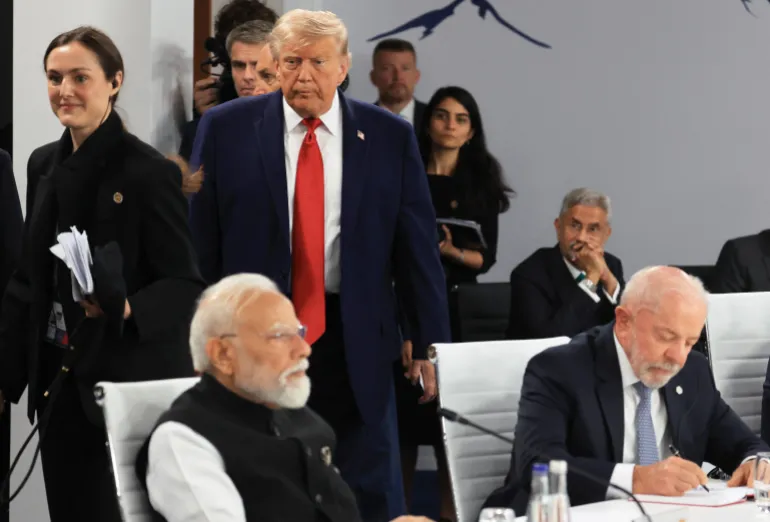
US President Donald Trump arrives on June 17 to a G7 meeting where India’s Prime Minister Narendra Modi, left, and Brazil’s President Luiz Inacio Lula da Silva, right, are already seated [AFP]
A race between Lula and Bolsonaro
Lula is currently a leading contender ahead of October’s race. If the left-wing incumbent wins, it will be his fourth term as president of Brazil. He previously served from 2003 to 2011, before being re-elected to a non-consecutive third term in 2022.
But Lula’s top election rival is a member of the Bolsonaro family: Senator Flavio Bolsonaro, Jair’s eldest son. Flavio is running as the candidate for Brazil’s far-right Liberal Party.
Since returning to office for a second term, Trump has been accused of seeking to sway Latin American elections in favour of right-wing candidates.
But in Brazil, questions have swirled as to whether Trump’s actions have already amounted to illegal intervention in the country’s judicial system.
Trump has made little secret of his support for the Bolsonaro family. Last year, after Jair Bolsonaro was charged with seeking to overturn his electoral defeat in 2022, Trump issued a public letter calling the trial a “witch hunt”.
“The way that Brazil has treated former President Bolsonaro, a Highly Respected Leader throughout the World during his Term, including by the United States, is an international disgrace,” Trump wrote. “This Trial should not be taking place.”
He proceeded to impose tariffs on certain Brazilian goods and sanctions on members of Brazil’s justice system, including Supreme Court Justice Alexandre de Moraes.
In September, Jair Bolsonaro was nevertheless sentenced to 27 years in prison for plotting an alleged coup and seeking to subvert Brazil’s democracy.
World leaders, including Lula (third from left) and Trump (second from right), pose for a group photo at the G7 summit, on June 16 [Julia Demaree Nikhinson/AP Photo]
Trump calls Brazil ‘rough’
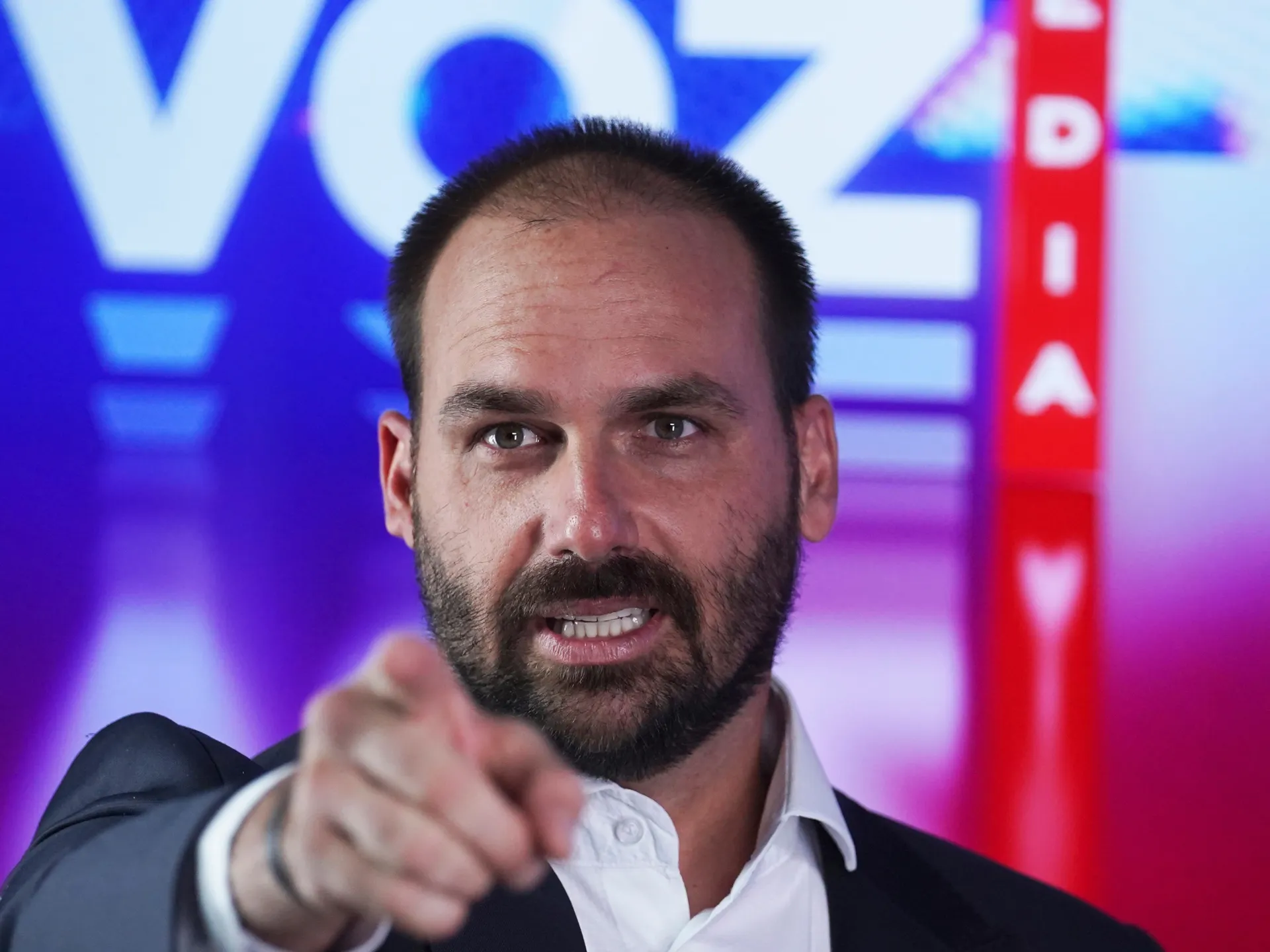
But the legal fallout has continued for the Bolsonaro family. After Jair’s third son, Eduardo Bolsonaro, lobbied the Trump administration on his father’s behalf, he was accused of orchestrating US interference in Brazil’s justice system.
Just this week, he was sentenced to four years in prison, after Brazil’s Supreme Court ruled his actions amounted to coercion. Eduardo has denied the charges and called the case a conflict of interest for Brazil’s courts.
Speaking at the G7 summit, Trump tried to address Eduardo’s sentence, though he appeared to mix the younger brother up with his older sibling, Flavio, the presidential candidate.
“ I hear they arrested somebody that’s running for office today,” Trump said. “ I heard that they arrested the Bolsonaro junior, who was doing well in the polls.”
Trump also suggested that Brazil had become “dangerous” for right-wing political views, an idea he has expressed before.
“It’s become a little rough country, right? Politically. A little dangerous, politically,” Trump said at one point.
At another, he appeared to compare the US election system to Brazil’s. “ They play pretty tough, but nobody plays tougher than the United States. Look, our elections are totally rigged. We have rigged elections,” he said.
But at Lula’s news conference, which was held separately, the Brazilian president dismissed concerns about the country’s electronic voting machines.
He called paper ballots a technology “of the last century” and offered to show Trump — a critic of electronic vote tabulation — how the machines work.
Reflecting on Trump’s assessment of Brazil, Lula also questioned the US president’s familiarity with the South American nation.
“I think he doesn’t know Brazil very well,” Lula said. “If he knows Brazil only through his relationship with the Bolsonaro family, then he doesn’t really know Brazil.”
A panel on the Brazilian Supreme Court has voted to convict Eduardo Bolsonaro of lobbying the United States to interfere in the trial of his father, former right-wing President Jair Bolsonaro.
On Tuesday, three of the four justices on the panel voted in favour of conviction, with one remaining justice yet to vote.
Recommended Stories
list of 3 itemsend of list
They determined that Eduardo Bolsonaro’s actions amounted to coercion against Brazil’s justice system and sentenced him to four years and two months in prison.
“It wasn’t merely an expression of opinion or a political stance, but rather conduct that clearly threatened Brazilian authorities and Brazilian citizens themselves,” Justice Cristiano Zanin said, calling Eduardo Bolsonaro’s actions “illegitimate and criminal”.
The conviction is the latest legal setback for the Bolsonaro family, which remains a dominant force on Brazil’s political right.
Jair Bolsonaro is serving a 27-year prison sentence for his efforts to remain in power after losing the country’s 2022 election.
Prosecutors described his actions as an attempted coup. Bolsonaro and his family have portrayed the trial as a political witch-hunt.
The ex-president’s third son and a member of Brazil’s Chamber of Deputies, Eduardo Bolsonaro has been active in his father’s defence.
In March 2025, he pledged that he would move to the US full time to “focus 100 percent” of his energy on “a single cause”: freeing his father.
Prosecutors accused him of mounting an illegal campaign to court US President Donald Trump and use foreign influence to pressure Brazilian officials to drop the case against Jair Bolsonaro.
Trump, an ally of Bolsonaro, had likewise tried to remain in office despite his loss in the 2020 election and has accused Brazilian officials of persecuting right-wing voices like Bolsonaro.
In July 2025, Trump issued a letter announcing 50 percent tariffs on certain Brazilian products, citing Jair Bolsonaro’s trial, specifically, as a reason.
“This Trial should not be taking place,” Trump wrote at the time. “It is a Witch Hunt that should end IMMEDIATELY.”
Trump also issued an executive order sanctioning one of the Brazilian Supreme Court justices involved in the Bolsonaro case, Alexandre de Moraes, on the basis that he worked to “target political opponents” and “suppress dissent”.
He called de Moraes a “threat” to the US, and his administration later expanded the sanctions to include the justice’s family members, as well as other Brazilian judicial officials.
Brazil’s current president, Luiz Inacio Lula da Silva, has denounced those actions as an attempt to interfere in Brazil’s domestic affairs.
As relations with Lula grew more cordial, the Trump administration relaxed its tariffs against Brazil. In December, it also repealed the sanctions against de Moraes and his family.
Lula, meanwhile, visited the White House in May and praised what he described as a productive meeting with his US counterpart.
But it remains unclear what role Trump may seek to play in Brazil’s upcoming presidential elections.
The left-wing Lula is campaigning for a fourth term, and he is likely to face his stiffest competition from Jair Bolsonaro’s eldest son, Senator Flavio Bolsonaro.
A CNT/MDA poll released on Tuesday projected that Lula would receive 49.3 percent of the vote in a run-off election against the senator’s 40.2 percent.
Flavio Bolsonaro has faced his own legal trouble in recent months, with police opening a probe in April into whether he defamed Lula. His connections to a disgraced banker have also raised media scrutiny.
Jair Bolsonaro, meanwhile, faced questions this week about the presence of a firearm in his home in Brasilia, where he is serving three months of his sentence on medical grounds.
Justice de Moraes likewise asked the elder Bolsonaro’s legal team to explain the presence of the weapon, which police discovered during a routine inspection on Monday.
A security guard for Bolsonaro initially said the 9mm Glock pistol was his own, but it was later revealed to be the ex-president’s.
De Moraes gave Bolsonaro’s legal team 24 hours to explain why “the convicted man kept a firearm at home”.
Oliver Tree, a genre-defying singer-songwriter and Santa Cruz native, was one of six people killed when two helicopters collided Sunday morning in Brazil, according to the Associated Press. He was 32.
Tree, a quirky artist known for his highly theatrical music videos and crisp bowl cut, had been traveling through South America as a part of his world tour. CNN Brazil reported Argentinian YouTuber Gaspar Prim, also known as Gaspi, was among those killed in the crash.
The mid-air collision occurred in Rio de Janeiro, with one of the helicopters landing in the parking lot of a car dealership, the AP reports. Local authorities have launched an investigation into the cause of the crash.
Tree, born Oliver Tree Nickell, broke out in the electronic music world first performing as, simply, Tree. He released an e.p., “Demons,” in 2013, which included a cover of Radiohead’s “Karma Police.” He later attended CalArts north of Los Angeles, and signed to Atlantic Records for his major-label debut e.p. “Alien Boy” in 2018.
To find his distinct look, he told the Santa Cruz Sentinel that “I was making a statement with it. Everybody’s trying to look so beautiful and sexy nowadays. It was my way of rebelling against that. So, I tried to make myself look as silly and ridiculous as possible.”
Tree was an instant hit on the festival circuit for his outlandish stage productions and outsider charisma, performing at Lollapalooza, Coachella and Outside Lands. He collaborated with Skrillex, David Guetta and Zeds Dead, and was fiercely protective of his meticulously weird visual identity and video concepts, telling Rolling Stone that “That’s kind of my signature. The people who do f- with me know me because of my videos..Music is my day job but my real dream is to be making feature films.
He released his major label debut LP, “Ugly Is Beautiful,” in 2020. His hit song “Life Goes On” and collaboration “Miss You” with German DJ Robin Schulz earned him international recognition and climbed onto the Billboard Hot 100. He released four full length albums as Oliver Tree, most recently April’s independent LP “Love You Madly Hate You Badly.”
Tree had performed in Buenos Aires on June 4.
From July to October, he had shows scheduled throughout Europe, Australia and China. This year, he performed at the Coachella Valley Music and Arts Festival this year as a special guest of electronic producer Subtronics. In one of his last social media posts, he made a point to spotlight an upcoming show on Aug. 9 in his hometown at the Quarry Amphitheater at UC Santa Cruz.
“I can’t believe Oliver is gone,” Schulz posted on Instagram. “You were such a lovely soul and a one of a kind character. Working with you on ‘Miss You’ was an honor. My deepest condolences to his family, friends and everyone who loved him.”
Vinicius Junior scored a brilliant goal to dig Brazil out of trouble after Ismael Saibari had put Morocco ahead.
A moment of magic from Vinicius Junior salvaged Brazil a point against Morocco in New Jersey, as the five-time World Champions made a shaky start to the tournament.
Ismael Saibari ran through to give Morocco a 21st-minute lead with a clever scoop in the Group C opener on Saturday, but a solo effort from Vinicius ensured the points were shared in this much-anticipated group match.
Recommended Stories
list of 4 itemsend of list
Here are the biggest takeaways from the 1-1 draw at New York New Jersey Stadium.
Brazil coach Carlo Ancelotti at half time [Jeenah Moon/Reuters]
Brazil make a slow start
Brazil are chasing a record sixth World Cup title, 24 years after last lifting the trophy, but this performance suggests there is a lot of work to be done by Carlo Ancelotti’s side.
They showed signs of nerves during the early stages of the game and struggled to cope with a lively Morocco attack.
A fifth-placed finish in South American qualifying underlined the scale of the challenge facing Ancelotti, and this performance has done little to ease concerns about the quality of the Brazil squad.
A number of their players struggled to cope with the intensity of the Moroccan team, with midfielder Casemiro subbed off at half-time after a difficult opening 45 minutes in the heat.
The World Cup final is a long way off in New Jersey, but Brazil will have to vastly improve if they are to have any hope of making it.
Morocco look like the real deal
The Atlas Lions stunned the world of football in 2022 as they made it all the way to the semifinals in Qatar.
Four years later, Morocco have the chance to show that it was not a one-off run to the last four and they are the real deal.
Judging by their performance in New Jersey on Saturday, the North African nation are truly a force to be reckoned with.
They arrived in North America as African Cup of Nations champions, after being retrospectively awarded the title following a controversial final defeat to Senegal, and they continued their strong form with a commanding performance against Brazil, playing with a high level of confidence and plenty of attacking threat.
Morocco appear set for another strong tournament showing.
Vinicius Junior showed his importance to Brazil with a brilliant solo goal in the first half [Jewel Samad/AFP]
Vinicius shows his top quality
If Brazil are to make it to the latter stages of this tournament, they will rely heavily on Vinicius to provide goals and assists in North America.
The Real Madrid man has consistently scored for his club this season, including 16 goals in La Liga and five in the Champions League, and it now appears that he is bringing this form to the world stage.
With Brazil struggling in the first half, Vinicius received the ball from Bruno Guimaraes on the left side of the area before cutting back onto his right foot and hammering into the far corner past Yassine Bounou.
It was the kind of magic moment that he regularly produces for Real Madrid, and the Selecao will be looking for more individual brilliance in their coming games.
Neymar injury hangs over Brazil
The Neymar soap opera is set to dominate another tournament for Brazil, with the 34-year-old on the sidelines for yet another major tournament match.
Brazil’s all-time record goalscorer is still recovering from a calf injury, having not played for his country since 2023.
He was dramatically recalled to the national squad, despite not featuring in Ancelotti’s plans during the Italian’s year in charge, but he remains under scrutiny over his fitness and form following years of injury trouble and an underwhelming spell back at Santos.
It is unclear exactly when Neymar will be fit enough to return to first-team action, but judging by the media’s focus on him during Saturday’s match, this saga is set to dominate discussion around Brazil.
Brazil’s Neymar Jr reacts after the match in New Jersey [Caean Couto/Reuters]
Draw leaves Group C wide open
Brazil and Morocco are the clear heavyweights in their group, but Saturday’s draw in New Jersey has left Group C somewhat in the balance.
Scotland currently sit top of the table after a 1-0 victory over Haiti in Boston, and they will now be eyeing the chance to reach the knockout stages for the first time in their history.
Morocco and Brazil remain heavy favourites to finish in the top two automatic qualification spots, but Scotland know that any points in their final two group games will almost certainly book their spot in the round of 32.
Béla Guttmann may be the most consequential soccer coach you’ve never heard of. But if it weren’t for Guttmann, you may never have heard of Pelé.
And Brazil may never have become the greatest soccer-playing country on Earth.
That’s because Guttmann changed the shape of modern Brazilian soccer — and changed the sport forever — when he imported the revolutionary 4-2-4 system from Hungary to Sao Paulo in 1957. A year later, Brazil won the first of five World Cups and the joga bonito was born.
But what Guttmann brought to Brazil isn’t nearly as interesting as how he got it there. That’s just one of the fascinating stories in “The Beautiful Game … The Untold Story,” the exhibit that will open the Holocaust Museum LA on Sunday at the Goldrich Cultural Center, a $70-million expansion that will double the size of the Pan Pacific Park museum’s campus to 70,000 square feet.
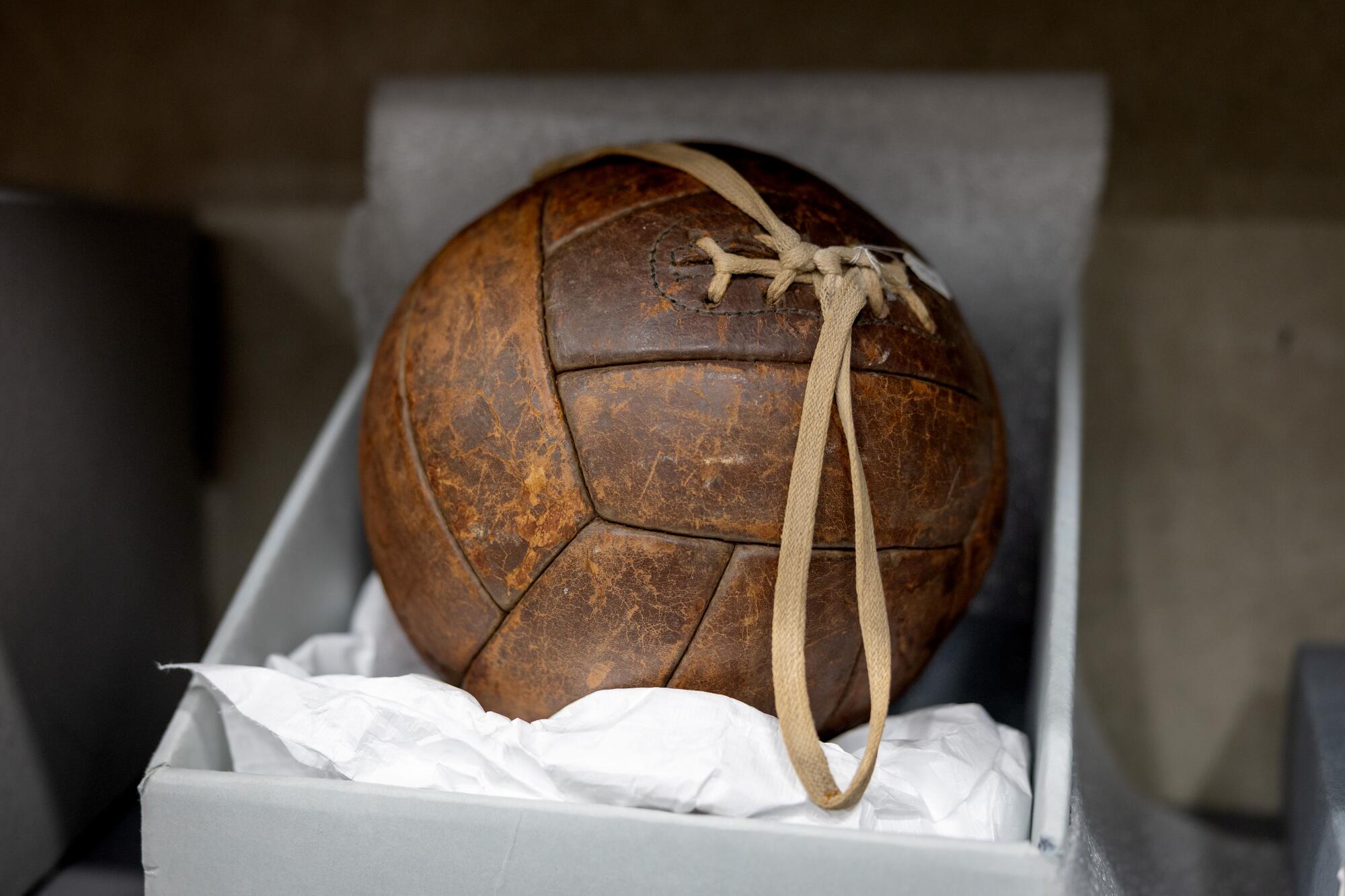
A soccer ball from the holocaust is among the items on display in the exhibit “The Beautiful Game … The Untold Story” at the Holocaust Museum LA.
(Eric Thayer/Los Angeles Times)
The exhibit was unveiled during a private reception on Saturday followed by a free preview day open to the public from 10 a.m. to 5 p.m. The grand public opening will take place in August.
The show’s launch coincides with eight local World Cup matches, which kicked off with the United States’ 4-1 win over Paraguay on Friday at SoFi Stadium, and it shines a light on the important but largely overlooked relationship between Jewish life and the global game, as well as how Jewish innovators like Guttmann shaped the modern rhythm, style and culture of the sport.
“It was in the same intellectual level as jazz, as art and everything modern and progressive,” journalist Allon Sander, who helped curate the exhibit, said of Jewish participation in European soccer in the years before World War II.
“The origin of the game and how it intersects with Jews and the Holocaust and the impact that these Jewish footballers and coaches had to shape the game and help popularize the sport is so fascinating,” added Beth Kean, the museum’s CEO. “And it’s an unknown history.”
Much of that story can be told through Guttmann, who was born in Budapest in the final year of the 19th century and developed into one of the sport’s first Jewish stars, representing Hungary in the 1924 Olympics and playing for nine teams in two countries before retiring to become a coach.
But none of that success mattered when the Hungarian government began introducing anti-Jewish laws in 1938, costing Guttmann his job and nearly his life when he was sent to a Nazi forced-labor camp, where he was tortured. Just days before he believed he would be shipped to Auschwitz, which meant certain death, he escaped alongside Erno Erbstein, another Jewish coach.
Erbstein revolutionized soccer in Italy before dying in 1949, along with the entire Torino team, when their plane crashed into a hilltop outside Turin. Four years ago, he was inducted into the Italian soccer hall of fame. Guttmann, meanwhile, who lost much of his family in the Nazi death camps, would go on to coach for 42 years in 14 countries, winning championships in six of them yet only staying in a single place for more than two years just once.
“He’s running away from his demons,” said Ronen Dorfan, a journalist and sports historian based in Budapest whose research was instrumental in putting the exhibit together. “His father was murdered, his sister was murdered. You never know how you survived in Budapest during the war so he had guilt feelings.”
A jersey worn by player Max Wozniak and a jersey from the 1930s are displayed in an exhibit called “The Beautiful Game … The Untold Story.”
(Eric Thayer/Los Angeles Times)
The exhibit was designed in three sections, the first devoted to the years before World War II, the second is about the Holocaust and the third is the postwar years. And while it details Jewish participation in, and influence on, global soccer, it also challenges the cliché that Jews were intellectuals, artists and laborers but not athletes.
“We are always trying to challenge stereotypes. Stereotypes that we might have about ourselves and even stereotypes that we believe about others,” said Jordanna Gessler, the museum’s vice president of education and exhibits who helped curate the show. “It’s crucial to help people find their place and their voice and really see the unity, the similarities between people.
“This is a story that was lost in time and we’re really bringing it out,” Gessler added. “To really have this conversation and encourage people to explore stories that they might not know.”
One thing people might not know is that in the 1920s and ‘30s, Europe’s best teams weren’t in England, Germany or France, but in Austria and Hungary, where they were led by Jewish players and coaches such as Hugo Meisl, Jozsef Braun, Arpad Weisz, Marton Bukovi, Gusztav Sebes and Gyula Mandi. Weisz and Braun were both killed by the Nazis.
A soccer ball from the 1974 World Cup is displayed at an exhibit called “The Beautiful Game … The Untold Story.”
(Eric Thayer/Los Angeles Times)
The surge of antisemitism and fascism in Germany, Italy and Eastern Europe helped spread the influence of those revolutionary players and coaches around the world.
“With the rise of the Reich and the Holocaust, the coaches ran away,” Dorfan said. “And they ran to every corner of the world, to Brazil, to Argentina, to Portugal [and] provided coaches to Real Madrid, to Barcelona, to Benfica, to Flamengo.
“There isn’t one of these clubs that doesn’t owe its tactical development in the ‘40s and ‘50s to the Jewish coaches, which came primarily from Hungary.”
The primary tactical development was the shift from the popular but rigid 2-3-5 formation, which required immense physical endurance and tactical discipline, to the fluid 4-2-4, which spread the wingers to the touch line and allowed for improvisation and creativity on the attacking end, a formation pioneered in Budapest in the 1920s.
“They developed a more refined game of passing the ball, keeping it on the carpet rather than the English kick and run, and really put thought into tactical thinking,” Dorfan said.
Guttmann, who played or coached for more than two dozen teams in his career — including one, in Romania, that paid him in vegetables during the postwar period — brought the Hungarian approach to Brazil in 1957 when he coached Sao Paulo to a championship. After Vicente Feola, the manager Guttmann replaced at Sao Paulo, took over the national team a year later, he brought the formation with him, popularizing many of the tactics still used in modern soccer, such as fluid defensive wingers, overlapping full backs, the use of a withdrawn striker and an attacking midfield.
The soccer team at the Theresienstadt concentration camp’s flag is displayed in a Holocaust Museum LA exhibit called “The Beautiful Game … The Untold Story.”
(Eric Thayer/Los Angeles Times)
“He is the whole exhibition in one man,” Dorfan said of Guttmann.
“Obviously if we wouldn’t have had the Holocaust, those [coaches] wouldn’t be kept out of Europe, Europe would be much stronger, much more developed. [And] then the development of Brazil or the success of Brazil would be coming much later,” Sander said.
Dorfan spent the better part of two years tracking down many of the more than 100 trophies, uniforms, photos and trinkets that make up “The Beautiful Game” exhibit, a search that required determination, perseverance and more than a little luck. Many of the items, because of their ties to Jewish athletes and teams, were hidden during the war and presumed lost. Others resurfaced only through detective work that sent Dorfan following leads that spanned decades and crossed more than a dozen borders.
That also cost money. So Alan Rothenberg, the man who, as president of the U.S. Soccer Federation, first brought the World Cup to Los Angeles 32 years ago, stepped up to lead an effort that raised more than $1 million to fund the exhibit.
“The story really needs to be told, particularly with what’s going on right now with respect to antisemitism,” Rothenberg said. “It’s really important for people to realize what can happen. And soccer is a great vehicle to draw them in. The one main thing in the museum is bringing schoolkids in.”
The Nazis and their collaborators failed in their attempt to erase the history of Jewish soccer pioneers; in fact, they inadvertently popularized both the men — and women — and their ideas. But the sport also helped other Jews survive a dark period and Kean said that may be the most beautiful and uplifting part of “The Beautiful Game.”
“The main reason we decided to do this exhibition in the first place is because for years so many survivors, when they talk about their life before the war, so many of them talk about soccer. So many of them were passionate and fond of the sport,” she said.
“We knew the exhibit opening was going to coincide with the World Cup. L.A. is going to be on the world stage. This is a great opportunity for the museum to get these stories out.”
The World Cup continues on Saturday, with Brazil beginning their campaign and three more group-stage matches taking place across North America.
Brazil take on Morocco in the day’s biggest match, while Qatar face Switzerland, Haiti meet Scotland and Australia play Turkiye as more teams get their tournaments under way.
Recommended Stories
list of 4 itemsend of list
Away from the football, there has been plenty to talk about. Donald Trump skipped the United States’ opener, former Canadian Prime Minister Justin Trudeau was at the US game instead of Canada’s, and Ghana midfielder Thomas Partey will miss his team’s first match after Canada denied his visa application.
In Peru, police made headlines after carrying out a drug raid dressed as World Cup mascots.
Here is what to know:
What’s the World Cup schedule on June 13?
Qatar take on Switzerland at BC Place in Vancouver, with kickoff scheduled for 12pm local time (19:00 GMT).
The day’s action concludes with Haiti meeting Scotland at AT&T Stadium in Arlington, Texas. Kickoff is set for 8pm local time (01:00 GMT on June 14).
Australia and Turkiye then get Group D under way at Lumen Field in Seattle, with kickoff at 9pm local time (04:00 GMT on June 14).
What do the predictions say for Brazil vs Morocco?
Brazil and Morocco have only faced each other once before at a World Cup, with Brazil winning their 1998 group-stage meeting. Morocco got their revenge in a 2-1 friendly win in 2023.
Brazil have won seven of their eight World Cup matches against African opponents, with their only defeat coming against Cameroon in 2022.
The five-time champions have not lifted the trophy since 2002. Since then, they have usually exited in the quarterfinals, apart from their run to the 2014 semifinals.
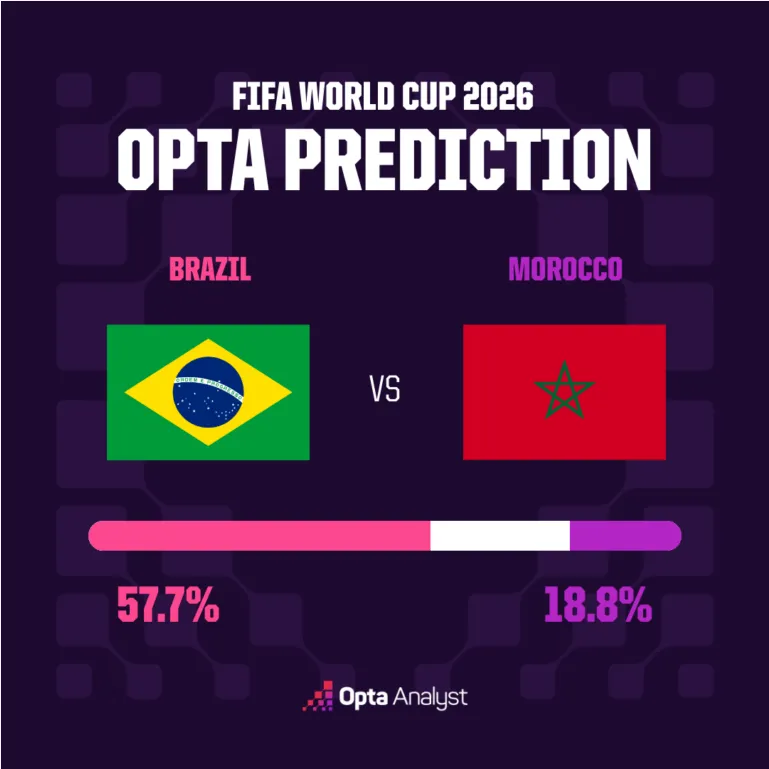
Opta’s 25,000 simulations give Brazil a 57.7 percent chance of winning. A draw happened in 23.5 percent of the projections, while Morocco won in 18.8 percent.
The winner could put themselves in a strong position to top Group C.
What do the predictions say for Qatar vs Switzerland?
Qatar and Switzerland have met only once before, with Qatar claiming a 1-0 friendly win in 2018 thanks to a late goal from Akram Afif. Afif is among nine players from that squad still in Qatar’s 2026 World Cup team, while Switzerland have seven survivors from that defeat, including Granit Xhaka and Remo Freuler.
Opta’s 25,000 simulations make Switzerland the clear favourites in this Group B clash, giving them a 76.0 percent chance of victory. Qatar won just 9.1 percent of the projections, while 14.9 percent ended in a draw.
A point would likely be considered a positive result for the Gulf side.
What do the predictions say for Australia vs Turkiye?
Australia and Turkiye have met only twice before, with Turkiye winning both friendlies in 2004. Turkiye have also won all four of their previous World Cup matches against Asian opponents.
Opta’s 10,000 simulations give Turkiye a 55.3 percent chance of victory, compared with 20.5 percent for Australia and 24.1 percent for a draw.
Neither side has a strong record in World Cup openers, however. Turkiye have lost both of their previous first matches, while Australia have lost five of their six opening games.
What do the predictions say for Haiti vs Scotland?
Haiti and Scotland have never faced each other before, making this one of several first-time matchups at the expanded 48-team World Cup. It will also be Haiti’s first-ever game against a team from the British Isles.
Opta’s 25,000 simulations make Scotland clear favourites, giving them a 59.0 percent chance of victory. Haiti won 19.2 percent of the projections, while 21.8 percent ended in a draw.
Haiti vs Scotland
What else is shaping the World Cup?
The football has only just started, but the World Cup is already making headlines away from the pitch, too.
Trump did not attend the US World Cup opener
The US president did not attend the US men’s national team’s World Cup opener against Paraguay in Los Angeles.
His absence drew attention because Trump has recently attended several high-profile sporting events, including Game 3 of the NBA Finals earlier this week. He is also expected to host a UFC event at the White House on Sunday.
A White House official said Trump instead plans to attend the World Cup final on July 19 at MetLife Stadium in East Rutherford, New Jersey.
The US president called into a USMNT team meeting with some words of support via Andrew Giuliani, the White House’s World Cup task force CEO.
Partey denied entry into Canada
Ghana midfielder Thomas Partey will miss his country’s World Cup opener against Panama after Canada denied his visa application while he awaits trial in the United Kingdom on multiple rape charges, which he denies.
FIFA confirmed on Friday that the 32-year-old would not be permitted to travel from Ghana’s base camp in Smithfield, Rhode Island, to Toronto for Wednesday’s match.
“His visa application has been refused by the Canadian government,” FIFA said in a statement.
“FIFA is not involved in the immigration processes of host countries, including the adjudication of visas. As with previous FIFA events, the host government ultimately determines who receives a visa and is admitted into the country.”
Trudeau attends the US’s World Cup
As Canada and the US kicked off their World Cup campaigns on the same day, former Canadian Prime Minister Justin Trudeau was in California rather than Toronto.
The 54-year-old did not attend Canada’s 1-1 draw with Bosnia and Herzegovina at BMO Field. Instead, he was at SoFi Stadium in Inglewood alongside pop singer Katy Perry, who performed during the pre-match opening ceremony before the US faced Paraguay.
Peruvian officers use World Cup mascot costumes in Lima drug bust
Peruvian police have gone viral after carrying out a drug raid in Lima dressed as World Cup mascots.
Video shared by police showed officers dressed as World Cup mascots breaking through a metal gate with a battering ram before entering the property.
Once inside, they arrested a suspected drug dealer and recovered weapons and bags of what authorities believe were narcotics.
The World Cup may be decided on the pitch, but another competition is already under way off it: Which host city has the best food?
In a report for Al Jazeera, Lou Browne travelled across North America to find out what fans can expect beyond the stadiums.
In Mexico City, taco vendors are hoping the tournament brings more customers. “Well, now the World Cup is coming, and we hope we’ll get customers,” a tortilla cook at El Califa de Leon told Al Jazeera. “I imagine there will be a lot of people, foreigners or locals.”
Philadelphia is proudly backing its famous Philly cheesesteak. Locals say visitors should learn how to order properly. “You want to tell them what kind of cheese you want,” Anthony Rossi, a cook at Geno’s Steaks, explained. “And you say if you want onions, which is ‘wit’ or ‘wit-out’ … Keep it simple.”
Across the border, Toronto is making the case for poutine, the Canadian dish of fries topped with gravy and cheese curds. “Poutine is the … not the best … dish, but poutine is from Canada,” said Lisa Deni, a French tourist.
In Kansas City, barbecue is a point of pride. “This is really good,” diner Camilla Thomas said. “We’ve been enjoying coming here. and bringing people from out of town here and giving them a little taste of Kansas City.”
And in Miami, locals insist the Cuban sandwich is a must-try. “The Cuban sandwich, croquetas, and cafecito are really the way to go,” said Daniel Figueredo, cofounder of Sanguich. “The Cuban sandwich really is the thing you have to have when you come to Miami.”
For fans travelling across North America this summer, the hardest choice may not be picking the World Cup winner, but deciding which host city serves the best food.
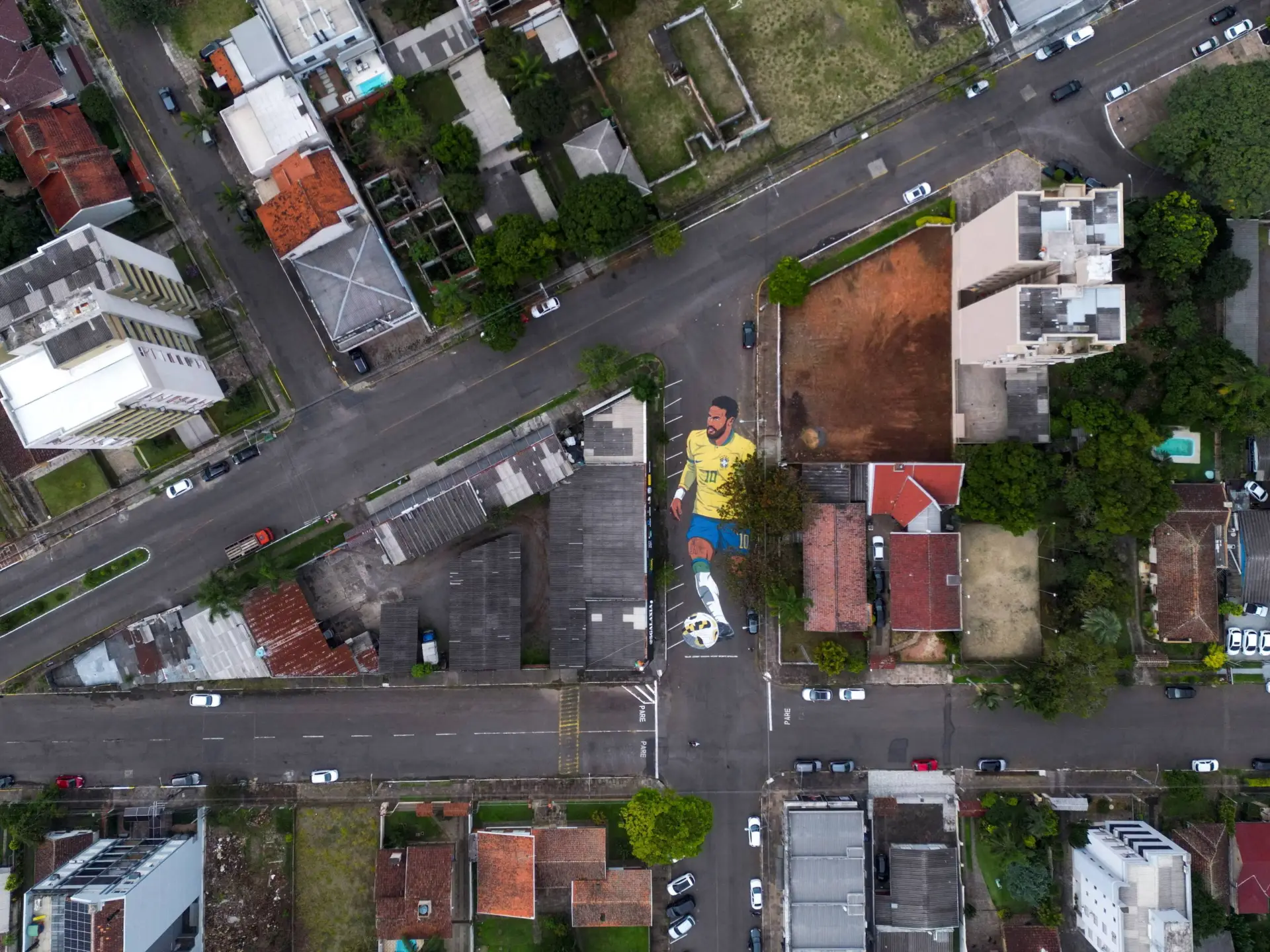
A massive 850-square-meter street mural of football star Neymar da Silva, created by six artists over two days in Brazil’s Novo Hamburgo, is turning heads ahead of the highly anticipated FIFA World Cup.
Krutzsch says the event was designed to be accessible. “It was critical to make sure that there were affordable opportunities for the community and fans of the World Cup, or any of these countries that are participating, to have a place to come be part of these official celebrations,” he says.
Tickets for FIFA Fan Festival are $10 including fees, with free admission for children ages 12 and under when accompanied by a paid adult. (There is a limit of three free child tickets per one adult ticket purchase.)
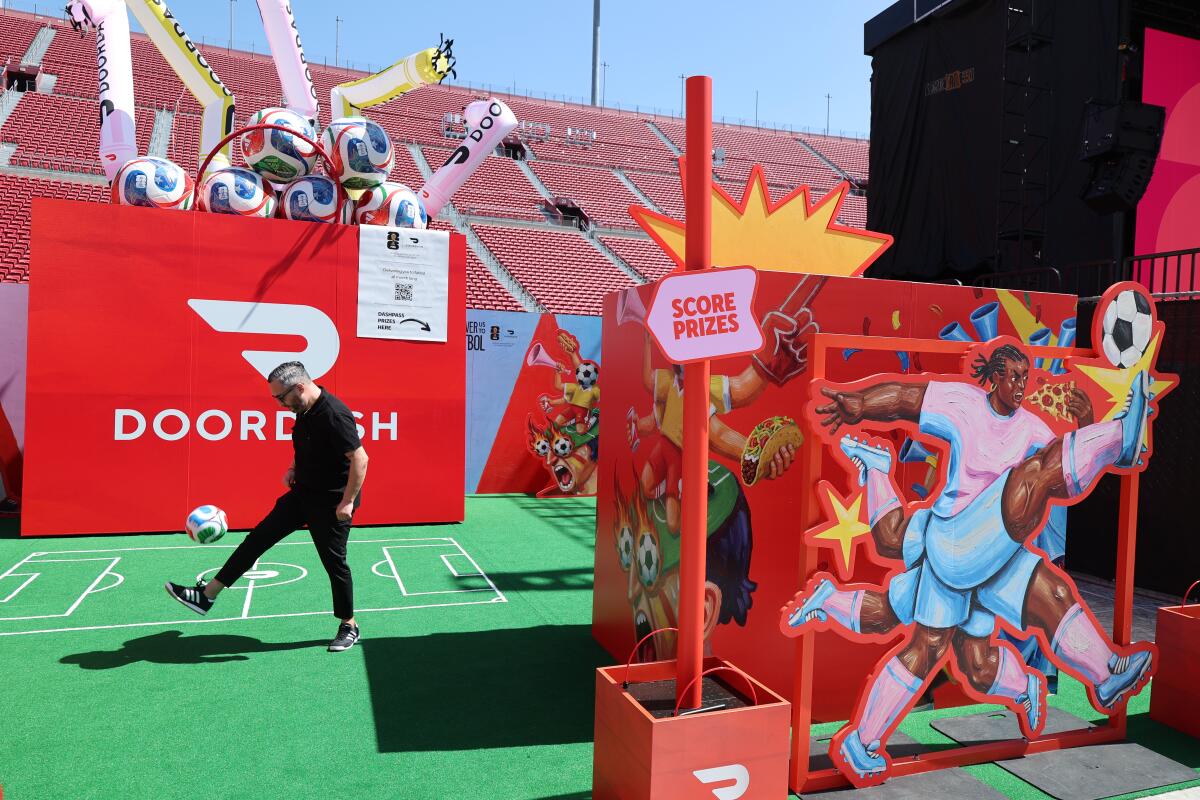
TikTok content creator Carlos Maciel plays a game at the DoorDash booth during a media preview of the FIFA Fan Festival.
(Allen J. Schaben / Los Angeles Times)
Meanwhile, reserved club seats and loge boxes are $30 including fees. These premium tickets offer access to shaded lounge areas, enhanced seating, food and beverage offerings and elevated viewing locations overlooking the festival grounds and match screens.
Tickets can be purchased online or at the Coliseum box office on event days when the festival is not sold out. The box office is located at Gate 29. General admission entry will be at Gates 1, 4 and 28.
Four Brazilian players and four members of their coaching staff were sent off during a dramatic encounter in Fortaleza.
Published On 10 Jun 202610 Jun 2026
Brazil were shown eight red cards during a chaotic 1-0 defeat to the United States women’s national team in a friendly in Fortaleza.
Brazilian coach Arthur Elias and three of his assistant coaches were sent off, while Bia Zaneratto and Tarciane were also dismissed. Two other players were shown red cards after the full-time whistle on Tuesday evening.
Recommended Stories
list of 3 itemsend of list
Sophia Wilson’s shot deflected off Isabela and snuck past Brazilian goalkeeper Lorena in the 63rd minute for the lone goal of the game before a crowd of more than 55,000 fans in northern Brazil. The hosts had no shots on goal, while the US had six.
Brazil manager Elias and several assistants were dismissed from the technical area during the second half.
Brazil then went down to nine in stoppage time after attacker Zaneratto was dismissed after picking up a second yellow card for pushing Emily Sonnett.
Moments later, her teammate, Tarciane, was shown a straight red for elbowing Wilson.
The chaos continued after the full-time whistle, with Brazil’s Kerolin and Ludmila both shown red cards for dissent.
Sophia Smith celebrates with teammates after the opening goal during the international friendly match between Brazil and the US [Brad Smith/Getty Images]
It was the second of two matches in Brazil for the Americans, with the US losing 2-1 in the opener on Saturday in Sao Paulo.
Dudinha appeared to hurt her right knee in a collision with Sonnett in the 30th minute and was stretchered off the field in obvious pain. The 20-year-old forward, who plays for the San Diego Wave in the National Women’s Soccer League, returned to the bench in the second half on crutches.
The matches in Sao Paulo and Fortaleza were played at stadiums that will be used next June and July for the Women’s World Cup. The US will start their qualification campaign in November.
Brazilian police have intercepted 108 Cuban nationals in a single day as they were being smuggled into the country.
In a statement on Tuesday, officials noted that the incident was part of a growing trend of undocumented immigration leaving the beleaguered Caribbean island for Brazil.
Recommended Stories
list of 3 itemsend of list
Brazil’s Ministry of Justice and Public Security described the operation as a “rescue”, designed to disrupt human trafficking and irregular migration.
“According to the Federal Highway Police (PRF), this was the largest humanitarian rescue operation ever recorded in a single incident in Roraima,” the ministry said, referring to one of Brazil’s 26 states.
Roraima is situated in the Amazon rainforest, along the border with Guyana and Venezuela. The ministry said that a “large portion” of Cubans are using Guyana as a gateway to enter Brazil.
Some 57.6 percent of the Cuban immigrants living in Brazil are either in Roraima or Amapa, another northern border state.
Cuba has been facing a heightened humanitarian crisis in recent months, as it weathers a de facto fuel blockade imposed by the United States.
Since January, no foreign oil has been allowed to reach the Caribbean island, save for one Russian tanker. The US has threatened steep tariffs against any country that might seek to supply Cuba with oil, a necessary fuel for its fragile energy grid.
The blockade has had wide-ranging repercussions, with public services in many areas grinding to a halt. The country has been gripped by multiple island-wide blackouts, and residents are reporting difficulties accessing basic supplies like food and medication.
Critics fear the pressure will lead to new waves of migration off the island. During the COVID-19 pandemic, for example, economic decline contributed to a mass exodus, with Cuba’s population dropping by roughly 10 percent or more.
Since 2024, Brazil’s Federal Highway Police say they have “rescued” roughly 297 migrants and asylum seekers in Roraima, most of them Cuban.
Five “coyotes”, or human smugglers, were arrested during Monday’s law enforcement efforts, which come as part of Operation Safe Route, an initiative launched in December 2024 to ensure roadway safety.
Three separate sets of arrests were made. One involved a convoy of three vehicles that attempted to flee federal police after being signalled to stop. Inside the vehicles were 39 Cubans, including children, being “transported in precarious conditions”.
“Many reported having gone without food for at least two days,” the Justice Ministry said.
In another incident, police found eight Cuban immigrants after seizing a vehicle that crossed the border illegally. In a third, law enforcement followed a vehicle suspected of human smuggling to a residence where 61 Cubans were found.
All 108 of the Cubans recovered on Monday were transferred to police officials for “immigration regularisation and subsequent referral to the social assistance network”, according to the Brazilian security ministry.
In its annual migration report for 2025, the ministry described Cuban immigration to Brazil as stable or even descending during the last decade, up until the early years of the COVID-19 pandemic.
“Migration flows of Cubans to Brazil were never particularly intense,” the report said. But then, starting in 2022, Cuban immigration into Brazil started to “rebound vigorously”.
“It is important to note that, in 2025, refugee applications submitted by Cubans surpassed those submitted by Venezuelans — not only due to a drop in applications from the latter group but, above all, due to the sharp rise in cases filed by Cubans, exceeding 40,000 requests,” the report explained.
The report also warned that the upward trend could continue, given the conflict between the US and Cuba.
Since returning for a second term, US President Donald Trump has taken an active role in Latin American politics and has suggested he may use military force to initiate regime change in Cuba.
“Should geopolitical tensions between Cuba and the United States of America escalate, migration flows toward Brazil could very well increase,” the report concluded.
Germany earned a 2-1 victory against World Cup co-hosts United States in the final warm-up game for both teams.
Kai Havertz had an early goal for Germany cancelled out by Antonee Robinson’s stunning volley before Leroy Sane’s winner for Julian Nagelsmann’s side.
“I’m happy with the performance of everyone,” said US coach Mauricio Pochettino, who believed his side were “unlucky” to lose.
“We played one of the most important teams in the world. I think we need to be happy with that.”
The US will start their World Cup campaign against Paraguay on 12 June, while Germany, who have won nine games in a row, begin with a game against Curacao on 14 June.
Germany coach Julian Nagelsmann said his side’s win against the US had been a “perfect test for us, both in terms of the weather and the opponent”.
Brazil beat Egypt 2-1 in the final warm-up game for both countries, with Newcastle United midfielder Bruno Guimaraes scoring early on for the winners.
Mostafa Zico equalised for Egypt but Raphinha set up Endrick to win it for the South American side, who had to take defender Wesley off after 17 minutes.
Egypt forward Mohamed Salah, who recovered from a “minor muscle injury” to play for Liverpool towards the end of the season, came on for the second half against Brazil.
“Salah underwent a rehabilitation program with Liverpool and then with the national team, and he is now ready for matches,” said Egypt coach Hossam Hassan.
Egypt’s opening game of the World Cup on Monday, 15 June will be against Belgium, who thrashed Tunisia 5-0.
Leandro Trossard, Charles de Ketelaere, Kevin de Bruyne, Dodi Lukebakio and Nicolas Raskin each scored against a Tunisia side reduced to 10 men following the dismissal of Ismael Gharbi after 62 minutes.
Belgium boss Rudi Garcia brought Romelu Lukaku on after 66 minutes as he manages the striker’s return to action.
“It is a good preparation for the World Cup, we know this team can do great things,” said Garcia, whose side were beaten 2-0 by Croatia in their previous game.