SABRINA Carpenter has apologised after she was accused of being “rude” and “mean” during her Coachella set.
The Espresso hitmaker called a fan “weird” for yodelling during her headline performance.
Sign up for the Showbiz newsletter
Thank you!
Sabrina Carpenter apologised after she called out a fan’s ‘weird’ yodellingCredit: XThe singer said she didn’t like the sound and briefly stopped the performanceCredit: X
In footage posted to X, Sabrina looked confused to hear the high-pitched note.
Addressing the audience, the singer said: “I think I heard someone yodel.”
She then singled out the fan, saying: “Is that what you’re doing? I don’t like it.”
The audience member responded that yodelling was part of their culture and used as a form of celebration.
Sabrina seemed surprised by the explanation, replying: “That’s your culture, yodeling?” before adding, “Is this Burning Man? What’s going on? This is weird,” followed by a brief laugh.
She then continued with the show, performing tracks including Taste, Please Please Please and We Almost Broke Up Again Last Night.
However, the moment didn’t go down well online. After the performance, social media users criticised her reaction.
One Reddit user wrote they had been enjoying the set until the comment, calling it “really rude.”
Another said her response showed a “total lack of respect,” adding that even after the cultural explanation, the reaction remained inappropriate.
Others suggested the incident could spark wider backlash, while some on X questioned whether she had dismissed someone’s culture as “weird.”
Still, not everyone agreed with the criticism. Some fans defended Carpenter, arguing she likely couldn’t properly hear what was being said from the stage.
One person wrote on X: “Sabrina saying that she doesn’t like a cultural Arabic cheer… this is so insensitive and Islamophobic. I am very disappointed in her.”
Sabrina took to X to apologise, writing: “My apologies i didn’t see this person with my eyes and couldn’t hear clearly.
“My reaction was pure confusion, sarcasm and not ill intended. Could have handled it better! Now I know what a Zaghrouta is! I welcome all cheers and yodels from here on out.”
Earlier in the set, Carpenter had shared her excitement about headlining the festival, telling the crowd: “I can’t believe I’m headlining Coachella! I mean, I can a little bit, but it’s nicer to say that, right?”
Susan Sarandon also made a surprise cameo during Sabrina’s performance.
The Thelma and Louise star, 79, played an older version of Sabrina, and gave a long monologue.
This riled some fans up, who joked that it went on for too long.
The 2026 Coachella Valley Music and Arts Festival is taking place across two weekends in Indio, California.
Carpenter joins Justin Bieber and Karol G as headliners, alongside a wide-ranging lineup including Anyma, Young Thug, Turnstile, David Byrne, FKA twigs, Addison Rae and Ethel Cain.
Veteran acts Iggy Pop, Moby and Devo are also on the bill, while Radiohead appear under a mysterious note referencing Kid A Mnesia. The xx and The Strokes are also set to return.
This comes after Coachella attendees were hit with last-minute cancellations.
Influencers across social media said their short-term rental accommodations through apps like Airbnb were cancelled last minute.
One TikTok user Andrea (@dreaviews) posted to the social media platform sharing that her Airbnb reservation was cancelled by the host just days before the festival.
“I booked everything back in September and they just cancelled my Airbnb reservation this morning,” she explained in the post.
“Very inconsiderate of the Airbnb host to just leave us hanging like that. Everything happens for a reason, but I’m just so sad and disappointed,” she added.
Another TikTok user Dania (@ladaniia) shared that her reservation was cancelled after the host wanted to up the per-night price for the stay.
“They want to raise the price to $1,600 from $500 a night,” they explained in the post.
“What are we supposed to do now? There’s like, three weeks left and everything else is like, $10,000,” she added.
While Andrea later updated that she was able to find a new place to stay, Dania has provided no such update post as of this writing.
Despite these accounts and others appearing on various social media platforms, Airbnb claims it is “not seeing any notable uptick in cancellations over Coachella weekends” per a statement provided to Los Angeles CW affiliate KTLA.
“We know host cancellations can disrupt plans, which is why we have deterrents, including cancellation fees, calendar blocks to prevent rebooking, and a ban on relisting for a higher price, as well as 24/7 guest support,” the statement from an Airbnb spokesperson continued.
The Sun US contacted Airbnb for comment.
She has since apologised and said that she wasn’t aware it was a cultural callCredit: XShe said that headlining the festival was the biggest achievement of her career so farCredit: X
The Brazilian dystopian thriller has been hailed a ‘rare gem’ and ‘masterpiece’ by fans
Netflix series 3% should be on your radar if you love thrillers(Image: GETTY)
The concluding series of the universally loved dystopian thriller, The Handmaid’s Tale, has been over for some time, leaving devotees hunting for their next television fixation.
Fans of thrillers are similarly captivated by a relatively obscure dystopian series titled 3%, showcasing a young ensemble and situated within an intriguing offshore community.
This Netflix offering from 2020 has accumulated numerous glowing reviews since its debut, with audiences declaring it “Tremendously Underrated”.
One IMDb critique states: “I was really surprised by the fact that this show is really unknown. It is a great TV series that definitely deserves more recognition.”
Another subscriber commented: “Cinematically and visually stunning, a political, Hunger Games-esque storyline with believable acting, and I thought very interesting, lifelike characters. The script is intelligent, the characters are strong, and the interaction is elegant in its simplicity and natural air”, reports the Express.
The narrative of this Brazilian thriller revolves around merely 3% of the population inhabiting luxury on an island, while the remaining citizens endure poverty on the mainland. Upon turning 20, ordinary people are given a single opportunity to join the elite 3% through a brutal competition dubbed ‘the process’.
Deliberately ruthless and potentially lethal to contestants, the competition concludes with most candidates returning to deprived circumstances – sometimes too incapacitated to even carry on.
While the series hails from Portugal, numerous English-speaking audiences have been captivated by the programme, eagerly watching every episode through subtitles or dubbed versions.
One enthusiast even labelled the show a “rare gem”.
They remarked: “3% is one of those rare shows that only gets better and better as it goes. Season 3, so far, is shaping up to be the most enthralling season yet, which, let me tell you, is absolutely saying something!”
“The world continues to be fleshed out, and the already quite complex characters are only getting more interesting. Do yourself a favour; watch at least to episode three before you pass judgement. You won’t regret it!”
Another viewer commented: “This is truly an outstanding dystopian/post-apocalyptic series. The acting, the shots, the pace, the character development, the storyline… Everything is on point! Seasons 1, 2 and 4 were, for me, all riveting.”
Boasting a Brazilian ensemble, the performers in this production are relatively unfamiliar but deliver an “outstanding” showing, according to audiences.
João Miguel portrays Ezequiel in the series, the Process’s leader, alongside Bianca Comparato, who appears as Michele Santana, and Michel Gomes as Fernando Carvalho. Reflecting on the performances in 3%, one viewer commented: “I watched this out of boredom, but boy, was I glad that I did. It totally caught me off guard by how wonderful this show was. It is intelligent, futuristic, and well acted; all in all, absolutely amazing.”
Whether you’re eager to discover what all the fuss is about, or simply on the lookout for something to watch after completing The Handmaid’s Tale, 3% is currently available to stream on Netflix.
The journey is the longest in the world(Image: Mario Gutiérrez/Getty)
The world’s longest bus journey spans 4,000 miles and has racked up a negative reputation. It takes over 100 hours to travel the route, which is roughly six days.
The journey connects the Pacific and Atlantic oceans as it goes from Lima in Peru to Rio de Janeiro in Brazil. It is made possible thanks to the Trans-Oceanic Highway.
The legendary Transoceánica holds the title of being the longest regularly scheduled, direct commercial bus route in the world.
It runs weekly by the Brazilian bus company and passes through coastal cities, savannas, wetlands, rainforests and the Andes Mountains.
The bus departs on Thursdays at 1pm and promises to be a ride passengers won’t forget. There are 44 regular seats and 12 sleeping berths on board. There’s also a toilet, small sink, water dispenser and Wi-Fi.
However, there are no showers on board. To be able to wash, passengers use facilities during the three scheduled stops per day at roadside stations.
The bus is driven by two alternating drivers, with one resting in a sleeping cabin while the other drives. According to Check My Bus, the ticket price is approximately R$1,300, which is around £186.
From the bus, passengers are able to see world-famous sites including the Amazon Basin, Andes Mountains, Christ the Redeemer and Machu Picchu.
Starting in Rio de Janeiro, the bus makes its way through São Paulo, Mato Grosso do Sul, Mato Grosso, Rondônia and Acre, until it reaches the border with Peru.
It then goes through the Peruvian Amazon, crosses the Andes and takes the Transoceanic Highway to Lima, the capital of Peru.
Despite the stunning scenery, some passengers have found the journey very tricky.
YouTuber Noel Phillips travelled the route and branded it “gruelling” and “absolute hell”. He said that on the bus, personal space was a non-existent concept.
In a video documenting the trip, Noel said: “Nobody has [headphones]; everyone just plays everything on full blast. And when they can’t hear it above everybody else’s, they just turn theirs up so in the end you just have 15 phones playing different things at 55,000 decibels.”
Noel admitted that by the time he reached Brazil, the journey felt repetitive. He faced a number of delays on his journey as well as a lack of heating on the bus.
Kasuwan Daji, once a bustling village, now lies in haunting silence.
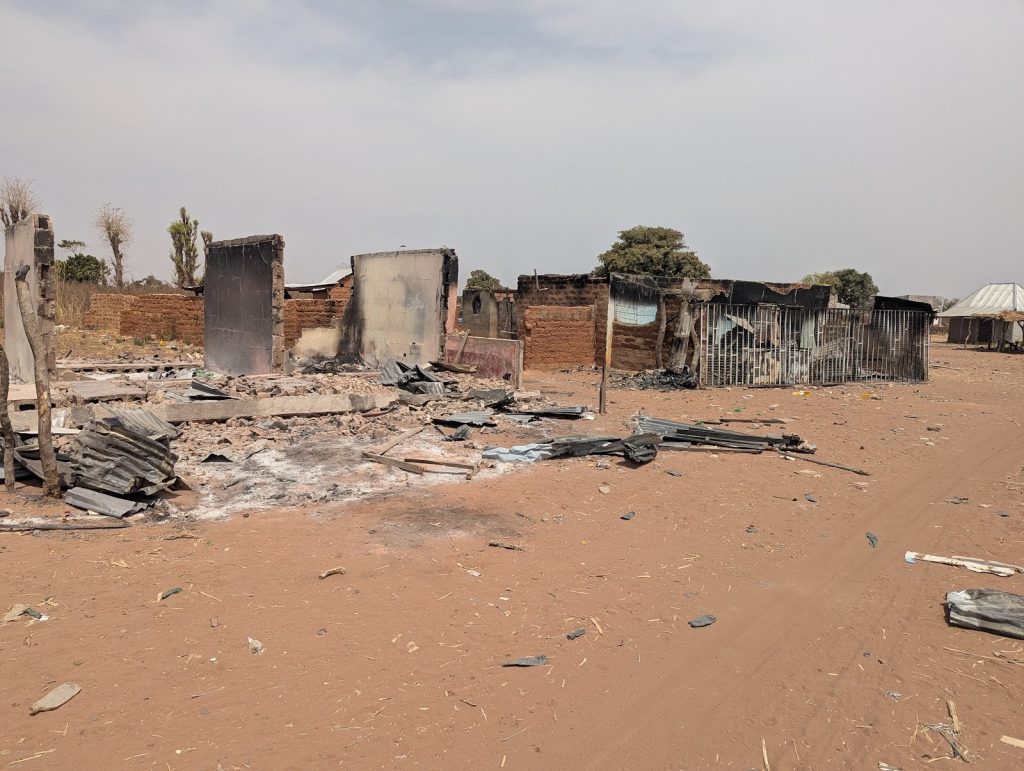
The aftermath of the Jan. 3 terror attack has stripped the community and market of their familiar rhythm, leaving behind charred homes and empty streets.
In the village market, located in the Borgu Local Government Area of Niger State, North Central Nigeria, where voices once mingled in trade and laughter every Wednesday, only the wind now moves through its abandoned, burnt makeshift tents.
When HumAngle visited the community in February, the village felt hollow, its people gone—either displaced, abducted, or buried.
Shops in the market that were burnt down by terrorists who attacked the Kasuwan Daji. Photo: Isah Ismaila/HumAngle.
Amid the ruins, Sule Amadu, an elderly man in his late 60s, moved slowly through the debris of his burnt house, searching for anything that might have survived the flames. He was dressed in the same clothes he wore on the day of the attack.
Sule lost his brother and his house, and nine of his grandchildren were abducted by the same terrorists who attacked his community on Jan. 3. Photo: Isah Ismaila/HumAngle.
His quiet scavenging symbolised both survival and loss.
“I was at the farm when I first heard the roar of their motorcycles heading towards our village,” he recounted. “Moments later, they began shooting sporadically. In panic, I exclaimed, ‘Innalillahi wa inna ilaihi raji’un’ [from God we are and to Him we shall return].”
Sule said the violence was relentless, as the terrorists aimed their bullets directly at people.
“Those who tried to run were chased down by terrorists on motorcycles. Two of them rode together—one driving, the other firing at random. What was our crime?” he added, his voice carrying both grief and bewilderment.
A distant view of some of the burnt houses and food storage facilities in Kasuwan Daji, now sitting in eerie silence. Photo: Isah Ismaila/HumAngle.
State authorities said no fewer than 30 people were killed in the attack. However, eyewitnesses who spoke to HumAngle say 57 people were buried that day, while 49 others were abducted, contradicting the official figures.
Sule narrowly escaped death. His younger brother was killed, and nine of his grandchildren and his son’s wife were abducted that day.
“When the terrorists stormed in, I was trying to bag my millet. One of them chased me while shooting, but by God’s mercy, I escaped the bullets. I ran and jumped into the river to save my life,” he said.
How the attack unfolded
Sule was not alone in witnessing the chaos that engulfed Kasuwan Daji. HumAngle met another resident, Isa Mamman, who said he was among the first to notice the approaching attackers and raise the alarm in the community that day.
Isa, a resident in his 40s, is a living witness to the atrocities committed by the terrorists who stormed his village on Jan. 3, 2026. He vividly remembers the horrifying scenes. Photo: Isah Ismaila/HumAngle.
He recalled how the attack began and how quickly it unfolded.
Isa was alone in a nearby bush around 4 p.m. when he noticed heavy dust rising in the distance and the sound of motorcycles approaching. He immediately ran towards the community to raise the alarm, where he met another villager who was also fleeing. Isa learned from him that the attackers had stormed in from the market axis.
Within minutes, chaos engulfed Kasuwan Daji.
Gunshots echoed across the village as people screamed and scattered. Terrorists on motorcycles fired indiscriminately, chasing down those who tried to escape. Shops and homes were set ablaze, and the once-thriving market became a scene of devastation.
Just like Amadu, Isa narrowly survived, as he was shot at twice as he fled into the bush. From his hiding place, he watched helplessly as villagers were slaughtered and houses reduced to ashes.
Isa narrowly escaped death when the terror struck. Photo: Isah Ismaila/HumAngle.
The violence stretched into the night as Isa remained hidden, fearing an ambush, while the community lay in ruins.
“By dawn, when I came back to the community, lifeless bodies were scattered across the village, food storage facilities were destroyed, and every house and the market were burnt,” he said. That day, I escaped by God’s grace. I ran into the bush to hide, but I could still see what was happening. I saw our people being slaughtered like rams.”
Get our in-depth, creative coverage of conflict and development delivered to you every weekend.
Subscribe now to our newsletter!
The area where people were tied and slaughtered by terrorists. Residents told HumAngle that dead bodies littered this area in pools of blood. Photo: Isah Ismaila/HumAngle.
Isa noted that, “There was no part of the community where we didn’t find dead bodies. Every house in Kasuwan Daji was set ablaze. Our market and storage facilities, where we kept food, were burnt down. We’ve all fled because we are terrified they might attack again.”
A new terror base
Field investigations conducted by HumAngle across the Kasuwan Daji, Wawa, and Babanna areas of the Borgu LGA of Niger State, in February show that terrorist factions are now entrenched in and around the Kainji Lake National Park axis.
Terror groups such as Mahmudawa (Mahmuda faction), Lakurawa, elements of Ansaru, and Jama’atu Ahlis Sunna Lidda’awati wal-Jihad (JAS) led by Sadiku and Umar Taraba, as well as a newly emerged cell affiliated with Jama’at Nusrat al-Islam wal-Muslimin, have turned the Kainji Forest Reserve into a safe haven.
These groups operate in interconnected networks rather than in isolation, exploiting local cover to conceal their movements. They conduct attacks in distant areas before retreating to established hideouts within the park’s surrounding communities.
Kasuwan Daji is situated within this geographic corridor and has become a focal point due to its depth, accessibility, and lack of security presence. It sits about 14 kilometres from the Saint Mary’s Catholic School, where some schoolchildren were abducted in Nov. 2025.
The largely ungoverned terrain provides violent groups with mobility, supply routes, and escape paths across state and national boundaries. This strategic advantage has made the area increasingly attractive to extremist factions seeking to expand their operational reach.
Recent incidents in Niger State and adjoining areas — including coordinated assaults on villages and high-profile abductions — have heightened concerns that extremist networks are embedding themselves beyond the country’s North East, their traditional stronghold. Their spillover into villages such as Kasuwan Daji, Agwara, Babanna, and Kaiama LGA of Kwara State underscores the emergence of a hybrid threat ecosystem in which ideology, criminal enterprise, and local grievances converge to reinforce instability.
This evolving dynamic positions Kainji not only as a local security challenge but also as a critical node in the broader extremist landscape of the North Central region.
Earlier attacks
The Kasuwan Daji attack of Jan. 3 was not the first.
Months before, precisely in September 2025, residents told HumAngle that terrorists had entered the community and abducted several of its most significant figures. Among them was Usman Jatau, the village head, along with five others: Ibrahim Jatau (zone chair of Kambari), Anthony Yakubu Takura (youth leader), Mathew Ibrahim (head of vigilante), David (businessman), and Abu Agwara.
Relics of the Jan. 3 attack. Photo: Isah Ismaila/HumAngleThis rhombus had over 20 stacks of sorghum that were stored by a farmer in Kasuwan Daji, but was razed by terrorists. Photo: Isah Ismaila/HumAngle.
To date, none of them has been heard from, a situation that has left families in anguish and the community without its leadership.
After the abduction, Ajikali Jatau, the brother of the village chief and head of the Kasuwan Daji market, said the same attackers returned with greater brutality.
“This time, their intent seemed clear—to wipe out the community. Villagers were slaughtered mercilessly, some tied with their hands behind their backs before being killed,” Ajikali told HumAngle. He believes the market was deliberately attacked because of its boom and constant business activities.
Ajikali Jatau is burdened by the pain of losing his brother, nephew, and relatives in the terror attack. Photo: Isah Ismaila/HumAngle.The remains of the Kasuwan Daji weekly market burnt by terrorists in the Borgu area of Niger State. Photo: Isah Ismaila/HumAngle.
Ajikali told HumAngle how the market itself had its own history of struggle.
“Before establishing Kasuwan Daji, we used to trade at Sokomba market every Wednesday. But after two young men from our tribe [Kambari] were killed and burnt there in broad daylight, we decided to stop going there.
“One of the victims had tried to escape but was shot dead. The repeated harassment and targeting forced us to request that the market be moved somewhere else, but after several futile efforts, we created our own,” he revealed.
Debris of burnt grains from the storage facilities razed by terrorists in Kasuwan Daji Market. Photo: Isah Ismaila/HumAngle.
For seven years, Kasuwan Daji market thrived, residents say, as they paid revenue to the local government—until it was reduced to ashes in the January attack.
Displacement and human toll
More than 300,000 people have been displaced across 10 LGAs in Niger State, including residents of Kasuwan Daji, according to Governor Umaru Mohammed Bago.
Hajara Shuaibu, a resident of Kasuwan Daji, is one of them. Her husband, Malam Shuaibu, a farmer, had made the village his home, cultivating produce with his family and planning to relocate there permanently. When the terrorists struck, Hajara’s world collapsed. Two of her younger brothers were kidnapped along with her husband’s other wife and daughter, forcing the family to flee to Papiri, a 14-kilometre drive from Borgu to Agwara LGA of Niger State, in search of refuge.
Hajara Shuaibu [in pink] and one of her daughters are now seeking refuge in the Papiri, Agwara Local Government Area of Niger State, after fleeing from Kasuwan Daji in Borgu. Photo: Isah Ismaila/HumAngle.
Before arriving at Papiri, Hajara said she and her children hid in the bush for three days, waiting for the violence to subside.
“Our house was burnt to the ground, along with our belongings and food supplies. About two truckloads of grains and groundnuts that were harvested by my husband were destroyed in the fire, erasing our year-long hard work in a single night,” she said.
Days later, her brother’s wife managed to escape captivity, only to return with devastating news: her husband [Hajara’s brother] and several others who had been abducted had been killed.
The terror was felt even among the youngest.
Suleiman, Hajara’s four-year-old grandson, was among the abducted persons from the attack but was later abandoned in the Gallah area of Agwara LGA, near the house of the village chief.
His cries were said to be so persistent that the attackers eventually dropped him off before leaving with the other captives.
Hajara said that the joy at seeing him [Suleiman] alive was quickly overshadowed by grief, as she remembered her slain brother and relatives still in captivity.
‘We’re not thieves’
In the aftermath of the Jan. 3 attack, the Niger State Governor described Kasuwan Daji as a “market of thieves”, claiming that the community had become notorious for the sale of rustled cattle. He made the remarks during a condolence visit to the Emir of Borgu.
Some of the houses that were burnt by terrorists who stormed the Kasuwan Daji community of the Borgu LGA of Niger State, North Central Nigeria. Photo: Isah Ismaila/HumAngle.
Adding to the despair, he instructed the survivors to leave the Kasuwan Daji village altogether, even though no plans were announced for their relocation or resettlement, leaving families displaced, vulnerable, and uncertain of their future.
However, survivors of the attack strongly refuted the governor’s framing.
Isa Mamman and Sule Amadu are the two people who have refused to leave the community; since they have nowhere to go, they serve as watchdogs watching over the ruins left behind. Photo: Isah Ismaila/HumAngle.
Ajikali, brother of the village chief and leader of the now-destroyed market, told HumAngle, “We are not thieves. We are hard-working people, and the emirate is aware of us and our market. We are farmers—that is our business and what we are known for. We do not deal in the cattle business, so how can we be called thieves?”
Sule also echoes this rejection of the governor’s claim: “I strongly disagree with the governor’s assertion that our market is ‘a market of thieves.’ We do not sell cows in Kasuwan Daji, yet he accuses us of selling rustled cows. He’s been misled by those around him.”
“The only thing I want is to have my grandchildren back. Even if they [terrorists] demand ransom, I have nothing to give except the clothes I am wearing. They burnt everything I owned—my food, my savings, and my animals were stolen,” he noted.
The Niger State Commissioner for Homeland Security, Bello Maurice Magaji, while reaffirming the government’s commitment to tackling insecurity through intelligence gathering and grassroots collaboration, also defended the governor’s branding regarding activities at the market, stressing that it was based on verified intelligence.
“We are adopting an intelligence-gathering strategy to understand the patterns of these crimes and attacks so that we can tackle the situation head-on,” the commissioner told HumAngle. He noted that the government is also engaged in advocacy to help citizens recognise early warning signs that may not have been obvious in the past.
“Also, I believe that whatever information was released by His Excellency is based on facts that were made available. Our government does not simply go out to brand or profile people based on unverifiable information. Our government is too serious to speculate or issue statements without evidence. Therefore, we stand firmly by what the Governor said about the market,” he stated.
Investigation by HumAngle revealed that there are two markets with the same name: Kasuwan Daji. One is situated in Niger State, North-Central, and another in the Kauran Namoda area of Zamfara State, in northwestern Nigeria.
Further checks also indicate that Kasuwar Daji Market in Kaura Namoda local government area of Zamfara State, is a popular hub for cattle rustling. Terrorists, in January, stormed the market and rustled over 500 cattle.
Aminu Garba, Chairman of the Cattle Breeders Association of Nigeria in the state, told journalists that the operation was not an isolated incident noting that similar attacks have occurred in the past, with one recorded about four years ago.
He explained that the terrorists infiltrate the market and nearby villages during the day, monitoring livestock transactions before striking.
It is not impossible that the Niger State government is mistaking one Kasuwan Daji for the other.
For Isa Mamman, another survivor of the attack in Niger State, the governor’s words add insult to injury. He explains that he and Amadu stayed behind in the community because they had nowhere else to go, even as their livestock was rustled and nearly fifty women and children were abducted.
“It has been almost two months since the attack, yet nothing has been done. Neither the state governor nor the district head of Kabe has visited our community. Instead, we were insulted and labelled as thieves. We pay revenue to the government, yet they claim our market is illegal. Now, we have no food, no peace, and countless lives have been lost, and nothing has been done.”