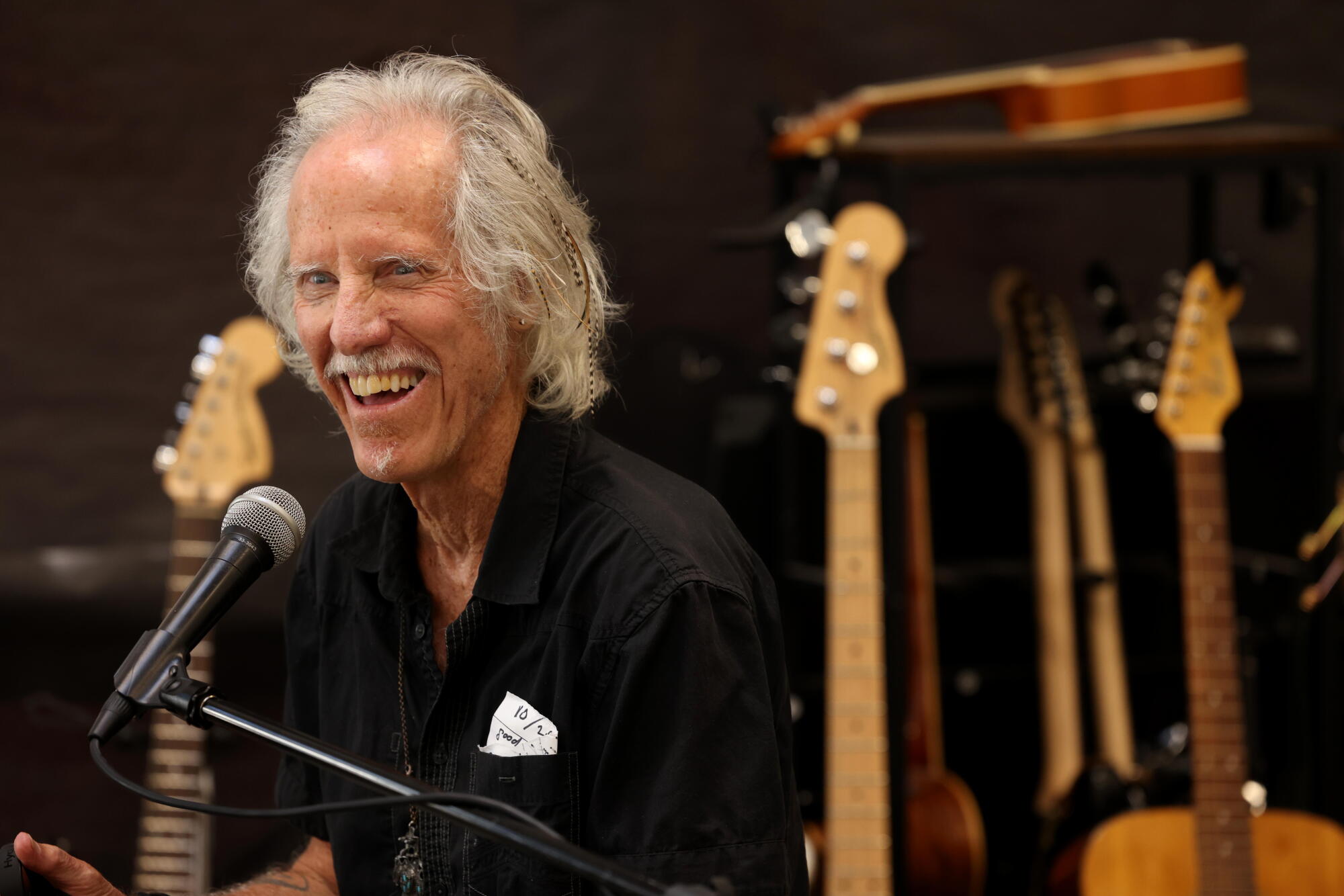
Doors drummer John Densmore jams at Homeboy: ‘Maybe I can do something here’
A couple of years ago, in a column about Father Greg Boyle, I noted that he is quite particular and even a bit preachy about the right way to eat a steak.
It should be medium rare, never well-done, and served with a proper elixir.
Doors drummer John Densmore took note. One thing led to another, and in July, Densmore, Boyle, former Times reporter Greg Krikorian and I went to dinner at the Smoke House in Burbank.
We did not necessarily follow Boyle’s meat and beverage protocols, but we jabbered away in a red leather booth, and a good time was had by all.
Then, in August, I got an email from Boyle.
“John walks into the Homeboy Art Academy,” he wrote, “and starts jamming as the homies are playing ‘Stand By Me.’”
Boyle sent a short video, and there’s Densmore, still keeping perfect time at 81.

John Densmore enjoys an upbeat moment while teaching a music class at Homeboy Art Academy.
I wasn’t surprised. Densmore’s a busy guy, with various charitable causes and artistic ventures. He and former Public Enemy rapper Chuck D just fused music genres on an album called “No Country for Old Men.” But he’s an admirer of Boyle and his decades-long mission of gang intervention and rehabilitation.
“Hey,” Densmore told the musicians he played with that day, “maybe I can do something here.”
He suggested that he return and stage a music workshop or a drum circle.
They said of course.
On Wednesday, before the music began, Densmore insisted that I see the Homeboy Art Academy, whose founder is artist Fabian Debora.
“I grew up in the projects when Father Greg first came in,” Debora told me, referring to Homeboy’s early days in the 1980s, when Boyle was pastor of Dolores Mission Church in Boyle Heights. “Through the arts, I found my way to healing and transformation. Then I said, ‘How can I fulfill a need that was missing in my life?’”
The answer is the academy he now runs with Dre Comers, located near Metro’s Chinatown station, providing art instruction to tens of thousands of people. On Wednesday, teachers were busy helping students with artwork in various stages of completion, including a painting of Boyle with a halo.
Most of the participants are young adults, many of whom were born decades after the Doors’ last album was released. One student, in his 20s, welcomed us and asked Densmore what he was known for.
“I’m a drummer,” Densmore said.
He was known to far more people in the music room, including longtime musician/instructors Joe Calderon and Martin Flores. They’re part of the Young Musicians Foundation’s Music Heals program, funded in large part by legendary songwriter Mike Stoller, who co-wrote dozens of hit songs including “Jailhouse Rock,” “Hound Dog,” “Poison Ivy” and “Stand by Me.”
The latter song appears on a brand new “Music Heals” album designed by art academy participants and released Tuesday, so with Densmore’s arrival on Wednesday, it was a big week for Homeboy arts.
“When you’re playing music,” Densmore told about 30 students and instructors, you can enter a state of timelessness. “It’s kind of like a meditation … A little bit of infinity creeps in … And everybody can get into that space. If you want to be a professional musician, cool. If you wind up playing the piano in a closet and nobody hears it, you’re still getting into this space that kind of heals and feeds you.”
And then it was concert time, with Densmore on drums and instructors Calderon on guitar, Flores on percussion and Mackenzie Azela on bass. Fabian Debora Jr. (bass and vocals) and Ralph Quintero (vocals) are both in the Homeboy rehabilitation program.
The band kicked off with a blues number called “Got My Mojo Working,” then it was Ben E. King’s “Stand by Me” followed by Cream’s “Sunshine of Your Love.”
It all went off pretty smoothly for a group that hadn’t worked together except for a quick minute on Densmore’s previous visit. The musicians were smiling, the spectators tapped and clapped, and that magical sense of timelessness was real, spanning multiple generations.
In a place filled with people confronting the challenge of rebuilding their lives, the lyrics of one particular song were a reverie.
No, I won’t be afraid.
Oh, I won’t be afraid.
Just as long as you stand by me.

Doors drummer John Densmore, right, leads a jam session while teaching a music class at Homeboy Art Academy in downtown Los Angeles.
Debora Jr., 27, told me it was pretty cool to be playing with a member of the Doors, a band he knew about through his elders. Quintero, 50, who is studying psychology and wants to be a drug counselor, said he still couldn’t believe he had just performed with a member of the Doors.
“It’s an honor,” he said.
Everyone in the room grabbed either shakers or a small drum, and with Densmore instructing and conducting, the ensemble conjured what he called the heartbeat of Mother Earth. The music rose and fell, rose and fell as the players became one, followed by an orchestrated hush that served as a silent accent.
“Like sex,” Densmore said.
He moved on to a brief Q&A, and one of the first questions was about what it was like to be around Doors lead man Jim Morrison.
“I miss his artistry,” Densmore said. “I don’t miss his self-destruction. So I’m 81. He died at 27. And there’s different ways to do this. Hopefully you guys will keep on breathing like I am.”
As Densmore packed up his things, a young man named Jeremiah asked the drummer if he’d record a short video for the family of his girlfriend. She had just lost her grandfather, a longtime Doors fan.
“That was their go-to music, every car trip,” Jeremiah said.
He sent the clip to his girlfriend and asked her what the family’s favorite songs were. “Riders on the Storm” was one. Along with “Break on Through,” “Touch Me,” and “L.A. Woman.”

John Densmore, right, congratulates musicians Joe Calderon, from left, Fabian Debora Jr., with bass, and Ralph Quintero after they performed.
At Homeboy, Boyle’s mission has been twofold, in a sense. To show love to his charges while preparing them for lives unlike the ones they’ve known. And through his books and teachings, to remind us all that we belong to each other.
There was a bit of that gospel in the note that Flores, program director at Music Heals, sent Densmore after his visit. He thanked him, telling Densmore he had “provided our students with not only an incredible artistic experience, but also a deep sense of connection, inspiration and hope as they navigate their journeys.”
Densmore answered immediately.
“I think I might have gotten more out of it than I gave.”
steve.lopez@latimes.com