For Santos Bravos, the first Latin American group to play KCON, pop has no borders
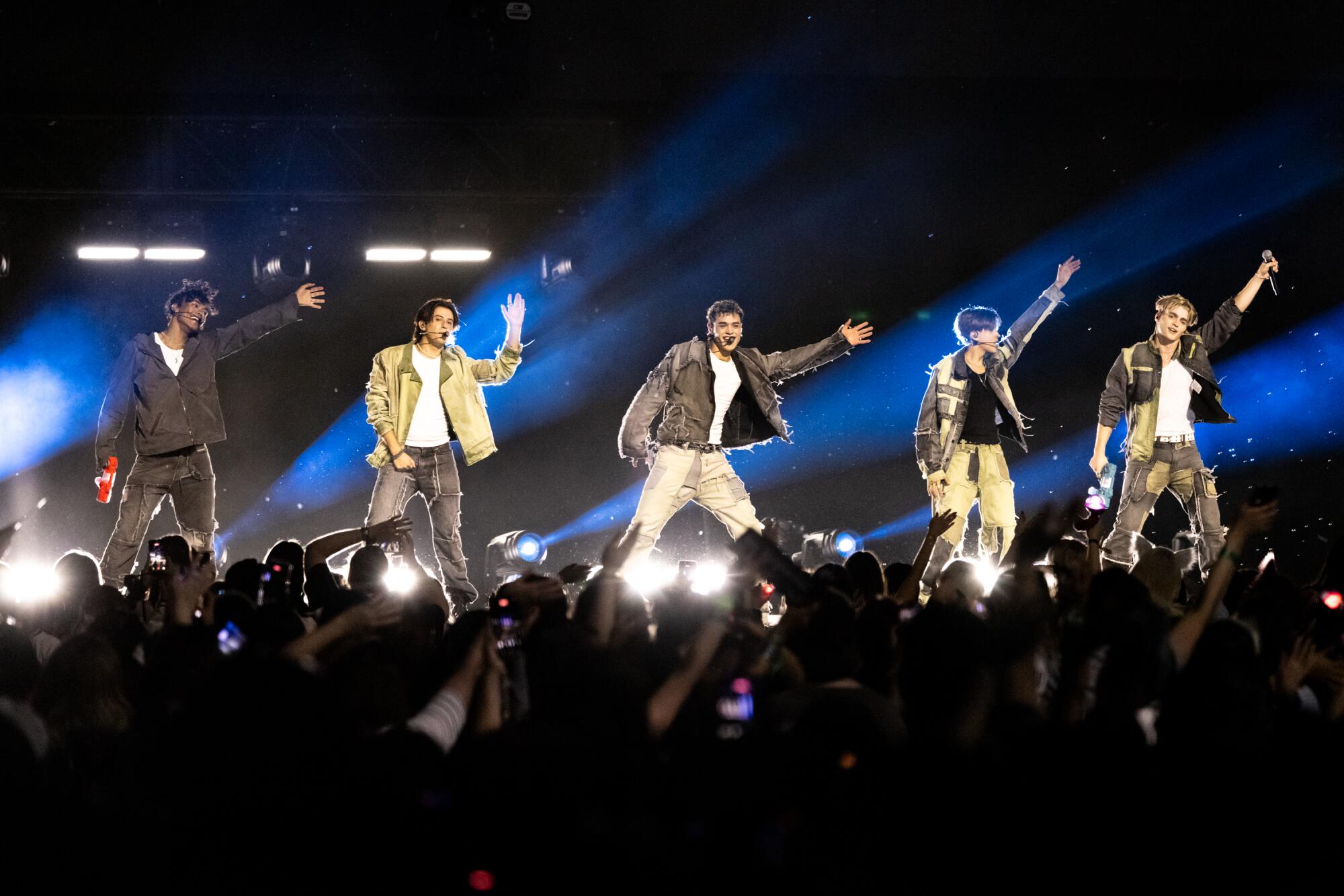
Under the hot lights of the Crypto.com Arena in Los Angeles, the five members of Santos Bravos stood center stage, ready to stake their claim to international stardom. It was the first night of KCON — a three-day festival of Korean pop culture, held every year since 2013 — and on Aug. 14, Santos Bravos became the first Latin American act ever to grace the bill.
Despite the band having debuted less than a year ago, the crowd was buzzing with excitement, but its energy heightened as the slashing knife sounds of “Hooligan,” a song off BTS’ latest hit album, “Arirang,” began to ring out. Because of their popularity, BTS songs are frequently covered by groups at KCON, but newcomers Santos Bravos, who are under the same parent label, Hybe, had more to prove to this audience.

Santos Bravos, a Latin American boy band based in Mexico City, performs on the Artist Stage on Aug. 14 at KCON at the Los Angeles Convention Center.
(Arwen Clemans / Los Angeles Times)
“Hooligan” was produced by Spanish producers Fakeguido and El Guincho (who worked on two records with Rosalía), as well as South Korean producer Ghstloop and American producer Jasper Harris. The multicultural song, with lyrics in both Korean and English, was an apt choice for Santos Bravos — between the five members, they speak and sing in three languages and represent several Latin cultures.
For BTS fans, nothing less than near the performance level of the superstar group is acceptable. But as Santos Bravos sang the opening verses in English, the crowd roared with approval — especially as lead vocalist Kauê Penna, who hails from Brazil, slid onstage to take on the high parts of BTS lead Jungkook.
While artists from different backgrounds working together is nothing new, Santos Bravos, like the Hybe x Geffen girl group Katseye, are part of an effort to bring K-pop training, marketing methods and fandom culture to other regions of the globe.

Fans watch as members of Santos Bravos walk off the stage and into the crowd during a performance on Day One of KCON.
(Arwen Clemans / Los Angeles Times)
Off the global success of BTS, Hybe evolved from a mid-sized label into one of the biggest music and entertainment players in South Korea. Santos Bravos operates under a division called Hybe Latin America, which is based out of Mexico City, where the band calls home. They are the first Hybe group to be based in a region outside of the United States or Asia.
Selected from 17 finalists on a 2025 competition reality show called “Santos Bravos — La Serie,” the contestants had vied to become part of Santos Bravos. Along the way, they received feedback and coaching from Song Sun-deuk, BTS’s longtime former choreographer and performance director. They also worked closely with Miami-based Cuban American choreographer Cultura, who has previously worked with Maluma, J Balvin, and Karol G, among others.
The final five debuted as a group at the show’s finale in October of 2025, where they performed before an audience of 10,000 at the Auditorio Nacional Mexico. Santos Bravos’ members are Penna, 19, from São João de Meriti, Brazil; Kenneth Lavíll,16, from Veracruz, Mexico; Gabi Bermúdez, 21, from San Juan, Puerto Rico; Alejandro Aramburú, 22, of Lima, and Drew Venegas, 26, from L.A. County.

The selected members were no starry-eyed amateurs: Both Lavíll and Aramburú were professional actors in their countries, while the honey-voiced Penna won the fifth season of “The Voice Kids, Brasil” in 2020. Bermúdez, the effusive mood-lifter of the group, was gunning for a career as a soloist when he entered the ring. Venegas, a dance specialist who had performed as a backup dancer for BTS, had a brief stint as a member of the Future X, a co-ed group formed by Simon Fuller that featured members of the queer community.
Not even a year into their formation, Santos Bravos topped Billboard’s new Latin music poll. In January, they performed alongside Mon Laferte and Feid in Willy Chavarria’s Paris Runway show, “Eterno.” In June, their debut EP, “Dual,” made it as high as No. 17 on the Billboard Top Latin Pop Albums chart. That same month, the group won its first award, the fan-voted artist duo or group at the 2026 Premios Tu Música Urbano Mix.
“We’re very disciplined,” said Venegas, who called West Covina home before joining the band. I met the band inside the Los Angeles Convention Center on Saturday, after their KCON breakout moment.
“One day of training was equivalent to one week of training,” he added. “I think combining all of our cultures together, then keeping our Latin essence with the K-pop methodology, [brings] something very new and very fresh for the eye.”


Although the group doesn’t perform in Korean — unless it’s for fun — they cater to K-pop fans, which is easy to do since they too are K-pop fans. They’ve paid a visit to the Hybe headquarters in Seoul, collaborated with bands like Le Sserafim and BoyNextDoor and livestreamed to fans via Hybe’s proprietary social platform Weverse. They’ve even performed on Korean television.
But for the members of Santos Bravos, the cultural exchange goes beyond marketing.
“In Mexico,” Venegas said, “when you’re eating we say, ‘Buen provecho,’ which is like ‘Enjoy your food,’ No matter who it is, no matter who you’re walking by. Food is a big part of acknowledging somebody, and that’s what we have in [common with Korean culture].”
Mostly talking to each other in Spanish — both Venegas and Penna learned to speak it as a second language — they occasionally forget which language they are speaking to each other in.
“Sometimes I find myself talking to Kenneth or Kauê in English when I don’t need to,” interjected the soft-spoken Aramburú, who plays the guitar — and, in between his shifts as a pop star, is finishing up his music degree at USC.
“The fact that we learn so many languages opens so many doors for us,” Aramburú said. “Personally, wherever we go, I love to learn the language. I’m on Duolingo learning Korean right now.”
Penna sees language as a way to not only open doors for Latin artists, but also reach people through their music.
“Thank God Latin America is being watched,” said Penna. “You know, people can see what we’re doing, and people also are interested in in our languages, in our culture. And in every country we [visit], we try to learn as much as possible about the culture. Now we’re focusing on Portuguese” — a language they test-drove in the song “Velocidade” — “and of course, English.”

Venegas has found that his experience as a Mexican American who didn’t grow up speaking Spanish resonates with some people.
“There were a couple of fans who came up to me who were of Mexican descent, but they didn’t get the chance to learn like me growing up,” he said. “And immediately, they were at a loss for words and kind of filled with emotions. I started getting emotional because I can feel the heartache and … feeling scared, like you don’t belong … and that’s what I felt like. Being able to speak with them and hear what they say made me feel like I’m not alone and like I do matter. Hearing, ‘OK you didn’t grow up getting spoken to in Spanish, but you were still called mijo like I was called mijo.’ ”
Asked why some people struggle to grasp multiracial Latino identity — Cardi B is brought up as an example — Penna weighed in.
“Being in Santos Bravos as an Afro Latino is something so important to me,” said Penna. “I feel like this ‘thing’ of being this or being that… It’s just cultural differences. I’m also working to understand how another culture sees me. As Brazilians, we are very mixed. Of course, I have my Afro side, my mom’s side, I have my Indigenous side… but of course, I am very open and very proud [with] what I’m representing in Santos Bravos.”
“People in general like to categorize,” said Bermúdez, who grew up idolizing Puerto Rican singer Chayanne. Raised in Puerto Rico by parents with both Boricuan and Cuban heritage, Bermúdez bristles at attempts to divide Latinos.
“We as Santos Bravos want to transmit to the world that Latin America is one,” he said

Santos Bravos
(Ronaldo Bolanos / Los Angeles Times)
On the Monday after KCON, I met up a second time with the members of Santos Bravos, who were milling about in the Hybe America offices in Santa Monica. Venegas scrolled through his phone while Penna shuffled past us to grab a drink from the office fridge. I ask whether he’s tired. “A little” he replies, but he’s good.
Upstairs, walking past a large poster of BTS, I met with Juanse Arenas, president of Hybe Global Label Services, who promotes artists outside of their home markets. He said the company looked closely at data and research when conceptualizing the group.
“Mexican regional music became really big, Bad Bunny himself went global,” Arenas said. “You have Karol G, J Balvin, all these massive artists who come from our countries. Latin music is no longer just Latin; it’s global, right? Now, there is a methodology that exists in K-pop that has produced very successful groups. But you can’t just apply that methodology blindly to new regions and to new places — you have to [consider] where the members are coming from, what makes them tick, what drives them and the audience they’re speaking to.”
After posing for individual promo portraits, they gathered for a group photo before singing an acapella version of the uptempo ballad “MHM” for social content. They also greeted their fans on the Weverse livestream, where they expressed sadness over leaving L.A.
“Nos vamos pronto de L.A., mi gente,” said Lavíll to fans. “Y estamos tristes.”