Border Patrol

Senate passes resolution to begin budget reconciliation to fund DHS

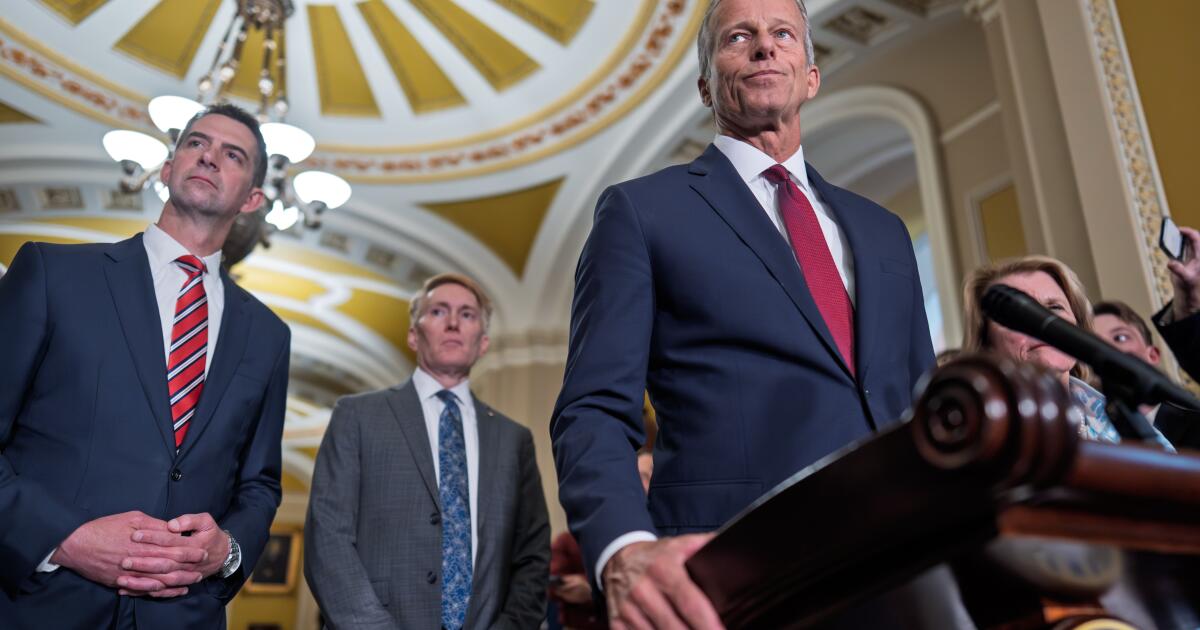
April 23 (UPI) — Senate Republicans were up all night voting, eventually adopting a budget reconciliation package Thursday morning to prepare to fund the Department of Homeland Security.

The Senate plans to fund the department without Democrats’ help. The resolution was adopted at around 3:30 a.m. EDT Thursday by a vote of 50-48 after about six hours.

The only Republicans to vote against the resolution were Sens. Lisa Murkowski, R-Alaska, and Rand Paul, R-Ky. The bill now goes to the House. If the House adopts the resolution, the final funding bill can be written and voted on by Congress.

They are following a deadline of June 1 set by President Donald Trump.

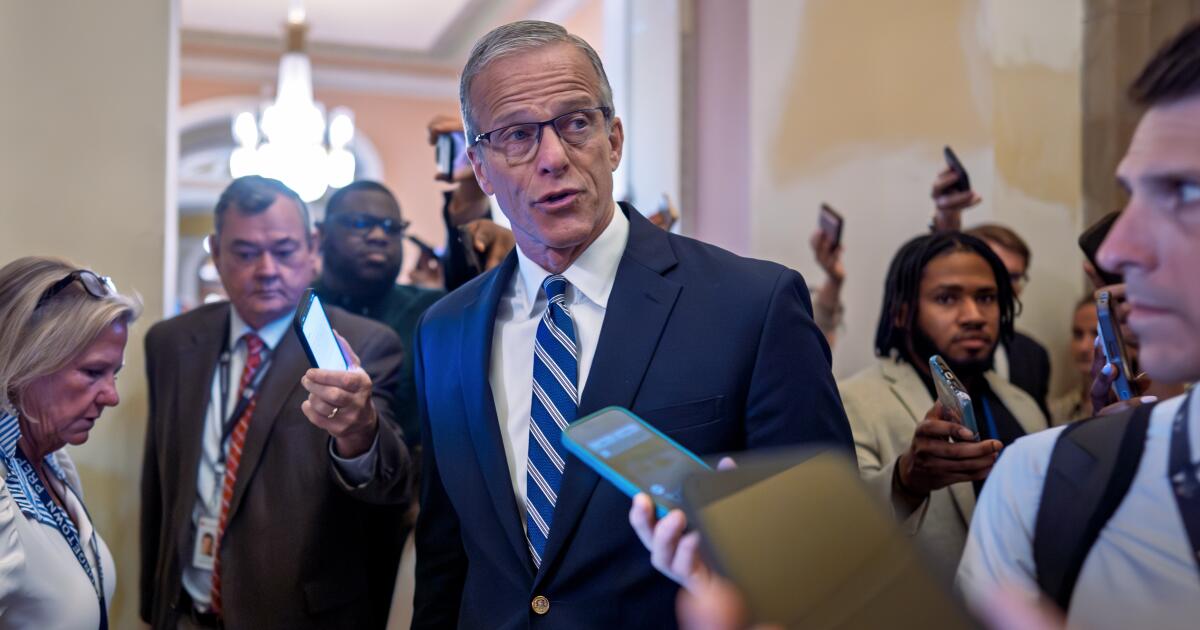
“We have a multistep process ahead of us, but at the end Republicans will have helped ensure that America’s borders are secure and prevented Democrats from defunding these important agencies,” said Senate Republican Leader John Thune, R-N.D.

Thune told fellow senators to keep the package narrow to ensure speedy passage.

Since the January deaths of Renee Good and Alex Pretti in Minnesota, both shot and killed by DHS officers, Democrats have refused to support funding the department without reforms. The department has been shut down since Feb, 14, though Trump told the department to use emergency funds to pay essential workers.

Just before the Easter recess, the Senate passed a bill that would fund most of DHS but not ICE and Border Patrol. But the House rejected it.

Republicans are hoping to fund the department through 2029 at a cost of between $70 and $80 billion.

The late-night vote-a-rama included votes about amendments that could be added to the resolution. Two Republican Senators who are vulnerable in the November elections — Sens. Susan Collins, R-Maine, and Dan Sullivan, R-Alaska — broke ranks on some amendments.

Collins and Sullivan voted for amendments to lower health care costs, to reverse last year’s Supplemental Nutrition Assistance Program cuts and to tackle insurance companies that delay or deny medical care. Sen. Josh Hawley, R-Mo., joined with Collins and Sullivan on the latter.

Sen. Bernie Sanders, I-Vt., also sponsored an amendment that would tell the budget committee chair to help cut prescription drug prices by half. Hawley, Collins and Sullivan supported Sanders on it. Sanders said his amendment would codify ensuring that Americans wouldn’t pay more for prescriptions than Canadians or Europeans.

The amendments wouldn’t have the power to force Republicans’ hands, but they would make Republicans go on record about their views of these items.

“This reconciliation, or this budget act, will show who’s on whose side, and clearly if Republicans vote against our amendments, they’re not on the side of the American people,” Democratic Leader Chuck Schumer, D-N.Y., said on the Senate floor.

Homeland Security Secretary Markwayne Mullin told Fox and Friends on Tuesday that the department will run out of money for salaries next month.

“I’ve got one payroll left, and there is no more emergency funds so the president can’t do another executive order because there’s no more money there,” The Hill reported he said.

The resolution does not include the SAVE America Act, the voter security bill that Trump and other Republicans have pushed for. Sen. John Kennedy, R-La., sponsored an amendment to add similar restrictions, but it failed 48-50. Collins, Murkowski, Sen. Thom Tillis, R-S.C., and Sen. Mitch McConnell, R-Ky., voted against it.

FBI Director Kash Patel speaks during a press conference at Department of Justice Headquarters on Tuesday. The Trump Administration announced charges against the Southern Poverty Law Center, which the government alleges funneled over $3 million toward white supremacist and extremists groups. Photo by Bonnie Cash/UPI | License Photo

Source link

High court to examine rights of green-card holders charged with crime

WASHINGTON, April 22 (UPI) — The Supreme Court will hear arguments Wednesday whether immigration officers can place permanent residents charged with a crime on parole if they leave and then re-enter the country.

In immigration, parole is a temporary, discretionary permission granted by the Department of Homeland Security that allows a person to enter or remain in the United States, even though they are not formally admitted.

Parole does not cancel a person’s green card, but essentially gives the Department of Homeland Security time to decide whether the person should be admitted or deported based on how the issue is resolved.

The court is poised to hear oral arguments in Blanche vs. Lau, which would determine when immigration officers can demote a permanent resident’s status to parole, a temporary status that can be revoked and result in deportation.

Lau is Chinese immigrant Muk Lau, a permanent resident with a green card. Blanche is Todd Blanche, the acting U.S. attorney general and named defendant in the case.

Typically, permanent residents are allowed to leave and re-enter the United States as they wish, with a few exceptions. If these immigrants have committed certain kinds of crimes, for example, officers can have them placed on parole when they return to the country after going abroad.

The case stems from an event on June 15, 2012, when 69-year-old Lau, who had gained permanent residency five years earlier, landed in a New York-area airport after traveling to China.

He presented his green card and passport to border control. His entry triggered an FBI match because a month earlier, Lau was charged with third-degree trademark counterfeiting for selling nearly $300,000 of fake designer shorts.

“I was arrested at a warehouse that contained some merchandise I had stored there,” Lau told the Customs and Border Protection agent, according to court documents. “I went to the warehouse to retrieve the merchandise because I had not paid rent, and when I got there, the cops were there and arrested me.”

The agent declared Lau inadmissible as a returning permanent resident due to the crime exception, and decided to let him in on parole, instead. A year later, Lau pled guilty to the counterfeiting, and in 2014, the Department of Homeland Security began deportation proceedings against him.

At the time, the Customs and Border Patrol agent did not know whether Lau was guilty — just that he had been charged with a crime. The crux of Lau’s case is whether the CBP agent needed “clear and convincing” evidence of a crime when placing him on parole or whether just charges were enough without such evidence.

Immigrant advocates argue the agent erred.

“Mr. Lau was absolutely, unequivocally, at that time, admissible,” said Jonathan Weinberg, who worked on the American Immigration Lawyers Association’s brief to the court. “He just was. He hadn’t been convicted of a crime. There was nothing else that would render him inadmissible.”

After an immigration judge and the Board of Immigration Appeals sided with the government, Lau appealed to the U.S. 2nd Circuit Court of Appeals. The appellate court, agreeing with Weinberg’s reasoning, granted Lau’s petition in March 2025.

The Federation for American Immigration Reform, a nonprofit advocating for lower immigration rates, also submitted a brief to the court. It argued that the border patrol officer did the right thing by paroling Lau into the country, and that the clear and convincing standard was too high.

“If you’re going to say that the officer in an airport is supposed to have all this information, you’re assigning that individual with an impossible task,” FAIR spokesman Ira Mehlman said. “You have thousands of people coming through the airports every day, and these are decisions that have to be made on the spot.”

Mehlman also said that the decision “shouldn’t be a problem” for green-card holders without any criminal history.

“When you come to the United States as a non-citizen, you are here on a conditional basis,” Mehlman said. “Even if you’re a green card holder, you’re subject to removal if you violate the terms of your presence here in the United States.”

There are nearly 13 million legal permanent residents in the United States. Legal immigrants, including green card holders, commit crimes at lower rates than natural-born citizens, according to research by the Migration Policy Institute. However, Weinberg said the ultimate decision would impact all legal permanent residents, including those who have not been convicted of any crime.

“If the government can admit Lau on parole, then the government can basically admit any returning green card holder on parole if it chooses to,” Weinberg said.

Lau’s case joins several immigration-related issues, including birthright citizenship and temporary protected status, which have made their way to the Supreme Court this spring.

“The immigrant advocacy community is, I think, fighting an uphill battle,” Weinberg said. “But that doesn’t mean you don’t give it your best shot.”

Source link

Thune: Senate may vote next week on ICE, Border Patrol funding

April 14 (UPI) — A budget resolution to fund federal immigration enforcement could hit the Senate floor by next week, Senate Majority Leader John Thune said Tuesday, as Republicans seek to bypass Democratic demands for reforms to Immigration and Customs Enforcement and Border Patrol.

Federal funding for Immigration and Customs Enforcement and Border Patrol lapsed on Feb. 14 after Republicans agreed with the Democrats to remove the Department of Homeland Security from a larger spending package and avert a government shutdown.

Neither agency has been funded through regular DHS appropriations since, though they continue operating through other, emergency funding.

Democrats began demanding reforms to the federal immigration enforcement agencies before agreeing to restore funding after two U.S. citizens were killed by federal immigration officers amid President Donald Trump‘s aggressive immigration crackdown.

Amid a stalemate in negotiations, Republicans are considering passing three years of funding for the agencies through a complicated legislative mechanism called a budget reconciliation bill that permits certain spending legislation to pass with a simple majority rather than 60 votes, Thune told reporters Tuesday in the Capitol.

“Republicans are going to stand with our Border Patrol, with our law enforcement agencies and we’re going to ensure that they are funded, not only today but well into the future,” Thune, R-S.D., said.

Sen. Lindsey Graham, R-S.C., is preparing the resolution to fund the agencies that will be followed by the reconciliation bill “to ensure the job gets done,” he said.

Democrats have blocked funding for ICE and Border Patrol until reforms — including requiring judicial warrants and banning officers from wearing masks — are made, but the reconciliation bill tactic could ensure funding without any votes from Democratic lawmakers.

The same tactic was used last year to pass Trump’s sweeping spending and tax cut bill, which provided $75 billion for ICE.

“All of the things that the Democrats made this about, which was supposed to be about reforms to the way that ICE and Border Patrol operate — they get none of that,” Thune said.

“And now, we’re going to fund those agencies for three years into the future. The only thing the Democrats got out of this was they now own the issue of open borders and defund law enforcement.”

Republicans hold a narrow 53-47 majority in the Senate, with two independents caucusing with the Democrats, as well as a 218-213 majority in the House.

The Senate has twice passed bipartisan bills to fund DHS aside from ICE and Border Patrol, which the House has balked at. Democrats blame the Trump administration’s influence on the lower chamber.

“Republicans are dragging the Senate through a partisan circus just to avoid basic accountability for ICE and Border Patrol,” Senate Minority Leader Chuck Schumer told reporters at the Capitol during a separate press conference on Tuesday.

He said Democrats will continue to push for immigration enforcement reforms.

“So, the pattern, unfortunately, with this administration is clearer and clearer,” the veteran New York Democrat said. “Chaos abroad — the war; chaos at home with not funding DHS with reforms. A failed war overseas, a manufactured crisis here in Washington — in both cases Republicans aren’t leading, they are following orders.”

Source link

TSA begins getting back pay Monday, but it’s not permanent

March 30 (UPI) — Some employees of the Transportation Security Administration started getting back pay that they’re owed for the partial government shutdown Monday, easing long lines at airports.

“Most TSA employees received a retroactive paycheck today that included at least two full paychecks covering pay periods 4 and 5 today,” Department of Homeland Security Acting Assistant Secretary of Public Affairs Lauren Bis told USA Today on Monday. “A small population might see a slight delay due to a variety of reasons, including financial institution processing times or issues with their direct deposit. We are working aggressively with USDA’s National Finance Center to complete processing for the half paycheck they are owed from pay period 3 as soon as possible.”

“Working without pay forced more than 500 officers to leave TSA and thousands were forced to call out,” Bis added.

The funding lapse has lasted since Feb. 14, causing extreme delays at airports because some TSA workers quit or called out sick.

Democrats have refused to vote for any package that doesn’t rein in Immigration and Customs Enforcement and Border Patrol. On Friday, the Senate voted unanimously to pass a measure that would fund Homeland Security but not ICE and Border Patrol. But the House rejected it, saying it wouldn’t pass it if ICE isn’t included.

In response, President Donald Trump ordered that TSA workers get paid through other Homeland Security funding. That pay is temporary. Congress began a two-week recess on Friday. They return April 14.

Angela Grana, regional vice president of the union that represents TSA workers at 38 airports in the Rockies, told USA Today that she got paid for working 200 hours. She said the overtime and holiday hours she worked didn’t appear to have been counted properly, and that she believed she was taxed at a higher rate than usual because of the lump-sum payment.

“This is all back pay. That doesn’t tell me I’m going to get paid in the future,” she said.

By late Monday morning, TSA lines were down to less than 30 minutes at most major airports, CNN reported.

George Bush Intercontinental Airport in Houston had 75-minute security lines before dawn Monday. Hours later, that number dropped to as low as 9 minutes.

At Hartsfield-Jackson Atlanta International Airport Monday, travelers waited 3 minutes.

About 500 workers, or about 0.82% of total personnel of 61,000, have quit since the partial shutdown began.

Atlanta TSA officer Aaron Barker told CNN he believes the number of agents will keep dropping.

“I do think that there’s going to be a mass exodus of officers,” Barker, the president of the American Federation of Government Employees Local 554, told CNN.

“Officers have gone into debt. Credit has been shot,” he said. “Officers have been evicted. Cars have been repossessed.”

“Back pay is not going to address [the] systemic issues,” he said. In the past five months, “We have been shut down 50% of the time.”

“This is a natural disaster that was caused by Congress,” said Johnny Jones, secretary-treasurer of the American Federation of Government Employees, which represents TSA workers.

“The vast majority are devastated,” he said. “My colleagues, they’re like, ‘Our finances are ruined.'”

Source link