boosting

US Senate advances major bill boosting energy infrastructure | Energy News

Rare bipartisan bill requires data centres to pay for infrastructure, but environmental groups say it falls short.

The United States Senate has voted to move forward on a bipartisan bill that would speed up the process to build new data centres and energy infrastructure in the country.

Nearly all of the chamber’s Republicans, as well as more than a dozen Democrats, voted 73-25 on Monday to take up the Bipartisan American Affordability and Jobs Act, which supporters, including US President Donald Trump, have said is necessary to meet the nation’s growing demand for electricity.

Recommended Stories

list of 3 itemsend of list

“This Bill is a BIG WIN for U.S. ENERGY INDEPENDENCE and DOMINANCE”, Trump posted on social media Monday as he encouraged lawmakers to support it.

The legislation would overhaul the permitting process for major energy projects – both clean energy and fossil fuel-run – across the US, reduce deadlines for environmental reviews and impose restrictions on when projects can be challenged in the country’s courts. It would also force owners of energy-hungry data centres to pay for the infrastructure that is needed to power them.

Growing anger in the US over those facilities’ use in powering artificial intelligence (AI), which has resulted in rising electricity bills for customers across the country, helped fuel last week’s takeover of the US Congress by Democrats.

“The people sent us a very clear message on Tuesday that they expect us to lower the costs in their daily lives,” Democratic Senator Martin Heinrich, the ranking member on the Senate Energy and Natural Resources Committee, said on Monday. “We don’t have to wait for the new Congress to start lowering costs. We can do that today.”

Authors of the bill claim it will provide $19bn in savings on residential electricity bills through 2040. The number of solar and wind projects connecting to the US electric grid would be doubled, with data centres paying $55bn over the next 10 years to cover their power usage.

But despite the bill’s claims of increasing clean energy projects, environmental organisations are opposed to the legislation. They argue it would also lock in development of fossil fuels, weaken environmental laws and make it harder for US residents to challenge projects in their communities.

Earlier this year, a coalition of national groups – including the Climate Justice Alliance, Indigenous Environmental Network and Western Environmental Law Center – issued a joint statement opposing the bill.

“We cannot allow the lies to continue, as the facts are clear: If this backroom permitting reform deal is pushed through, it will enable a no-guardrails buildout of dangerous projects that will harm our health and environment, drive up energy costs, and violate our rights,” they said in September.

“This will be especially harmful for communities of color and lower income neighborhoods already overburdened by pollution and climate impacts.”

While the legislation received rare overwhelming support from both major political parties, the Democrats’ midterm win could complicate its final passage.

Some in the party argue that the legislation should be shelved until new Democratic majorities in the US House and Senate are sworn in early next year.

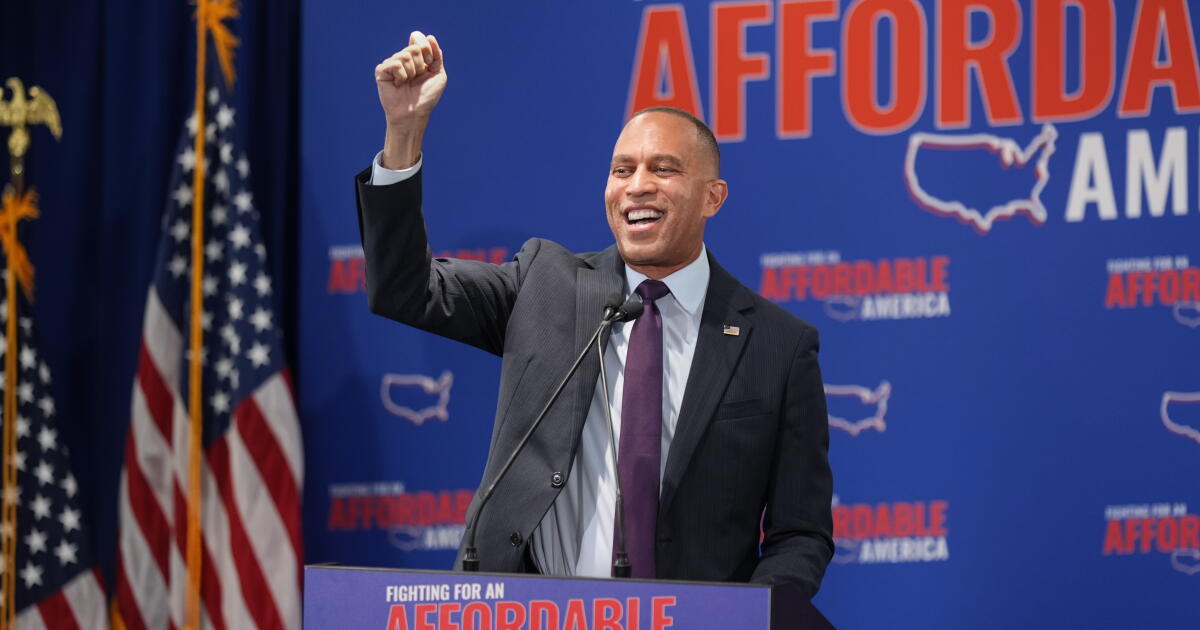
House Minority Leader Hakeem Jeffries, who is on track to become the body’s new speaker in January, criticised the bill last week, warning it “falls short” in several areas.

“We must once again support the clean energy economy and combat the climate crisis with the fierce urgency of now,” a Jeffries spokesperson said in a statement released to the Associated Press.

Jeffries’s office added: “Leader Jeffries will not rubber-stamp legislation that emerges from the Senate without more constructive involvement with our Caucus as we fight to make life more affordable for the American people.”

Source link

House Democrats will start their majority focused on boosting healthcare and ending the Iran war

House Democratic leaders are placing an early emphasis on healthcare as they discuss their immediate priorities upon the swearing-in of the new Congress on Jan. 3.

Early votes in the House next year are expected to focus on boosting Medicaid and restoring an enhanced tax subsidy that is designed to lower the cost of Affordable Care Act health plans for millions of enrollees.

Democrats are also promising swift action on legislation to stop the war with Iran and to reverse some of President Trump’s tariffs.

“We’re going to get out of the gate fast,” said New York Rep. Hakeem Jeffries, the Democratic leader who is in line to become the next House speaker.

The legislative flurry carries enormous stakes for Democrats as they seek to translate their sweeping victories in the midterms — their numbers will exceed 250 in the 435-member House — into achievements that deliver on their promises to lower the cost of living.

Obstacles for the Democratic agenda

Passing those bills should not be a problem with such a large Democratic House majority. Getting them signed into law most certainly could be.

A 60-vote threshold in the Senate looms for the legislation, as does a potential presidential veto. Trump on election night posted a photo on his social media site of a red hat with a simple message on it: “Veto.”

Following those early votes, Jeffries said five working groups are developing plans to put forward bills that would lower costs in areas such as housing, energy, groceries and caregiving.

Rep. Ted Lieu (D-Torrance) said Democrats will at some point take up legislation dealing with artificial intelligence and data centers. He is part of a group of lawmakers working on a document that will lay out some of the priorities for Jeffries to consider.

“House Republicans last year made a conscious decision to let the AI industry run wild, and that was a bad decision politically and a bad decision on policy,” Lieu said. “Two things will change next term. We will hold public hearings on AI. We will pass legislation, reasonable guardrails on AI, and specifically data centers.”

A return to past political fights

Democrats are trying to reverse Medicaid changes that are expected to cut more than $900 billion from the program over a decade. The Republican-approved cuts helped offset some of the costs of Trump’s big tax and spending cut bill that was signed into law last year. The Medicaid changes in the bill imposed new administrative requirements and added conditions for eligibility, including work requirements.

Some of the most substantial changes have yet to take effect. Still, enrollment in Medicaid has dropped by about 5 million, or about 7%, since July 2025, when the bill was signed into law, according to KFF, a health policy research and news organization.

Reversing those cuts would probably require Trump and the Republicans to abandon the hard-fought changes they made to cut entitlement spending in their signature tax bill. It’s an unlikely proposition.

The effort to extend enhanced tax subsidies for certain enrollees in ACA plans has also been debated and voted on in the current Congress. The measure passed the House with some Republican support but stalled in the Senate.

There also have been numerous war powers votes regarding Iran — 14 in the Senate and six in the House.

Gridlock may be on the horizon

Senate Majority Leader John Thune (R-S.D.) said going into the election that a Democratic majority in the next Congress would amount to “two years of paralysis.”

“I don’t think that’s good for anybody,” Thune said.

But Democratic leader Chuck Schumer of New York is insisting that his party will push its agenda with or without the Republican president’s help.

“If he vetoes it, it will show the divisions. As much as we didn’t want to shut down, when we shut down the government for a month over healthcare, people knew we were on their side,” Schumer said in an interview with the New York Times’ podcast “The Daily.”

Schumer said he believes Democrats can gain some Republican votes on restoring the enhanced subsidies for ACA plans. When asked if he was hearing from Republicans expressing a willingness to work with him on legislation, he replied: “They’re never so definitive but, yes, I am getting initial signs that way on certain issues, not on every issue.”

While the prospects for getting any of the early priority bills over the finish line are uncertain, the votes in Congress will help frame the choices voters will face during a presidential election in 2028.

Tensions within the new majority

Progressive groups call the agenda outlined by Jeffries a good early start, but they have much greater expectations for Democrats this Congress.

“It’s perfectly fine if the Senate and the House are unified and Donald Trump is standing in the way because that sets up another tidal wave election in 2028,” said Adam Green, co-founder of the Progressive Change Campaign Committee, a Democratic-aligned group that backs progressive candidates and policies.

At the same time, he said Schumer cannot be content to let bills die in the Senate because of the 60-vote threshold.

“It will require the Democrats to get rid of the filibuster,” Green said. “There’s no doubt about it.”

He said there’s a disparity because Republicans’ top priorities — tax cuts and Supreme Court justices — can get through with simple majorities. But the Democratic Party’s top priorities require 60 votes to overcome a filibuster.

“The only question is will the American public trust Democrats enough to keep giving us more power or will this week’s gains whittle away because we do nothing? That’s why the filibuster is a threshold question,” Green said last week.

Schumer, in an interview with the Associated Press last week, would not say whether he would try to eliminate the filibuster.

“The focus has got to be on getting things done,” Schumer said. “That’s all I am saying.”

In a memo to fellow members of the Congressional Progressive Caucus, Rep. Greg Casar (D-Texas) said Democrats also need to target what he called “powerful forces outside of government.” Examples he cited were corporations using Americans’ private data to adjust their pricing based on a consumer’s personal data and AI companies that he says are putting jobs and lives at risk.

“By focusing not just on the Trump administration but also on big corporations and billionaires, we will show the American people we are not just anti-Trump but also pro-worker and pro-consumer,” Casar said.

Freking writes for the Associated Press. AP writer Mary Clare Jalonick contributed to this report.

Source link