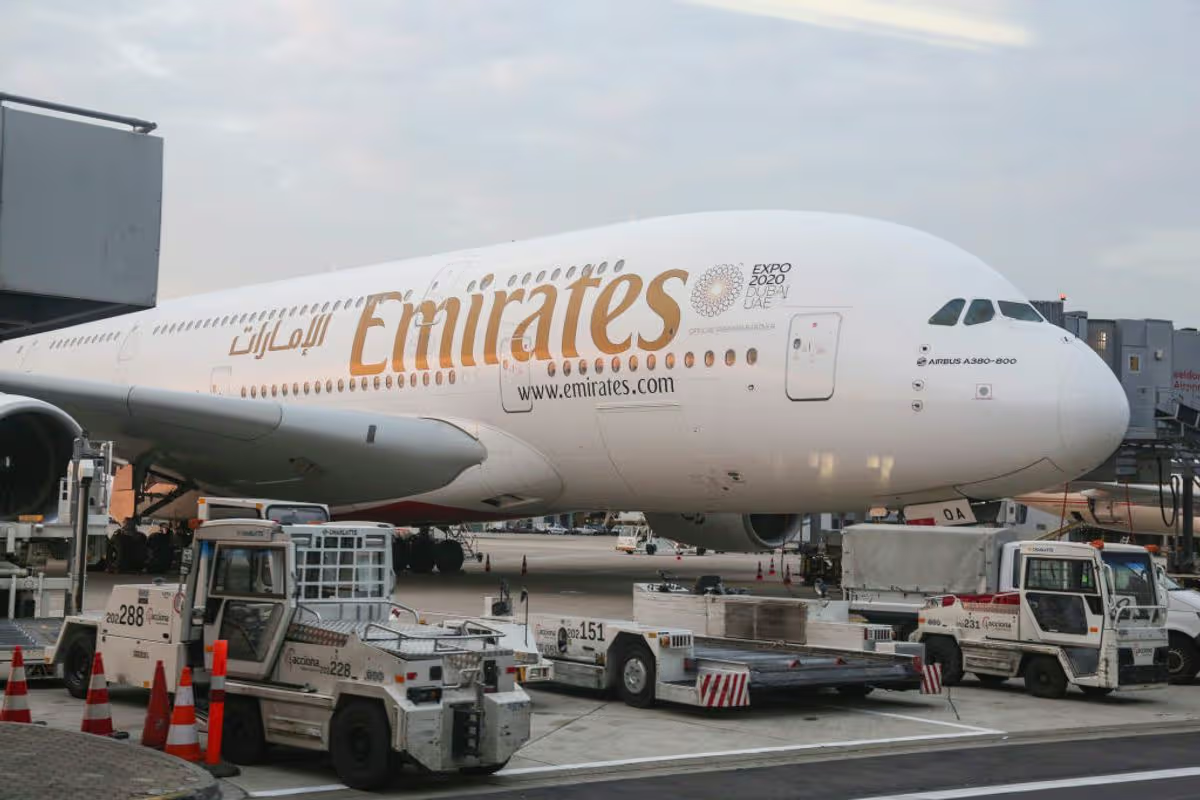


Simon Calder gave his thoughts on when travel disruption will start to ease following the strikes on Iran
13:00, 11 Mar 2026Updated 16:05, 11 Mar 2026
Travel remains severely disrupted as strikes on Iran continue
A travel expert has shared his views on when ‘people will be able to travel again’ as the Middle East conflict continues to escalate. Journalist Simon Calder, who specialises in travel, discussed the crisis and its impact on worldwide travel.
American and Israeli strikes on Iran are approaching the end of their second week, with no resolution in sight. Travel to the Middle East remains limited, with airlines cutting back on the number of flights to and from the area.
Countries such as Oman, Qatar, and the United Arab Emirates serve as vital transport hubs for destinations including Asia and Australasia. The outbreak of hostilities has left hundreds of thousands of travellers stuck.
Speaking to Sky News, Mr Calder offered his perspective on when travel might become more straightforward. He said: “We’ve already seen missiles sent to Turkey and attacks on Cyprus. Now, personally, I think the chances of anything happening to a tourist in Turkey or Cyprus are microscopically low, but I also know that people are rebooking away. They’re going to the western Mediterranean – typically Spain and Portugal – because they believe they will be safer there.
Content cannot be displayed without consent
“If you’re flying from the UK to a holiday spot such as Turkey or Cyprus and that flight is cancelled, then, fortunately, air passenger rights rules are squarely on your side. The airline that cancels the flight has to get you to your destination as soon as possible, regardless of the cost. And if you can’t get there immediately, the airline has to provide meals and accommodation, if necessary, before you are able to get to your destination.
“The Foreign Office warns against travel to Kuwait, to Bahrain, to Qatar and, crucially, to the UAE, home to the busiest hub in the world: Dubai International Airport. But I’m also predicting that, actually, that ruling is going to lift fairly quickly, and people will be able to travel again.”
Flights are still operating through Dubai International Airport, despite two Iranian drones injuring four people after exploding at the facility. The Dubai Media Office, which releases statements on behalf of the city-state’s government, confirmed flights are continuing, and that the attack caused ‘minor injuries to two Ghanaian nationals and one Bangladeshi national, and moderate injuries to one Indian national’.
Officials have been attempting to restore its flight schedule, though the airport has been targeted amid the conflict. The war has created uncertainty for travellers with flights booked in the coming weeks, prompting Mr Calder to offer his guidance on what passengers should do.
“If your flight is due to go, I’d say, a week or more from now, well, all you can do is just hope that it goes ahead,” he stated. “If you’re going imminently and you do not know if your trip is running, well, the basic news is that if you go to Abu Dhabi, to Dubai, to Doha, you will be going against Foreign Office advice. So, be aware of that; your travel insurance will be invalidated.
“I’ve got some skin in the game. I am booked to fly out on Saturday night from Jakarta, the Indonesian capital, through to Abu Dhabi and connect onwards to London. Now, at the moment, along with many, many other travellers, I’m absolutely promised the flight will go ahead as normal, and I trust that it will. But I simply do not know.
“At the moment, I’m definitely not cancelling my flight because, well, bluntly, if you cancel the flight – which is what the airlines would really like you to do – you will simply be removing yourself from the problem. If, like me, you’re booked in a few days’ time and you do have a bit of flexibility, then absolutely keep your booking open.
“If you go for a refund, first of all, the airline will be delighted because you’ll be a problem that’s removed from their cares and, secondly, you could find yourself paying three times, five times, 10 times as much to get back. Much better to remain a problem for the airline; they’ve got to get you where you need to be.”
British Airways has warned all services from Oman up until March 7 are now fully booked as the scramble to return from the Middle East continues amid regional tensions
(Image: AFP via Getty Images)
British Airways has issued a warning that flights returning to the UK are ‘fully booked’ as the rush to get back from the Middle East intensifies.
In its most recent public statement, the UK’s flag carrier cautioned that all services departing from Oman through to 7 March are now completely full.
“Flights from Muscat on 5, 6 and 7 March are now fully booked. We will continue to review the situation and, if we are able to, we will add additional services,” a BA spokesperson stated at 2.14pm on Wednesday.
Oman is the nearest nation to major hubs, including Dubai and Abu Dhabi, with accessible airspace. Out of the 136 flights scheduled to depart from Oman today, just 14 have been axed so far. This stands in stark contrast to the UAE, Bahrain, Kuwait, Iraq and Lebanon, where most flights remain grounded.
The latest guidance from BA reads: “We remain unable to operate flights from Abu Dhabi, Amman, Bahrain, Doha, Dubai and Tel Aviv. We have scheduled further flights from Oman (Muscat) to London Heathrow departing on 6 and 7 March.
“Flights are for our customers with an existing booking who are in Oman or the UAE. If you wish to travel on one of these flights, please contact us via our dedicated phone line on +44 203 467 3854. Our teams will also be getting in touch with our customers.”
One BA flight bound for London Heathrow left Muscat after just a short delay this morning. Another is scheduled to leave at 2.30am local time tomorrow, and a third at the same time on Saturday.
Home Office minister Alex Norris has announced that a Government-chartered plane, which failed to depart from Muscat, is now scheduled to leave for the UK on Thursday.
However, he was unable to provide an exact departure time.
Mr Norris expressed confidence that the first Government rescue flight departing Oman amidst the escalating conflict in the Middle East would take off on Thursday, following an overnight delay. When questioned by LBC about the reason for the delay, he explained: “It didn’t take off because there are operational reasons… about getting passengers on board, and it wasn’t able to happen in the time that it had to happen. So that’s now going to go today instead.”
Earlier on BBC Breakfast, Mr Norris said: “We made sure we got them (the passengers) hotel rooms for the night as well, and we are facilitating and rebooking today’s flight. We hope that they do, and there’s multiple flights after it as well.”
In other news, Defence Secretary John Healey is en route to Cyprus in an attempt to defuse tensions with the island’s government following a drone strike on the British base RAF Akrotiri.
Mr Healey is expected to land in Cyprus later on Thursday. His visit follows the Cypriot high commissioner to Britain expressing his disappointment at the UK Government’s response to defending the island.
On Monday night, a hangar at RAF Akrotiri was struck by an Iranian-made Shahed drone, launched from Beirut in Lebanon, according to Cypriot officials. Two further drones detected on Monday were sh.
Shot down by British warplanes that took off from Akrotiri.
The UK has deployed air defence destroyer HMS Dragon to aid in the protection of Cyprus, although the Type 45 warship isn’t expected to set sail until next week.
Wildcat helicopters equipped with anti-drone capabilities have also been sent to the island and are anticipated to arrive this week.
In other developments in the conflict:
– Iran’s ambassador Seyed Ali Mousavi was summoned by the UK Government on Wednesday.
– A US submarine sank an Iranian warship in the Indian Ocean.
– Iran persisted in launching attacks at countries across the region, with Saudi Arabia and Kuwait targeted with missiles and drones.
– Western officials reported that the rate of Iranian missile strikes had declined, estimating that Tehran had several more days of capability to continue based on the current firing rate – although they warned that the decrease could also be a result of Iran trying to conserve its stockpiles.
– Turkey reported that a “ballistic munition” launched towards it from Iran was intercepted by Nato air defences.
– Economic uncertainty continued over the conflict in a region that plays a crucial role in international oil and gas supplies.
WHEN it comes to Spanish islands, trying to avoid the crowds can be near impossible.
But Menorca in the Balearics has far fewer tourists than some of it’s neighbours, and is a great alternative according to a TUI travel agent who has been in the biz for over 25 years.
Sign up for the Travel newsletter
Thank you!
Menorca is a great alternative to the likes of Ibiza and TenerifeCredit: AlamyTUI Travel Agent Claire Moye has worked in travel for 26 yearsCredit: TUI
Each year, Menorca welcomes around 1.5million tourists – a fraction of Ibiza that sees up to 4million visitors, or Majorca‘s 13million.
TUI Travel agent Claire Moye, who has worked in travel for 26 years, has booked over 1,000 trips to Menorca and has even dubbed it a great alternative to the lively Ibiza.
So why visit what Claire called ‘Ibiza’s chilled-out sister’?
In the summertime, Menorca can see highs of 30C, and thanks to the island’s smaller size, airport transfers are short.
Not to mention it can be less expensive too. Claire revealed: “In peak summer, Menorca can work out cheaper than some of the more established hotspots.
“A casual meal out for a family of four typically costs less in Menorca, with families often spending around €60 – €90 compared with €90 – €120 in busier hotspots. And a pint of beer can be a few euros less too.”
If that hasn’t sold you on a trip yet, check out Claire’s top beaches, restaurants and her favourite hidden gems…
Best beaches
“If you love those picture-perfect Ibiza beaches like Cala Comte or Cala d’Hort, then Cala Macarella is Menorca’s answer.
“It’s got those similar limestone cliffs and the most incredible turquoise water – honestly, it’s just as stunning but without lots of people fighting for a spot.
“The smaller sister cove, Macarelleta, is even more secluded and feels really special. I always tell couples to head there if they want that romantic, intimate vibe – although it is a nudist-friendly beach, so just be aware of that before you go.
“Cala Turqueta is another absolute stunner – the water is so clear you can see straight to the bottom, and there are pine trees for shade which is a godsend in the midday heat.
“And if you want something a bit different, Cala Pregonda has this gorgeous reddish-golden sand that you won’t find anywhere else. It’s a bit of a walk to get there, but that’s what makes it feel like a proper hidden gem.”
Bars and nightlife
Claire says if you’re after the party life of Ibiza with all its superclubs like the newly reopened UNVRS, then Menorca might not be for you.
But there is one very unique bar that is worth checking out – and it has plenty of room for dancing.
“Cova d’en Xoroi, is just magical. It’s a bar built into caves on the cliffsides, and watching the sunset there with a cocktail in hand is just so beautiful.
“They do have DJ nights too, so be prepared to bring out your Ibiza-style moves once the dance floor opens at 11pm.
Cala Pregondo is a unique beach with reddish golden sandsCredit: AlamyCova d’en Xoroi is a bar built into the cliffside in MenorcaCredit: Alamy
“The port of Mahon also has a lovely string of bars along the waterfront where you can have drinks with beautiful harbour views.
“It’s not about clubbing until dawn, but there’s definitely a buzz in the evenings and it has a lot in common with Ibiza old town – both are working natural harbours packed with history perfect for evening promenades.
“I tell all of my customers to try a pomada while they’re there – it’s the local cocktail made with Menorcan gin and lemonade.
“The island actually produces its own gin called Xoriguer, and the gin and tonics there are massive.”
Restaurants
“For restaurants, Café Balear in Ciutadella port is legendary – it’s right on the harbour and the seafood is incredible. You’ll see locals queuing up alongside tourists, which is always a good sign.
“It actually started out as a tavern in the harbour back in the 70s, mainly for seafarers who would drop by in the early hours before they went to work. Nowadays I’d recommend booking ahead because it gets packed!
“Also in Ciutadella, for those who want Michelin standard fine dining like Ibiza’s famous La Gaia or Amante, you should book well ahead for Smoix; set inside a former shoe factory it’s called out as one of the island’s best eateries.
“Or for Ibiza countryside-luxury vibes head for Cala en Porter and the Torralbenc Restaurant, set in a restored finca with vineyard and sea views, for organic farm to table food.”
Cala Macarelleta is a picture-perfect beach on the southern coastCredit: Alamy Stock PhotoOne strange hidden gem is Lithica Pedreres de s’Hostal – an abandoned quarryCredit: Alamy Stock Photo
Shopping
Make sure to take time away from the hotels and the beaches to explore the shops.
Claire said: “The markets in Menorca are brilliant. Mercat des Claustre in Mahón is a traditional covered market where you can get local cheeses, fresh fruits and sobrassada (which is a type of sausage that’s spreadable, a bit like pate).
“Like Ibiza’s best markets, it’s less about shopping and more about soaking up everyday island life. It’s my personal favourite, and ideal for putting together a picnic or picking up gifts to take home.”
Hidden Gems
“One of my favourite hidden gems is Lithica Pedreres de s’Hostal – it’s an abandoned quarry that’s been transformed into gardens with a bit of a maze carved into the stone walls.
“It has the same slightly surreal, unexpected feel as some of Ibiza’s ‘alternative’ cultural spaces. It honestly looks a bit dystopian, but they often host concerts and events there.
“It’s the kind of place that surprises people because they don’t expect to find something so unique on a small island.”
This article contains affiliate links, we will receive a commission on any sales we generate from it. Learn more
I booked a mystery holiday for £79 and thought things couldn’t get worse — they did(Image: Portia Jones )
While doom scrolling and sipping a large glass of cava, I came across a deal that stopped me mid gulp: a mystery holiday for just £79. As a travel writer and podcaster, I’m constantly planning work trip itineraries, so I rather fancied the thought of letting someone else decide where I’m going. What could possibly go wrong?
If, like my husband, you are wondering what a mystery holiday is, allow me to explain. The popular Wowcher deal promises return flights and two nights in a hotel somewhere abroad for a low price. It was £79 per person when I booked it on a deal, but it’s normally £99 per person. It could be Dubai, New York, the Maldives, Las Vegas or Mexico, or European destinations such as Paris, Monaco, Sicily, and Lake Como.
Your destination is allocated via a randomised draw and is subject to availability. Every booking is randomly assigned to one of three tiers. Six holidays sit in Tier 1. Twelve in Tier 2. And a whopping 1,982 in Tier 3. That is 2,000 packages in total, enough for 4,000 travellers, all distributed by draw.
Tier 1 means the headline, long-haul, brag-on-Instagram trips, but the vast majority are European weekend breaks. You just have to make peace with the fact that you may end up posting sunset shots from Tier 1 Barbados or in an adequate three-star hotel in a European city. You have to decide if it’s worth the risk.
Darling husband was not wildly enthusiastic about paying to be surprised, but I deployed my usual negotiation technique: talking until he loses the will to live. We bagged the deal at £79 each in a special offer, and we were in the game.
Obviously, the odds of us swanning off to Dubai were, frankly, casino-level, but I chose optimism. I was determined we would escape the British drizzle and emerge somewhere glamorous.
Credit card in hand, I effectively gambled our annual leave on Wowcher and waited for the universe to reward my impulsiveness.
Shortly after paying, a code and redemption link arrived in my inbox, which felt very exciting. I entered our details into the site, selected our preferred departure airport, and discovered that flying from anywhere other than London costs extra, and if you want to take more than a t-shirt and a pack of fem wipes, you’ll have to pay for a bag. Of course.
Then came the grand reveal. I was mentally picturing us in the Caribbean, toes in turquoise waters, sipping piña coladas. Then I clicked. It was the Costa del Sol. I screamed the F word. And it wasn’t “fantastic!”
After my minor meltdown, I regrouped. Spain in February would be great, a chance of blue skies, tapas and cocktails by the sea. Given that it has rained every single damn day in Britain for weeks, this trip was destined to be the sunny salvation my vitamin-D-deficient heart deserved.
I pictured balmy afternoons in a cute seaside resort with an ocean view where I could watch epic sunsets. This is what I told myself as I boarded our delayed Ryanair flight in the freezing cold.
I stayed positive through the turbulence. Nothing could ruin my holiday. Then the captain spoke: “Good afternoon, ladies and gentlemen, this is your captain speaking from the flight deck. As we begin our descent, I’d like to give you an update on the weather conditions. The area is currently experiencing adverse weather, including heavy rain and strong winds.”
And that was it. Right there. Right there, that was the moment I officially abandoned all hope. I was landing in the middle of Storm Leonardo rather than in lovely Spanish sunshine. Things could not possibly get worse, until they absolutely did.
It turns out that Wowcher’s concept of a ‘minimum three-star hotel stay’ differs from mine. While I had imagined a cutesy hotel with an ocean-view terrace, what we got was a tired-looking budget apartment block in Benalmadena town that clearly hadn’t been updated since the 90s. To be fair, our apartment was fairly clean and of a decent size, but it was extremely basic.
No balcony, toiletries or even coffee. There was also the threat of “fines” if you left the light on when you went out, and you had to check out before 10 a.m. This was a bare bones stay for the budget traveller, not the mid-tier relaxing break I had hoped for.
I’m not sure what I was expecting for £79, but I was now fully in a negative spiral as Storm Leonardo raged outside, rain lashing and wind howling.
Husband, after living with my particular brand of travel chaos for 12 years now, seemed surprisingly calm about the whole thing, almost as if it had fully met his expectations for a holiday for less than £100. It’s always irritating when he’s completely right.
Undeterred, I confidently announced we would visit the aquarium, the perfect place for a wet and windy Wednesday. Surely penguins would cheer me up.
“Due to Storm Leonardo, the aquarium is closed”, the sign taped to the door read. Rightio. Of course. To the pub then. “Sorry love, we don’t do Sauvignon blanc.” Must. Not. Scream.
So why, you might reasonably ask, didn’t we admit defeat, check out, and head home? To take a short break from being a negative Nancy, the answer is that when the sun made appearances in between downpours, Benalmadena town really isn’t that bad.
The town is divided into three main areas: the traditional hilltop Pueblo, the central Arroyo de la Miel, and the seaside Costa, and there’s plenty to do here.
Sure, like most places in the Costa del Sol, you have bars for boozed-up Brits with blaring music, souvenir stores hawking tat, and vape shops, but there’s also a gorgeous seafront, swish marina and tasty tapas.
When the weather is behaving, plod along the 10-kilometre stretch of sandy beaches, including Blue Flag options like Santa Ana Beach. The palm tree-lined promenade is also dotted with ocean-view restaurants and bars where you can buy an Aperol Spritz and watch the waves.
Puerto Marina is also worth a visit. The major, uniquely designed marina features shopping, dining, and the Sea Life aquarium (when it’s not closed due to rain, despite the marine life living in tanks).
Attractions in the area include the 33-metre-tall Buddhist Stupa, Colomares Castle, and the Teleférico (cable car) to Mount Calamorro for panoramic views.
If you want a slice of more ‘authentic Spain’, wander away from the seafront, and you’ll soon stumble across tapas bars and restaurants like Asador Casa Miguel serving Andalusian dishes. The Iberian pork medallions were exceptional.
If you’re feeling adventurous, you can always hop on a cheap, 30-minute train to Málaga, a historic port city packed with culture and excellent eats.
Explore the palm-dotted city, and you’ll find astonishing historical sites, such as Alcazaba (Moorish fortress), a Roman Theatre, and a 16th-century cathedral. There are also over 30 museums here, including the Picasso Museum and the Carmen Thyssen Museum.
As the weather alternated between rain and sunshine, we found that a trip to Málaga was an excellent way to escape the rain, and the sun also came out.
We spent a delightful few hours visiting cultural heavyweights like the Picasso birthplace and the Roman Theatre and eating our way around the buzzing Mercado de Atarazanas (Malaga food market).
Here you’ll find stalls brimming with local produce where you can slurp fresh oysters on the shell for €3 and sip cava for under €4 a glass. Lush.
Despite the stormy weather, our time in Costa del Sol felt all too brief, and it was soon time to head back to the airport. I suppose that’s the issue with this particular Wowcher mystery deal: you’re given a narrow window in which to experience your destination. If the weather is glorious, you’re smug. If it’s biblical, you’re essentially on a layover with sangria.
But here’s the real lesson the Wowcher mystery holiday taught me. In travel, as in life, you get exactly what you pay for.
During my 20s, while backpacking on the cheap, I stayed in three-dollar-a-night hostels with sanitary conditions so questionable the Red Cross would have intervened.
I am older now. Wiser. More aware of thread counts. I like comfort and hotels with fluffy towels and working air conditioning.
I have learned, repeatedly, that if you book a budget break, you must be prepared for budget realities: inconvenient flight times, accommodation with “character,” and dire customer service.
So, is it worth booking? That depends entirely on your expectations. If you’re dreaming of ticking off a bucket-list long-haul destination, swanning into a five-star resort with seamless transfers and a welcome Bellini, perhaps do not gamble £99 on a surprise getaway.
Especially when the “extras” (baggage, seat selection, breathing near the aircraft) begin adding up. For money-saving tips, sign up to our Money newsletter here
However. If you’re game for a laugh, can persuade your partner or a few pals to embrace chaos, and, importantly, you enjoy a story more than a sun lounger, then it’s worth a punt for under £100.
Sure, you might end up with awful flight times, a dingy hotel and landing during a storm, but at least you’re not at work, right?
Book the deal. Surrender to the travel gods, pack lightly and manage expectations heavily. Who knows, you might get Thailand, or you could be jetting off to Benidorm. May the odds ever be in your favour.