North Korea on Monday condemned the “hostile policy” of the United States and vowed to continue bolstering its nuclear arsenal. In this October 2025 photo, leader Kim Jong Un attends a military parade in Pyongyang. File Photo by KCNA/EPA
SEOUL, Aug. 31 (UPI) — North Korea on Monday condemned what it called the United States’ continued “hostile policy” and vowed to keep bolstering its nuclear arsenal despite U.S. President Donald Trump’s recent overtures to Pyongyang.
In a statement carried by the official Korean Central News Agency, a spokesperson for the Foreign Ministry accused Washington of maintaining a confrontational stance toward North Korea in both “rhetoric and behavior.”
“The Trump administration has thus fully reconfirmed its invariable hostile policy to wantonly violate the sovereignty, political system and security interests of the DPRK through the ‘denuclearization’ racket, ‘human rights’ smear campaign and military threat,” the statement said, using the official acronym for North Korea.
“It is pointless to expect any detente in the region,” it added.
The statement comes amid a push from Trump to restart direct diplomacy with North Korean leader Kim Jong Un, with whom the U.S. president has touted a “very good relationship.”
Earlier this month, Trump ordered Seoul and Washington to curtail their joint Ulchi Freedom Shield military exercise, citing its cost and saying the drills sent an “inappropriate and hostile” signal to Pyongyang. The exercise was subsequently shortened by almost a week.
Despite the move, the U.S. State Department last week reaffirmed its commitment to the “complete denuclearization” of North Korea in a statement to Yonhap News Agency.
The United States, South Korea and Japan also confirmed last week that their annual Freedom Edge trilateral military exercise will be held Sept. 7-11 in international waters east and south of South Korea’s Jeju Island.
The Foreign Ministry spokesperson called the multi-domain exercise a “threat to the DPRK and regional countries.”
North Korea routinely denounces joint military drills as rehearsals for an invasion and has carried out weapons tests around major allied exercises.
The spokesperson said North Korea’s nuclear status, which has been enshrined in its constitution, could not be “weakened nor diluted” by repeated U.S. calls for denuclearization.
“Our nukes serve as an absolute guarantee for defending its sovereignty and the nuclear weapons in possession of the DPRK and their sustained bolstering are the most responsible and correct option for ensuring regional peace and security,” the statement said.
“There is no change in our policy toward the U.S. to respond to its invariable hostile policy with the toughest stand to the last,” it added.
The new Army air defense unit on Guam will be designated 3rd Battalion, 43rd Air Defense Artillery Regiment (3-43rd ADA). It will be under the purview, at least in part, of the 94th Army Air and Missile Defense Command (94th AAMDC) headquartered at Joint Base Pearl Harbor-Hickam in Hawaii.
“So, over the past couple of years, we’ve been working to increase the level of protection on Guam. In the past, we’ve had the THAAD [Terminal High Altitude Area Defense] battery there, and of course, Aegis BMD [ballistic missile defense capable] ship[s],” Army Col. Matt Dalton, Deputy Commander of the 94th AAMDC, said last week. “We’ve been working the past few years to increase that to provide a 360-degree defense, cruise missile defense, of the homeland [on Guam].”
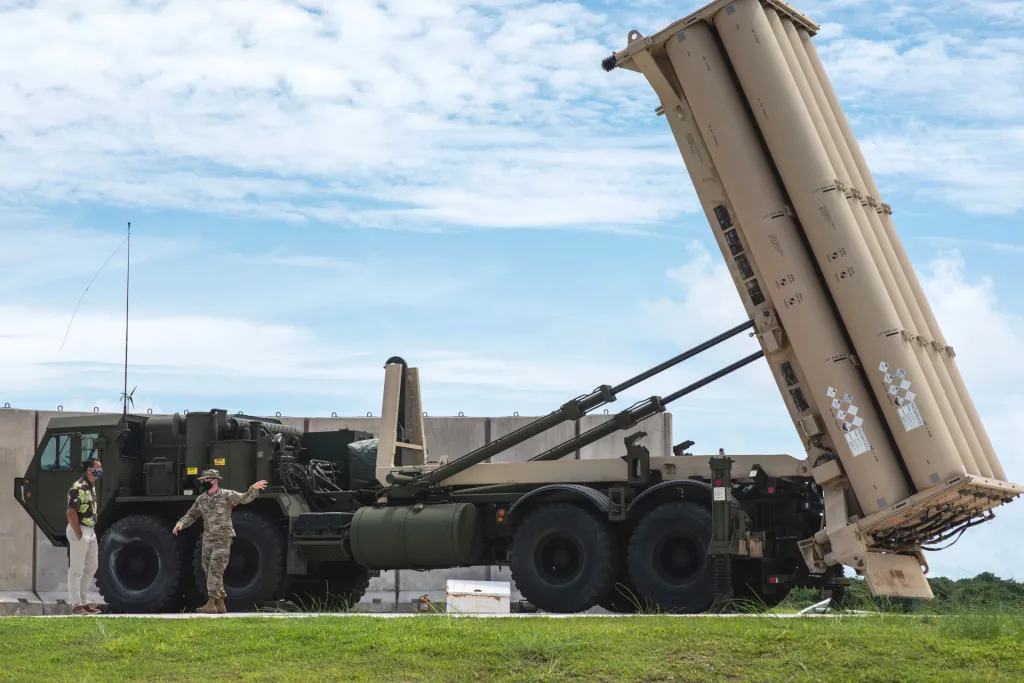
One of Task Force Talon’s THAAD launchers on Guam. USAF/Senior Airman Zachary Heal
“What does that entail? Construction, planning, barracks, housing, defense design, coordinating with the local authorities in the joint community, the governor’s office, FAA [Federal Aviation Administration] – so many, many things over the last couple of years,” he continued. “I think right now what we’re seeing is we’re starting to see the fruits of all that labor. This summer, the battalion commander arrived. This fall, 3-43rd ADA will stand up in October. Currently, there are about 120 or so soldiers specifically for that battalion on [the] island, on top of the the soldiers already there for the THAAD battery. And then over the next few months, we’re going to see the delivery of the weapon system.”
“The battalion will have both the Patriot Missile System and IFPC, or mobile ground-based launchers, which they will integrate to provide 360-degree, layered air and missile defense for Guam as part of our expansion to the defensive architecture to better protect everyone living there,” an Army spokesperson told TWZ when asked for more information about the “weapon system” Col. Dalton had referred to.
IFPC stands for Indirect Fire Protection Capability. IFPC dates back to the early 2000s, but the Army transitioned to the second phase, or Increment 2, of the program in 2021. That, in turn, led to the acquisition of the Enduring Shield system, which is primarily intended to help defend against cruise missiles and drones. We will come back to this in a moment.
Whether the Patriot systems headed for 3-43rd ADA are new-production assets or available with the Army’s existing inventory as part of a reorganization of other units is unclear, and TWZ has reached back out for more details. At the time of writing, the service is known to have 15 operational Patriot battalions, as well as two more that are non-deployable dedicated training units. A typical one of these battalions consists of a headquarters element and between three and five firing batteries. A single Patriot firing battery can have up to eight trailer-mounted launchers, along with a fire control radar and other supporting equipment.
A graphic depicting the components of a typical US Army Patriot battery. via GlobalSecurity.org
“We know we have to grow that [Patriot force]. We have plans on the table to build a 16th, 17th, and 18th [battalions],” now-retired Army Gen. James Mingus, then the service’s Vice Chief of Staff, said last year. “And that’s not to include the Patriot battalion that we’re going to put in Guam as part of the Guam defense system.”
At that time, the Army general also talked about the possibility of future composite battalions with Patriot and IFPC/Enduring Shield systems. The Army also has plans to establish nine dedicated IFPC/Enduring Shield battalions.
“The IFPC battalions that are coming online will help offset that [demand for Patriot] as well, even though it’s not quite the same capability,” Mingus said. “In some environments, that [IFPC] actually is more appropriate to apply than a full-up Patriot battalion.”
How many IFPC/Enduring Shield systems will be assigned to 3-43rd ADA is also unclear. The Army has said in the past that a typical IFPC/Enduring Shield platoon, multiple of which would be contained with a single battery, consists of four launchers linked to at least one AN/MPQ-64 Sentinel-series radar via the Army’s Integrated Battle Command System (IBCS) network. In their current form, each palletized launcher can be loaded with up to 18 AIM-9Xs. The Army is working to fielding at least one new interceptor for IFPC/Enduring Shield, primarily to help improve the system’s ability to defeat ever-more capable supersonic cruise missiles, though it would also boost its capabilities more broadly.
An Army Enduring Shield launcher deployed in South Korea. USAF Pfc. Sang Woo Choi
The initial Mk 41-based launcher for the Guam Defense System (at left), as well as a view of it firing an SM-3 missile during a test in December 2024 (at right). MDA
Uniformed US military and civilian personnel pose in front of the AN/TPY-6 radar on Guam on July 16, 2026. USN
The Army has also previously deployed a Lower Tier Air and Missile Defense Sensor (LTAMDS) to Guam. LTAMDS can be used as a standalone sensor, but also intended as next-generation radar for Patriot, and it could easily be tied with 3-43rd’s other assets when the battalion stands up later this year.
A US Army Lower Tier Air and Missile Defense Sensor (LTAMDS) at Marine Corps Base Camp Blaz on Guam during Exercise Valiant Shield 2026. US Army
“So instead of what we have today, with our Q-series [AN/MPQ-65] radars that have about a 270-view look, which grows – or, kind of negates how much coverage that you can have, the new LTAMDS is 360 [degrees],” Gen. Mingus said last year. “It also goes from about 85 kilometers [close to 53 miles] up and 85 kilometers out to 300 by 300 [kilometers; around 186 miles]. So [it] greatly expands the range, the altitude, and it’s a 360.”
In works since 2021, the overall GDS plan reflects the extremely strategic position Guam occupies in the Western Pacific and the growing threats the island faces. As we previously wrote:
“Since 2021, expanding air and missile defenses on Guam has been a centerpiece of larger U.S. military efforts to reorient itself to preparing for future large-scale conflicts, especially a potential high-end fight with China in the Pacific. Guam is a vital hub for U.S. air and naval operations in the Western Pacific. It is also an important location for staging ground forces for onward movement across the region. In turn, being able to adequately protect key facilities on the island, including Andersen Air Force Base, Naval Base Guam, and Marine Corps Base Camp Blaz, especially from a growing array of Chinese ballistic, cruise, and hypersonic threats, is seen as critical. Various tiers of drones are also a real and still evolving threat. Guam could be a target for other adversaries, as well. Concerns about increasingly longer-range North Korean ballistic missiles prompted Task Force Talon’s initial deployment more than a decade ago.”
As mentioned, the Army establishing a new Patriot battalion, even one also equipped in part with IFPC/Enduring Shield is a significant development in of itself. The service’s existing Patriot force has been heavily in demand, and under significant strain as a result, for years, most recently due to the ongoing conflict with Iran. TWZroutinely highlights the worryingly inadequate capacity of the Army’s existing Patriot battalions to meet operational requirements now, let alone should a high-end fight, such as one against China in the Pacific, break out.
The PATRIOT Missile in Action
At the same time, work to establish the 3-43rd ADA highlights continued challenges the Army faces in bolstering its Patriot force, as well as its air and missile defense capabilities and capacity more broadly. As noted, it will have taken more than a year just to stand up this composite battalion on Guam, which will also be dedicated to defense of the island. The Army’s timeline for establishing the three other planned Patriot battalions is unclear. Prime contractor Raytheon is itself under immense strain to meet existing global orders for new Patriot systems due to competing priorities, and not just ones emanating from the United States. Last year, Switzerland saw its orders for new Patriot batteries deferred to meet urgent requests from Ukraine, and authorities in Geneva subsequently raised the prospect of canceling the deal altogether as a result of the delays.
The establishment of 3-43rd ADA on Guam in October will still be an important development. At the same time, there is still much work to be done before the Army meets its larger goals for a sorely needed expansion of its Patriot force.
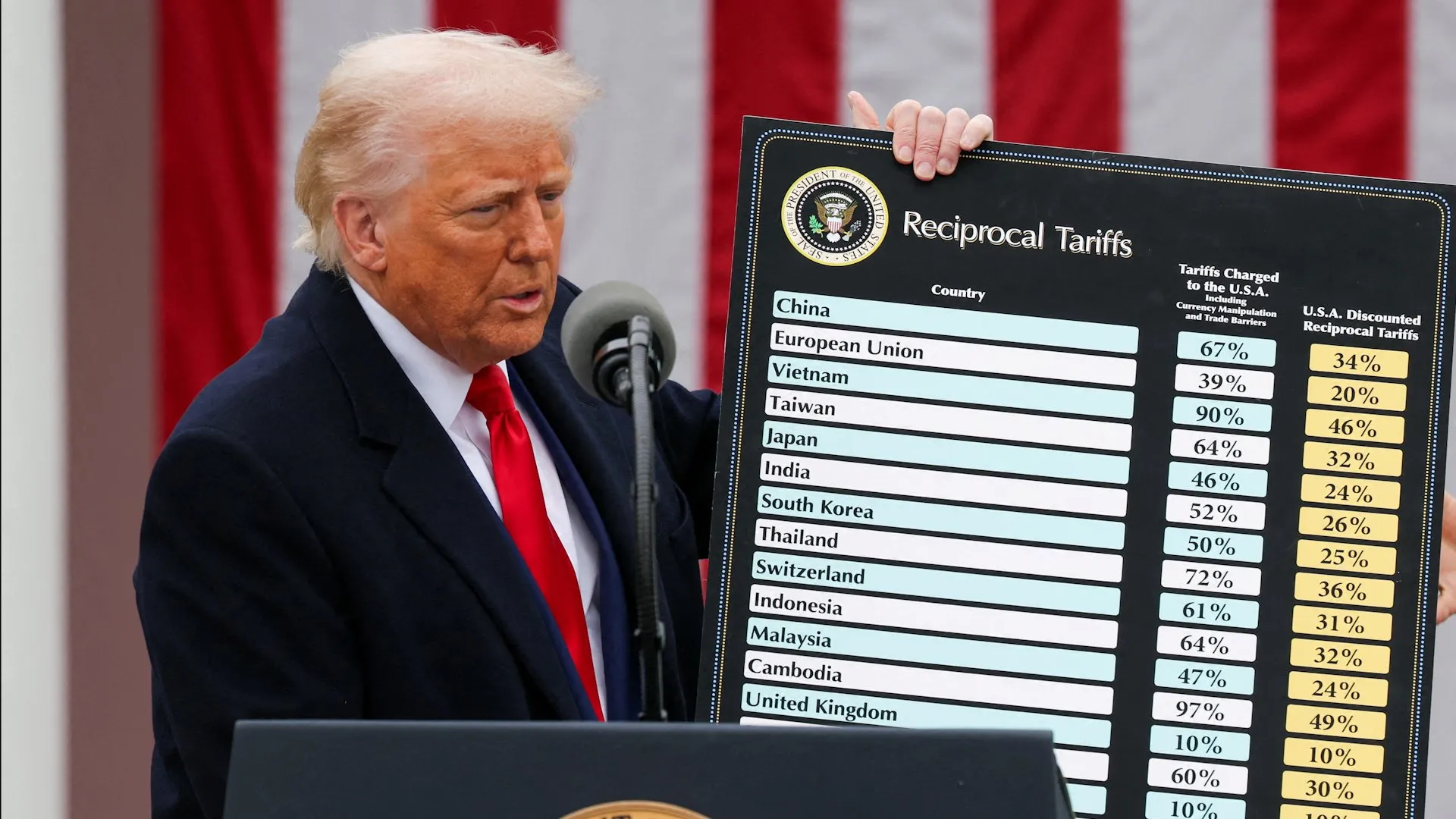
Donald Trump’s second term has been dominated by tariffs, a tool he uses to solve all sorts of problems. He wants them to bolster the US economy and production, but even economists who agree with the strategy question the results.
Min Aung Hlaing stressed that his government was focused on ending the civil war and restoring peace.
Published On 6 Aug 20266 Aug 2026
The head of Myanmar’s military-backed government has met Thailand’s prime minister in Bangkok as he seeks to boost his government’s legitimacy more than five years after seizing power.
President Min Aung Hlaing arrived in Thailand’s capital on Thursday, on his first official visit to the country since taking power in a coup in 2021.
Recommended Stories
list of 3 itemsend of list
Myanmar remains in the midst of a bloody civil war triggered by the coup, which has killed more than 100,000 people, according to monitoring group Armed Conflict Location & Event Data (ACLED).
During a meeting with Thai Prime Minister Anutin Charnvirakul, Min Aung Hlaing stressed that Myanmar’s military-backed government was focused on ending the civil war and restoring peace to the resource-rich country.
“Myanmar has now reestablished itself on the path to democracy and is moving toward a better future,” Min Aung Hlaing said. “As the new government, we have now begun working on national stability, peace, and national reconciliation.”
Min Aung Hlaing is pushing for Myanmar to be readmitted to the Association of Southeast Asian Nations (ASEAN), from which his government was barred after failing to implement a peace plan agreed with member states in 2021.
Thailand is one of Myanmar’s top foreign investors and has called for a “calibrated re-engagement approach” with its neighbour, with which it shares a 2,400km (1500-mile) border.
Following the meeting, the two leaders delivered speeches at the Thailand-Myanmar Business Forum.
Anutin said Thailand and Myanmar are ready to “step into the new chapter of economic cooperation that is built upon mutual trust and benefit for the people of the two countries”.
Min Aung Hlaing told attendees they could “invest with confidence” in Myanmar’s energy, agriculture, manufacturing, healthcare, technology and other sectors.
The visit has drawn criticism from activist groups such as Justice For Myanmar, which stated that the trip lends “false legitimacy” to Min Aung Hlaing and the ruling generals.
About a dozen demonstrators gathered outside the United Nations regional headquarters in Bangkok to oppose the visit. Some protesters could be seen holding placards denouncing him as a “criminal” who was not welcome in Thailand.
Min Aung Hlaing was sworn in as president of Myanmar in April following an election that UN experts dismissed as a “sham”.
Western governments have shunned and sanctioned Min Aung Hlaing and his associates for overthrowing Aung San Suu Kyi’s government. Subsequent serious rights violations followed a deadly military crackdown on protests, which subsequently triggered a nationwide armed resistance movement and a bloody civil war.
Aung San Suu Kyi, who was overthrown in 2021 and remains under house arrest, was allowed to meet a representative of the International Committee of the Red Cross (ICRC) on Monday.
Suu Kyi’s son Kim Aris welcomed the development but cautioned that he has not yet received independent confirmation of his mother’s condition or wellbeing.
Critics say the visit was a government stunt as it tries to rehabilitate its image.