BOK

S. Korea’s per capita household net assets up 9 pct in 2025: BOK

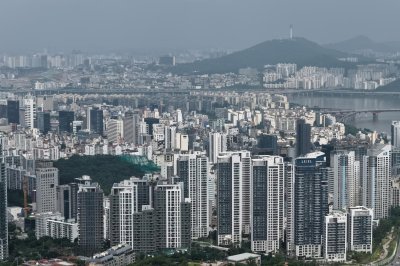
South Korea’s per capita household net assets rose more than 9 percent from a year earlier in 2025, the central bank said Wednesday. This photo, taken July 19, shows apartment complexes in Seoul. Photo by Yonhap

South Korea’s per capita household net assets rose more than 9 percent from a year earlier in 2025 on higher housing and securities prices, the central bank data showed Wednesday.

The average value of net assets held by households per capita stood at 274.7 million won (US$185,600) last year, up 9.1 percent from the previous year, according to the national balance sheet from the Bank of Korea (BOK).

The figure was calculated by dividing the total assets of households and nonprofit organizations — 14,200 trillion won — by the country’s population of 51.6 million, according to the BOK.

It marked a sharp acceleration from the 3 percent growth tallied in 2024.

“Last year, South Korea’s main bourse and overseas stock markets were bullish, contributing to the gains,” a BOK official said. “Housing prices also rose, leading to an asset increase.”

The BOK said the latest figure translates into $193,000 when applying the average exchange rate for 2025.

At the end of 2024, the figure for the United States stood at $514,000, followed by Australia, Canada and Germany at $422,000, $297,000 and $267,000, respectively. Japan’s figure came to $172,000.

The average household net assets came to 634.3 million won, up 7.9 percent over the cited period.

South Korea’s total national net worth, meanwhile, reached 24,561 trillion won at the end of 2025, up 2.2 percent from a year earlier. The growth slowed from a 5 percent rise posted in 2024.

Non-financial assets, such as land and housing, came to 23,291 trillion won, up 3.8 percent from a year earlier, on the back of higher property prices.

The combined value of property assets in the country came to 17,836 trillion won, up 4.1 percent from the previous year.

Net financial assets, on the other hand, fell 20.4 percent to 1,271 trillion won.

The BOK said that while financial assets rose 11.4 percent to 2,794 trillion won, debt increased at a faster pace, rising 13.6 percent to 3,120 trillion won.

By sector, households and nonprofit organizations held the largest amount of net assets, worth 14,200 trillion won, followed by the government with 6,194 trillion won, non-financial corporations with 3,657 trillion won and financial corporations with 510 trillion won.

Copyright (c) Yonhap News Agency prohibits its content from being redistributed or reprinted without consent, and forbids the content from being learned and used by artificial intelligence systems.
Source link

BOK lifts S. Korea’s growth forecast to 2.6 pct for this year amid robust chip-driven exports

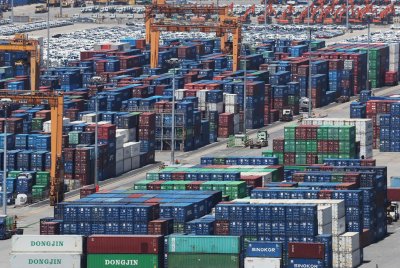
The central bank on Thursday raised its economic growth forecast for South Korea to 2.6 percent for 2026 amid solid semiconductor exports. This file photo shows containers stacked at a port in Pyeongtaek on May 8. Photo by Yonhap

The central bank on Thursday raised its economic growth forecast for South Korea to 2.6 percent for 2026 amid solid exports driven by a semiconductor super cycle.

The revision by the Bank of Korea (BOK) represents a 0.6 percentage-point increase from its previous forecast of 2 percent issued in February.

It is the largest upside revision since May 2021, when the BOK raised its growth projection by 1 percentage point from 3 percent to 4 percent.

For 2027, the central bank estimated its growth outlook at 2.1 percent.

The South Korean economy grew 1.7 percent in the first quarter, marking the sharpest quarterly growth in 5 1/2 years.

The revised outlook broadly aligned with forecasts from other institutions.

The International Monetary Fund (IMF) projected growth of 1.9 percent this year, while the Asian Development Bank (ADB) projected 1.9 percent growth.

The Korea Development Institute (KDI) earlier improved its growth forecast to 2.5 percent for 2026 from 1.9 percent.

The BOK also revised up its inflation prediction to 2.7 percent from 2.2 percent, citing higher international oil prices in the aftermath of the U.S.-Iran war.

For 2027, consumer prices are estimated to rise 2.3 percent, according to the BOK.

“The Korean economy is projected to expand by 2.6 percent this year, well above the February forecast of 2 percent, driven by robust semiconductor exports, while government measures, including the supplementary budget, partially offset the Middle East-driven supply shock,” the BOK said in a release.

BOK Gov. Shin Hyun-song said in a press conference that strong exports will likely contribute 0.7 percentage point to the country’s growth this year, alongside the 0.2 percentage point gains generated by the government’s fiscal support and the 0.1 percentage-point increase brought on by the local stock market rally. On the other hand, the ongoing U.S.-Iran war will drag down the economy by 0.4 percentage point, he added.

“Based on our analysis, we concluded that if the situation in the Middle East is resolved early, this year’s growth rate could exceed 2.6 percent,” he said. “We do not think the growth is a short-lived trend.”

The central bank presented an optimistic scenario in which semiconductor-driven exports gain further momentum, raising its growth forecast by 0.5 percentage point for 2026 and 0.3 percentage point for 2027.

Under a pessimistic scenario, however, a possible slowdown in artificial intelligence investments would lower economic growth by 0.3 percentage point this year and 0.2 percentage point next year, the central bank said.

In line with the upbeat outlook, the BOK kept the key interest rate unchanged at 2.5 percent but signaled a possible rate hike in the second half.

Copyright (c) Yonhap News Agency prohibits its content from being redistributed or reprinted without consent, and forbids the content from being learned and used by artificial intelligence systems.

Source link