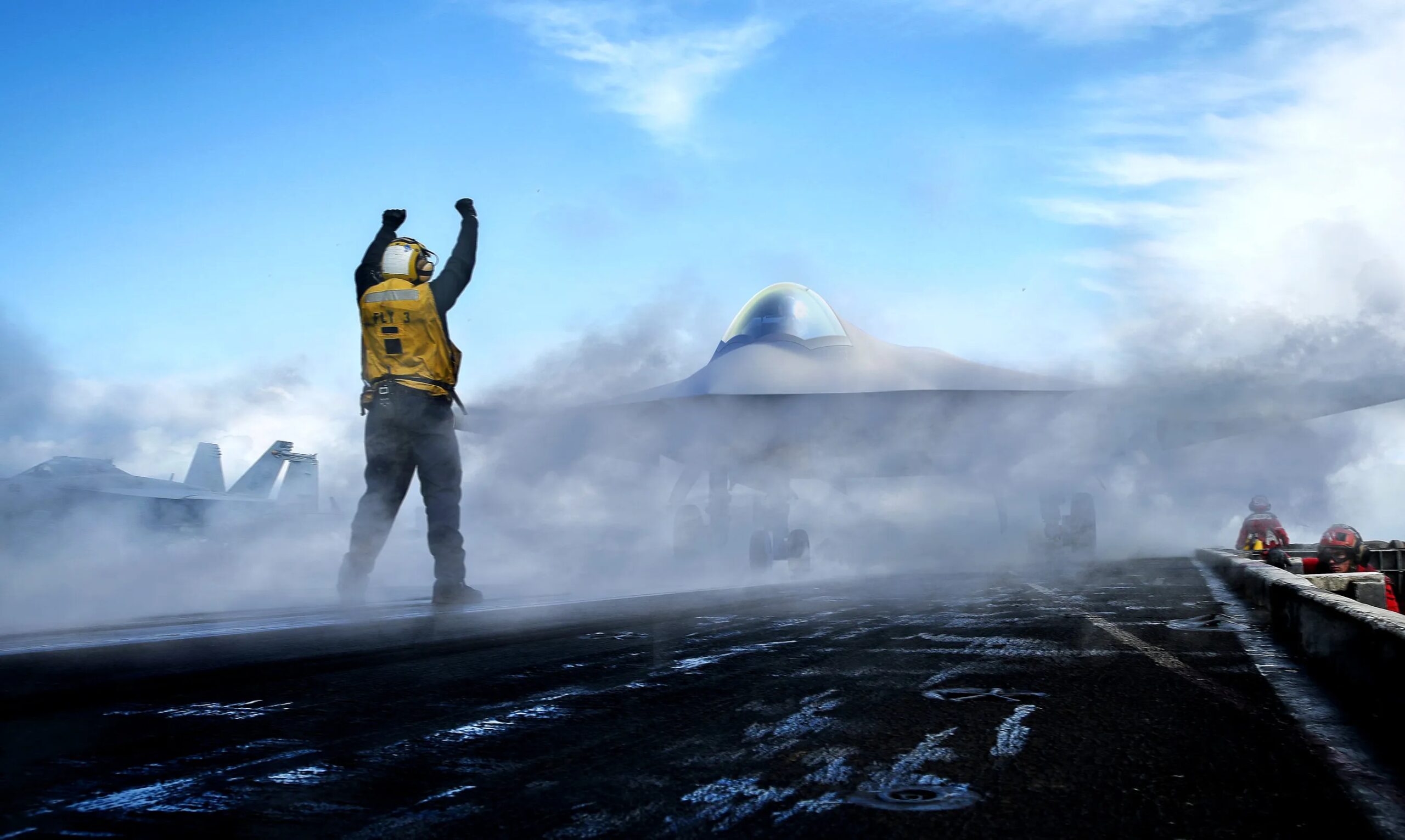
Boeings

First USAF F-15EX To Be Based In Japan Departs Boeing’s St. Louis Plant

The first F-15EX Eagle II destined for permanent assignment at Kadena Air Base in Okinawa departed Boeing’s St. Louis, Missouri, facility on August 28, 2026. The aircraft left St. Louis for the 142nd Wing at Portland Air National Guard Base, Oregon, where it will undergo final staging and integration preparations before its eventual deployment to the sprawling Okinawa installation it will call home. The Oregon unit is acting as a coordination and preperation unit for the 18th Wing, a function you can read more about in our interview with the wing’s commander.

A U.S. Air Force F-15EX Eagle II designated for Kadena Air Base, Japan, taxis at Boeing’s St. Louis facility, Aug. 28, 2026, before departing for Portland Air National Guard Base, Oregon. The milestone brings the 18th Wing another step closer to the permanent stationing of the Air Force’s most advanced iteration of the Eagle platform at Kadena. (U.S. Air Force photo by Senior Airman Melany Bermudez)
A first F-15EX Eagle II designated for Kadena Air Base, Japan, taxis at Boeing’s St. Louis facility. U.S. Air Force photo by Senior Airman Melany Bermudez

This departure represents a critical, long-awaited milestone for the 18th Wing, which has been working toward the permanent stationing of the service’s most advanced Eagle variant to replace its now-withdrawn F-15C/D fleet. The arrival of the F-15EX in Japan, expected to begin in fiscal year 2027, which begins on October 1, 2026, will be a central pillar in the Air Force’s modernization of tactical airpower in the Indo-Pacific region.

“This is an important next step toward bringing the F-15EX home to Kadena,” said Brig. Gen. John Gallemore, 18th Wing commander, in an Air Force release. “Our team is ready to welcome the F-15EX, and this is another milestone that brings us closer to putting this capability in the hands of the airmen who will fly, maintain and employ it from Japan.”

A U.S. Air Force F-15EX Eagle II designated for Kadena Air Base, Japan, departs Boeing’s St. Louis facility, Aug. 28, 2026, en route to Portland Air National Guard Base, Oregon. While in Portland, the aircraft will receive additional updates and preparations for its future stationing at Kadena. F-15EX aircraft are scheduled to begin arriving at Kadena in fiscal year 2027. (U.S. Air Force photo by Senior Airman Melany Bermudez)
The first F-15EX for Kadena Air Base, Japan, at Boeing’s St. Louis facility last month. U.S. Air Force photo by Senior Airman Melany Bermudez

The first F-15EX for Kadena’s 18th Wing, serial 22-0022, was noted flying test sorties from St. Louis in early August, initially in primer paint. By the middle of the month its was flying with its full livery, including the famous “ZZ” tail code.

The F-15EX is a significant jump in capability over the legacy Eagles. With modernized avionics, flight controls, an expanded electronic warfare suite, and increased weapons carriage — as well as potentially new and longer-reaching weapons — the jet is well-suited to operating in the vast Western Pacific. As Kadena prepares for the permanent arrival, the 18th Wing plans to integrate the EX with regional allies, including the Japan Air Self-Defense Force, building upon existing bilateral training exercises.

A U.S. Air Force F-15EX Eagle II and F-15E Strike Eagles assigned to 85th Test and Evaluation Squadron, Eglin Air Force Base, Florida, land at Kadena Air Base in June 2026. U.S. Air Force photo by Airman 1st Class Gracelyn Hess

Two active-duty squadrons of F-15EXs are set to be established at Kadena, taking the place of units previously based there that had flown F-15Cs. The Air Force has been deploying F-15Es, F-22s and other fighters to the base on a rotational basis to fill the gap in the meantime.

The F-15EX will give U.S. forces in the Indo-Pacific a high-capacity platform that complements the fifth-generation F-22 and F-35. With its ability to carry large air-to-air and air-to-surface payloads, the Eagle II can serve as a long-range “missile truck,” extending the reach and firepower of stealth aircraft operating closer to contested airspace. Its open-architecture systems also allow it to incorporate new sensors, weapons, and electronic warfare capabilities more readily than the aging F-15C/D fleet.

A U.S. Air Force F-15EX Eagle II designated for Kadena Air Base, Japan, is photographed at Boeing’s St. Louis facility, Aug. 28, 2026. Equipped with advanced avionics, radar and electronic warfare systems, the F-15EX represents the latest evolution of the Eagle platform and the modernization of U.S. tactical airpower. (U.S. Air Force photo by Senior Airman Melany Bermudez)
The first F-15EX designated for Kadena Air Base, Japan, is photographed at Boeing’s St. Louis facility, on August 28, 2026. U.S. Air Force photo by Senior Airman Melany Bermudez

The aircraft’s value is also tied to its role in networked operations. Exercises such as Valiant Shield have demonstrated how the F-15EX can work with uncrewed aircraft like the  MQ-28 Ghost Bat, pointing toward mixed formations in which crewed fighters provide weapons, sensing, and command-and-control capacity for autonomous wingmen. Operating from strategic locations such as Kadena, the Eagle II could help the Air Force generate more combat power across the vast Pacific while reducing the burden on its limited number of stealth fighters.

A U.S. Air Force F-15EX Eagle II accompanies an MQ-28 Ghost Bat during the U.S.-led Valiant Shield 26 military exercise. PACAF

Kadena will become the second Air Force location with combat-coded F-15EX aircraft, following the Oregon Air National Guard’s 142nd Wing.

The Air Force has previously announced plans to stand up National Guard F-15EX squadrons in California, Louisiana, and Michigan. Most recently, the Air Force announced plans to put F-15EX fighters at Seymour Johnson Air Force Base, North Carolina, to replace older F-15E Strike Eagle jets that will move to Whiteman Air Force Base, Missouri.

While the movement of this first Kadena-bound F-15EX is a positive step, the wider Eagle II program is currently navigating some issues. According to a new Pentagon selected acquisition report released in August, the Air Force’s decision to aggressively expand its F-15EX fleet from 129 to 267 jets — intended to recapitalize the older F-15E force — has introduced substantial cost and schedule uncertainties that officials are now scrambling to manage.

A U.S. Air Force F-15EX Eagle II designated for Kadena Air Base, Japan, taxis at Boeing’s St. Louis facility, Aug. 28, 2026, before departing for Portland Air National Guard Base, Oregon. The milestone brings the 18th Wing another step closer to the permanent stationing of the Air Force’s most advanced iteration of the Eagle platform at Kadena. (U.S. Air Force photo by Senior Airman Melany Bermudez)
The first F-15EX designated for Kadena Air Base, Japan, taxis at Boeing’s St. Louis facility, before departing for Portland Air National Guard Base, Oregon. U.S. Air Force photo by Senior Airman Melany Bermudez

The report warns that the extended acquisition strategy, which shifted from eight production lots to 12, will require Boeing to execute a “major technical refresh” to combat diminishing manufacturing sources and material shortages. As systems like the radar, mission computer, and engines face potential obsolescence over the now-lengthened production timeline, the service faces what the report characterizes as a “significant redesign effort.” Program managers are planning to mitigate these risks by integrating upgrades through operational flight program releases scheduled between 2031 and 2035, a strategy they describe as a “structured, risk-reduced pathway” to avoid production line gaps.

Compounding these technical challenges are tangible production delays, largely stemming from a labor strike at the St. Louis plant from August to November 2025. The report notes that these are “unrecoverable delays,” forcing a cascading schedule slip. While Boeing was contracted to deliver all 12 jets from Lot 3 by early 2026, the company will only be able to field half of those by the end of the year. This has directly impacted the timeline for the Kadena deployment, which was originally envisioned for earlier in 2026, and has left the Air Force relying on “bridging strategies” and rotations to cover operational requirements until the Eagle IIs can fully stand up in Okinawa.

A U.S. Air Force F-15EX Eagle II designated for Kadena Air Base, Japan, flies en route to Portland Air National Guard Base, Oregon, after departing Boeing’s St. Louis facility, Aug. 28, 2026. The F-15EX will modernize Kadena’s permanent fighter force, providing advanced capabilities to strengthen readiness and support the enduring U.S.-Japan defense partnership. (U.S. Air Force photo by Senior Airman Melany Bermudez)
The first F-15EX for Kadena Air Base, Japan, flies en route to Portland Air National Guard Base, Oregon, after departing Boeing’s St. Louis facility, on August 28, 2026. U.S. Air Force photo by Senior Airman Melany Bermudez

The Pentagon is now moving toward an aggressive production ramp-up, tasking Boeing to hit a rate of two jets per month. Keeping the F-15EX schedule on track will be a challenge, however, requiring successfully navigating ongoing parts shortages for critical systems, all while balancing the needs of foreign military sales customers who are also integrated into the supply chain.

For the 18th Wing, the arrival of the first F-15EX will bring a major advance in capabilities in a part of the world that needs them badly. At the same time, the program’s overall trajectory suggests that the wider transition to the new Eagle will come with some complex logistical and industrial challenges.

Contact the author: thomas@thewarzone.com

Thomas Newdick is a staff writer at TWZ, where he covers military aviation, defense technology, weapons systems, and international security. Based in Berlin, Germany, he reports on conflicts, military modernization efforts, and emerging aerospace technologies around the world, with a particular interest in airpower and its role in contemporary warfare. His reporting is informed by deep expertise in modern and historical airpower, particularly in Europe, with a focus on military aviation, air campaigns, and aerospace developments across the continent and beyond.


Source link

Boeing’s fatal disasters from mid-air disintegration to ‘deadliest crash in history’

Netflix documentary Freefall: A Reckoning of Boeing chronicles the deepening corporate crisis, alleged safety failures and tragic death of whistleblower John Barnett

An explosive new Netflix documentary threatens to blow the lid on alleged systemic safety failures at Boeing as well as the tragic death of whistleblower John Barnett.

Freefall: A Reckoning for Boeing is a sequel to the 2022 documentary film Downfall: The Case Against Boeing, which examined the crashes of two Boeing 737 Max jets in 2018 and 2019 that claimed 346 lives.

This new offering, from director Rory Kennedy, takes a closer look at Barnett’s battle against Boeing and his later suicide, as well as investigating the testimony of other whistleblowers, who claim managers told them on occasion to overlook safety problems.

Following Boeing’s 1997 merger with McDonnell Douglas, the company was accused of being governed by Wall Street executives obsessed with profit, rather than an engineer-led organisation.

The company faced allegations of prioritising cost-cutting and outsourcing vital engineering work, and has continued to face production crises, including improperly installed wiring and unsealed door plugs that blew out mid-flight on Alaska Airlines Flight 1282 in January 2024.

Ahead of the documentary’s release on August 19 , we take a closer look at some of the biggest disasters in Boeing’s history.

Tenerife Airport Disaster (1977) — 583 Fatalities

On March 27, 1977, two Boeing 747 passenger jets (KLM Flight 4805 and Pan Am Flight 1736) collided on a foggy runway at Los Rodeos Airport (now Tenerife North Airport) in the Canary Islands, Spain, resulting in 583 fatalities. Known as the ‘Tenerife Airport Disaster’, it remains the deadliest aviation accident in history.

A series of events led to the collision. Neither planes were supposed to be there; earlier that day, a bombing at Gran Canaria Airport forced planes, including the KLM flight and the Pan Am flight, to divert to the smaller airport in Tenerife.

That diversion overwhelmed the small airport, forcing pilots to taxi up and down the active runway because taxiways were blocked.

Then the thick fog came rolling in, impacting visibility. And finally, there was a fatal misunderstanding.

The Pan Am jet was taxiing on the runway but missed its intended exit. At the same time, the KLM pilots mistakenly believed they were cleared for takeoff and accelerated, crashing straight into the hidden Pan Am plane.

The impact and the resulting fire killed all 248 people on board the KLM plane and 335 of the 396 people on board the Pan Am plane, with all 61 survivors being in the front section of the aircraft.

Japan Airlines Flight 123 (1985) — 520 Fatalities

Japan Airlines Flight 123 was a domestic flight travelling from Tokyo to Osaka on the evening of 12 August 1985. But just 12 minutes after takeoff, the Boeing 747 suffered a severe structural failure and explosive decompression. After flying under minimal control for 32 minutes, the plane crashed in the area of Mount Takamagahara.

The aircraft had 524 people on board, and the initial crash killed all 15 crew members along with between 460-490 of the 509 passengers on board. An estimated 20 to 50 passengers survived the initial crash but died from their injuries while awaiting rescue, leaving only four survivors.

The crash, which claimed the lives of 520 people in total, is the deadliest single-aircraft accident in aviation history and remains the deadliest aviation incident in Japan.

Japan’s Aircraft Accident Investigation Commission – assisted by the U.S. National Transportation Safety Board – concluded that the structural failure was caused by a faulty repair by Boeing technicians following a tailstrike seven years earlier. A tailstrike occurs when the rear part of an aircraft’s fuselage hits the runway or ground, and usually happens during takeoff if the nose is lifted too aggressively, or during landing if the pilot raises the nose too high while trying to touch down.

When the faulty repair eventually failed, it resulted in a rapid decompression that ripped off a large portion of the tail and caused the loss of function of all hydraulic systems and flight controls.

Charkhi Dadri Mid-Air Collision (1996) — 349 Fatalities

The catastrophic Charkhi Dadri collision occurred mid-air when Saudia Flight 763 (a Boeing 747) and Kazakhstan Airlines Flight 1907 (an Ilyushin Il-76) collided over Haryana, India.

The crash, which took place on 12 November 1996, killed all 349 people aboard both aircraft, making it the deadliest mid-air collision in aviation history.

It was found to have been caused by the flight crew of Kazakhstan Airlines Flight 1907 failing to maintain their assigned altitude. The Kazakh Ilyushin Il-76 descended past its cleared altitude of 15,000 feet right into the path of the ascending Saudi Arabian Airlines Flight 763 at 14,000 feet.

This stemmed from three key factors. The Kazakh flight crew’s English was poor and inside the cockpit, only the flight engineer – not the pilots – spoke English, forcing them to rely on a radio operator for continuous Russian translation of Air Traffic Control (ATC) instructions.

The Kazakh crew also exhibited confusion and poor communication during their descent, struggling to interpret the ATC’s directions as the two planes converged on intersecting flight paths.

There were also equipment limitations to contend with the Air Traffic Control radar at Delhi’s Indira Gandhi International Airport was a primary surveillance radar which meant controllers could see the planes’ distance and bearing but could not independently verify their altitudes.

Furthemore, neither aircraft was equipped with a Traffic Collision Avoidance System (TCAS), which would have alerted the pilots to the impending collision.

The accident led the International Civil Aviation Organization to make it mandatory for commercial aircraft to be equipped with TCAS, establish English as the universal language for aviation communication, and mandate that arrival and departure routes at busy international hubs be separated.

Malaysia Airlines Flight 17 (2014) — 298 Fatalities

Malaysia Airlines Flight 17 was travelling from Amsterdam to Kuala Lumpur when it was shot down over eastern Ukraine by a surface-to-air missile on 17 July 2014. All 283 passengers and 15 crew members were killed.

All contact with the aircraft, a Boeing 777-200ER, was lost when it was about 50 kilometres from the Ukraine–Russia border, and wreckage from the aircraft landed near Hrabove in Ukraine, 40 km from the border.

It was said to have been shot down by Russian-backed forces. The Russian government denied involvement in the shooting down of the aircraft, but on 17 November 2022, following a trial in absentia in the Netherlands, two Russians and a Ukrainian separatist were found guilty of murdering all 298 people on board the flight. The Dutch court also ruled that Russia was in control of the separatist forces fighting in eastern Ukraine at the time.

MH17 was Malaysia Airlines’ second aircraft loss during 2014, after the disappearance of Flight 370 four months prior on 8 March. It is also the deadliest aircraft shoot-down incident to date

China Airlines Flight 611 (2002) – 225 Fatalities

China Airlines Flight 611 was travelling from Taiwan to Hong Kong International Airport when it disintegrated midair and crashed into the Taiwan Strait, just 20 minutes after takeoff. It killed all 225 people on board.

The in-flight breakup was caused by metal fatigue cracks from a tail strike at Kai Tak Airport on 7 of February 1980. The aircraft had not been properly repaired according to Boeing policies and manuals. Metal fatigue from over 22 years of service and repeated pressurization cycles caused tiny cracks that led to the aircraft’s breakup.

The crash remains the deadliest in Taiwan, and the second-deadliest accident in China Airlines history, behind China Airlines Flight 140 with 264 fatalities.

Lion Air Flight 610 (2018) – 189 Fatalities

Lion Air Flight 610 was travelling from Soekarno–Hatta International Airport in Tangerang, to Depati Amir Airport in Indonesia on 29 October 2018, when it crashed into the sea 13 minutes after take off.

All 189 passengers – 181 passengers and eight crew – onboard the Boeing 737 MAX 8 were killed.

The Indonesian government’s search and rescue found debris and human remains soon after from a 280-kilometre-wide (150-nautical-mile) area, and the flight data recorder (FDR) was found on 1 November and recovered for analysis.

A subsequent investigation, led by the National Transportation Safety Committee, revealed that a new software function in the flight control system caused the aircraft to nose down.

That function, called the Maneuvering Characteristics Augmentation System (MCAS), had been intentionally omitted from aircraft documentation for aircrews by Boeing, so the pilots did not know about it, and did not know what it could do.

Investigators concluded that an external device on the aircraft, the angle-of-attack (AoA) sensor, was miscalibrated due to improper maintenance which sent erroneous data to MCAS. In turn, MCAS responded by pushing the nose of the plane down.

The problem had occurred on the same aircraft during its immediately preceding flight, and the pilots had recovered using a standard checklist. But during the fatal flight, the pilots did not properly follow the checklist, with the result that MCAS remained active and repeatedly put the aircraft into an unsafe nose-down position until it crashed into the water.

The United States Federal Aviation Administration and Boeing issued warnings and training advisories to all operators of the Boeing 737 MAX series. But similar issues caused the crash of Ethiopian Airlines Flight 302 on 10 March 2019, leading to a worldwide grounding of all 737 MAX aircraft.

Ethiopian Airlines Flight 302 (2019) – 157 Fatalities

Just five months after the Lion Air Flight crash, Ethiopian Airlines Flight 302 crashed near the town of Bishoftu on 10 March 2019. The plane went down just six minutes after takeoff, and all 149 passengers and 8 crew members on board died.

The crash was again caused by a fault in the plane’s Maneuvering Characteristics Augmentation System (MCAS), the flight stabilizing system developed by Boeing for the MAX 8. Due to a failure in the sensor, the aircraft’s nose was repeatedly pitched down against the pilots’ inputs, eventually leading the plane to crash.

It was the second accident involving a MAX 8, and prompted a two-year worldwide grounding of the jet and an investigation into how the aircraft was approved for passenger service.

The documentary film Freefall: A Reckoning for Boeing will be released globally on Netflix on August 19, 2026

Source link

Boeing’s New Larger Ghost Bat Can Carry AIM-120 AMRAAMs Internally

Boeing has provided details of the latest iteration of its MQ-28 Ghost Bat collaborative combat aircraft (CCA). Already, the Ghost Bat was the most mature known CCA, but the enhanced version of the drone, the Block 3, has various new features. These include a larger wing and a pair of internal weapons bays, which means it can carry munitions without diminishing its low-observable characteristics.

The MQ-28 Block 3 was revealed today at the ILA Berlin airshow, taking place this week in the German capital. The unveiling was conducted by officials from both Boeing Australia and Germany’s Rheinmetall. The German firm is partnered with Boeing to offer the drone to the German military, as well as to tap into the potentially very lucrative European CCA market.

“This is the aircraft that we are offering to Germany,” MQ-28 Global Program Director, Glen Ferguson, said at the rollout. “This is the third iteration of design now, and we are on point to build out first [Block 3] aircraft next year.”

The previous Block 1 and Block 2 variants have completed more than 150 test sorties in Australia and the United States.

Australia has already acquired eight Block 1 MQ-28s, which are configured as pre-production prototypes.

The first nine Block 2 drones, now in production, are seen as a pathway to an operational capability, which is fully realized in the Block 3.

An MQ-28A Ghost Bat taxis prior to flight at Woomera, South Australia, in September 2025. Australian Department of Defense

The Block 3 aircraft features a wing that is 25 percent larger, combined with a thrust increase from 10,000 pounds to 12,000 pounds. It’s not immediately clear how that thrust increase will be achieved, but coupled with greater wing area, it will confer an increased payload capability. This translates into an additional 2,000 pounds of fuel, stores, and mission payloads.

“That additional capacity gives operators freedom to balance payload and endurance to configure for the mission at hand, whether that means carrying extra fuel for longer-range operations, increasing weapons carriage, or any combination of both,” Ferguson said.

The latest iteration of the drone also adds beyond-line-of-sight (BLOS) control. Introduction of BLOS communication links means the MQ-28 can be operated at unlimited standoff distances, whether from a ground station, a naval vessel, or a crewed aircraft. With its range of over 2,000 nautical miles, adding BLOS to the drone also ensures that it can conduct independent operations when not controlled by a crewed aircraft, which was always envisioned as a potential role for Ghost Bat. Having a SATCOM option also opens up better resiliency for control in electronic warfare combat environments.

“Inclusion of features such as BLOS capability is a direct result of our learnings to date along with feedback from air forces as they understand more about the role and integration of CCAs into joint force operations,” Ferguson explained.

As for the critical internal weapons bays, these are added within each side of the slab-side fuselage, shown in a video released by Boeing.

A screencap from a Boeing video showing a CG version of the Block 3 drone with one weapons bay open, to reveal SDBs. Boeing screencap

Each bay can carry a single AIM-120 Advanced Medium-Range Air-to-Air Missile (AMRAAM) or two Small Diameter Bomb (SDB) precision-guided munitions. These can comprise either the GBU-39/B SDB I or the GBU-53 SDB II, also known as StormBreaker. The Ghost Bat is the first CCA we have seen capable of carrying AIM-120s internally, a significant development in itself. The option for internal stores carriage is also a huge deal at this point, with Boeing having recently validated its radar cross-section (RCS), proving that the CCA is harder to detect and better able to operate in contested environments.

Elevation, or pitch, is one angle engineers analyze to validate MQ-28’s radar detectability inside Boeing’s test chamber. Other positions used in radar cross-section testing include azimuth (measure from nose to tail) and roll (rotation around the aircraft). Above left: Views of MQ-28 on the flight line. Boeing

“The combination of a highly capable platform, stealth features and advanced autonomy provides unprecedented ability for air forces to extend their mission effectiveness and operational flexibility,” said Brad Thompson, director for Phantom Works Australia, after the completion of the RCS trials.

The drone also has provision for three external weapons stations. At least one of these has already been tested, during an end-to-end engagement in which a target drone was brought down by an AMRAAM. The air-to-air role is notably relevant since the drone is also envisaged as a force-protection asset, to defend airborne early warning aircraft and tankers, etc, as well as working with fighter aircraft. Combined with more thrust and larger wings, the external pylons would appear to open up the possibility of flying with as many as five AMRAAMs, and at least four, or with a mixed load of air-to-air and air-to-ground weapons.

An AIM-120 is launched from an MQ-28A Ghost Bat during Trial Kareela at RAAF Base Woomera, South Australia. Australian Department of Defense

For Block 3, Boeing is also known to be working on three or four alternative sensor payloads. Integration of these would be facilitated by the fact that the entire nose can be swapped out to accommodate different payloads.

A quartet of MQ-28s, the two in the middle having IRST sensors on top of their noses. Boeing

Bringing the MQ-28 Block 3 from Australia to Berlin reflects the relationship between Boeing Australia and Rheinmetall and the fact that the German Air Force — the Luftwaffe — is being pitched to for its CCA requirement.

“At the moment, we are still in negotiations with the German government, but if they want to have the plane by 2029, my expectation is that by at least next year, we have to go into the final stage of negotiating the contract,” Rheinmetall CEO Armin Papperger told Breaking Defense.

In expectation of a German CCA requirement, the ILA Berlin airshow featured a heavy presence of combat drones.

Also making its public debut was a full-scale model of the Airbus U760 Ravenstorm, a combat drone designed to operate alongside fighter aircraft in air-to-air combat, strike missions, and electronic warfare roles. The new uncrewed aircraft is part of a revamped drone portfolio from the company, and you can read more about it here.

A rendering of the U760 Ravenstorm. Airbus

As well as Ravenstorm, Airbus is also offering a Europeanized version of the stealthy XQ-58A Valkyrie, which is apparently being pitched as a lower-cost aircraft and one that offers the option of runway-independent operations.

From the United States, General Atomics Aeronautical Systems presented a full-size model of a drone from its Gambit family, with the company also confirming that it has been in talks with Germany regarding its CCA requirements.

Meanwhile, German firm Helsing revealed a new version of its CA-1 Europa drone — which looks remarkably similar to Ghost Bat. The CA-1EA (for Electronic Attack) follows the CA-1KA (Kinetic Attack) and reflects the high priority Germany attaches to its need for a CCA to accompany its forthcoming Eurofighter EK electronic warfare jets, as well as other combat aircraft.

Helsing says the CA-1KA is planned to begin flight testing early next year. To get around issues of testing this class of drone in European airspace, the first flying prototype will feature a cockpit for a safety pilot.

Even if the MQ-28 Ghost Bat loses out in Germany, in the face of stiff competition, the Block 3 version already has the support of Australia, which also wants to upgrade earlier aircraft to the same standard.

“These features, developed in partnership with the Royal Australian Air Force, will be progressively released to the fleet through a spiral upgrade program, and are available to interested allied countries,” Ferguson said.

The Boeing official added that the MQ-28 will be in service with the Royal Australian Air Force in 2028, and he is “fairly certain that it will be the first operational CCA anywhere in the world.”

When Boeing and Rheinmetall announced their strategic partnership back in March of this year, they said that the MQ-28 could be provided to the German Armed Forces by 2029.

It should also be noted that Boeing is now conducting test flights of the Ghost Bat from the U.S. Navy’s base in Point Mugu, California. The company says its main goals in doing this are to demonstrate the maturity of the design and promote export sales, but the trials could well also point to potential U.S. military interest.

A lot could change before then, and it is unclear to what degree Germany’s CCA requirements have been defined, while any procurement will also have to navigate decision-makers in the government.

In the meantime, the MQ-28 Ghost Bat continues to evolve. The unveiling of the Block 3 version today underscores how rapidly the collaborative combat aircraft market is maturing.

Contact the author: thomas@thewarzone.com


Source link