The baseball world was captivated by left-handed pitching prospect Jim Abbott ahead of the 1988 major league draft mostly because he didn’t have a right hand. Seven teams passed on him before the Angels picked him.
Why? Largely because Angels scouting director Bob Fontaine Jr. ignored the potential limitations that others fixated on when evaluating Abbott. Rather than dwelling on the absence of a right hand, Fontaine saw something wondrous coming out of Abbott’s left hand — a cut fastball.
“He’s actually more suited to the pro game than the amateurs with the aluminum bats,” Fontaine told The Times after the draft. “He’s going to be breaking off a lot of these wood bats with that cut fastball.”
As usual, Fontaine, who died Saturday at age 73, was prophetic in his assessment. Abbott became the rare pitcher to go straight from college — he’d starred at Michigan — to the major leagues, skipping the minors entirely and enjoying a 10-year MLB career while inspiring numerous fans in disabled communities.
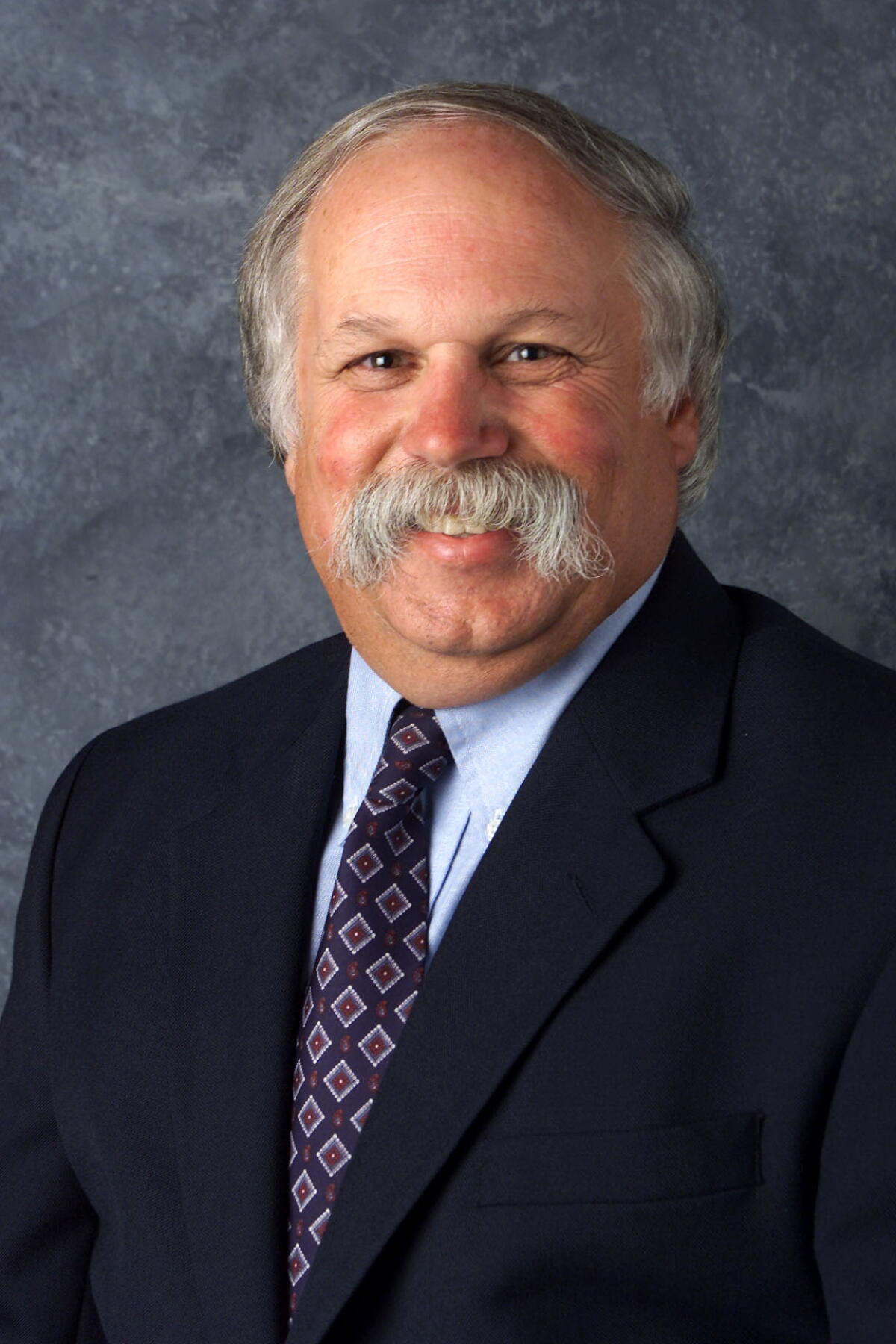
Bob Fontaine Jr. as director of player development for the Seattle Mariners.
(Seattle Mariners)
“I think every scout, if they scout for any length of time, is going to have one player that just is special to you. Jimmy Abbott was that,” Fontaine told JapanBall in 2022. “There were people that were even kind of saying, ‘Oh, they did it for a publicity stunt.’ I remember saying, ‘Yeah, we took the eighth player in the country for a publicity stunt? Give us some credit!’”
Fontaine was showered with plenty of posthumous credit over the weekend. He scouted for six teams, and a highlight of his resume was drafting the nucleus of the Angels’ roster that won the 2002 World Series.
“What a character … what a storyteller … and what a talent evaluator … there is no 2002 World Series title for the #Angels without Bob Fontaine Jr. … RIP,” wrote former longtime Times baseball writer Mike DiGiovanna on X.
What a character … what a storyteller … and what a talent evaluator … there is no 2002 World Series title for the #Angels without Bob Fontaine Jr. … RIP https://t.co/1eHIStuWWY
“Crushed regarding Bob Fontaine Jr.’s passing, as he was a special man who I was lucky to work closely with three times @WhiteSox @Mariners, and @BlueJays. Fun as hell, elite evaluator, and phenomenal people skills. RIP, Robert,” added former Dodgers general manager Dan Evans.
“A gifted talent evaluator and mentor, Bob helped shape generations of Angels by overseeing the signing and development of numerous Halos, including Jim Abbott, Jim Edmonds, Garret Anderson, Tim Salmon and Darin Erstad,” the Angels said in a statement. “Bob left a lasting mark on baseball by devoting over five decades to the game. Our thoughts are with his family and loved ones.”
The Angels frustrated Fontaine at times by declining to spend big on players from talent-rich Latin America. Rather than sulk, however, he scoured the globe, in 1992 signing three players from Russia and a fast-pitch softball player from New Zealand named Gus Leger.
Asked by The Times’ Bill Shaikin if he had ever played baseball, Leger responded, “I haven’t. Would it help?”
The experiment failed — none of the quartet advanced beyond Class A — yet Fontaine maintained the sunny outlook he inherited from his father. Bob Fontaine Sr. was a scout who worked under the legendary Branch Rickey with the Brooklyn Dodgers before becoming scouting director of the Pittsburgh Pirates for 18 years and the first scouting director of the expansion franchise San Diego Padres. He also served as general manager of the Padres from 1977 to 1980.
“[My father] told me when I got started, ‘Don’t you ever, ever not appreciate where you are and what you’re doing, because you’re lucky. You’re going to a ballpark to make a living, so your bad days aren’t that bad,’” Fontaine Jr. said. “I never forgot that, I never forgot how lucky I am.
“Hey, you’re looking at a guy that barely squeaked through high school, who doesn’t have any ability, and I lasted almost 50 years. It’s because in baseball, if you listen, and you’re not afraid to take a chance once in a while, even somebody with my lack of ability can stay around for a while,” he said.
Fontaine got his foot in the door through his father. His first job as a teenager was as a minor league bat boy with the Pirates. Next he became a peanut vendor at Forbes Field. By age 19, he caught on with the Padres as an area scout.
Both Fontaines were scouts well ahead of the deep empirical and objective analysis of baseball data — sabermetrics is the catchall term — that some believe has made scouts obsolete. Fontaine maintained the best evaluations come when scouting is utilized along with numbers.
“What the traditional scout gives you is personal reference, like with things I learned on players that I missed on,” he said. “Analytics didn’t do that. I’m a firm believer that the best video camera is your eyes, the best model is your brain, and the best way to make a tough decision is with your heart.”
Fontaine’s methods produced results. Under his guidance in 1977, the Padres drafted future Hall of Fame shortstop Ozzie Smith in the fourth round. Four years later Fontaine plucked another future Hall of Famer, taking outfielder Tony Gwynn in the third round.
And when Fontaine moved to the Montreal Expos in 1985, he took a 6-foot-11 left-handed pitcher out of USC named Randy Johnson in the second round — another Hall of Famer.
Fontaine co-authored a memoir in 2021, “In Search of Millionaires (The Life of a Baseball Gypsy): The Accounts of Bob Fontaine Jr.”
“Baseball has provided me with a fabulous opportunity to see the world and work in an industry that most people envy,” he wrote in the book. “I didn’t get rich, except in experiences. To meet and work against so many fine people, as well as some great general managers and owners, has been a privilege.”
Times sports columnist Bill Shaikin contributed to this story.
Former Walt Disney Co. Chief Executive Bob Chapek knows his reputation among Disney fans, especially Disneyland loyalists. In his new book “Behind the Castle Walls,” he defends his changes to the Disneyland experience, the vast majority of which are still felt today.
“Contrary to what some people tried to paint me as,” he writes, “I wasn’t just a maniacal, money-optimizing machine.”
Sign up for Mr. Todd’s Wild Ride
An insider guide to the ever-changing world of theme parks, coming to you straight from SoCal — the theme park capital of the world.
By continuing, you agree to our Terms of Service, which include arbitration and a class action waiver. You agree that we and our third-party vendors may collect and use your information, including through cookies, pixels and similar technologies, for the purposes set forth in our Privacy Policy such as personalizing your experience and ads.
When I had the chance to talk to him last week, I wanted to know if having that image bothers him.
“I’m not concerned about it,” he says, speaking via phone from his Florida home. “I don’t give that any thought at this point. But I’m very proud of the performance of the parks segment during my time. The numbers bear that out.”
Chapek, in his role as chairman of the parks division and later CEO of the company, presided over an eight-year period beginning in 2015 in which Disneyland would significantly raise prices, introduce add-on perks, and, in my opinion, create the unsettling sense that you could be having more fun if you just spent more money.
When Chapek took over the parks segment, Disneyland would begin to fully remake its annual passholder program, largely by significantly increasing its price and limiting access. (In 2015, the top priced annual pass was close to $800. Today, it’s $1,899.) Single-day tickets to the parks would also begin a period of aggressive price hikes. Today, a one-day, one-park ticket tops off at $224. It’s widely expected that Disneyland will be raising its prices again this October, as it has done nearly every year in recent history.
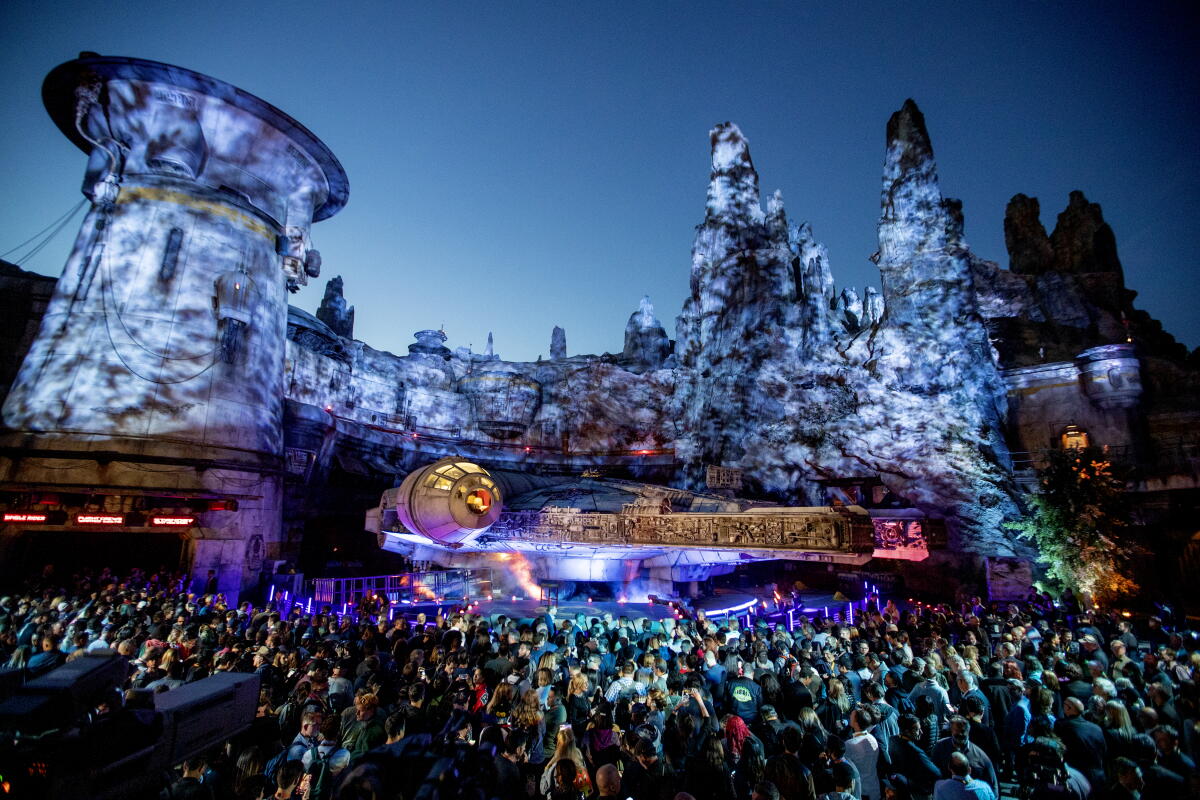
Additionally, benefits that Disneyland guests long took for granted as free, such as the line-skipping Fastpass program, would become a paid perk on Chapek’s watch. Access to some attractions would be grouped together as part of a package now known as a Lightning Lane. In-demand rides such as Star Wars: Rise of the Resistance would be sold separately.
Bob Chapek has defended price increases at Disneyland, noting that ambitious projects like Galaxy’s Edge require capital.
(Allen J. Schaben / Los Angeles Times)
Prices on all of the above typically increase yearly. Today, guests who spring for the front-of-the-line Lightning Lane pass as well as individual access to Rise of the Resistance can expect to pay around an extra $65 per person once having their tickets scanned.
Chapek notes he faced significant opposition at Disney in making these changes.
“To all who come to this happy place, welcome,” goes Walt Disney’s original dedication speech, which for decades was used as a guiding light that every guest who entered Main Street, U.S.A., would be treated as an equal. That meant, with limited exceptions, no special access for anyone.
This was seen as an “inviolable virtue” at Disney, but one Chapek was ready to break, as he writes in his book.
“Everyone is equal when they come through the gates no matter what walk of life they come from,” Chapek tells me. “What’s different, though — and this isn’t because we say it’s different, it’s because the guests say it’s different — it’s that guests say they want an experience that’s tailored to what they can afford.”
Maybe. I don’t have access to guest satisfaction surveys, but that sounds like something only people with a certain privilege say. No doubt guests who can afford less don’t want a worse experience.
Chapek in his book describes himself as a “disruptor,” and considers Lightning Lane-like add-ons “bespoke” experiences that appeal to guests who crave a more customizable day. While they are common at nearly every theme or amusement park, I consider them classist, creating a haves-versus-have-nots mindset as soon as guests step through the gates.
Chapek defends the move to me, pointing out that while he presided over the parks, it’s lowest price one-day, one-park ticket stayed steady at $99 (today it’s $104). While true, and while Disneyland has even sought to increase the number of days offered at its introductory price since Chapek was ousted from the company in 2022, these are often midweek tickets, necessitating that working families take a day off and force a child to skip school.
“How about demand?” says former Walt Disney Co. CEO Bob Chapek, seen here with Minnie Mouse at Hong Kong Disneyland, when defending his price hikes.
(Kin Cheung / Associated Press)
“How about demand?” Chapek says to me when I point out that I have been critical of the moves. “Do people stop coming? That would obviously be a big concern. Even with the increase in prices that were taken on the annual passes, it would temporarily soften demand, but a year later they were subscribed just like they were before. Wall Street has certain expectations that may not be consistent with the expectations of guests of a certain pass type.”
Chapek reveals in his book that there is somewhere around 1.1 million annual passholders to Disneyland, which is today known as a Magic Key. With each price increase, he writes, that number would tumble to around 1 million, but within about 12 months they would be back to a level they were at before the rise in prices.
During Chapek’s reign, the company also introduced a reservation system, which asks guests to plan in advance. The price increase, later coupled with a reservation system, is designed to cut down, in part, on spontaneous trips to the resort, forcing guests to be more intentional about their Disneyland plans. This can aid, of course, in forecasting crowds and park staffing, but is also intended to limit days in which the park can feel overcrowded.
During his five-year tenure as parks chairman, Chapek writes that profits within the segment went up 18%. And that was largely due to an increase in individual guest spending. Over the decades, certain leaders of the Walt Disney Co. have arguably more closely ingratiated themselves with fans than Chapek has, but the fact remains that Chapek fundamentally and forever altered the approachability and the affordability of a Disneyland visit.
“In order to build things like Galaxy’s Edge and Avengers Campus, that takes capital,” Chapek says. “That capital takes revenue.”
My long-term fear, however, is that this has created a slippery slope. Disneyland guests now brace for yearly price hikes each fall, and this is coupled with yearly spikes on food prices each summer. Once the company and its shareholders become accustomed to such a financial boost, an environment where individual guest spending sharply increases even when domestic park attendance is soft or steady, there’s likely no turning back. Disney has created a business that will target the highest-spending consumer year in and year out.
And thus, guest equality, what was once an “inviolable virtue,” is forever a thing of the past, no matter who is in charge.
This week in SoCal theme parks
The X2 roller coaster at Six Flags Magic Mountain.
(Myung J. Chun / Los Angeles Times)
X2 has been retired. Six Flags has officially pulled the plug on Magic Mountain’s X2 coaster, which has been the subject of recent controversy after several lawsuits allege people were injured on the ride. Six Flags shut down X2 in July amid a state investigation into the coaster. “While X2 consistently passed a multitude of safety tests, we have decided to close the ride because we believe it’s the right thing to do. Ride safety is a cornerstone of our business, and when we see guest confidence affected, we take it seriously,” Brian Oerding, Six Flags Magic Mountain president, said in a statement. The Times’ Fedor Zarkhin has more on the news.
Don’t miss Disneyland’s mariachi band. There are a few more opportunities to catch Mariachi Alegría de Disneyland in Rancho Del Zocalo park inside Frontierland. The performances, set for the evenings of Oct. 6, 7, 13 and 14, are part of the resort’s National Hispanic Heritage Month celebrations. Also, beginning Oct. 4 and lasting through Oct. 15, guests can meet the character of Elena of Avalor near Royal Hall next to Sleeping Beauty Castle.
Heads up for those attending Halloween Horror Nights. If you have a visit planned to Universal Studios Hollywood’s Halloween Horror Nights and you’re interested in the park’s new Fast & Furious: Hollywood Drift coaster, there’s now an opportunity to ride it. For a cost. Universal is selling access to the coaster for $19.95 per person. Previously, the coaster was only available to those who sprung for the fancy R.I.P. Tour, which is now sold out.
Work out in Disneyland! The Disneyland Resort has announced new fitness classes across its two parks, an early morning perk for guests staying at one of its three hotels. Among the offerings is the ability to do yoga in Star Wars: Galaxy’s Edge, agility and strength exercises in Cars Land, and a mini-boot-camp-style class in Avengers Campus. Classes range in price, but most are under $49.
Tell us your stories. Ask us your questions.
Have a theme park tale to share? Whether it was a good day or less-than-perfect day, I would love to hear about it. Have a question? A tip? A fun photo from the parks to share? Email me at todd.martens@latimes.com. I may feature your note in an upcoming newsletter.
Ride on,
Todd Martens
P.S.
Me, enjoying a beverage, on the now shuttered Star Wars: Galactic Starcruiser.
(Allen J. Schaben / Los Angeles Times)
There is one area where the former CEO of the Walt Disney Co. and I are in complete agreement. Chapek and I both miss Star Wars: Galactic Starcruiser, colloquially known as the Star Wars Hotel. The ambitious, but costly, multi-day experience was one of the most creatively inspiring offerings in company history.
In “Behind the Castle Walls,” Chapek writes that he believes it was shuttered too soon. The Starcruiser closed after about a year of operation. “Was it perfect the first time? Absolutely not,” Chapek tells me. “Was it one of the most ambitious lodging experiences we have ever created? Yes.”
A place dedicated to play — and light role-play — the Starcruiser allowed guests to fully inhabit a fictional world. It was an argument that interactivity could have been the future of theme parks. “It seemed to have the plug pulled on it prematurely,” Chapek says, “and I think it was a big opportunity missed.”
— This newsletter is free thanks to the support of L.A. Times subscribers. If you’re not yet a subscriber, explore subscription packages to unlock unlimited digital access and support award-winning local reporting.
Was this newsletter forwarded to you? Sign up here to get it in your inbox.
May we assume that Rep. Bob Livingston was an adulterer two weeks ago? Did he think then that he was unfit to lead? His stepping down (Dec. 19) leads me to believe that a private adulterer suffers no loss of ability to lead; but that inability only comes with public knowledge of the “sin.”
I call this gratuitous grandstanding. I call this hypocrisy.
MARIAN L. GOLDBERG
Marina del Rey
*
First we hear that Rep. Henry Hyde admits to “youthful indiscretions” and now Livingston admits to previous affairs (Dec. 18). Our major newspapers tend to treat such matters rather gingerly and relegate them to one of the back pages. We continue to hear that our president’s crime was not about sex but lying under oath. But one cannot help wondering how these highly respected gents would have behaved at the time had they been subjected to the machinations of a Tripp-Starr duo.
WARREN PAINTER
Granada Hills
*
After reading about Livingston’s admission to having an affair and the House’s response of a standing ovation, I have finally figured out the real difference between Republicans and Democrats. Democrats view cheating on their spouses as unacceptable behavior and try to keep it secret. The Republicans view cheating on their spouses as acceptable as long as they admit they did it.
And these people have the nerve to talk to me about the president’s moral authority? Maybe we should throw out the entire legislature and start all over.
JIM PRIETTO
Laguna Niguel
*
Do the Republicans truly believe that their children will understand the difference between Clinton’s perjury and the lies of Hyde and Livingston?
JESSE ALBERT
Los Angeles
*
Any effort by the liberal media to compare Livingston’s admission of adulterous indiscretions with Bill Clinton’s sexual scandal is an effort to deceive the American people. You don’t have to be a rocket scientist to know they are not the same. Clinton lied under oath and tried to obstruct justice.
ART AMASAKI
Torrance
*
The cost to expose sexual misconduct by a major politician: federal government–$40 million; Larry Flynt–$1 million. The Republicans might say, “Chalk another one up for the private sector!”
DUAINE OSBORNE
La Mirada
*
It’s as ironic as it was inevitable that the furies unleashed by Kenneth Starr’s overzealous investigations would turn on the Republicans and begin to consume them.
JERRY BUCK
Sherman Oaks
*
During the Joseph McCarthy days the most frequent question asked by the Congress was, “Are you now or have you ever been a member of the Communist Party?” Today’s question asked by Congress can be characterized as, “Are you now or have you ever been guilty of infidelity?”
SAMUEL M. ROSEN
Newbury Park
*
Character does matter, especially if you happen to be a Democrat.
BBC Radio 2 legend Bob Harris has shared a new health update amid his cancer battleCredit: whisperingbob/ InstagramBob presented The Country Show from April 1999 to April 2026Credit: Instagram/whisperingbob
Bob’s Instagram followers flocked to share their reactions to his newsCredit: whisperingbob/ InstagramLast month, Bob shared an update saying the cancer was “taking more of a hold”Credit: instagram
“I was speaking this morning with my oncologist, the amazing Costi and we are going to continue with my cancer treatment.
“We’re getting back under control, I was a little bit worried a short time ago, but everything is getting back under control now.
“I can see the pathway of my life ahead of me opening up again.”
At this point, Bob revealed he also had a second piece of news to share, but would reveal it on Tuesday at 10am.
One person commented: “Excellent news Bob!!!!”
Another added: “Excellent news Bob, everyone is 100% backing you for your recovery.”
It comes after Bob shared a devastating health update on his cancer battle last month, as he revealed the disease is “taking more of a hold.”
He said: “It has been a while since I last posted a health update and I want to let you know how I’m getting on, because there have been some changes with my cancer diagnosis.
“As regular followers will know, earlier this year I was forced to step back from BBC Radio 2 to concentrate on treatment and rest.
“I have been missing my programmes so much, but this space has given me a most beautiful summer here at home, enjoying a most precious commodity… TIME.“
Bob continued: “I feel very blessed to have been able to spend lovely moments with family and friends (some of which I’ve posted here on Instagram) in the glorious summer sunshine, but during this time my cancer has been getting more of a hold.
“I still feel well but I am now at the start of an intensive course of intravenous radiotherapy which we are confident will keep things at bay. I should know the outcome quite soon.”
While Purdue is not projected to be a Big Ten juggernaut this season, UCLA coach Bob Chesney and his team expect to be challenged during their first game against Big Ten competition on Saturday at the Rose Bowl.
The Boilermakers’ defensive line features five high-impact players that are at least 6-foot-3, and a nose tackle who weighs in at 301 pounds and anchors a defensive front that ranks second in the Big Ten with 17 tackles for loss.
“They’re talented in who they’re as individual players, there are some game-wreckers in there,” Chesney said. “They are as vertical as can be, they jump out of their stances, they’re jumping snap counts and they’re violent. They pose a giant problem, and we are not going to be able to push them around, and we are not going to be able to find ourselves in a spot where they tire. This is going to be a battle on the inside throughout the entire course of that game.”
While UCLA’s ground attack has dominated through the first two games of the season — rushing for 277 yards and six touchdowns against California and 214 yards and four scores against San Diego State — it might be harder for the Bruins’ running backs to have their way against the Purdue defense.
Purdue held both Indiana State‘s and Wake Forest’s starting running backs to less than four yards per carry, and has conceded just two rushing touchdowns to those starters this season.
“There’s some things that I think Purdue does a really good job defensively, in terms of getting off the ball,” said UCLA offensive coordinator Dean Kennedy. “They have got a lot of length. They’re a very, very big team, it will probably be one of the biggest teams we will face, so we have to be prepared for that.”
However, the Boilermakers have struggled to stop quarterbacks on the run — allowing Indiana State’s Elijah Owens and Wake Forest‘s Gio Lopez to combine for 118 rushing yards and two touchdowns — giving Bruins senior quarterback Nico Iamaleava the opportunity to rely on his legs.
While Iamaleava should have wide receivers Landon Ellis and Brian Rowe Jr. back to full strength, fortifying the aerial attack, the signal-caller will be without Mikey Matthews, after the slot receiver went down with a lower-body injury against San Diego State.
“There’s a fine line. Understanding what the coverage is doing, when is it time to take off and go,” Kennedy said. “If you are going through your read, from a clock standpoint, and it’s not there, it’s a great time to take off and go. It’s our job as an offense to create explosives, whether it’s him taking off or it’s him creating a scramble drill. We look at scramble drills, that we have to create explosives, and that’s something we have to do a better job of.”
Defensively, the “Bruin Bullies” will be tasked with stopping running back Fame Ijeboi, who has run for 201 yards and four touchdowns on 5.3 yards per carry this season. Chesney said that Ijeboi has a “Wayne Knight” feeling to him, where he plays low to the ground, displays proficient body balance and leg drive, allowing him to be influential in the passing game and break tackles.
While UCLA has already faced formidable rushers in Cal’s Adam Mohammed and San Diego State’s Lucky Sutton, Ijeboi could be the most impactful yet. And no one knows that more than Bruin defensive coordinator Colin Hitschler, who went to the same high school as the Boilermaker running back.
“It’s been fun to watch his growth, following him through high school, and watching him earn those scholarships and opportunities,” Hitschler said. “Those first two games, he jumped off the tape. He’s got great potential and he’s going to go a long way. We have to do a good job putting a physical shoulder on him and knocking him down because he’ll run through contact and does a great job of finding the edges.”
If Ijeboi is unable to get it going, it will have to be up to Purdue quarterback Ryan Browne to generate offense.
While the signal-caller struggled last season — throwing nine touchdowns with 10 interceptions — Browne has looked like a new player in 2026, passing for 646 yards and four touchdowns.
Browne has benefited from the addition of two premier slot receivers in Florida Atlantic transfer Asaad Waseem and Iowa State transfer Xavier Townsend. They have combined for 25 receptions, 277 yards and one score.
“What makes them unique is there are a lot of them,” Hitschler said. “When you have 10 personnel and that many receivers that can catch the ball, it can create mismatches, and we play a lot of man, so who’s going to fold first?” Hitschler said. “Are we going to be able to man them up or are we having to play more zone? Those are questions that will play out as the game dictates by who’s winning the one-on-one matchups. It’s the chess match that always happens in any game.”
The Bruins’ defense will look to force turnovers, but that is no easy feat as the Boilermakers have yet to turn the ball over this season.
Kids’ favourite TV character Bob the Builder – complete with a voice over by actor Neil Morrissey – has been hired to encourage more people to learn green energy skills
Bob the Builder has returned for a one-off advert in his original stock motion form (Image: E.on)
Much-loved cartoon character Bob the Builder is making a return in his original form after 15 years – to plug green energy.
The kids TV favourite, voiced by Men Behaving Badly actor Neil Morrissey, appears in a new advert from energy giant E.on.
And he also reveals what he has been doing since the original stop motion version of the show ended in 2011, including taking up yoga, bird watching and travelling to Australia.
It is Down Under, so the new story goes, that Britain’s best known tradesman twigs the importance of green energy, such as solar panels and home batteries. On returning home, he decides to learn the skills needed to fit the new kit, with the advert ending with his famous catchphrase: “Can we fix it? Yes we can.”
The 90 second piece, which will run across E.ON UK’s social media channels, is designed to encourage many more people to learn the same type of skills.
It comes as new research commissioned by the company found that around one third of professionals in the UK energy sector believe the workforce is not yet fully equipped to install the technologies needed for the transition to green energy.
At the same time, 89% agree that greater investment and closer collaboration between government and industry are needed. And the vast majority say that upskilling the existing workforce will be just as important as attracting new talent to meet future demand.
Helen Bradbury, chief people officer at E.ON UK, said: “Bob the Builder has always inspired people to solve problems and build things that matter. Today, those same qualities are needed to help deliver the UK’s transition to clean power.
“By embracing green skills and fronting this campaign, he’s a shining example of how we can make new energy work for everyone.
“If we invest in people’s homes, we can build a new energy system from the ground up. One that uses low-carbon, connected technologies like solar panels and batteries to put customers back in control of their energy use and lower their bills.”