New Delhi, India — Dressed in a blue Navy uniform and sleek sunglasses, Indian Prime Minister Narendra Modi, in late October, addressed a gathering of the country’s sea warriors.
He listed out the strategic significance of the Indian Ocean — the massive volumes of trade and oil that pass through it. “The Indian Navy is the guardian of the Indian Ocean,” he then said, to loud, proud chants of “Long Live Mother India” from his audience.
Less than five months later, India has been shown up as a “guardian”, unable to protect its own guest.
On Wednesday, the Iranian warship, IRIS Dena, was torpedoed by a US submarine just 44 nautical miles off (81km) southern Sri Lanka, as it was returning home from naval drills hosted by India. During the “Milan” biennial multilateral naval exercise, Indian President Droupadi Murmu had posed with sailors from the Dena.
Yet it took the Indian Navy more than a day after the Iranian warship was struck to respond formally to the attack, which US officials made clear was a sign of how the Donald Trump administration was willing and ready to expand its war against Iran.
“An American submarine sank an Iranian warship that thought it was safe in international waters,” US Defense Secretary Pete Hegseth said at the Pentagon on Wednesday. “Instead, it was sunk by a torpedo. Quiet death.”
Tehran is furious over the attack on its warship hundreds of miles away from home. And Iran made sure to note that the IRIS Dena warship was “a guest of India’s navy”, returning after completing the exercise it joined upon New Delhi’s invitation.
“The US has perpetrated an atrocity at sea, 2,000 miles [3,218km] away from Iran’s shores,” Iran’s foreign minister Abbas Araghchi said, referring to the sinking of the frigate. “Mark my words: The US will come to bitterly regret [the] precedent it has set.”
Now, the IRIS Dena is at the bottom of the Indian Ocean, and more than 80 Iranian sailors, who marched during joint parades and posed for selfies with Indian naval officers during their two-week visit, are dead.
What has also fallen, said retired Indian naval officers and analysts, is India’s self-image as a net security provider in the Indian Ocean. Instead, they said, the US attack on the Dena has exposed the limits of India’s power and influence in its own maritime back yard.
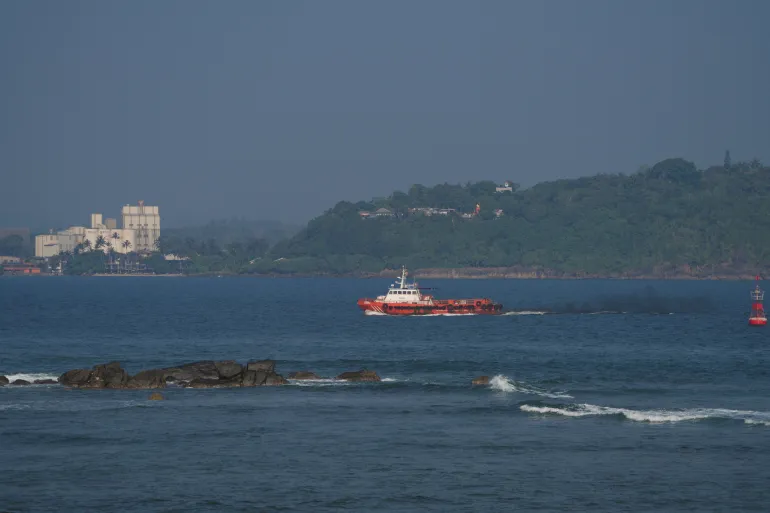
A vessel sails off the Galle coast after a submarine attack on the Iranian military ship, Iris Dena, off Sri Lanka, in Galle, Sri Lanka, March 4, 2026 [Thilina Kaluthotage/Reuters]
‘War reaches India’s backyard’
After participating in the naval exercises, IRIS Dena left Visakhapatnam on India’s eastern coast on February 26. It was hit in international waters, just south of Sri Lanka’s territorial waters, in the early hours of March 4, local time.
In response, Sri Lankan Navy rescuers recovered more than 80 bodies and picked up 32 survivors, reportedly including the commander and some senior officers from the warship. More than 100 men are still missing.
In a tweet welcoming the Dena to the naval drills, the Indian Navy’s Eastern Command had posted: “Her arrival … [reflects] long-standing cultural links between the two nations [Iran and India]”.
Vice Admiral Shekhar Sinha, the former vice chief of India’s naval staff, told Al Jazeera that he attended the Iranian parade at the function.
“I met and really liked them, especially their march for sailors travelling thousands of miles,” Sinha said. “It is always sad to see a ship sinking. But in a war, emotions don’t work. There’s nothing ethical in a war.”
Sinha said that the Indian Ocean — central to the strategic and energy security of the nation with the world’s largest population — was thought to be a fairly safe zone earlier. “But that is not the case, as we are learning now,” he told Al Jazeera.
“The unfolding battle [between the US and Israel on the one hand, and Iran on the other] has reached India’s back yard. New Delhi has to be concerned,” Sinha, who served in the Indian Navy for four decades, added. “The liberty we enjoyed in the Indian Ocean has apparently shrunk.”
Security personnel stand guard as an ambulance enters inside the Galle National Hospital, following a submarine attack on the Iranian military ship, IRIS Dena, off the coast of Sri Lanka, in Galle, Sri Lanka, March 5, 2026 [Thilina Kaluthotage/Reuters]
India’s Catch-22 situation
Only on Thursday evening did the Indian Navy issue any formal statement on the attack — more than 24 hours after the Dena was hit by a torpedo.
The Navy said that it received distress signals from the Iranian ship and had decided on deploying resources to help with rescuing sailors. But by then, it said, the Sri Lankan Navy had already stepped to lead the rescue effort.
Neither New Delhi nor the Navy has criticised — even mildly — the decision by the US to sink the Iranian warship.
Military analysts and former Indian naval officers say India is caught in a classic catch-22: Was India aware of the incoming US attack in the Indian Ocean on an Iranian warship, or was it blindsided by a nuclear-submarine in its backyard?
Admiral Arun Prakash, the former chief of India’s naval staff, told Al Jazeera that if New Delhi was blindsided, “it reflects on the US-India relationship directly.”
“If it is a surprise, then that’s a great concern since we have a so-called strategic partnership with the USA.”
And if India knew about the attacks, it would be seen by many as strategically siding with the US and Israel over their war on Iran.
C Uday Bhaskar, a retired Indian Navy officer and currently the director of the Society for Policy Studies, an independent think tank based in New Delhi, said that the US sinking an Iranian warship in the Indian Ocean muddies the Indian perception of itself as a “net security provider” in the region.
Bhaskar said the incident is a “strategic embarrassment” for India and weakens New Delhi’s credibility in the Indian Ocean, while its moral standing “takes a beating” because of the Indian government’s near-silence.
An injured Iranian sailor is moved on a stretcher at Galle National Hospital, where the sailors are receiving treatment, following a submarine attack on the Iranian military ship, IRIS Dena, off the coast of Sri Lanka, in Galle, Sri Lanka, March 5, 2026 [Thilina Kaluthotage/Reuters]
‘India on aggressor’s side’
In the post-colonial world order, India was a leader of the non-alignment movement, the Cold War-era neutrality posture adopted by several developing nations.
India now no longer calls its approach non-alignment, instead referring to it as “strategic autonomy”. But, in reality, it has inched closer to the United States and its allies, most importantly, Israel.
Merely two days before the US and Israel bombed Iran, Modi was in Israel, addressing the Knesset and warmly hugging Prime Minister Benjamin Netanyahu, who called his Indian counterpart a brother.
But Iran, under the late Supreme Leader Khamenei, was a friend of India as well, with New Delhi making strategic, business, and humanitarian investments in the country.
However, Modi has not said a word in condolence after Khamenei’s assassination. On Thursday, Indian Foreign Secretary Vikram Misri visited the Iranian embassy in New Delhi to sign a memorial book. Indian governments normally deploy ministers — not bureaucrats or diplomats — for such sombre occasions.
It is against that backdrop that India’s response to the attack on the Dena has come under scrutiny.
Because the frigate was hit when it was in international waters, India had “no formal responsibility”, said Srinath Raghavan, an Indian military historian and strategic analyst.
“But the US Navy’s actions underline both the spreading geography of this war and the sharp limits of India’s ability to manage, let alone control, its fallout,” Raghavan told Al Jazeera.
Diplomatically, India has “objectively positioned itself on the side of the aggressors in this war,” he said, by “acts of commission — visit to Israel on the eve of war — and of omission, with not even [an] official condolence, let alone condemnation, of the assassination of the Iranian head of state.” Modi visited Israel on February 25-26.
Mallikarjun Kharge, the president of India’s opposition Congress party, said the Modi government had recklessly abdicated “India’s strategic and national interests”. And the government’s silence “demeans India’s core national interests and destroys our foreign policy, carefully and painstakingly built and followed by successive governments over the years.”
In addition, Raghavan highlighted that Modi has only criticised Iran’s retaliation, which threatens to drag the Gulf region to the brink of war.
“It is difficult not to conclude that India has drastically downgraded its interests in the relationship with Iran,” he said.
“All of this detracts from India’s credibility as a player in the region and will have short and long-term consequences for the equities in West Asia [as the Middle East is referred to in India],” Raghavan told Al Jazeera.
Drayton Manor has launched a K-Pop themed takeover for half term, and while it had some fun moments, our favourite attraction was worlds away from the glittering world of K-Pop music
11:37, 17 Feb 2026Updated 11:40, 17 Feb 2026
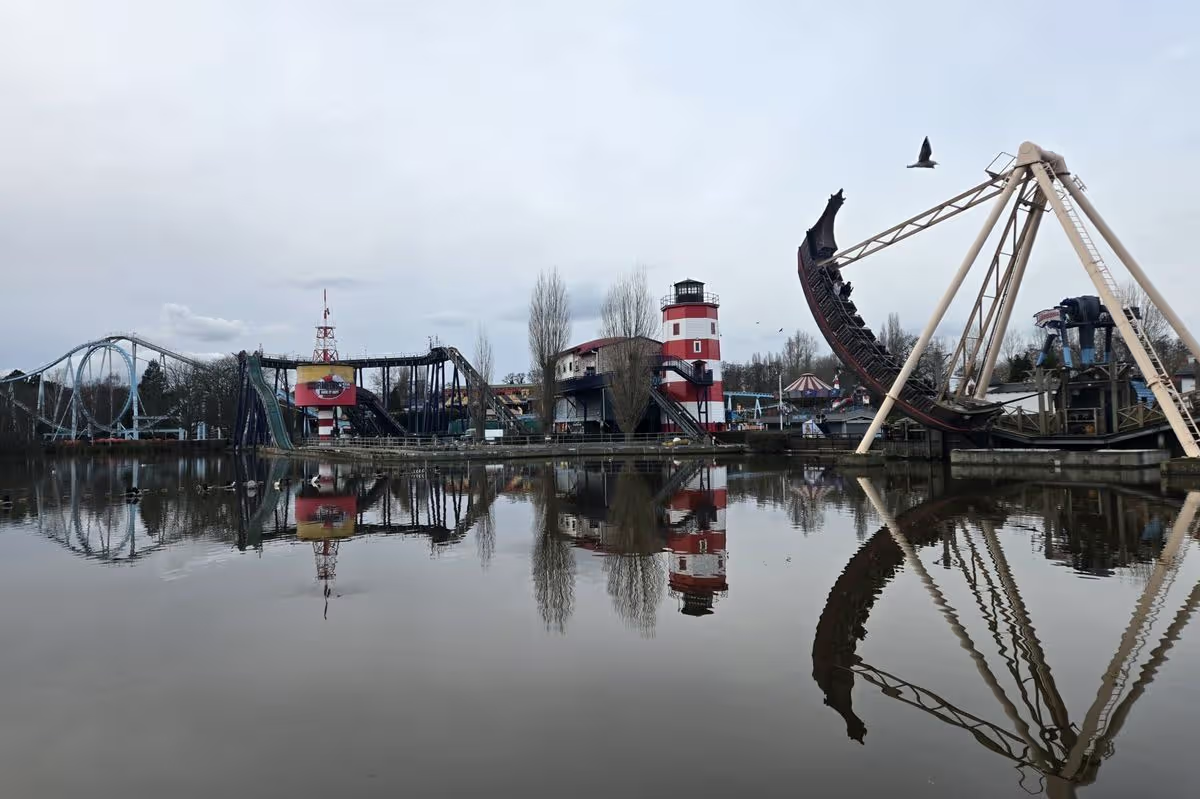
A few Drayton Manor rides were open along with Thomas Land(Image: Matthew King)
If you have a child of primary school age, the soundtrack to your life is likely to be the cheery sounds of K-Pop. K-Pop, which stands for Korean Pop, has been on many music fans’ radar for years now, but 2026 is likely to be a big year for the genre.
Not only has K-Pop Demon Hunters become the most-watched original title in Netflix history with 500 million views – quite a few of which have come from my house – but K-Pop bands have been all over the charts. In August 2025, a record seven K-Pop tracks made the top 40 singles chart, including BLACKPINK and Stray Kids. A recent tour announcement by BTS saw a Taylor Swift-style clamber for tickets and UK dates sold out in 30 minutes.
So, it wasn’t a huge surprise to see that Drayton Manor, a theme park in the West Midlands, would be hosting a K-Pop Takeover for February half term. My daughter was thrilled to be going to a K-Pop themed day and wore her favourite HUNTR/X hoodie for the occasion. And of course, Spotify was cued up with an appropriate playlist on the way.
While the park isn’t fully open during February half term, in addition to the K-POP activities the ticket price includes Thomas Land, a handful of rides, plus the zoo. With tickets starting at £19.90, the price reflects that you won’t get the full theme park experience.
We arrived just in time for ‘K-Pop games’ on the park’s main stage, and a very enthusiastic entertainer was leading some kids in a game of red light, green light, followed by some singing along to the tune of Golden. There was also a K-Pop themed dance workshop later on, with excited kids dancing in front of the sparkly stage.
Other than some Korean fried chicken being served in the burger bar, and some Korean souvenirs in the gift shop, there wasn’t a huge amount of K-Pop theming throughout the park. However, the end of day K-Pop concert definitely brought in the crowds and seemed to be widely enjoyed.
Three entertainers, dressed as a K-Pop girl group, sang songs by HUNTR/X, Saja Boys, and Rosé, bringing the day to a close with a water show in the park’s lake. Kids and adults were bopping along to the tunes, and I was impressed that the group’s lead singer managed to tackle the high notes in Golden.
But the real draw at Drayton Manor is Thomas Land. While it took the silver award for Best Theme Park for Toddlers in 2025, people of all ages seem delighted when wandering around the Sodor-themed attraction. Even grown adults were posing for photos with Thomas, showing the nostalgia around the show never went away.
It seemed to be a good time to visit. Queues were pretty minimal on most of the rides, although we did unfortunately wait half an hour to get on Winston’s Whistle-Stop Tours only for the ride to break down. However, quite a few of the smaller rides had no queue at all, and it meant we got a couple of turns on Toby’s Tram Express and some other favourites.
Thomas Land also had regular shows, and we got the chance to meet Sir Topham Hatt, or depending on your age, the Fat Controller. The performer was great, and I noticed he could communicate in Makaton – a type of sign language often used for children with learning or communication difficulties. It would be great to see more theme parks train staff in this way to make the entertainment more inclusive.
So, is this review Golden or is it a Takedown? Overall, I’d say it’s worth visiting the park for the K-Pop Takeover. Outside of the main stage, there’s not a whole lot of K-Pop theming, but enough to keep fans happy. The end of day concert was definitely a highlight for my youngest and she hasn’t stopped talking about it, and concert only tickets are available if you just want to visit later on. But Thomas Land is always worth a day out. Just make sure you bring your big coat.