‘Blade Runner 2099’: Michelle Yeoh and Hunter Schafer explain ending
There are no easy answers at the end of “Blade Runner 2099.” The eight-episode limited series builds on the sci-fi world of Ridley Scott’s 1982 film “Blade Runner” and Denis Villeneuve’s 2017 sequel “Blade Runner 2049.” And like those films, it culminates with purposeful ambiguity.
“What I love about both films is that there’s so much debate about what the endings mean,” says creator and showrunner Silka Luisa, speaking via video call. “Everyone has a different interpretation of what would happen afterwards. I wanted to give that experience to audiences too.”
The series, now streaming on Prime Video, imagines a post-revolution Los Angeles, where the bioengineered humanoid replicants have risen up and taken power from the humans, now second-class citizens. It’s a reversal from the movies, where humans build the replicants for labor and ultimately suppress them.
“The actual war itself I was less interested in,” Luisa says. “I wanted to know what would they do with winning. And what would happen to us when we’d lost.”
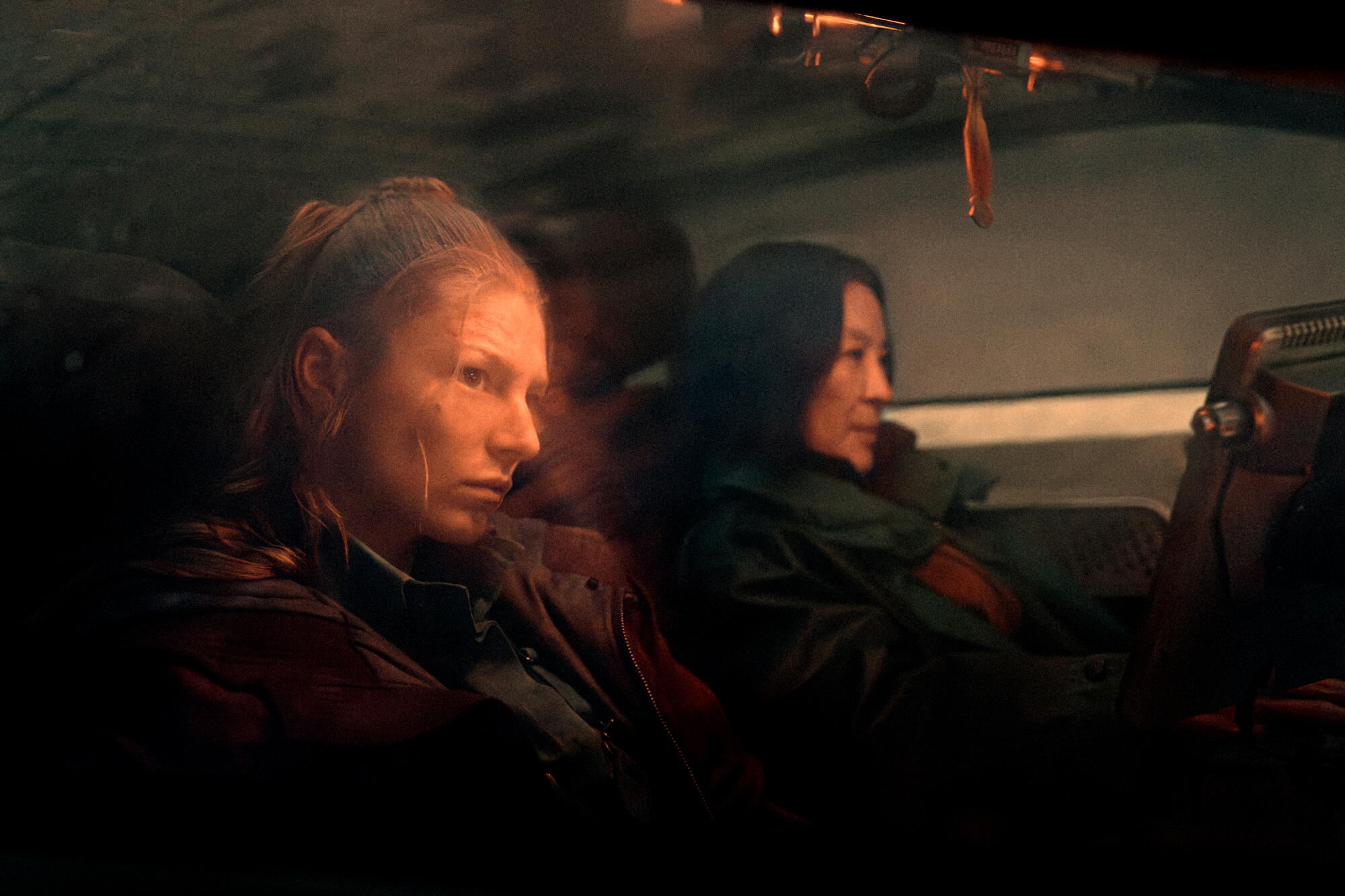
That supposition created a compelling backdrop for a more intimate story between fierce replicant blade runner Olwen (Michelle Yeoh) and determined but down-on-her-luck human Cora (Hunter Schafer). Cora takes on the identity of a blade runner in hopes of a better life only to find herself in too deep at the LAPD when a group of replicants go rogue. She and Olwen find an unlikely collaboration as they track down the group, which includes Marek, Olwen’s former partner.

Cora (Hunter Schafer), left, and Olwen (Michelle Yeoh) in “Blade Runner 2099.”
(Clay Enos / Prime)
It was the companionship that develops between Olwen and Cora that interested Yeoh, 64. “They realize how much they needed each other by the end of their journey,” she says, speaking with Schafer via video call from Los Angeles. “It’s about them discovering not just what is important to the world, but also to themselves and to each other.”
“Everybody is living in fear, especially the humans,” says Schafer, 27. “The replicants have given them a little bit of hope to keep them suppressed. [Olwen and Cora’s] relationship is so emotional in this capitalist world that encourages the isolation of humans. They’re both quite lonely for their own reasons.”
Both are also harboring secrets: Olwen, who is nearing the end of her life, is searching for Marek without the LAPD’s knowledge. Meanwhile, Cora is struggling to conceal her true identity. It was important not to wait until the end of the season for these secrets to come out.
“They can’t start having a connection until you strip those away,” Luisa says. “So much of ‘Blade Runner’ is about loneliness and the inability to find connection. The final story movement is about them seeing each other for who they really are and embracing that.”
Yeoh felt that Olwen was deeply conflicted by the discovery that Cora is human in Episode 5.

Schafer’s Cora is a lonely human struggling to conceal her identity in the series. “So much of ‘Blade Runner’ is about loneliness and the inability to find connection,” says showrunner Silka Luisa.
(Robert Ascroft / For The Times)
“Olwen has been hiding so many things from her,” Yeoh says. “So why is she so pissed off with someone who did exactly the same thing? And what Olwen was really pissed off about is she did not see this coming. She is the ultimate experienced replicant and she got lied to by a mere human. That was a blow to the ego.”
That revelation allowed the co-stars to more fully explore their characters in the subsequent episodes. Schafer points to a scene on the beach in Episode 6 where Olwen and Cora begin to understand each other — and to care about each other.
“It was one of my favorite scenes to film because it was a softer, sweeter moment between the two,” Schafer says. “It’s not overtly affectionate, but there’s this real connection, understanding and love, which makes it feel that much more profound.”
Yeoh adds, “There were no more barriers between these two characters. They needed to feel at peace with each other and with themselves.”
Both actors point to the emotional scenes as their favorites to film, although they also enjoyed the high-octane action sequences. For Yeoh, a veteran actor who has performed in numerous action films over the course of her storied career, including an Oscar-winning performance in “Everything Everywhere All at Once,” the series offered the best of both worlds.
“You watch them and you think, ‘Yeah, I kicked ass!’” Yeoh says. “Or in the case of Cora, she got her ass kicked a lot. But to do those, you do them in parts and they get edited together.”
However, she says the more intimate scenes required them to be present. “We were present with each other as Cora and Olwen, and their moments together were so deep.”

For Yeoh, “Blade Runner 2099” is the latest performance to utilize her action background, but she also enjoyed filming the more intimate scenes between Olwen and Cora.
(Robert Ascroft / For The Times)
For Schafer, “Blade Runner 2099” marks her latest foray on TV after her breakout role as Jules in HBO’s “Euphoria,” which concluded in May. While “Blade Runner 2099” required her to act in propulsive action scenes, the intimacy she’s known for portraying in her roles is evident here; she sees parallels between the franchise’s first film and the series. “One of the most impactful moments from the first one, at the end when it gets really poetic and quiet and intimate between Roy and Deckard, and he’s talking about tears in the rain. It’s one of the most iconic moments from the movie.”
“Those are the moments where you feel the connection,” Yeoh adds. “The movie is so beautiful. It’s breathtaking. It’s those connections we wanted to build on. That’s very human. And in life that’s what we’re looking for too.”
Luisa describes the relationship between Olwen and Cora as “an enemies to allies dynamic.” For Yeoh and Schafer, it became almost maternal.
“When Cora and Olwen came together, it was two lonely souls recognizing each other,” Yeoh says. “Olwen feels protective of her, but she can’t understand why she is feeling protective toward a replicant.”
She adds that Olwen presents herself as a strong replicant with no emotion, which is how they were programmed. “Replicants can’t have empathy,” Yeoh says. “They get tested the minute there’s doubt. But you see this other side of her.”
Cora, too, feels protective of Olwen. During the climactic battle in the finale with Tom Burke’s Nexus-1 model Julius, she takes a blow meant for Olwen. Schafer imagined that Cora felt a familial connection with Olwen, in part because she has a difficult relationship with her brother Elias (Lewis Gribben) and because she misses her adopted mother, the other Nexus-1 model Helena (Sheila Atim).
“The idea of losing another mom is too much,” Schafer says. “She watched her real parents die and then she watched her adopted mom die and she’s having this third opportunity to do something about it. She can’t let that happen.”
“It becomes very instinctive to protect the one you care for,” Yeoh adds. “You wouldn’t even think about it. You would just do it. The two characters have gotten to that stage where they’re no longer on their own.”

The relationship between Cora and Olwen becomes very protective. “It becomes very instinctive to protect the one you care for,” Yeoh says.
(Robert Ascroft / For The Times)
“She probably also looks at Olwen and sees, ‘You could have more of a life after this than I ever could,’” Schafer says. “Even when we leave off with Cora, it’s like, ‘Where do we go from here? You’re still stuck here in this place.’ But Olwen can get off world and have more of a life.”
The later episodes reveal that Julius has been searching for a memory from Eldon Tyrell, the founder of the Tyrell Corporation, which created the replicants. He and Helena were the original models and, unlike the newer models, they didn’t have an expiration date. Julius hopes to use the memory to remake the replicants like himself — a rebirthing process he successfully tests on fellow replicant Clotilde (Amy Lennox). Luisa had freedom to explore the mythology from the original “Blade Runner” film.
“I was very cautious about not touching ‘2049’ too much,” Luisa says. “But in terms of the original Tyrell lore, I was allowed to generate all that. It’s never directly stated what happened with the earlier Nexus models and that felt like it was just sitting out there. Like they had hidden this mystery on purpose.”
Olwen shoots Julius after he attacks Cora, but he destroys the memory — stored in an orb — simultaneously destroying the hope of Olwen extending her lifespan. After he dies, Clotilde reveals that she knows the process. The finale depicts a single hand emerging from one of the rebirth pods, but it’s unclear who it belongs to. Olwen departs to go off-world and Cora returns to the LAPD office, still disguised as a Blade Runner.
But was Cora remade as a replicant in order to survive?
“It’s left open,” Schafer says. “‘Blade Runner’ is famous for its open endings. Maybe we’re not entirely sure what happened.”
“I think you should question all of it,” Luisa confirms. “That is part of the ambiguity that we wanted.”


Olwen survives and goes off-world, but what about Cora — is she alive or has she been remade? “It’s left open,” Schafer says. “‘Blade Runner’ is famous for its open endings. Maybe we’re not entirely sure what happened.” (Robert Ascroft / For The Times)
Although Olwen and Cora develop a strong connection, Luisa didn’t want to keep them together at the end of the series. The characters change each other and then move on.
“At the beginning, neither has empathy and by the end they discover it,” Luisa says. “That doesn’t necessarily mean they have to spend the rest of their lives together. But the value of the time they spend together has forever shifted them.”
“I think the only thing that she was sad about leaving was Cora,” Yeoh adds of Olwen. “She’s a very practical person and she’s content with this, like ‘I’m doing what I deserve to do.’ She realizes that living a full life is good enough. It doesn’t have to be a long life. She went to the stars because that’s where she belongs.”
However, despite the finale’s open end, “Blade Runner 2099” is intended as a stand-alone series. Currently, there are no plans for another season.
“The ending was meant to be a final moment for both of them,” Luisa says. “The hope is that people will fall in love with the world and the ideas of ‘Blade Runner,’ so that other stories can be told.”
Like its predecessors, “Blade Runner 2099” asks big questions about what it means to be human. Although replicants are modeled after humans, they lack human empathy. They are not robots or AI, but similar concerns exist about their relationship with us. The actors are aware of how timely the conversation feels.
“They are made of flesh and bone,” Yeoh says. “They were created to do menial, tough labor. We humans made them in our form, like we are gods and they are our subjects, and then we put them to work. And people are beginning to have a fear of AI because there is so much talk about how it will take over jobs.”
“The ‘Blade Runner’ question of it all is: If these things have developed neural networks and pathways that resemble those of our own with emotions, what does it mean to have created something for labor?” Schafer adds. “It’s the right time to be asking all these questions because the show questions what it is to be human.”
For Luisa, the message of the show is simple. “Empathy is what separates us from machine,” she says. “We can either gain it or we can lose it.”