Southern Democrats see hope for first time in years, seek to build on discontent of midterm voters
DOTHAN, Ala. — People crowded shoulder to shoulder upstairs in a south Alabama coffee shop, in a region sometimes called the reddest in the heavily conservative state.
They were there to hear Doug Jones, the Democratic nominee for governor and the last Democrat to hold statewide office in Alabama.
“Alabama has been under Republican control for almost two decades. We’re not getting any better,” said Jeff Scroggins, 61, a government contractor from Slocomb who was part of the crowd that came to Mural City Coffee Company and said he is voting for the Democrat.
Scroggins, who usually votes Democratic, called himself the “black sheep of the family” in supporting Jones this fall against Republican U.S. Sen. Tommy Tuberville, but said there are more Democrats and “stubborn independents” in the state than people realize.
Jones and other Democrats running in Alabama and neighboring states are banking on it.
“People want change,” Jones said after an hour of talking with people who came to see him. “That is the real key. People are not satisfied with their government of Alabama.”
Democrats sense a shift among voters
Deep South Democrats, largely absent from statewide offices, are aiming for a comeback this year. They are seeking to mobilize Black voters who are angered about the Republican moves to dismantle minority congressional districts, as well as voters who are frustrated with high gas prices, the Iran war, data centers and other issues.
Jones is trying to win a rematch with Tuberville after the Republican ousted him in a 2020 Senate race. Jones would be the first Democrat since 1998 to win an Alabama governor’s race.
In Mississippi, prosecutor Scott Colom is trying to unseat Republican Cindy Hyde-Smith and become the state’s first newly elected U.S. senator since 1946. In Georgia, former Atlanta Mayor Keisha Lance Bottoms is trying to reverse a losing streak in races for governor that began for Democrats in 2002. Elsewhere, Democrats are trying to pull off U.S. Senate upsets in Louisiana and South Carolina.
In Alabama, Jones’ town halls have attracted hopeful Democrats, some independents and even a few Republicans. Their concerns mirror those of voters nationwide: the rising cost of living, worries over data centers and the affordability of healthcare, issues they say have gone unaddressed by the Republicans who control the state.
Some said state policies, including an abortion ban that makes no exemption for rape, have been too extreme. Others said some comments by Tuberville, such as calling Islam “a cult,” are embarrassing to the state.
Still, the math across the Deep South has been difficult for Democrats. Other than Jones’ victory in the special U.S. Senate election, the last Democrat holding statewide office in Alabama was defeated in 2012. Statewide Democratic candidates have hit a ceiling of around 40% of the vote in recent elections.
The results are similar in most other Deep South states. In Georgia, U.S. Sens. Raphael Warnock and Jon Ossoff, who is seeking reelection this year, offer a bright spot for Democrats.
Jones noted that Alabama saw a surge in the number of people voting in the Democratic primary. While about 58% of primary voters were Republican, the Democratic primary vote doubled since 2022. Some counties, including a tech hub in north Alabama, saw more Democratic votes than Republican.
Optimistic about their chances, Democrats are running candidates in all major state races for the first time in years.
“The numbers are there,” Jones said. “It’s a question of getting those voters out.”
Republican gerrymandering creates a backlash
In nearby Troy, a crowd gathered on the campus of Troy University to hear Jones speak alongside Shomari Figures, one of Alabama’s two Black U.S. House members. The district was substantially redrawn by Republicans after the U.S. Supreme Court earlier this year gutted the Voting Rights Act.
Figures said there is an excitement he has not felt since Jones’ 2017 Senate victory. Figures won election two years ago after a federal court ruled that Alabama had been illegally diluting the voting power of Black Alabamians and ordered new district lines. The Supreme Court’s reversal this year allowed state Republicans to reshape the district and substantially reduce the percentage of Black voters who align with Democrats.
Figures said the goal of the redraw was obvious: to reduce Black representation.
“But we are going to win it in November,” he said.
Figures has often emphasized the economic needs of the district at a time when affordability is one of the main topics of the midterms. He noted that the individual median income in Alabama is $34,000.
“Let that sink in — $34,000 before taxes, before rent, before water, before lights, before gas, before cellphone, before health insurance, before car insurance, before childcare, before food,” he said.
Alabama is one of 10 states that did not expand Medicaid under the Affordable Care Act, a decision that Jones and Figures said leaves thousands of working people without access to healthcare coverage.
Figures faces Trump-endorsed Republican Rhett Marques, a state lawmaker. Marques framed the race as “common sense” versus “craziness.” Both have raised about $1.3 million so far.
In Mississippi, Colom looks to make history
Colom echoes many of Jones’ and Figures’ arguments in his bid against Hyde-Smith.
“We’ve been gifted an opportunity,” he said, pointing to Mississippi’s large base of Black Democratic voters, Hyde-Smith’s relatively low profile in her first full Senate term and voters’ frustrations over the economy.
With the largest share of Black voters of any state, Mississippi’s general elections have been closer for years than its immediate Southern neighbors. Trump won by double digits in each of his three presidential contests, but in 2023 Republican Gov. Tate Reeves managed to win reelection by a margin of just 3 percentage points.
Colom insists he can close the gap by increasing Black turnout and peeling off enough disenchanted white voters from Republicans. It is the same kind of electoral math that propelled Ossoff and Warnock in Georgia.
“For me, it can’t be just about getting a Senate majority,” Colom said. “It’s got to be about having a party that represents rural America again, suburban America, urban America — a party that makes sure we actually deliver for voters in ways that make their lives better, and we don’t come up with excuses as to why we can’t do it.”
Republicans say they aren’t worried
Alabama’s Republican Party chairman, Scott Stadthagen, said Democratic priorities, in his opinion, “are far outside the views of conservative Alabamians.” He said there has been previous chatter of a Democratic resurgence, and “each election cycle, we remain the brightest red state in the decidedly conservative southeastern United States.”
Tuberville has declined Jones’ challenge to debate. Expressing confidence about November, Tuberville said he is running “against an ideology that’s not very compatible with the people of Alabama.” He will appear with Trump at a rally in Mobile next week.
“I’ve been representing Alabama for six years, and we’ll turn it over to the voters here in about six, seven weeks and see what they say,” Tuberville told reporters.
As the November election draws closer, Democratic candidates are attracting impressive crowds.
To Sam Phillips, who attended the rallies in Dothan and Troy, the crowds and energy felt different from previous election years.
“It doesn’t get any redder than here, and there was a whole lot of excitement in both places,” the 67-year-old said. “So I feel optimistic.”
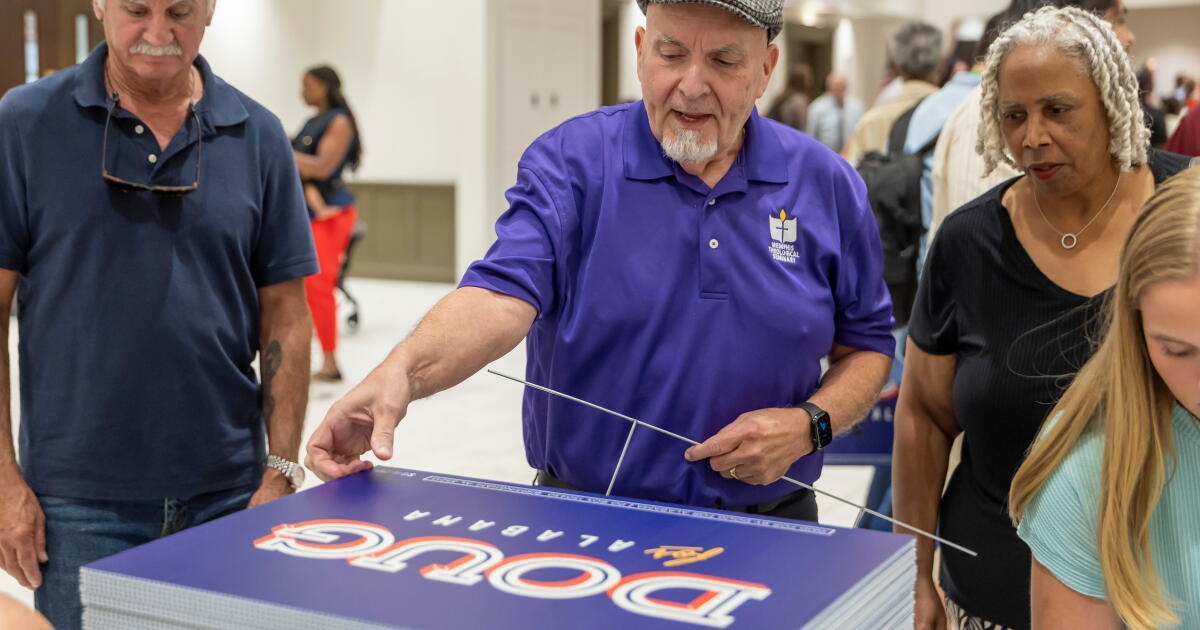
Gwendolyn Davis, a 67-year-old retired special education teacher, left the town hall in Troy with an armful of yard signs for Figures and Jones. She said she is determined to reach people who have been sitting out elections.
“If we don’t get people out to vote, it will be kind of heartbreaking,” she said.
Chandler and Barrow write for the Associated Press. Barrow reported from Atlanta.