billion

KHNP chief visits Czech Republic to review $18 billion nuclear project

Korea Hydro & Nuclear Power CEO Kim Hoe-chun (R4) inspects facilities at Doosan Skoda Power in Plzen on Thursday. He visited the Czech Republic to review progress on a project to build two nuclear reactors in the European country. Photo by KHNP

June 19 (UPI) — Korea Hydro & Nuclear Power, or KHNP, said Thursday that its CEO Kim Hoe-chun has traveled to the Czech Republic to review progress on the construction of two nuclear reactors in the European country.

The state-backed utility noted that Kim took part in a meeting of the Dukovany Steering Committee in Prague alongside South Korea’s Minister of Trade, Industry and Resources Kim Jung-kwan and Czech Deputy Prime Minister Karel Havlicek.

Kim’s visit is timed with the first anniversary of the signing of an $18 billion contract to build two 1,000-megawatt reactors in Dukovany, located around 120 miles southeast of the Czech capital.

Groundbreaking is targeted for 2029, with commercial completion expected by 2037. The South Korean consortium includes such industrial partners as Daewoo E&C and Doosan Enerbility.

The two sides also discussed ways to strengthen bilateral nuclear cooperation, while companies from the two countries signed an engineering support agreement related to the project, according to KHNP.

Kim also toured the manufacturing facilities of Doosan Skoda Power in Plzen, situated roughly 55 miles west of Prague. The Czech turbine manufacturer owned by the Doosan Group is expected to play a key role in the Dukovany program.

“The Dukovany project is a monumental endeavor that symbolizes the strategic partnership between South Korea and the Czech Republic,” Kim said in a statement.

“We will work closely with the Czech government, the project owner, local communities, and Czech companies to make this project a model for the safest and most successful nuclear power plant construction in the world,” he added.

Source link

30 years and $3 billion later, ‘Toy Story’ still Disney’s surest bet

Woody, Buzz Lightyear and Jessie will be back at the box office this weekend, delivering what could be the biggest film debut of the year.

Analysts expect the fifth installment of Disney/Pixar’s “Toy Story” franchise will pull in at least $150 million in the U.S. and Canada, with some predicting as much as $175 million — either of which would set a franchise record, topping the nearly $121-million opening of 2019’s “Toy Story 4.”

A strong showing for “Toy Story 5” will further fuel a recovery of the box office this year from the post-pandemic doldrums.

Domestic ticket sales are up over last year, and Roth Capital Partners forecasts the second quarter will climb 6.5% to $2.8 billion — a post-pandemic high.

“Toy Story 5” is the first of several family tentpoles this summer, ahead of Universal and Illumination’s “Minions & Monsters” and Disney’s live-action “Moana.”

“Right now we’re on pace for the best opening of the year,” said Daniel Loria, editorial director at Box Office Co. “This is a performer.”

The timing also is fortuitous for Walt Disney Co. at a moment when its other once-reliable franchises such as “Star Wars” and Marvel have faltered. The recent “Star Wars: The Mandalorian and Grogu” dropped sharply at the domestic box office after its late-May opening, bested by low-budget horror films “Backrooms” and “Obsession.”

“People love these characters from ‘Toy Story,’ ” said Paul Dergarabedian, head of marketplace trends at Comscore. “It’s just as appealing as ever.”

Indeed, across four films and 30 years, “Toy Story” has grossed more than $3 billion worldwide. It is the most-watched franchise on Disney+, with more than 2 billion hours streamed. Woody, Buzz Lightyear and Jessie have spawned 19 theme park rides, four themed lands, two hotels and roughly $1 billion a year in global retail sales.

The production budget for “Toy Story 5” is about $150 million to $200 million. A crew of about 300 people worked on the film at Pixar’s Emeryville, Calif., headquarters.

For Pixar, the reliance on “Toy Story” reflects a shift away from originals that used to be its lifeblood.

February’s “Hoppers” managed a respectable $372 million worldwide, but the surer money now comes from sequels.

“Inside Out 2” grossed nearly $1.7 billion in 2024, and both “Toy Story 4” and “Toy Story 3” crossed $1 billion globally.

Still, the franchise label is no guarantee: The 2022 spin-off “Lightyear” stalled at $226 million worldwide after straying from the formula, recasting Buzz as an actual sci-fi hero — voiced by Chris Evans rather than Tim Allen — and sidelining Woody and the rest of the gang.

“Toy Story 5” stays closer to home but wades into new territory: the explosion of tech in everyday life. The toys must contend with Lilypad, a tablet that captures the attention of their owner, Bonnie — a premise that grew out of a tech-toy character originally written for “Toy Story 4” and scrapped for time. Disney is betting the underlying tension is universal.

“What parent hasn’t had anxiety over tech versus toys with their kids?” said Andrew Cripps, head of theatrical distribution for Walt Disney Studios.

Disney is betting that this universal concern will drive audiences to the film.

The fifth installment also arrives with an unusually high-wattage assist: Taylor Swift wrote and performed an original song, “I Knew It, I Knew You,” and made a surprise appearance at last week’s premiere, performing it after the credits before joining longtime franchise composer Randy Newman for “You’ve Got a Friend in Me.”

“It means the world to me to be a small part of the universe of these films,” Swift told the crowd.

The expected blockbuster opening for “Toy Story 5” would be a full-circle moment for the long-standing franchise; Pixar animators in 1995 hadn’t even considered the possibility of a sequel while working on the first “Toy Story.”

“There was so much learned on that first film, specifically our iterative process,” Pixar Chief Creative Officer Pete Docter said in a phone call last week from Madrid, shortly before the film’s Spain premiere. “A lot of things that we discovered having worked on that film have just continued to inform every movie that we make.”

“Toy Story” revolutionized the movie business as the first computer-animated feature film. But its enduring appeal was in the bonds between the characters, Docter said.

Docter, who supervised animators and helped with character design and writing on the original “Toy Story,” added: “It certainly had some new technology, but it was really up to the story and characters to carry the audience.”

The franchise’s longevity is also due to its ability to capture generations of fans.

“Having parents now that say, ‘I grew up with “Toy Story,” and now I’m showing my kids,’ has been really gratifying,” Docter said.

Source link

Fox Corp. to buy streaming platform Roku for $22 billion

Fox Corporation has agreed to acquire the streaming platform Roku Inc. in a deal valued at $22 billion, the companies announced Monday.

The deal will combine the Murdoch family’s media assets, which include its news, sports and broadcast channels, with the San Jose-based streaming platform that reaches 100 million consumers globally.

The acquisition would give Fox access to consumer households at a time when the traditional pay-TV universe continues its slow decline as viewers move away from cable and satellite services to video streaming. Fox already owns the free ad-supported streaming service Tubi, which recently became profitable.

“This is a defining moment for Fox and a natural extension of the deliberate and focused strategy we have been executing for nearly a decade,” Fox Corp. Executive Chair Lachlan Murdoch said in a statement.

By owning Roku, Fox gets access to data from the 100 million households connected to the service, which can be used to better target audiences with advertising. The combination would also make Fox less dependent on traditional pay TV platforms for the distribution of its channels.

According to Nielsen data, 21% of all internet-connected TV viewing comes through Roku. The Roku Channel, which carries 500 ad-supported streaming networks, accounts for 3% of all TV viewing.

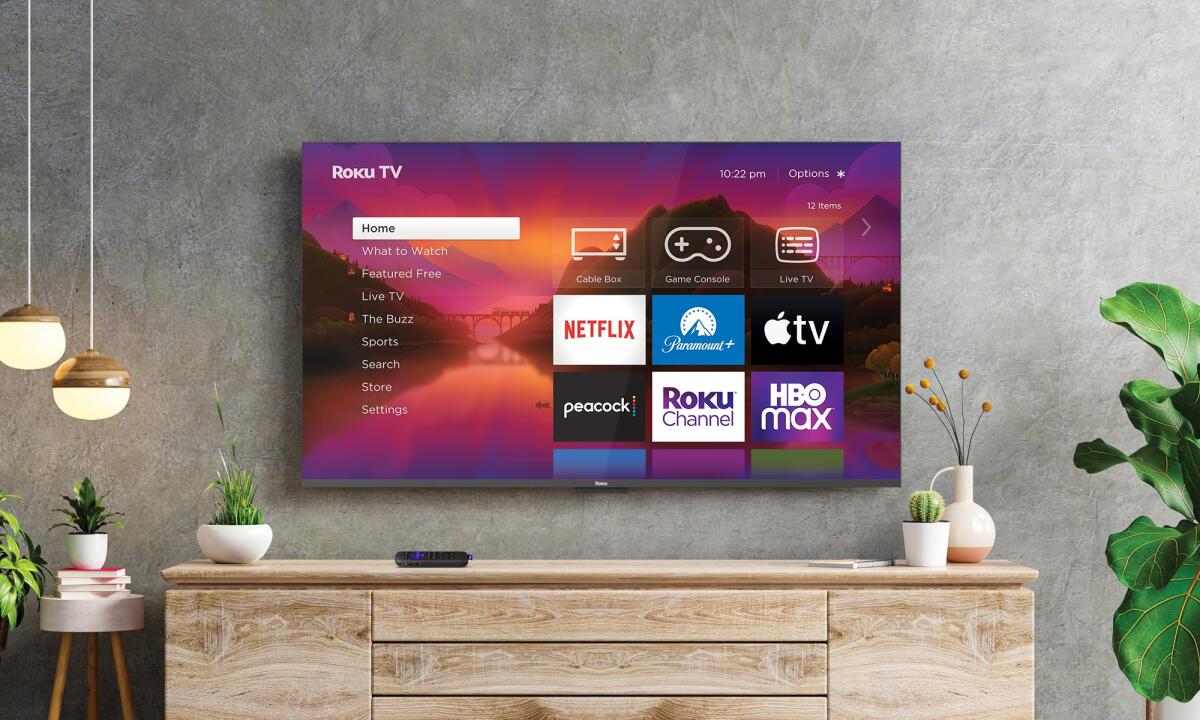
An image of a Roku branded TV.

An image of a Roku branded TV.

(Roku)

Research firm Emarketer projects ad revenues of $3.57 billion for Roku this year, up 19% from last year.

Lloyd Grief, chief executive of the Los Angeles investment bank Greif & Co., said Roku would have been challenged to compete against far better capitalized competitors in the streaming business and that a sale was “inevitable.”

For Fox, the proposed deal makes them a larger player in the digital advertising business. Emarketer senior analyst Ross Benes said the Roku business will “more than double,” the company’s revenues in that area.

“It remains to be seen how well the combination of a digitally innovating streaming company will mesh with a media conglomerate rooted in legacy assets,” Benes said.. “But the strategy makes sense and it jibes with the continual consolidation that’s occurring in streaming.”

Fox sold its TV and movie production assets to Walt Disney Co. in 2018. Rather than invest heavily in scripted entertainment to compete with emerging streaming companies, Fox decided to concentrate on sports and news.

The Roku deal will put Fox deeper into the distribution network. Over its history, the company has held stakes in satellite TV provider DirecTV and Sky TV.

The companies said they are committed to keeping Roku as a “partner-friendly” platform that carries program services that compete with Fox. Brian Wieser, a consultant at Madison and Wall said that might require some convincing.

“Other content owners may still need Roku’s distribution, but they may be less comfortable with the idea that one of their competitors controls an increasingly important part of the streaming interface,” Wieser wrote in his note on the proposed deal.

Roku shareholders will receive a combination of cash and Fox Corporation stock valued at $160 a share.

The companies say they expect cost savings of $400 million in the combined entity.

Roku was founded in 2002 by Anthony Wood, a British digital entrepreneur. The company launched a streaming device, the Roku player, in 2008. Within six years, the company sold more than 10 million devices, as the popularity of streaming video rapidly grew.

Fox Corp. shares were down 10 to 15% on news of the deal, trading around $55.57 Monday morning. Roku shares were down slightly to $142.

Times staff writer Wendy Lee contributed to this report.

Source link

Judge extends block on Trump’s $1.8 billion ‘Anti-Weaponization Fund’

A federal judge agreed on Friday to extend a court-ordered block on the Trump administration’s creation and operation of a $1.8 billion settlement fund for compensating people who claim to be victims of a weaponized government.

Earlier this month, acting Atty. Gen. Todd Blanche told Congress that the government is scrapping its plans for the fund in the face of a fierce bipartisan backlash. Government attorneys have argued that lawsuits challenging the fund are now moot, but plaintiffs’ attorneys aren’t satisfied by Blanche’s assurances that the fund won’t move forward.

Neither was U.S. District Judge Leonie Brinkema, who ruled that the “Anti-Weaponization Fund” will remain blocked until further notice from the court.

“The (government’s) mootness argument, in my view, doesn’t go anywhere,” the judge said.

President Trump, meanwhile, has not publicly and unequivocally endorsed its cancellation. He has continued to express support for the fund in remarks to reporters.

Brinkema gave the parties a week to negotiate an agreement for Blanche to submit a sworn declaration that the administration won’t revive the fund.

Brinkema previously agreed to temporarily block the administration from proceeding with the fund for at least two weeks. Her May 29 order was due to expire on Friday.

Trump’s Republican administration created the fund to resolve his lawsuit against the Internal Revenue Service over the leak of his tax returns.

Plaintiffs who sued to block fund payouts argue that the government can’t legally divert taxpayer money into what they argue is a slush fund for compensating Trump’s allies.

In a separate case on Wednesday, a different judge in Washington, D.C., rejected a government watchdog’s parallel request for a court order temporarily blocking the Trump administration from forging ahead with the fund. U.S. District Judge Richard Leon said he accepts Blanche’s representation that the fund is now moot.

Leon had asked Justice Department attorney Andrew Block why Blanche doesn’t formally rescind his May 18 order establishing the fund. Block said he didn’t know. He still didn’t have an answer to that question when Brinkema posed it two days later.

“It’s a huge gap in the record that we don’t have an answer to that question,” the judge said.

In the Virginia case, attorneys from the legal advocacy group Democracy Forward asked for an order to temporarily suspend the fund’s implementation and stop the Trump administration from disbursing any payouts from it.

The plaintiffs include a fired prosecutor and a college professor acquitted of assaulting federal agents at a protest.

Even before the administration said it was dropping the fund, the Justice Department did not form the five-member commission that would decide on payout criteria, so no money was paid out nor claims accepted.

Many of the Republican president’s allies are opposed to compensating rioters who stormed the U.S. Capitol on Jan. 6, 2021. In May, however, Blanche wouldn’t rule out the possibility that Capitol rioters who engaged could be eligible to apply for payments from the fund.

Trump issued mass pardons to Capitol rioters on his first day back in the White House last year. More than 1,500 people were charged in the Jan. 6 attack before Trump erased every case with his sweeping act of clemency.

Brinkema was nominated to the bench by President Clinton, a Democrat.

Kunzelman writes for the Associated Press.

Source link

Trade turnover in Eurasian Economic Union exceeds €80 billion last year

Eurasian Economic Union (EAEU) countries are moving towards deeper economic integration through digitisation and AI, as leaders of the bloc met in Astana for a two-day summit.


ADVERTISEMENT


ADVERTISEMENT

During the high-level talks, member states discussed creating a unified digital environment to build a seamless market across a shared economic space of more than 20 million square kilometres.

Delegations focused on trade, joint projects and the development of shared digital tools and AI systems designed to strengthen cooperation and reduce fragmentation across the bloc.

Last year, trade within the union more than doubled, while turnover with third countries rose by 72%, while around 90% of settlements are now conducted in national currencies, as EAEU states also mull a single transit system.

With digitisation driving developments across the union, Kazakhstan’s President Kassym-Jomart Tokayev said trade turnover between EAEU members could increase by around 6%, exceeding €85 billion this year, compared with €80 billion last year.

He added that GDP growth across EAEU countries is projected at around 2.5% for 2026–2027.

Now in its 12th year, the EAEU functions as a single integrated market and free trade zone for its five members – Russia, Belarus, Kazakhstan, Kyrgyzstan and Armenia.

The bloc already has agreements in place with a number of countries including Serbia, Vietnam, the UAE, Mongolia and Indonesia. China remains the bloc’s key partner, accounting for around one-third of external trade.

Integration through AI

Kazakhstan’s Tokayev said that during its chairmanship of the EAEU, the country has proposed the practical use of AI to help implement the bloc’s so-called four freedoms, with the aim of strengthening the competitiveness of member states.

Member states also proposed developing common principles for the responsible use of AI, as well as shared computing capacity and joint model development.

Meanwhile, Russia proposed a high-level AI get-together next year to further cooperation on domestic AI models and connecting its IT and energy infrastructure, according to Russian President Vladimir Putin.

On the ground, pilot projects are already being tested at the EAEU level.

In Kazakhstan, several AI-powered digital assistants have been developed by both government agencies and startups to help citizens navigate legal and regulatory systems more easily.

According to Deputy Minister of Artificial Intelligence and Digital Development Dmitry Mun, these AI legal assistants are designed to simplify legislation, reduce bureaucracy, and make regulatory systems more accessible for citizens and businesses.

Some of these tools are now being tested to streamline processes across member states.

Trade corridors and logistics modernisation

Around 85% of goods travelling from China to Europe are routed through the Middle Corridor, according to officials.

Artificial intelligence is increasingly being deployed alongside the TDN and the Digital Transport Corridor along the Trans-Caspian International Transport Route. Together, these measures are expected to increase non-commodity exports by around 30% over the next two years.

Kazakhstan’s Minister of Trade and Integration Arman Shakkaliyev said the country also aims to leverage major transport routes, including the Middle Corridor and the North–South Corridor, to build a fully integrated logistics ecosystem.

The goal, he said, is to position Kazakhstan as a key regional hub where transport routes converge and large export flows are consolidated.

The ambition is to develop a fully functioning system by 2030, with cargo volumes reaching around 10 million tonnes. Work is already under way, including railway modernisation and new infrastructure development.

Putin visit and bilateral agreements

The summit followed Putin’s state visit to Kazakhstan, during which the two countries signed seven key pillars of bilateral cooperation, along with a broader package of agreements covering energy, transport, finance, education and industrial development.

Russia remains Kazakhstan’s largest investor, with nearly €25 billion already invested and plans to increase that figure further. It is also building Kazakhstan’s first nuclear power plant, valued at around €14 billion.

Putin said the plant would account for around 20% of Kazakhstan’s electricity consumption, adding that financing conditions for such projects are in line with international practice.

He noted that the project supports Russian industrial capacity through equipment orders and long-term maintenance contracts, while also strengthening cooperation between the two countries in uranium and nuclear technology.

For Kazakhstan, officials say the project represents both energy security and a step towards moving beyond raw-material exports to high-value technological cooperation.
Source link

Finnish smart ring maker Oura plans IPO at over €9 billion as wearable market heats up

Published on

Oura, the Finnish company that created the ring-shaped health tracker worn by millions worldwide, has confidentially submitted draft paperwork to the US Securities and Exchange Commission for a proposed IPO, according to several reports.


ADVERTISEMENT


ADVERTISEMENT

While the number of shares and the expected price range remain undisclosed, the company had a recent funding round in the fall of 2025 that valued the business at around $11 billion (€9.5bn), more than double the $5 billion (€4.3bn) valuation it earned in a previous round in 2024.

According to CEO Tom Hale, more than 5.5 million Oura rings had been sold up to the end of last year’s third quarter.

At the time, Hale also projected that the company would reach $2 billion (€1.7bn) in annual revenue in 2026 compared with $500 million (€430mn) just two years ago.

The move towards an IPO puts a European wearable brand on Wall Street’s radar at a time when investor appetite for consumer health technology appears to be returning.

Oura has become a standout name in the fast-growing smart ring category, competing against smartwatch giants such as Apple, Garmin and Samsung, while carving out a niche with a distinct piece of hardware that some consumers find less obtrusive.

Over the past two years, the company has expanded aggressively into software, subscriptions and AI-powered health analysis. Its wearable platform now focuses on long-term health signals including sleep, readiness, heart rate, stress and recovery.

More recently, Oura has pushed further into women’s health and AI-based personal coaching, including tools designed to interpret physiological data and provide tailored wellness recommendations.

Analysts see that transition from device maker to subscripton-based health platform as central to its IPO pitch as the firm is currently on pace to surpass 5 million paid members.

A European tech champion heading to US markets

The IPO filing marks a significant moment for one of Europe’s most prominent health tech success stories.

Founded in Finland and developed around research into sleep, recovery and biometric monitoring, Oura has grown from a Nordic hardware start-up into a global player in the wearable market.

However, for Europe’s start-up ecosystem, Oura’s planned listing carries broader significance.

While its roots and design philosophy are deeply tied to Finland, the company recently transitioned to a US-based parent company, named Oura Inc. and headquartered in San Francisco, to access American venture capital while keeping its European operations.

Its decision to prepare for a US listing rather than a European one reflects a wider pattern among high-growth European tech firms seeking deeper capital markets and greater visibility among global investors.

The planned flotation arrives during renewed debate over whether Europe is losing some of its most successful technology companies to US exchanges.

Oura joins a growing list of European-founded businesses choosing Wall Street as their route to public markets, drawn by scale, liquidity and stronger investor familiarity with consumer technology.

The company’s IPO will also be seen as a test of investor sentiment towards wearable technology after a mixed few years for the sector.

Unlike smartwatches, smart rings remain a relatively young category, though interest has accelerated rapidly.

Oura is widely viewed as the segment’s category leader and its public debut could offer a clearer benchmark for how markets value next-generation health hardware combined with software subscriptions and AI services.

Source link