Eagle Rock residents push back against bus lane on Colorado Boulevard
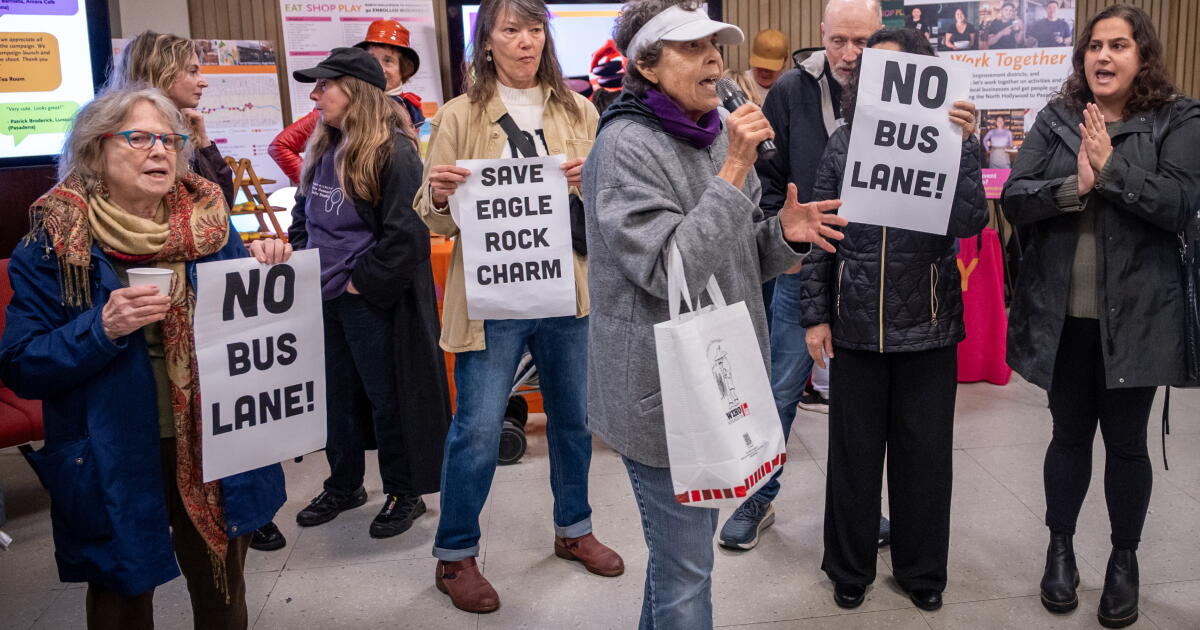
Carrying signs proclaiming “No Bus Lane!,” Eagle Rock residents swarmed a public meeting Thursday night to push back on plans to create a dedicated busway through their community’s business district.
The bus lane route along Colorado Boulevard is part of L.A. Metro’s plan to link the San Fernando and San Gabriel valleys by 19 miles of dedicated roadway for buses. But in Eagle Rock, it will mean the loss of a vehicle traffic lane, multiple left-turn lanes and some street parking.
“I want there to be buses and I want there to be bike lanes. But I also want our street to feel liveable for a local community,” said longtime resident Amber Sealey, who attended the community meeting on the project at Occidental College. “I don’t want our main street to feel like a freeway, which is what it’s going to feel like.”
Sealey and other opponents want Metro to instead create shared lanes between buses and vehicles. They pressed Los Angeles City Councilmember Ysabel Jurado, who represents the area, to push for safety mitigation efforts.
“We’re for public transit — I’m for public transit. But just because we’re supportive of it, it doesn’t mean it should get a blank check. And at this moment in time, we’ve been pushing for more transparency on the schedule and the timeline,” Jurado said Thursday. “What are the street improvements and what’s that schedule going to be? Because it is going to interrupt this community and the small businesses.”
The plan to connect North Hollywood, Burbank, Glendale, Eagle Rock and Pasadena via rapid bus is one of multiple Metro projects that would significantly expand public transit ahead of the 2028 Olympics in areas where access is limited. The route will use the freeway in some parts and fluctuate between bus-only lanes and lanes shared between buses and vehicle traffic.
In Eagle Rock, one existing lane will become a dedicated bus lane along a roughly 1.2-mile stretch through the area’s main drag. That portion on Colorado Boulevard’s Historic Route 66 is surrounded by residential neighborhoods to the north and south without any major thoroughfares that run parallel to it.
Construction of the bus route along Colorado Boulevard was supposed to begin this fall. Work is now expected to start in January and last for roughly 16 months.
Terryn Westbrook was one of several Eagle Rock residents who complained that residents have been kept in the dark about the busway plans.
“I support the bus, I ride the bus, I like public transit,” she said. “But what’s happening here is that we all got this project shoved down our throats and it’s just underway.”
Carol Allen, another longtime resident of the area, said in a telephone interview with The Times that she regularly rides the bus to Glendale and Pasadena. She said that she benefits from public transit, but she believes the current plans will make traffic worse and inundate surrounding roads like hers with congestion when multiple left-hand turn options are eliminated, making her street one of the few to receive that traffic, and street parking is reduced in an area that has one public parking lot.
“It all seems like we’re being used as basically an experiment for the rest of L.A.,” Allen said.
There is often a push and pull with projects that intend to improve public transit in sprawling areas like L.A. County while also disrupting neighborhood ecosystems.
Joshua Schank, a partner with transportation strategic advisory firm InfraStrategies and former chief innovation officer of Metro, said a dedicated lane may cause extra traffic for some, but could significantly benefit others.
“A lot of the people on the bus are not necessarily going just to and from that community. They’re going to other places in the region, and every time you have them in mixed traffic, you’re slowing that trip down substantially,” he said.
“There are a lot more people, and a lot lower income people, who are on the bus needing to get to places than there are people who desperately need that extra lane of traffic,” Schank said. “Drivers generally have access to far more places in a far shorter period of time than transit users in Los Angeles.”
The $429-million project is funded largely through Measure M — a sales tax that voters approved in 2016 to invest billions of dollars into transit projects. According to Metro, a trip along the entire route would take about 66 minutes — far less than existing transit options. Zero-emission electric buses would also be used.
Initial outreach about the route started in 2018 and the Metro board of directors approved it in 2022, an action that Metro told The Times “defined the project scope and defined the [bus rapid transit] route.”
Those who support the project say they have been aware of plans from the beginning. The neighborhood has not been in the dark, Eagle Rock resident Andrew Jacobs said at Thursday’s meeting.
“This has been an ongoing process,” Jacobs said. “Will traffic get a little bit worse? It’s possible. But I also think I don’t know what the alternative is. We have to build better, faster public transportation because traffic is only going to keep getting worse year after year and it’s not a solution to do nothing.”
Metro has had multiple virtual community meetings about the project and officials said that public input helped shape the plans. But many residents in the small enclave of the city have felt ignored as they have asked for clarity over the route design, believing that leadership in Eagle Rock was distracted when the project was being developed.
Previous councilmembers who represented Eagle Rock include Jose Huizar, who was convicted on corruption and bribery schemes, and Kevin de León, who lost his bid for reelection after being one of the city councilmembers caught on tape making racist comments.
Jurado took office at the end of 2024. She said that for months, she has regularly met with Metro to advocate for the community.
She recently met with a handful of community members and representatives from Metro and from the mayor’s office over Zoom about the project. Mayor Karen Bass is the current chair of Metro. The last meeting that she chairs before leaving office occurs next month. Then, Mayor-elect Nithya Raman will take over. Raman is a staunch supporter of public transit and has supported bus lane expansion projects.
During the meeting, Jurado questioned whether SB 79 — recently passed legislation that would allow multifamily and multiunit housing developments to be built near certain transit corridors — could be triggered by the bus route. It’s a question others in the community have raised too.
“The implications depend on the property and local implementation rules; eligibility does not mean a development has been approved,” Jurado told The Times. “Residents deserve clarity about those possibilities, with affordability and protections against displacement central to the conversation.”
Metro said it’s currently working to secure “approvals from the City on Metro’s final design and traffic control packages” while coordinating construction permits.
There’s been pushback elsewhere on the route too. Burbank, for instance, has also pushed for a mixed-flow route, where buses and vehicles share lanes. That is the case for Pasadena, where construction is underway on the project.
Nadine Levyfield is a lifelong resident of Eagle Rock who lives on the same property she grew up on. She is not opposed to a bus route, but has questioned the decision not to implement a multi-flow option in Eagle Rock too.
She also wants assurance that speed humps or other efforts to alleviate congestion will be in place for streets that will absorb more traffic — before construction begins.
“We want kids to be safe,” she said. “Yes, we don’t like the design, and we’re worried about traffic. But the No. 1 thing here is the safety.”