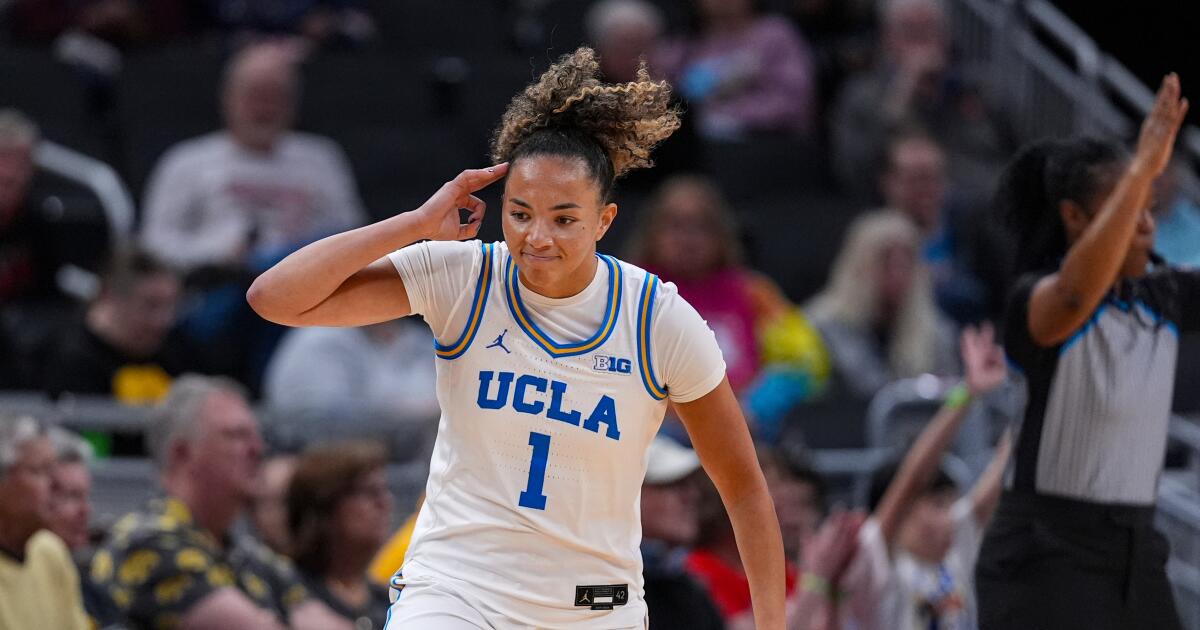
On his bobblehead night and 31st birthday, Smith delivered a two-run home run in the eighth inning as the Dodgers swept their season-opening series against the Arizona Diamondbacks with a 3-2 victory Saturday at Dodger Stadium.
Cue an aerial shot of the Hollywood sign.
“When you talk about big hits, clutch, Will’s right at the top of the list,” manager Dave Roberts said.
Roberts originally planned to sit Smith. The catcher played in the first two games of the series, and an off day on Sunday would have given him two straight days of rest early in a grueling season.
“We always talk about stuff,” Smith said. “He was going to give me the day off, I just kind of dropped the bobblehead card [for Saturday] and he let me in there.”
A key edit to the script.
Roberts made a few tweaks to the lineup ahead of the Dodgers facing a left-handed starter for the first time this season. Against Eduardo Rodriguez, Roberts swapped first baseman Freddie Freeman and Smith in the batting order; Smith hit fourth and Freeman fifth.
Santiago Espinal also made his Dodgers debut, starting at third base. Roberts said it wouldn’t be a platoon between Espinal and Max Muncy at third, but he wasn’t sure exactly how the playing-time split would play out.
For the first five innings, no one on the Dodgers did much on offense, except for Freeman.
Freeman went hitless in the first two games of the series despite making hard contact. But he had three hits in four at-bats Saturday, including a double in the sixth inning that drove in the Dodgers’ first run.
“Definitely nice to get off the barrel on the first one and hit a flare up the middle,” Freeman said. “And obviously once you get one, you can just kind of rest easy. And then they played the shift on my third hit, and that was nice, because then I was able to stay on the fastball and hit it to left field down the line.”
That hit cut the Diamondbacks’ lead to one run, thanks to a strong showing from the Dodgers’ pitching staff.
Dodgers pitcher Tyler Glasnow delivers during the first inning against the Diamondbacks on Saturday.
(Gina Ferazzi / Los Angeles Times)
Tyler Glasnow turned in a quality start. Holding the Diamondbacks to two runs over six innings, Glasnow used his curveball as his putaway pitch against right-handed hitters, and two-strike sinkers kept left-handed batters off balance, especially deeper into his start. Glasnow recorded six strikeouts.
The Dodgers’ bullpen continued its scoreless streak for the series, as Alex Vesia, Will Klein and Edwin Díaz shut down the Diamondbacks through the last three innings.
For the second straight night, Díaz entered to a live rendition of Timmy Trumpet’s “Narco,” performed by trumpet player Tatiana Tate.
“When Edwin comes in the game, that means something good’s happening for the Dodgers,” Freeman said. “So I’m a fan.”
Although the Dodgers’ offense was quieter than in their other wins of the series, their lineup again proved to be pesky. In all three games, they fell behind 2-0. In all three, they won.
Dodgers catcher Will Smith, left, celebrates with Tesocar Hernández after hitting a two-run home run in the eighth inning Saturday.
(Gina Ferazzi / Los Angeles Times)
With two outs in the bottom of the eighth inning Saturday, Mookie Betts drew a walk. Then Smith worked a 2-2 count, fouling off three fastballs before he was right on time for one at the top of the strike zone.
“We never feel like we’re out of it,” Smith said. “We keep taking good at-bats, keep believing in each other, keep believing that someone’s going to come up with a big hit.”
On Saturday, it was destined to be Smith.
“Birthday and bobblehead day,” Glasnow said, “It was a magical night.”
Roll credits.
Injury updates
Dodgers utility players Tommy Edman (right ankle surgery recovery) and Kiké Hernández (left elbow surgery recovery) took early batting practice on the field Saturday afternoon.
Roberts has said he expected Edman, on the 10-day injured list, will be an option by at least the end of May. Hernández will be eligible to be activated off the 60-day IL around the same time.
“I’d be shocked if [Hernández] wasn’t ready when that time is up,” Roberts said. “Taking grounders, the way he’s moving, the way he’s throwing, catching, the swing, ball coming off the bat. If I didn’t know any better, I’d think he was in the lineup tonight.”
WASHINGTON — In a case that echoes the Jack Abramoff influence-peddling scandal, two Northern California Republican congressmen used their official positions to try to stop a federal investigation of a wealthy Texas businessman who provided them with political contributions.
Reps. John T. Doolittle and Richard W. Pombo joined forces with former House Majority Leader Tom DeLay of Texas to oppose an investigation by federal banking regulators into the affairs of Houston millionaire Charles Hurwitz, documents recently obtained by The Times show. The Federal Deposit Insurance Corp. was seeking $300 million from Hurwitz for his role in the collapse of a Texas savings and loan that cost taxpayers $1.6 billion.
The investigation was ultimately dropped.
The effort to help Hurwitz began in 1999 when DeLay wrote a letter to the chairman of the FDIC denouncing the investigation of Hurwitz as a “form of harassment and deceit on the part of government employees.” When the FDIC persisted, Doolittle and Pombo — both considered proteges of DeLay — used their power as members of the House Resources Committee to subpoena the agency’s confidential records on the case, including details of the evidence FDIC investigators had compiled on Hurwitz.
Then, in 2001, the two congressmen inserted many of the sensitive documents into the Congressional Record, making them public and accessible to Hurwitz’s lawyers, a move that FDIC officials said damaged the government’s ability to pursue the banker.
The FDIC’s chief spokesman characterized what Doolittle and Pombo did as “a seamy abuse of the legislative process.” But soon afterward, in 2002, the FDIC dropped its case against Hurwitz, who had owned a controlling interest in the United Savings Assn. of Texas. United Savings’ failure was one of the worst of the S&L; debacles in the 1980s.
Doolittle and Pombo did not respond to requests for interviews last week. They publicly defended Hurwitz at the time, saying the inquiry was unfair. Hurwitz’s lawyer said Friday that the FDIC had been overzealous. This summer, a judge in Texas agreed and awarded Hurwitz attorney fees and other costs in a civil suit he filed. “They sought to humiliate him,” U.S. District Judge Lynn N. Hughes, said in the ruling. The government is appealing the decision.
In key aspects, the Hurwitz case follows the pattern of the Abramoff scandal: members of Congress using their offices to do favors for a politically well-connected individual who, in turn, supplies them with campaign funds. Although Washington politicians frequently try to help important constituents and contributors, it is unusual for members of Congress to take direct steps to stymie an ongoing investigation by an agency such as the FDIC.
And the actions of the two Californians reflect DeLay’s broad strategy of cementing relationships with individuals, business interests and lobbyists whose financial support enabled Republicans to extend their grip on Congress and on government agencies as well. The system DeLay developed and Abramoff took part in went beyond simple quid pro quo; it mobilized whatever GOP resources were available to help those who could help the party.
In the Hurwitz case, Doolittle and Pombo were in a position to pressure the FDIC and did so. Pombo received a modest campaign contribution. In another case, Pombo helped one of Abramoff’s clients, the Mashpee Indians in Massachusetts, gain official recognition as a tribe; the congressman received contributions from the lobbyist and the tribe in that instance.
Andrew Wheat, research director for Texans for Public Justice, a nonpartisan electoral reform group based in Austin, put it this way: “DeLay and Hurwitz seem like natural allies in that they have geographic and ideological proximity. Mr. Hurwitz is a guy who has a reputation of being willing to pay to play. And DeLay likes to play that game too, so there’s a natural affinity.”
DeLay announced Saturday that he was giving up his efforts to regain the majority leader position. He was majority whip when he first became involved in helping Hurwitz.
In the Abramoff scandal, members of Congress allegedly did favors for the politically connected lobbyist’s clients — including Indian casinos — and received campaign contributions and lavish free entertainment. Last week, the lobbyist pleaded guilty in separate cases in Miami and Washington in a deal that government investigators hope will lead to more prosecutions. Others involved have also made deals to cooperate, and Washington is braced for new criminal charges to come.
The episode involving Hurwitz and the two California congressmen took place with little public notice just before the Abramoff scandal began to escalate. The Sacramento Bee published a story when Doolittle inserted FDIC investigative documents into the Congressional Record, noting that it occurred at a time when Congress was distracted by the Sept. 11 terrorist attacks and the anthrax episode.
But what lay behind Doolittle’s action, and the actions of Pombo and DeLay, did not become clear until recently, when the government documents and copies of letters between the congressmen and FDIC officials were obtained by The Times.
J. Kent Friedman, the general counsel for Hurwitz’s vast Houston-based holding company, said last week that the FDIC was overzealous in its dealings with his boss.
“Their case was weak from the start. They had a terrible case,” Friedman said. He said anyone trying to connect the congressmen to the fact that the case fell apart would be “attempting to put a bow on a pig.”
The Texas S&L; in which Hurwitz held a controlling interest of about 25% collapsed in 1988 as part of a financial fiasco that took federal regulators years to untangle. The investigation of Hurwitz began in 1995 and continued for about seven years before it was dropped.
After DeLay’s 1999 letter attacking the investigation failed to dissuade the FDIC, Doolittle weighed in with a statement on the House floor in 2001, saying the FDIC investigators were “clearly out of control” and should have “dropped the case, period.”
Pombo, in his own 2001 floor statement, suggested that the banking regulators were using strong-arm methods against Hurwitz, or what Pombo called “tools equivalent to the Cosa Nostra — a mafia tactic.”
Doolittle, 55, an eight-term congressman, represents California’s fourth district, the Sierra Foothills region and the eastern suburbs of Sacramento. He has a consistent conservative voting record, opposing gun control and abortion and siding with property rights, timber and utility interests against environmental groups.
By 2000, he had grown close to DeLay, working with the Republican leader to oppose proposed changes to campaign finance law and restrictions on fundraising. When DeLay was indicted in Texas last year, Doolittle distributed about 100 lapel pins in the shape of tiny hammers as a tribute to the man nicknamed the “Hammer” for his ability to pound congressional Republicans into line.
Doolittle also was closely aligned with Abramoff. Records show that Abramoff gave Doolittle tens of thousands of dollars in contributions and employed the congressman’s wife for other fundraising activities.
Pombo, the son of cattle ranchers, plays up his cowboy roots, often appearing in his district wearing a ranch-hand’s hat and ostrich-skin boots. Forty-five years old, a seven-term congressman, he represents the fertile farming expanse of the Central Valley.
He had impressed DeLay with his fundraising prowess, garnering about $1 million for his 2002 House reelection, which he won easily.
And not long after his role in helping Hurwitz, the GOP House caucus — led by DeLay — helped get Pombo elected chairman of the Resources Committee over several more senior Republicans.
Hurwitz has been a prolific campaign donor since the early 1990s.
He has contributed personally and with funds provided by his Houston-based flagship company, Maxxam Inc., through subsidiaries such as Kaiser Aluminum, and through a company political action committee, Maxxam Inc. Federal PAC.
In the last three federal elections cycles, those entities have given about $443,000 in political contributions — most of it to conservative politicians, including President Bush, for whom Hurwitz pledged to raise $100,000 in the 2000 campaign and also helped during that year’s vote tally deadlock in Florida.
Hurwitz has been generous with DeLay too.
Starting in the 2000 election cycle, the businessman and his committees have distributed at least $30,000 to DeLay and his federal causes, including $5,000 for his current legal defense fund in the Texas money-laundering case.
Hurwitz also contributed $1,000 to Pombo for his 1996 reelection campaign. And through the Maxxam PAC, Hurwitz gave Doolittle $5,000 for his 2002 reelection campaign and then followed up with $2,000 more for his 2004 race.
When DeLay went to bat for Hurwitz, he was particularly critical of reported internal government discussions that would have pressed Hurwitz to settle his obligations for the collapsed S&L; by selling the government vast forest areas and redwood trees in Northern California near Scotia. The forest land was owned by Hurwitz’s Pacific Lumber company
“I am extremely concerned,” DeLay told then-FDIC Chairwoman Donna A. Tanoue, “about the apparent abuse of governmental power and what appears to be misconduct in the form of harassment and deceit on the part of government employees.”
Tanoue responded by telling DeLay “we can assure you that the FDIC lawsuit against Mr. Hurwitz was not filed for political reasons.”
The investigation pressed on, and a year later the House Resources Committee, which had jurisdiction because of the forest area, set up a special Headwaters Forest Task Force and launched its own review. Doolittle was appointed task force chairman, and Pombo one of its members.
Duane Gibson, the committee’s general counsel who later went to work for Abramoff, was named the chief investigator. They immediately subpoenaed internal records from the FDIC and the Office of Thrift Supervision, which also had responsibilities for S&Ls.;
Both agencies were wary and, although complying with the subpoenas, repeatedly urged the lawmakers not to make the documents public or share them with Hurwitz.
William F. Kroener III, general counsel at the FDIC, warned the committee that Hurwitz and his lawyers were not entitled to see many of the documents.
Kroener told the panel that, should the material end up in their hands, it “could significantly injure our ability to litigate this matter and reduce damages otherwise recoverable to reimburse taxpayers.”
Carolyn J. Buck, chief counsel at the Office of Thrift Supervision, also wrote the committee emphasizing that “we note our objection to any publication or release of these documents.”
The task force was set up for six months, and disbanded in December 2000. It held one hearing, and called FDIC and Office of Thrift Supervision officials as witnesses.
At that hearing, Tanoue defended the FDIC’s investigation.
“I have listened to and considered the arguments made directly to me by representatives of Mr. Hurwitz,” she testified. “However, I have found no compelling reason to take the extraordinary step of … taking this case out of the hands of the judicial system.”
Kroener testified that the FDIC was not interested in a trees-for-debt swap, saying his agency “has expressed its preference for a cash settlement.”
Six months later, in June 2001, Pombo submitted a portion of the subpoenaed documents that filled 14 pages in the Congressional Record.
Six months after that, in December 2001, Doolittle did the same, even though he was no longer a member of the committee. And his submission was much larger — filling 111 pages.
The documents were so voluminous that Doolittle and Pombo had to pay a total of about $20,000 from their congressional accounts to cover the extra printing costs.
The FDIC was outraged over the documents’ release.
Its chief spokesman, Phil Battey, said in a statement to the Sacramento Bee at the time that the publication of the materials was a “subordination … and a seamy abuse of the legislative process.”
Not long afterward, the FDIC dismissed its case, and the Office of Thrift Supervision settled with Hurwitz for about $200,000 in administrative costs.
*
Times staff writer Ted Rohrlich contributed to this report.
FOR Dermot Kennedy’s third album, he wanted to explore both the beauty and burden of a successful music career.
The award-winning Irish singer might headline huge arenas but he has always had his feet firmly on the ground, valuing a normal life, privacy and simple things such as walking in his local woods — the theme of his new record.
Sign up for the Showbiz newsletter
Thank you!
Dermot Kennedy says a lot of songs from his new album, The Weight of the Woods, carry a ‘vulnerability’ he has not previously shownCredit: SuppliedKennedy says it’s better for him to ‘sit back and let the music do the work’Credit: Supplied
He says: “I feel I’m at a sweet spot, because I can play The O2 in London but I can walk around all day and no one really knows who I am.
“Having a career in music is a blessing. It’s the most amazing thing, but at the same time, there are certain challenges that come with it. It tests relationships and tests your own resolve, it’s a pressure. And I wanted to write about that.”
The pull of nature as a place to reset became more powerful to the singer as he found success — both his previous collections, Without Fear (2019) and Sonder (2022), topped the album chart.
“With a career in music, you’re not anonymous, you’re constantly moving from city to city,” he explains.
“Being somewhere where you can only see trees in every direction has become more and more important to me, and more powerful. Where I live is quite remote, and that’s the way I want to be.”
This recurring woodland imagery reflects a sense of calm and nostalgia to Kennedy, and the cover of his new album, The Weight Of The Woods, features the singer in a woodland setting.
As we chat in his central London record label offices, he’s signing a huge pile of his new CDs.
“It’s a great album cover,” he says smiling. “Even signing these all morning, I’m not sick of looking at it yet.”
A standout on Kennedy’s new record is the track Sycamore, a gorgeous introspective ode to home and identity.
“The Irish landscape has always been important to me,” he says. “Where we took the picture for the album still resonates. It’s a big part of how I’m inspired.”
Working with producer Gabe Simon — who produced Noah Kahan’s 2022 breakthrough album, Stick Season — Kennedy made The Weight Of The Woods in Ireland, Nashville and Norway.
He says: “Sycamore is lush and smooth, which felt different for me. It was the first song we made when Gabe came over — there’s a sycamore tree right in front of my house that’s become a kind of talisman in my life. It felt like a lovely way to start.
“A lot of these songs carry a vulnerability I haven’t shown before, and that felt important, because you can’t pretend you’re 100 per cent all the time. It’s just not true.”
This shift shows a new confidence, one that allows him to do things his own way.
“Generally, I’m a quiet person, so on previous albums I wasn’t the loudest in the room whereas with this one, I have the confidence to shout for it and take my time.
“It’s taken this long to get to a point where I know what I want — what I need and what’s authentic.”
The Weight Of The Woods reflects a stage in his life where Kennedy feels more secure, more at home and more fully himself. Now married with a baby daughter, his perspective has shifted in ways he struggles to fully articulate.
“How has fatherhood changed me?” he ponders. “It’s hard to sum up, I can’t explain it in a couple of minutes.
“It just means the world to me and gives you a completely new perspective on life.
“It makes you realise there are more important things than chasing goals in music.
“The best thing I can do now is make music that moves me and try to live in a way that feels like the purest version of who I am. It becomes the centre of everything.
“Fatherhood has given me more confidence, but also a different kind of fragility, making me more emotionally open.
“A lot of these songs carry a vulnerability that I haven’t shown in my music before, and that’s important.”
Musically, Kennedy feels the album has a strong Irishness, though it was not a deliberate concept.
Honest is a track that feels especially personal, as it directly references where he is from in Ireland.
He says: The first lyric is about Kilteel [near Rathcoole, Co Dublin] which is an important part of where I’m from. It’s a more personal record so I needed to tell the story of where I’m from.”
He reflects on the pull of home: “Sometimes when you’re trying to have a career in music, people assume they need to move away and live somewhere else.
“But in Ireland we have one of the richest musical landscapes in the world, you know? So, it’s nice to be a part of that.
“And it’s the most Irish-sounding track. I played the bodhran [a traditional Irish frame drum] on it, the drum you hear at the beginning, and there’s also a tin whistle. It all came together very naturally so these songs feel dynamic to me and they’re really going to work live.”
Wasted is a favourite of Kennedy’s on the record. Inspired by US singer and producer Dijon, he says: “It felt like it had that excited, upbeat energy without being pop. It felt real in the room and exciting.”
Then there’s The Only Time I Prayed, which explores the singer’s relationship with faith.
“I’ve got songs like Glory, and lyrics about the devil, but I’d consider myself definitely agnostic. I believe in otherworldly things but I’m not a practising Catholic.
“Still, when things get difficult, people pray — regardless of faith. It comes from desperation, and I find that fascinating. Sometimes I even feel envious of people with a strong faith.”
The singer says it has taken time for him to discover what he truly wants, needs, and feels is authenticCredit: Supplied
Another highlight on the record is Funeral, a stunning track about letting go of the past to move forward.
“I just wanted that song to be about ditching any difficult stuff I’ve been through,” he says.
“Songwriters spend an awful lot of time wallowing in the past and I wanted it to feel triumphant — moving forward into something more positive.
“It felt good and the vocal carries an energy which is always a fun thing on a song.”
On this third album, Kennedy feels more confident, self-assured and clearer about what is authentic to him.
He says: “It’s less inhibition and less stress — not poring over every decision. So confidence showed up in quite a carefree, exciting way.”
It was important to Kennedy that the album was stripped back and imperfect to add to the studio atmosphere.
“Musically, if you listen closely, there are lots of imperfections, little noises other artists or producers might take out,” he says.
“You can hear someone talking, a chair creaking. It puts me back in that room, and I don’t want to lose that.”
That same approach mirrors a wider creative release: “I feel like I’ve let go massively, which is a good thing.”
That sense of letting go has also reshaped how he defines success.
“Any pressure that came with the second album was internal, applied by myself,” he says. “I don’t think being competitive puts me in the best place to be the best artist I can be. I’m pretty sure it doesn’t.
“Tracking streams or records isn’t success to me. With this record, it was just lovely to get back to a place where I really enjoyed making the music, the visual world around it, and playing the songs.
“Don’t get me wrong, I still want lots of people to hear it, but I feel like I’ve already succeeded with this project.
“If it reaches a ton of people, that’s fantastic, but I had a beautiful time making it, and that’s everything.
“When you chase numbers and all that stuff, it’s all quite surface level and not very fulfilling in the end.
“I don’t think trying too hard is the move. It’s important to work hard and promote things, but being overly try-hard isn’t appealing.
“It’s better to sit back and let the music do the work. By letting go — stepping back from social media and putting the music first — it feels more likely to set my career up the way I want it.”
Live performance remains central to Kennedy’s identity. He feels he has built his career the “old-fashioned way” by playing rooms and winning audiences over.
He says: “Nowadays, there’s so many ways that someone can forge a career. You can blow up on the internet or go viral. For me, it’s never really been like that.
“It’s been more about getting people into a room. I think I can play in such a way that they might want to come back and see it again next time.”
“For me, when I dreamed about having a career in music, all I thought about was playing in big, beautiful theatres. So playing live is an important part of what I do.”
Even as he now fills large venues, Kennedy is keen to preserve a sense of intimacy within those spaces.
He explains: “We’re going to do it differently. There are lots of ways you can use tech in a live show. You can run tracks for things like horns and production, but then the whole show ends up on track and can feel like elevated karaoke.
“You can come off stage feeling like you haven’t really achieved much. So, with this tour, we’ve got rid of the click track and any backing tracks. It’s about keeping it real and letting the performance have more freedom.
“We’re getting rid of any kind of bells and whistles, and it’s just fun. I could start a song at any tempo, I could be feeling a certain way that ends up being a faster version with more energy, or we could pull it right back.
“You go to a live show for the energy, and I think it’s far easier to tap into that special place if you don’t have that stuff.”
Kennedy is also more careful about looking after his voice when he tours
“I try not to do more than two nights in a row, because it compromises the rest of the tour. It means I can walk on stage excited, instead of just hoping I get through it.”
It’s part of a wider shift in how he approaches performance. “It’s a process as well, working with vocal coaches and stuff. I run a lot more now, because you need that lung capacity. I’m not sure about other people’s experience touring, but it feels like a sport sometimes.”
That mindset has also made him more aware of the level required to sustain a major live career — something he saw first-hand watching Taylor Swift live.
Kennedy on stage in the US earlier this monthCredit: Getty
“Well, I saw her at the venue I’m playing this summer, and it was inspiring.” he says. “I saw Travis, her fiancé, talking about her fitness regime and just how she’s operating at a kind of scary level.
“I find that really inspiring, because it makes you realise this is a very high level of what we do — you have to take it seriously. When someone is that on top of their game, it’s just incredibly motivating.”
“The show is, what, three hours long? It was wild to see. And honestly, it was just cool to be in Dublin and see people so excited by those songs.
“What really struck me was that it was just her songs. You realise this is someone who started out just writing songs, and now it’s millions of people all over the world.
“But it doesn’t feel like some manufactured pop machine. It just feels like someone who writes songs, and that’s what makes it so powerful.”
The album The Weight Of The Woods is out on April 3.
Dermot Kennedy’s The Weight Of The Woods is out on April 3Credit: supplied
Reality star Loana Petrucciani, who shot to fame after having sex in the pool while appearing on the French edition of Big Brother, has been found dead at her home
Daniel Bird Assistant Celebrity and Entertainment Editor
21:59, 25 Mar 2026Updated 22:16, 25 Mar 2026
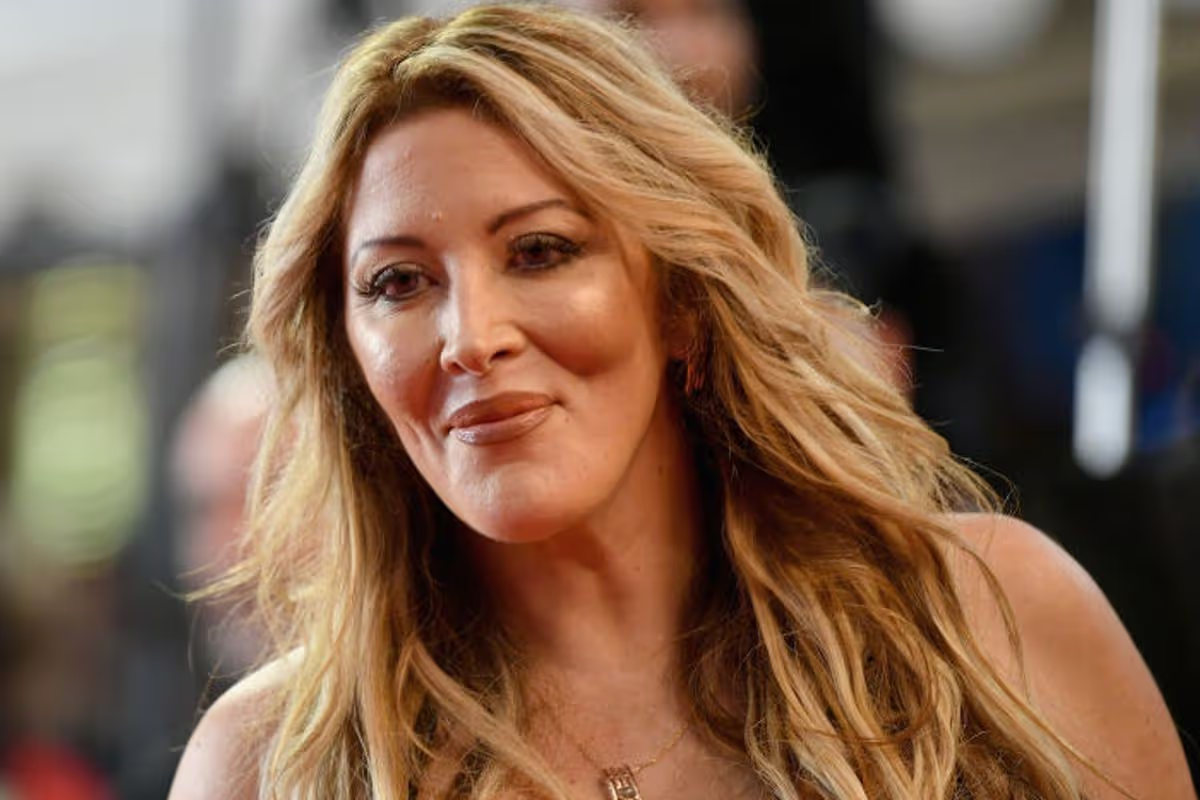
Loana Petrucciani was found dead at her home(Image: Getty Images)
A TV star who became known for having sex in the Big Brother pool has been found dead. Loana Petrucciani, who won the first series of Loft Story France 1, was just 48-years-old.
It’s reported that the reality star, simply known as Loana, was found dead at her home in Nice. Prosecutor Damien Martinelli stated that an investigation has since been opened to “find the causes of death”, before stating the TV star had been dead for “several days”.
Loana gained fame in 2001 when she entered the Loft Story house, living with strangers for ten weeks under constant surveillance from cameras, mirroring the Big Brother format. In the wake of her death, TV network M6 said: “An iconic figure of the first season of ‘Loft Story’, she will forever remain a personality who profoundly marked an entire generation of viewers,” before praising her for “her pontaneity, sensitivity and authenticity.”
Ensure our latest headlines always appear at the top of your Google Search by making us a Preferred Source.Click here to activateor add us as your Preferred Source in your Google search settings.
Alexia Laroche-Joubert, CEO of Loft Story’s production company Banijay France, said: “It is with immense emotion that I learned of Loana’s passing. Our paths crossed 25 years ago, and I am honoured to have shared so many memories with her. I witnessed her successes and her struggles.
“My thoughts are, of course, with her mother, Violette, her daughter, her brother, and the other housemates who were part of this adventure. Let us never forget that behind her public image was a sensitive and extremely intelligent woman.” Benjamin Castaldi, presenter of Loft Story said: “There are some faces we never forget. And hers, Loana’s, is part of our collective history.
“Thought we would watch a show. In fact, we were witnessing a revolution. The first one. The truth. The one that changed television forever… and maybe also our view on humans. Loana was not a character. She was a woman. A real one. With its cracks, its sweetness, its fragility in the open sky. And that’s precisely why we loved it.
“But that’s also why we dropped her. We applauded his light… not protecting his shadow. His authenticity has been consumed… without measuring the price she would pay. We’ve watched her live, love, fall… without ever really wondering who would pick her up after. The truth is, we’re all a little responsible. Because we all watched. Cuz we all commented Because we’ve all, at one point, looked away when it got too hard.
“She embodied raw innocence in a world that didn’t forgive anything. And we couldn’t match what she gave us. Today, there’s only a television memory. There’s still an emotion. Embarrassment. A regret. The one of not being human enough to someone who deeply was. So yeah… We lived a revolution together. But maybe we forgot, along the way, the important thing: Behind the phenomenon… There was a woman.”
It was on Lost Story that Loana became known for sleeping with co-star Jean-Edouard Lipa, sparking outrage across the country. Despite the scandal, she walked out of the house as the champion and was welcomed as she paraded down the Champs-Élysées.
With her newfound fame came magazine deals, gracing the cover of Elle, photographed by Jean-Baptiste Mondino and her deeply personal memoir several months later.
In her memoir, the Cannes-born star opened up about the highs and lows of her career in the spotlight, as well as previous suicide attempts. Speaking about entering Loft Story, she said previously: “I went there feeling very insecure. I was worried. The casting director said to me, ‘Aren’t you ashamed to come dressed like that?’ I took it very badly, especially since he was asking everyone that question.”
She added: “He asked me to flirt with the camera: I don’t know how to do that, it’s impossible. I blushed, I stammered. Then they asked me to dance and sing. I left and thought to myself, ‘I didn’t show them anything.'” She said of her fame: “There are two women inside me. The public loved both. Before, we saw a lot of the extroverted Loana who danced on the catwalks, but we didn’t see the other side, because she was too shy to express herself. But, in Loft Story, we saw that there was another side to her.”
In the early 2010s, Loana attempted to take her own life, which left her in a coma. Her family and friends later discovered that she had made several attempts on her life prior to this.
If you’re struggling and need to talk, the Samaritans operate a free helpline open 24/7 on 116 123. Alternatively, you can email jo@samaritans.org or visit their site to find your local branch
If you have been affected by this story, Cruse Bereavement Support offers free help to make sense of how you are feeling. Click here for their website or call 0808 808 1677.
IT ISN’T even summer yet but we wouldn’t blame you if you are already excited about Christmas – and there’s good reason to be with some changes coming to LaplandUK.
LaplandUK – the huge family-friendly Christmas attraction – will be dropping tickets for both the Ascot and Manchester experiences this week,
Sign up for the Travel newsletter
Thank you!
LaplandUK has a number of changes being introduced this yearCredit: LaplandUK
Ahead of the drop on March 27 (this Friday) at 10am, the attraction has also revealed some big changes to the experience this year.
One of the biggest changes is that guests will get more time in the Elven Village.
This means guests will have more time to go ice skating, letter writing and enjoying the magical atmosphere of the Elven World.
Whilst LaplandUK hasn’t yet confirmed how long visitors will now have in the Elven Village, in previous years visitors had 90 minutes to enjoy the area.
Another change for this year is that every child will now have the opportunity – included in their ticket – to create their own reindeer food with the Elves, ready to lay out on Christmas Eve for Father Christmas’ reindeer.
There is also a new invitation box this year, meaning that anyone who books a LaplandUK experience for 2026 will receive their invitations by the end of summer.
Returning this year will also be Mother Christmas’s Kitchen where kids will get more time to decorate gingerbread before meeting with Mother Christmas and the Elves for traditional story time.
LaplandUK is also bringing back the portal that takes humans ‘back to the UK’, but making it bigger for this year.
This year, LaplandUK will run from November 7 to December 24, with tickets costing between £60 and £195.
Last year, 350,000 tickets were available and before the tickets were released, over 750,000 people were waiting in the virtual queue online.
On March 27, when tickets go on sale, there will be a virtual queue online from 9am.
Guests will need to select their preferred venue – either Ascot or Manchester, – and then at 10am when tickets are released, each guest will automatically be allocated a random place in the queue for the venue they selected.
Once they reach position one in the queue, they will be able to select the number of tickets they want and the date they wish to visit.
After purchasing their tickets, in the following months guests will be sent a personalised invitation.
On the day of visiting, guests will venture through “secret portals in the Whispering Woods of the UK and follow magical pathways to arrive in Lapland”.
Visitors will get more time in the Elven Village for exampleCredit: LaplandUK
And throughout the day there will be performances and interactive activities such as helping out the Elves in the Toy Factory to make a toy to pop in Father Christmas’ Sleigh.
Kids will get a special moment with Santa as well, where they get a gift to take home and their parents are handed the toy they created in the Lapland Toy Factory to be given on Christmas Day.
Netflix has confirmed Bridgerton’s fifth season is currently in production but fans aren’t happy about the direction of the hit period drama
Bridgerton fans fume ‘big mistake’ as Netflix confirms season 5 leads(Image: NETFLIX)
Bridgerton season five will officially focus on middle daughter Francesca with Hannah Dodd taking the lead in Netflix’s popular period romance drama.
Dodd will be starring alongside Masali Baduza as Michaela Stirling, marking the first time the hit streaming series will spotlight a same-sex couple.
The upcoming instalment, which is currently in production, will be set after the death of Francesca’s husband John Stirling (played by Victor Alli) as she begins to explore her complex feelings for his outgoing cousin.
A synopsis confirms: “The fifth season of Bridgerton spotlights introverted middle daughter Francesca.
“Two years after losing her beloved husband John, Fran decides to reenter the marriage mart for practical reasons.
Content cannot be displayed without consent
“But when John’s cousin Michaela returns to London to tend to the Kilmartin estate, Fran’s complicated feelings will have her questioning whether to stick to her pragmatic intentions or pursue her inner passions.”
A first-look teaser for the upcoming season has given fans a tantalising glimpse of the pair together, giving each other a tender glance as inspiring music swells.
While countless fans are thrilled to see Fran and Michaela’s romance develop, others have criticised the decision to delay Eloise Bridgerton’s (Claudia Jessie) storyline to season six.
In Julia Quinn’s original novels, 28-year-old Eloise finds love in the fifth book, To Sir Phillip, With Love, after exchanging letters with widower Sir Phillip Crane, played by Chris Fulton in the TV adaptation.
“Big mistake it should have been Eloise next, no buzz here l’m sorry to say,” one viewer fumed on X, adding a shrug emoji.
Someone else exclaimed: “BIG Mistake! should’ve been Eloise first, Fran should’ve had time to grieve.”
Another said: “im actually mad because wdym im not seeing [Eloise’s] season till 2030.” A third wrote: “THEYRE DOING FRANCESCA BEFORE ELOISE?? WHATTT.”
The conversation continued on Reddit, where one user reasoned: “I’m not sure how to feel about this I’m excited for them and their story but honestly what are they going to do with Eloise for another season, i just can’t see what they do with her.”
Watch Bridgerton on Netflix for free with Sky
This article contains affiliate links, we will receive a commission on any sales we generate from it. Learn more
Sky is giving away a free Netflix subscription with its new Sky Stream TV bundles, including the £15 Essential TV plan.
This lets members watch live and on-demand TV content without a satellite dish or aerial and includes hit shows like Bridgerton.
“I mean great but I have mixed feelings. I just really wanted Eloise to be the next,” another agreed.
Though someone else argued: “Ayyy, my girls!! So excited to see them lead, I know it’s going to be a fantastic season! Hopefully they can advance Eloise’s plotline as well, like how Fran’s story got a headstart in S3.”
Production starting this spring indicates the next season should arrive on Netflix at some point in 2027.
Hopefully that also means fans won’t be waiting too long before Eloise finally gets her time to shine.
Jordan Chiles captured the Big Ten all-around crown with her seventh perfect score of the season, leading UCLA to its second straight Big Ten championship gymnastics title on Saturday.
“Our team is just going up from here,” Chiles told Big Ten Network after the meet. “We haven’t hit our peak yet.
“Obviously, there are still things that we can work on as individuals, but I think the team environment is definitely there. I couldn’t be more proud of each and every single athlete that went up today and stepped in as well.”
UCLA opened with Chiles scoring a 9.925 on beam. Tiana Sumanasekera scored a 9.925, and Katelyn Rosen, Sydney Barros and Mika Webster-Longin each scored a 9.850. Rosen managed to achieve the feat after missing the last few weeks with a foot injury.
UCLA closed the first rotation in second place, 0.125 behind Michigan.
With Chiles leading the way on floor, Webster-Longin posted a 9.925, tying her career high. Sumanasekera had the same score and Ashlee Sullivan had a 9.950.
Riley Jenkins led UCLA in the vault with a 9.950. Webster-Longin celebrated her 9.875 routine with splits. Sumanasekera had a 9.850 in the event and Sullivan received a 9.850 on her Yurchenko. Chiles closed out the vault with a 9.925, keeping the Bruins in first place ahead of Michigan State by 0.325.
Chiles and Barros each had scores of 9.950 in the uneven bars — the best mark of the season in the discipline for Barros. Webster-Longin performed some celebratory splits again when she tied her season high with a 9.900 on the uneven bars. Sumanasekera and Nola Matthews each had a 9.875 in the event.
“We are coming for y’all,” Chiles said. “This is our year and I’m very proud to say that we are the Bruins.”
The Foreign Office has issued a new warning on travel to a country where 400,000 Brits a year travel
Steffan Rhys Deputy Content Hub Director
02:26, 21 Mar 2026
The Foreign Office has issued a new warning on travel to a country popular with hundreds of thousands of British tourists(Image: THEGIFT777 via Getty Images)
The UK Foreign Office regularly updates its guidance on destinations that are unsafe for British citizens to visit. Currently, there are 69 countries to which some form of warning applies.
Generally, the Foreign Office splits its warnings into three categories:
The Foreign Office advises against all travel to a country: this is its highest warning level
The Foreign Office advises against all travel to parts of a country.
The Foreign Office advises against all but essential travel to a country or parts of a country.
And it has this week revised its travel guidance for a country to which approximately 400,000 Brits travel annually, with a particular warning on a world-famous tourist hotspot. The Foreign Office has updated information on fraud and scams, nightlife and dating, driving rules and pedestrian safety and Table Mountain National Park in South Africa. It says:
Terrorists are likely to try to carry out attacks in South Africa, which could be indiscriminate and target public spaces and places visited by foreigners.
There are regular protests and demonstrations in South Africa which can turn violent at short notice.
There is a high crime rate in South Africa, with incidents including violent muggings, snatching jewellery and valuables, carjacking, ‘smash and grab’ attacks on vehicles, house robbery, rape and sexual assault and murder. It says “most violent crimes occur in townships located on the outskirts of major cities” and that “There have been recent attacks and violent crime on secondary roads to and from Cape Town airport”.
Scammers target people using taxi apps in major cities and you should make sure you use an internationally recognised service.
The risk of kidnap is increasing throughout South Africa and that “criminals generally kidnap people for financial gain”.
Card skimming and confidence scams are widespread, crime around ATMs and money exchanges is common.
Criminals use dating apps to rob, rape or sexually assault victims.
There have been recent violent attacks and muggings against hikers and foreign tourists in Table Mountain National Park.
However, it is important to note that the Foreign Office does not warn against travel to South Africa or any parts of South Africa and it is not one of the 69 countries listed below, reports the Liverpool Echo.
Countries where the Foreign Office recommends against all travel
Afghanistan, where British nationals face an elevated risk of detention.
Belarus, where “you face a significant risk of arrest if you have at any time engaged in any activity now considered illegal by the Belarusian regime”.
Burkina Faso, owing to “the threat of terrorist attacks and terrorist kidnap, and the unstable political situation in the country”.
Haiti, owing to a volatile security situation.
Iran, because of the ongoing Iran War. The FCDO warns: “If you are a British national already in Iran, either resident or visitor, carefully consider your presence there and the risks you take by staying. British and British-Iranian dual nationals are at significant risk of arrest, questioning or detention. Having a British passport or connections to the UK can be reason enough for the Iranian authorities to detain you.”
Iraq, due to recent escalation in regional conflict. The FCDO warns: “There is significant risk of further escalation, and events are fast-moving and unpredictable.”
Israel, due to the escalation in conflict in the region which poses significant security risks and has led to travel disruption.
Mali, owing to unpredictable security conditions.
Niger, owing to the increase in reported terrorist and criminal kidnappings of foreign nationals.
Palestine, owing to the ongoing conflict between Israel and Hamas.
Russia, owing to a heightened risk of British nationals being detained in Russia and the dangers and threats stemming from its continued invasion of Ukraine.
South Sudan, owing to the danger of armed conflict and criminal activity.
Syria, owing to uncertain security circumstances and the risk of terrorist incidents.
Yemen, owing to the devastation caused by an ongoing civil war and humanitarian catastrophes.
Countries to which the Foreign Office advises against all travel to certain areas
The 36 countries to which the Foreign Office advises against all travel to certain areas are:
Algeria: FCDO advises against travel to within 30km of Algeria’s borders with Libya, Mauritania, Mali, Niger and Tunisia.
Armenia: FCDO advises against all travel to within 5km of the entire eastern border between Armenia and Azerbaijan, owing to tensions between the two countries Azerbaijan: The FCDO advises against all travel within 5km of the border with Armenia.
Benin: The FCDO advises against all travel to border regions near Niger and Burkina Faso.
Burundi: The FCDO advises against all travel to a region where there is a rebel group and the risk of possible armed incursions from the Democratic Republic of the Congo (DRC).
Cameroon: The FCDO advises against travel to borders with Nigeria, Chad and the CAR.
Central African Republic: The FCDO advises against all travel to the entirety of the Central African Republic, excluding the capital, Bangui.
Chad: The FCDO advises against all travel to the northern provinces of Chad, among other regions.
Congo: The FCDO advises against all travel within 50km of the Republic of Congo-Central African Republic border.
Côte d’Ivoire: The FCDO advises against all travel within 40km of the borders with Burkina Faso and Mali.
Democratic Republic of the Congo: The FCDO advises against all travel within 50km of most of its northern and eastern border.
Djibouti: The FCDO advises against all travel to the Djibouti-Eritrea border.
Egypt: The FCDO advises against all travel within 20km of the Egypt-Libya border and the border with Israel and Gaza.
Eritrea: The FCDO advises against all travel within 25km of all of Eritrea’s land borders.
Ethiopia: The FCDO advises against all travel to anywhere near borders with Eritrea, Somalia, South Sudan, Kenya and Somalia.
Georgia: FCDO recommends against all travel to the Russian occupied territories of South Ossetia and Abkhazia.
India: FCDO recommends against all travel within 10km of the India-Pakistan border and the Union Territory of Jammu and Kashmir.
Indonesia: FCDO recommends against all travel to a number of volcanoes in Indonesia.
Jordan: FCDO recommends against all travel to within 3km of the border with Syria.
Kenya: FCDO recommends against all travel to the Kenya-Somalia border and northern parts of the east coast.
Lebanon: FCDO recommends against all travel to the vast majority of Lebanon.
Libya: FCDO recommends against all travel to Libya except for the cities of Benghazi and Misrata.
Mauritania: FCDO recommends against all travel to the eastern half of the country.
Moldova: FCDO recommends against all travel to Transnistria, a region bordering Ukraine.
Myanmar (Burma): FCDO recommends against all travel to most of Myanmar.
Nigeria: FCDO recommends against all travel to large parts of north-west and north-east Nigeria.
Pakistan: FCDO recommends against all travel to within 10 miles of the border between Pakistan and Afghanistan and some other areas.
Philippines: FCDO recommends against all travel to western and central Mindanao and the Sulu archipelago.
Saudi Arabia: FCDO recommends against all travel to within 10km of the border with Yemen.
Somalia: FCDO recommends against all travel to the vast majority of Somalia.
Sudan: FCDO recommends against all travel to the vast majority of Sudan Togo: The FCDO advises against all travel within 30km of the border with Burkina Faso.
Tunisia: The FCDO advises against all travel to parts of its border with Libya and Algeria.
Turkey: The FCDO advises against all travel within 10km of the border with Syria. There are no warnings relating to the rest of the country.
Ukraine: The FCDO advises against all travel to the vast majority of Ukraine.
Venezuela: The FCDO advises against all travel within 80km (50 miles) of the border with Colombia, within 40km (25 miles) of the border with Brazil and within 40km (25 miles) of the border with Guyana as well as some central areas.
Countries to which the Foreign Office advises against all but essential travel
The 19 countries to which the FCDO advises against all but essential travel are as follows. The warnings could include either the whole country or part of a country.
Cambodia: FCDO advises against all but essential travel to within 20km from the land border with Thailand.
Colombia: FCDO advises against all but essential travel to several parts of Colombia including the borders with Venezuela, Panama and Ecuador, and central Colombia.
Cuba: FCDO advises against all but essential travel to Cuba.
Ecuador: FCDO advises against all but essential travel to several parts of Ecuador, where a 30-day state of emergency was renewed on February 28 due to internal disturbance and armed violence.
Ghana: FCDO advises against all but essential travel to the Upper East region of Ghana.
Guatemala: FCDO advises against all but essential travel to within 5km of the Mexican border from the Pacific Coast up to and including the Gracias a Dios crossing, as well as to to the towns of Santa Ana Huista, San Antonio Huista and La Democracia.
Kosovo: FCDO advises against all but essential travel to a section of northern Kosovo.
Kuwait: FCDO advises against all but essential travel to Kuwait because of the escalating conflict in the Middle East.
Laos: FCDO advises against all but essential travel to Xaisomboun Province, where there are intermittent attacks on infrastructure and armed clashes with anti-government groups.
Malaysia: FCDO advises against all but essential travel to all islands and dive sites off the coast of eastern Sabah from Sandakan to Tawau, including Lankayan Island, due to the threat of kidnapping.
Mexico: FCDO advises against all but essential travel to multiple cities and regions in Mexico because of escalating violence due to conflict between drug cartels and government forces.
North Korea: FCDO advises against all but essential travel to North Korea, because “the level of tension on the Korean Peninsula remains high” even if “daily life in the capital city, Pyongyang, may appear calm”.
Papua New Guinea: FCDO advises against all but essential travel to certain provinces due to the high risk of tribal fighting.
Peru: FCDO advises against all but essential travel to areas near the border Colombia and elsewhere. There is a state of emergency in Peru.
Qatar: FCDO advises against all but essential travel to Qatar because of the conflict in the Middle East.
Rwanda: FCDO advises against all but essential travel to a section of the border with the Democratic Republic of Congo (DRC).
Tanzania: FCDO advises against all but essential travel to a section of the Tanzanian border with Mozambique, due to attacks by groups linked with Islamic extremism.
Thailand: FCDO advises against all but essential travel to parts of the south near the Thailand-Malaysia border and all but essential travel to within 20km of the land border with Cambodia.
United Arab Emirates: FCDO advises against all but essential travel to the UAE, which includes Dubai and Abu Dhabi, because of the conflict in the Middle East.
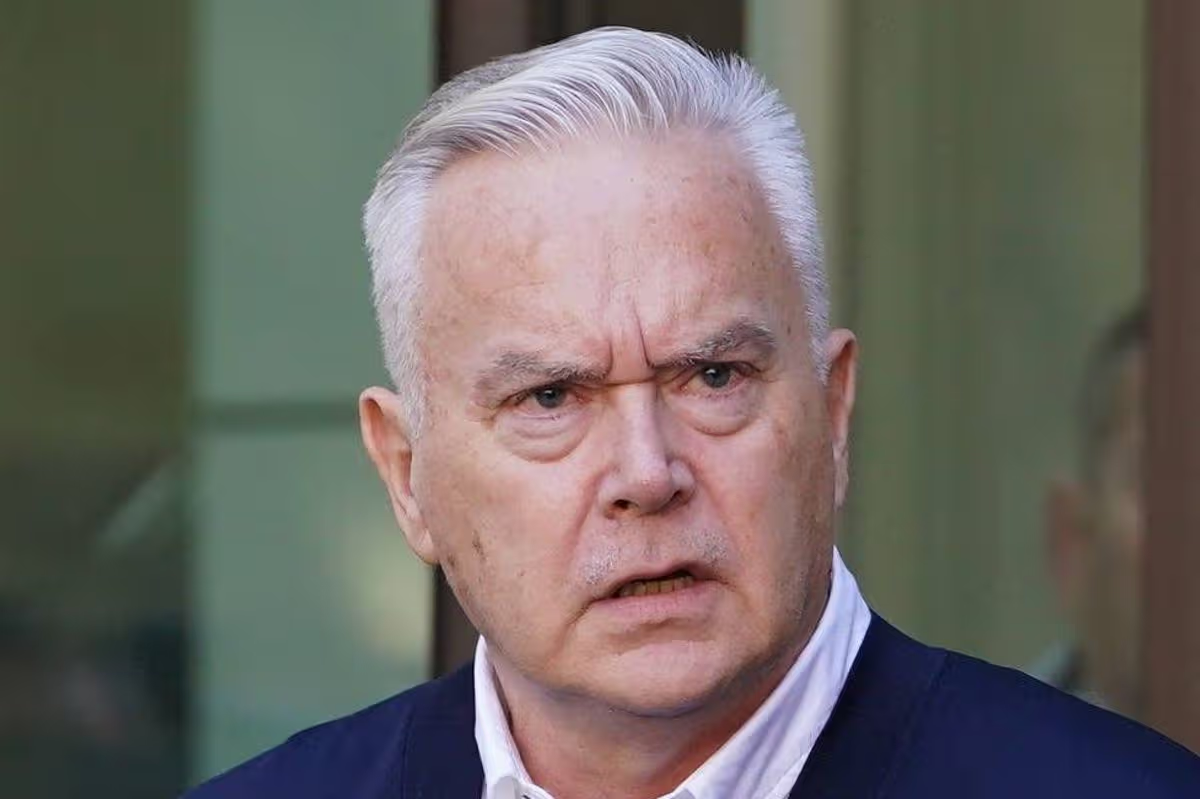
Huw Edwards touted himself as a bastion of righteousness and good but behind closed doors he led a depraved double life that destroyed the lives of those around him
17:41, 19 Mar 2026Updated 18:04, 19 Mar 2026
The alleged texts have been revealed in a new TV drama(Image: Lucy North/PA Wire)
Huw Edwards presented himself as the trusted voice of the nation, but off-screen he lived a secret life of depravity.
Married for 31 years, the Welsh BBC newsreader was welcomed into homes each night and anchored some of the country’s most seismic events – including the death of the late Queen Elizabeth. He reported on downfalls, scandals and abuses of power. But little did viewers know that he, too, was guilty of his own trangressions.
It started with a report in The Sun alleging he had paid a you for sexual pictures. The Met Police investigated but found no evidence of crime. Then came accusations that he inappropriately messaged a freelance journalist, a sixth-form student and other staff at the BBC. Finally, he was arrested after police learned indecent images of children had been sent to his phone by convicted sex offender, Alex Williams. He pleaded guilty to three counts of making indecent images of children and was given just six months imprisonment, suspended for two years, with a requirement to complete a sex offender programme.
Slowly, a picture began to emerge of a middle-aged man who became obsessed with social media and its ability to bring him both adoration and sexual connection with men and women. As his wife Vicky Flind struggled to care for her ailing mother, Edwards – who was described as a ‘volatile’ man with a ‘history of agitation’ – instead looked to his phone for cheap thrills.
In a report, Dr Appleyard, a Forensic Psychosexual therapist, told a September 2024 court hearing: “His social media engagement presented as an easy way to manage his low mood and provided him with a number of men and women who were motivated to be sexual with him which not only boosted his fragile self esteem but allowed him to re-engage with his sexual interest in men which had been managed since 1994.
“The feelings of being desirable and unseen alongside Mr. Edwards’ unresolved sexual orientation created a perfect storm where he engaged in sexual infidelities”
Now, the sordid saga is being retold in Channel 5 drama, Power: The Downfall Of Huw Edwards. Martin Clunes stars as Edwards, and executive producer Sam Anstiss has compared reading the raft of text messages sent by Edwards to “going into the heart of darkness.”
“Because here in these messages was, in the most visceral, disturbing way, a very imbalanced relationship of power. They were so disturbing. It was, ‘I love you, but you kill me’,” she told The Sun.
Here, the Mirror explores the damning texts Edwards allegedly sent…
The young man, now aged 23 and who wishes to remain anonymous, says he feels like Edwards, 64, ‘groomed’ him after they first connected in 2020. At first, Edwards was not named publicly, but within days his identity was revealed by his wife and he was admitted to hospital due to serious mental health concerns.
The man said he was in a very troubled state of mind when he first contacted the television newsreader. Having fallen out with his mother and step-father, he was sleeping on friends’ sofas and had spent a few nights at a homeless shelter, which he described as ‘scary’. He began sending messages to famous people asking for help. He was in a burger bar in Cardiff when he happened to see Edwards on the TV, so decided to message him on social media.
Edwards was the only person to reply to any of the messages. The man said he didn’t ask for money, but Edwards deposited £500 into his PayPal account, which went towards hotel costs for a few days. The man told the Mirror: “Although it was a friendship at the beginning, it did change. He would say things like, ‘Are you going to do something for me then?’ I needed help, so I did. I feel like he sort of fed on my vulnerability… as he knew I needed the money. I felt like I was being groomed.”
Messages seen by The Sun and shared in its documentary, Huw Edwards: Unmasked, are harrowing reading. In one, he allegedly says, “I want a pic of you totally naked head to toe.” After transferring the fan £2,000, he then rages after receiving only a picture of the young man’s naked top half.
“F*** that. F*** that. Really not impressed by you. I believed you were serious. But you’re not. You chase me for cash. But you then ‘forget’ to deliver. F*** that,” he wrote, according to the publication.
After paying for the young man’s train ticket to London, he allegedly teased: “Then you really would owe me.” But the texts take a dark turn. On New Year’s Eve 2022, the documentary states that he sent a string of abuse to the man. “Stop being a kn*b and talk to me tomorrow when you’re sober.”
“Now listen to me. If you want help in future stop this cr*p OK,” he is said to have raged. “You’ve disappointed me… I regret helping you so much… I should have known… You should know better.”
In the February, the film claims that Edwards unleashed another tirade on the young man after worrying that his payments for sexual images could be exposed. “You’re a disaster area,” he is said to have raged. “Why does this happen all the time??!??… Im with family stop being a pain… I’m sick of you getting into a mess all the time… Don’t be stupid… My Monzo is easily traceable. I can do PayPal nothing else.”
“You are really really really trying my patience,” he allegedly continued. “I don’t need this f***ing sh*t… Delete these messages if it’s not your phone OK???… Send me your Monzo details you idiot… You make me so angry… WTF you talking about you f***ing disaster… Go f**k yourself. Get f***ing real. Tell you what. I’ll stop helping you then you can see what no care is. F**k you. You’re an ungrateful t**t.”
Edwards then seemingly softens, apparently adding: “I f***ing love you…but you kill me x” and “I love you seriously x… I will never end you. You idiot. You know that. X… Next time in Cardiff you need to see me x… Good boy… Don’t forget. I love you x”
But there was yet another alleged outburst after the young man called him in the night. “I can’t trust you to respect my situation,” the News at 10 anchor reportedly fumed. “Now leave me alone. Actually calling me at 2am? F**k that. Calling me at 2am even when I told you to stop ?????? You’re so f***ing out of order. Grow up. Just grow up. And when someone helps you – show respect.”
The man told The Mirror how Edwards messaged on an unknown number In October just one month before he was arrested – but was left “staggered” by his reaction. The man said: “I think it was about two weeks before he got arrested. The message said ‘guess who’ or something like that.
“The message said ‘don’t say my name on here… just call me’. So I phoned him and he said download the messaging app Signal. And he said we can catch up on there.” The man said he was staggered by Edwards’ demeanour on the call, adding: “He said, ‘What’s been going on? I really care about you’. He had no remorse for anything at all.”
It was the final time they spoke. A month later Edwards was arrested over the indecent images on his phone in an unrelated case. He stood down from the BBC in April 2024.
‘Strange messages to journalist’
The Express’ assistant politics editor Sam Stevenson has shared his experience of a message exchange with Edwards.
When Sam started his journalism career five years ago, he was keen to make contacts and keep up-to-date with the rolling news cycle. His first port of call was to follow as many “leading industry figures” as he could on Twitter, now X. He said he wanted to follow those he “respected” and “hoped to one day emulate”.
Sam claimed that within minutes of following Edwards, he was followed back “much to his delight”. He stated that he “couldn’t have been more thrilled” to have “perhaps the most famous news anchor in Britain” acknowledge him. Edwards is said to have sent Sam a message just “seconds later”.
It reportedly read: “Latecomers are welcome, Sam” followed by a praying hands and a yellow smirking face emoji. Sam recalled being on holiday at the time and excitedly sharing the news that Edwards had sent him a direct message to his family. He admitted to wondering why “a high-profile celebrity 32 years my senior, with almost 200,000 followers versus my measly 1,000, want to speak to me”.
Sam replied: “Haha, thanks for the follow, Huw! Big fan of your work” alongside a thumbs up emoji. Edwards is said to have reacted to Sam’s message with a thumbs up emoji and added: “Thanks, Sam. Keep in touch. H.”
Writing in the Express, Sam said: “At that moment, I was not sure what to make of it. My immediate thought was what an excellent new contact I had just made. But, knowing what we do now, perhaps the reality was something more sinister. On reflection later that day, it was clear from his playful and casual manner, the coquettish nature of his initial message, the liberal emoji use, the over-familiarity coming seemingly at random, and the plea to ‘keep in touch’, that something was off.”
Sam admitted to feeling “somewhat uneasy” that the “playful tone” had “came from somebody who was so well-respected”. He said: “It did not feel right. Then, the penny dropped. Huw Edwards, the Huw Edwards, was privately flirting with me. Looking back, it makes my blood run cold.” The journalist ended by writing: “For my part, I am relieved I managed to avoid him. Others were not so lucky.”
Sixth-form student ‘exchange’
Welsh TV channel SC4 launched its own investigation into the scandal and interviewed a young man who said he met Edwards while he was performing in a concert. He was an 18-year-old sixth-form pupil and Edwards was the compere.
“I was in my school uniform. He came up to me at the end of the concert and said hello, that the performance was really good. He told me I was very talented. He was interested to have some sort of contact with me,” the student claimed. “He told me if I wanted to come to London to meet him, he could give me a tour of the BBC and maybe meet a couple of musical contacts.”
The pair connected on Instagram and the teen travelled to the London to visit the BBC but began to suspect that Edwards’ intentions were not admirable. In messages shown by the channel, Edwards signed off messages with a kiss or a heart. In one, Edwards wrote: “Yeah, OK big boy, we believe you.”
“I think it’s clear he was trying to groom me, trying to pull me in,” the young man said. After a few months, however, Huw stopped answering his messages and stopped following him. “He just lost interest in me, I wasn’t giving him what he was looking for,” the student added.
Junior BBC employee ‘sickened’
Victoria Derbyshire shared details about how an ex junior staffer – whose story featured on Newsnight – “felt sick” upon hearing Edwards had child sexual abuse images on WhatsApp. According to Derbyshire, the former employee was in their mid 20s when Edwards allegedly messaged then on Instagram.
Posting on her X account, Derbyshire wrote: “Here’s what they told me IN FULL today: Huw Edwards messaged me on social media several times, despite us having never met and not knowing each other. Many of these messages were clearly inappropriate, including telling me unprompted what he was doing in the early hours of the morning, asking that I take him for food, and including several kisses at the end of his messages. I was quite junior in the BBC at the time, so just tried to play them off and not pay too much attention to them.
“At the time I was confused as to why he was sending such messages to me, but I had heard stories of other younger employees in the BBC having similar experiences with him. That is why I first got in touch with Newsnight: when the original Sun story came out, I felt like the extent of this inappropriate behaviour was likely more widespread than I knew. I didn’t contribute to the subsequent internal BBC inquiry, mostly as I felt I had already come forward and told the important parts of my story to Newsnight and was very busy at the time. It was not because of a lack of trust in the BBC.
“I didn’t report the inappropriate messages at the time when I was working at the BBC, mostly because I had other important things going on in my life that year, not because of a lack of confidence over the efficacy of raising such concerns.”
The anonymous employee claims he had initially connected with Edwards on Instagram before switching to WhatsApp, where he says they sent hundreds of messages between April 2021 and August 2022.
The reporter claimed that when told he lived in a house-share, Edwards said: “So I could pop in to have some tea?” and a few days after the funeral, he tried again, suggesting, “‘Or I can come to yours.”
On the eve of the funeral – where the late Queen was forced to mourn her husband alone because of Covid restrictions – Edwards allegedly sent him a picture of his hotel room, featuring just one bed, with the caption: “Missed a good night. You could have stayed here.”
The BBC worker told the Daily Mail: “He sent me a picture of his hotel room. I felt it was very suggestive. There were lockdown restrictions at the time. The Covid rules about households not mixing were still in force, the Queen was all alone on the pews at Philip’s funeral, and then Boris [Johnson] got a hammering for the parties in No.10 – and that was the same night Huw Edwards suggested I stay in his hotel room.
MIAMI — The victors erupted onto the field and into multiple dogpiles. Some wore national flags around their shoulders. Within minutes, the Venezuelans wore T-shirts that read: “The Best Baseball in the World.”
The players from the United States watched from their dugout. Within minutes, they trudged back onto the field so a silver medal could be draped around their necks. Not every player wore the medal all the way back to the dugout.
You can say all you want about how the World Baseball Classic has matured into a must-see event for fans and a must-play event for the game’s elite players. You can salute Venezuela for a spirited and thrilling victory, and the Venezuelan fans for nine innings of joyful delirium.
But you also can say this: A U.S. team billed as featuring a killer lineup could not hit, and the U.S. could not use its best pitcher because the San Diego Padres said so. The result: For the second consecutive World Baseball Classic, the U.S. lost the championship by a 3-2 score.
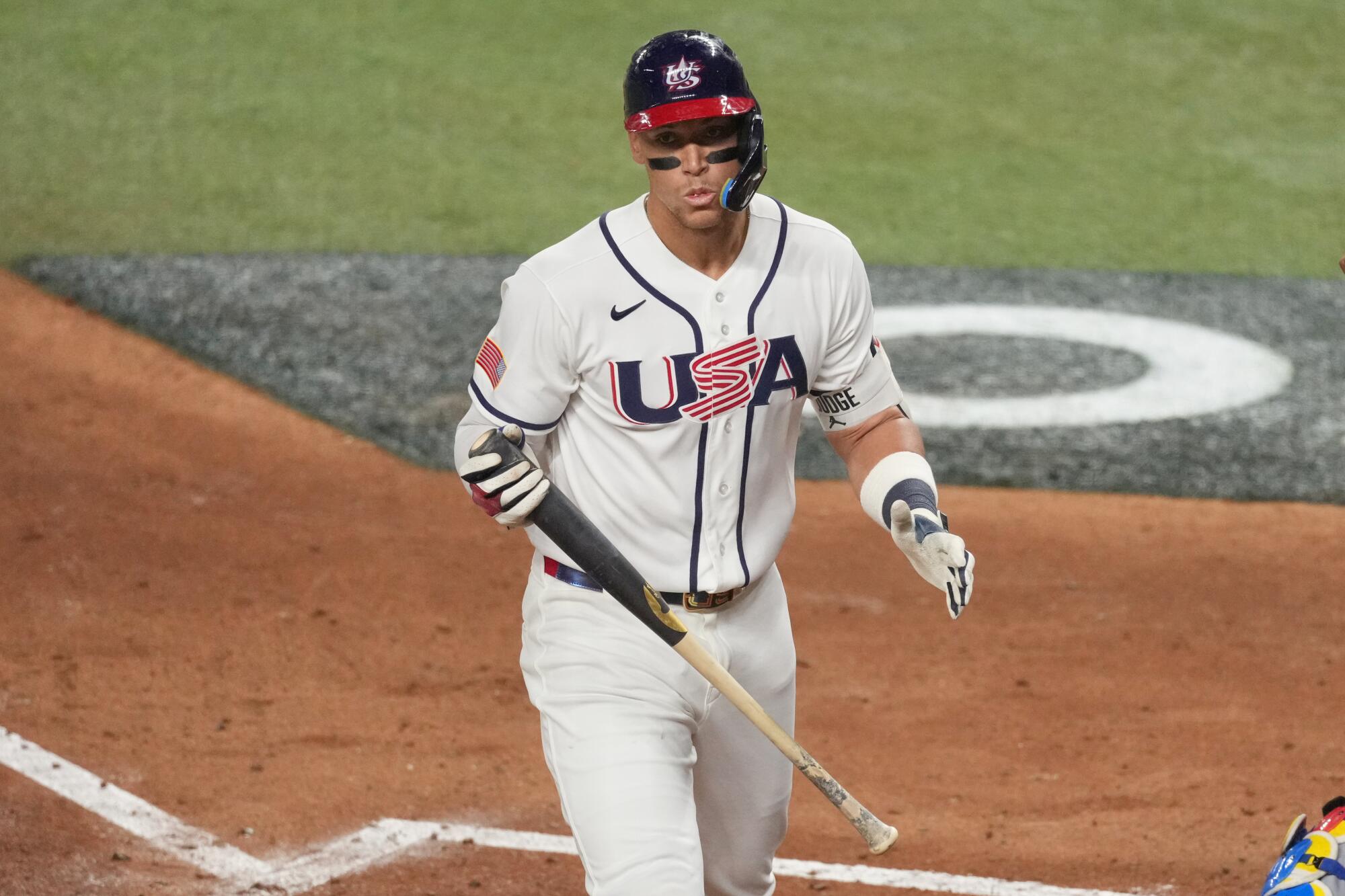
U.S. captain Aaron Judge looks across the field after striking out against Velezuela at the World Baseball Classic Tuesday.
(Lynne Sladky / Associated Press)
“I’m not OK with winning silver,” Bryce Harper said. “I don’t want to win silver.
“I want to win gold, just like anybody else. But, at the end of the night, they did it, they won, all the congratulations to them. They fought hard. I’ve got nothing but respect for them.”
By the time the eighth inning rolled around, the mighty U.S. offense had not gotten a runner into scoring position on Tuesday, and had gone scoreless for 18 of its previous 19 innings. With two out in the eighth, and Venezuela up 2-0, Bobby Witt Jr. walked, and Harper followed with a 432-foot home run, so monstrous that Venezuelan pitcher Andres Machado could only watch the flight of the ball and smile.
Harper stood and watched too, then he flipped his bat toward the dugout. At third base, he stopped to give a salute, then spotted the cameraman trailing him around the bases and pointed to the American flag on his left sleeve.
“Just enjoying the moment,” Harper said. “Super grateful for it.”
With the game tied 2-2 entering the ninth, the pitcher trotting in from the U.S. bullpen should have been Mason Miller, who had not given up a hit in the WBC and struck out 10 of the 14 batters he had faced.
Before the game, U.S. manager Mark DeRosa had said Miller would be available. After the game, DeRosa said he and Miller’s employers, the Padres, had agreed Miller would only be used to protect a lead.
Once the game entered the ninth, Miller would not be able to protect a lead, since the U.S. was the home team and there could be no save situation for him. DeRosa nonetheless declined to use Miller.
“Honoring the Padres,” DeRosa said.
This is not on DeRosa, but that is nonsense. If a closer cannot be used three times in five days — with another week to ease into the regular season by throwing bullpens or in structured B games, or taking a few days off, or whatever — then he should stay home.
Venezuela scored the winning run in the ninth off Garrett Whitlock, on a walk, stolen base and RBI double by Eugenio Suárez.
In its final five WBC games — after routs of Brazil and Britain — the U.S. scored more than five runs once, with a two-run win, a two-run loss, a two-run win, a one-run win, and a one-run loss. In the semifinal and final, the U.S. combined to bat .159 and strike out 25 times, and every run came on a home run.
That — not any attempt at small ball — is American baseball. And the U.S. was outslugged by six other teams, including Australia and Italy. For glory, as the U.S. team hoodies said.
“A lot of pop ups, a lot of just-missed pitches,” U.S. captain Aaron Judge said. “I wouldn’t say we tensed up. We just didn’t execute when we needed to.”
Said DeRosa: “I mean, surprised because of the names at the back of the jersey, but not surprised because of where they’re at in spring training.
“Yeah, that’s my answer. I really don’t have a rhyme or reason to why. I just think you’re either hot or not in a seven-game blast like this.”
American Bryce Harper celebrates at home plate with teammates after hitting a two-run home run during the World Baseball Classic Tuesday in Miami.
(Lynne Sladky / Associated Press)
The WBC absolutely was a blast. The Venezuelan fans delivered concert-level noise all night long, without needing a silly stadium host or scoreboard command to do so. The WBC allowed fans to bring in 16 “permissible instruments,” including bongos, cowbells, maracas and trumpets.
“There’s bands playing,” Judge said. “There’s chants going on. You don’t usually hear that too much in the World Series games. That’s amazing. So much fun.”
More Americans watched the U.S.-Dominican Republic semifinal than watched last year’s NBA All-Star Game, according to Fox. The championship game almost certainly will have drawn more viewers than at least one game of last year’s NBA Finals.
In the 10 minutes I spent along the concourse before Tuesday’s game, I counted fans wearing the jerseys of many national teams and 17 MLB teams, plus the late and greatly beloved Montreal Expos. Japan did not qualify for the final four, but I nonetheless counted 11 fans in Japan jerseys with Shohei Ohtani’s name on the back. The advertisers believed too: DeRosa spoke in front of a banner displaying the logo of nine corporate sponsors, eight of them Japanese.
After such a lively event, can these players get fired up to go back to spring training, and then for the grind of a 162-game season?
“I’m always fired up for the Yankees, but I’m still pissed about this,” Judge said.
“I’m looking forward to the next time we get a chance to throw on the red, white and blue and take care of business.”
That would be the 2028 Olympics in Los Angeles, where Dave Roberts has expressed interest in managing Team USA at Dodger Stadium. The major leaguers are almost certainly coming, even if the details are still being worked out.
Dubai Airport has seen substantial flight disruption as British Airways announces it will halt all flights into Dubai until June as Iranian attacks on airports across the region continue
19:18, 17 Mar 2026Updated 19:38, 17 Mar 2026
Passenger planes are parked at Dubai International Airport in Dubai (file photo)
British Airways (BA) has cancelled all flights into Dubai until June as Iran continues its attacks on the UAE.
BA confirmed that flights to Amman, Bahrain, Dubai and Tel Aviv were now cancelled up to and including May 31, and flights to Doha were cancelled until April 30, the airline said in a new update.
“[The cancellations are] due to the continuing uncertainty of the situation in the Middle East and airspace instability, and to provide more clarity to our customers,” a BA spokesperson said.
Ensure our latest headlines always appear at the top of your Google Search by making us a Preferred Source. Click here to activate or add us as your Preferred Source in your Google search settings.
In 2025, Dubai International Airport was the world’s busiest airport for international passengers, accommodating nearly 90 million travellers.
December 2025 alone saw around 8.7 million passengers, the busiest single month in the airport’s history, The Express reports.
The airport connects travellers to 291 destinations across 110 countries.
The UK Foreign Office currently advises caution or against all but essential travel to the UAE and other Gulf states due to regional tensions.
Those already in the UAE are advised to follow local authorities’ instructions, register your presence with the UK government and be prepared for sudden changes in the security situation.
Despite Dubai being on the UK Foreign Office’s “No go” list, many travellers were still choosing to take the risk and fly there, Travel journalist Simon Calder told BBC Radio Scotland’s Breakfast programme.
As anticipated, it ended up being One Battle After Another’s night at the 98th annual Academy Awards, with the political thriller carting away six Oscars out of a total of 13 nominations.
But while Paul Thomas Anderson’s magnum opus continued its march towards award-season domination, there were moments of genuine surprise and subversion in Sunday’s ceremony.
Recommended Stories
list of 3 itemsend of list
Some of those moments had to do with the current political climate in the United States.
Host Conan O’Brien and his fellow presenters deftly avoided mentioning President Donald Trump by name, but their barbs took direct aim at his policies since returning to office.
Other surprises came from within the filmmaking community itself. For only the seventh time in Oscar history, a tie was announced: Two films had gotten an equal number of votes for Best Live Action Short.
As a result, both the surrealist thriller Two People Exchanging Saliva and the moody bar-room drama The Singers shared the Academy Award.
Here are six key takeaways from the night.
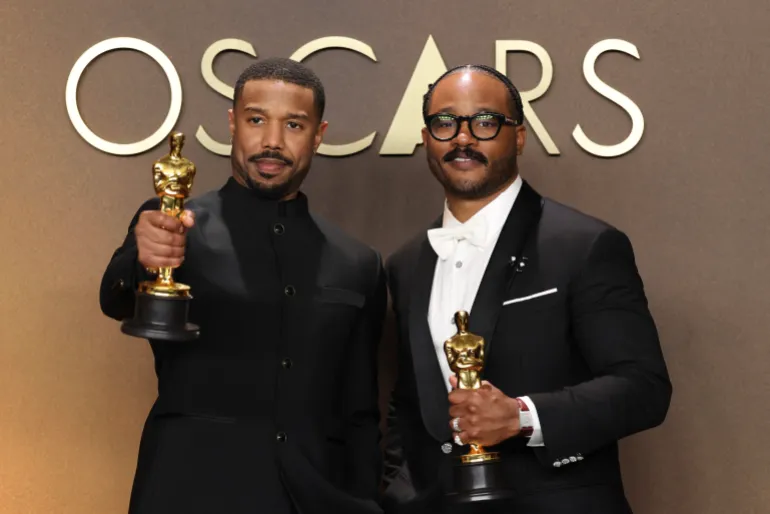
Actor Michael B Jordan holds the Oscar for Best Actor next to director Ryan Coogler, who earned an Oscar for Best Original Screenplay [Valerie Macon/AFP]
A two-horse race between Sinners and One Battle
The vampire film Sinners came into Sunday night’s ceremony with a record 16 Oscar nominations. But the big question of the night was: How many nods could it actually convert into wins?
Its biggest competition was, of course, Anderson’s One Battle After Another, which had the second highest tally of nominations.
Sinners director Ryan Coogler and Anderson were in direct competition in several top categories, including Best Picture and Best Director.
In both cases, Anderson came out ahead, though he acknowledged how fickle such awards can be.
“ I just want to say that, in 1975, the Oscar nominees for Best Picture were Dog Day Afternoon, One Flew Over the Cuckoo’s Nest, Jaws, Nashville and Barry Lyndon,” the four-time Best Director nominee said, listing films now considered to be Hollywood classics.
“There is no best among them. There is just what the mood might be that day.”
In the categories for Best Supporting Actor and Best Film Editing, One Battle After Another also triumphed, as well as for the inaugural award for Best Casting.
But in a sign of how well matched their two films were, both Coogler and Anderson emerged from the night with writing Oscars.
Anderson picked up Best Adapted Screenplay award for his use of the Thomas Pynchon novel Vineland, while Coogler made off with the Best Original Screenplay Oscar for Sinners, a work inspired by his uncle’s love of the blues.
US cinematographer Autumn Durald Arkapaw poses in the press room with her Oscar for Best Cinematography [Valerie Macon/AFP]
Jordan dunks on Chalamet in Best Actor race
Sinners, which won four Academy Awards overall, earned some of the most emotional, nail-biting victories of the night.
In the Best Cinematography category, for instance, Autumn Durald Arkapaw became the first woman to top the field.
It was her first nomination and first win, with Arkapaw besting veteran cinematographers like Marty Supreme’s Darius Khondji and Frankenstein’s Dan Laustsen, both multiple nominees.
Another big win for Sinners came in the form of Michael B Jordan, the actor whom Coogler has cast in every film since his directorial breakout in 2013’s Fruitvale Station.
Jordan, 39, was in a tight race for Best Actor with another young performer, 30-year-old Timothee Chalamet of the 1950s ping-pong drama Marty Supreme.
But Chalamet’s aggressive campaigning may have ultimately sabotaged his prospects. Multiple cracks were taken throughout the night at Chalamet’s recent comments disparaging opera and ballet.
“Nobody cares anymore” about either art form, Chalamet said in an interview last month.
“We can change society through art, through creativity, through theatre and ballet and also cinema,” director Alexandre Singh said pointedly during his acceptance speech for Best Live Action Short.
O’Brien, meanwhile, acknowledged the backlash with a joke about heightened security at the night’s Oscar ceremony.
“I’m told there are concerns about attacks from both the opera and ballet communities,” O’Brien said, before turning to Chalamet. “They’re just mad you left out jazz.”
Irish actress Jessie Buckley celebrates her win during the 98th Annual Academy Awards [AFP]
A conga line of snubs
Given the dominant performances from Sinners and One Battle After Another, plenty of critically acclaimed films left empty-handed, or nearly so.
Guillermo del Toro’s Frankenstein, as expected, earned three wins in technical categories, including Best Production Design, Best Costumes and Best Hairstyling and Makeup.
Netflix’s smash hit KPop Demon Hunters, meanwhile, also fulfilled expectations that it would dominate in its categories, Best Animated Feature and Best Original Song.
But then there were former frontrunners like Hamnet that failed to generate much traction, including for director Chloe Zhao, a past Oscar winner. Out of eight nominations total, it only came away with one win: a Best Actress trophy for Irish performer Jessie Buckley.
Marty Supreme and the Brazilian film The Secret Agent fared worse, however. Despite having nine nominations and being considered an early shoo-in for Best Actor, Marty Supreme scored no wins.
The Secret Agent, which swept the Best Actor and Best Director categories at the 2025 Cannes Film Festival, also earned nothing at this year’s Oscars.
Same was true for the quirky kidnapping drama Bugonia, from Oscar darling Yorgos Lanthimos.
South Korean-US singer Ejae poses with the Oscar for Best Original Song for the film KPop Demon Hunters[Angela Weiss/AFP]
Fears about artificial intelligence
The ceremony, however, did occasionally veer away from the competition between the films to discuss issues facing the film industry and the country as a whole.
Among those was the creeping growth of artificial intelligence (AI) in the creative sector.
In the weeks leading up to the 98th Oscars, an AI-generated video clip had gone viral, appearing to show Hollywood icons Brad Pitt and Tom Cruise in a rooftop brawl worthy of a James Bond movie.
The clip had been generated through AI software developed by the Chinese firm ByteDance, and Hollywood leaders quickly denounced it as a threat to their livelihood, not to mention a copyright infringement.
Those concerns reverberated on the Oscar stage on Sunday, with O’Brien and others addressing the growing use of AI.
“Tonight we are celebrating people, not AI, because animation – it’s more than a prompt,” actor Will Arnett said emphatically as he introduced the animation awards.
O’Brien, meanwhile, joked that, by next year, his hosting gig would be taken by “a Waymo in a tux”.
Host Conan O’Brien performs onstage during the 98th Annual Academy Awards [Patrick T Fallon/AFP]
Trump skewered for threatening free speech
Another concern looming over the night’s Oscar ceremony came in the form of President Donald Trump, who has courted controversy by launching deadly military attacks in Venezuela and Iran, as well as leading a violent immigration crackdown in the US.
At no point was Trump mentioned by name. But his leadership was alluded to throughout the night.
O’Brien, the host, set the tone early on with his oblique jabs at the Republican president in his opening monologue.
“When I hosted last year, Los Angeles was on fire,” the two-time Oscar emcee said in remarks dripping with sarcasm. “But this year, everything’s going great.”
Fellow comedian Jimmy Kimmel was even more direct. Last September, his show was briefly suspended after Trump criticised the comedian.
The head of the Federal Communications Commission, a Trump appointee, subsequently threatened the broadcasting license of the TV channel Kimmel performs on.
“There are some countries whose leaders don’t support free speech. I’m not at liberty to say which. Let’s just leave it at North Korea and CBS,” Kimmel quipped, referring to another channel that cancelled a fellow late-night comedy show.
Several filmmakers honoured at the Oscars likewise waded into the controversies surrounding Trump.
Best Documentary Feature winner David Borenstein, for instance, implied a parallel between his film — an exploration of authoritarianism in Russia — and what is currently happening in the US.
“Mr Nobody against Putin is about how you lose your country,” Borenstein explained.
“What we saw when working with this footage is that you lose it through countless small little acts of complicity: when we act complicit, when a government murders people on the streets of our major cities, when we don’t say anything, when oligarchs take over the media.”
Indian actress Priyanka Chopra and Spanish actor Javier Bardem present the award for Best International Feature Film [Patrick T Fallon/AFP]
Political speeches avoid mention of Iran war
The Oscars come roughly seven months ahead of the pivotal midterm elections in the US, which could see Trump’s Republican Party lose its majorities in Congress.
But while several filmmakers did hint at their anti-Trump stances, few explicitly denounced his policies.
For example, Norway’s Joaquim Trier, the winner of the Best International Feature category, veiled his criticism in a James Baldwin quote about the duty to protect children.
“Let’s not vote for politicians who don’t take this seriously into account,” Trier said.
No artist during the night referenced the US and Israeli war against Iran either, though its effects were felt among the participants of this year’s Oscar crop.
Writer-director Jafar Panahi, whose work was up for two Oscars on Sunday, has already said he plans to return to his native Iran after the awards season concludes.
Meanwhile, Iranian politician Sara Shahverdi — the subject of a nominee in the Best Documentary Short category — was prevented from attending the Oscars at all due to Trump’s ban on visas for 39 countries.
Palestinian actor Motaz Malhees, star of the Oscar nominee The Voice of Hind Rajab, likewise told media outlets he could not be present at the ceremony due to the travel ban.
The most pointed acknowledgements of the US-led and US-backed conflicts in the world were brief. When Spanish actor Javier Barden took the Oscar stage to present an award, he offered up six words, “No to war, and free Palestine!”
Russian filmmaker Pavel Talankin, meanwhile, made a similar appeal to the audience. “In the name of our future, in the name of all of our children, stop all of these wars now,” he said.
But by and large, the Oscar winners and presenters kept their remarks vague, emphasising global unity over political criticism.
“If I can be serious for just a moment, everyone watching right now around the world is all too aware that these are very chaotic, frightening times,” O’Brien told the audience at the outset of the night.
“It is at moments like these that I believe that the Oscars are particularly resonant. Check it out. Thirty-one countries across six continents are represented this evening, and every film we salute is the product of thousands of people speaking different languages.”
Cinema, he and others argued, transcended borders. The talent on stage was not the US’s alone.
KYLIE Jenner has stunned in a body-hugging sparkly red gown ahead of the Oscars to support her boyfriend and nominee, Timothee Chalamet.
The beauty mogul will join Timothee, who is up for Best Actor for his performance in the sports drama Marty Supreme, at the 98th Academy Awards on Sunday.
Sign up for the Showbiz newsletter
Thank you!
Kylie Jenner showed off the body-hugging red gown she’s wearing to the 98th annual Oscars ceremony on Sunday, March 15Credit: Instagram/kyliejennerKylie posted a video of her look on Instagram shortly before the showCredit: Instagram/kyliejennerThe reality star hinted that her look channeled the sexy cartoon character, Jessica Rabbit
Kylie, 28, teased her outfit in an Instagram video, in which she donned a low-cut Schiaparelli dress that showcased her cleavage and curvy figure.
The ensemble featured a cut-out of a lock beneath her breasts, and she paired it with a diamond necklace and earrings.
She wore her brunette hair in loose waves and a full face of makeup for the A-list event.
Kylie hinted in her caption that her look channeled the sexy cartoon character, Jessica Rabbit.
Several celebrities in the Kardashian-Jenner inner circle gushed over Kylie’s appearance in the comments.
“My heart skipped a beat,” Kylie’s sister, Khloe Kardashian, wrote.
“OMG YES,” the reality star’s BFF Stassi Karanikolaou said.
“Everything,” Lauren Sanchez Bezos added alongside a red heart emoji.
Most read in Entertainment
Kylie has been by Timothee’s side – amid fierce backlash over his claims that no one cares about the ballet or opera – throughout the 2026 awards season, as he was a heavy favorite following his Golden Globes win against standouts Michael B. Jordan, Leonardo DiCaprio, and Ethan Hawke.
He even gave a shoutout to the Kylie Cosmetics founder in his acceptance speech for Best Actor at the January 11 ceremony, saying, “For my parents, for my partner, I love you. Thank you so much.”
Days earlier, Timothee, 30, again called out The Kardashians star, who shares daughter Stormi, 8, and son Aire, 4, with her ex, Travis Scott, while accepting the Critics’ Choice Award for Best Actor at the January 4 show.
“Lastly, I would like to say thank you to my partner of three years,” the Call Me by Your Name star said onstage.
“Thank you for our foundation. I love you. I couldn’t do this without you. Thank you from the bottom of my heart,” he concluded.
Kylie looked visibly touched by the sentiment, smiling and mouthing “I love you” back to him.
Biggest Oscar Nominees of 2026 Academy Awards
Everyone in Hollywood hopes to snag a nod on the industry’s biggest night but only few get that honor. Here are the nominees from the major categories of the 2026 Academy Awards:
Best Picture
Bugonia
F1
Frankenstein
Hamnet
Marty Supreme
One Battle After Another
The Secret Agent
Sentimental Value
Sinners
Train Dreams
Best Director
Chloé Zhao — Hamnet
Josh Safdie — Marty Supreme
Paul Thomas Anderson — One Battle After Another
Joachim Trier — Sentimental Value
Ryan Coogler — Sinners
Best Actor (Leading Role)
Timothée Chalamet — Marty Supreme
Leonardo DiCaprio — One Battle After Another
Ethan Hawke — Blue Moon
Michael B. Jordan — Sinners
Wagner Moura — The Secret Agent
Best Actress (Leading Role)
Jessie Buckley — Hamnet
Rose Byrne — If I Had Legs I’d Kick You
Renate Reinsve — Sentimental Value
Emma Stone — Bugonia
Kate Hudson — Song Sung Blue
Best Supporting Actor
Benicio Del Toro — One Battle After Another
Jacob Elordi — Frankenstein
Delroy Lindo — Sinners
Sean Penn — One Battle After Another
Stellan Skarsgård — Sentimental Value
Best Supporting Actress
Teyana Taylor — One Battle After Another
Wunmi Mosaku — Sinners
Amy Madigan — Weapons
Elle Fanning — Sentimental Value
Inga Ibsdotter Lilleaas — Sentimental Value
Best Original Screenplay
Bugonia — Yorgos Lanthimos & Will Tracy
Marty Supreme — Josh Safdie & Ronald Bronstein
One Battle After Another — Paul Thomas Anderson
Sentimental Value — Joachim Trier & Eskil Vogt
Sinners — Ryan Coogler
Best Adapted Screenplay
Blue Moon — Richard Linklater & Glen Powell
Frankenstein — Guillermo del Toro
Hamnet — Chloé Zhao
The Secret Agent — Kleber Mendonça Filho
Train Dreams — Clint Bentley & Greg Kwedar
Best Animated Feature
Arco
KPop Demon Hunters
The Magnificent Life of Marcel Pagnol
Zootopia 2
The Night Gardener
Best International Feature Film
The Secret Agent — Brazil
Sentimental Value — Norway
It Was Just an Accident — Iran
Universal Language — Canada
Sujo — Mexico
Best Documentary Feature
The Alabama Solution
Come See Me in the Good Light
Four Daughters
No Other Land
The Perfect Neighbor
In December, Kylie showed support for Timothee on the red carpet of the film’s LA premiere, where they sported matching orange ensembles.
The mom of two rocked a dangerously low-cut, skintight dress with cut-outs along the midsection.
She paired the look with high heels, a chunky gold necklace, orange nails, and her long black hair flowing straight down.
Timothee wore pants, a button-down shirt, a jacket, and boots, accessorized with a black cross-body bag shaped like a ping pong paddle, as a nod to the film.
It was their first major public appearance together since rumors began that their relationship was on the rocks.
In October, fans believed there was trouble in paradise after they appeared to show a lack of affection toward one another while watching a New York Yankees game, with many accusing Kylie of “looking bored.”
Weeks earlier, Timothee was a no-show at Kylie’s mom, Kris Jenner’s, elaborate 70th birthday bash, fueling chatter that they were ready to call it quits.
In November, a source exclusively revealed to The U.S. Sun that the couple were at odds over Timothee’s desire to keep their romance private, while Kylie wanted to share their love with the world.
The insider also claimed that Kylie had been “pressuring” Timothee about “cementing their relationship,” but the Wonka star wanted to focus on “fixing their issues.”
Kylie and Timothee first began dating in April 2023, although they didn’t make their public debut until they were spotted at a Beyoncé concert later that September.
They managed to keep their romance out of the public eye until they made their red carpet debut as a couple in May 2025 at the 70th David Di Donatello Awards in Rome.
Kylie had parted ways with her baby daddy, Travis, shortly before getting together with Timothee, and had previously been in a years-long relationship with rapper Tyga.
Timothee dated Johnny Depp’s daughter, Lily-Rose Depp, whom he met on the set of the Netflix film The King, from 2018 to 2020.
Kylie is supporting her boyfriend, Timothee Chalamet, who is nominated, at the awards showCredit: GettyRumors previously circulated that the pair were having trouble in their relationshipCredit: GettyThe duo had primarily kept their relationship out of the public eye, which sources exclusively told The U.S. Sun was Timothee’s requestCredit: Getty
In late November, Gabriela Jaquez scored 29 points against Tennessee. It wasn’t her career high; that came when she tallied 30 points two years prior.
But that game, when Tennessee had no answers for a player who was then the UCLA women’s basketball team’s fifth offensive option, felt like Jaquez’s coming-out party after years as a quieter cog in the Bruins’ rotation. It changed the way teams had to defend her. Previously known more for attacking the rim than for shooting from outside, Jaquez showcased a different dimension.
Suddenly, one of the best teams in the nation had one of the best breakout stars. Entering the NCAA tournament, the 31-1 Big Ten champion Bruins are relying on Jaquez as one of their super seniors to guide them back to the Final Four.
UCLA guard Charlisse Leger-Walker hugs teammate Gabriela Jaquez, who led the Bruins in scoring during a win over Tennessee on Nov. 30 at Pauley Pavilion.
(Luiza Moraes / Getty Images)
“I do think she’s always been that player,” said senior guard Kiki Rice, who has played four seasons with Jaquez. “But I do think she’s had a lot more opportunity to demonstrate that, and you saw that in the beginning of the year. She just started off such a hot shooter, and the way that she’s developed every single year, gotten better and just found a way to impact the team.”
Though she hasn’t reached that same scoring peak again, Jaquez has quietly buoyed UCLA’s dominant run this season as the Bruins have emerged as one of the favorites to win a national title. She ranks second on UCLA (among players with at least 30 attempts) in field-goal percentage at 54.3%, second in three-point shooting at 41.1% and third in scoring.
Jaquez has gotten attention for being part of a family legacy at UCLA and spending an offseason with the Bruins’ softball team. But in the background, even when she hasn’t been the leader for the UCLA women’s basketball team, Jaquez has honed herself into one of just 25 Power Four conference players shooting better than 40% from deep this season.
Jaquez, who tallied her 1,000th career point early this season, is having a career-best season with 13.6 points per game, has added double-digits in 25 of her 31 games this season.
“There’s so much depth to her,” said guard Charlisse Leger-Walker, who often dances alongside Jaquez in videos posted on social media and Leger-Walker’s YouTube video series. “Getting to understand her off the court, I think has really helped our connection on the court, and kind of how her personality is so outgoing. She likes to bring people along. You can see that on the court.”
Jaquez came in as a 5-foot-11 freshman who played primarily as an undersized forward and would crash the net and collect rebounds.
The shooting, though, has been the biggest change this season.
“I think of her as someone who, especially early on, like she doesn’t need to have the ball on hand, she doesn’t need to have plays run for her to impact the game,” Rice said. “But then she’s been shooting so well too.”
Early in the season, teams doubled Lauren Betts, who leads the team with 16.4 points per game as a center, which opened Jaquez to shoot from deep, establishing herself as someone who needed to be keyed on.
UCLA’s Gabriela Jaquez shoots the ball under pressure from Oregon’s Katie Fiso on Dec. 7 at Pauley Pavilion.
(Luke Hales / Getty Images)
Her 107 three-point attempts are a career-high this season, with her shot selection jumping to 32.4% coming from behind the arc. That’s come with a career-high 2.2 assists per game and an 85.2 defensive rating, ranked in the top 20% of the nation.
“She can shoot the ball, she can finish, she defends,” shooting guard Gianna Kneepkens said. “I love playing with Gabs. Sometimes I get caught watching her because she’s just so amazing.”
Now, Jaquez projects as a first-round WNBA pick, in large part because of her versatility on offense. She is listed as a guard on the Bruins’ roster, but often starts at forward, where she can stretch the floor. Her 5.4 rebounds per game are third on the team, thanks in large part because of her ability to fill positions one through five.
During UCLA’s Big Ten semifinal win over Ohio State, Jaquez shot four for 12 but Bruins coach Cori Close noted Jaquez’s importance when her shooting isn’t on target.
“What I liked about that the most is that she struggled a little bit in the middle of the second half,” Close said. “It just showed a lot of her mental toughness that, when we needed her the most, she was going to be there for us on the defensive end and on the rebounding end.”
While all five starters have been mentioned as possible WNBA first-rounders, Jaquez has perhaps made the biggest leap, two WNBA scouts not authorized to publicly discuss prospects said.
UCLA senior Gabriela Jaquez celebrates with the Big Ten tournament trophy after the Bruins beat Iowa in the finals on March 8 in Indianapolis.
(Michael Conroy / Associated Press)
When Rice and Leger-Walker are on the bench, Jaquez has taken on point guard duties.
“She does all those little hustle plays,” Leger-Walker said. “She will score if you need her to, she’ll cut, she’ll rebound, like, she’s so versatile. You know what you’re getting from her, and she’s kind of that person who’s the engine of our team.”
Jaquez hasn’t thought much about what happens after this season. This year’s mantra of joy has resonated after last year’s crushing Final Four loss to Connecticut.
“It’s been fuel,” Jaquez said. “That started [last] spring and into the offseason, knowing exactly what to work on, how to prepare…. But I just love the team aspect of basketball, I love this group of girls specifically and I think having so much fun out there has [been the most important thing] and winning has made it even better.”
The night Jaquez hit five three-pointers against Tennessee may have felt like her arrival. But for the teammates who have watched her develop for four years, it looked less like a breakthrough and more like the rest of the country finally catching up.
The rest of the country may have only noticed this season. But inside UCLA’s locker room, Jaquez has been that player all along.
“Gabs is an extremely confident person, so I feel like if you’d asked her this freshman year, she would have believed that she’d become just the incredible player that she is,” Rice said. “Just the opportunity, her experience at this level these past few years has really helped her develop into what she is.”
They revealed they were starstruck when Ginger Spice popped into their rehearsal at a West London studio last month, accompanied by her husband Christian Horner’s daughter.
Asked about their celebrity fans, Danny said: “The legend that is Geri Halliwell and her step-daughter came to the rehearsal studio to watch our set. They had wanted to come to our London show, but were due to be away when it was on, so we invited them to our rehearsals.
“Geri was like a pocket rocket. Petite and loads of personality.
Last month, they attended their first Brit Awards, in Manchester, and have told how they brushed shoulders with singers Lola Young and Sam Fender, as well as Happy Mondays maracas player Bez.
Cruz said: “I was partying with Bez in the DJ booth — he is funny. He and I have got to go to Ibiza one day.”
To celebrate Mother’s Day, the boys have been treating their mums after receiving their first big pay cheque.
Hendrik said: “I have been saving money to try and finish my mum and dad’s house. They have been wanting to finish it for years.”
Despite the global stardom that awaits, it sounds like the boys are keeping their feet on the ground.
SIMON ‘PROUD’ OF LADS
DECEMBER 10 have revealed how their mentor Simon Cowell was proud of them after their sold-out London show.
The music mogul and his fiancee Lauren Silverman attended their gig at the O2 Academy Islington, in North London, last month.
December 10 have revealed how their mentor Simon Cowell was proud of them after their sold-out London showCredit: Getty
Band member Nicolas said: “He really enjoyed that we incorporated instruments into the live show, and when he spoke to us, that was one of the main things that made him really happy and proud.”
John added: “He has also always said that he just wants great songs. Over the past few months that we have been recording music, we have been working towards that.”
And the boys reckon it still feels surreal seeing thousands of teenagers queuing to hear them play.
Nicolas said: “I wouldn’t say it’s overwhelming, it’s more of a strange feeling, because the first show was a bit of a shock.
“It is a feeling for me, personally, that I don’t think I will get used to.”
WIN A SIGNED T-SHIRT
DECEMBER 10 have signed a T-shirt exclusively for one lucky Biz on Sunday reader.
For your chance to win the prize, email sunday features @the-sun. co.uk by March 26.
For T&Cs, visit thesun.co.uk.
HE HAZ TO SEE MATES
HE is one of the biggest pop stars on the planet, but Harry Styles says he had to change his mindset so he did not become a recluse.
He explained: “When you shut out a lot of the things that are assumed can be negative, you also just unconsciously shut out a ton of positive things.
Harry Styles says he had to change his mindset so he did not become a recluseCredit: Getty
“It can be hard to go to a bar and hang out with friends because there’s maybe people who would act [in a certain] way.
“There’s also incredible people that you can meet in that bar – that you also shut yourself off from.”
He added on SiriusXM: “I was having some experiences where I was meeting some really great people that were kind of really planting the seed of, like, ‘Oh, I don’t want to shut myself off from this world’.”
It comes as his record Kiss All The Time. Disco, Occasionally has topped the albums chart, while his track American Girls is No1 in the singles rundown.
DENISE VAN OUTEN and Johnny Vaughan are creating a new Big Breakfast-style TV show 25 years after the original was axed.
I can reveal the pair, who presented the Channel 4 show in the Nineties, are working on a new format set to shake up TV schedules.
Denise said: “In my new touring show [An Evening With Denise], of all the things I’ve done, The Big Breakfast section gets the biggest reaction. I think people are still craving that chaos and the fun – we’ve lost it.”
She added: “I’m working on something with Johnny, it’s going to have that feel to it. It’s all come from the show and speaking to people. I was like, ‘Oh, people are missing this, they want this’.”
I cannot wait.
YOU’RE SO ROUGE, CHRISTINA
CHRISTINA AGUILERA was red hot on stage in this basque and matching gloves.
The US hitmaker teamed them with thigh-skimming black boots in Austin, Texas, as she headlined the Coca-Cola Sips & Sounds Music Festival.
Christina Aguilera was red hot on stage in this basque and matching glovesCredit: Shutterstock Editorial
Highlights included a performance of her 2001 hit Lady Marmalade, from film Moulin Rouge!, as fireworks lit up the sky.
MAYA’S VILLA TO VILLAIN
MAYA JAMA has revealed what her dream movie role would be – and it’s not what you might expect.
The Love Island host, who is set to star in the second series of Guy Ritchie’s Netflix crime-comedy The Gentlemen, said: “I’ve always said I don’t want to be what people expect me to be on camera.
Maya Jama has revealed what her dream movie role would be – and it’s not what you might expectCredit: Getty
“I’d want to be the complete opposite to that . . . so a monster or a mean, evil person. A villain maybe would be nice.”
The pair, who married in 2018, have both appointed legal teams and have quietly started proceedings.
Millie Mackintosh and Hugo Taylor have filed for divorceCredit: Getty
Reality star turned author Millie, who has two daughters with entrepreneur Hugo, has been through the process before, having split from rapper Professor Green, who she was married to from 2013 to 2016.
A pal said: “Fans will be sad to hear that their relationship is really over, but the pair just want a clean break.
“Millie and Hugo are committed to co-parenting their two young children and keeping everything stable. They are still very amicable with each other and have a lot of respect for one another.
“They want the divorce to go through as painlessly as possible and are focusing on work in the meantime.”
Professor Green has a son with model and actress Karima McAdams, who he dated for five years after splitting with Millie.
Now, he is back in touch with Millie and said: “There’s no resentment in me. She is gorgeous. We were not good for each other at that time.
“We spoke about our mutual diagnosis (ADHD) and our kids.”
The couple are eyeing up Son Marroig, a stunning, 17th century, clifftop temple on the Spanish island for their summer nuptials.
Molly Smith and Tom Clare are set to tie the knot in Majorca – home of the original dating show’s villaCredit: Supplied
The venue is popular among celebrities, with Pixie Geldof, weatherman Alex Beresford and Man City defender Nathan Ake all having held their ceremonies there.
A source said: “Majorca is a stunning destination for a wedding and there is plenty of privacy on the island. Many of the buildings are difficult to access by road and it has a secluded feel.
“There is guaranteed sun and it offers a beautiful backdrop with the most stunning sunsets.”
Tom and Molly do a weekly podcast called NearlyWeds and post regular vlogs about their planning.
Congrats guys . . .
EX-PM SNAPS GEM OF A SHOT
GEMMA COLLINS posed with an unlikely fan at the Cheltenham races this week – as I am told that former PM David Cameron asked for a photo.
And reality favourite Gemma was only too happy to oblige David and wife Samantha in the Royal Box.
Gemma Collins with David and Samantha Cameron at the Cheltenham racesCredit: Gemma Collins/Instagram
A source said: “Gemma was honoured that David asked her for a picture. They chatted about politics and her fondness of current Conservative leader Kemi Badenoch.”
Chuffed Gemma quickly shared the snap with her 2.2million Instagram followers.
She wrote: “It was lovely to be in the Royal Box and have a good chat with David Cameron and his lovely wife. We spoke politics and . . . what we were going to bet on next.”
Gemma, who is a face of bookmaker Paddy Power, won a mighty impressive £20,000 at Cheltenham – and £5,000 off just one bet.
The GC was spotted shouting, “I’m loaded” as she basked in her glory alongside stars including Danny Dyer and Peter Crouch.
CHICAGO — This was hardly a masterpiece of Big Ten basketball, what with the barrage of bricks and busted possessions. Nor was it the sort of night to convince you of UCLA’s chances as a surefire conference contender.
But amid the mess of its 72-59 win over 14th-seeded Rutgers on Thursday night, UCLA showed the sort of mettle it may need to keep its season kicking this March.
It started with Donovan Dent, whose masterful month continued with his first career triple-double — and the first triple-double in Big Ten tournament history. The senior tallied 12 points, 10 rebounds and 12 assists. He and Tyler Bilodeau, who added a game-high 21 points, were the rare bright spots on offense for the Bruins.
Otherwise, UCLA struggled to find any sort of rhythm. It shot just 38% from the floor, worse than it had in any win this season. And still, the Bruins were in control for most of the game after pulling away early in the second half.
None of that will fly against No. 3 seed Michigan State on Friday at 6 p.m. PDT, which beat UCLA by 23 points the last time they met.
But until Thursday it’d been quite some time since UCLA actually managed to win away from home. Not since Jan. 29 had it won outside of L.A., and only once this season had it won outside of the Pacific time zone.
For a while, it didn’t seem like UCLA intended to win Thursday, either. Even as Rutgers gave it every chance to pull away.
The Bruins did shut down Rutgers’ Tariq Francis, who was fresh off a 29-point performance in a first-round win over Minnesota. Francis didn’t score until the nine-minute mark in the second half. He finished with six points on two-of-11 shooting.
The two teams spent most of the first half trading wasted possessions and taking turns with their respective shooting slumps. Four minutes scoreless for Rutgers. Three scoreless for UCLA. Four scoreless for Rutgers. Then three scoreless for UCLA. Back and forth they went in their futility.
The Bruins had plenty of chances to build a lead early. While Rutgers struggled to find rhythm on offense, settling mostly for contested shots inside the arc, UCLA got its share of open shots all around the floor. It just wasn’t able to hit many of them. Both teams shot a meager 31% before halftime.
Those shots fell more frequently in the second half, as UCLA pushed its lead to 15. The Bruins still struggled to put the Knights away, until Dent took matters into his own hands late, pushing UCLA to victory.
Weighing in at about 550 pounds, Woody, his largest hog (named by a grandson after the “Toy Story” icon) plays “like a puppy” in his free-range paddock, Staples told me, gobbling up the rye, clovers and winter peas that have grown knee-high under the Southern sun.
Swine life on Staples’ sustainable family farm is a jarring contrast to the existence of a pig on one of America’s “intensive” corporate-owned mega-farms, where some sows are confined to cages so small they literally can’t turn around or take more than a step or two in any direction.
“It’s not necessary and it hasn’t proven to be good science,” Staples, a self-described conservative Republican, said of Big Ag porcine lockups. “It’s also cruel.”
At issue is the Save Our Bacon Act, a sneak attack backed by foreign corporations currently hidden deep inside the farm bill. It would severely curb the ability of states to enact limits on animal confinement and maybe accidentally open the door for ending all kinds of state-level food safety laws.
The SOB Act, an apt nickname, would not only cripple small family farmers such as Staples (though its supporters claim it helps family farmers), it would negate the will of California voters, potentially introduce risk into the food chain, and turn greater power of our food supply over to China.
It would also limit consumer choice at a time when more Americans — from fans of far-right Health Secretary Robert F. Kennedy Jr. to far-left granola grandmas — are demanding a say in how their food is produced.
Let’s break that down.
What is the SOB Act?
For the vegetarian hard-liners out there, it is true that Woody himself will someday likely be bacon.
But, increasingly over the past decades, meat-friendly consumers have moved toward wanting animals to “live a really great life and have one bad day,” as Nate Beaulac, another conservative Oklahoma pork farmer, describes it.
In 2018, to further that aim, about 63% of California voters passed Proposition 12, which increased the space that breeding sows were required to have, from something about the size of a small car trunk to the size of a coat closet. We’re not talking rolling acres here — just enough room to turn around. Some of these sows are basically caged for the majority of their breeding life — years — and are about the size of a black bear.
But here was the real bite in Proposition 12: No pork from any state could be sold in California if it didn’t come from a farm that met the new standard.
Overnight, the corporate breeders were locked out of the Golden State market. They sued bigly, and lost bigly in 2023 at the Supreme Court, which upheld California’s right to impose the state standard.
The SOB Act would negate Proposition 12 (and a similar law in Massachusetts) and forbid states from making laws regarding animal confinement, according to an analysis by the Animal Law & Policy Program at Harvard Law.
That would emphatically overturn the will of the majority of California voters who want those standards.
But hey, Big Pork would make big bank.
“They want to limit American consumers’ ability to fight,” Beaulac told me. “They wanted to limit Americans’ ability to pursue any sort of change. And that is why me, not only as a farmer, but as an American and a capitalist, I’m strongly opposed to the Save Our Bacon Act, and in staunch support of Proposition 12.”
What Prop. 12 did
Beaulac was once a Californian himself, before heading to the Sooner State for college. He describes himself as a “Christian, capitalist, conservative environmentalist,” and a sustainable farmer who depends on consumers’ desire for healthy food to sell his pigs, chickens and cows.
Proposition 12, Beaulac said, “was a huge help to smaller farms, and the only people that it really hurt were the huge multinational conglomerates.”
“I mean very simply, we want the opportunity to compete,” he said.
Staples, Woody’s owner, who is also an expert in project management and environmental compliance from a previous career in the power industry, makes the case that the mega-farms can also come with mega-dangers.
“You have 100,000 pigs within two miles of each other, the chance of issues with a swine flu or natural disaster just increases,” he said. He points out that issues such as disease, groundwater contamination and waste disposal have already become problems for some large farms.
The flaws in the SOB Act don’t stop there.
The Harvard Law analysis points out that the loose language of the bill could have other consequences, maybe even gutting some state safety, labeling and cleanliness standards.
And some Republicans in Congress, including Californian Reps. David Valadao and Young Kim, oppose the measure and sent a letter to the Agriculture Committee late last year urging them to dump the act, pointing out that at least a quarter of Big Pork is owned by Chinese companies and does not represent American interests.
“Foreign-owned corporations — particularly those tied to adversarial nations — already hold a disturbing amount of control over U.S. agricultural assets,” the letter read, citing Chinese-owned Smithfield Foods, the largest pork producer in the United States.
The SOB Act “could further consolidate the influence of such foreign entities,” the letter‘s authors warned.
Armed with those arguments and others, Staples and Beaulac traveled to Washington recently to make their case against the SOB Act with lawmakers.
But, both men told me, they were met with a wall of lobbyists and money.
“It’s very eye-opening in terms of how many lobbyists are there every day,” Beaulac said. “The reality is Big Ag donates big money to the senators, and so when they need their bill to go through or they need a bill shut down, they’re going to have a lot more leeway than the small farmers.”
The lobbyists, Staples said, had the debate wrapped up tight long before the farmers even knocked the dirt off their boots and entered Congress.
“It was very obvious,” he said. “I was not prepared for what Big Ag had done, how they had prepared members of Congress to address the issues we wanted to address.”
Beaulac said he’s discouraged and fears the SOB Act will pass, but also isn’t giving up hope. He sees it as a bipartisan issue, and one he hopes for which people will stand up. This week, a social media post featuring a sad photo of a caged pig went viral, drawing attention across party lines.
“Blue, red. It doesn’t matter. People want healthy food,” Beaulac said. “They want to know how it’s raised. They genuinely care how they’re feeding their family, and it has nothing to do with who they vote for in November.”
P.S. Here’s a post by right-wing commentator Michael Cernovich on the SOB Act, just a taste of how much some of the MAGA folks don’t like this measure.
— Was this newsletter forwarded to you? Sign up here to get it in your inbox.
CHICAGO — The eventual end of the USC men’s basketball season came the same way that it fizzled out during the past month, with yet another second-half collapse that featured the added pain of overtime.
The Trojans led the Huskies by 13 in the second half and had chances to win at the end of regulation and overtime, only to miss all three potential game-winning or game-tying shots and go 2-for-5 from the free-throw line in overtime. For a team that was once in NCAA tournament consideration before stumbling, that failure to finish was a persistent flaw.
USC guard Alijah Arenas talks with coach Eric Musselman during the Trojans’ loss to the Huskies in the Big Ten tournament on Wednesday in Chicago.
(Michael Reaves / Getty Images)
“That’s been the story of our last eight games,” Musselman said. “I think we’ve led at halftime four of our last eight games, and as a group, we haven’t figured out how to close games, the last 20 minutes with a lead. It’s a disappointing last eight games of the season. I thought up until that point we played good basketball.”
With the Trojans likely to decline any postseason invitation, Musselman said, he was headed to the team hotel Tuesday night to get back to work filling out next season’s recruiting class, starting with more freshmen before the transfer portal officially opens next month.
That group already includes two top-30 recruits in the Ratliff twins, Adonis and Darius, but if USC learned anything from the way this season ended, all too similar to the way last season ended, it’s that whatever depth and talent Musselman has assembled in his two years at USC hasn’t been enough, whether that’s freshmen or transfers.
“We want a blend of both,” Musselman said. “It’s early in our tenure, and we’ve got to figure out a way to get better than what we’ve done the last two years.”
Tuesday, the Trojans had no shortage of chances to fend off the end.
They had a double-digit lead with 13 minutes to play. They had the ball at the end of regulation with the score tied. They had a chance to win it in overtime and were gifted a last-chance shot to tie it.
They missed all three pivotal shots — the first two by Kam Woods, the last a 3-pointer by Jordan Marsh — to see a game they once led comfortably slip away again and again.
“On the last one, I feel like I missed Ezra [Ausar] on that cut,” said Woods, a grad transfer who joined the team in midseason. “Coach trusted me with the ball in my hands, and I feel like I let him down.”
Woods finished with 24 points while Jacob Cofie scored 14, Marsh 13 and Ausar and Ryan Cornish 10 each for 13th-seeded USC (18-14) as the 12th-seeded Huskies (16-16) beat the Trojans for the third time this season.
Freshman Alijah Arenas, who led the Trojans in scoring in both games without Baker-Mazara, was held to six points on 3-for-10 shooting and sat out the final six minutes of regulation and all but eight seconds of overtime. Musselman said that was his decision, as was the virtual absence of senior Terrance Williams, who played only one minute.
That left USC with what was essentially a six-player rotation to conclude a season that began without the injured Arenas and ended without Rodney Rice and Amarion Dickerson, both hurt, as well as the departed Baker-Mazara — all of which factored into Musselman’s position on any postseason plans.
“I haven’t had in-depth conversations with the administration yet about that, but I would assume we’re not going to play, just based on the number of bodies and how we played the last eight games,” Musselman said.
It was not all that long ago that USC was thinking about the NCAA tournament. Winners of the Maui Invitational, USC was 18-6 and above .500 in the Big Ten standings after a February 8 win at Penn State, solidly in a workable position on the NCAA tournament bubble.
But as the injuries mounted and momentum waned, second-half struggles just like the Trojans’ on Tuesday became an increasingly fatal flaw as they slumped to their longest losing streak in a decade. The loss to Washington compounded the misery of a second straight frustrating season, in familiar fashion.
“As a team, we faced a lot of adversity,” Cofie said. “I felt like we did a good job sticking with it and trying to play for each other. We had to deal with a lot of injuries. I felt like that played a huge deal in it. We still fought. We tried our best.”
Walt Disney Co. and Pixar’s “Hoppers” took the box office crown this weekend in an encouraging sign for the company’s original animated films.
The film generated $46 million in ticket sales in the U.S. and Canada, marking the highest domestic opening for an original animated movie since 2017’s “Coco,” according to studio estimates. The global box office total for “Hoppers” was $88 million.
The zany movie features a young environmental advocate who “hops” her consciousness into a robotic beaver and bands together with other woodland creatures to stop a planned freeway expansion through a glade.
The film is directed by Daniel Chong, who created the Cartoon Network animated series “We Bare Bears.”
The muscular debut for “Hoppers,” as well as the strong performance from Sony Pictures Animation’s “Goat” last month, has been a positive sign for audience interest in original animated films.
Since the pandemic, theatrical returns for animated sequels have far surpassed that of original films. Disney’s “Zootopia 2,” for instance, has now grossed more than $1.8 billion in global box office revenue, with more than $426 million domestically. Disney and Pixar’s 2024 hit “Inside Out 2” also crossed more than $1.6 billion globally.
By contrast, Disney and Pixar’s 2025 original film “Elio” brought in about $154 million in worldwide box office revenue.
Original films are vital to Pixar’s future, as the Emeryville-based studio built its reputation on its string of nearly uninterrupted original blockbuster hits, including 1995’s “Toy Story” and 2004’s “The Incredibles.”
Paramount Pictures and Spyglass Media Group’s “Scream 7” came in second at the box office with $17.3 million in its second weekend in theaters. Warner Bros. Pictures’ “The Bride!,” Sony’s “Goat” and Warner Bros.’ “Wuthering Heights” rounded out the top five at the box office, according to data from Comscore.
With several strong releases, as well as popular holdover films from 2025 that continue to bring in revenue, the first few months at the box office have been a notable improvement over last year’s dismal first quarter.
Domestic box office revenue so far is up more than 12% compared to the same time period in 2025, according to Comscore.
INDIANAPOLIS — As it turns out, the UCLA women’s basketball team was more than ready for the moment.
After competitive games in their first two Big Ten tournament contests, the Bruins dismantled No. 2 seed Iowa from start to finish during a 96-45 victory from Gainbridge Fieldhouse to seal an NCAA tournament berth and win the Big Ten.
The 51-point win was the largest margin of victory in Big Ten championship history, eclipsing the 33-point mark Iowa set in its 2023 win over Ohio State. UCLA’s 34 team assists were also a Big Ten championship record, and a season-high for the Bruins.
In front of a Iowa-heavy crowd, the Bruins put up one of their best shooting games of the season, firing 63% from the field. Gianna Kneepkens tallied 19 points and all five starters reached double digits.
It was UCLA’s 25th consecutive win dating back to November.
Kiki Rice finished with 15 points and eight assists, earning Big Ten tournament most outstanding player honors.
After Iowa (26-6, 15-3) held down Michigan in the semifinal, the Bruins (30-1, 18-0) returned the favor. The Hawkeyes tallied just five first-quarter points, their season-low in any period.
Iowa missed nine consecutive shots and committed four turnovers during a five-minute run during which UCLA mounted an 11-0 run. By the second quarter, the Bruins built a 25-point lead.
UCLA scored netted back-to-back three-pointers in 25 seconds early in the third quarter to take a 32-point advantage — 55-23.
As the Bruins did Saturday against Ohio State, UCLA relied on its defense to extend its lead. The Bruins forced 19 Iowa turnovers that led to 22 points in transition. They also held Iowa to 28% from the field.
The Hawkeyes likely earned themselves a No. 2 seed in the NCAA tournament with their conference performance.
UCLA will learn its seeding and bracket placement during Selection Sunday next week before hosting first and second round contests.
IN northern Portugal is a beautiful city that was once the home of the country’s very first king.
This year it’s set to become even more popular on the map this year thanks to it being awarded the title of European Green Capital for 2026.
Sign up for the Travel newsletter
Thank you!
In the city centre of Guimarães is Toural Square which is filled with cafes and shopsCredit: AlamyThe city of Guimaraes was the birthplace of the first king of PortugalCredit: Alamy
Guimarães is well-known for being the home of the country’s first king who was born there around the year 1109.
Dom Afonso I was the first King of Portugal, he reigned from 1139 until his death in 1185 – and secured Portugal’s independence from the Kingdom of León.
Visitors to the city can to this day see Guimarães Castle, the 10th-century fortress is said to be the actual birthplace of the first Portuguese king.
Tourists are allowed to enter the castle, although it is unfurnished, for around £5.
When it comes to food and drink, one visitor on Tripadvisor wrote that you could pick up wine between €3.75 and €4 (£3.49).
In Northern Portugal, most restaurants and bars will serve ‘fino’, a small draft beer that you can usually pick up for around €2 (£1.74).
Something else to try is Guimarães’ take on Doces conventuais – which are traditional Portuguese desserts.
A Torta de Guimarães is a crescent moon-shaped pastry with a thin, flaky, and crispy puff pastry shell.
It’s filled with a sweet and creamy mixture ofegg yolks,sugar,ground almonds, andchila(gila) squash jam.
Any bakery in the city is likely to sell Tortas de Guimarães which you can usually pick up for around €3 (£2.62).
Guimarães isLargo do Toural is at the the heart of the city. The central square was once used as a market and now has vibrant cafes.
For some incredible views, head up to the cable car which connects the city centre to the summit of the nearby Monte da Penha.
It travels up 1700 meters so you can get incredible views across the whole region.
At the very top is the Penha Sanctuary, a modern, art-deco-style church.
The Guimarães Cable Car typically costs €10 (£8.72) for a return.
For incredible views of Guimaraes, head up the cable carCredit: AlamyAt the top of the cable car is the Penha SanctuaryCredit: Alamy
This year, Guimarães has been named European Green Capital for 2026.
Part of the reason Guimarães was selected for this was its green spaces – between 2012 and 2023, the city added 95.7 hectares of natural spaces.
This includes along the main rivers and in its forests.
If you want to see it for yourself, Guimarães has a Green Map which takes visitors from Penha Mountain into the city.
Along with it, events are being held all year – Guimarães will host its spring festival in late March where there’s a 10km race through the city.
In April it will hold a three-day contemporary dance festival and the city will take part in Green Week in June as well as Mobility Week in September.
For Brits, the best way to get to Guimarães is by flying to Porto – which is around 25 miles away.
From there, you can hop on a direct bus which takes just 35 minutes and costs £5.
Here’s another quaint Portuguese canal city with white-sand beaches and cheap wine…
For striped houses that look like giant beach huts and beautiful stretches of coastline – head to Aveiro.
The city in Portugal sits on the west coast and is much less known than its neighbour – Porto – and is considered to be the country’s ‘Venice‘.
Along with its waterways, Aveiro is known for its beautiful waterfront houses, bars and boat tours.
The city is built around water including the Ria de Aveiro which is a shallow coastal lagoon – and throughout Aveiro are lots of canals.
The largest is Canal Central de Aveiro, right in the city centre and it’s here where tourists can hop onto a boat and take a river cruise.
Dotted along the water are the brightly coloured Moliceiro boats which were historically used to collect seaweed.
Now, these are used for leisure tours which you can book from €13 (£11.22).
A local pint will set you back just €2.75 (£2.38).
Just a short trip from Aveiro is the Bairrada Region Proximity, which produces plenty of sparkling and red wine, so the city is also perfect for wine lovers.
It is an excellent hub for exploring vineyards on reasonably priced tours, and bars and restaurants in the city centre offer glasses from as little as €2.30 (£2).
Aveiro is known for a local delicacy called ‘ovos moles’ – these traditional Portuguese pastries are essentially a sweet, creamy egg yolk and sugar mixture inside a thin wafer shell.
You can pick these up in local cafes or bakeries for around €1.60 (£1.38) each – and if you treat yourself to a coffee, it will cost as little as €2.16 (£1.87).