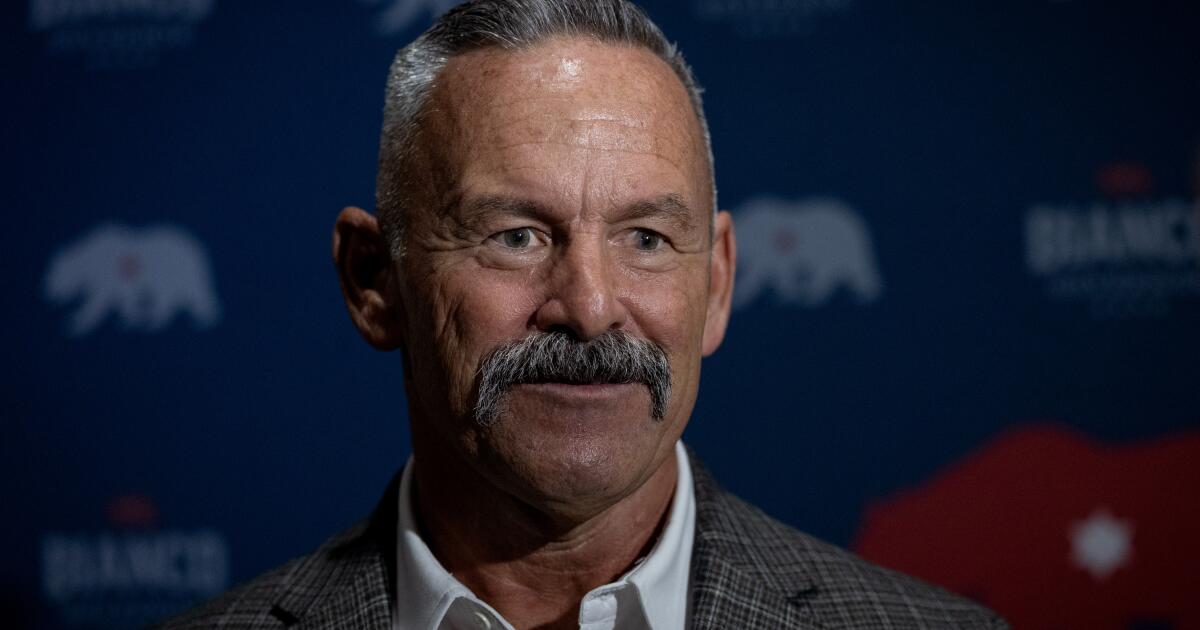
bianco

California Supreme Court appears skeptical of sheriff’s ballot seizure

California Supreme Court justices hammered Riverside County Sheriff Chad Bianco over his seizure of hundreds of thousands of Proposition 50 ballots in a pair of back-to-back hearings on Monday, appearing poised to order the ballots returned and sharply limit the sheriff’s power to snatch similar election materials in the future.

Bianco, a Republican who came in fourth in this spring’s crowded California gubernatorial primary, carted off truckloads of ballots from the Riverside County Registrar of Voters in February, after securing a warrant based on claims that the office allowed fraudulent votes in the special election to redraw California’s congressional districts last fall.

According to a sworn declaration by one of Bianco’s sergeants, armed deputies from Riverside County’s Special Investigations Bureau, Emergency Response Team and SWAT unit were sent to sweep up pallets of sealed votes and bring them to the Moreno Valley Sheriff’s Station on Feb. 26 — a day after California Atty. Gen. Rob Bonta and Secretary of State Shirley Weber ordered Bianco to stand down.

In the days that followed, deputies began their own ad hoc recount — an activity they’d never been trained for, and which state officials and civil liberties groups say flies in the face of the plain language of the state’s election law that says “in no event shall ballots be moved.”

Voters sued. So did Bonta. In oral arguments on both cases Monday morning, California‘s seven Supreme Court justices appeared at times flabbergasted by claims that the move was not only permitted but blessed under state law — and that California’s top cop had no power to block it.

“I’m just wondering … why didn’t the sheriff’s office contemplate the available routes under the elections code for resolving the alleged disparity?” asked Associate Justice Goodwin H. Liu. “Isn’t there a procedure for resolving this?”

“Certainly there are other paths,” said Bianco’s attorney, Bradley W. Hertz.

Hertz, who argued the sheriff’s case after Riverside’s county counsel largely sided with the plaintiffs, said Bianco simply exercised his legal discretion.

“This wasn’t come in with guns blaring and take the documents,” Hertz said.

The dispute began over handwritten notes made as part of an experimental program to increase voter confidence in the county’s election procedures. That informal tally fell about 46,000 votes short of the official count, prompting accusations of fraud.

Officials contend the discrepancy between the computer count and the paper tally is “a good deed that went punished” — the result of exhausted officials being handed an extra-credit project they couldn’t quite execute.

“It was a pilot program that the registrar implemented at the request of the public, on top of all their other duties, to do these handwritten logs to try to track 350,000 pieces of mail that come in,” said Dale Larson, who represented Riverside County Registrar of Voters Art Tinoco at the hearing.

Both times it was attempted, the hand tally produced a significant undercount, prompting officials to cancel the pilot, Larson said.

Bianco and his allies insist the difference is evidence of maleficence, and that criminal law authorizes the sheriff to sidestep the state’s detailed election code and the attorney general’s sweeping authority to get to the bottom of it.

The justices repeatedly pressed on Hertz to explain how the general authority conferred to the sheriff under criminal law could trump the specificity of the state’s election rules — a position that would seem to upend foundational rules of American law.

They also cast doubt on Bianco’s “counterintuitive” claim that Bonta’s “supervisory” role over the state’s elected sheriffs was merely advisory and did not carry the authority of law.

“It’s not just counterintiitive — again, we’ve said a million times, we’ve got to just look at the plain language,” said Associate Justice Joshua P. Groban. “Nobody would think that’s what ‘supervised’ means, so why should we think that here?”

For the record:

4:55 p.m. Aug. 24, 2026An earlier version of this story said a lawsuit against Bianco was brought by the ACLU. It was brought by the UCLA Voting Rights Project.

The court battle has played out with the UCLA Voting Rights Project bringing the suit on behalf of voters, and the Riverside County district attorney’s Office and the California State Sheriffs’ Assn. backing many of Bianco’s claims.
But it has also pitted the sheriff against the registrar, who was named as a co-defendent in the UCLA suit despite siding with plaintiffs in all but a narrow subset of its claims.

In court filings, Riverside County Counsel Minh C. Tran co-signed claims that Bonta and the voters had it right, carving out a narrow disagreement over whether Tinoco should have ignored the sealed warrant and faced arrest rather than allow ballots to be taken. They also questioned whether he was obligated to go to court himself to stop the seizure.

UCLA hit back at that claim, saying it was “the responsibility of the registrar to go to jail rather than hand over the ballots.”

“I know that’s strong medicine,” said Chad W. Dunn of the UCLA Voting Rights Project. “The registrar has a duty to announce publicly and get into court immediately, or at least allow the public to get into court immediately to contest the movement of ballots before it occurs.”

The decision looms as the Trump administration has moved to restrict mail-in voting and signaled it could contest results of the upcoming midterms — partisan flash points UCLA urged the court to address.

“This is bound to be repeated again,” Dunn said. “These are the public’s ballots, that’s why the election code is crafted the way it is, so that the public have a right to weigh in.”
Source link

Why a loss for Hilton would be a win for Trump

If the last few weeks have shown us anything, it’s that the gubernatorial primary is an unexpectedly close race among a trio unlikely leaders: MAGA Republican Steve Hilton, and Democrats Xavier Becerra and Tom Steyer.

Though Trump endorsed Hilton, a former Fox News host, a Hilton loss may be just what Trump wants — more fuel to fire up his MAGA base with false claims of rigged elections.

“Whether Hilton finishes first, second, or third, Trump will declare with zero evidence that there is voter fraud.,” Matt Barreto told me. He’s a professor of political science at UCLA and a founder of its Voting Rights Project, meant to promote free and fair elections.

And since California will probably take days or weeks to count all the ballots, a tight race will be fertile ground for those fraudulent fraud claims. President Trump has already started, clearly planning to use our primary to further his push to assert federal control of state-run elections.

“You have a really rigged vote in California,” Trump said last week, when asked about Hilton and Los Angeles mayoral candidate Spencer Pratt, another unlikely right-wing contender. “California’s one of the most dishonest states for voting.”

California is not, of course, dishonest in its voting, and Trump has whined about elections for so long that this rhetoric might elicit little more than a shrug from most. But California elections matter at this pivotal moment only months before the midterms. Fraud claims here will further erode trust in our electoral system and could provide Trump with ammunition for interference across the country.

Voter fraud claims may also test a new California law meant to protect real election integrity and trust — a law (Senate Bill 73, signed by Gov. Gavin Newsom last week) that has received little notice but one that could provide a model of protection for the rest of the U.S. It stops law enforcement agents, including federal agents, from “providing unauthorized access, disruption, modification, or seizure of voter rolls, voter lists, or certified voting technology,” without a court order.

Call it the Sheriff Chad Bianco Act.

Bianco, another MAGA gubernatorial hopeful, seized hundreds of thousands of ballots from a recent election, claiming he was investigating the kind of wrongdoing Trump constantly alleges without proof. State Sen. Tom Umberg (D-Santa Ana), a former federal prosecutor, said the warrant Bianco obtained from a friendly judge was “woefully deficient.”

So Umberg helped pass the measure to “protect the integrity of California elections” from “rogue law enforcement officials,” he said.

And he’s not just talking about Bianco.

“I am worried about interference in the election by federal authorities,” Umberg said. “I believe Donald Trump when he says, ‘I’m going to interfere in the election.’”

Umberg is so concerned that he has two other bills in the works he hopes will be law by November. One would stop Immigration and Customs Enforcement agents from being present at polling places. The other would make it illegal for anyone running for a third term as president to appear on the California ballot.

The buildup of fraud claims around California elections and the pushback from legislators like Umberg is a background battle that hasn’t received much attention, but one that is real and consequential.

Trump, through demands for voter rolls by the U.S. Department of Justice, the promotion of the SAVE Act, vague threats of ICE or other federal agents at polls, and the placement of election deniers in key federal rolls has gutted safeguards for voting on the national level.

States have been slow to meet the threat, largely waiting for November to see how it plays out. California, to it’s credit, isn’t so complacent.

The strange circumstances of this particular California election may be a test for both sides. Barreto, the UCLA voting expert, said he thinks “Hilton has the highest probability of finishing first on Tuesday with Becerra close by in second, and Steyer in third.”

But that could — and probably would — change as more ballots are counted.

By Thursday, Barreto said, it’s probable (far from certain) that Becerra is in the lead and Hilton is second.

“There will definitely be millions more ballots counted on Wednesday and Thursday and they will be disproportionately Democratic and contribute to both Becerra and Steyer numbers,” he said.

Maybe pushing Steyer into second? Again, a long shot. But possible.

Democrats have been holding on to their ballots until the last minute this year, with a huge number waiting until just the last few days to vote. It’s possible (though unlikely) that by sheer numbers, Democratic voters will propel both Steyer and Becerra toward November.

We do know that Republicans, despite their smaller numbers, have been voting, and trusting the postal service with their ballots this time around at a fairly high rate. That’s despite Trump’s claims that mail-in voting is inherently fraudulent.

So at the same time that we are expecting a big influx of Democratic ballots in coming days, Republicans may be closer to their voting peak, meaning Hilton’s numbers could top out on election night.

If Hilton doesn’t make the top three, after having been in the lead during in-person voting, MAGA will most certainly lose its collective mind.

And Trump will have something just as good as a Republican governor in the Golden State — “proof” we cheated.

Source link

Becerra leads governor’s race; Hilton, Steyer in tight contest for second spot

On the cusp of California’s gubernatorial June 2 primary, voters are closely divided among three candidates vying to succeed Gov. Gavin Newsom at a perilous moment in the state and nation’s history, according to a poll released Thursday.

Among likely California voters, 25% support Xavier Becerra, a Democrat and former Biden Cabinet secretary, according to the survey by UC Berkeley’s Institute of Governmental Studies that was co-sponsored by the Los Angeles Times. Republican Steve Hilton, a former Fox News commentator and British political strategist, has the backing of 21%, while 19% backed billionaire hedge fund founder turned environmental activist Tom Steyer, a Democrat.

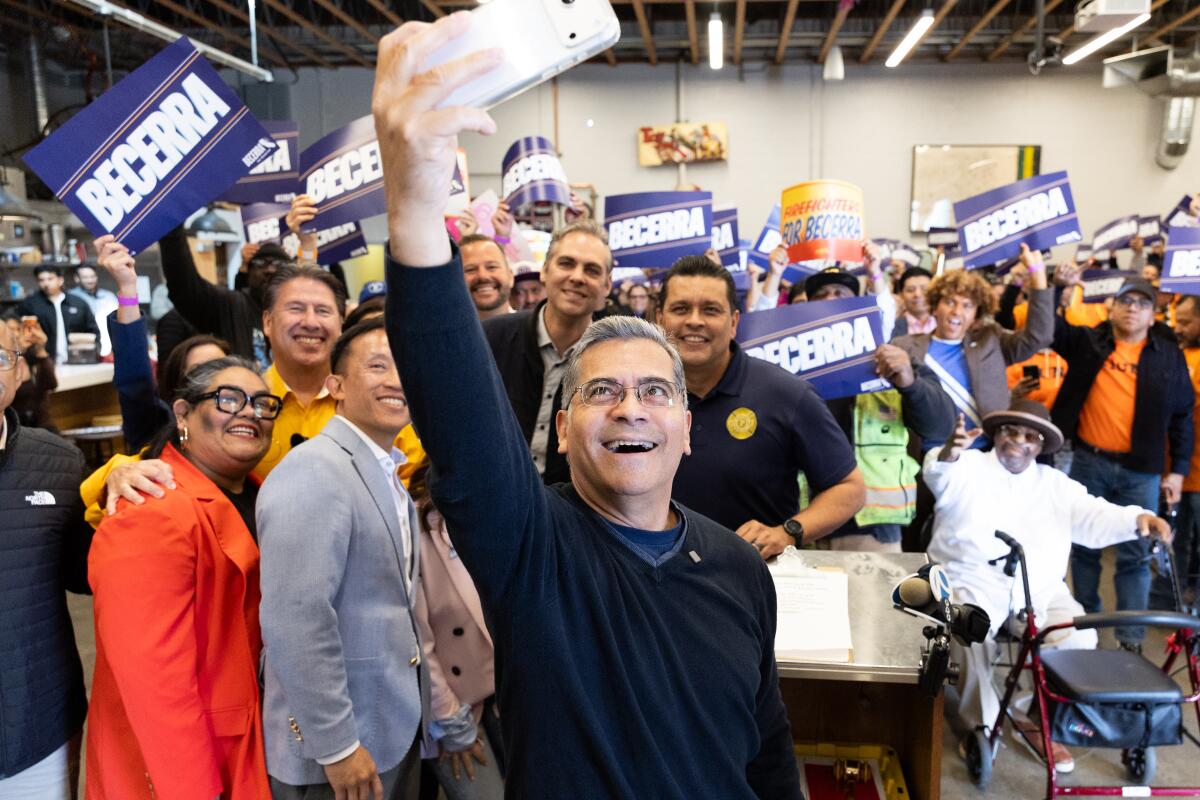
California gubernatorial candidate Xavier Becerra takes a selfie at an event while campaigning

California gubernatorial candidate Xavier Becerra takes a selfie at an event while campaigning on May 26, 2026 in San Francisco, California. Becerra is the former United States Secretary of Health and Human Services and is running as a democratic candidate for governor. California’s statewide election is on June 2.

(Benjamin Fanjoy / Getty Images)

The survey provided the clearest indication yet that the three have separated themselves from the rest of the field. Support increased for Becerra, Hilton and Steyer since the last Berkeley IGS poll in March. Becerra leapfrogged everyone. In early March he wallowed near the bottom of the pack at just 5% support among likely voters, and now is the front-runner.

The other candidates floundered. Support for Riverside County Sheriff Chad Bianco, a Republican, dropped 5% and he now finds himself in a distant fourth place. Former Democratic Rep. Katie Porter of Irvine dropped by almost half to 7%. San Jose Mayor Matt Mahan, former Los Angeles Mayor Antonio Villaraigosa and state Supt. of Public Instruction Tony Thurmond — all Democrats — remained mired in the single digits.

Poll director Mark DiCamillo cautioned that it remains unclear which candidates will finish in first and second place in the June 2 primary, a pivotal question since only the top two finishers will advance to the November general election regardless of party affiliation. The low voter turnout thus far makes predicting the outcome especially difficult.

Although every registered voter in California was sent a mail-in ballot, many have not returned them or dropped them off at voting locations — a telltale sign of the uncertain nature of this year’s governor’s race. The survey, which included all 61 of the gubernatorial candidates on the ballot, found that Democratic turnout thus far is noticeably lower compared with past primary elections, DiCamillo said.

Steve Hilton, Republican gubernatorial candidate for California, arrives for a news conference

Steve Hilton, Republican gubernatorial candidate for California, arrives for a news conference at the San Jose Diridon Station in San Jose, California, US, on Tuesday, May 26, 2026. Republican gubernatorial candidate Steve Hilton is announcing his intention to halt future taxpayer-funded payments for California’s High-Speed Rail project, if elected in November.

(Jason Henry/Bloomberg via Getty Images)

“We’re assuming that … the Democrats will in fact turn out in the final week after we had concluded our poll and begin to make up ground on what looks like an early lead for Hilton, and those voters favor Becerra,” DiCamillo said.

The survey, conducted between May 19 and 24, found that likely Democratic voters favored Becerra over Steyer by 11 percentage points. Voters registered as “no party preference” were evenly divided between Becerra, Steyer and Hilton. Among likely Republican voters, Hilton led Bianco by almost 2 to 1.

Becerra also had a notable edge over Steyer among women and Latino voters, while Steyer had an advantage among Black voters. Hilton was favored over the two Democrats among self-identified libertarians and among voters in Orange County, the Central Valley and northern coast and Sierra region.

The poll found that 7% of voters remained undecided.

For the first time in more than a quarter of a century, the contest to lead the nation’s most populous state and the world’s fourth-largest economy has consistently lacked a front-runner despite a plethora of candidates.

Two of California’s best-known Democrats, former Vice President Kamala Harris and U.S. Sen. Alex Padilla, both toyed with a run for governor before deciding not to run, which contributed to the sluggishness of the race. The 2026 campaign for governor also languished in the shadow of the mayhem stirred up by President Trump, including his immigration raids throughout Southern California, and the devastation wrought by the 2025 Pacific Palisades and Altadena wildfires.

But a whirlwind of recent developments has drawn attention to the race.

Former Rep. Eric Swalwell (D-Dublin), once a front-runner in the contest, withdrew from the race and resigned from Congress in the aftermath of multiple allegations of sexual misconduct and assault that he denies.

Tom Steyer, Democratic gubernatorial candidate for California, during a campaign event

Tom Steyer, Democratic gubernatorial candidate for California, during a campaign event in Santa Rosa, California, US, on Wednesday, May 27, 2026. California is holding its primary election on June 2. Photographer: David Paul Morris/Bloomberg via Getty Images

(Bloomberg/Bloomberg via Getty Images)

Additionally, record-breaking amounts of money have flowed into the race. Steyer has smashed state self-funding records by contributing $212 million to his campaign as of Tuesday, according to the California secretary of state’s office. Nearly $85 million has been donated to independent expenditure committees by corporations, labor unions, tech titans, Native American tribes and other special interests, most of which will have policy interests that will be in front of the next governor.

Although the 2026 California governor’s race lacks the allure of recent contests that featured candidates such as global movie star Arnold Schwarzenegger, political scion Jerry Brown and former San Francisco mayor and likely 2028 presidential candidate Gavin Newsom, it is unfolding at a crucial time for Californians.

The state’s most vulnerable residents are facing severe reductions to medical care because of looming federal healthcare funding cuts, and California’s budget, already volatile because of its reliance on the state’s wealthiest residents, may grow more unpredictable. California’s highest-in-the-nation gas prices increased even more because of the U.S.-Iran war, adding to the state’s entrenched affordability crisis, which has driven many residents out of the state.

The cost of living, homelessness and public safety were among the top concerns expressed by voters, according to the poll. Protecting voting rights was also supported by most voters, though their underlying concerns could be starkly different based on their political views.

Democrats have been focused on the disenfranchisement of voters, a fear that has heightened in the aftermath of a recent Supreme Court decision that gutted a section of the Voting Rights Act that forced states to draw voting districts to help elect Black or Latino representatives to Congress. Republicans echo President Trump’s claims of elections being rigged.

Chad Bianco is interviewed after the California Gubernatorial debate

Los Angeles, CA – MAY 06, 2026: Chad Bianco is interviewed after the California Gubernatorial debate at Skirball Cultural Center on Wednesday, May 6, 2026 in Los Angeles, CA.

(Jason Armond/Los Angeles Times)

Voters split largely along party lines about issues such as Trump’s policies about climate change, immigration and taxes.

Voters’ uncertainty in the governor’s race is partly driven by California’s unique, voter-approved “jungle” primary system, in which the two candidates who win the most votes in the June 2 primary advance to the November general election, regardless of party affiliation.

Although the state’s voters are largely registered Democrats, the party’s leaders feared earlier this year that they would splinter among the multiple Democrats on the ballot, leading to Hilton and Bianco advancing to the November general election and ensuring that a Republican would be elected governor. Bianco had the backing of 11% in the new Berkeley survey.

The Republicans were once roughly tied in polls, until Trump endorsed Hilton in April. More than one-third of likely Republican voters said Trump’s endorsement of Hilton made them more likely to support him. Among voters who identified with the “Make America Great Again” movement, nearly two-thirds supported Hilton while less than 3 in 10 backed Bianco.

Though Bianco’s followers seem to be more passionate, “Hilton has got the much broader base of support, and then he got Trump’s endorsement,” DiCamillo said.

He added that Hilton’s rise is unusual in California, where statewide candidates typically spend enormous sums of money to raise their visibility among the state’s 23.1 million registered voters.

“What’s interesting about Hilton is that he hasn’t really done much of his campaigning in the traditional way. He hasn’t run huge amounts of television advertising, you don’t see his name out there in the traditional media, other than in free media,” DiCamillo said. “You can see that in the data, because almost a third of voters still have no opinion of Hilton … about what it was back in March, which is startling for a candidate who is among the leaders.”

Democrats’ fear of being locked out of the November general election led party leaders and allies to effectively urge low-polling candidates to drop out of the race in remarkable public statements in March.

The tables have since turned — the prospect of two Republicans winning the top spots in the June primary appear nonexistent, while polling shows a small possibility of two Democrats advancing to the general election.

“I’m not saying it’s likely, but it’s possible that two Democrats could emerge, and that would have huge implications on turnout in the [November] election,” DiCamillo said, pointing to California congressional races that could shape control of the U.S. House of Representatives. “If you don’t have a Republican at the top of the ticket, it would be dismal for the Republicans’ chances.”

The poll of 8,578 registered California voters was conducted online in English and Spanish and has a margin of error of about 2 percentage points in either direction.

Source link