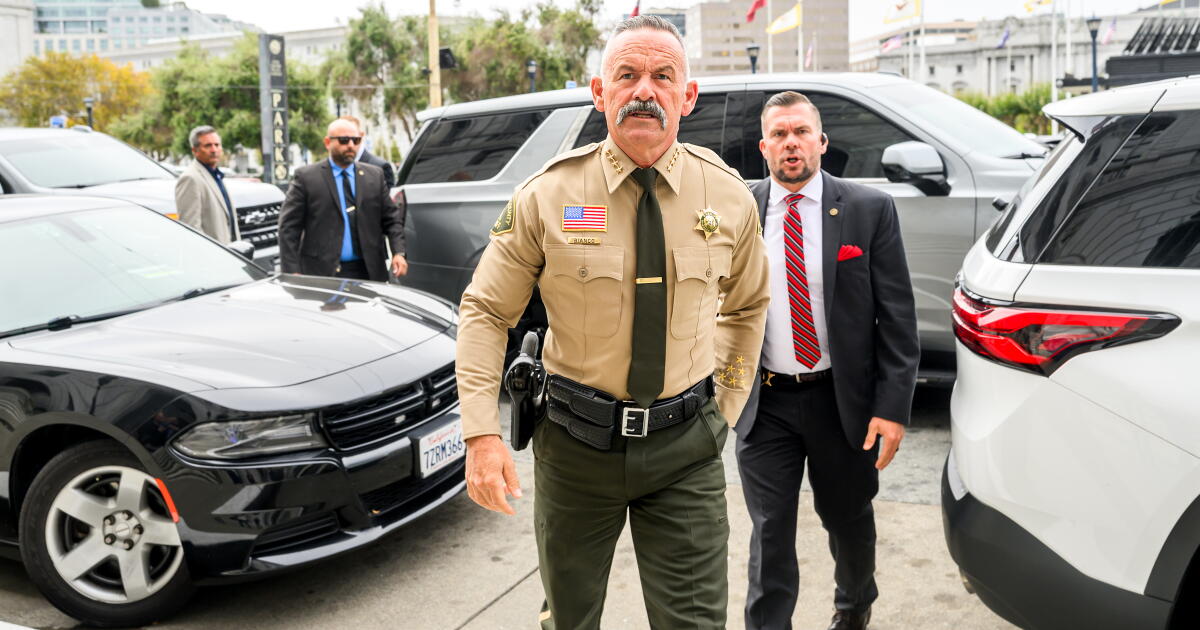
bianco

Sheriff Chad Bianco can’t catch a break. That’s a good thing

Riverside County Sheriff Chad Bianco is not lazy, I’ll give him that.

During his unsuccessful run for governor this year, you may recall that the MAGA devotee found time to seize more than 650,000 ballots from the Proposition 50 redistricting race, claiming he suspected there were tens of thousands more votes cast than there should have been — a favorite (and false) complaint of election deniers.

There were not.

Undaunted by reality, and likely law, Bianco announced he was going to have his deputies recount the votes, even though this kind of interference in the chain of custody of ballots never had occurred anywhere in the United States.

This unprecedented seizure of ballots — something election-denier-in-chief President Trump has been hinting at trying himself for years — quickly became a national news story, and a national concern.

With midterms looming and more than one MAGA sheriff out there, what would stop another conspiracy-minded, badge-wearing maverick from doing something similar this November, potentially throwing our national election into turmoil?

The specter of Bianco setting a precedent for like-minded conspiracists to follow prompted two significant lawsuits — one led by the election experts at the UCLA Voting Rights Project and the other from state Atty. Gen. Rob Bonta.

The state Supreme Court heard arguments in those cases Monday, and while we’ll have to wait for the official rulings, things did not seem to go well for the sheriff.

What surprised me most, or maybe just relieved me, was how thin Bianco’s arguments were to support his actions. In the end, his legal team came with little more than contortions and cartwheels, trying to twist Bianco’s overreach into existing law.

His lawyer, Bradley Hertz, attempted to argue that legislators, when crafting laws protecting ballots, meant different rules to apply to investigations of elections preceding formal prosecutions. If that sounds confusing, it’s because it is.

Hertz seemingly was trying to convince the court that Bianco legally could pull his shenanigans as long as he didn’t actually find criminal wrongdoing, which would trigger a different set of rules.

“That seems bizarre,” Justice Goodwin H. Liu said during a back-and-forth with Hertz.

Indeed.

But it was Justice Joshua Groban who hit at the national implications of what Bianco had done — and what it could mean for the midterms if this court ruled in his favor.

“It seems like under your broad view of the warrant power … the sheriff could could seize ballots even before election day, right?” Groban asked. “Even before they were counted.”

It’s terrible to have ballots seized after they’re counted. It’s devastating if they were to be taken before there was an official tally, because how would anyone trust that there hadn’t been tampering? Simply seizing uncounted ballots, no matter what happens next, would create such paranoia and uncertainty that the election results almost certainly would be called into question — something that could play into the favor of, say, a wannabe authoritarian who fears he’s likely to lose a fair vote count.

Even Hertz seemed to acknowledge such a scenario was bad.

“If search warrants were allowed during the election or preelection, that would obviously wreak havoc,” he said. “There would be, kind of, a cat out of the bag, so to speak. You can’t count ballots if they’re not in the possession of the registrar.”

But then Hertz tried to come up with logic that what Bianco was arguing wouldn’t mean that ballots could be seized anytime, anyhow, and that instead courts could find a way to allow seizing only after the official count. The court did not seem convinced that this was a good idea, or that that is what the law should or did allow.

If that case didn’t go well for Bianco, it was the second case brought by Bonta that really might end up being a hard loss.

For years, decades really, in California and across the country, there has been a group of sheriffs who have argued they are a law onto themselves because they are elected, not hired or appointed. Some of these sheriffs argue that they are literally above federal law.

In California, there has at times been momentum to rein in this line of thinking by creating clear boundaries in law, but the state Legislature always has backed down in the face of opposition from law enforcement.

One potential curb on sheriffs’ power comes from a single line in our state Constitution that seems to say the state attorney general has supervisory power over them. But the meaning and power of this particular clause has long been debated and seldom invoked.

Bonta, however, invoked it against Bianco, claiming the the sheriff had to back off the ballot-seizing because Bonta had authority to order him to stop. Bianco did stop, to his credit. But the standoff was heard by the court Monday and likely will force clarity on an issue that has long lacked it.

Here again, the justices seemed amenable to Bonta’s argument that sheriffs, at least to some extent, answer to him as the state’s chief law enforcement officer. But the justices seemed far more cautious on this issue, and even the state’s attorney conceded that “it’s actually pretty remarkable how little our Constitution says about county sheriffs.”

If Bianco loses on this issue, it would be huge. It would mean that Bianco not only overstepped his power by seizing the ballots, but that he also had forever lessened the power of California sheriffs by clarifying they do answer to the attorney general. I’m sure that will be very popular with other sheriffs.

We’ll see what the justices say, but at least it seems likely that this embarrassing chapter of California election history will end in favor of the law, and democracy.

Maybe Bianco really does believe his conspiracy theories. After all, “there are some people who believe they had breakfast with Elvis on Sunday,” pointed out Chad Dunn, who argued the case for the Voting Rights Project.

“We can’t satisfy them,” Dunn warned.

More importantly, we shouldn’t — even when they wear a badge. Our laws already have robust protections for elections, and rogue sheriffs aren’t one of them.

Source link

California Supreme Court appears skeptical of sheriff’s ballot seizure

California Supreme Court justices hammered Riverside County Sheriff Chad Bianco over his seizure of hundreds of thousands of Proposition 50 ballots in a pair of back-to-back hearings on Monday, appearing poised to order the ballots returned and sharply limit the sheriff’s power to snatch similar election materials in the future.

Bianco, a Republican who came in fourth in this spring’s crowded California gubernatorial primary, carted off truckloads of ballots from the Riverside County Registrar of Voters in February, after securing a warrant based on claims that the office allowed fraudulent votes in the special election to redraw California’s congressional districts last fall.

According to a sworn declaration by one of Bianco’s sergeants, armed deputies from Riverside County’s Special Investigations Bureau, Emergency Response Team and SWAT unit were sent to sweep up pallets of sealed votes and bring them to the Moreno Valley Sheriff’s Station on Feb. 26 — a day after California Atty. Gen. Rob Bonta and Secretary of State Shirley Weber ordered Bianco to stand down.

In the days that followed, deputies began their own ad hoc recount — an activity they’d never been trained for, and which state officials and civil liberties groups say flies in the face of the plain language of the state’s election law that says “in no event shall ballots be moved.”

Voters sued. So did Bonta. In oral arguments on both cases Monday morning, California‘s seven Supreme Court justices appeared at times flabbergasted by claims that the move was not only permitted but blessed under state law — and that California’s top cop had no power to block it.

“I’m just wondering … why didn’t the sheriff’s office contemplate the available routes under the elections code for resolving the alleged disparity?” asked Associate Justice Goodwin H. Liu. “Isn’t there a procedure for resolving this?”

“Certainly there are other paths,” said Bianco’s attorney, Bradley W. Hertz.

Hertz, who argued the sheriff’s case after Riverside’s county counsel largely sided with the plaintiffs, said Bianco simply exercised his legal discretion.

“This wasn’t come in with guns blaring and take the documents,” Hertz said.

The dispute began over handwritten notes made as part of an experimental program to increase voter confidence in the county’s election procedures. That informal tally fell about 46,000 votes short of the official count, prompting accusations of fraud.

Officials contend the discrepancy between the computer count and the paper tally is “a good deed that went punished” — the result of exhausted officials being handed an extra-credit project they couldn’t quite execute.

“It was a pilot program that the registrar implemented at the request of the public, on top of all their other duties, to do these handwritten logs to try to track 350,000 pieces of mail that come in,” said Dale Larson, who represented Riverside County Registrar of Voters Art Tinoco at the hearing.

Both times it was attempted, the hand tally produced a significant undercount, prompting officials to cancel the pilot, Larson said.

Bianco and his allies insist the difference is evidence of maleficence, and that criminal law authorizes the sheriff to sidestep the state’s detailed election code and the attorney general’s sweeping authority to get to the bottom of it.

The justices repeatedly pressed on Hertz to explain how the general authority conferred to the sheriff under criminal law could trump the specificity of the state’s election rules — a position that would seem to upend foundational rules of American law.

They also cast doubt on Bianco’s “counterintuitive” claim that Bonta’s “supervisory” role over the state’s elected sheriffs was merely advisory and did not carry the authority of law.

“It’s not just counterintiitive — again, we’ve said a million times, we’ve got to just look at the plain language,” said Associate Justice Joshua P. Groban. “Nobody would think that’s what ‘supervised’ means, so why should we think that here?”

For the record:

4:55 p.m. Aug. 24, 2026An earlier version of this story said a lawsuit against Bianco was brought by the ACLU. It was brought by the UCLA Voting Rights Project.

The court battle has played out with the UCLA Voting Rights Project bringing the suit on behalf of voters, and the Riverside County district attorney’s Office and the California State Sheriffs’ Assn. backing many of Bianco’s claims.
But it has also pitted the sheriff against the registrar, who was named as a co-defendent in the UCLA suit despite siding with plaintiffs in all but a narrow subset of its claims.

In court filings, Riverside County Counsel Minh C. Tran co-signed claims that Bonta and the voters had it right, carving out a narrow disagreement over whether Tinoco should have ignored the sealed warrant and faced arrest rather than allow ballots to be taken. They also questioned whether he was obligated to go to court himself to stop the seizure.

UCLA hit back at that claim, saying it was “the responsibility of the registrar to go to jail rather than hand over the ballots.”

“I know that’s strong medicine,” said Chad W. Dunn of the UCLA Voting Rights Project. “The registrar has a duty to announce publicly and get into court immediately, or at least allow the public to get into court immediately to contest the movement of ballots before it occurs.”

The decision looms as the Trump administration has moved to restrict mail-in voting and signaled it could contest results of the upcoming midterms — partisan flash points UCLA urged the court to address.

“This is bound to be repeated again,” Dunn said. “These are the public’s ballots, that’s why the election code is crafted the way it is, so that the public have a right to weigh in.”

Source link