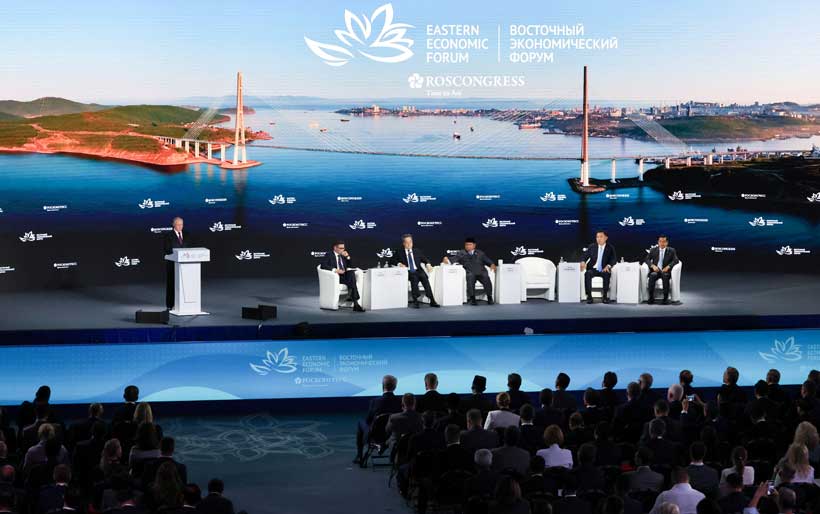
The Eastern Economic Forum (EEF) has been described as a successful solid platform since its creation. It increasingly attracts guests from widely different countries, especially leaders of China, India, Malaysia, Mongolia, and Myanmar. The leaders of Vietnam, Kazakhstan, Laos, and Thailand have visited it in various capacities. The business segment of the forum has long gone far beyond the geographical boundaries of Eurasia. Its frequent unprecedented large number of guests includes businesspeople from South America, Africa, and the Middle East. That, however, it remains open for entrepreneurial contacts with everyone whose natural interests are primarily in the trade, economic, and social spheres. This cross-platform cooperation between the structures is developing, growing deeper and creating a new agenda. The most essential feature is that the platform is guided by the principles of equality, mutual benefit, and honest dialogue, which are entirely different from those of Western-oriented structures.
The EEF, which opened on 1st-4th September, in Russia’s Far Eastern city of Vladivostok, has become a solid platform for open and constructive dialogue among business leaders, government officials, and members of the expert community. It has also become a unique venue for discussing the strategic development of the Russian Far East and the country as a whole, while fostering and strengthening potential partnerships with counterparts, particularly from the Asia-Pacific region, in food production, infrastructure, logistics, industry, energy, and many other sectors of the economy. While recognizing the huge untapped economic potential of the region, it is also understandable that the development of the Far East largely depends on human capital, entrepreneurial efforts, and the ability of regions to create the necessary conditions for realizing the practical expectations.
On 2nd September, as part of the business program, the “Towards a Common Future: Inclusion as a Development Resource for the Far East” discussion was held with a strong focus on how to create an equal opportunity environment, develop human capital, and engage diverse groups in economic and social life. The following day, the majority of the participants in the “Inspiring Investments: A Development Strategy for Growth and Scaling” session touched on funding mechanisms for creative projects, opportunities to enter foreign markets, and collaboration between businesses, investors, development institutions, and government agencies. The key point focused on the development of the creative economy and international cooperation with Asia-Pacific countries, industry investments, the export of intellectual property and creative products, the media’s role in the development and positioning of regions in the Far East, new content formats, and training personnel for the economy of the future.
As part of the discussions at the forum, Russia and the United States continued their business dialogue, headed by Robert Agee, president and CEO of the American Chamber of Commerce in Russia (AmCham Russia), and with the participation of US representatives. It was spearheaded by the Roscongress Foundation in Russia. Anton Kobyakov, Adviser to the President of the Russian Federation, noted, however, that there is a strong appetite on both sides for direct professional engagement. What matters most is to sustain the momentum and possibly broaden the agenda to include bilateral entrepreneurial partnership.
Stay ahead of the geopolitical week.
MD Briefing delivers expert analysis across five global fronts — the Indo-Pacific, energy, geoeconomics, European security, and the Middle East — every Monday morning. Free.
“There is the need to facilitate more networking to identify specific strategic areas for cooperation,” said Robert Agee, president and CEO of the American Chamber of Commerce in Russia, and unreservedly agreed to continue their work on developing business ties and prepare for the participation of American representatives in the Russian Federation.
With many Asian and Pacific participants, explored opportunities for developing small and medium-sized enterprises. This is becoming increasingly important amid structural changes in the economy, as businesses look for new avenues for growth. The EEF made it possible not only to exchange experience but also to find concrete solutions that will help entrepreneurs adapt to changing conditions and unlock new opportunities for growth.
Developing trade, strengthening of interstate ties, and the creation of a common space for interaction among Asia-Pacific countries have assumed a new trend with Russia. The argument was logically based on Russia’s historical experience of cooperation with East Asian countries. It was further underlined that Russia and the Asia-Pacific attract politicians and entrepreneurs from around the world. In these current geopolitical circumstances, Russia needs to seek out new opportunities for development, particularly from the Asia-Pacific region, and with reference to the emerging new multipolar world. At the heart of the forum program was the search for new sources of growth and resilience for SMEs amid structural changes in the economy, from raising productivity and adopting new technologies to managing risks and adapting business models. One section of the program focused on the role of automation and artificial intelligence, changes in business processes, employees’ readiness to work with new technologies, and ways of improving productivity.
In addition to the above, a special session was devoted to analysis where experts outlined the key economic trends across the Asia-Pacific region. As monitored, this session was set out in the analytical review entitled “Asia Trends 2026: The AI Boom, Industrial Relocation, and Geopolitical Fragmentation,” prepared ahead of the opening of the Eastern Economic Forum on 1st September. The review clearly noted, among other things, that Asia accounts for around 60% of global GDP growth and is becoming the world’s new center of trade, industry, technology, finance, and military power. Within the region, however, economic growth is highly uneven, while technology and capital are concentrated in a small group of states, making consolidation difficult. The ASEAN countries, meanwhile, face competition from Chinese manufacturers while also coming under growing geopolitical pressure from Washington. More broadly, the Asia-Pacific region is more exposed than any other to the effects of the energy crisis and to climate risks such as a super El Niño.
According to the International Monetary Fund, Asian GDP grew by 5% in 2025, significantly ahead of global growth of 3.5%. Within the region, however, countries face a range of specific challenges, from high labor costs and insufficient industrial capacity to balance-of-payments difficulties and currency instability. These factors are driving increasingly divergent development paths among Asian economies. The region’s advanced economies, such as Japan and South Korea, posted lower growth rates, at 1.2% and 1%, respectively, in 2025. Asia’s emerging economies grew by 5.5% overall over the same period, with performance ranging from a 2% contraction in GDP in Myanmar to an 8% surge in Vietnam.
Countries with the strongest growth prospects are attracting investment, leaving others with fewer opportunities to draw in capital. According to the United Nations Conference on Trade and Development, developing countries in Asia attracted US$644 billion in foreign direct investment in 2025. That is around 40% of the global total and more than 70% of all investment in developing countries. Capital flows are unevenly distributed: eight of the ten largest recipients of foreign direct investment among developing countries are in Asia, and together they account for around 60% of all inflows to developing economies and more than 80% of inflows to the region.
Capital is becoming increasingly concentrated not only in a small number of countries but also in a narrow range of sectors, particularly artificial intelligence, clean energy, semiconductors, and critical minerals. In the longer term, this could deepen inequality and worsen the position of countries without a strong presence in these fields. Asia is one of the principal beneficiaries of the global AI boom. The investment cycle associated with its development has driven up demand for semiconductors, memory, servers, network equipment, and related electronics. The region occupies a central position in the global supply chain for these products. Technology exports will remain a powerful engine of economic growth in Asia, although the benefits will be distributed unevenly depending on each country’s position in the value chain.
South-East Asia’s role as an industrial center is growing as production capacity relocates there from China, which is no longer a low-cost manufacturing base. Chinese companies have begun redirecting production to Vietnam and Indonesia in particular in order to mitigate the impact of US tariffs. At the same time, China has increased its exports of industrial components and capital goods, supplying the equipment and parts needed by manufacturing centers in other countries. Exports of intermediate goods, including memory chips, other semiconductors, and industrial components, rose by 9% in 2025. Part of this represented an indirect offset to reduced shipments to the United States, as components, particularly in electronics, were used by manufacturers in other countries to produce goods that were subsequently exported to the US. A fall of roughly US$15 billion in smartphone exports, for example, was matched by a comparable increase in shipments of components, notably to India.
In many other cases, however, the growth in exports of components and equipment was not linked to replacing sales China had lost in the US. Instead, it supported the expansion of production in third markets, especially developing ones, reinforcing China’s role as a supplier of production inputs rather than an exporter of finished goods. The result is an integrated supply chain taking shape across the region, encompassing research and development and the manufacture of high-technology components in China, assembly and packaging in an ASEAN country such as Malaysia or Vietnam, and the subsequent shipment of products to markets within the region and beyond.
Amid the fragmentation of the global economy and trade, the development of the Eurasian space calls for resilient regional supply chains and logistical connectivity between states. Russia’s Far Eastern Federal District can play a strategically important role here. Thanks to its location, the district can serve as a resource and logistics gateway within the transport corridors linking European Russia with Asia. For a long time, infrastructure constraints held back the expansion of ties between Russia and Asian states, but the situation has begun to change with the development of the Eastern Operating Domain, which comprises the Baikal–Amur Mainline and the Trans-Siberian Railway.
A program to modernize the Eastern Operating Domain has been under way since 2013, aimed at eliminating bottlenecks on the railways of Siberia and the Far East. Over that period, its carrying capacity has increased by 84%, reaching 180 million tonnes in 2025. The modernization is expected to raise that figure to 210 million tonnes by the end of 2030 and 270 million tonnes by the end of 2032. The development of the rail network and port infrastructure will largely determine the prospects for Eurasia and for the Asia-Pacific region in particular, as the world’s economic, financial, and trade center shifts towards the region.
Emerging trends are reshaping the world; South-South economic partnership is seemingly becoming both the political and economic architecture. Logically, developing collaboration with Asian partners, anchoring discussions on technological leadership, and making breakthroughs in scientific fields and adopting innovative technologies are increasingly reshaping the world. Today, the role of academic institutions is to build a solid scientific and technological foundation that addresses applied industrial challenges while enhancing business efficiency, eco-friendliness, and sustainability. It is only through this synergy between science and the real economic sectors that can bring true multifaceted sovereignty. In conclusion, Asia-Pacific and Russia have to create a new model of economic and business and trade relations in the Global South.
As monitored from official reports, Russia is creating practically a new model of development of the Far East with maximally comfortable conditions for enterprises, as well as legal innovations for the investment climate in the region. Therefore, potential Asia-Pacific investors have to work on new ideas and new strategies for developing trade, agro-processing, industry, and other economic sectors in the Far Eastern region. The Eastern Economic Forum was held from September 1 to 4 on the campus of the Far Eastern Federal University. This year’s theme: “The Far East: Development for the Benefit of People.” It was the 11th EEF and organized by the Roscongress Foundation.
A former White House teleprompter operator accused of placing bets on the Kalshi (KALSHI) platform using inside information obtained from Donald Trump’s speeches has been ordered to pay nearly $173K as part of a settlement with the Commodity Futures Trading Commission.
Iran is betting global economic fallout from the war and Republicans worried about the midterms will force President Trump to back down first. That’s according to Cato Institute’s Doug Bandow who told ‘This is America’ that Tehran is playing a game of ‘chicken’.
Los Angeles County election officials are examining steps ahead of the November midterms to respond to the rising popularity of election trading via prediction markets, including a possible ban on wagering for county election workers.
The discussions follow a fracas during the June ballot count, when a handful of influencers suggested fraud could be occurring in L.A.’s mayoral primary because the results began diverging from the market’s prediction.
That incident, the most prominent interaction of prediction markets and a U.S. election to date, revealed a new dynamic in the battle for public trust in elections. Now, election administrators around the country are considering the possible implications of the markets’ forecasts, including whether they have the power to affect voter confidence in election results.
“We’re … trying to find our way in this,” L.A. County Registrar-Recorder Dean Logan said in an interview. “It’s opened up a lot of questions that we’re grappling with.”
Three months before the midterms, with much of the American public concerned about democracy and trust in elections dropping, officials are paying attention to anything that could create further uncertainty around how elections are run.
The midterm contests are high stakes for both parties, which are battling for control of Congress amid a difficult economy, the war in Iran and low approval ratings for President Trump. And many Americans are wagering on what might happen — users have traded nearly $200 million on the midterm elections so far, a July analysis by NBC News found.
Prediction market platforms and their proponents say trading contracts on the markets is not the same as betting, likening it instead to trading on the stock market. Critics say it amounts to gambling, regardless of how the markets are set up.
The timeline for election administrators to think through the issue before November is tight, and it poses challenges for offices that already are stretched thin preparing for other possible election-day scenarios. What happened during the L.A. mayoral primary, however, has prompted discussions around the country, said Carolina Lopez, executive director of the Partnership for Large Election Jurisdictions, or PLEJ, a nonpartisan organization that represents election administrators.
“The potential effect on confidence [in elections] is significant,” Lopez said.
A spokesperson for Kalshi, one of the leading trading platforms, said the platform bans insider trading and welcomes any policy measures doing the same. The company takes “seriously our responsibility to be a responsible actor in this space,” spokesperson Jacki McGavick said.
Los Angeles could become one of the first major election jurisdictions to implement guidance or policy related to prediction markets. Delaware County, Pa., in suburban Philadelphia, already has taken such a step — adding prediction markets to an oath poll workers already were required to sign affirming that they have not wagered on the election.
Last month, Maryland’s top election official asked the state prosecutor to open an investigation into the legality of prediction markets. In late July, Wisconsin’s election administrator warned voters that it is illegal under state law to both vote in and bet on an election. That drew swift attacks from executives at Kalshi, one of whom claimed the state would “disenfranchise voters who use Kalshi.”
In L.A. County, Logan said his office is in the research stage for an insider-trading policy for staff. His office also is creating public messaging to deploy in various scenarios and factoring the potential dynamics around prediction markets into security planning.
Any potential for unrest or protests related to people’s monitoring of market forecasts is likely to come in the days following the election, while ballots still are being counted, Logan said.
Elections staff also is preparing FAQ documents about prediction markets and discussing how to talk about the issue with reporters, gaming out different scenarios, he said.
Orange County Registrar of Voters Bob Page said he advised his office’s staff before the primary, and plans to do so again before November, that participating in election markets could create a conflict of interest prohibited by county code. Staff betting could been seen by the public “as improper,” Page said he told his staff, “ which would undermine trust in the integrity of the election.”
Thirty-nine percent of likely midterm voters in a recent survey commissioned by PLEJ said their confidence in an election outcome would be reduced if the official result differed from prediction market odds. Three-quarters of those surveyed said they believed prediction markets create confusion around elections.
A majority was unable to correctly identify what prediction market odds represent, according to the survey results, with more than a third believing they showed the current number of votes for each candidate or an official projection from election officials.
The rise of the exchanges, which allow users to stake money on the chance that a given event will happen in the future, has provided a way to create predictions that some experts say are more accurate than political polling.
Leaders of the platforms have suggested they can help combat election misinformation by providing predictive insights and help decision-makers understand public sentiment. Kalshi launched what it termed a “midterms hub” late last month, which it said would contain not only market forecasts but also news, polling and fundraising data.
“Election markets have been my dream since the start of Kalshi,” Luana Lopes Lara, a co-founder of the platform, said on social media upon the hub launch. “The holy grail of prediction markets, they shed light on some of the most consequential, decentralized and human processes in the world, where good data is crucial and hard to find.”
She added: “It’s changed the way I interacted with the electoral process and made me smarter — I hope it does the same to you.”
McGavick, the spokesperson, said about 75% of Kalshi visitors view the odds without buying anything in order to understand what “the crowd forecasts.”
“Kalshi has become a leading indicator of where elections are headed,” she said.
As users trade contracts — each one representing a bet for or against a given event, such as a certain candidate winning an election — the market generates odds. On Tuesday, for instance, L.A. Mayor Karen Bass had a 61% chance of winning in November on Kalshi, while City Council member Nithya Raman had a 39% chance.
Either Bass or Raman could win, but if the public’s understanding of the markets is murky, experts say, voters may confuse their speculation for certainty.
In June, the market odds appeared to drive some public belief about what the results would be, Logan told reporters at a briefing last month — in this case, that Republican Spencer Pratt would be one of the top-two vote-getters, which ultimately did not happen.
“That put us in a position as election officials of having to respond to a whole new layer of misinformation,” Logan said. “Not only were we being asked how were the polls wrong … but [people were saying], ‘We saw numbers’ or ‘We saw odds.’”
Experts worry it could become more common for market odds to be cited by people who are dissatisfied with an election result as a new way to attempt to discredit a ballot count, adding a new quiver in the bow of election deniers and potentially confusing the public.
The existence of prediction markets “provides one more source of information” that could be used by bad actors to stir up confusion or distrust in election results, said Mindy Romero, executive director of the California-based nonpartisan Center for Inclusive Democracy.
“People might think … prediction markets are a good thing or a bad thing,” Romero said, “but you can’t deny that it is one more thing that could potentially be manipulated.”
Separately, prediction markets have drawn the attention of lawmakers in Congress for various reasons, including fears of insider trading. Members of both parties have proposed guardrail legislation this year. Several states are locked in legal battles with the federal government over whether they can regulate the markets under state anti-gambling laws.
Last week, as destructive wildfires raged in Washington, Oregon, California and elsewhere, California Sens. Adam Schiff and Alex Padilla joined with other Democratic senators from western states to urge the Commodity Futures Trading Commission to restrict the markets from offering betting on wildfires. They cited concerns that people could be tempted to influence fires or commit arson in order to “make sure their bets are successful.”
Schiff introduced a bill to prohibit such trading in March. Kalshi has a ban on markets tied directly to death and war. Kalshi and the other leading platform, Polymarket, also regularly report suspected insider trading to the federal government for investigation. Last month, federal investigators alleged that Trump’s teleprompter operator had used inside knowledge to win more than $100,000 after Kalshi spotted his activity.
In Los Angeles, Logan said his office may issue guidance by November, but the task will extend beyond the next election day.
“What we want to do is defend against anything that would devalue the elections process,” Logan said. “We don’t want voters to be discouraged from participating.”
President Trump signaled he’s prepared to let economic pressure on Iran build rather than launch fresh military strikes to force a reopening of the Strait of Hormuz, even as the Islamic Republic reiterated that the conditions still aren’t in place to allow free passage through the key waterway.
“We are just watching Iran with its huge inflation and the fact they have no money,” Trump told Axios in an interview on Sunday, saying that a US naval blockade of the country was deepening its financial woes. “We are low-keying it.”
The president’s comments mark a shift from his repeated threats to escalate the bombing campaign against Iran and come amid lingering talks between Tehran and Oman to reopen Hormuz. Iran has said it’s nearing a deal, while laying out a list of demands for Washington to meet before shipping can resume — including the lifting of sanctions.
“As long as hostile actions continue, the conditions for ensuring the safety of this waterway are not in place,” Iran’s foreign ministry spokesman Esmail Baghaei told reporters on Monday. “Its reopening is contingent on the US ceasing its illegal actions, lifting the siege and compensating for damages.”
Brent crude rose 1% on Monday to over $84 a barrel, extending a rally of more than 5% over the previous three sessions. The contract is still down since the start of the month.
The Islamic Republic’s economy has taken a hammering from the war, with much of its industrial capacity destroyed, crude exports severely curtailed by a US blockade and central bank data showing year-on-year inflation recently reaching 77%.
The currency, meanwhile, has fallen more than 10% from its prewar level, adding to the economic pressure on Iranians. A depreciation of the rial sparked violent nationwide protests that peaked early this year, leading to a crackdown by authorities that left thousands dead. There have been no signs of the anti-government demonstrations resuming.
Iran reemphasized its determination to continue wielding control over Hormuz in the face of US opposition by naming hard-line former Islamic Revolutionary Guard Corps commander Mohsen Rezaee to its top security post over the weekend. An advocate for full Iranian control over the waterway, he served as military adviser to Iranian Supreme Leader Mojtaba Khamenei and will now head the Supreme National Security Council, which coordinates decisions on the war and negotiations to end it.
Rezaee replaces Mohammad Bagher Zolghadr, a fellow hard-liner who accepted a new position as political adviser to the supreme leader. The appointments were reported by the state-run Islamic Republic News Agency late Sunday.
Over the weekend, Iranian Foreign Minister Abbas Araghchi said a pact with Oman to establish a shipping route through the strait was “very close,” without providing details on the substance. He ruled out direct talks with the US for now, but said the two sides are exchanging messages through intermediaries.
The Strait of Hormuz, through which one-fifth of the world’s oil and liquefied natural gas transited before the war, has become a key sticking point in the negotiations to bring a lasting end to the fighting that began when the US and Israel staged airstrikes on Iran on Feb. 28. Trump has demanded free passage for months.
Tehran’s demands for a full reopening include the US lifting its naval blockade on Iranian ports, the release of frozen assets and compensation for war damage. It has also called for a permanent end to attacks on groups it backs in Lebanon, Iraq, Yemen and Gaza. It’s unclear how strictly Iran will stick to the list of conditions.
Some of the demands will be difficult for the US to meet alone. In Gaza, a proposal by US-backed mediators to disarm Iran-backed Hamas and push Israeli army out of the Palestinian enclave was rejected by Israel’s Prime Minister Benjamin Netanyahu on Sunday.
In Yemen, clashes between the Iran-backed Houthi rebels and forces from the internationally recognized government supported by neighboring Saudi Arabia, have escalated. The Houthis claimed to have struck Saudi Aramco’s Jazan refinery on Sunday, while Saudi authorities reported a fire that was quickly extinguished, with no injuries.
The incident would mark at least the second blaze at the 400,000 barrel-a-day complex in a month. Satellite images in late July showed a tank fire following another claimed Houthi attack.
To become a financial hub, the sultanate needs the infrastructure that a major custodian can provide.
U.S. custody giant State Street is expanding into Oman, a vote of confidence in the Gulf’s smallest aspiring financial center.
At the Oman Capital Market Conference in Muscat in early June, the bank signed an agreement with Riyadh-based Jadwa Investment, which manages about $30 billion in client assets, to jointly pursue institutional clients in the sultanate, with a focus on global custody and asset servicing. The agreement formalizes State Street’s deeper push into the Omani market. State Street, one of the big three global custodians alongside BNY and Northern Trust, has served Omani clients from a Muscat office for more than two decades.
The Gulf Cooperation Council, of which Oman is a member, is a declared strategic priority for State Street. But for both sides, the logic of the deal centers on infrastructure.
Targeting Emerging Market Status
Custody and asset servicing are what Oman, as a financial center, has lacked at scale as it pursues its central ambition: to elevate the Muscat Stock Exchange (MSX) from frontier to emerging market status, attracting index-tracking capital, credibility, and prestige.
The sultanate has spent five years working toward that goal. The Oman Investment Authority, its sovereign wealth fund, took ownership of the MSX in 2021 and began injecting liquidity and floating state assets, including units of the energy group OQ. Market capitalization has nearly doubled to about $98 billion in an economy of roughly $117 billion.
Even so, the bourse is a sliver of the region’s dominant exchange, Saudi Arabia’s $2.7 trillion Tadawul. A unified regulator, the Financial Services Authority, created in 2024, has since introduced listing incentives, a junior market for smaller companies, and cross-border arrangements to give foreign investors a way in. Oman plans to privatize as many as 35 state firms by next year, further increasing the total float.
As its Gulf rivals absorb the fallout from the Iran war, Oman’s long-cultivated neutrality, its port of Duqm, and its free-trade agreement with the U.S. have positioned it as a relative haven. Whether it will harden into a genuine regional financial hub is less certain; Oman is a latecomer to a field led by Dubai and Abu Dhabi, and liquidity on the MSX remains thin, with heavy state ownership and slim free floats.
The agreement between State Street and Jadwa is, for now, only a memorandum of understanding, with no concrete mandate and no assets yet committed. But the signal is clear. When a custodian of State Street’s heft attaches its name to Oman, it redraws the Gulf’s financial map at the edges. Muscat has decided it would rather build the back office than keep renting someone else’s.
Kim Iskyan is a contributing writer based in the U.S.
Most generative AI projects in finance fail. Here’s what it means for CFOs and their future hires.
Mid-market finance chiefs aren’t hiring like they used to. A Gartner survey of more than 300 finance executives shows that while companies are pouring more money into artificial intelligence tools, the share of CFOs planning to expand headcount has fallen.
“Four out of five were either freezing capacity or headcount or reducing capacity in their team,” Alok Ajmera, chief executive officer at Prophix, told Global Finance in a phone interview.
While CEOs and boards pressure their teams to show productivity gains from generative AI, results have been uneven, Ajmera added.
The GenAI Reality Check
Another Gartner estimate shows that more than 90% of generative AI proof-of-concept projects in finance departments failed to generate incremental value. This “staggering amount,” Ajmera said, curdles AI enthusiasm into AI skepticism.
“A lot of projects from an AI perspective felt really good on paper, but have not actually materialized the value … in real life,” he added.
He attributed the shortfall to a mismatch between the technology and finance work itself.
“This is not a probabilistic exercise, this is a deterministic exercise,” Ajmera said. “You can’t be 99% accurate with your numbers. You have to be 100% accurate.” CFOs remain comfortable using AI for reporting, commentary and analytics, he said, but “extraordinarily uncomfortable” letting it touch journal entries or adjust numbers directly.
Shifting Skills, not Mass Layoffs
Ajmera pushed back on warnings of mass AI-driven unemployment, including recent comments from Amazon founder Jeff Bezos, saying “the Doomerism view has been overhyped.” He pointed to software engineering — home to agentic coding, the most monetized AI use case to date — as evidence. “We have hired more engineers in 2026 than we did in 2025,” despite productivity tools making individual engineers more efficient, he said.
He predicted finance will see similar skill displacement rather than outright job losses. “I would not be surprised in a couple of years if we start seeing finance operations engineers” managing AI agents on staff. Slower hiring, Ajmera added, is not the same as letting people go.
Ajmera also described a broader consolidation trend, as companies unwind software sprawl built up earlier this decade. He cited a mid-market manufacturer in the Midwest whose cloud application count grew “from five or six applications to 25 or 30” before Prophix helped consolidate roughly nine or 10 of those tools onto a single platform.
Looking ahead, Ajmera said he expects more caution from CFOs. “There’s a lot of caution in the air,” he said, predicting longer purchasing cycles and heavier scrutiny of technology spending amid broader economic uncertainty.
Anthony Noto covers corporate finance and private credit. Contact him at anoto@gfmag.com
Gold futures gained Thursday after a weaker-than-expected June employment report pressured the U.S. dollar and cooled near-term expectations for rate-tightening from the Federal Reserve.
Only 57K non-farm jobs were added in June, the Bureau of Labor Statistics reported, well below analyst forecasts
Ecobank is betting that saving African biodiversity is good business — and investors are all in.
In May, Togo’s Ecobank became the first commercial bank in Africa to issue a nature bond, mobilizing $450 million that will primarily be utilized to finance sustainable agriculture, biodiversity, and water infrastructure across sub-Saharan Africa. Floated at the main market of the London Stock Exchange, it is being touted as the world’s first commercial bank-issued nature bond that meets standards set by the International Capital Market Association (ICMA).
The ICMA last year introduced the nature bond label as a secondary designation under its Green Bond Principles framework. Ecobank thus becomes the first commercial bank to issue a green bond with the nature bond label.
The offering creates a new route for investors who want to help protect the continent’s biodiversity. Home to 1.5 billion people — about 20% of the global population — Africa hosts 25% of global biodiversity, although it has lost nearly a quarter of its pre-industrial total, according to a study by the Stockholm Resilience Centre (SRC).
Conflicts, perennial food insecurity, economic instability, and stunted development are among the culprits, and action is only becoming more urgent as the climate crisis worsens, yet Africa receives less than 3% of global nature finance.
Given the challenge, the Ecobank bond has generated unprecedented excitement. The 10.25-year, Tier 2 eurobond was oversubscribed nearly four times, attracting order books in excess of $1.36 billion against an initial target of $350 million. Owing to the overwhelming demand, Ecobank decided to increase the transaction by $100 million and tighten pricing by 50 basis points. Moody’s awarded the transaction its SQS1 Excellent score, the highest possible sustainability quality mark.
“This transaction is a defining moment for African sustainable finance,” said Jeremy Awori, Ecobank CEO. “Investors did not just support this bond. They demanded more of it, allowing us to increase the size and tighten pricing.”
Biodiversity Investors
FMO, the Dutch entrepreneurial development bank, was the anchor investor with a $50 million participation, noting that the bond aligns with its strategy of supporting green and sustainable finance that contributes to biodiversity in sub-Saharan Africa. It was the second time FMO has served as anchor investor for an Ecobank transaction. In 2021, it invested a similar amount in the bank’s inaugural $350 million Tier 2 sustainability notes.
Finnfund was another major investor, with a $15 million ticket; the bond falls in line with the Finnish development financier and impact investor’s broader focus on safeguarding biodiversity.
“By supporting investments that promote sustainable land use and protect natural resources, Finnfund aims to contribute to preserving the natural capital that economies and livelihoods depend on,” said Ulla-Maija Rantapuska, Finnfund’s senior investment manager, in a prepared statement.
For Ecobank, the nature bond’s debut was timely, enabling it to refinance its outstanding $350 million of 8.75% notes, which are due to mature in June 2031. The proceeds of the transaction will be ring-fenced to support smallholder farmers adopting sustainable agricultural practices. Additionally, the funds will back agri-processors with verified deforestation-free supply chains. Funding will also target water infrastructure protecting freshwater ecosystems that millions of people rely upon.
Ecobank operates in 34 sub-Saharan African countries, where it boasts 32 million customers and $801 million in pre-tax profits as of last year; it has identified 24 markets as key for biodiversity lending. Critical lending criteria favor countries where agricultural land-use change is the primary driver of biodiversity loss.
John Njiraini is a contributing correspondent based in Nairobi, Kenya.
Two of the biggest box-office standouts of 2026 so far were not made by established studio directors or built on franchise IP.
“Obsession” and “Backrooms” — horror films from internet-native directors in their 20s — have outperformed far more expensive studio releases.
The breakout success of these films has ignited debate across Hollywood about what made these movies so popular, especially among Gen Z moviegoers who haven’t been flocking to cinemas in recent years. Here’s what to know:
The numbers
”Obsession” was directed by 26-year-old Curry Barker, who got his start on YouTube with sketch comedy and horror shorts. Released May 15 by Focus Features, the film was made for just $750,000 but opened to a staggering $17 million and has improved on its debut every weekend since.
“Obsession” set an all-time horror record for the biggest fourth weekend for a film at the domestic box office, raking in $25.4 million. It now ranks as the year’s fifth most popular film, nearing $200 million domestically and roughly $295 million worldwide — ahead of Pixar’s “Hoppers” ($166 million) and Paramount’s “Scream 7” ($121 million), per Box Office Mojo.
Released May 29 by A24 (known for such acclaimed films as “Moonlight” and Everything Everywhere All at Once”) on a reported $10-million budget, it opened to $81 million and crossed $100 million in under a week.
Within two and a half weeks, it had outgrossed the entire theatrical runs of horror films “Five Nights at Freddy’s 2,” “Smile” and “Scream 7.” It sits as 2026’s eighth-highest-grossing film.
Who is watching?
The audiences are young. In recent weeks, nearly 90% of “Backrooms’” viewers were under 35, with more than half under 25. Over “Obsession’s” first few weekends, 75% of the audience was 17 to 34, which is significant at a time when major studios have struggled to consistently get younger viewers to trek to the multiplex.
Why it’s working
Audiences have clearly latched onto the stories, said Jason Blum of Blumhouse–Atomic Monster, who worked on both films.
“There’s been an audience kind of waiting to get back to the movie theaters, and we in Hollywood really have not landed on what would get them back,” he told The Times in an interview this week.
Blum, who upended horror genre with the “Paranormal Activity” franchise, ties the success of “Backrooms” and “Obsession” to a connection to the directors’ origins.
Because the films were made by creators who speak to younger viewers daily on YouTube, he said, that generation “feels like they’re being spoken to.”
David Gross, an analyst at FranchiseRe, framed it as a new pipeline of talent and material. Creators can build large followings very inexpensively, he said, and their stories arrive further developed — which expedites the development and discovery process. He called internet-based storytelling “another additive source for material for movies.” Blum added that the films’ success could make studios more willing to bet on undiscovered directors who “might not have been considered” before.
Rosie Ramirez, chief marketing officer at Galaxy Theatres, said a young first-wave audience tends to generate buzz. More than a month after “Obsession” was released, she said, the Nevada chain’s four California locations are only now seeing a second wave of moviegoers curious about the hype.
Whether this marks a lasting shift or a fluke is unclear. May crossed $1 billion in box office — with “Backrooms” and “Obsession” doing much of the heavy lifting. Despite the improvement, the box office has yet to full return to pre-pandemic levels, with the summer tracking roughly 3.5% behind summer 2019, said Comscore’s Paul Dergarabedian.
And Dergarabedian questioned how the industry could replicate a success that, in his words, was “authentically and organically created” rather than manufactured: “It just happened,” he said.
Ramirez argued the broader summer slate — franchise tentpoles like “Toy Story 5” alongside some original surprises — points to a healthy box office regardless, a reminder that “it doesn’t always have to be the big summer blockbuster.”
Weekly insights and analysis on the latest developments in military technology, strategy, and foreign policy.
Norwegian missile-maker Kongsberg has finalized its acquisition of a majority stake in Zone 5 Technologies, bringing under its umbrella the U.S. start-up’s Rusty Dagger low-cost cruise missile, among others. With both those weapons already moving into large-scale production, the two companies are making the case for combining Kongsberg’s stealthy Joint Strike Missile (JSM) cruise missiles in operational scenarios. Zone 5 has also now confirmed that the Rusty Dagger, which is already being supplied to Ukraine, is now cleared for use on four different types of fighter aircraft, including the F-16.
At the ILA Berlin airshow yesterday, where TWZ was in attendance, officials from the two companies announced that Kongsberg has now formally acquired a 90 percent stake in Zone 5. California-based Zone 5 will continue to operate as an independent subsidiary under the Norwegian contractor. As well as discussing the industrial acquisition, the officials provided details of how the Rusty Dagger fits into the new-look portfolio, and updates on how that program is progressing.
Zone 5 Technologies – Rusty Dagger
Founded in 2011, Zone 5 is one of an emerging class of defense companies gaining prominence for developing low-cost, rapidly deployable capabilities. In many ways, they represent the inverse of traditional defense contractors, favoring speed, scalability, and cost efficiency over highly customized, high-priced systems.
Kongsberg first announced the acquisition in December, with executives noting that buying a stake in Zone 5 offered the fastest path to offering lower-cost missiles that still deliver meaningful combat capability, especially in terms of bringing these to the European market.
“What we’re doing here is that we’re combining Kongsberg’s niche, exquisite technologies with a company very capable of designing for cost efficiency and mass production,” explained Thomas Akers, founder and CEO of Kongsberg.
As to why Kongsberg didn’t choose to develop its own equivalent to the Rusty Dagger, Harald Aarø, Kongsberg’s executive vice president for business development and strategy, provided the following answer:
“Technically, could we be capable of doing it? Yes, but we are not as capable, as we will probably spend a longer time, and perhaps not strike as smart solutions,” Aarø said. “That doesn’t mean that our engineers aren’t just as smart. Our engineers are just as smart, but on a different sports field, so to speak.”
A briefing slide with various details about the JSM’s capabilities. Kongsberg
Aarø also described how the specific combination of the Rusty Dagger and the JSM makes for “a very effective future strike solution.” Namely, the Rusty Dagger provides cost-effective but still highly capable standoff strike, while the more exquisite JSM comes with a heftier price tag but offers a greater chance of making it through to even heavily defended targets, on account of its sophisticated guidance and low-observable characteristics.
According to Tom Kanewske, Zone 5’s chief strategy officer: “What’s interesting about our missile is that the same base, light cruise missile is field retrofittable for all employment modes, and that puts us in a very unique space, in that a country and their [armed] services are able to purchase the same munition and field retrofit for that to be surface launched, whether from land or the deck of a ship, or pylon launched from a fighter aircraft, or palletized.”
Since larger numbers of Rusty Daggers can be launched in any given scenario, they can overwhelm enemy air defenses and improve the chances of success.
According to Kanewske, Rusty Dagger and JSM “offer a weapon pairing that truly no other missiles in the world do.”
While the JSM can be carried internally in the F-35, the same is not currently the case for the Rusty Dagger, although Kanewske said that this is “something that is of keen interest to the [U.S. military] services and several of our international partners.”
A mock-up of a JSM in one of the internal weapons bays of an F-35. Kongsberg
When it comes to utilizing the Rusty Dagger and JSM together in a combat scenario, Kanewske noted the possibility of integrating capabilities that would allow the Rusty Dagger to offer “cooperative behaviors” with the JSM. This reflects a growing trend toward leveraging artificial intelligence to help make all munitions more effective and survivable, something that has been demonstrated via Golden Horde and follow-on programs.
Both missiles fly at high-subsonic speeds, the Rusty Dagger being able to strike targets at a range of 250 miles, according to Zone 5, while the JSM has a range of more than 215 miles.
In one highlighted scenario, F-35s could penetrate closer to the target, with their JSMs carried internally to preserve their low-observable features. Meanwhile, much larger numbers of Rusty Daggers could be pylon-launched from fighters, and dropped in palletized form out of the cargo holds of transports, from outside of the range of hostile air defenses.
Three views of a Rusty Dagger live-fire test on January 22, 2025, at Eglin Air Force Base, Florida. via U.S. Air Force
Kanewske confirmed that, this year, its first year of production, “well above 1,000 units for Rusty Dagger” will be completed, including for the U.S. Air Force, as the AGM-188, under the Family of Affordable Mass Missiles (FAMM) program. The Air Force’s proposed budget for the 2027 Fiscal Year laid out plans to buy nearly 28,000 FAMM munitions over the next five years.
Last month, the Pentagon laid out plans to acquire at least 10,000 lower-cost cruise missiles over the next three years, as part of a broader strategy to dramatically bolster its stockpiles of standoff strike munitions and prepare the industrial base to sustain those inventories going forward. This is seen as especially critical for supporting the demands of future high-end fights, such as one in the Pacific against China, and doing so in a cost-effective manner.
The Rusty Dagger has so far been cleared for use from four different types of fighter aircraft, Kanewske said. One of these is the F-16, which used the weapon in end-to-end live-fire trials at the Eglin Test and Training Range in Florida earlier this year. Another platform may be the A-4, with a contractor-operated example of the attack jet having been used in company trials. Then there is the Ukrainian Air Force, which is using the Rusty Dagger, under the Extended Range Attack Munition (ERAM) program, although the specific platforms have not been disclosed. Any of the MiG-29 Fulcrum, Su-25 Frogfoot, and Su-27 Flanker are likely candidates — as well as its own F-16s.
A series of unverified photos, first published by Russian sources, showing purported parts of Rusty Dagger missiles retrieved after being used by Ukraine:
It appears that the AGM-188A “Rusty Dagger” cruise missile has undergone field testing in Ukraine.
Russian sources are publishing photos of an unknown 8-element CRPA antenna. On the back side of the unit there is a circuit board with a large heatsink, which carries the CAGE code… pic.twitter.com/phZeOJfHJ0
— 𝔗𝔥𝔢 𝕯𝔢𝔞𝔡 𝕯𝔦𝔰𝔱𝔯𝔦𝔠𝔱△ 🇬🇪🇺🇦🇺🇲🇬🇷 (@TheDeadDistrict) June 7, 2026
In the case of the F-16, Kanewske said that only 72 hours were required to integrate the Rusty Dagger on the jet during the trials at Eglin.
A U.S. Air Force F-16 flies over the Gulf of America carrying a pair of Rusty Dagger Family of Affordable Mass Munitions (FAMM) weapons. U.S. Air Force U.S. Air Force photo by Staff Sgt. Blake Wiles
“We’re the only affordable mass munition that is currently on contract with an export international customer, and we are actively involved with them at this time,” Kanewske said, clearly referring to Ukraine.
Zone 5 is currently under U.S. Air Force contract for both FAMM and ERAM, and is also under contract with the U.S. Army for its Low-Cost Containerized Missile (LCCM) program, and for the U.S. Navy as part of its Coalition Heterogeneous Affordable Offensive Strike (CHAOS) program, which seeks a low-cost anti-ship cruise missile to provide to partner countries. Both LCCM and CHAOS involve surface-launched missiles.
As well as the ability to rapidly scale up production and a relatively low unit cost, the Rusty Dagger brings with it an open-architecture concept, applying to both software and hardware. This means new, sovereign features and capabilities can be introduced at short notice by customers. In the past, an operator might have to wait up to five years for unique subcomponents to be integrated in a similar weapon, Kanewske contended. With the Rusty Dagger, Zone 5 has demonstrated that this can be achieved in under 12 months.
Then, when it comes to producing the missile at mass, rather than having to “make that factory bigger and bigger,” Kanewske explained that the company offers a franchise model “that allows us to roughly parachute in the design, the equipment, the tooling, the fixtures, the quality control, so that countries can drop in their own subsystem capabilities, and we can achieve manufacturing at pace and at scale.”
A U.S. Air Force F-16 releases a Rusty Dagger over the Gulf of America. U.S. Air Force photo by Staff Sgt. Blake Wiles
Speaking in Berlin yesterday, Kongsberg’s Harald Aarø confirmed that Germany is a particular target for this franchise model, including for the Rusty Dagger. He identified Germany as having “probably the best manufacturing capabilities on this planet,” making it an obvious choice for a European manufacturing footprint.
Reflecting on the changing security situation on the continent since Russia’s full-scale invasion of Ukraine, Aarø said that now is “a natural time to start looking at a production site in Europe,” providing nations there with national sovereign capabilities based on the Kongsberg/Zone 5 joint portfolio.
Kongsberg’s acquisition of a majority stake in Zone 5 evidences a broader shift in Western defense planning toward affordable, mass-produced precision weapons that can be fielded at scale alongside more sophisticated strike systems.
The war in Ukraine has exposed the harsh reality that Europe needs far more standoff weapons than it currently possesses, and it needs them at a price point that allows stockpiles to be measured in the thousands rather than the dozens. Rusty Dagger is very much indicative of a new generation of systems designed around that requirement, prioritizing low-cost mass production over the exquisite but scarce munitions that have traditionally dominated Western arsenals.
As conflicts in Ukraine and the Middle East continue to highlight the operational value of low-cost, long-range munitions, demand for capabilities such as the Rusty Dagger is likely to grow. In an increasingly crowded marketplace, Kongsberg and Zone 5 will hope they can leverage their partnership, the Rusty Dagger’s combat use in Ukraine, and the potential to harness its capabilities in combination with the JSM, to build on the missile’s success.
At the same time, Kongsberg’s interest in establishing European production reflects a wider recognition across the continent that long-range strike capacity, industrial resilience, and the ability to sustain missile inventories are becoming increasingly important elements of national and collective defense.