Bernie

Bernie Sanders hasn’t changed. Is that his strength or a weakness?

After breakfast on a recent Saturday, Robert Fraass crossed the river from Omaha to this southwest corner of Iowa to catch Bernie Sanders at the opening of his newest campaign office.

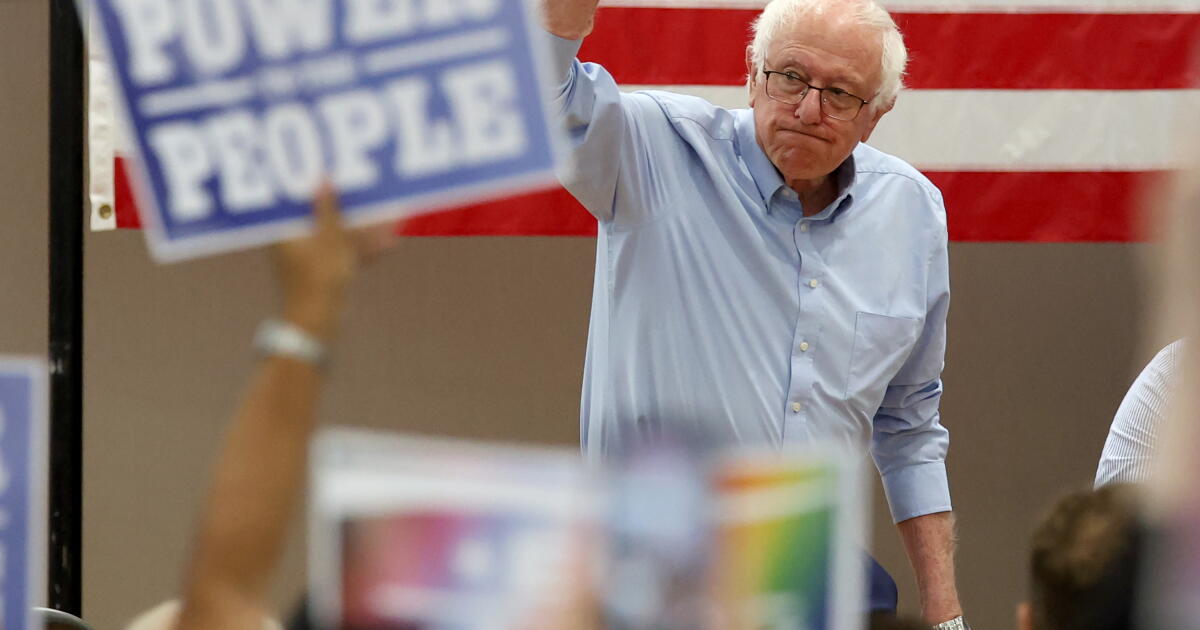
He sat in the fourth row, cheering and clapping with about 200 others as Vermont’s senator delivered his familiar tirade against the oligarchs and plutocrats and greedy corporations that he said are choking the life from America’s middle and working classes.

Fraass voted for Sanders in the 2016 Democratic primary when the candidate ran as the left-leaning, fist-shaking alternative to establishment favorite Hillary Clinton. He’s still a fan. But this time, with more than two dozen presidential candidates to choose from, Fraass is shopping around.

He worries that Sanders, 77, is too old and too far left to win a general election. “Realpolitik,” said Fraass, 53, a project manager who works in the credit card industry. “I want someone who can beat Trump, and I wonder if Sanders can do it or if someone else would be better suited.”

Robert Fraass backed Bernie Sanders in 2016 but right now he's shopping among Democratic candidates.

Robert Fraass backed Bernie Sanders in 2016 but right now he’s shopping among Democratic candidates.

(Mark Z. Barabak)

By several measures — polling, fund raising, die-hard support — Sanders remains one of the leading contenders for the Democratic nomination. He has more cash on hand — nearly $27.5 million — than any other Democrat and commands strong on-the-ground organizations in the two most politically crucial primary states: Iowa, which he barely lost four years ago, and New Hampshire, which he won handily.

But he’s fallen behind former Vice President Joe Biden in most state and national polls, lagged several rivals in the latest fundraising quarter and is no longer the political and cultural phenom he was four years ago.

Rather, Sanders has become something considerably less buzz-worthy, just another candidate scrabbling to break from the pack of presidential hopefuls, many staking positions similar — if not identical — to his own. Most have the added benefit of seeming newer and fresher.

“He’s been consistent. I think he’s as honest as the day is long,” said Tom Stewart, 72, a semiretired educator who swung by to hear Sanders at a Sunday morning coffee-and-doughnuts stop at the United Auto Workers hall in Ottumwa. Stewart might even vote for him again. But first, he said, “I want to see other candidates.”

To some degree, Sanders has been a victim of his own success.

“Last time when I was campaigning here in Iowa, I had ideas that many people in the political establishment and the media establishment thought were really radical. Far out,” he said, with a bit of ’60s hippie intonation as a crowd of 100 or so sweltered inside his storefront campaign office in downtown Ottumwa. “Well, a lot has changed over the last four years.”

Much of what Sanders proposed then — a government-financed universal healthcare system, a $15 federal minimum wage, higher taxes on the rich, tuition-free college, nationwide decriminalization of marijuana — has, in fact, become standard orthodoxy for many of the Democrats running.

For all that has changed, however, a great deal remains the same; a person waking from a 2016 coma might not even realize time has passed.

Sanders burns with the same white-hot flame, spits out the same dramatic statistics on income inequality, gives unshirted hell to the pharmaceutical and fossil-fuel and military- and prison-industrial complexes, just as he did last time.

With a fluttery wave of his hands, like a conductor before an orchestra, he excoriates the corruption in Washington, the rotten influence of political cash, the overweening power of special interests, all heightened, he says, “by the worst president in the history of this country.”

He appears mindful, if unabashed, that he incessantly repeats himself.

“I don’t want to beat a dead horse here,” Sanders told a gathering of several dozen seniors in Council Bluffs, as he launched into his standard attack on the evils of the American healthcare system. The flogging then continued through another 20 minutes of questions and answers.

Not that his audience seemed to mind. They spent an hour recounting horror stories about insurance coverage heedlessly denied, families destroyed and lives shattered by various health crises.

To supporters, his repetition is reassuring, a sign of Sanders’ passion and dedication.

John Blasingame, who took part in a panel discussion on the candidate’s “Medicare for all” proposal, has looked over others in the Democratic field and was impressed by Sens. Kamala Harris of California and Elizabeth Warren of Massachusetts. (The two are cosponsors of Sanders’ universal healthcare legislation.) Blasingame would like to see more women elected to political office.

“But I support Bernie because he has come out continuously, year after year after year, in support of people like me,” said the 80-year-old retired construction worker. “He’s introduced bills again and again in both the House and Senate which go toward helping the mass of people, not the rich privileged few, and he’s done this forever.”

John Blasingame likes Kamala Harris and Elizabeth Warren but supports Sanders because of his longstanding consistency.

John Blasingame likes Kamala Harris and Elizabeth Warren but supports Sanders because of his longstanding consistency.

(Mark Z. Barabak)

Others remain to be convinced.

Sandra Cerveny, 69, a retired college administrator, likes Sanders and very much supports Medicare for all. But she also has good things to say about Harris and former Vice President Joe Biden, who has criticized Sanders’ healthcare plan and suggested expanding the Affordable Care Act instead. “Frankly, I’m for whoever can beat Donald Trump,” Cerveny said, suggesting any of several Democrats would do just fine.

Faiz Shakir, who manages Sanders’ campaign, concedes that the candidate may have lost his novelty.

“For sure, the fact is other candidates are fresher,” Shakir said. But he noted that there will be plenty of opportunities over the next several months for them to rise and, he believes, fall again. “There are going to be a lot of boomlets,” he said.

But in the end, Shakir continued, those moments “will evaporate” and the Democratic contest will come down to who can deliver fundamental change and which candidate is best poised to defeat President Trump. Sanders, with his appeal to working-class voters in key states like Wisconsin, Michigan and Pennsylvania and unwavering call for political revolution, is the candidate best suited to achieve both, Shakir asserted.

There have been some small adjustments.

Sanders, who struggled last time for support among African Americans, has spoken more about his early involvement in the civil rights movement, seeking to broaden his appeal to black voters. He’s increased his outreach to older Americans — his recent Iowa swing was almost entirely devoted to senior issues — another group that largely spurned his insurgent 2016 effort.

After filling stadiums to deliver his angry oratorio — he packed Santa Monica High School’s amphitheater at a Friday night rally — Sanders has begun staging smaller, more intimate events intended to offer the up-close experience that voters in Iowa and New Hampshire, especially, have come to expect. In two days zigzagging the breadth of Iowa, from the Missouri to Mississippi rivers, he never spoke to a crowd larger than 250 or so and sometimes spent more time answering questions than giving his standard stump speech.

He has even begun posing for selfies — by now a staple of the presidential campaign trail — a task Sanders conducts with the joyless precision of a worker manning an assembly line. Smile. Click. Next.

What Sanders can’t change is the fact he’s no longer quite so compelling. For some Democrats that’s a reason — for now, anyway — to look elsewhere.

Back in Council Bluffs, Fraass left Sanders’ campaign office happy with the scorching rhetoric he’d heard. “I really liked his energy,” Fraass said, toting a blue-and-white “Bernie 2020” poster as he stepped into the 96-degree heat.

But Fraass wasn’t through shopping. Sixty miles east, in Shenandoah, Iowa, he planned to catch an afternoon appearance by this year’s political phenom, South Bend, Ind., Mayor Pete Buttigieg.

Source link

John Sterling, theatrical Yankees broadcaster, dies at 87

John Sterling, the longtime New York Yankees radio broadcaster known for extravagant, individualized home run calls, died Monday. He was 87.

Sterling had undergone heart bypass surgery this winter and after the procedure was attended to by health care aides at his home in Edgewater, New Jersey. He died Monday at Englewood Hospital, according to his former wife, Jennifer.

“John Sterling breathed life and excitement into Yankees games for 36 years while wearing his passion for baseball and the Yankees on his sleeve,” the team said in a statement. “He informed and entertained generations of fans with a theatrical and unapologetic style that was uniquely his own. John treasured his role as the voice of the New York Yankees, and his enthusiasm for the art of broadcasting perfectly complemented our city and our fans. The symmetry between John and his audience was both undeniable and magical, and his signature calls will resonate for as long as we put on pinstripes — especially after every Yankees win.”

He had called 5,631 games — 5,420 regular season plus 211 postseason — when he retired in April 2024 just after the season’s start, citing fatigue. Sterling broadcast 5,060 consecutive games from September 1989 through July 2019 after beginning with the Yankees as a pregame host. He came out of retirement to broadcast Yankees games during the 2024 postseason.

Sterling’s call for a player’s home run became as treasured a part of a Yankees identity as an initial set of pinstripes or a championship ring. As rookies prepared for debuts and former opponents arrived in trades, fans speculated how he would label the newcomer’s first longball.

From “Bernie goes boom! Bern, baby, Bern!” for Bernie Williams, to “It’s a Jeter jolt!” for Derek to “It’s an A-bomb from A-Rod!” for Alex Rodriguez, “The Giambino!” for Jason Giambi and ”A thrilla from Godzilla!” for Hideki Matsui, Sterling created personal stamps resonating from the clubhouse to the bleachers.

“It wasn’t meant that way. I just happened to do something for Bernie Williams. He hit a home run and I said, `Bern, baby, Bern!′ And it kind of mushroomed from there,” Sterling said at the time of his retirement. “But it never was intended for every player, because, frankly, I’m not smart enough to do something for every player. But I did the best I could, and it’s amazing what started out as — became so big.”

“I did say `A-bomb from A-Rod!′ when he hit a home run and I did say: `Robbie Canó, don’t you know,′ and I think those were pretty good,” Sterling said of calls for Rodriguez and Robinson Canó.

Born Josh Sloss on July 4, 1938, Sterling grew up in Manhattan and left college to work for radio stations. He had wanted to be a broadcaster since hearing “The Eddie Bracken Show” in the 1940s.

“I didn’t want to be Eddie Bracken. I wanted to be the guy who says: `Live from Hollywood!’” Sterling said. “And I knew that maybe a year or two later, but before puberty I knew I was going to be on the air. And it really helped me because I didn’t worry about school, because I knew what I was going to do. And it was a good thing because I was a terrible student — terrible.”

He started his radio career in 1960 at a station in Wellsville, New York.

“I was preparing this all my life. It was easy,” he said. “I could always open my mouth and talk.”

Sterling cited Mel Allen, Russ Hodges and Jim Karvellas as influences. He wound up joining Allen in the history of memorable Yankees broadcasters along with Red Barber, Phil Rizzuto, Bill White and Frank Messer.

Sterling announced the NBA’s Washington Bullets and Morgan State football in his early years and gained notoriety for shrieking “Islanders goal! Islanders goal!” during the hockey team’s games from 1975-78. He broadcast for the NBA’s Nets from 1975-80.

Sterling’s first connection with the Yankees was during WMCA pregame radio talk shows from 1971-78. He moved to Atlanta and worked for the Braves from 1982-87 and Hawks from 1981-89 before switching to the Yankees, where he replaced Hank Greenwald.

Sterling was seldom in the clubhouse and dressed in Brooks Brothers suits even though he was on the radio.

He partnered with Jay Johnstone (1989-90), Joe Angel (1991), Michael Kay (1992-2001), Charley Steiner (2002-04) and Suzyn Waldman (since 2005). Sterling and Waldman were inducted into the New York State Broadcasters Hall of Fame in 2016.

He was married to the former Jennifer Contreras from 1993 to 2004. In addition to her, he is survived by triplets Bradford, Derek and Veronica, and daughter Abigail.

Sterling was proud of his unique style.

“Harry Caray told me some years ago,” he recalled in 2024 of the famous Chicago Cubs and White Sox broadcaster, “and he says, ‘John, all the guys are great. We just have different styles.’ And no one has a more different style than I have.”

Source link