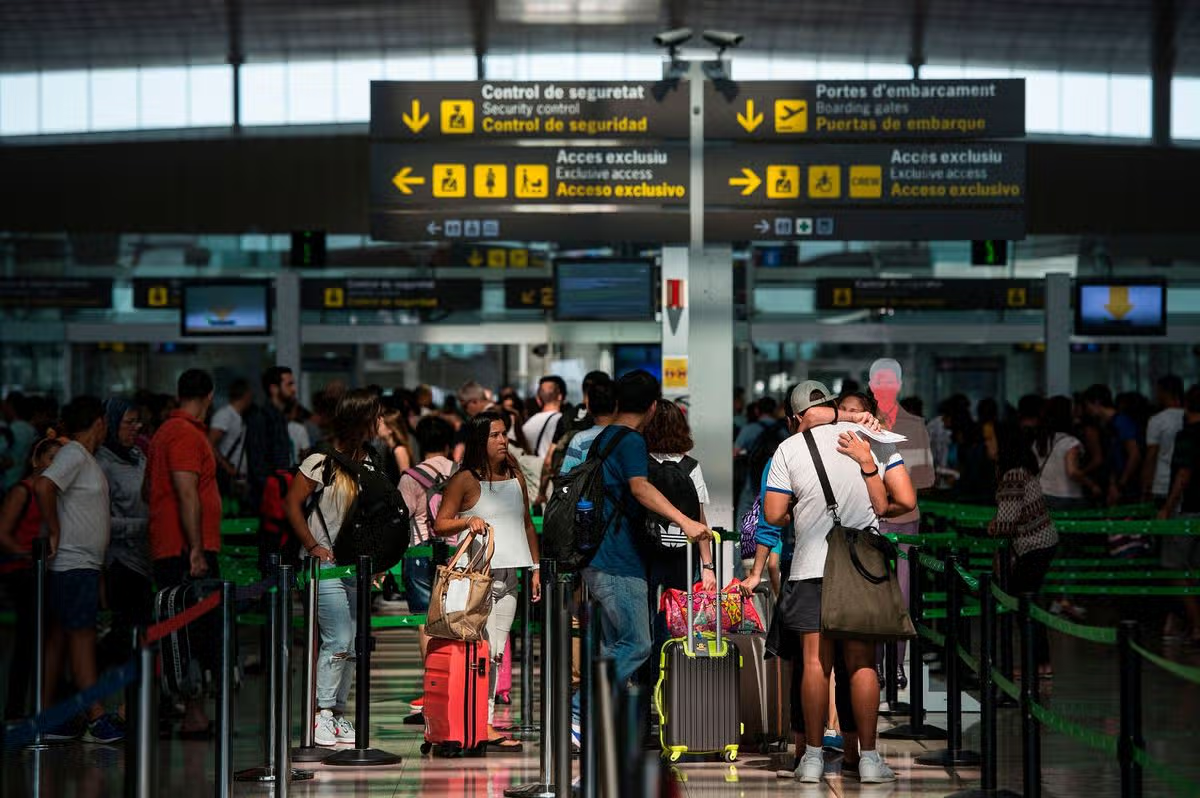
Drought and extreme heat are drying up rivers and farmland across Europe, with record-low water levels disrupting agriculture, shipping and even nuclear power plants that rely on rivers for cooling.
BELGIUM is currently seeing its largest wildfire on record, causing hundreds to evacuate.
Shifting winds have even caused smoke to drift as far as France and Germany as well.
Belgium is currently experiencing its biggest wildfireCredit: AFP
The fire first started on August 14 after temperatures reached 37C.
Here’s everything you need to know about the current situation and what to do if you are due to travel to Belgium:
Sign up for the Travel newsletter
Thank you!
Where are the wildfires in Belgium?
The wildfires in Belgium are currently concentrated in the High Fens nature reserve, which is in the Liege province in the eastern part of Belgium, close to the German border.
The reserve is Belgium’s largest nature protection.
Currently, surrounding impacted areas include Waimes, Bütgenbach, Jalhay and Malmedy.
Some smoke and fire is also evident near the German border in the town of Monschau.
Currently, the wildfires have impacted around 7,400 acres, making it the largest wildfire in Belgium’s history.
In parts of Waimes and Bütgenbach, around 600 residents have been evacuated so far.
It started on August 14 after temperatures hit 37CCredit: Reuters
Is it safe to travel to Belgium right now?
Major tourist hubs such as Brussels, Bruges, Ghent and Antwerp are entirely unaffected.
However, if you are planning or due to travel to the east of Belgium or the Ardennes region, you must exercise caution.
A recent rainfall and drop in temperature has helped to slow the fire spreading, but thick smoke has drifted widely and as far as eastern France.
Visitors and residents are currently being warned to not travel to the nature reserve, hiking trails or surrounding forests in eastern Liège.
Are flights still going to Belgium?
Flights are still operating as normal to Belgium.
The current fire zone is around 85 miles east of Brussels, and while the smoke has caused locals to evacuate it has not caused disruption to flights.
What if I have a holiday to Belgium booked?
As the Foreign Office has not warned against travel to Belgium, there are no special circumstances in place for holidaymakers to cancel their trip and receive a full refund.
Depending on what travel insurance you have, your policy might include natural disaster cover.
If so, your insurance policy should cover you for when you are unable to reach your holiday destination due to natural disasters, such as wildfires.
So it is worth checking your travel insurance policy.
It is also worth noting, that once in Belgium, open fires, disposable barbecues and wild camping outside official campsites are banned across Wallonian forests and nature reserves at the moment.
Can I cancel my trip?
If you want to cancel your trip or holiday, it is best to contact your airline and/or holiday provider.
Companies do not have an obligation to refund bookings unless Government advice changes.
Neighbouring countries send personnel to help keep the blaze from crossing into Germany.
Published On 16 Aug 202616 Aug 2026
Firefighters are battling Belgium’s largest wildfire on record as it burns through the High Fens nature reserve near the German border on Sunday.
The fire broke out on Friday in Belgium’s Liege province and has been spreading east towards Germany. It has burned more than 27sq km (10.4sq miles).
Recommended Stories
list of 2 itemsend of list
Belgium’s previous record fire occurred in 2011, burning 14sq km (5.4sq miles) of the same reserve, the European Forest Fire Information System said.
More than 250 emergency services personnel have been deployed, among them firefighters from Belgium, Germany, Luxembourg and the Netherlands.
Firefighters focused on containing the advancing front of the fire, spokesperson for the government of Belgium’s Wallonia province, Stephanie Ernoux, told the Reuters news agency.
About 600 people in the Belgian border municipalities of Waimes and Butgenbach were told to leave their homes on Saturday as winds shifted and smoke spread.
Authorities said no homes had been affected as of Sunday morning, but urged people to stay away from the fire zone.
In Germany, the town of Monschau said the fire had come within about 3km (1.9 miles) of the border. Officials did not expect the flames to cross the border, the town said, but it advised residents of three of its districts to leave temporarily due to the smoke.
The fire came as Belgium had just come through another burst of severe heat, the thermometer touching roughly 37C (98.6F) in places on Friday, on top of weeks with barely any rain.
Like other parts of Europe, Belgium is in the middle of a summer of repeated heatwaves. Weather agencies logged temperatures above 35C (95F) in several European countries on Thursday, and the United Kingdom had its hottest day of the year when west London reached 38.1C (100.5F).
Fires have frequently followed the heat. Thousands of people have been driven from their homes in Germany, France, the UK, Croatia and Greece in recent days, and about 500,000 hectares (about 1.24 million acres) have burned across the European Union this year.
The decisions mark both a victory and a setback for President Emmanuel Macron, who had championed both policies.
France’s Constitutional Council has upheld a law passed by parliament to legalise assisted dying in specific circumstances, while striking down a separate bill that sought to ban under-15s from using social media.
The council, France’s highest constitutional authority, issued its rulings on Friday. The decisions mark both a victory and a setback for President Emmanuel Macron, who had championed both policies.
Recommended Stories
list of 3 itemsend of list
France is set to join several European countries that have already legalised assisted dying, including Belgium, Germany and Luxembourg, among others.
“This decision marks the culmination of a long democratic and parliamentary effort, conducted with listening, respect, and rigour,” Elisabeth Borne, MP and former French prime minister, said in a post on X about the assisted-dying decision.
“I welcome this definitive validation of a text that guarantees everyone the freedom to choose, within a strict and protective framework.”
The council upheld the law in its entirety while clarifying three provisions, including the so-called conscience clause, under which pharmacists may refuse to assist a patient in ending their life.
Private treatment centres can also refuse to participate in the procedure if it goes against their mission, and other centres can serve local needs. Lastly, in the case of protected patients, the opinion of the person responsible for their welfare must be taken into account.
French citizens and legal residents can request medical support in ending their lives under strict conditions. The legislation stipulates that the patient must be “suffering from an incurable, life-threatening illness in an advanced or terminal phase”, and that the illness must cause “constant physical or psychological suffering that is untreatable or unbearable”. Lastly, the patient must exercise free and informed consent.
The French National Assembly passed the bill last month by a majority of 50, with 291 voting in favour and 241 against.
Meanwhile, the Constitutional Court struck down legislation banning under-15s from social media, citing freedom of expression.
“By prohibiting minors under the age of fifteen from accessing certain online services, the law inherently requires every person, even an adult, to prove their age before accessing them,” the court said in its decision.
“However, by failing to specify the conditions and limits under which such proof must be provided, the legislature has not established the legal safeguards necessary to ensure compliance with these requirements,” it added. The court also said that the law fails to safeguard people’s privacy.
The bill was one of Macron’s flagship policies and was passed by parliament last month.
It stipulated that everyone in France would have to verify their age to access social media sites, and it was supposed to come into effect in January 2027. Macron was eager for the bill to be passed before the presidential election next year.
After Friday’s ruling, Macron asked Prime Minister Sebastien Lecornu to work on a new “legally robust draft” of the legislation.
Last month, Amnesty International responded to the French parliament’s decision to impose the social media ban on teens, urging lawmakers to focus their efforts on forcing companies to redesign their apps, including what it described as “addictive features”.
“There is no doubt that regulating platforms to protect children is an imperative of our time. We commend states for taking social media harms seriously but rather than pursuing blanket bans, efforts should be on forcing platforms to abandon their reckless pursuit of profit to the detriment of human rights,” Secretary General Agnes Callamard said.
“Building safe platforms requires a robust response. To ensure platforms are spaces where children can access community, connection and knowledge in a healthy and safe way, governments should first focus on banning the features that drive harm, including engagement-based algorithms that Amnesty International’s research has shown can draw children into rabbit holes of depressive and suicidal content.”
Jeremy Doku says he is “not against” the journalist who criticised his plan to leave the Belgium camp during the World Cup to attend the birth of his first child.
Doku’s wife Shireen was due to give birth during the second week of July and he told Reuters, external before the start of the tournament he intended to leave the camp to be at the birth even if his side were still in contention.
But it brought fierce criticism from L’Equipe channel presenter France Pierron, who labelled a father “completely useless” at the time of their child’s birth.
L’Equipe later apologised and said Pierron’s comments were “very far removed” from its values. The presenter also apologised but was taken off air until the end of the current season of her show.
Doku eventually missed Belgium’s 0-0 draw against Iran in the group stage to fly back to the UK for the birth of his son, Praise.
“There was a lot of noise of course,” the Manchester City winger said.
“I can understand why people felt like maybe this was orchestrated because it was too perfect.
“I also saw the journalist speak about me and the situation and all the people getting at her. But I just wanted to use this video as well to really… pray over her.
“I don’t want to come at her in a way that most people did. I don’t want people to be too harsh on her. We don’t know what she has experienced. It’s her opinion.
“She got fired and all these things. I never want this for a person. I’m not against her. I’m not angry at her or anything. She just said her opinion.”
Doku played 86 minutes of Belgium’s opening 1-1 draw with Egypt in Group G of the World Cup before missing their next game, with his absence explained as illness.
A Belgium statement later said, external that the 24-year-old travelled to London to be with his wife “with the approval of and accompanied by one of our team doctors”.
Lando Norris speaks up ahead of Hungarian Grand Prix with drivers feeling new regulations have cramped their speed.
Published On 25 Jul 202625 Jul 2026
Formula One has been driven too much by business decisions and needs to remember it is a sport, according to McLaren’s world champion Lando Norris.
With drivers chafing at new regulations that have cramped their speed, particularly at last weekend’s Belgian Grand Prix, the Briton told reporters ahead of Sunday’s Hungarian round that Formula One could do better.
Recommended Stories
list of 4 itemsend of list
“It’s a business,” said the Briton. “Everyone wants to make money, so in order for Audi and other teams to come in we had to change these things. It’s a shame. It should never have been like that. But that’s how businesses work.”
Audi have entered the sport this season after taking over Swiss-based Sauber, with the German carmaker encouraged by new rules that have increased the electrical element of the power unit to near-parity with the internal combustion engine. The rules have been tweaked for 2027 to reduce the electrical contribution.
“Formula One will always be great,” said Norris, whose car has a Mercedes engine. “It can just be better.
“Us as drivers just know it better than everyone else. The thing that’s a shame is that Formula One is too heavily led by the fact it’s a business nowadays and not how can you make the sport the best possible. It’s ‘how can you just make the most money as a business?’
“And that’s just not what it should simply be. That’s not how a sport should be run. The fact we have hybrids, 50-50 and all that, that’s just because more teams wanted to come in it and because you make more money.”
Norris said the Liberty Media-owned sport was also divided between fans who followed Formula One before the arrival of the popular Netflix docu-series “Drive to Survive” and those who have been drawn to it since.
“I think the fans you have nowadays, because they’re a lot more personality-based … and not simply of Formula One as a whole sport, I think there’s less interest in basically how the actual race goes, and more just ‘has the driver done well or not?’” he added.
“I think that’s just how the fans have changed over time, and that’s completely fine. But the biggest voice should always be ours as drivers … We have the best idea of how racing should be, how it can be, what’s possible, what’s not.
“We would just want the best for everything, the best for the fans, the best viewing, the best racing for us, the most fun to drive. And at the minute, we don’t … we have very, very little say, and a lot more of it’s done because if you can have Audi and other teams in it, it’s a bigger win than the drivers being happy.”
A Formula One spokesman responded to Norris’s comments by saying drivers were listened to more than ever.
“The sport on track is, and always will be, the priority,” he said. “Everyone has benefitted from the commercial success of Formula One, the drivers included. Decisions are made for the best strategic outcome for everyone: the fans, teams and partners.”
Norris was fastest in final practice for the Hungarian Grand Prix on Saturday.
Last year’s race winner lapped the Hungaroring circuit with a best time of 1:17.939, 0.117 seconds quicker than Ferrari’s Lewis Hamilton.
Formula One championship leader Kimi Antonelli was third fastest, 0.129 seconds off the pace and ahead of Ferrari’s Charles Leclerc, McLaren’s Oscar Piastri and Mercedes teammate George Russell.
Red Bull’s Max Verstappen was seventh on the timesheets, with teammate Isack Hadjar eighth but 1.004 off the pace.
The budget airline has confirmed it’ll be cutting the number of aircraft from one of its city bases by five, and its schedule will have two million fewer seats to a popular city break destination as of winter 2026
Two million seats will be cut from Ryanair’s schedule(Image: Jonathan Raa/NurPhoto via Getty Images)
Ryanair has slashed the number of seats from its schedule for a city break destination that’s famous for its Christmas market and historic sites, as well as being a major business hub.
The decision was made in response to the country’s decision to raise aviation taxes, with Ryanair releasing a strongly-worded statement to announce they would be cutting two million seats from two of the capital’s airports.
The Federal Government of Belgium announced plans to raise the country’s aviation tax from €5 (about £4.20) to €7 (about £6) as of January 2027. This was erroneously described by Ryanair in a statement as a “250% increase since 2025.”
As a result, the budget carrier plans to cut five aircraft from its base at Brussels South Charleroi Airport, and reduce capacity by two million seats overall from Belgium’s Charleroi and Zaventem airports. The reductions will be applied to the winter 2026 and summer 2027 schedule.
Brussels is not the first destination to see a cut in the number of Ryanair seats this year. Earlier this year it announced reductions in services to Spain and Portugal, with smaller regional airports the most affected.
Valladolid and Jerez saw cuts to their services, while scrapped routes included Asturias and Vigo. A service to Tenerife North was also scrapped as a result of a dispute over airport fee hikes, leaving the airport with no alternative direct UK routes. Ryanair also closed its two aircraft base at Santiago de Compostela which reduced capacity.
As a result over one million seats were taken from the winter 2025 routes, and 1.2 million cut from the summer 2026 schedule. Another cut was to a Portugal service, with Ryanair cutting six routes to and from the Azores, an emerging tourist destination. It was estimated the cuts affected around 400,000 passengers.
At the time, Ryanair blamed this cutback on growing airport charges set by Portuguese authorities and environmental taxes linked to the EU Emissions Trading System. John Paul II Ponta Delgada Airport, the islands’ main airport, now only has a single seasonal UK route from London Heathrow operated by British Airways.
Speaking about the cuts in Belgium, Ryanair CEO, Eddie Wilson, said in a statement: “It’s absurd that the Federal Govt have decided to increase Belgium’s aviation tax by 250% from Jan ’27, especially when competing EU countries, like Sweden, Hungary, Slovakia, regional Italy, and Albania are abolishing aviation taxes to grow traffic, tourism and jobs.
“We warned Prime Minister De Wever that increasing Belgium’s aviation tax would result in traffic cuts, but he failed to listen. As a result, Ryanair will now remove 5 aircraft from our Charleroi base and 2m seats from our Brussels schedules (Charleroi and Zaventem) for Winter ’26/Summer ’27 and relocate to more competitive economies.”
Have a story you want to share? Email us at webtravel@reachplc.com
EAST RUTHERFORD, N.J. — The largest, longest and most complex World Cup in history came to a close Sunday, with Spain beating Argentina 1-0 in extra time. But FIFA president Gianni Infantino didn’t bother waiting for the final result before passing judgment on the tournament.
“By all means this World Cup has exceeded all expectations,” he said during a reception at Trump Tower two days before the final kicked off. “This has not just been the greatest FIFA World Cup of all time. It is the greatest human social and cultural event that mankind has ever witnessed.”
No, but it was pretty good, with FIFA emerging as the World Cup’s biggest winner, allowing Infantino to reportedly shore up support within the organization despite a number of norm-shattering decisions during the tournament.
Attendance topped 6.8 million, a World Cup record averaging more than 65,000 fans a game. FIFA estimated the cumulative global TV audience topped 5 billion people across linear television, digital streaming and social platforms while more than 1.8 billion people were expected to watch the final, according to the BusinessStats website, making it the most-viewed sporting event in history.
Argentina goalkeeper Emiliano Martínez reacts as Spain’s Ferran Torres scores during the World Cup final in East Rutherford, N.J., on Sunday.
(Julio Cortez / Ap Photo/julio Cortez)
Exact figures won’t be known for a few days.
Revenue for the four-year World Cup cycle is anticipated to reach $13 billion, making it the first $10-billion sporting event in history — bolstering Infantino’s case for reelection as FIFA’s president next year.
The final was among the most expensive U.S. sporting events of all time, with the get-in asking price for a single ticket on the secondary market peaking at about $7,400 three hours before kickoff and the average purchase price topping $10,800. One seat sold for $32,502, which is either a good thing or a bad thing, depending on whether you’re buying the ticket or selling it.
Inglewood’s SoFi Stadium hosted eight games, including two of the U.S. team’s three group-stage games and Spain’s quarterfinal win over Belgium. The matches had a total attendance of 561,656 people, about 99.6% of capacity — that’s more than each of the first three World Cups drew for the entire tournaments.
U.S. and Paraguay oversized flags are featured on the pitch before a World Cup group stage match at SoFi Stadium on June 12.
(Allen J. Schaben/Los Angeles Times)
Weather disrupted just a handful of matches, not the dozen or more that were feared, and the logistical nightmares of staging the 39-day tournament across three countries for the first time — the U.S. co-hosted the event with Mexico and Canada — never materialized. The expansion to 48 teams and 104 games, meanwhile, made room for a number of surprises that gave the tournament its life and sparkle.
Tiny Cape Verde, the second-smallest country to qualify for a World Cup, made a memorable debut, playing Spain to a scoreless draw in its opener, then taking Argentina to extra time before falling in the cruelest way possible, on an own goal, in the knockout rounds.
Norway, playing in the tournament for the first time this century, made it to the quarterfinals behind its hulking striker Erling Haaland, who quickly became a fan favorite while the team’s supporters saw their synchronized “Viking Row” celebration go viral.
Canada and Egypt both won World Cup games for the first time, advancing to the Round of 16, with Egypt becoming one of nine African teams to make it to the knockout rounds. Of FIFA’s six continental confederations, only UEFA, representing Europe, did better than Africa, sending 13 teams beyond the group stage.
Argentina’s Lionel Messi erased any doubt that he’s the greatest player in World Cup history — if not soccer history — by willing his team to the final and winning the Silver Ball, runner-up for the tournament’s most outstanding player. On Sunday, Messi was thwarted in his attempt to win a second straight World Cup and third Golden Ball, but he walked off the field at MetLife Stadium as only the second man to play in three World Cup finals.
And he finished his record-setting sixth tournament as the all-time leader in games (34), assists (12) and goal contributions (33), more than standing the test of time. Two of the players Spain started against Argentina in the final hadn’t even been born when Messi, 39, made his World Cup debut in 2006.
But if those were the highlights, there were also lowlights.
This was by far the most political World Cup in history and the first in which a host country, the U.S., was actively at war with a participating one, Iran.
Iran defender Ramin Rezaeian celebrates with teammates after scoring during a World Cup match against New Zealand at SoFi Stadium on June 15.
(Allen J. Schaben/Los Angeles Times)
That had all kinds of ramifications, starting with the State Department’s refusal to grant visas to more than a dozen members of Iran’s official delegation. Iran was also forced to move its base camp from Tucson to Tijuana, and though it played all its games in the U.S., it was denied permission to remain in the country after each match, an option granted to every other team.
Despite the harassment, Iran did not lose a game, playing to three draws despite having three goals — any of which would have sent it to the knockout rounds — erased by video reviews.
The State Department also denied entry to Omar Abdulkadir Artan, a decorated Somali referee, turning him away at Miami International Airport in June, citing “vetting concerns.” Artan, named Africa’s top referee last year, had a valid entry visa and was selected by FIFA to work the tournament last April.
Iran wasn’t the only team to have its World Cup ended early by technology. Although the video assistant referee (VAR) system was adopted primarily to alert the head official to potential clear and obvious errors or serious missed incidents, in this tournament it became intrusive, eliminating Croatia on evidence from a NASA-level ball sensor and costing Egypt what would have been a game-winning score for a perceived foul that took place nearly 100 yards from the goal.
Coaches and players are still allowed to make mistakes, but the technology now has referees making calls on things that are imperceptible to the naked eye, something critics say has removed any sense of judgment or nuance, robbing the game of much of its drama.
“Football is an art. That’s why we love it,” said Christina Unkel, a former FIFA referee and a rules of the game analyst for multiple TV networks. “When you do pursue black and white — objectivity is what they’re trying to get to, and I get it; they want to eliminate as much subjectivity as possible — what everyone is hating is this perfection thing.”
Then there was the official’s call that President Trump took credit for overruling from 2,800 miles away.
When striker Folarin Balogun, the U.S. team’s leading scorer, was given a red card in the second half of his team’s Round of 32 win over Bosnia-Herzegovina, he was immediately suspended from the Americans’ next elimination game with Belgium. But Trump admitted he phoned Infantino three times, lobbying for the suspension to be rescinded.
U.S. forward Folarin Balogun stepped on Bosnia-Herzegovina defender Tarik Muharemovic’s foot during a World Cup match and received a red card at Levi’s Stadium on July 1.
(Robert Gauthier/Los Angeles Times)
Less than 30 hours before the Belgium game, the card penalty was suspended and Balogun was placed on one year’s probation by FIFA’s disciplinary committee, marking just the second time in World Cup history that a player who received a red card was allowed to play in his team’s next game. The international uproar that followed overwhelmed the U.S. team, which played its worst game of the tournament against Belgium.
Trump, who was booed as he saluted the national anthem Sunday from a luxury box before the game, was booed again by the crowd of 80,663 when he strode onto the pitch for the awards ceremony afterward.
UEFA, the FIFA confederation in which Belgium plays, protested the decision to let Balogun play, saying it had “crossed a red line.” It was far from the only bright red line Infantino crossed in this tournament. And some of that line crossing could set dangerous precedents.
Allowing the U.S. to turn away the Somali official and limit the Iranian team’s time in the country, for example, could embolden future World Cup hosts to do the same. What’s to stop Morocco, co-host of the 2030 tournament, from banning officials and players from Algeria over the two countries’ territorial dispute in the Western Sahara? And if a red card is handed to a player from Spain, another 2030 co-host, would the Spanish prime minister call Infantino to try to get it rescinded? Despite FIFA’s insistence that the disciplinary committee works independently, many believe Trump’s meddling worked.
But as always with FIFA, money speaks the loudest, so Infantino’s norm-shattering behavior over the last year doesn’t seem to have cost him much support. The Guardian reported last week that as the World Cup neared its successful conclusion, nearly 200 of FIFA’s 211 member associations are endorsing Infantino’s bid for reelection to a fourth term as president next March.
Which is why Spain wasn’t the only winner in this tournament.
Mercedes driver won his sixth GP of 2026 as championship rival and teammate George Russell crashes out on first lap.
Published On 19 Jul 202619 Jul 2026
Kimi Antonelli won the Belgian Grand Prix for Mercedes on Sunday to stretch his Formula One lead to 45 points over Ferrari’s Lewis Hamilton on a bleak day for teammate George Russell, his closest title rival heading into the race.
Russell had been the 19-year-old Italian’s closest rival before the start at Spa-Francorchamps, but the Briton spun off into the gravel on the opening lap after a collision with Hamilton while trying to make up places lost at lights out.
Recommended Stories
list of 4 itemsend of list
Ferrari’s Charles Leclerc was second in the 44-lap race, 1.952 seconds behind after leading, thanks to a pit stop while a virtual safety car was deployed, with Max Verstappen third to give Red Bull their 300th Formula One podium.
Hamilton finished fourth, despite serving a five-second penalty for the collision with Russell, but remained under investigation for an unsafe release from a pit stop that could drop him to fifth and further stretch Antonelli’s lead.
Mercedes’ Kimi Antonelli leads Red Bull Racing’s Max Verstappen at the beginning of the Belgian Grand Prix [Sarah Meyssonnier/POOL via AFP]
It was Antonelli’s sixth win in 10 rounds this season, leaving him 50 points clear of Russell. Antonelli was first in qualifying, continuing Mercedes’ clean sweep of pole positions this season.
“It’s great to be back on the top step after a few difficult rounds,” said Antonelli, who had drawn a blank in two of the past three rounds.
“It was a hard-fought race. We lost first place with the VSC but then we managed to make our way back.
“The momentum was always there. It was just about getting the results,” he added. “Today we were a bit lucky with what happened in terms of the championship but you have to take every opportunity because we saw how much it can swing.”
McLaren’s Oscar Piastri finished fifth, with Isack Hadjar sixth for Red Bull from last on the grid. Reigning champion Lando Norris was seventh for McLaren after starting 13th due to a 10-place grid drop.
Gabriel Bortoleto brought more points for Audi in eighth place, with Arvid Lindblad ninth for Racing Bulls and Argentine Franco Colapinto completing the scoring in 10th place for Renault-owned Alpine.
The move lands as EU foreign ministers remain deadlocked over a bloc-wide ban on illegal settlement trade
Published On 18 Jul 202618 Jul 2026
Belgium’s federal government has approved a ban on importing goods produced in Israeli settlements in the occupied Palestinian territories.
It is the latest among a small but fast-growing group of European countries acting alone on a question still unresolved at EU level.
Recommended Stories
list of 3 itemsend of list
The decision came at the government’s final cabinet meeting before the summer break, the Belgian News Agency (Belga) reported on Saturday.
The move fulfils a commitment made last year over the scale of Israel’s bombardment of Gaza and its death toll.
Earlier this week, Belgian foreign minister Maxime Prevot pressed EU counterparts at a closed-doors meeting in Brussels for a bloc-wide ban, accusing the European Commission of offering ministers “a bone to chew on” rather than a genuine plan to act.
Belgium’s ban arrives as both a domestic pledge fulfilled and a signal to the EU leadership.
The case for tighter controls was strengthened this year by a Global Echo Litigation Center investigation, which examined more than 30,000 export documents covering thousands of Israeli agricultural shipments to Europe.
Roughly one in six contained goods grown in settlements in the occupied West Bank or Golan Heights, rising to nearly one in five among shipments bound for EU countries.
Investigators found exporters routinely obscured the true origin of the produce, labelling it Israeli, blending it with genuine Israeli stock, or shipping it under addresses unconnected to where it was grown.
Similar moves by others in Europe
The EU is Israel’s largest trading partner, buying close to 30 percent of its exports and accounting for nearly a third of its total trade in goods, worth 43 billion euros ($49bn) last year.
Belgium joins a list of states no longer waiting for EU-wide action.
Spain enshrined a ban in law last September, the Netherlands agreed to one in May and Slovenia adopted a similar measure earlier this year, though it has dramatically shifted its approach to Israel following the election of a more pro-Israel government.
Ireland’s parliament passed its own prohibition on July 15 , days before Belgium’s move.
The wave of national bans follows efforts earlier this month by the EU to coordinate action among its member states.
The European Commission reportedly circulated a paper to EU capitals setting out three options: an import ban, a licensing scheme, or high tariffs on settlement goods. However no decision was reached.
Five former European officials, including ex-Italian prime minister Enrico Letta and former German Vice Chancellor Sigmar Gabriel, published a joint call for the EU to adopt a bloc-wide ban.
They argued that national bans like Belgium’s carry limited weight alone, since goods cleared through customs in one member state can move freely across the rest of the bloc.
A ban, they wrote, would not amount to a sanction against Israel but would simply bring EU trade policy into line with restrictions it has applied before, including on conflict minerals and goods made with forced labour.
Several EU countries, including Spain, Italy and Germany, have also acted to restrict arms exports to Israel over the war in Gaza.
LONDON — The British government on Thursday urged FIFA to investigate Argentina’s team after players posed with a banner claiming sovereignty over the contested Falkland Islands.
Argentina beat England 2-1 in a World Cup semifinal on Wednesday in Atlanta.
During post-match celebrations, Argentine players held a banner handed over by fans in the stands, reading “Las Malvinas son Argentinas” — “The Malvinas are Argentine.”
Argentina refers to the Falkland Islands as Islas Malvinas. They were invaded in 1982 under orders from Argentina’s then-military dictatorship, triggering a 10-week war won by Britain.
“The World Cup might not be ours, but the Falkland Islands definitely are,” a spokesperson for Prime Minister Keir Starmer said Thursday. “Self-determination rests with the islanders and our commitment to the Falklands will never waver.”
Starmer supported calls for FIFA to investigate, the spokesperson said, after U.K. Business Secretary Peter Kyle said the players’ behavior was “entirely inappropriate.”
FIFA can prosecute Argentina’s players and soccer federation because its disciplinary code prohibits at stadiums any “message that is not appropriate for a sports event” including those of “a political, ideological, religious or offensive nature.”
The FIFA fines for political messaging are $5,000 to $20,000.
FIFA was approached for comment Thursday.
A FIFA disciplinary case under previous leadership banned a South Korea player for two 2014 World Cup qualifying games because he held up a similar banner about a territorial claim against Japan at the 2012 London Olympics. Park Jong-woo took a fan banner with the slogan “Dokdo is our territory” after South Korea beat Japan in the men’s bronze medal game.
On Wednesday, Argentina player Lisandro Martínez was asked if the banner could have stirred deep emotions and tears for a veteran of the Malvinas conflict.
“We couldn’t let the Argentine people down” said Martínez, who has played in England for the past four years with Manchester United.
Argentina-England soccer rivalry
The sporting rivalry between the two countries is heightened by political tensions over the South Atlantic archipelago. It is a British overseas territory with a population of around 3,500 people located about 8,000 miles from the U.K. and 300 miles from Argentina.
Argentina argues that the islands were illegally taken from it in 1833. Britain, which says its territorial claim dates to 1765, sent a warship to the islands in 1833 to expel Argentine forces who sought to establish sovereignty over the territory.
The war in 1982 killed 649 Argentine troops, 255 British service personnel and three islanders.
That conflict ended during the 1982 World Cup in Spain where Argentina, England, Scotland and Northern Ireland all played. British television networks declined to broadcast Argentina playing in the tournament’s opening game, when the defending champion lost to Belgium.
“Sadly, it is a sad part of our history,” Argentina player Leandro Paredes said in Atlanta about the banner, “for everyone involved in that chapter of, I repeat, our history. And it hurts. We knew we were playing for them, too.”
Politics in soccer
British government minister Kyle told the BBC “politics needs to be separate from football.”
“In fact, the World Cup has one of its central tenets that politics is separate from football,” he said. “That is now a matter for FIFA.”
FIFA’s statutory political neutrality has been questioned at this World Cup after its president, Gianni Infantino, and disciplinary process — which could now judge Argentina — seemed to cave to pressure from U.S. President Donald Trump in allowing United States forward Folarin Balogun to play Belgium in the round of 16.
Balogun was shown a red card in the previous round and FIFA disciplinary rules mandated he should be banned from his team’s next game. FIFA deferred that suspension for one year of probation, provoking an all-time controversy in modern World Cup history. Belgium beat the U.S. 4-1 to advance to the quarterfinals.
Infantino is expected to sit with Trump and Argentina President Javier Milei, who are political allies, at the World Cup final Sunday. Argentina plays Spain in East Rutherford, New Jersey.
Previous cases
Argentina players showed the same “Las Malvinas son Argentinas” slogan at a warmup game in June 2014 in Buenos Aires for the World Cup that started days later in Brazil.
FIFA’s disciplinary panel ruling in that case was published after the tournament finished and fined the Argentina federation $37,000.
In the 2012 London Olympics case, FIFA’s ruling said the conduct of the South Korea player “cannot be tolerated.”
At the 2022 World Cup, FIFA fined the Serbia federation 20,000 Swiss francs ($24,800) for hanging a political banner about neighboring independent state Kosovo in the locker room before playing Brazil.
It showed a map of Serbia that included the territory of Kosovo, which has been an independent state since 2008, and the slogan “No Surrender.”
Lawless and Dunbar write for the Associated Press. Dunbar contributed to this report from Geneva.
Erling Haaland and SoFi Stadium, ladies and gentlemen. Your breakout stars of the World Cup.
We’ve all fallen for the blond forward who has rowed Norway to its first World Cup quarterfinal berth — and also for SoFi Stadium.
Or “Los Angeles Stadium,” FIFA’s designation for the $5.5-billion architectural masterpiece that welcomed the world to Inglewood.
I cover Rams and Chargers games there regularly, but the World Cup changed how I feel about the place. It has more soul now, more character.
There is more history attached, “core memories,” as Kevin Demoff, president of parent company Kroenke Sports & Entertainment, put it.
The exultation when the United States went up 1-0 in the seventh minute of its tournament-opening, 4-1 victory over Paraguay? “That’s now a core memory of this stadium,” Demoff said.
So is the proud Iranian diaspora showing up en masse to mostly support Team Melli twice, in draws with New Zealand and Belgium.
And the goal by LAFC’s Stephen Eustáquio in the second minute of second-half stoppage time to lead Canada to a 1-0 victory over South Africa in its first knockout game.
And Spain’s taut, 2-1 victory over Belgium in Friday’s high-stakes quarterfinals match.
FIFA might say these sensational scenes put L.A. — our tiny hamlet of more than 18 million people — “on the map.”
What they did was put SoFi Stadium on everyone’s radar as one of the world’s foremost football stadiums.
Jose Ovalle, a 34-year-old from Reynosa, Mexico, has watched matches at Estadio Azteca in Mexico City and Estadio BBVA in Monterey, both sites of World Cup action this summer.
“They’re amazing stadiums — a lot of history, so much history,” Ovalle said Friday. “But [SoFi Stadium] is one of the top stadiums in the world.”
Spain midfielder Fabián Ruiz, left, celebrates after scoring past Belgium goalkeeper Thibaut Courtois, right, in the World Cup quarterfinals at SoFi Stadium on Friday.
(Allen J. Schaben / Los Angeles Times)
Nah, said New Zealand coach Darren Bazeley: “This is the best football stadium I’ve ever been in.”
Swiss center back Manuel Akanji plays for Inter Milan and roots for the Atlanta Falcons. It was a big deal for him to play at their home field, Mercedes-Benz Stadium, in last year’s FIFA Club World Cup.
“It’s really nice, but this is the best,” Akanji said after Switzerland defeated Bosnia-Herzegovina in group play at Sofi Stadium. “This is the best I’ve seen overall among all the stadiums I’ve ever been to. It’s amazing.”
Eight matches, five group stage games, two round-of-32 knockout affairs, Friday’s quarterfinal and a partridge in a pear tree — it was a monthlong run that was everything SoFi Stadium’s team could have wished for when it began preparing to host eight years ago. And more.
“I don’t think you can envision the passion of national team fans,” Demoff said. “We’ve seen so many great events here, NFL games, concerts, but the pride of a national event and seeing people come to Los Angeles and the U.S. for the first time, and seeing this building for the first time…
“There’s something magical about 30,000 Bosnians in blue singing, marching from the airport to here. You can’t properly envision that, no matter how many times you’ve been here.”
People raved about sight lines and sound. They admired the architecture and the infinity screen and the way the canopy kept things cool. In line to buy merchandise Friday, Orange County’s Nick Valencia looked around and mused: “Wow, humans made this.”
Players had the run of the place on real grass, not the artificial turf in place for NFL games. (Don’t expect that to change, Demoff said, noting that upkeep would be doubly challenging at SoFi Stadium with two NFL teams using the field.)
Soccer fans amplified their positive reviews online, where the only complaint having to do with SoFi Stadium was that FIFA decided to give the World Cup final to the archaic-by-comparison MetLife Stadium — a.k.a. “New York/New Jersey Stadium” — instead.
The stadium popped in person and on TV, its distinctive, futuristic shape making it immediately recognizable in a way that not every stadium is.
Vibes were good among volunteers and visitors from around the world and every corner of the United States — and among stadium staffers, who won raises in a late-breaking contract agreement that resulted in increases to more than $30 per hour.
The Rams’ house — and Chargers’ — was full almost every match, with four sold-out crowds of 70,492 and an eight-game total of 561,656.
People paid thousands of dollars for tickets and got their money’s worth at the world’s most-expensive stadium, a modern marvel that’s only getting better with age.
Dodger Stadium is dripping in lore, from Kirk Gibson’s legendary walk-off home run in 1988 to more history, like Shohei Ohtani playing perhaps the greatest game ever last postseason.
Staples — er, Crypto.com Arena — is where Kobe Bryant dropped 81. Decathlete Rafer Johnson lit the Olympic flame in 1984 at the Los Angeles Coliseum. And we all can picture Brandi Chastain ripping off her top in her iconic celebration after scoring the game-winning penalty kick in the 1999 Women’s World Cup at the Rose Bowl.
“We may not have the Brandi Chastain moment from ‘99,” Demoff said. “But we’ve had so many great moments off this tournament that I think will be replayed over and over and over again.”
There are more moments to come, with SoFi Stadium slated to host Super Bowl LXI in February and then, in 2028, to stage the Olympic Opening Ceremony and the Olympic swimming competition.
“Where the U.S. scored the opening goal,” Demoff said, “is going to be the middle of the Olympic swimming pool. I think that contrast blows people’s minds. It certainly blows mine.”
And for the past month, Los Angeles’ stadium blew the world’s mind.
The striker says FIFA’s decision to suspend his one-match ban led to ‘a lot of outside noise’ before USA’s knockout match.
Published On 15 Jul 202615 Jul 2026
US striker Folarin Balogun says he expected “a lot of controversy” after FIFA suspended his one-game ban at the World Cup following United States President Donald Trump’s request to review the decision.
Balogun was sent off during his team’s 2-0 win over Bosnia and Herzegovina in the last 32, but FIFA controversially suspended his ban for a one-year probationary period. The striker has spoken about the incident for the first time in an interview with CBS Mornings on Tuesday.
Recommended Stories
list of 4 itemsend of list
“My initial reaction was I was happy to be back in the team. But when I kind of started to reflect, I knew it was going to cause a lot of controversy,” he said.
“I could almost see within my teammates a bit of nerves because it was something that’s so unique.
“But the closer we got to the game, I tried to just focus as best as I could. But it was difficult – a lot of outside noise, and that’s hard to avoid.”
Balogun received the red card for stepping awkwardly on the right ankle of Bosnia’s Tarik Muharemovic in a 2-0 win for the USA in their round-of-32 match, triggering an automatic one-game suspension.
FIFA’s decision to suspend that ban – leading to Falogun playing in the game against Belgium – caused a furore in the football world, and accusations that the body bent its rules to please Trump.
The global football body announced that it had suspended the red card after the US president urged FIFA chief Gianni Infantino to review the case.
The decision prompted criticism from Belgium’s football association, Europe’s top football body, a former FIFA boss, multiple top former players, and many others. Critics argued that overturning a red card suspension after direct political intervention undermined the integrity of the tournament and set a dangerous precedent.
Balogun conceded that the saga led to a confusing few days for him. After the red card, he took on a supporting role in training to try to keep the team’s morale high before finding out he was cleared to play.
“We found out on the team bus. Everybody was like screaming and shouting,” Balogun said. “It was a pretty intense bus ride to the practice field.”
The US striker said it was not hard to separate “the emotion from the job at hand” ahead of the match against Belgium.
“We’re all professionals, so it’s not something I think was too difficult to be able to separate once we kind of got over the initial announcement that I’d be back in the team,” Balogun added.
The USA lost 1-4 to Belgium, with Balogun struggling to influence the game, following a fine overall tournament in which he scored three goals.
Folarin Balogun insists that the red card controversy surrounding him during the World Cup was not the reason the U.S. lost 4-1 to Belgium in the round of 16.
But, the breakout American star said Tuesday on NBC’s “Today” show, “it didn’t help.”
“As an athlete, you go into a game that’s already difficult enough with everything that goes on, the pressure,” Balogun said. “So to have more pressure, not just internally [but also] from almost the whole footballing world, was difficult. But it’s not an excuse. We were disappointed with the way it ended, but there’s still a lot to be proud of.”
Balogun, a birthright U.S. citizen whose Nigerian parents live in England, scored his third goal in four World Cup games during a 2-0 win over Bosnia and Herzegovina on July 1 in Santa Clara. But he also received a straight red card for stomping on the ankle of Bosnian center back Tarik Muharemović, meaning the top-scoring American player would have to miss the next game.
It was a controversial call, with some feeling the red card was unwarranted since Balogun’s action didn’t seem intentional.
The only other time a red-card suspension was overruled during a World Cup was in 1962, when Brazilian attacker Garrincha was allowed to play in the final after Brazil’s prime minister lobbied on his behalf.
“My initial reaction was, I was happy to be back in the team,” Balogun said Tuesday on “CBS Mornings.” “But when I kind of started to reflect, I knew it was going to cause a lot of controversy.”
He was correct about that. Although Infantino insisted that the FIFA Disciplinary Committee makes its decisions independently, the reversal caused outrage among many in the soccer world. Belgium submitted an appeal, but it was rejected hours before the game.
Amid all that, the U.S. had to prepare for Belgium — first without and then with Balogun in the mix. He told CBS the situation was “confusing” for all involved.
“I could almost see within my teammates a bit of nerves, because it’s something that is so unique,” Balogun said. “But the closer we got to the game, I tried to just focus as best as I could, but it was difficult. A lot of outside noise, and that’s hard to avoid.”
He added, though, that he and his teammates were “able to separate the emotion from the job at hand,” and the distractions didn’t contribute to the disappointing loss.
“We’re all professionals, so it’s not something I think was too difficult to be separate once we kind of got over the initial announcement that I’d be back in the team,” Balogun said. “I think you saw definitely it was a difficult game against Belgium, and that can kind of overshadow whether we were focused or not. … I know we had full concentration going into the game.”
Spain-France clash is filled with superstars like Kylian Mbappe, Ousmane Dembele and Lamine Yamal, among others.
European giants France and Spain will compete for a place in the World Cup final on Tuesday, as the first semifinal kicks off in Dallas.
Both sides have some star names among their ranks, with the likes of Kylian Mbappe, Michael Olise and Lamine Yamal set to play a key role in securing their country’s place in Sunday’s final.
Recommended Stories
list of 4 itemsend of list
Here’s a closer look at some of the key players who will decide Tuesday’s first semifinal.
Kylian Mbappe in action against Paraguay during their round of 16 match [Bill Streicher/Reuters]
Kylian Mbappe
World Cup 2026 statistics:
Goals: 8
Assists: 3
Minutes played: 563
The French captain has been in remarkable form at this World Cup, breaking numerous records along the way.
After bagging four goals in the group stages, Mbappe has now scored in every knockout round so far, and he has also provided a number of assists.
The Real Madrid forward is in the form of his life and is the biggest threat in a star-studded Les Bleus XI.
After scoring a hat-trick in a World Cup final loss to Argentina in Qatar, Mbappe will be determined to go one step further this year.
Michael Olise in action against Paraguay [Bill Streicher/Reuters]
Michael Olise
World Cup 2026 statistics:
Goals: 0
Assists: 5
Minutes played: 488
Michael Olise may not have got himself on the scoresheet at this World Cup so far, but he is the player that has provided the most assists.
He has set up five goals for France, and his partnership with Mbappe has been a highlight of the tournament.
The Bayern Munich midfielder has the technical ability to unlock defences, and he will be a key attacking threat in the semifinal with Spain.
France’s Ousmane Dembele celebrates scoring their second goal against Morocco [Mike Segar/Reuters]
Ousmane Dembele
World Cup 2026 statistics:
Goals: 5
Assists: 2
Minutes played: 492
The dynamic Paris-Saint Germain (PSG) forward came into this tournament looking for his first-ever World Cup goal. He now has five of them.
He scored a first-half hat-trick in a group game with Norway and also bagged the second in France’s 2-0 win over Morocco in the quarterfinals.
Les Bleus have been having their own Golden Boot competition, with Dembele pushing Mbappe all the way.
The pair have now scored 13 goals between them at this World Cup, a feat that has not been achieved by two players from the same country since Brazil’s Ronaldo and Rivaldo in 2002.
Spain’s Lamine Yamal celebrates after the match as Spain qualify for the semifinals [Gary Vasquez/Reuters]
Lamine Yamal
World Cup 2026 statistics:
Goals: 1
Assists: 0
Minutes played: 405
At a tournament where stars like Lionel Messi, Kylian Mbappe and Harry Kane have been prolific, 18-year-old Lamine Yamal has just one goal to date, in a routine 4-0 group drubbing of Saudi Arabia.
Despite this, the Barcelona teenage sensation remains a key attacking threat for La Roja and scored against France in the semifinals of Euro 2024.
He was awarded player of the match for his performance in Spain’s quarterfinal win over Belgium, and he has also recorded the most successful dribbles at the tournament so far.
“I know I can contribute even if I don’t score. I know my movements draw in many opponents, so I do everything I can to help the team,” Yamal said after Spain’s victory over Belgium.
Mikel Oyarzabal, left, celebrates scoring his team’s first goal during the round of 32 match between Spain and Austria [Etienne Laurent/AFP]
Mikel Oyarzabal
World Cup 2026 statistics:
Goals: 4
Assists: 1
Minutes played: 519
The Real Sociedad forward is Spain’s top scorer at this World Cup, and he will be La Roja’s biggest hope for goals in Tuesday’s semifinal.
He scored six goals in six games during World Cup qualification and has followed that up with four goals at the tournament proper.
Oyarzabal also has experience of scoring crucial goals at the business end of tournaments. He bagged an 86th-minute winner against England in the Euro 2024 final, proving he can perform under pressure on the biggest stage.
La Roja will hope for more of the same this week.
Mikel Merino celebrates scoring his team’s second goal against Belgium in the quarterfinals [Paul Ellis/AFP]
Mikel Merino
World Cup 2026 statistics:
Goals: 2
Assists: 0
Minutes played: 180
If Spain need a goal against France in the closing stages of the semifinal, then Luis de la Fuente will be turning to one man on his bench.
Mikel Merino has twice played the role of super-sub at this World Cup, coming off the bench to score late winners against Portugal and Belgium.
The Arsenal midfielder is unlikely to start against Les Bleus on Tuesday, but he remains a key part of Spain’s squad and will pose a real threat against tired legs towards the end of the match.
European Union foreign ministers met in Brussels on Monday to discuss whether there is enough support for new measures to curb trade with Israeli settlements in the occupied West Bank.
“Everybody agrees that the situation in the West Bank is really intolerable,” EU foreign policy chief Kaja Kallas said at the start of a meeting.
“What is happening in the West Bank is actually making it more and more impossible that the two-state solution ever can come into effect.”
Here is more about the ongoing EU discussions on Israeli settlements.
What options are the EU foreign ministers discussing?
The discussions are based on a confidential paper by the European Commission that floats three different options – an import licensing system, prohibitive tariffs, or a ban – an unnamed senior EU diplomat and a European official said, Reuters reported.
The EU has long struggled to take major decisions on Middle East policy because of deep and long-standing divisions among its 27 member countries, particularly on the Israeli-Palestinian conflict.
Diplomats said the debate at a meeting in Brussels on Monday was not expected to yield any concrete decisions, but would help to sound out if there is enough support to move forward.
Are Israel’s illegal settlements in the West Bank expanding?
Israel has occupied the West Bank since 1967. More than 500,000 Israeli settlers live in the territory, excluding east Jerusalem, among some three million Palestinians.
This month, Israel’s Security Cabinet has approved a plan to establish 13 new settlements in the central occupied West Bank.
The number of new settlements has soared recently, according to new data from the Palestinian Forum for Israeli Studies (MADAR). After averaging approximately eight outposts annually between 2012 and 2022, the number jumped to 32 in 2023, then 62 in 2024, reaching 86 during 2025.
Nasser Khdour, Middle East assistant research manager at the Armed Conflict Location and Event Data Project (ACLED), said that 2026 is the deadliest year for settler violence since ACLED began tracking incidents in Palestine a decade ago.
“Incidents have included attacks on Palestinians, property destruction, damage to farming equipment and facilities, tree uprooting, and grazing on Palestinian agricultural land. Other incidents have involved looting, including the theft of equipment, sheep, and crops,” Khdour was quoted as saying on the ACLED website in May.
What pressure has the EU faced to take measures about this?
Under pressure for the EU as a whole to take measures, the bloc’s executive last week laid out options to curb trade with settlements, including a ban.
“There have been a lot of asks and requests from the member states regarding the ban of the trade with illegal settlements,” Kallas said.
“Let’s see if these options that have been provided now will have a stronger push from member states.”
Belgium’s Foreign Minister Maxime Prevot said the options laid out appeared to be more “a bone to gnaw on than a genuine desire to move forward”.
“We are calling for concrete proposals,” he said.
There is disagreement in Brussels as to whether that move would need backing from all 27 member states or just a weighted majority.
Diplomats say that key players Germany and Italy are still undecided on the move.
What has the EU’s position been so far?
Several EU countries – including Spain, the Netherlands, and the Republic of Ireland – have already imposed their own trade restrictions on Israeli settlements in the occupied Palestinian territories, considered illegal under international law.
In May, the EU imposed sanctions on four entities and three individuals over what it described as serious and systematic human rights abuses against Palestinians in the West Bank.
In a July 2024 advisory opinion, the International Court of Justice said Israel’s occupation of Palestinian territories and settlements in the West Bank are illegal and that states should take steps to prevent trade or investment relations that help maintain the situation.
Israeli Foreign Minister Gideon Saar last year described a push by some European governments to implement the advisory opinion as “shameful”.
I am a lifetime resident of Los Angeles and my family has always rooted for the Dodgers. Last year we gave them a pass when they went to visit Trump at the White House. This year after Trump’s attack on our community we cannot accept the Dodgers visiting Trump again. Dave Roberts should know that the first obligation of a patriot is to stand up against tyranny. Shame on him and any other Dodger who goes to the White House this year. I will be canceling my Spectrum service. I’m not playing with the future of our democracy.
Felipe Caceres Los Angeles
If the Dodgers kowtow to Donald Trump yet again, Angelenos should consider boycotting the team for the rest of the season. Yes, they are an exceptional team and might return to the World Series yet again. However, other great athletes, such as the recent U.S. women’s Olympic hockey team, have displayed their courage and integrity in refusing to bow down to that dangerous tyrant.
By serving, as too many others continue to do, to support and enable the thug, they are enabling him in his inhumane and destructive policies and actions. As well, Trump invaded L.A., and the Dodgers did little to support the city they allegedly represent. If they return, it is more than a slap in the face of every sane and thoughtful Angeleno.
Barry Cutler Palm Desert
I have always paid for the Dodgers’ games on mlb.tv, but this year when the Dodgers did not decline the White House visit, I did not. I was holding out hope they wouldn’t squeeze a visit in on their road trip after the All-Star Game and I’d get half a season. Instead I’m listening to the games on the radio. I’ve heard the players say things like “you never know when this might happen again” or “it’s tradition.” I don’t get either one of those excuses. Is Mookie Betts going to ask Trump why he posted the picture of the Obamas as monkeys? Or any of the players going to stand up for anything?
How about be like the women’s Olympic hockey team and stand up for what is right? Don’t be a pawn for another photo op for this dysfunctional White House. Please?
Marnie Jernagan Fresno
Columnist Bill Plaschke wants to impose his political views on us and the Dodgers. Let each player decide if he wants to go to the White House, and if some players don’t want to go, then fine — don’t go. But why should all the players be confined to Plaschke’s view of politics?
David Waldowski Laguna Woods
I was a huge Dodgers fan until last year when they visited the White House. What a happy crowd they looked, even presenting President Trump with his own jersey, No. 47. That wasn’t enough? They’re off again, with Dave Roberts talking about “respecting the highest office in the land, it doesn’t matter who’s in office” while Clayton Kershaw, who presented the jersey is so “excited to go” again. Roberts had previously talked about it being a tradition. Nothing about this White House or this president is traditional, and not going is not making a “political” stand. It would be a stand for decency and normalcy. While visiting the East Wing maybe they can present Trump with the inaugural Baseball Peace Prize. Shame on the Dodgers!
Mikel Merino emerges as Spain’s hero yet again as the substitute scores in the 88th minute to stun Belgium and set up a World Cup semi-final against France.
Spanish star has scored just one goal in the World Cup, where he’s been sharing celebrations with his little brother.
Published On 11 Jul 202611 Jul 2026
Despite not scoring a goal in Spain’s quarterfinal win over Belgium, Lamine Yamal was named the player of the match for his contributions and capped off the win by sharing a touching moment with his little brother during the post-match celebrations in Los Angeles.
Yamal, who has not scored since Spain’s group-stage win over Saudi Arabia on June 21, said after the match on Friday that nobody will care about his lack of goals if Spain win the World Cup.
Recommended Stories
list of 4 itemsend of list
At a tournament where stars like Lionel Messi, Kylian Mbappe, Erling Haaland and Harry Kane have been prolific, 18-year-old Yamal has just one goal to date, in a routine 4-0 group drubbing of Saudi Arabia. He failed to find the net once again as Spain booked their place in the World Cup semifinals for the second time.
“Obviously I want to score, but I don’t go onto the pitch thinking about that. I do it thinking about helping the team,” said Yamal.
“If we win the World Cup, no one will remember whether I scored goals … The important thing is winning,” said the Barcelona star, after the victory in Los Angeles set up a semifinal clash with France.
“I know I can contribute even if I don’t score. I know my movements draw in many opponents, so I do everything I can to help the team,” he said.
Despite the lack of goals, Yamal has performed consistently for La Roja and has also broken records along the way.
On Friday, he made his sixth FIFA World Cup appearance, the outright most by a player aged 18 or younger in the competition.
Breakout star
Two years ago, then aged 16, Yamal was the breakout star of the Spanish team that won the European Championships in Germany.
“There’s an idea that I should be scoring more, like at the Euros, but we won the Euros with me scoring just one goal. And I have one goal here too, so I’m relaxed about it,” he said, with a smile.
But Spain will be hoping Yamal, who turns 19 the day before the semifinal, can bag further goals if his side is to see off the free-scoring tournament favourites France.
“There are two possibilities – either they reach three consecutive World Cup finals, or we beat them three times in a row. We’ll see what happens,” said Yamal.
“We aren’t afraid at all.”
Yamal shares endearing moment with brother Keyne
Amid Spain’s post-match celebrations, Yamal and his half-brother Keyne were caught in a sweet moment when the younger sibling was shown on the big screen.
The three-year-old was screaming and stuck his tongue out when the camera panned on him. Keyne then blew a kiss at his brother, making the teen Spanish star laugh and wave at him.
Keyne, who often accompanies Yamal to award shows and other public events, has been a fan favourite for the crowds at the World Cup.
He has been picked up by the cameras on multiple occasions, drawing a chuckle from his older brother and cheers from the crowd around him.
Kenye, younger brother of Yamal, is seen on the screen at the quarterfinal in Los Angeles [David Ramos/Getty Images via AFP]
The Belgian side that beat Algeria 2-1 in their opening group stage game of the 2014 World Cup read like an all-star fantasy team of players in their prime.
Courtois, De Bruyne, Witsel and Lukaku all started, as did Eden Hazard, Mousa Dembele and Vincent Kompany, with Dries Mertens and Marouane Fellaini coming off the bench.
Belgium topped their group in their first World Cup since 2002 and reached the quarter-finals, before going one better and reaching the final four in 2018 and winning the third-place play-off.
The same group of players reached the quarter-finals of both Euro 2016 and 2020, before crashing out of the group stages of the 2022 World Cup in Qatar.
Critics say such a talented group should have achieved more, but for a nation of less than 12 million people, was international success ever a realistic aim?
“To be a golden generation you have to win some gold and then you can be called that,” said Spanish football journalist Guillem Balague.
“It’s put the expectations very high in Belgium and it’s interesting that people look back at that group of players because with Lukaku, De Bruyne, Tielemans, Trossard they have actually had a good run.
“They were third in the last World Cup and that seems to have been forgotten with Roberto Martinez as their manager. I’m not sure how much more you could ask for.
“In the context of other teams like an England side that had the golden age, with an Italy that have had such experience and managed to get a wonderful Euros, with Spain on the up as well, to demand Belgium to win is a maybe a little bit too much.”
Along with those celebrated names, Leandro Trossard (31), Brandon Mechele (33), Timothy Castagne (33), Hans Vanaken (33), and Thomas Meunier (34) have likely played their last World Cup minutes.
“I’m disappointed for those that maybe might not come back with the national team,” manager Rudi Garcia said after the match.
“I took a team that I wanted to take as far as possible. My veteran players, who are maybe on their way out, that they could have one last hurrah.
“It is a shame because I think everyone deserves to go far in this World Cup.”
Belgium became the first team to beat Spanish goalie Unai Simón on Friday. But they couldn’t beat his team, with second-half substitute Mikel Merino scoring in the 88th minute to lift Spain to a 2-1 victory in a World Cup quarterfinal before a sold-out crowd at SoFi Stadium.
The win, which extended Spain’s unbeaten streak to 36 games, sends the team on to Tuesday’s semifinal with France in Arlington, Texas. For Belgium, its first loss in 19 games ended its tournament.
The turning point came not on the pitch but on the Belgium bench, where coach Luis de la Fuente sent backup goalkeeper Senne Lammens on for an injured Thibaut Courtois in the 71st minute.
The dropoff in talent wasn’t great — Lammens started 32 times for Manchester United this season — but the difference in experience was. Courtois was playing in his 21st World Cup game, second-most all time, and had been brilliant up to then against Spain, making four saves.
But just before the second-half hydration break, he dropped to the turf with a thigh injury that required attention from trainers. He tried to continue, but moments later De la Fuente made the change, with Courtois walking to the bench in tears.
Lammens stopped the first shot he faced, a low shot from close range by Pau Cubarsí in the 88th minute, but he pushed the rebound right at Merino, who had come on less than two minutes earlier. His tap-in was his second winning goal in as many games for Spain.
The goal overcame a score from Belgium’s Charles De Keterlaere, who became the first player to score on Spain in this World Cup when he beat Simón with a spectacular goal late in the first half.
Spain midfielder Mikel Merino scores off a header in front of Belgium goalkeeper Senne Lammens during the second half of Spain’s 2-1 quarterfinal win in the World Cup quarterfinals Friday at SoFi Stadium.
(Robert Gauthier / Los Angeles Times)
Not only has Spain given up the fewest goals in this tournament, it has given up the fewest shots as well. Before De Keterlaere, no one had come close to scoring against Simón since the final group-play game — of the last World Cup.
But if La Roja, ranked third in the world by FIFA, had been an immovable object in this World Cup, Belgium had been an unstoppable force, scoring 12 times in its previous three games. Entering the quarterfinals, only France and Argentina had scored more often.
And no team had taken more shots than Belgium’s 107.
Spain struck first Friday, with Fabián Ruiz giving Simón a 1-0 lead with his first goal of the tournament in the 30th minute. The sequence started with Pedro Porro sending a cross into the box for Dani Olmo, whose shot was parried away by Courtois. But Ruiz pounced on the rebound and deflected a shot past defender Timothy Castagne and into the back of the net.
De Keterlaere matched that 11 minutes later, shielding Cubarsí with his body and one-hopping a Castagne cross past a flat-footed Simón for his third goal in two games, one Courtois reacted to by charging out of the his penalty area toward the Belgian bench, waving his gloved fists in celebration.
Spain, the reigning European champion, last advanced beyond the round of 16 at the World Cup in 2010, when it allowed just two goals en route to its only title. Belgium, ranked eighth in the world, was playing in the quarterfinals for the third time in four World Cups.