Venezuela’s National Assembly approved, in its first reading on Thursday, August 27, the reform of Article 65 of the Organic Law of the Supreme Court of Justice. Why is a measure like this so important for Venezuela? Because it is the first institutional and legal step taken by the interim authorities that might lead to a genuine transitional process.
On August 12, the first agreement was signed between the delegation of the interim authorities and that of the National Assembly in 2015. But that is a political document, of which the reform of Article 65 of the Organic Law of the Supreme Court of Justice would be the first true institutional implementation, a first legal step in a process that is just beginning and that, eventually, could take us to a transition.
Article 65 of the current law regulates the composition of the Nominations Committee: the body that selects citizens nominated for judgeships, from which the National Assembly chooses the judges. Currently, the Nominations Committee has 21 members: 11 members of the National Assembly and 10 members of civil society. The reform (which must be approved in its second reading in the National Assembly and then become law) would increase the number of Committee members from 21 to 23, but the most significant aspect is that these two additional members would come from civil society.
According to the political agreement of August 12, the National Assembly must appoint all 32 Justices of the Supreme Court.
In short, the reform allows for greater citizen participation in the choosing of the 32 justices, just after the agreement reached on August 12 to completely renew the country’s highest court, a key component of chavista’s hold to power during the 21st century. This shift, along with the other aspects of the August 12 agreement, could generate confidence for prestigious university professors and lawyers to apply in the upcoming process to form the new Supreme Court of Justice.
This reform could be followed by another, also structural in nature, concerning the same Organic Law of the Supreme Court of Justice (LOTSJ) and other laws of the justice system, as announced at the end of the first round of talks between the delegations of the interim authorities and the National Assembly in 2015. Therefore, this first step could be very important for moving toward a political transition.
Naturally, the question that arises from the previous experience of two decades of dialogue between Chavismo and the opposition is how to prevent the regime from controlling the Nominations Committee and ensure that it has a loyal majority among the 12 members of civil society that it would have if this reform is approved.
The answer is the same as it applies to this process: unlike all previous negotiations, here there is a third party that, rather than being a mediator, has the most influence—a Trump administration that theoretically benefits from a safer legal environment for foreign investment, and therefore has incentives to ensure that this reform truly becomes an opening that leads to the restoration, albeit gradual, of Venezuelan institutions.
Weekly insights and analysis on the latest developments in military technology, strategy, and foreign policy.
The air-launched version of Castelion’s Blackbeard hypersonic strike missile for the U.S. Navy has now at least been test-loaded onto an F/A-18E/F Super Hornet. Castelion and the Navy are pushing to have the lower-cost Blackbeard ready for a limited early entry into operational service no later than August 2028.
Attendees at the Tailhook Association’s annual convention this past weekend were shown a picture of a pair of Blackbeard test articles under the right wing of a Super Hornet. The image was shown alongside another one offering a general side profile view of the missile, seen at the top of this story, which was first released publicly last week.
TWZ has reached out to the Navy about obtaining the full image and for more information.
Where or when the picture of the Blackbeards loaded on the Super Hornet was taken is unknown. In March, Axios reported that the missile would “fly aboard an F/A-18 in the near future,” without directly naming a source. In a press release the following month regarding a $105 million contract award from the Navy, Castelion said that funding would go in part to “completing the hardware and software integration of Blackbeard onto the F/A-18E/F airframe.”
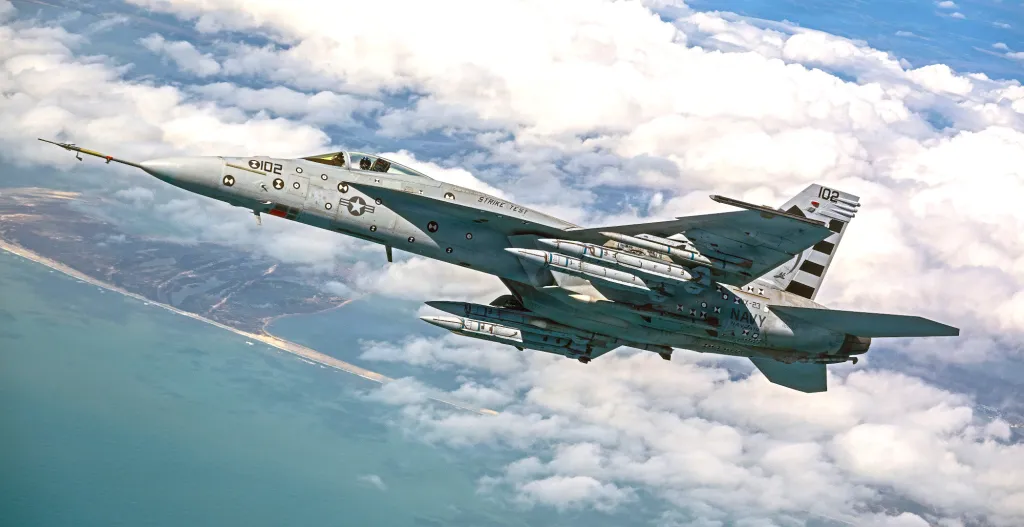
A Super Hornet test jet carrying AIM-424 missiles. The Navy also revealed the existence of this weapon at the Tailhook Association’s annual convention this year. USN
Whether or not any actual flight tests have been conducted is also unclear. Another slide in the Navy briefing at Tailhook included a bullet point reading “Project Alpha – Hypersonic missile shot in 2026,” but does not explicitly say whether or not that milestone has already been reached. The MACE slide makes clear that the program is directly intertwined with Project Alpha, if they are not just different names for the same effort.
Beyond the confirmation of this important new step in testing, the picture of the Blackbeards on the Super Hornet’s wing offers a new look at the front of the missile, showing what look to be apertures on one side of the design’s wedge-shaped nose. The apparent apertures are also seen pointed up, but many air-launched munitions do flip down after release.
How exactly Blackbeard is guided remains unknown, but a downward-angled aperture at the nose end for a seeker system would make sense for this weapon, which the Navy is pursuing primarily as a new way to target enemy ships. In particular, a wide array of existing anti-ship and land attack missiles, as well as certain anti-air types, have variously shaped apertures in their noses for imaging infrared seekers. Imaging infrared has the benefit of being immune to radio frequency electronic warfare jamming. In addition, it is a passive capability that does not send out signals that can give an opponent advance notice of an incoming attack. Blackbeard’s full guidance package very likely also includes some means of navigating to a target area first, and it could have multiple modes of operation.
The imaging infrared seeker apertures on the AGM-158 Joint Air-to-Surface Standoff Missile (JASSM) family of air-launched cruise missiles are clearly visible in this picture of a US Air Force F-15E Strike Eagle loaded with five of them. USAF
The apertures could also be present in this case for testing or other purposes, though this seems far less likely.
We previously discussed the other visible aspect of the design after last week’s release of the side profile picture, writing:
“A profile photo at the company’s headquarters reveals a weapon with a ballistic missile-like booster, on top of which is mounted what could be an unpowered hypersonic glide vehicle (HGV). A booster brings an HGV to the desired velocity and altitude before releasing it toward its target. The concept is in contrast to air-breathing cruise missiles capable of traveling at hypersonic speeds. Hypersonic speed is generally defined as anything above Mach 5, which larger ballistic missiles also reach in the course of their flights. More precise performance figures for Blackbeard are lacking, but Castelion has previously hinted it could hit targets out to just under 500 miles. Alternatively, the second stage may also have its own motor, allowing it to continue accelerating or sustain high-speed flight. A similar arrangement has been suggested as the propulsion system for the Russian Zircon missile.”
“Both stages of the weapon have cruciform fins, while the upper one features a prominent ‘chine’ line along the length of its body, and a slightly beaklike nose. The trolley on which the weapon is mounted provides some idea of its overall size. The blue stripes seen on each stage normally signify that a munition is an inert, non-explosive round utilized for training or tracking purposes. This would indicate a real (unarmed) missile rather than a dummy or mockup.”
As noted, Castelion and the Navy are hoping to see the air-launched Blackbeard reach an early operational capability (EOC) within the next two years. Castelion’s press release in April said EOC was being targeted for 2027, a timeline that had been previously reported. Just yesterday, the company put out a press release announcing a new nearly $90 million contract from the Navy specifically to help push the weapon closer to that milestone, as well as perform other activities. The release did not explicitly mention a new EOC schedule, but did say the contract covered work through August 2028, by which point the hope is that at least 50 missiles will have been delivered.
Castelion previously released the video below to highlight continued work on Blackbeard, including in an air-launched form for integration on the Navy’s F/A-18E/F Super Hornets.
Blackbeard is coming 🏴☠️
The U.S. Army is also separately funding development of a surface-launched version of Blackbeard. In May, the Pentagon outlined plans for the acquisition of 12,000 Blackbeard missiles over the next three years, but it is unclear whether this covers surface- or air-launched versions, or a mix of both. At that time, the Pentagon also announced a framework for purchases of 10,000 lower-cost surface-launched cruise missiles in that same timeframe.
As underscored by those planned orders, Blackbeard is being developed with an eye toward lower cost and relative ease of production, as well as exportability to U.S. allies and partners. Historically, hypersonic missiles have been viewed as expensive, low-density assets offering a more limited ‘silver bullet’ capability against high-value targets. Depending on the price point that Castelion can achieve with Blackbeard, it could help change this calculus. Expanding sales beyond America’s armed forces could help further spread cost burdens and drive down unit prices through economies of scale.
For the Navy, from an operational perspective, Blackbeard is seen as a particularly important addition to the arsenal available to the service’s carrier air wings. The missile will offer Navy Super Hornets, and potential other aircraft, a boost in the range at which they can hold targets at risk, as well as the ability to cover those longer distances faster. Castelion’s design will also give the service a new stand-off strike weapon that is far more survivable and more capable, especially against time-sensitive targets. The missile’s speed will lessen the need for persistent kill chains, as well.
Greater standoff reach is already becoming more and more valuable, if not vital, as carriers and their air wings are being pushed further and further away from target areas by expanding and evolving adversary anti-access/area denial (A2/AD) bubbles. Similar considerations are pushing the Army and other services toward greater standoff strike capabilities.
If the development schedule for Blackbeard holds, the Navy will see the arrival of its first operational air-launched hypersonic weapon in the next two years. We now know that work on this weapon has already reached another important milestone, with testing on the Super Hornet now underway.