President Trump on Thursday continued projecting confidence in the U.S. war effort in Iran, suggesting online and during a high-level Cabinet meeting that Iran has been “obliterated,” that its leaders were “begging” for a deal, and that the U.S. is “roaming free” over Iran and “NEEDS NOTHING” from its European allies.
His description of the war as all but finished — he actually said “we’ve won” — stood in contrast to the facts on the ground, where Iran continued to launch attacks and threaten oil tanker traffic in the vital Strait of Hormuz, and the U.S. continued sending troops and warships to what is already the largest U.S. military buildup in the Middle East in decades.
Trump’s framing of the conflict also contrasted with that of Iranian officials, who have remained publicly defiant, downplayed negotiations and outwardly rejected several of Trump’s conditions for ending the war — as Trump himself acknowledged, accusing them of saying one thing in private and another in public.
“They better get serious soon, before it is too late,” the president wrote on social media, “because once that happens, there is NO TURNING BACK, and it won’t be pretty.”
“They are begging to make a deal, not me,” Trump reiterated later Thursday, while hosting his first Cabinet meeting since the war began. “Anybody that sees what is happening understands why they are begging to make a deal.”
Trump asserted that Iran’s military capabilities have been destroyed, and that the American mission is “ahead of schedule.” He said American forces were operating without opposition over Iran, and “there’s not a damn thing they can do about it” because they’ve been “beat to s—.”
Trump’s outward confidence, a defining feature of the war campaign that has been consistently echoed by Secretary of Defense Pete Hegseth and other administration loyalists, continued despite growing concerns this week in Congress — and not only from Democrats.
Several Republicans emerged from a classified war briefing Wednesday clearly frustrated with the administration for not providing a clearer picture of the path out of the now monthlong war, or clear answers on whether it planned to deploy ground troops.
“We want to know more about what’s going on,” said Rep. Mike Rogers (R-Ala.), chairman of the House Armed Services Committee. “We’re just not getting enough answers.”
“I can see why he might have said that,” said Sen. Roger Wicker (R-Miss.), chairman of the Senate Armed Services Committee.
Democrats have hammered the president — contrasting the war and its massive budget with rising fuel costs for average Americans and lamenting the deaths of U.S. service members.
“Thirteen American lives lost and tens of billions of taxpayer dollars spent in just three weeks since Donald Trump plunged us into war without congressional authorization. There is still no plan, no clear justification, and no end in sight,” Sen. Alex Padilla (D-Calif.) said. “Americans called for lower prices, not endless wars.”
For weeks, Trump, Hegseth and other war leaders such as Gen. Dan Caine, the chairman of the Joint Chiefs of Staff, have focused on U.S. wins in the conflict — tallying up Iran’s sunken ships and grounded planes, assassinated leaders and undermined missile capabilities.
In recent days, Trump has suggested that, because of those wins, Iran is buckling and its leaders reaching out for a deal. He has said the U.S. is pushing a 15-point plan that will forever block Iran from developing a nuclear weapon or threatening the U.S. or its allies. And he and others in his administration have accused the media of ignoring tremendous battlefield wins to harp on losses instead.
Israel, America’s major partner in the conflict, has projected similar confidence while showing no signs of slowing its attacks on Iran. On Thursday it announced it had killed several senior Iranian naval commanders, including Commodore Alireza Tangsiri, the head of Revolutionary Guard’s navy.
Israel’s Defense Minister Israel Katz said the deaths should send a “clear message” that Israel will continue to hunt down top Iranian military officials. Iran did not immediately acknowledge Tangsiri’s death.
The head of U.S. Central Command, Adm. Brad Cooper, praised Tangsiri’s killing, said U.S. strikes would continue, and called on Iranian fighters to “immediately abandon their post and return home to avoid further risk of unnecessary injury or death.”
Meanwhile, death, destruction and environmental and economic damage from the war spread far beyond Iran, where officials recently increased their estimated death toll to nearly 2,000.
Israel was fighting off a barrage of incoming missiles Thursday, with booms heard in Tel Aviv and Jerusalem and an impact reported in the central town of Kafr Qassem. Iraqi Defense Ministry spokesman Maj. Gen. Tahsin al Khafaj on Thursday said 23 people had been wounded in a Wednesday strike on a military clinic in western Iraq’s Anbar province.
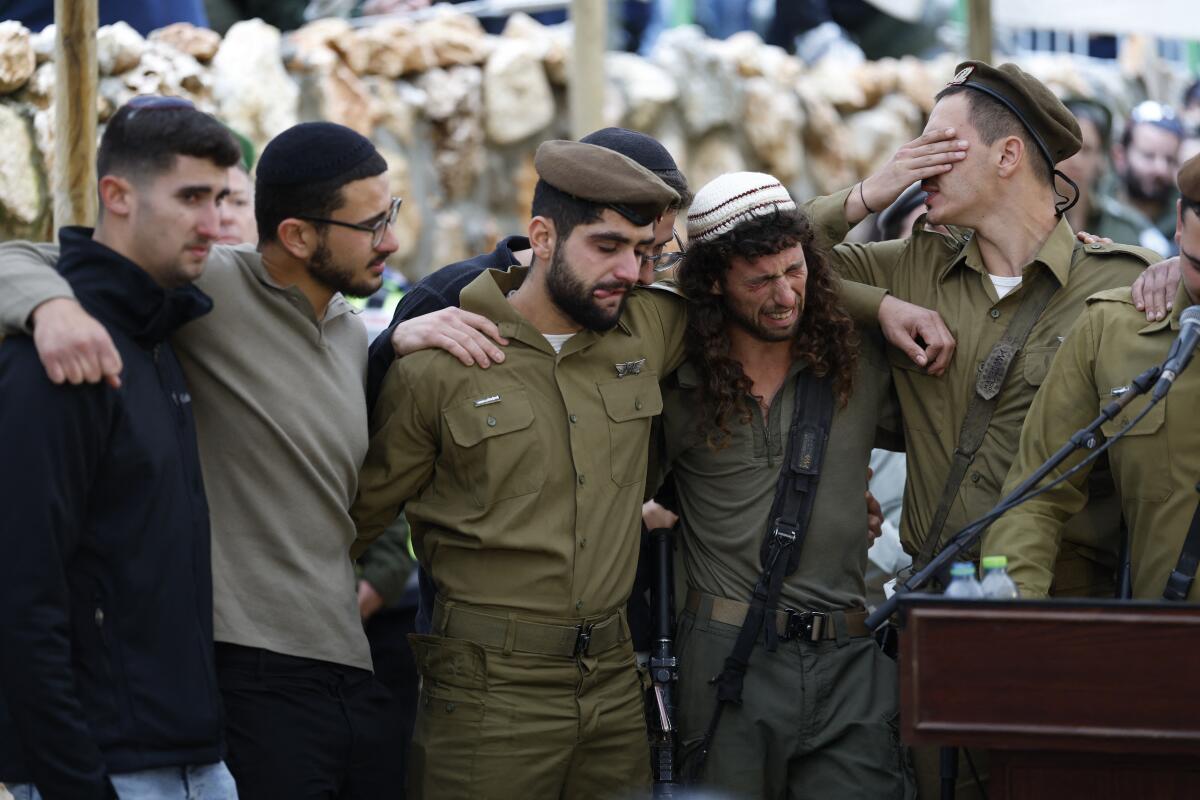
Israeli soldiers grieve during the funeral of Staff Sgt. Ori Greenberg, 21, at the Mount Herzl military cemetery in Jerusalem on Thursday.
(Odd Andersen / AFP via Getty Images)
Thousands of additional U.S. troops are on their way to the region, while many of the tens of thousands already stationed there have been displaced into hotels and other temporary housing — diminishing their war-fighting capabilities — by Iranian attacks that have left the 13 regional military bases they normally live on “all but uninhabitable,” the New York Times reported.
Iran announced Thursday that it had launched drone and missile attacks on a U.S. military base in Kuwait and a separate air base used by American forces in Saudi Arabia.
Jasem Mohamed al-Budaiwi, the secretary-general of the Gulf Cooperation Council, accused Iran of charging fees for ships to safely transit the Strait of Hormuz, continuing the economic toll on global oil supplies. Environmental experts warned of massive pollution from burning oil and gas fields.
Russia, emboldened by the Iran war, which has drawn resources away from Ukraine and led the U.S. to ease sanctions on Russian oil, has launched a renewed spring offensive against Ukraine.
The distance between U.S. and Iranian messaging about the war and their negotiations to end it — which foreign officials have said are occurring through intermediaries — has contributed to the tensions and the reluctance of allies to get involved, with some citing similar frustrations as Republicans in Congress this week.
Many allies have largely stayed out of the conflict despite Trump vacillating between demanding their help and insisting it isn’t necessary.
In one of his posts to social media Thursday morning, Trump blasted allies in the North Atlantic Treaty Organization, or NATO, for having “DONE ABSOLUTELY NOTHING TO HELP” in the conflict, and said the U.S. would “never forget.”
During his Cabinet meeting, Trump said that when the “right deal” is made with Iran, the Strait of Hormuz will reopen — while insisting that Iran no longer has any “mine droppers” that would threaten merchant vessels passing through the key oil route.
Steve Witkoff, one of Trump’s top advisors leading the negotiations in the Middle East, said the Iranians were looking for an “offramp,” that Pakistan is serving as a mediator between Washington and Tehran, and that the U.S. has presented a 15-point plan that “forms the framework for a peace deal.”
“These are sensitive, diplomatic discussions and you have directed us to maintain confidentiality on the specific terms and not negotiate through the news media, as others do,” Witkoff said. “We will see where things lead and if we can convince Iran that this is the inflection point, with no good alternatives for them other than more death and destruction.”
Trump has also declined to say whom Washington is negotiating with in Iran, but described them as “very smart,” “not fools,” and “very lousy fighters, but great negotiators.”
He also said he knows they are “the right people” for the U.S. to be dealing with because they had given him a “present” — and proved they are in control — by allowing “eight big boats of oil” travel through the strait this week.
Asked if he intended to send U.S. troops into Iran to take its enriched uranium, he called it a “ridiculous question” that he wouldn’t answer.
Treasury Secretary Scott Bessent said he is confident that more merchant vessels will soon be able to safely pass through the Strait of Hormuz. He also told the president that he believed the oil market is currently “well supplied” and that once the war ends, energy prices will drop.
Hegseth repeatedly slammed the media for falsely framing the war effort as floundering or unfocused, saying Iran’s “air defenses are gone,” its leaders hiding in “underground bunkers,” and its fighters losing morale.
He said Iranian officials in private are admitting “very heavy losses,” and that the U.S. and the world are benefiting from having Trump, whom he called the “ultimate deal maker,” working toward a peace deal.
In the meantime, he said, the U.S. military will “continue negotiating with bombs.”
Airbnb has gained popularity over the years for its cozy and unique places to stay across the world, but one user of the app is ‘begging’ hosts to stop using 1 thing
Abigail Nicholson Content Editor
09:50, 27 Feb 2026
Airbnb can be a more personalised experience(Image: Getty Images)
An Airbnb user is “begging” hosts to stop using 1 thing in their rooms, calling it “weird” and “uncomfortable”.
When visiting new towns, cities or countries, people have different ideas of where they would like to stay.Some people prefer the convenience of a well-placed hotel where you know you’re going to get a comfy and clean room with a number of amenities, such as a hairdryer and even a kettle for hot drinks.
Others, however, prefer to stay in an Airbnb, which are homely and often have even more perks, such as an entire kitchen, a hot tub or even a balcony, depending on where you stay.
There is no right or wrong way to travel, but one Airbnb user is asking hosts of properties and rooms to stop using one thing in their bedrooms that they find ‘weird’.
The user took to Reddit to write the post titled “Hosts: please, for the love of five stars and good repeat guests….”
The post read: ” Don’t use microfiber bedsheets. They don’t stay put. Unless you get into bed and immediately become corpse-like, the whole thing gets wrinkled and baggy almost immediately.
“They don’t breathe. No matter how nice and cool the ambient temperature is, inside the sheets is uncomfortable.
“It’s weirdly warm on the skin in the same way sleeping in a thin plastic bag is. Actually, that’s exactly what sleeping in microfiber sheets feels like, minus the crinkly sounds.
“They feel cheap. Yes they don’t wrinkle, yes they’re smooth to the touch, but so is a painter’s tarp. Basic cotton sheets—they don’t even have to be of a high thread count—will fix this! That is all.”
Dozens of people agreed with the poster after noticing a number of hotels also moving away from cotton sheets.
One person said: “Plastic sheets are the worst! Cotton sheets. Hell, most hotels only have 350 threadcount cotton sheets. All you “need” per say.
“I’m with you though. I cannot stand microfiber, anything with polyester or rayon or any of that plastic rooted fibers.”
A second added: “I am a host and sometimes a guest and fully agree, nothing worse than microfiber or polyester sheets, I only use linen or cotton.“And for pillows and duvet cover just feather and down. They can actually be washed and drycleaned and are so much more comfortable.”A third said: “I totally agree. I recently stayed at a VERY expensive AirBnB in Sonoma, CA and they had microfiber sheets! I hate them. Automatic deduction of a star in the review.”