Sacramento — A veteran California political consultant has agreed to plead guilty in a scheme to steal campaign funds from Xavier Becerra, now a leading candidate for governor, when he served in the Biden administration, according to filings in her criminal case on Thursday.
Dana Williamson will plead guilty to three counts, including bank fraud and lying to authorities. In exchange, the federal government will dismiss 20 other counts against her related to her tax filings and a federal COVID-era loan she received.
A court hearing is scheduled Thursday morning.
Williamson, a former chief of staff to Gov. Gavin Newsom, was arrested in November and pleaded not guilty. The government secured guilty pleas in December from two advisors who worked with alongside her to skim money from Becerra.
Prosecutors say that Williamson, Becerra’s then-chief of staff Sean McCluskie and lobbyist Greg Campbell took part in a scheme to siphon money from Becerra’s dormant campaign account and funnel it to McCluskie.
McCluskie needed the money, according to prosecutors, so he could afford to fly home frequently to see his family in California while working for Becerra, who was Biden’s health secretary, in Washington, D.C.
As part of the scheme, Williamson and another consultant charged Becerra’s account up to $10,000 a month to manage one of his dormant state campaign accounts.
Becerra approved the payments, even though he had never paid such a high amount for a similar job. He told The Times that McCluskie told him to pay the fees.
Becerra’s rivals in the governor’s race are hammering him over his decision, arguing he should have known something wasn’t right. Becerra has said that he didn’t know about the criminal behavior and has called the charges a “gut punch.”
Known as an hard-nosed and aggressive operator, Williamson’s career in politics also included working for former governors Jerry Brown and Gray Davis and mentoring other women.
McGregor Scott, Williamson’s attorney, told reporters last year that federal authorities initially approached Williamson about helping them with a probe into Newsom. She refused, he said, and was subsequently charged.
Details contained in the indictment and other public records suggest that federal authorities were looking into the state’s handling of alleged sexual harassment at Activision Blizzard Inc., a video game company.
SACRAMENTO — As Xavier Becerra rose to the top echelons of power in Washington and Sacramento over the last two decades, his trusted advisor Sean McCluskie joined him at every step.
The son of a Scottish immigrant, McCluskie had a reputation as a political street fighter and his gruff style complemented Becerra’s more measured, cerebral approach.
Rivals in the California governor’s race have seized on the case to question whether Becerra, one of the front-runners in the contest to succeed outgoing Gov. Gavin Newsom, is fit for office and could be swept up in the case.
“We can’t have someone who is running as a Democrat who could run into legal difficulties,” said candidate Tom Steyer, who is close to Becerra in the polls.
Becerra has not been accused of wrongdoing, and prosecutors’ court filings describe him as a victim. He told The Times that he cooperated with investigators, including appearing before the grand jury.
“Sean was as close as any staffer that I’ve ever had,” Becerra said in an interview last week, describing how McCluskie moved across the country twice to work for him.
He added that he’s “racked” his brain to understand the case involving McCluskie and his longtime political consultant, Dana Williamson, both of whom he described as “very highly accomplished people.”
Williamson, who also served as Gov. Gavin Newsom’s chief of staff, was indicted in November. She had refused to cooperate with federal investigators and pleaded not guilty, but recently discussed a plea deal with prosecutors. A court hearing is set for Thursday, according to court filings.
Former Orange County Rep. Katie Porter, one of the Democrats who has watched Becerra’s rapid ascent in the race, said in a CNN interview Monday that California can’t risk having Becerra in the race with the specter of the ongoing criminal case.
She acknowledged that “I do not have the facts” about the case, but said if Becerra were to finish in the top two in the June 2 primary and then be indicted by the Trump administration’s Department of Justice, a Republican ultimately could win the governor’s race in November.
“Secretary Becerra cannot and has not guaranteed or promised the people of California that he will not be named as a co-conspirator and indicted,” she said.
Other candidates, and reporters, have questioned whether Becerra had a blind spot in trusting McCluskie.
Appearing on Fox40 News last year, Becerra likened the criminal case to being “married for 20 years” and “all of a sudden you find out that your spouse has been cheating.”
According to prosecutors, McCluskie, Williamson, and another consultant skimmed $225,000 from one of Becerra’s dormant campaign accounts and funneled it to McCluskie through various entities.
McCluskie, who declined to speak to The Times, sought the money because he’d taken a pay cut after joining Becerra in Washington when Becerra became Health and Human Services secretary in 2021, according to prosecutors.
And unlike Becerra, he didn’t move full-time to D.C., and was splitting his time between the nation’s capital and California, where his family lived.
On a phone call recorded by the FBI in 2024, McCluskie talked about the scheme and told a consultant, “This money you guys are giving me is helping me fly back and forth to D.C. and live there half part time.”
Becerra, in an interview, said McCluskie never mentioned his money problems. The pair worked together when Becerra served in Congress and as California attorney general.
After President Biden appointed Becerra to lead Health and Human Services, the pair discussed the move back to D.C.
“Even before we went to HHS, we had talked about whether we wanted to do this,” Becerra said. “We both agreed, ‘Yeah, you know, it’s going to be a sacrifice. We’re going to have to make changes.’”
Former Becerra staffers told The Times that Becerra and McCluskie were such a close team that they have a hard time imagining Becerra working in government without McCluskie.
Another former staffer, Amanda Renteria, said the two men bonded over their humble immigrant backgrounds. McCluskie’s family came from Scotland and Italy; Becerra’s relatives came from Mexico.
McCluskie relished going to battle for those less fortunate, she said.
“When Becerra became A.G., [people questioned] whether or not he had the style that could really take on Trump. If you were to meet Sean, you’d be like, Oh yeah, Sean is totally ready for a fight, he’s ready to take him on.
“That was sort of a difference with Becerra. Becerra had that fight in him. Sean wore it a little bit more,” said Renteria, a political strategist.
Becerra has faced repeated questions about his financial judgment after the criminal case revealed that he agreed to pay up to $10,000 a month to Williamson and another consultant to oversee one of his dormant campaign accounts.
The consultants charged him the fee as part of the scheme to divert money to McCluskie, prosecutors allege.
At the time, Becerra, a Biden Cabinet member, was barred from involving himself in campaign matters.
Becerra defended the payments during an interview with Fox40 last year, stating, “I was told that’s the rate I would have to pay to get someone who could manage that and make sure that I don’t have to worry about [violating any federal rules].”
Campaign finance records show Becerra had never paid such a high fee for his other accounts.
Becerra told The Times that his longtime attorney Stephen Kaufman, whom he was also paying to oversee the account, didn’t flag the payments. “I would have expected him to raise issues if he thought there was something wrong,” Becerra said.
Kaufman didn’t respond to questions about the account.
Los Angeles-based political consultant Eric Hacopian told The Times that the fees are “certainly high.”
“It’s obviously something he should’ve noticed. Either he was not paying attention, or was too trusting of these people,” said Hacopian, who isn’t involved in the governor’s race. “At the end of the day, he’s the primary victim.”
At a debate last week, rival candidate Antonio Villaraigosa pounced on the payments made by Becerra, saying that the politician “has to be under suspicion because it doesn’t pass the smell.”
Danni Wang, a spokesperson for Steyer, said in a statement, “So, which is it — did Becerra know about the illegal payments and participate in the campaign’s corruption, or was he a totally incompetent manager oblivious to what was going on underneath his nose?”
Renteria, the former Becerra staffer, said the allegations against McCluskie and others are particularly surprising given Becerra’s reputation as a “straight A student.”
“Part of it broke my heart,” she said.
Jonathan Underland, a Becerra spokesperson, said Becerra “has always been consistent and clear: Every action he took was in accordance with the law.”
“What he didn’t know — and what the FBI’s own investigation goes out of its way to clarify — is that his staff cooked up a scheme designed to deceive him.”
Becerra, in an interview, repeatedly said that he relied on McCluskie. It was McCluskie, he said, who advised him to make the payments. “I trusted him to handle the accounts,” he said.
He also said he was unaware of some of the details laid out by prosecutors.
Prosecutors said Williamson and others created a “no show” job for McCluskie’s wife, Kerry MacKay, to do work for the consultants.
MacKay never was paid, however, and the money went to an account controlled by McCluskie. MacKay, who didn’t respond to requests for comment, was not charged.
McCluskie’s plea agreement states that he told Becerra about his wife’s job with the consultants, though he didn’t tell the politician that his wife wouldn’t actually be doing any work.
Becerra, in an interview, said he didn’t recall McCluskie informing him about his wife’s work.
McCluskie’s sentencing is scheduled for June 4, two days after the primary.
Becerra argues that there are economic conditions for a gradual restoration of the minimum wage. (Venezuelanalysis)
Adelmo Becerra is a Venezuelan trade union representative from the National Institute for Training and Socialist Education (INCES) and also a member of David Hernández Oduber Revolutionary Current (CREDAHO). In the past, he worked as an instructor at INCES and as a worker in the steel industry in Ciudad Guayana. In this interview, Becerra discusses the Venezuelan government’s recent labor policies under US sanctions, the growing labor reform prospects, and the present struggles and challenges facing the working class.
On May 1, the Venezuelan government raised non-wage bonuses while maintaining the minimum wage frozen. What was your reaction to these announcements? How do you place them in the context of recent labor policies in Venezuela?
The announcements represent a continuity of the labor policies of recent years. There had been expectations for restoration of the minimum wage in the short term. According to Article 91 of the Constitution, it must be adjusted once a year. Naturally, it would be a partial and limited restoration. But it is important to place the announcements in the context of various processes currently unfolding in the labor sphere.
In Venezuela, the Social Dialogue Forum, a body coordinated by the International Labour Organization (ILO), has been in place since 2021. Several trade union federations participate in this forum, including the Independent Trade Union Alliance of Venezuela (ASI), to which the INCES union belongs, the Venezuelan Workers’ Confederation (CTV), the Bolivarian Socialist Workers’ Federation (CBST), as well as government representatives. The Social Dialogue Forum is not binding, but Venezuela has ratified conventions, including Convention 26, which establishes consultations with trade union organizations for setting the minimum wage. However, a mechanism for establishing it has not yet been agreed upon.
At the same time, the government led by Acting President Delcy Rodríguez has established the National Dialogue for Labor Consensus, which includes the CTV, ASI, and CBST labor federations, along with representatives from business associations FEDECÁMARAS and FEDEINDUSTRIA, and government officials.
Then there is the struggle on the streets that has unfolded in the country in recent years. I would single out the August 2018 Program for Growth, Recovery, and Economic Prosperity as a starting point. This program produced two instruments that have denied wage and labor rights established in collective bargaining agreements, even disregarding the Constitution and labor legislation. I am referring to Memorandum 2792, from October 2018, which sets out the broad guidelines regarding the suspension of collective bargaining rights. And then there is the 2021 ONAPRE Directive, which addresses its specific application. Both instruments remain in force, and their repeal has been a constant demand in the workers’ struggles.
So, back to May 1, there was no restoration of the minimum wage. However, the announcements stem from agreements reached at the National Dialogue for Labor Consensus. And the signed minutes refer to a “wage consultation process” that will begin in May. This indicates that the issue of the minimum wage is far from settled. Similarly, the agreements “urge” the private sector to establish this same US $240 income floor, specifying that it may be through “non-wage bonuses,” although in reality there are no mechanisms to enforce it.
But the minimum wage is not an isolated issue. We have heard spokespersons from both the government and the private sector speak of labor reform. Just in recent days, in a meeting of the Social Dialogue Forum, one of the agreements was to “coordinate consultations of labor-related laws with the National Assembly.”
Adelmo Becerra during a rally in 2023. (Frenpodes)
Let us take a closer look at the issue of bonuses versus wages. What are the consequences of this “bonus-ization” policy?
The main impact is on workers’ entitlements, specifically in the form of social benefits. These benefits accumulate over the course of the employment relationship, and their primary function is to recognize seniority so that it can be taken into account when paying out benefits.
But there is also another concept: retroactivity. This means that benefits are paid based on the final salary. Thus, when an employment relationship ends at a private company, the benefits paid as compensation are calculated based on the final wage and the duration of the employment. The same applies to those retiring from the public sector, or from a private company that offers a retirement plan –which is very rare in Venezuela.
This issue is very important because it has been at the center of the historical Venezuelan working-class struggles following the oil-led industrialization and the 1936 Labor Law. Social benefits allowed Venezuelan families to have assets, purchase homes or other property, and also served as a safety net in contexts of unemployment or economic crisis. This safety net no longer exists today because the minimum wage has been effectively eliminated.
Then there are other important factors, such as social security contributions, which fund the Venezuelan Social Security Institute (IVSS). This is a universal solidarity-based system in which both employers and employees contribute, and it serves as the economic foundation for old-age pensions and other IVSS social support initiatives, such as in healthcare. So, this system is also in crisis because contributions are computed based on wages.
The result is that for the private sector, both social security contributions and severance pay are practically free right now, and that in turn affects job stability.
Speaking specifically about INCES, which is a state-run training institute, what is the current employment situation like? Do the staff work full-time?
According to data recently provided to us by the authorities, there are approximately 11,500 people on the payroll, 6,800 of them active workers, and the rest are retirees. The vast majority receive only the “economic war” and bonuses, now set at $200 and $40 a month, respectively. Through our collective bargaining agreement, retirees also receive the food bonus, which is not the case in general in the public sector.
In recent years, as a union, we have held discussions with INCES authorities and the Ministry of Labor –which oversees the institute –to ease the requirement that people come to work every day while we try to secure better conditions. Simply put, if their income isn’t enough, they should have the option of trying to find a second or third job. With the recent increases in bonuses, the authorities are putting more pressure on workers to return to full-time work, but it’s complicated.
We are still in that struggle to improve conditions, even though we have not even been able to make progress on a memorandum of understanding to improve the socioeconomic clauses of the current collective bargaining agreement. But that’s the priority.
Turning now to the private sector, you have participated in the Observatory for Labor Dignity, which has investigated current working conditions in Venezuela. In general terms, why the focus on the private sector? And what is the reality of that world?
The first reason is that unionization rates in the private sector have historically always been very low in our country. At its peak, in the 1970s, it reached 30%, and today it is likely below 15% –and that is being optimistic. We must take into account the massive migration of recent years. It is a very low unionization rate, and in sectors such as retail or services, there are practically no unions.
Consequently, the level of job insecurity and vulnerability is much higher, especially given the government’s policy of restraining official workplace inspections based on tacit agreements with the private sector under the pretext of “promoting employment.”
One issue that came up repeatedly was the lack of maternity protection which was one of the advances of the 2012 Labor Law. Right now, in the companies we investigated, such as [department store chain] Traki or [textile distributor] El Castillo, no woman wants to get pregnant because that would mean immediately losing their job. Not only that, but it would also make it impossible to get a reference letter or a recommendation for another job.
It is important to stress that the approach to undermine or marginalize collective bargaining agreements was not limited to the public sector. The private sector also adopted it. Under the guise of “protecting jobs”–claiming that companies would go bankrupt otherwise –many employers sent workers home on minimum wage, with some being called back to work at the employer’s discretion.
Given the context of crisis and precariousness, under US economic sanctions, that has persisted for several years now, is the impact on workers’ awareness noticeable?
Indeed, there is a very acute lack of awareness regarding labor rights. The new generation of workers is entering the workforce with virtually no knowledge of the rights they hold by law, in part because they have never had access to them.
So, issues like employment contracts, pay stubs, or even working hours themselves are a problem. It is very common to have 10, 12, or even 14-hour workdays, or for the two days off per week not to be upheld. At Traki, this is usually respected, although the two days are not necessarily consecutive. In El Castillo, the average is one and a half days. In El Castillo, there is also a practice of having workers sign their contract and a resignation letter at the same time, which is obviously illegal.
Another characteristic is high turnover. Fixed-term contracts have become the norm. Although after several contracts the law grants the right to continued employment, this is practically nonexistent. The vast majority of people move around a great deal between jobs. This is, of course, made possible by the fact that benefits are nearly non-existent and it is extremely cheap to dismiss a worker, which in turn keeps people in a much more precarious situation.
But there is an important factor to consider: the shift in subjectivity –and this, of course, is not a phenomenon unique to Venezuela. A few days ago, I watched an interview with a North American researcher who found that for young people in the US a job at Starbucks seems like a good opportunity –better than average. Here, in some of the testimonies we collected, young people expressed satisfaction with working at the Traki department stores. They earn some $250 a month, work 9- or 10-hour shifts –while conditions elsewhere are worse –have two days off a week, and would like to stay there. Therefore, the notion of work with rights has also eroded. Issues like overtime pay, not to mention social security, become irrelevant due to the precariousness of the present. The employment relationship, which includes rights and mechanisms to protect them, is beginning to be viewed simply as a commercial transaction.
Former President Hugo Chávez wrote “social justice” as he enacted the 2012 Labor Law. (Archive)
Labor reform talks are underway. Government spokespeople talk about “updating” the law following the impact of US sanctions, while private sector spokespeople are also voicing their demands. What is currently at stake?
I think there are several aspects to consider. We are clearly witnessing an aggressive campaign being waged by the media, along with well-known economists and influencers, to impose a narrative that any wage increase will cause inflation. As such, the only way to raise wages is to reduce employers’ responsibilities and eliminate the retroactive nature of labor benefits.
The 2012 Labor Law reinstated the calculation of benefits based on the last salary. This had been modified, amid much controversy, during the Caldera administration in the 1990s. Still, unlike proposals we see now, retroactivity was not completely eliminated. There is a proposal to let workers choose between receiving benefits immediately or accumulating them, which completely distorts the concept and takes advantage of current economic difficulties. If wages are insufficient, workers obviously prefer to collect as much as they can right away. Even if the current $240 minimum income was turned into salaries, this would represent less than 50% of the food basket for a family, according to different estimates.
I believe it is essential to reject the narrative promoted by groups like Fedecámaras, to reject the premise that we must give up our rights and historic achievements because there are no conditions to sustain them. For starters, there is a lack of transparency and information. We do not even have reliable information on the size of the economically active population. The last census was in 2011, and following the massive migration over the past decade, we do not know what the current picture looks like.
According to 2021 data from the National Institute of Statistics (INE), there were roughly 4 million workers in the formal private sector, just over 3 million in the public sector, and around 5 million pensioners. Therefore, with that precise data, and with transparent information on revenues, it would be possible to quantify whether or not there are resources. Because GDP was heavily hit by the US blockade but has been growing—according to the Central Bank, for 20 consecutive quarters –but the last adjustment to the minimum wage, to $30 per month, was in March 2022.
Another piece of data we lack is the distribution of surpluses among the workforce, private capital, and the state. According to research by former Minister Víctor Álvarez, the labor share reached 40% by 2010. Currently, according to estimates by researcher Carlos Dürich, that figure may be around 20%, which is what is typically observed in African countries with high levels of poverty and inequality.
We need all that data if we want to discuss what is possible or not, and how the wealth that is generated will be distributed. This is especially true in this context, where, outrageously, the US controls Venezuela’s oil sales. Now the Central Bank will be subject to external auditing, but the public still lacks information. So there is a second layer of opacity there.
In summary, under the present conditions, with an unfavorable correlation of forces and foreign control over the Venezuelan economy, it is not possible to restore the minimum wage and have it cover living costs, as established in Article 91 of the Constitution. Nevertheless, economists and trade union federations have argued that there are conditions for a partial restoration.
In this complex context, both domestically and internationally, what is the path forward for the workers’ struggle in the country?
For me, there is one fundamental factor –one that has been evident in recent years –and that is social pressure. Workers are the only force that has exerted pressure on the government, and to some extent on the private sector as well, particularly since 2022. In 2023, the government placated the protests by introducing the “economic war” bonus. The minimum wage had been devalued to $5 at the beginning of the year, and 15 days later the government set the bonus at $25, and then in May at $70. Even if it happens through non-wage bonuses, it is a struggle with the bourgeoisie over the country’s income.
The May 1 increase, again via bonuses, is also a response to pressure from the streets. We will now see what happens with the wage consultations and labor reform plans. The challenge is to sustain the actions and protests over time. But that sustainability depends on unity.
Labor organizations have demanded an increase of the minimum wage. (Archive)
And what are the challenges to building unity around the labor agenda? A few weeks ago, we witnessed an absurd demonstration by certain union factions asking for support at the US Embassy.
Precisely. On May 1, there was a unified demonstration that likely drew 3,000 to 4,000 people in Caracas, along with smaller marches in other parts of the country. Various labor federations were present, ranging from the more left-wing ones like the CUTV to those social-democratic or Christian-democratic like the CTV or ASI.
On March 12, we also had a united mobilization, but since then the forces have split. And that weakens us because it reduces our impact; the business leaders rub their hands together.
This division has partly to do with issues of leadership and protagonism, and with the fact that not all federations understand that we must play on two chessboards at this moment: on one hand, the negotiating tables, and on the other, applying pressure in the streets.
But the division is also due to a particular factor: a group called the Coalición Sindical, whose main focus is not so much labor or wages, but politics. It serves as the vehicle within the labor movement for María Corina Machado’s political faction, which is obviously trying to capitalize on labor issues for its own agenda. This group has no interest in joint actions to secure better conditions –even if only partial –for the working class; rather, its priority is to stoke conflict.
That is why we see actions such as demonstrations in front of the US Embassy, calling on Trump to intervene. But right now, the priority for the US is stability, so it can advance its energy and mining interests. It views social pressure as something the Venezuelan government must handle on its own.
In short, it is essential at this moment to have a united force with a specific agenda: to fight for the restoration of wages, for the reopening of collective bargaining negotiations, for the release of unjustly imprisoned workers and trade unionists, and to defend labor rights against regressive reform efforts.
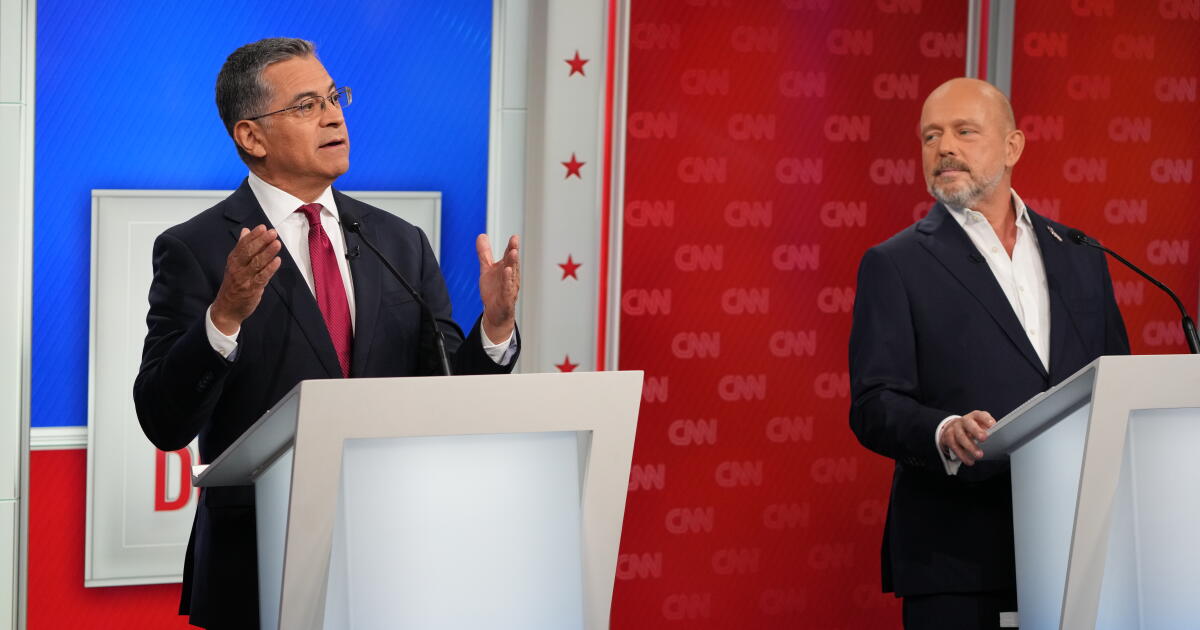
The top candidates in California’s wide-open race for governor took the stage Wednesday night in a Los Angeles debate that began politely but quickly devolved into another raucous clash.
Former Biden Cabinet member Xavier Becerra and billionaire Tom Steyer, both Democratic frontrunners, were primary targets of the political attacks — Becerra for his record as U.S. Health and Human Services secretary and Steyer over his past investments, including in private prisons that housed immigrant detainees.
San José Mayor Matt Mahan started off the debate by lashing out at both Republicans and Democrats.
“We do not need the leadership that MAGA candidates on this stage are offering that’s divisive. We don’t need the leadership of a billionaire who’s now against everything he made his money in, or a career politician who has failed again and again to deliver results,” Mahan said, taking shots at conservative commentator Steve Hilton and Riverside County Sheriff Chad Bianco, Steyer and Becerra, respectively.
Mahan had good reason to go on the attack. The moderate Democrat has struggled to meet early expectations that he would emerge as a top-tier candidate.
The California Democratic Party’s latest poll, released Monday, showed Hilton and Becerra tied at 18%, and Bianco, a Republican, with 14%. Steyer received the backing of 12%, while support for the other top Democrats in the race — former Orange County Rep. Katie Porter, Mahan, former L.A. Mayor Antonio Villaraigosa and state Supt. of Public Instruction Tony Thurmond — were in the single digits. Thurmond did not meet the polling threshold to qualify for the televised debates this week.
Sanctuary state policy leads to kerfuffle
In a tense exchange on immigration and the state’s sanctuary laws, Porter said, “We ought to enforce our sanctuary laws everywhere so we don’t have crazy cowboys taking the law into their own hands.”
It was a shot at Bianco, who has criticized the law that blocks local law enforcement from assisting federal immigration agents.
“Tell that to the crazy mother who lost her child,” Bianco said, referring to a case in his county involving a 14-year-old who was hit and killed by a driver who he said had two prior DUI arrests and was in the country illegally.
“Sir, I don’t need any lectures from you about being a mother,” Porter, a single mother of three and the only woman on the debate stage, shot back.
“You might,” Bianco said, prompting a nasty look from Porter and groans and boos from the studio audience.
The one-hour clash followed another Wednesday evening debate, among candidates for Los Angeles mayor, part of a doubleheader hosted and broadcast by NBC4 and Telemundo 52 in Los Angeles. Both took place at the Skirball Cultural Center and were moderated by NBC4 News anchor Colleen Williams, chief political reporter Conan Nolan and Telemundo 52 News anchor Enrique Chiabra.
Republicans and Democrats divided on immigration
Democrats were in lockstep on most issues related to immigration, including opposing Immigration & Customs Enforcement raids and supporting the sanctuary law that prohibits police from coordinating with the federal agency.
Republicans said the controversial state law, which was approved in 2017 during President Trump’s first term, has hurt public safety.
“I have someone in my jail right now … he’s convicted of a felony, but the three prior convictions for DUI, he was released from jail,” Bianco said. “He was deported on two of them, [came] back into the country, and then he killed a 14-year-old boy with another DUI. So we have to wait until somebody dies before we deport criminals who are in our jail.”
Villaraigosa countered that the law allows for violent criminals to be deported and that thousands have been by state and local law enforcement agencies.
Hilton, a British national who became a U.S. citizen in 2021, declared himself “the candidate of the legal immigrant community” and said the governor’s job is to enforce laws, whether they agree with them or not.
All the Democrats said they would restore full Medi-Cal coverage for undocumented immigrants, which has been rolled back due to budget constraints, while Republicans said they would not.
Courting Latino voters
One of the many undercurrents of Wednesday’s debate was the ongoing tussle between Becerra and Villaraigosa. Both have been competing for California’s pivotal Latino vote, and the former Los Angeles mayor’s attacks have become increasingly aggressive as Becerra has ascended in the governor’s race.
At about 40% of the state’s population, Latinos are California’s largest ethnic group but also among the groups least likely to vote, casting just 21% of ballots in the 2022 primary election.
Mindy Romero, director of the Center for Inclusive Democracy at USC, said Becerra’s surge in momentum could boost Latino turnout, “but I don’t see any evidence right now that actually tells us that will happen. The thing about primaries, unfortunately, is that turnout is always low. Even in a competitive primary like this.”
On Wednesday, Villaraigosa launched a new digital ad highlighting a former member of the Biden administration questioning Becerra’s record as U.S. Health and Human Services secretary.
He highlighted the issue during Wednesday’s debate after the moderates asked the candidates how they would address homelessness in California.
“Mr. Becerra, are you proud that you pushed out 85,000 migrant children? They were, according to the New York Times, they were maimed, they were exploited,” Villaraigosa said. “Some were even killed. You said those are MAGA talking points, it’s a MAGA hoax. Tell that to the children who died.”
“So I’m not sure what that had to do with homelessness, but cálmate, Antonio, cálmate,” Becerra responded, urging his opponent to “calm down.” He accused Villaraigosa of parroting the unfounded attacks that Trump deployed against former Democratic Vice President Kamala Harris in the 2024 presidential election.
“We protected kids. We did not let them be abused,” Becerra said. “Stop lying.”
Speaking of homelessness
The Democrats and Republicans on stage were sharply divided on the best way to address California’s ongoing homelessness crisis.
People living on the streets are “pawns in the homeless industrial complex,” Bianco said, adding: “This is not and has never been about homes. This is about drug and alcohol addiction.”
Mahan, Villaraigosa and Becerra touted their records building housing and expanding mental health services, saying those will help reduce homelessness. They, along with Porter, also called for more oversight of state homelessness spending.
Hilton said the issue is one of the state’s biggest failures and blamed the Democrats — the party that has controlled state government for the past 16 years.
“Some of these Democrats are on this stage, they talk as if we’re in some parallel universe where Democrats haven’t been running this state for the last 16 years of one-party rule,” he said.
Democratic shift on nuclear plants, high-speed rail
A series of lightning-round questions highlighted some subtle shifts on traditional Democratic policies as candidates aim to make the state more affordable.
Democrats led the charge to decommission nuclear power plants in California over concerns of potential environmental and health catastrophes, but as the state struggles with energy affordability, all the Democrats (and both Republicans) said they would support further extending operations at the state’s only remaining nuclear plant, Diablo Canyon in San Luis Obispo County.
Most of the Democrats also said they support finishing a high-speed rail line from Bakersfield to Modesto, despite the massive cost overruns and delays, but said the project should be done cheaper and more efficiently. Hilton and Bianco want to scuttle the project.
And all Democrats except Steyer said they would vote against a proposed billionaire tax that will likely be on the November ballot mostly to backfill federal cuts to healthcare coverage. Although most of the Democratic candidates aside from Mahan say they support higher taxes on the wealthy, they have raised issues with the details of the proposal, including the fact that it is a one-time tax.
U.S. Rep. Xavier Becerra’s mayoral campaign not only produced a scandalous telephone ad in the Los Angeles mayoral race but later erased the message after it had prompted an investigation, Dist. Atty. Steve Cooley said Wednesday.
Although the actions did not constitute a crime, the district attorney’s report could spell political trouble for both Becerra and Los Angeles Councilman Nick Pacheco, a Becerra supporter connected to the telephone bank that issued the calls.
In the prerecorded telephone calls made days before the April 10 election, a woman posing as county Supervisor Gloria Molina attacked former Assembly Speaker Antonio Villaraigosa and his record on crime.
Although Becerra said he had no involvement in the calls, Molina said Wednesday that she felt “personally abused and personally hurt by Xavier Becerra and his campaign.”
Molina told reporters that the congressman could not hide behind his aides and that, even if he did not personally authorize them, had to accept responsibility for the calls.
Molina’s strong statements could hurt Becerra, who has benefited from her support and enjoyed a squeaky-clean image.
“There’s no way to see this in a positive light,” said Arturo Vargas, executive director of the National Assn. of Latino Elected and Appointed Officials and a longtime friend of Becerra. “I can’t imagine him knowing. On the other hand, he is the candidate and he is ultimately responsible for the actions of his campaign.”
Late Wednesday, Becerra said he had offered an apology to Molina and Villaraigosa. In a two-page statement issued from his attorney’s office, the congressman said his campaign staff had long denied involvement in the calls.
Becerra said he had told his staff not to engage in negative campaigning. “I can’t express how disappointing and frustrating it is to now learn that those instructions and responsibilities may have been ignored in this case,” he said.
Pacheco, a rising force at City Hall, also found himself entangled in the scandal. The nonprofit organization that he co-founded, Cal Inc., leased its telephone bank to La Colectiva, which made the controversial calls. And one of his top aides was a pivotal figure in the inquiry.
The calls targeted rival mayoral candidate Villaraigosa just days before the April election, in which he finished first out of six major candidates. He is now in a runoff with City Atty. James K. Hahn; Becerra finished fifth with 6% of the vote.
In the calls, made to 80,000 voters, a woman identifying herself as “Gloria Marina” declared: “Please don’t hang up. This is an emergency call.” She then made allegations about Villaraigosa’s record on crime.
One day after the calls began, Molina asked Cooley to investigate them. Seven weeks later, the district attorney said that even though his office found no crime committed, it was important for the public to know what happened.
“Although those responsible for this reprehensible conduct will not face criminal prosecution, this office remains hopeful that the court of popular opinion will rule that this type of underhand political ‘dirty tricksterism’ will not be tolerated,” Cooley wrote in a letter to Molina.
A detailed report on the investigation combined with other information obtained by The Times shows that investigators first interviewed people at La Colectiva on April 2, two days after the calls were made.
“After . . . it became clear that investigators from this office were focusing on La Colectiva,” the report says, Floyd Monserratt, a top aide to Pacheco who was working as a volunteer for La Colectiva, became concerned and spoke with Becerra campaign manager Paige Richardson. At that point, the report adds, Richardson told Monserratt to change the recorded call. During the switch, the “Marina” recording was erased.
Over the course of the probe, investigators found themselves stymied by some of the Becerra campaign’s top officials, prosecutors said.
Monserratt initially denied any knowledge of the controversial calls.
Several days later, Cooley said, investigators tried to reach Monserratt but were unsuccessful until an attorney representing him contacted the district attorney’s office. But on May 1, under oath, Monserratt explained La Colectiva’s role in making the controversial calls.
Richardson also failed to cooperate with authorities’ efforts to get to the source of the phone calls, the report says. As early as April 5, a district attorney’s investigator spoke to Richardson at the campaign’s headquarters, where she denied any knowledge of the calls, according to Cooley’s office. Last weekend, Richardson refused to speak to an investigator who flew to her New Mexico home.
By then, prosecutors had interviewed two other members of the Becerra campaign who said Richardson had given them a script for the call. One, press deputy Allyson Laughlin, said she believed it was “inappropriate” to record the call because as press deputy “her voice was so recognizable,” the district attorney’s report says.
Richardson then asked Veronica Del Rico, a scheduling aide, to record the announcement, prosecutors said. Stephen Mansfield, an attorney for Del Rico, said his client was a low-level employee who was presented a script by her superiors. She asked whether the call would be ethical, legal and accurate before recording it, he said.
The prosecutors’ report also says Richardson and deputy campaign manager Scott Nunnery made the decision to have the caller identify herself as “Gloria Marina.”
“Ms. Richardson and Mr. Nunnery laughed at the idea, and Ms. Richardson said something like, ‘It would be a slap in her face since she just endorsed Villaraigosa,’ ” the report states.
Richardson’s attorney has denied that she originated the recorded call. Nunnery did not return calls for comment.
“The D.A.’s report is inaccurate in many respects,” Richardson’s attorney, Fred Woocher, said in a statement Wednesday. “At this point, however, she sees no value in pointing her finger elsewhere or in spreading the blame.”
On Tuesday, Becerra said in a statement that he had just learned the district attorney’s investigation was focusing on La Colectiva. On Wednesday, in a more detailed statement, he said he had heard “rumors” of the connection weeks ago and asked his campaign attorney to look into it.
Becerra said his attorney reported back that all staffers denied involvement.
Cooley took issue with the notion that the congressman only recently become aware of the focus on La Colectiva. Indeed, Cooley said that, although his office only recently contacted Becerra, there was no doubt the congressman’s campaign was under scrutiny.
“After all, we had been interviewing his campaign staffers for several weeks,” Cooley said. He also disputed Pacheco’s claim that the councilman was instrumental in finding out who was behind the calls.
“That is not an accurate representation,” Cooley told reporters. “He surfaced only because we contacted him last Friday.”
In a letter dated Tuesday to the district attorney, Pacheco said he encouraged Monserratt to share what he knew of the calls with prosecutors.
“That assertion would be inconsistent with our investigation and the statements of Mr. Monserratt,” Cooley said. Adding that Pacheco could have done more to let investigators know about the calls, the district attorney said: “One would think that Nick would have known his information would be helpful.”
Pacheco said he was “stunned” that Cooley told reporters he failed to quickly disclose his knowledge of the calls. “All I can tell you is I was hearing secondhand stories,” Pacheco said. “I’m stunned a prosecutor would want an investigation started with secondhand rumors.”
*
Times staff writers Tina Daunt and Matea Gold contributed to this story.
In June 2017, with President Trump newly installed in office for the first time, one of the biggest battles with the administration was about oil. He’d just named the chief executive of Exxon Mobil, Rex Tillerson, as his secretary of State, even though great reporting — in this newspaper among others — had recently shown that the company knew all about, and lied all about, climate change as far back as the 1980s.
Back east, the attorneys general of New York and Massachusetts were trying to take the oil giant on, initiating investigations of the company to try to hold it accountable. Environmental advocates and consumer groups were pressing hard for California Atty. Gen. Kamala Harris to join in, and she seemed to be considering it. Then she left the office to assume her new U.S. Senate seat, and the decision fell to her replacement, Xavier Becerra — now a leading candidate for California governor.
As I wrote in these pages at the time, it was a great test for him, and a great curiosity that he was staying silent, “since the rest of Sacramento is hard at work dealing with climate change.” I was not the only one who noticed. Seventy thousand Californians signed petitions demanding action. Eight California representatives in Congress — including Jared Huffman and Ted Lieu — sent him a letter demanding a “vigorous” inquiry and pointing out that it was particularly important because the newly elected Trump administration was clearly favoring the oil industry. “California has led the world in responding to the dangers of climate change, and we know that it will continue to do so,” they wrote. “You now have a leading role in that effort.” But ultimately Becerra did not have a leading role, or indeed any role at all: He punted, as this editorial page pointed out. What Sen. Ted Cruz (R-Texas) is now trying to do by statute — immunize the big oil companies from prosecution for climate liability — Becerra accomplished by sheer silence.
In the years since, of course, California has paid a huge price for our inaction on climate. Just looking at wildfire, there were of course the great blazes that Los Angeles County will never forget in 2025, but also the 2020 August Complex fire in Humboldt and Mendocino counties, the 2021 Dixie fire up north, the 2017 conflagration across Napa and Sonoma counties, the 2017 Thomas fire in Ventura and Santa Barbara counties, the 2018 Camp fire that devastated Paradise — the list goes sadly on and on and on.
Meanwhile, Big Oil and its friends at Big Utility have racked up huge profits, and Californians have faced ever higher bills. An unhobbled oil industry played a huge role in reelecting Trump in 2024 and in taking us to war with Iran.
And through it all, during his years as attorney general, Becerra did little or nothing to help. As I said all those years ago, it’s a mystery why, though I fear the mystery gets clearer with each campaign funding filing over his long career. As California’s top prosecutor, he took big donations from oil industry giants such as Chevron, and also from energy companies Sempra and Southern California Edison. As a member of Congress, he took larger checks from Pacific Gas and Electric and Edison International.
This time around, as he seeks the governor’s office, Chevron has maxed out its contributions to his campaign, the first time they’ve found a gubernatorial candidate to back in a decade. Meanwhile, across the country, leading progressives have signed a pledge refusing fossil fuel donations. Another gubernatorial contender, Katie Porter, is among them. Needless to say, Becerra is not.
The California chapters of Third Act — a group of Americans over 60 that I helped found — canvassed their members last month and issued an endorsement of Tom Steyer, on the grounds that he had worked hard over the years to address energy and climate issues. Instead of taking money from Big Oil, he’s given money, time and counsel to those of us volunteering in the fight against the industry. In fact, I think that whether one is most concerned about lowering utility bills with clean energy or protecting California’s forests, beaches and insurance rates from the global warming threat, he’d be the most climate-conscious elected official in America.
But Third Act was also founded to help protect our democracy. And that means disconnecting public policy from campaign donations. We need leaders who will do the right thing for us, not for their donors. Steyer has called on Becerra to return his donations from Big Oil. That would be a start, but it doesn’t really make up for the wasted decade we’ll never get back.
Bill McKibben is the founder of Third Act and the author, most recently, of “Here Comes the Sun: A Last Chance for the Climate, a Fresh Chance for Our Civilization.”
Democrat Xavier Becerra’s rapid rise in California’s race for governor made him a ripe and constant target during a combative nationally televised debate Tuesday evening, his first real test in a high-stakes election that remains highly volatile.
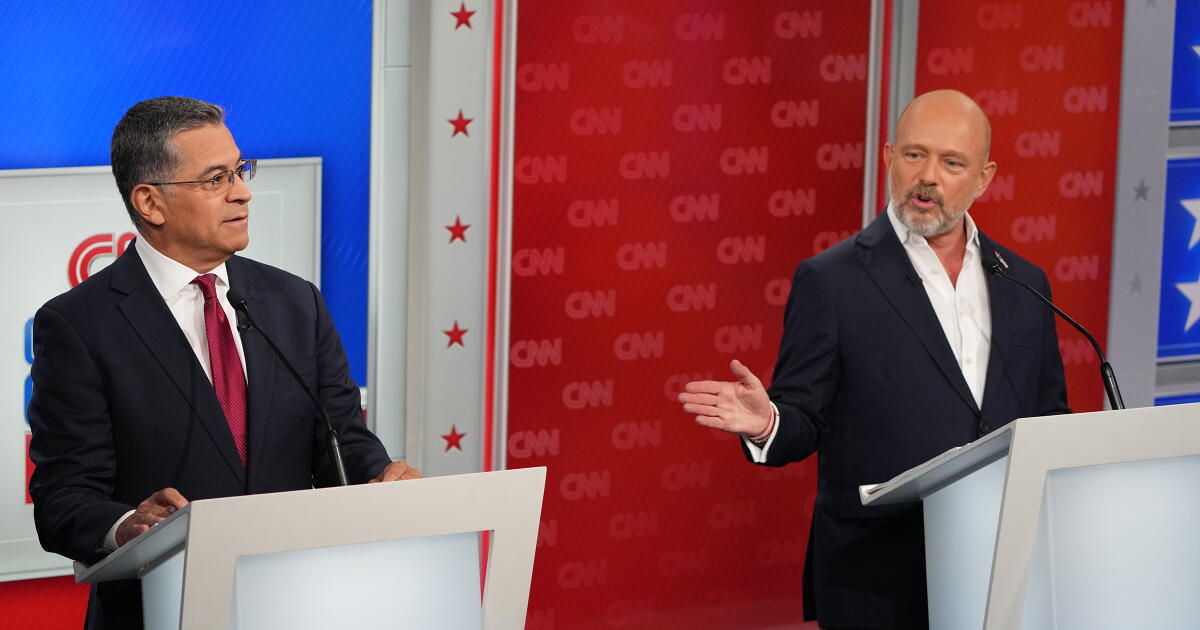
Becerra was ripped throughout the two-hour CNN debate, primarily by his Democratic rivals, who accused him of dodging questions about his stance on single-payer healthcare, falling short as a Biden Cabinet secretary and pocketing a campaign donation from Chevron.
“I think everyone’s invoking my name. It’s nice to hear my name quite a bit,” said Becerra, who served as the U.S. secretary of Health and Human Services during the Biden administration. “I will tell you this: Distorting the facts in your quest to be governor is never good, but using Trump lies to try to damage your opponents is worse, and that’s what we see happening.”
As ballots land in California voters’ mailboxes, the state’s seven top gubernatorial candidates clashed over immigration, President Trump, tax policy, political temperament and a hodgepodge of scandals, mudslinging and other unsavory actions that have risen to the forefront of the hotly contested race.
The snarky, sometimes petulant exchanges reflect how unsettled the race to replace termed-out Gov. Gavin Newsom is, as well as California’s outsize economic and political gravitas on the national and international stage.
Shortly after the debate began, former Orange County Rep. Katie Porter chastised her fellow candidates for their unceasing attacks.
“I can’t believe [the] interrupting and bickering and name calling and shouting and disrespect for everyone up here who’s stepping into public service that anyone wants to talk about my temperament,” said the former Democratic Congress member from Irvine.
Here are the top takeaways from a two-hour debate that somehow seemed even longer:
Becerra takes his lumps
Beccera, who has surged in the weeks before the June 2 primary, faced a barrage of attacks from his Republican and Democratic rivals about his oversight of unaccompanied immigrant minors during his tenure at the Health and Human Services Department and his relationship with a longtime adviser who, along with other consultants, skimmed about $225,000 from one of Becerra’s dormant campaign accounts.
Becerra is not accused of wrongdoing and has been painted as a victim in the prosecutor’s court filings. Still, conservative commentator Steve Hilton, a Republican, suggested Becerra knew about the scheme, and former Los Angeles Mayor Antonio Villaraigosa, a Democrat, questioned why Becerra paid an unusually high fee to one of the consultants named in the indictment.
“It doesn’t pass the smell test,” Villaraigosa said.
Becerra also was accused of changing his position on single-payer healthcare, a top priority of liberal voters that aims to create a healthcare system run and funded by the federal government.
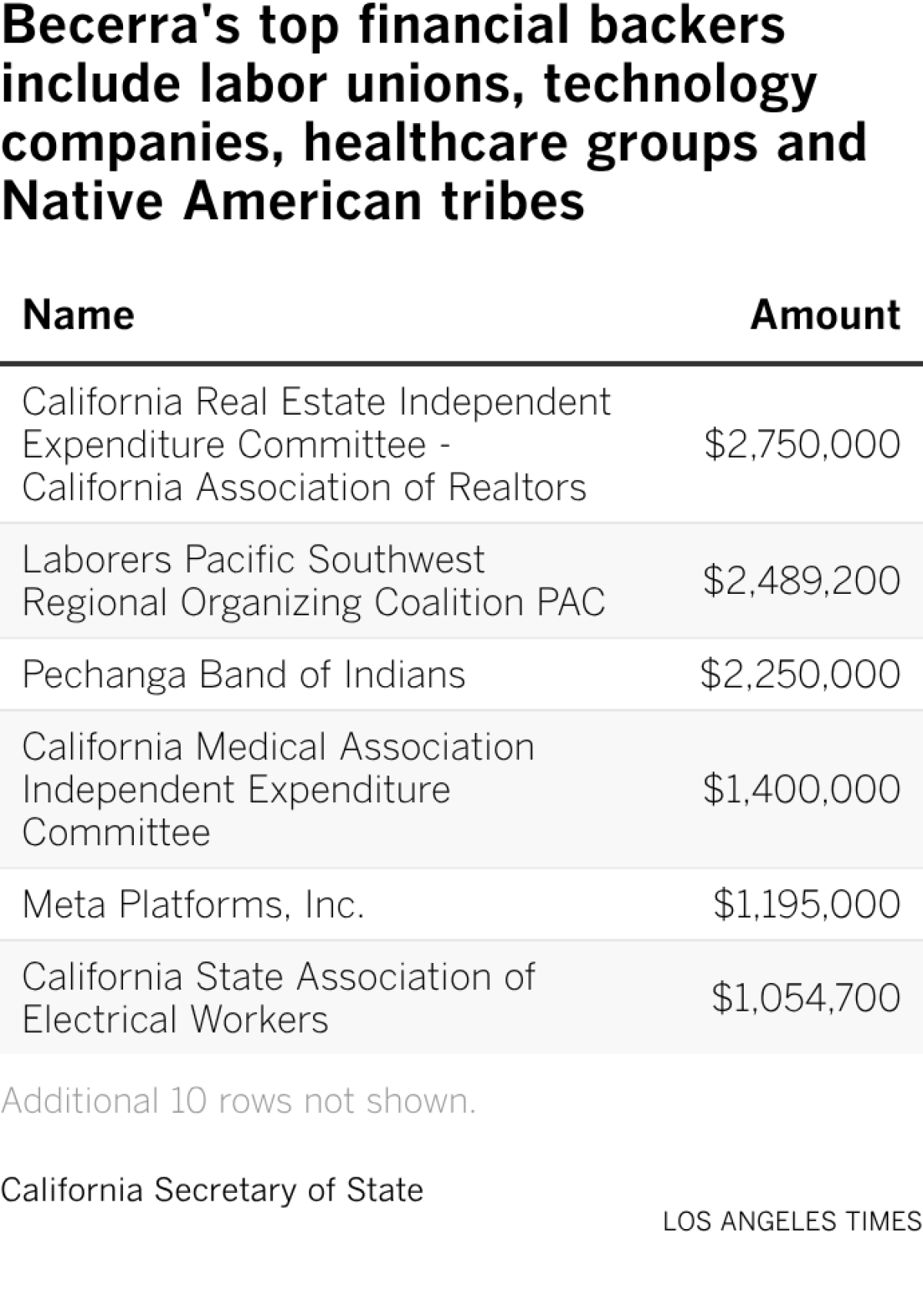
Though Becerra has long supported single-payer healthcare, he recently assured members of the California Medical Assn. — one of the most influential medical lobbyinggroups in California, which has endorsed him — that he would not support it as governor, according to a KQED report.
When asked directly about this, Becerra said “those reports were inaccurate. I continue to be for Medicare for all.”
Becerra sidestepped repeated questions from Porter about whether he supported a state-sponsored single-payer healthcare system in California, saying that he wants to cover “everyone with something like Medicare for all.”
“Covering everyone with something is not single-payer. It’s not even federal Medicare for all. But you won’t say whether you support California having its own state-run single-payer system,” Porter said.
Single-payer healthcare is a telling issue
Democratic billionaire Tom Steyer also has taken heat for changing his position on the issue. The hedge fund founder turned environmental warrior opposed single-payer healthcare during his 2020 presidential bid and now supports a statewide single-payer system called CalCare. He is endorsed by the California Nurses Assn., one of CalCare’s biggest supporters.
A recent analysis by UC researchers estimates CalCare would cost $731 billion to implement in 2027 — a price tag that’s $14 billion larger than all anticipated healthcare spending in California next year.
Villaraigosa said creating a state-sponsored single-payer healthcare system — with a price tag larger than the entire state budget — is a “pie in the sky” proposal. He said he considers healthcare a human right but said a system such as CalCare would require approval from the Trump administration — and that’s not going to happen.
“As a patient, it nearly killed me,” he said. “That’s another story we don’t have time for. As a policymaker, you end up with the worst patient satisfaction, costs that you can’t afford, taxes, sky-high to pay for it. It is a total disaster.”
Race remains a toss-up
The 2026 gubernatorial contest has been an undulating, unpredictable whirlwind. Unlike every governor’s race for more than a quarter of a century, there is no clear frontrunner, leading to a sprawling field of candidates with notable resumes but little recognition among California’s 23.1 million registered voters.
On Monday, the state Democratic Party released its latest voter survey, which found Hilton and Becerra tied at 18%, and Bianco with 14%. Steyer received the backing of 12%, while support for the other top Democrats in the race — Porter, San José Mayor Matt Mahan, Villaraigosa and State Supt. of Public Instruction Tony Thurmond — was in the single digits. Thurmond did not meet the polling threshold to qualify for Tuesday’s debate or an NBC/Telemundo face-off taking place on Wednesday.
Tuesday’s debate with the leading candidates took place at East Los Angeles College and was hosted by CNN, the first time national media has paid such attention to a California statewide contest since 2010.
Partisan divide on immigration
On the debate stage in Los Angeles, a city that was targeted by Trump administration immigration raids, Bianco criticized California’s sanctuary state laws, which prevent local law enforcement from assisting with federal immigration enforcement.
Villaraigosa defended the undocumented immigrants residing in California, saying they are vital to the economic success of the state. He also accused Bianco of not understanding how California’s sanctuary state policy works — with the former Los Angeles mayor telling him that California has turned over thousands of undocumented immigrants convicted of crimes to federal immigration officials.
“I want Mr. Villaraigosa to tell the mother of the 14-year-old in my county that is dead because of an illegal immigrant that had been deported three times because of DUIs that sanctuary state policy keeps us safe. I don’t think she’s going to agree with you,” Bianco said.
Democrats Porter, Steyer, Mahan and Becerra accused the Trump administration of “terrorizing” Latino communities and targeting people for deportation based on the color of their skin.
Steyer said he would prosecute ICE agents “and the people who send them,” including former Homeland Security Secretary Kristi Noem and Trump advisor Stephen Miller, for illegal racial profiling.
Agreement on need for housing
On the issue of housing, the candidates agreed that California has fallen short of providing enough homes to make the state affordable. Mahan, the mayor of San José, said he has reduced the city’s homeless population by making it easier to build ADUs in people’s backyards, and by reducing red tape for additional types of housing.
Villaraigosa said he built more market-rate, affordable and workforce housing when he was mayor of Los Angeles than anyone else on the stage.
Hilton pressed for building single-family homes in areas of the state with space, rather than forcing more housing into places where residents don’t want them.
Steyer said, “Californians can’t afford to live here,” and there has to be a greater conversation about building more housing, and faster. He also said that cities and counties “do not want new housing” because they can’t afford to pay the health and education costs associated with more residents, and he will solve that issue by closing tax loopholes for big businesses.
Still, housing, homelessness and affordability — top-of-mind issues for California voters — overall received scant attention during the debate, even though CNN debate moderators Kaitlan Collins and Los Angeles-native Elex Michaelson pressed the candidates on the state’s incessant problems with affordability.
Steyer did use the affordability issue to criticize Becerra, currently his greatest political threat, for taking a campaign contribution from Chevron.
“Being in bed with oil companies is a mistake,” Steyer said. “Xavier Becerra has taken the max amount of money from Chevron, and he has said they’re good guys that we need. The truth of the matter is the oil companies are ripping us off at the pump. They’re polluting our air and they’re burning up the climate.”
Becerra responded that it was “a rich response from a guy who made his billions investing in fossil fuels and oil companies, in coal companies.”
“Now he makes the billions, and he has spent more than every other candidate combined in this campaign, using those profits to now try to buy his seat in the governor’s office,” Becerra said.
Where they stand on the proposed billionaire tax
A notable area of policy disagreement among Democrats is a proposal to levy a one-time 5% tax on the wealth and assets of billionaires. Supporters of the measure say they have gathered enough signatures to qualify it for the November ballot.
If approved, the funds would mostly pay for healthcare cuts approved by the Trump administration last year.
Porter said that, although she wants to increase taxes on the state’s wealthiest residents, she doesn’t support the proposal because it is a “one-time tax” that won’t solve the state’s underlying budget issues.
“Yes to a progressive tax code, yes to the wealthy paying more, but this tax is about cheap political points,” Porter said.
Steyer said he would vote for the tax, but he agreed that state leaders ought to go further, including by taxing corporate interests more.
Bianco agreed with Porter that the billionaire tax is a bad idea.
Villaraigosa said California relies too much on the its wealthiest residents to fill state coffers, which leads to “feast and famine” in its budgets. He said businesses and high-earners are leaving the state, and that a plan to tax the wealthiest Americans needs to be enacted at the federal level.
Republican vs. Republican
The two Republicans on stage appeared content to spend their time blasting the Democrats rather than each other.
Bianco was asked if he thought that Republican voters could trust Hilton.
“You’ve called Hilton unethical and dishonest and said that he swindled his way into the Republican side,” Collins said, citing an article from the Atlantic.
“I would never use the word swindled, but the context — yes, I have said that,” Bianco said after some back-and-forth about the particulars of his criticisms. “Have Steve and I disagreed? Absolutely we have.”
He avoided directly criticizing Hilton but said he was the only person on the stage “that their entire existence in their job revolves around honesty, integrity.”
Hilton swerved, saying voters cannot keep voting for the same thing — Democratic leadership — if they want to see change in the state.”
Times staff writers Dakota Smith and Doug Smith contributed to this report.
For the third time in as many weeks, the leading candidates for California governor met on the debate stage Tuesday night.
The latest installment was a two-hour session, hosted and carried live from Monterey Park by CNN. The debate marked the first time the candidates appeared before a national audience and came as mail ballots have begun arriving in homes throughout the state.
Columnists Gustavo Arellano, Mark Z. Barabak and Anita Chabria took in all 120 minutes, absorbed every zinger — scripted and otherwise — and dutifully observed each parry and thrust. Here’s what they took away:
Arellano: Antonio Villaraigosa finally rises above his gubernatorial rivals. Is it too late?
I wrote my thoughts about this debate while writing my next columna on … something, stopping to pay attention only when issues in my bailiwick like immigration and the failure of the Democratic Party were the subject of discussion. The rest of the time, what the candidates said came off as one giant shout-fest straight out of the studios of the late, great Wally George, with everyone playing true to form.
Chad Bianco raged, Steve Hilton tried to mask his MAGA-ness with his British accent. Katie Porter scolded, Tom Steyer channeled Bernie. Xavier Becerra did his best impression of the old Bunsen character from “The Muppet Show.” Matt Mahan was just … there.
You know who sounded the best? Antonio Villaraigosa.
Anyone who really knows the former L.A. mayor has always seen him as Chicano Prince Hal, someone who doesn’t take himself as seriously as he should. His infidelities effectively killed his political career after his mayoral years; his consulting for the nutritional supplement company Herbalife made Villaraigosa a walking joke among too many Latinos I know.
He has spent the last decade effectively embodying Marlon Brando’s famous quote in “On the Waterfront”: He coulda been a contender. Even his gubernatorial run, announced way before many of his opponents, has mostly had the air of a has-been — that’s one of the reasons why Villaraigosa has polled so low through most of the race to the point he was excluded from many of the early debates.
But that hangdog Villaraigosa was nowhere to be seen tonight.
His wisecracks were kept to a minimum. He stayed mostly within his time limits and didn’t interrupt much. He hammered Hilton over his refusal to admit that President Trump lost the 2020 presidential election and his dismissal of undocumented immigrants.
Villaraigosa especially went hard on his forever frenemy Xavier Becerra on everything from his time as President Biden’s health secretary to how former staffers have been charged with stealing millions of dollars from his campaign funds. (Becerra has not been accused of any wrongdoing.)
When CNN co-moderator Elex Michaelson asked Villaraigosa if he would cancel California’s much-maligned high-speed rail project, the candidate’s emphatic “No” thundered down like a Lebron James dunk. He called out the waste on the multibillion-dollar project, said he revived L.A.’s subway to the sea, and spoke with a passionate gravitas that Becerra could only dream of doing.
“When I make a mistake, I’m accountable,” Villaraigosa said at the end of the debate. This sounded like a candidate who can win — and now he has a month to make a comeback worthy of his political mentor, the late, great Gloria Molina.
Four weeks to prove them wrong, Antonio.
Barabak: It was a no-hitter.
No startling breakthrough. No game-changing moment. No candidate so irresistibly charming he or she knocked the race akimbo and stamped themselves as the far-and-away front-runner in the slowly consolidating contest.
By now, the candidates are plowing well-furrowed ground.
To anyone who has watched each of the debates — and there may not be a great many of those viewers out there — it was all quite familiar.
What is new, and what may have been the draw for those just tuning in, is a sense the race is finally taking a coherent shape, with Xavier Becerra unexpectedly emerging as the candidate to beat.
A month ago, Eric Swalwell was a leading contender in the dozy contest and Becerra was an afterthought, being urged to quit for the sake of his dignity and the good of the Democratic Party. (Fears of a Democratic shutout in the June 2 primary have greatly receded.)
When Swalwell left the race and vacated his congressional seat amid allegations of sexual assault and other potentially illegal misconduct, it was widely assumed much of his support would move to either Steyer or Porter, the two other leading Democratic contenders.
But Becerra has been the clear-cut beneficiary and his new status was evident Tuesday night as he faced repeated attacks. He didn’t particularly dazzle, but that’s not his appeal. It’s his steadiness and seeming unflappability in a time of great upheaval and stress, and that was again evident.
With less than four weeks to election day — and voting already underway — time is waning for another dramatic shake-up like the one that took place between Swalwell’s implosion in April and Becerra’s surge in May.
It seems, however, as though little to nothing will change, with Becerra steadily gaining ground, Hilton consolidating GOP support and the remainder of the field looking for something — or someone — to drastically shake up the race one more time.
Chabria: I don’t know about a winner, but the debate definitely had a biggest loser: Bianco. The Riverside County sheriff, to his credit I guess, didn’t try for a hot second to hide who he really is — a conspiracy-loving immigration hardliner with ties to an extremist group.
Bianco sort-of said he was a member of the Oath Keepers, a far-right organization best known for some of its members participating in the Jan. 6, 2021, storming of the Capitol. He threw out election fraud theories, even suggesting state Atty. Gen. Rob Bonta could be involved. He made it clear that undocumented folks are breaking the law by existing in the state.
Maybe some MAGA voters will stick by that shtick, but I’m guessing independents and more moderate Republicans will find Hilton, the Trump-endorsed Republican, even more appealing after Bianco’s ragey ramblings. Hilton may well be sending his opponent a thank-you note and a bottle of bubbly for that performance.
As for winners, a couple of the Democrats had their moments. Porter spoke with clarity and force on issues including single-payer healthcare (she supports it) and resisting Trump’s immigration policies in this state of immigrants.
But she also directly addressed the criticism of her having a bad temper in a way that I think may haunt her.
As her male opponents bickered back and forth, taking swipes at each other, Porter said that given all the “shouting” and “disrespect” onstage, she was shocked that “anyone wants to talk about my temperament.” It’s a pushback she tried out earlier in the week with a new advertisement that sought to make a punchline out of the criticism.
I get her point and I don’t think a male candidate would face the same scrutiny for yelling at a staffer as she has, but also — what’s more unappealing to voters than an angry woman? A complaining one. That moment of resistance against the narrative may not land the way she intends with voters.
I agree with Gustavo that Villaraigosa had a good night, and that Steyer had Bernie energy — which may be good.
Steyer was the most lively and direct he’s been in a debate, landing a few punches and making points with clarity (far less wonky than he’s been in the past). He’s owning his far-left politics, and labeling himself the “change-maker.”
Steyer has been trailing Becerra in the polls, but Becerra again had a steady if less-than-thrilling appearance. For fed-up Democrats, Steyer may be looking better all the time.
Reporting from Sacramento — Few California Democrats have garnered more praise from the party’s various constituencies than Atty. Gen. Xavier Becerra, who has led the state’s charge against the administration of President Trump with 47 lawsuits on issues including immigration and healthcare.
But in recent months, Becerra has come under criticism from progressives and civil rights leaders for his reticence to support legislative checks on police use of force. That blowback could have ramifications for an ambitious politician who seems primed for ever-higher offices.
On Tuesday, Becerra announced that his office would not seek criminal charges against two Sacramento police officers involved in the fatal shooting of Stephon Clark, an unarmed African American man.
While that decision was not unexpected, it built on another recent controversy in which Becerra was sued by civil rights groups for not releasing use-of-force records. He later outraged many progressive allies by threatening legal action over police misconduct records he said were improperly released to the media.
Becerra has long walked a line of presenting himself as both a civil rights defender and a friend of law enforcement. But has also disappointed some supporters for not taking a stand in support of legislation that would toughen use-of-force rules as well as a proposal that the state Department of Justice routinely provide independent investigation of police shootings.
“A Democratic attorney general, in particular, is kind of torn between two worlds — the law enforcement entities and officials with which he or she must work and build credibility with, and Democratic constituencies that are highly suspicious of, if not downright hostile to, law enforcement,” said Garry South, a Democratic political consultant.
“Becerra is now caught between these two constituencies in a pretty public way,” said South, who managed Gov. Gray Davis’ 1998 and 2002 campaigns that portrayed Davis as a law-and-order Democrat. Sen. Kamala Harris faced the same pressures when she was attorney general, South said.
Capitol watchers see Becerra as a possible contender some day for higher office, including governor or U.S. senator if one of those jobs opens up.
But Becerra risks alienating key voters by his handling of the Clark case and his refusal to take a position on legislation making it easier to prosecute police officers, said the Rev. Shane Harris, a civil rights activist who has long served as a delegate for the California Democratic Party.
“He needs to realize that if he wants to be governor someday, he is going to need black votes and brown votes,” said Harris, president of the People’s Alliance for Justice. “If he has any aspirations, they just went out the window for now. This right here really took him backwards when it comes to the black vote in the state of California.”
Harris said Becerra could regain ground with minority voters by supporting tough reform legislation and embracing calls for the attorney general’s office to independently investigate all fatal police shootings.
He won election last year with strong support from police groups, including big campaign checks from the California Statewide Law Enforcement Assn. political action committee, the California Correctional Peace Officers Assn., the Los Angeles Police Protective League, the Assn. of Orange County Deputy Sheriffs PAC, the Long Beach Police Officers Assn. and the Oakland Police Officers Assn. PAC.
Becerra is too close to the law enforcement community, said Melina Abdullah, a professor of Pan-African Studies at Cal State L.A. and a member of the Black Lives Matter movement.
“I think the complete unwillingness of the attorney general to intervene in the murders of black people by law enforcement — even under the most extreme circumstances, like Stephon Clark — demonstrates either a completely failed moral compass or a shameful submission to political cowardice,” Abdullah said.
On Tuesday, Becerra defended his actions in police use-of-force cases as “by the book” and based on the evidence.
He resisted the idea that his office should routinely “parachute in,” as he calls it, and investigate officer-involved shootings that are now reviewed by prosecutors in each of the state’s 58 counties.
“I don’t have the capacity and the resources to try to take over the work of 58 different D.A.s in this one shop,” Becerra said.
He said local prosecutors are “far closer” to what is going on in their communities.
He said he knows the African American community feels hurt by the shooting of Clark, but added “I think there is a lot of hurt in the Police Department too, because they are under a microscope and two of their fellow officers are now under a microscope.”
The attorney general’s actions on law enforcement issues have frustrated some people who supported his election last year, including civil rights attorney John Burris, who represented Rodney King in his civil rights lawsuit against the Los Angeles Police Department.
“I’m disappointed,” Burris said after Becerra’s announcement in the Stephon Clark case. “I supported him wholeheartedly [during the election]. I think I had higher hopes for him in the beginning.”
Burris said he has asked Becerra in the last few years to look at other police shootings and the attorney general has always sided with the local district attorneys in not pursuing action against officers.
“At the end of the day, the attorney general is law enforcement, and they have to work with law enforcement throughout the state,” Burris said. “That’s what makes it very difficult for him and others to be very critical of the local police unless the evidence is overwhelming.”
The Clark decision was not the only action that concerned some Becerra allies.
Becerra is under criticism from groups including the First Amendment Coalition, which sued him last month after he refused to release records related to investigations of shootings or confirmed cases of sexual assault by officers.
The lawsuit alleges that Becerra is required to turn over the documents by a law — SB 1421 — that was approved last year. Police unions have sued to keep records from being released.
The ACLU of Southern California is “very disappointed” that Becerra is refusing to make public records ordered released by the state Legislature, said Melanie Ochoa, a staff attorney for the group.
“It is unfortunate that the state’s top cop is sending a message that it is OK for agencies to deny the public access to information about serious police misconduct and uses of deadly force — particularly when we already have numerous courts that have decided that agencies must release this information,” Ochoa said.
Becerra’s actions on the release of records are defended by Robert Harris, a director with the Los Angeles Police Protective League.
Harris praised Becerra for withholding such records in the Justice Department’s possession while court cases deciding whether the law applied to investigations of incidents that occurred before this year were pending.
“I think that’s an appropriate decision until we have a definitive answer,” Harris said.
Becerra defended his actions on the release of police misconduct records, citing privacy laws.
“My progressive values are still there,” Becerra told The Times.
“If I have your Social Security numbers, and there’s a good chance I do in one of my databases … you would not want me to disclose it lightly,” Becerra added. “My job is to protect that privacy.”
In January, in response to a group of journalists in Berkeley, the state’s Commission on Peace Officer Standards and Training released a list of 12,000 names of police officers and job applicants who had been convicted of crimes.
Becerra later said the state office made a mistake in releasing the names to reporters for the Investigative Reporting Program at the UC Berkeley Graduate School of Journalism.
In a letter, he told the reporters to destroy the records, arguing that possession of the data was a criminal offense.
Becerra said this week that his letter to Berkeley was part of due diligence to enforce the law.
“Someone needs to ask the folks that are in possession of information that they are unauthorized to possess or use, what don’t they understand about the law that says, ‘You are in possession of information that you shouldn’t have.’ It’s like stolen property,” he said.
The attorney general also finds himself in the center of a storm of controversy over possible legislative measures to reduce excessive force.
Becerra refused Tuesday to take a position on pending legislation by Assemblywoman Shirley Weber (D-San Diego) that would make it easier to criminally prosecute law enforcement officers who kill civilians.
Police unions and chiefs are supporting a separate measure that would instead focus on internal department policies and training.
Becerra said he has withheld taking a position on the two use-of-force bills because he has not read them yet and he wanted to first complete the investigation into the Clark shooting, which he wanted to be seen as independent and fair.
“I have not gone through the bills to the point of making decisions,” Becerra told reporters at a news conference on the Clark shooting.
“I will get involved because it’s important,” he said. “I don’t intend to be AWOL when it comes to the discussion of how we write this new chapter.”
The top candidates for California governor clashed over the high costs of gas, housing and homeowner’s insurance in a testy debate Tuesday evening, a fiery exchange that may finally draw voter attention as the June 2 primary election fast approaches.
Former Fox News host Steve Hilton, a Republican who leads all candidates in the most recent opinion polls, ripped Becerra for promising to declare a state of emergency to address rising homeowner’s insurance rates, saying the governor lacks that constitutional authority.
“We can’t have a governor who doesn’t understand how the government works,” Hilton said.
Becerra, who served as California attorney general before joining the Biden administration, quickly defended himself, saying he knows the law better than Hilton does.
“We don’t need a talking head from Fox News to tell us how the government works,” he said.
And that was after Becerra got in an early dig at Hilton, who has been endorsed by President Trump, by referring to Trump as “Hilton’s daddy.”
The debate was broadcast and livestreamed by CBS stations around the state. Hundreds of people watched from Pomona College’s historic Bridges Auditorium, a Renaissance Revival-style landmark with Art Deco flourishes that was once among the premier performance venues in Southern California.
With eight major candidates from both parties participating, CBS moderators billed it as “the largest and most inclusive debate of the election.” Becerra and Hilton were joined by Republican candidate Riverside County Sheriff Chad Bianco and Democratic candidates San José Mayor Matt Mahan, former Orange County Rep. Katie Porter, billionaire Tom Steyer, state Supt. of Public Instruction Tony Thurmond and former Los Angeles Mayor Antonio Villaraigosa.
Some takeaways from the debate:
Candidates didn’t shy away from the top issues
Moderators set the theme for the first half-hour of the debate as “affordability,” a top concern among California voters, and almost immediately the candidates began sniping and talking over one another.
Almost all of them vowed to accelerate home construction in California, pivotal to reducing the state’s high cost of housing.
There was no shortage of ideas for other ways to ease the financial burdens facing Californians, but few specifics on how they would deliver on those promises given the state’s complex and arduous legislative process.
Hilton promised to cap the price of gas at $3 per gallon, and Mahan vowed to suspend the state gas tax. Bianco said Democrats have long overregulated and overtaxed Californians, and the state’s supermajority Democratic Legislature would have to get in line with him and end those things if he’s elected.
Becerra said he would reduce prescription drug prices. Thurmond said he would provide down-payment assistance grants to those trying to own their first home.
Barbs traded over climate-caused emergencies
Anchors and reporters from local CBS stations moderated the debate, including Los Angeles anchor Pat Harvey, Sacramento anchor Tony Lopez, Bay Area anchor Ryan Yamamoto and national investigative correspondent Julie Watts. They were joined by Sara Sadhwani, an assistant professor of politics at Pomona College and a member of California’s independent redistricting commission.
Moderators pointed to the surge in catastrophic wildfires across the state in recent years due to climate change, as well as the threat of earthquakes, and asked the candidates how they would respond to future emergencies.
As he did throughout most of the debate, Bianco responded by bashing California’s Democratic leadership, which he said created most of the ills facing the state.
Bianco said the root causes of fire disasters in the state are “not because of climate change” but due to “failed environmental activist policies” that prevented fire departments from clearing highly flammable brush around communities for years.
Mahan, after touting his actions as a Silicon Valley mayor during emergencies, quickly pivoted to take shots at Becerra and his role as U.S. Health and Human Services secretary during the pandemic.
He said Becerra had “never met a crisis that he couldn’t ignore” and accused Becerra of failing to deal with COVID-19, monkeypox and the surge of unaccompanied minors at the U.S.-Mexico border during the Biden administration.
Becerra responded by saying that his agency dealt with the crises by working with all 50 states and the federal government to quickly roll out vaccines and other resources.
“You’re not wearing a mask, are you, Matt? You’re not worried about catching monkeypox, right?” Becerra said.
Steyer also came under attack when he starting discussing his plans to “make polluters pay” for the effects of climate change. Porter criticized the former San Francisco hedge-fund founder for making millions off the oil and gas industry, and using those profits to fund his campaign for governor. Steyer has spent more than $143 million of his own money on his campaign, according to fundraising disclosures filed with the California secretary of state’s office.
“How about profiteers pay? You pay the lowest tax rate on this stage, and yet you made the billions that you’re using to fund your campaign off fossil fuels,” Porter said to Steyer.
Steyer responded that he is a “change agent” candidate opposed by special interests and pointed to campaign committees funded by utility and other industry groups opposing his bid. PG&E, the California Chamber of Commerce and the California Assn. of Realtors have put more than $29 million into a pair of committees to fund attack ads against the billionaire.
Republicans focus on blaming Democrats
Just weeks before the June 2 primary, the race to replace term-limited Newsom remains wide open, with many voters still undecided.
Republicans Hilton and Bianco have led numerous public opinion polls while the large field of Democrats have split the vote, leading to fears among Democrats that the party could get shut out of the general election, despite outnumbering Republicans nearly two-to-one among the state’s registered voters. In California’s open primary, the top two finishers advance to the general election, regardless of party affiliation.
The two Republicans avoided overtly attacking each other at the debate but were regularly the targets of other candidates on the stage.
Becerra, speaking about federal healthcare funding cuts approved by President Trump and congressional Republicans last year, referred to the president’s endorsement of Hilton. “The first thing we have to do is stop Steve Hilton’s daddy,” Becerra said.
Hilton responded jokingly that his father, who was the goalie for the Hungarian national ice hockey team, hadn’t weighed in on the race. And he said Becerra’s comment pointed to what is wrong with California politics — a fixation on Trump despite Democrats controlling the state for more than a decade.
“We’ve had the same people in charge for 16 years now, and it’s such a disaster and such a high cost of living for everyone, and the highest poverty rate in the country and the highest unemployment rate in the country, and the worst business plan,” Hilton said. “All these things going wrong, they can’t do anything except blame Trump. Let’s see how many times you hear that tonight.”
Bianco grew visibly frustrated several times over the debate’s format and his opponents’ answers. At different points, he compared the event to “The Twilight Zone” and called it “the hour and a half that [viewers] are never going to get back.”
Pressed on what he would do differently if elected, the Riverside sheriff also focused on criticizing Democrats and accusing them of lying.
“We have a group of of 20-ish-year-old kids and we’re just sitting here lying to them about broken Democrat policies in California for the last 20 years, and we’re going to sit here and blame a president who’s been president for a year. This is absolutely ridiculous,” he said.
Hilton has seen a bump in his polling numbers since he wasendorsed by President Trump earlier this month. A CBS News/YouGov poll of more than 1,400 registered voters released Monday showed Hilton leading with 16%, followed by Steyer with 15%, Becerra with 13%, Bianco with 10%, Porter with 9%, Mahan and Villaraigosa with 4% and Thurmond with 1%. The largest group of voters — 26% — was undecided.
Nixon reported from Sacramento and Mehta reported from Claremont. Times staff writers Kevin Rector, Dakota Smith and Blanca Begert contributed to this report.
After winning his first race for Congress in 1992, 34-year-old Xavier Becerra credited a wave of community supporters in Los Angeles, many Latino, for backing his upstart campaign, saying he hoped his win was proof that grassroots politics was more valuable than “heavy dollars.”
More than 30 years later, Becerra, 68, is again an upstart candidate — this time for California governor. Again he is facing monied competition — including from chief Democratic rival Tom Steyer, a self-funded billionaire — and relying on Latino and other grassroots support.
California gubernatorial candidate Xavier Becerra speaks during a campaign event in Los Angeles on April 18.
(Jae C. Hong / Associated Press)
“You are the people power that it takes,” he told a crowd of supporters at a recent “Fighting for the California Dream” town hall in Los Angeles. “California wasn’t built by billionaires. It was built by your families. It was built by our families.”
That Becerra is still fighting in the race — and drawing new people to his events — reflects a remarkable and hard-to-explain turnaround for a campaign that appeared all but dead less than a month ago, then bounded back into contention after Rep. Eric Swalwell dropped from the race and resigned from Congress amid sexual assault allegations.
Before Swalwell’s collapse, Becerra’s biggest splash in the race came in March, when USC excluded him and other low-performing candidates from a planned debate. The criteria left every candidate of color out, and after Becerra and others complained, the forum was canceled.
A California Democratic Party tracking poll, released in early April before the Swalwell scandal broke, showed Becerra near the bottom of the field with 4% support among likely voters. In a party poll taken after it broke, Becerra’s support jumped to 13% — the biggest increase of any candidate.
Certainly some of Swalwell’s supporters shifted to Becerra, but political observers are still pondering why so many did — and not to Steyer, former Orange County Rep. Katie Porter or other Democrats with single-digit support, such as former L.A. Mayor Antonio Villaraigosa or San José Mayor Matt Mahan.
Whatever the answer, Becerra’s surge has sparked fresh interest in his candidacy. It also has raised questions about his time as California attorney general, when he sued the first Trump administration more than 120 times, and U.S. Health and Human Services secretary, when he backed the Biden administration’s strict COVID-19 rules and oversaw the agency’s response to a massive influx of unaccompanied minors at the southern border.
It has also put a growing target on Becerra’s back — including at Wednesday night’s gubernatorial debate, when rivals criticized him as a “D.C. insider” with poorly detailed plans for the state — and sparked hope among many Latinos that California will elect one of them as governor for the first time in state history, sending a strong message of resistance to the intensely anti-immigrant Trump administration.
Of course, Becerra faces hurdles. Steyer, a hedge fund founder who has donated more than $130 million to his own campaign, has been ahead of him in polling, as have two Republicans: Silicon Valley entrepreneur and former Fox News host Steve Hilton, who has President Trump’s endorsement, and Riverside County Sheriff Chad Bianco. Only the top two candidates in the June 2 primary advance to the November election.
Still, Becerra now has a path to victory, one that did not exist even a month ago, and new funding. Many Democratic voters remain undecided, and many — shocked by the Swalwell scandal — are looking for another Democratic front-runner to back.
In an interview with The Times, Becerra said he’s the man for the job, because “California needs a work horse, not a show horse.”
Xavier Becerra, left, gathers with other candidates for Los Angeles mayor in 2000.
(Gary Friedman / Los Angeles Times)
Rising wave of Latino political power
A Sacramento native and the son of a Mexican immigrant mother and a Mexican American father, Becerra graduated from Stanford Law School and served as a deputy to California Atty. Gen. John K. Van de Kamp before being elected in 1990 to the California Assembly.
In 1993, Becerra entered Congress on a rising wave of Latino political power and the heels of a fractious presidential election in which former White House aide Pat Buchanan challenged President George H.W. Bush in the Republican primary on a stridently anti-immigrant, “America First” message — one Trump repurposed in both 2016 and 2024.
It was a defining political moment for Latinos across the country, and for Becerra personally, said Fernando Guerra, founding director of the Center for the Study of Los Angeles at Loyola Marymount University.
“He certainly has been and is part of the incorporation of Latinos into California history and California politics, and it really begins in the early ’90s,” Guerra said. “His rise and political career is really a reflection of the rise and political incorporation of Latinos.”
In 1994, Becerra helped oppose Proposition 187, a state initiative to deny undocumented immigrants access to public education and healthcare. In 1996, he sharply criticized the passage of the Personal Responsibility and Work Opportunity Reconciliation Act, which cut federal benefits for many legal immigrants. By 1997, Becerra — just 39 — was chair of the Congressional Hispanic Caucus and the first Latino member to serve on the powerful House Ways and Means Committee.
By 2016, Becerra, 58, was the highest-ranking Latino in Congress when then-Gov. Jerry Brown tapped him to replace a Senate-bound Kamala Harris as California attorney general. There, Becerra played a key role in defending the Affordable Care Act, known as Obamacare, against Republican attacks.
Then-U.S. Health and Human Services Secretary Xavier Becerra arrives for a hearing to discuss reopening schools during the COVID-19 pandemic in 2021.
(Greg Nash / Associated Press)
Criticism and praise
In a rush of endorsements in recent days, Becerra’s supporters have lauded his executive experience, calling him a “proven leader” who, amid constant threats from the Trump administration, is “ready to fight back on day one.”
Becerra’s critics also have pointed to his leadership record, but to highlight what they contend are glaring failures.
Steyer spokesman Kevin Liao alleged Becerra was “absent, ineffective, or too late” in responding to COVID-19 and other public health crises as health secretary, and that California “cannot afford incompetence, or someone who disappears when things get hard.”
The remarks echoed others made during the pandemic, including by Eric Topol, who is executive vice president of Scripps Research in La Jolla, a professor of translational medicine and a cardiologist. During the pandemic, Topol accused Becerra of being “invisible” in the fight to control it. In a recent interview, he said he still believes that.
Topol said the Biden administration’s COVID response was defined by poor data collection and “infighting” among agencies such as the National Institutes of Health, the Centers for Disease Control and Prevention and the Food and Drug Administration, including on vital issues such as when Americans should receive booster shots and how long they should isolate after infection.
Becerra “basically took a very absent, low profile — didn’t show up, didn’t harmonize the remarkable infighting,” Topol said. “The buck stops with him.”
Dr. David A. Kessler, the Biden administration’s top science official on COVID-19 and now a professor of pediatrics and epidemiology at UC San Francisco, fiercely defended Becerra, crediting him with rolling out some 676 million vaccines and steering the nation out of a wildly unfamiliar health crisis with substantial success — what Kessler called a “historical achievement” that proved government “can do big things.”
Kessler said Becerra rightly assessed that the country needed to hear from medical experts, not politicians, and so deferred at times to the doctors, epidemiologists and vaccinologists he smartly surrounded himself with and trusted — but he was never absent. “He enabled us. He was there. Anything I needed, he helped deliver,” Kessler said.
Becerra said there were a lot of people involved with the COVID-19 fight, including a White House team launched before his confirmation as health secretary. Still, it was his agency that ultimately led the response, and helped bring the pandemic to an end, he said.
“At the end of four years, when we had put some 700 million COVID shots into the arms of Americans and pulled the country and our economy out of the COVID crisis, it was HHS — and I was the secretary of HHS,” he said.
Becerra’s rivals in the governor’s race also have attacked him for how he responded to an influx of unaccompanied immigrant minors during the pandemic. They allege Becerra rushed their release to relatives and other sponsors while ignoring concerns from career health staff that some of those placements weren’t safe — resulting in thousands of kids being lost to the system, forced into child labor or trafficked.
The criticism stems in part from a sweeping New York Times investigation that found the health department couldn’t find some 85,000 children it had released, that Becerra had relaxed screening processes for sponsors and that placement concerns from career health staff went ignored or were silenced.
The investigation by reporter Hannah Dreier found that thousands of the 250,000 or so migrant children who arrived in the U.S. between early 2021 and early 2023 had “ended up in punishing jobs across the country — working overnight in slaughterhouses, replacing roofs, operating machinery in factories — all in violation of child labor laws.”
Atty. Gen. Xavier Becerra holds a news conference in Border Field State Park in San Diego in 2017.
(Francine Orr/ Los Angeles Times)
It found there were many signs of “the explosive growth of this labor force,” and that staff had repeatedly flagged concerns about it in reports that reached Becerra’s desk. It also reported that, during a staff meeting in the summer of 2022, Becerra had pressed staff to move children even more quickly through the process, comparing them to factory parts.
“If Henry Ford had seen this in his plants, he would have never become famous and rich. This is not the way you do an assembly line,” Becerra said, according to a recording of the meeting obtained by the newspaper.
Danni Wang, another Steyer spokesperson, said children “were handed to gang members, traffickers, and abusers because [Becerra] stripped the background checks that had protected them for years.”
Becerra said the controversy is one he has addressed publicly for years, including in multiple congressional hearings. He said his team worked diligently to properly vet sponsors and do right by the thousands of children in their care, despite Congress failing to provide the budget needed to restore a system of licensed care facilities that the first Trump administration had dismantled.
“It was a wreck. They had closed facilities, they had fired the licensed caregivers. And remember, this was during COVID, [when] you didn’t want anyone to be near each other,” he said. “How do you take care of thousands of kids in a center that could house maybe 50 kids?”
He said he led an aggressive push to stand up temporary facilities — including in places like the San Diego Convention Center — while rebuilding the licensed care facilities Trump had dismantled and working to place kids into the community as quickly and safely as possible.
Ron Klain, who served as Biden’s chief of staff for the first two years of the administration, said Becerra helped lead the administration out of the crisis by being “an outspoken advocate” for the children in its care.
“Xavier was very, very insistent in meetings and very outspoken on the risk that some of these people [the kids] were being placed with were not the proper people to place them with, and pushed hard for more rigor in the process,” Klain said.
Becerra also has faced criticism and questions related to the federal indictment of his former chief of staff Sean McCluskie, who pleaded guilty to conspiracy to commit fraud after authorities accused him of stealing some $225,000 from Becerra’s dormant state political campaign account.
Becerra was not implicated in the scandal — which he’s previously described as a “gut punch” — and said he did everything he could to ensure McCluskie and others were held accountable once it came to light, including by providing “testimony and documents” to the FBI and federal prosecutors.
Hilton has said the scandal, which also implicated a former aide to Gov. Gavin Newsom, showed that “corruption has become totally ingrained and systemic” under Democratic rule in California.
Looking ahead
Experts said Becerra’s long resume will help him stand out in a race with less experienced competitors and no household names — and that Californians electing a Latino for the first time, as the Trump administration conducts one of the largest ever deportation campaigns, dismantles immigrant rights and targets people on the street based largely on their looking and sounding Latino, would be a major political moment.
Becerra said his extensive experience should matter to voters, because such experience will be necessary in the pivotal and no doubt chaotic Trump years ahead, when “pizzazz and dazzle” will matter less than steady competence from “someone who’s actually been in the midst of that hurricane” before.
“It helps to have gone through these things. I’ve been there, I’ve done that, and I’ve done it successfully,” he said. “I’ve proven that, whether it was taking on Donald Trump toe to toe as the [attorney general], whether it was getting us out of COVID working closely with the White House to deploy the resources and get that done, we made it happen.”
Xavier Becerra needed to land a knockout punch, even more so than the five other candidates for California governor he was facing at Wednesday night’s debate.
Instead, he fired off some slaps.
He needed to roar about his many accomplishments in his 35-year career in Sacramento and Washington, to distinguish himself from the relative political neophytes around him.
Instead, Becerra recited his resume with the vigor of someone rattling off his LinkedIn page.
Instead, he offered the oratory equivalent of a pat on the shoulder.
No candidate had more at stake that night than Becerra, who went from an afterthought to a contender after Eric Swalwell dropped out and resigned his congressional seat over sexual assault allegations.
Five weeks ago, Becerra and other candidates of color were protesting their exclusion from a USC debate because they were all polling so low. Now, the 68-year-old has a chance to become California’s first Latino governor.
This possibility seems to have uncorked California’s silent majority — the rancho libertarians turned off by hard-right politics but also the wokoso politics they feel have left them behind. The people who yearn for an unglamorous, competent leader after eight years of all-about-me Gavin Newsom and a decade of Donald Trump.
Becerra’s campaign, once as rudderless as a leaf in a river in a race so chaotic for Democrats that many feared two Republicans would win on June 2 and face each other in the general election, suddenly latched onto a palpable wave.
At the Los Angeles Times Festival of Books last weekend, I saw people sporting Becerra campaign buttons who had just come from a rally that was expected to draw a few hundred but instead had over 2,000 RSVPs. On social media, friends who had never especially cared for state politics suddenly declared they were for Becerra and fought off their more lefty pals who think he’s a Latino Ned Flanders not up for this fraught moment.
Unglamorous and competent are Becerra’s middle names, and they were on display at the debate — for better and mostly worse. This was his chance to show both his new followers and undecided voters that they could trust him as California’s next governor.
But where he needed to be limber like a prizefighter, the former California attorney general was as tightly wound as a Rolex.
While the other candidates pressed their palms against the podiums, ready to pounce on every question, Becerra clasped his hands like an altar boy. When he did gesture, his movements never went further than the span of his shoulders.
As the others grinned and grimaced at their rivals’ responses, Becerra was as stone-faced as Buster Keaton. He stumbled more than he should have — how could someone in his position mistake Iraq for Iran when criticizing Trump’s Middle East quagmire? — and rarely seemed at ease, as if the weight of the moment and the good luck of his surge had suddenly hit him at the worst possible time.
Candidates in California’s gubernatorial race, from left, Matt Mahan, Xavier Becerra, Chad Bianco, and Steve Hilton look on during a debate Wednesday, April 22, 2026, in San Francisco.
(Jason Henry / Associated Press)
Becerra’s supporters say a level-headed leader is what California needs. But voters almost never go for what they need — they pick what they want. And California wants someone who’s loud, or at least louder than Becerra. There’s a reason why strident partisans like Republicans Chad Bianco and Steve Hilton and progressives Tom Steyer and Katie Porter have consistently placed high in the polls, while moderates like Becerra, his frenemy Antonio Villaraigosa and San Jose mayor Matt Mahan have lagged.
The weird thing is that Becerra does know how to brawl. Wallflowers don’t go from a working class Mexican immigrant family to Stanford Law School. Wimps don’t survive the ruthlessness of Eastside politics as an outsider to become a congressmember at just 34. Cowards don’t file over 100 lawsuits against the Trump administration as California’s top prosecutor or tackle the coronavirus pandemic as President Biden’s health secretary.
I’ve only encountered the Sacramento native a few times but always came away impressed. In small crowds, he makes people laugh and tear up. He’s quick with ripostes, righteous in off-the-cuff remarks and has a do-gooder aura that never comes off as sanctimonious.
We saw hints of that Becerra at the debate. To Hilton, he quipped, “You can be a talking head and not worry about the consequences of what you do” after the former Fox News host babbled on about how one-party ruled had failed California.
After Porter accused him of not offering hard numbers for his economic plans, Becerra responded that he has balanced federal budgets larger than California’s. “It’s easy to say you haven’t done this; it’s easier to prove that you actually have,” he concluded.
But after Becerra described the evils of racial profiling by law enforcement and Bianco, the sheriff of Riverside County, ranted that California politicians need to stop thinking so much about race, it was Porter who responded with a verbal haymaker as Becerra silently looked on.
You don’t fight as a choirboy in a battle royale. Becerra wasn’t bad at the debate but he also wasn’t great — and that won’t win this race.
Voters want someone who’ll do the job, yes — especially if it comes with no drama. They also want to elect someone they think is a human, not a joyless bureaucrat. So how did Becerra respond to the debate’s last question about what was the last series you’ve streamed?
Becerra flashed his biggest smile of the night. It was such a softball query that even a kindergartener could have slammed it à la Shohei Ohtani.
“I wish I could tell you I had time to watch streaming shows,” he replied.
Dude. We’re all overworked, but everyone I know unwinds by watching mindless drivel (my current obsession is “Vanderpump Villa”). We all need to relax, even for a moment. As my dad says when he sees me filing one columna after another and urges me to take a break, “El trabajo nunca se acaba pero uno sí se acaba.”
Work never ends, but people do.
Xavier, you know you’re on the wrong side of California when the only other candidate with a similar answer was Bianco, who said he doesn’t watch television at all.
Being careful has served you well, but this is the greatest opportunity of your life. You don’t have to suddenly become a flamethrower, but some sparks would help. It’s six weeks until the primary, so time to throw down — channel your inner cholo and go get what should be yours.
Xavier Becerra, a former cabinet secretary in President Biden’s administration, appears to be surging in the curiously unsettled California governor’s race.
Until recently, the former U.S. Health and Human Services secretary had been mired in the single digits in polling to replace termed-out Gov. Gavin Newsom and lead the nation’s most populous state.
But after former Rep. Eric Swalwell, (D-Dublin) dropped out of the race earlier this month amid accusations ofsexual assault and other misconduct Becerra has seen a boost in polls, fundraising and endorsements.
On Tuesday, Assembly Speaker Robert Rivas endorsed Becerra alongside 14 Democratic members of the legislative body.
Arguing that Californians are under constant threat from President Trump’s policies, Rivas cited Becerra’s decades-long record in public office, including defending Obamacare and young immigrants, or dreamers, to argue that Becerra is best positioned to lead the state.
“There’s no time to learn on the job — we need a governor who’s ready to fight back on day one,” Rivas said in a statement, noting that Becerra sued the Trump administration 122 times while he was California’s attorney general. “We have a strong Democratic field for governor. But right now, we need someone ready on day one. Xavier Becerra is that leader.”
Becerra said he was honored to receive the legislators’ backing.
“I look forward to working with the Speaker and legislators on Day One to tackle the problems Californians care about most — from the skyrocketing cost of groceries and housing to our unyielding fight against the Trump Administration’s disastrous policies,” he said in a prepared statement. “Californians need an experienced and trusted leader who doesn’t need on-the-job training.”
Despite Becerra’s long tenure in state and federal office, the unflashy politician is not well-known among California voters. He was among the underdogs in the 2026 gubernatorial race. Swalwell, by contrast, was among the leading Democratic candidates.
Amy Thoma, a former Republican strategist who is no longer affiliated with a political party, noted that Becerra’s surge comes at a critical moment in the election, shortly before ballots land in Californians’ mailboxes.
“Voters are starting to tune into the race. Yes, they want someone who will stand up to Trump, but it also seems they want someone with experience who can address the very real issues facing the state,” Thoma said.
She added that Becerra’s life story is “incredibly compelling.”
“The word authentic is overused, but every time he talks about his love for this state, for his family and wanting to make California work for everyone, it comes across incredibly sincere,” Thoma said. “Voters can see through candidates who fake it.”
Becerra was respected by colleagues across the aisle, including former GOP legislative leader and state Republican party chairman Jim Brulte. Both men were elected to the state Assembly in 1990 and though their politics often sharply differed. However, they had a warm relationship.
“He was progressive and I am a conservative,” Brulte said. “We never agreed much on policy, but he is a good man with a great heart.”
The 2026 governor’s race has been unlike any in recent memory, with no clear front-runner in a crowded field of candidates and voters just beginning to pay attention to the contest shortly before the June 2 primary.
There were two prominent Republicans and eight prominent Democrats in the race, leading to fears among Democratic leaders in the state that their party’s candidates could be shut out of the governor’s race in the general election because of California’s unique primary system. The two candidates who win the most votes in the June 2 primary will move onto the November general election, regardless of party affiliation.
Democratic leaders remain concerned that despite California’s sapphire-blue tilt, the number of their party’s candidates in the race could lead to a splintering of Democratic voters that results in two Republicans advancing to the November ballot.
Six prominent Democrats remain in the race, after Swalwell and former state Controller Betty Yee dropped out.
The race — lacking a global superstar such as Arnold Schwarzenegger or the scion of a storied political family and former governor like Jerry Brown — is ephemeral. Anything can happen before the June 2 primary.
But Becerra is having a moment. In addition to the new endorsements, he has seen notable movement in polls, most recently in a survey released Monday by the state Democratic party. Becerra jumped nine points from the party’s last poll, tying with billionaire Tom Steyer at 13%.
While Becerra will never be able to match Steyer’s deep pockets, he raised more than $1 million on ActBlue, the top Democratic fundraising platform, in the week ending on April 18, making him the biggest fundraiser on the site in the nation.
“Ninety-seven percent were first-time donors,” Becerra’s campaign said in a statement. “This is not a donor base being recycled. It is a movement being born.”
The most unpredictable California governor’s race in recent history took another set of dizzying turns on Monday, with former Health and Human Services Secretary Xavier Becerra surging after former Rep. Eric Swalwell dropped out in the face of sexual assault and misconduct allegations, and former state Controller Betty Yee ending her bid.
The race to replace termed-out Gov. Gavin Newsom is the first in a quarter of a century with no clear front-runner and a sprawling field of candidates who have been jockeying for the attention of Californians, who are just beginning to pay attention to the campaign two weeks before ballots arrive in their mailboxes.
“I certainly could not have imagined the twists and the disturbing turns that this race has taken,” Yee said as she announced she was dropping out. “But through it all, my values and my vision for California has never wavered.”
A poll released Monday by the state Democratic Party — its first since Swalwell (D-Dublin) dropped out — showed Becerra’s support jumped nine points to 13%, placing him in a tie with Tom Steyer, the billionaire hedge fund founder turned environmental warrior. Former Rep. Katie Porter of Orange County saw a slight bump to 10% from 7%, while the remaining Democrats in the contest were mired in the low single digits.
The party began the surveys out of concern that Democrats could be shut out of the governor’s race because of California’s unique primary system, where the top two vote-getters in the June 2 primary move on to the November general election regardless of political party.
“I continue to believe there are too many Democrats in the field,” California Democratic Party Chairman Rusty Hicks told reporters Monday. “My call for candidates to honestly assess the viability of their candidacy and campaigns still stands, especially if you are stalled in the single digits, seeing financial resources dry up and/or are failing to pick up additional support.”
Hicks and other party leaders and allies had unsuccessfully urged low-polling candidates to reconsider their candidacies before the filing deadline in an attempt to cull the field and avoid splintering the Democratic vote. Though most did not name candidates who they thought should think about their viability, Yee was widely believed to be among them.
Yee became emotional as she said on Monday that she decided to withdraw from the race because she wasn’t able to raise the resources necessary to compete in the state. She also said her message of competency and experience wasn’t resonating among voters who were seeking a fiery foil to President Trump, not “Boring Betty,” as she dubbed herself. Yee said she would assess the field before making an announcement on whether she would endorse one of her fellow Democrats.
Becerra was another candidate believed to be a target of party leaders’ efforts to shrink the field. But he held on and apparently benefited from Swalwell’s downfall.
“I’m not the richest candidate, I’m not the slickest candidate, but I am the guy that’s got you,” Becerra said, rallying supporters in Los Angeles on Saturday.
The audience was filled with members of labor groups backing the longtime politician, and Becerra told them he’d serve as a “union man” in the governor’s office.
Pro- and anti-Becerra forces tussled outside the town hall after two people, who declined to identify whom they were working for, passed out fliers highlighting critical media investigations of the U.S. Department of Health and Human Services during the migrant crisis when the agency was led by Becerra.
Pro-Becerra attendees grabbed the fliers and told the men to go away, prompting a security guard to intervene.
The question is whether Becerra, who also served as state attorney general, a member of Congress and a state Assembly member, can raise the funds necessary to compete in a state with some of the nation’s most expensive media markets. And he was tied in the state party poll with a billionaire who dumped an additional $12.1 million of his own money into his campaign last week.
Steyer’s total investment in his bid reached $133 million, according to the California secretary of state’s office. He also received the endorsement of Our Revolution, a progressive political organization founded by U.S. Sen. Bernie Sanders (I-Vt.).
“We’ve never endorsed a billionaire — but Tom Steyer is using his position to upset the system,” the group posted on X on Monday. “As Our Revolution executive director Joseph Geevarghese told @theintercept, ‘He’s been a partner in the movement. Most billionaires have used their wealth and privilege to lock in the status quo. Tom is doing the opposite.’”
San Jose Mayor Matt Mahan, who is also running for governor, accused Steyer of hypocrisy for the hedge fund he founded profiting from investments in private prisons being used to house ICE detainees, and Steyer calling for the abolishment of ICE.
Steyer got “rich investing off the ICE infrastructure he now wants to abolish,” Mahan posted on Instagram.
Steyer, who sold his stake in the hedge fund in 2012, has said he ordered the company to divest from the private prison company and has repeatedly expressed remorse about his former firm’s ties with the detention company.
Mahan also appeared Monday at a Hollywood production lot to announce his proposal for a special fund to lure sporting events, concerts and other productions to California as part of his plan to help the struggling film and television industry.
An independent effort supporting Mahan has also raised roughly $11 million since Swalwell left the race.
Mehta reported from Los Angeles and Nixon from Sacramento. Times staff writer Dakota Smith contributed to this report.