‘Obsession’ team explains film’s ending, sequel ideas and more
Curry Barker shot his shoestring-budgeted, megahit horror movie “Obsession” in October 2024, bopping between Burbank, San Fernando and North Hollywood, filming five to six pages a day while using real locations like Little Toni’s Italian restaurant and the Green Man, the metaphysical shop where, in the movie, Bear (Michael Johnston) buys the magical One Wish Willow to make his dream girl Nikki (Inde Navarrette) love him “more than anyone in the f— world.”
Barker, Navarrette and Johnston regrouped several months later in May 2025 for six days of reshoots, adding a few scenes, including the creepy one where Bear wakes up to discover that Nikki has cut his hair. The movie premiered at the Toronto International Film Festival that September at a Midnight Madness screening that stoked a 24-hour bidding war, with Focus Features buying the rights for $15 million.
But it would be nine months between the film’s momentous festival debut and its opening in theaters, leaving its stars in a weird state of limbo. Here they were, headlining a film that looked like it’d be a sensation. It blew the roof off in Toronto. But very few people in Hollywood had seen it.
“I don’t think I got any auditions for a year,” Johnston says. “It was crickets.”
Navarrette made do walking dogs on Rover and babysitting. She applied for a coffee shop job near her Redondo Beach apartment, but they turned her down. Barker had been a barista at a Starbucks in Sherman Oaks, an inspiring place to work, he says, because “you don’t want to work there and all day at work you’re just thinking about going home to work on the script just because you have to come back and work there the next day.”
-
Share via
Now, talking over a lunch of tempura rolls and salad, they speak with wonder at how their lives have changed. Johnston, 30, is just in from London, where he’s shooting a new “Mummy” movie with Brendan Fraser. In a few days, he’ll be in Morocco riding a camel. Navarrette will soon be playing Rogue in an “X-Men” reboot and is starring in and producing a sci-fi thriller, “The Waffle House Index,” for Apple Original Films. Barker wrote and shot his next movie, “Anything But Ghosts,” before “Obsession” arrived in theaters. Focus has given the horror-comedy a prime release date in May next year.
“Everywhere we go, we hear, ‘My kid went to see your movie five times,’” Navarrette, 25, says of “Obsession,” which grossed $525 million worldwide. “There’s not a studio exec, person in the industry, person on the street … I have moms and dads coming up to me, asking, ‘Can I take a photo with you for my child?’ It really is kind of an obsession.”
But talking with this trio about the collaborative creative process behind the movie, it’s easy to imagine an alternate universe where “Obsession” became a modest hit but stopped short of turning into a cultural phenomenon. For starters, Capstone Studios, which funded the film, told Barker that they’d increase the movie’s budget to $2 million from $750,000 if he’d rewrite it and make Bear the hero instead of the antagonist he becomes once he realizes that Nikki has no consent in their wish-fueled relationship. A bigger budget and the ways it would enhance his film intrigued Barker, but he passed.


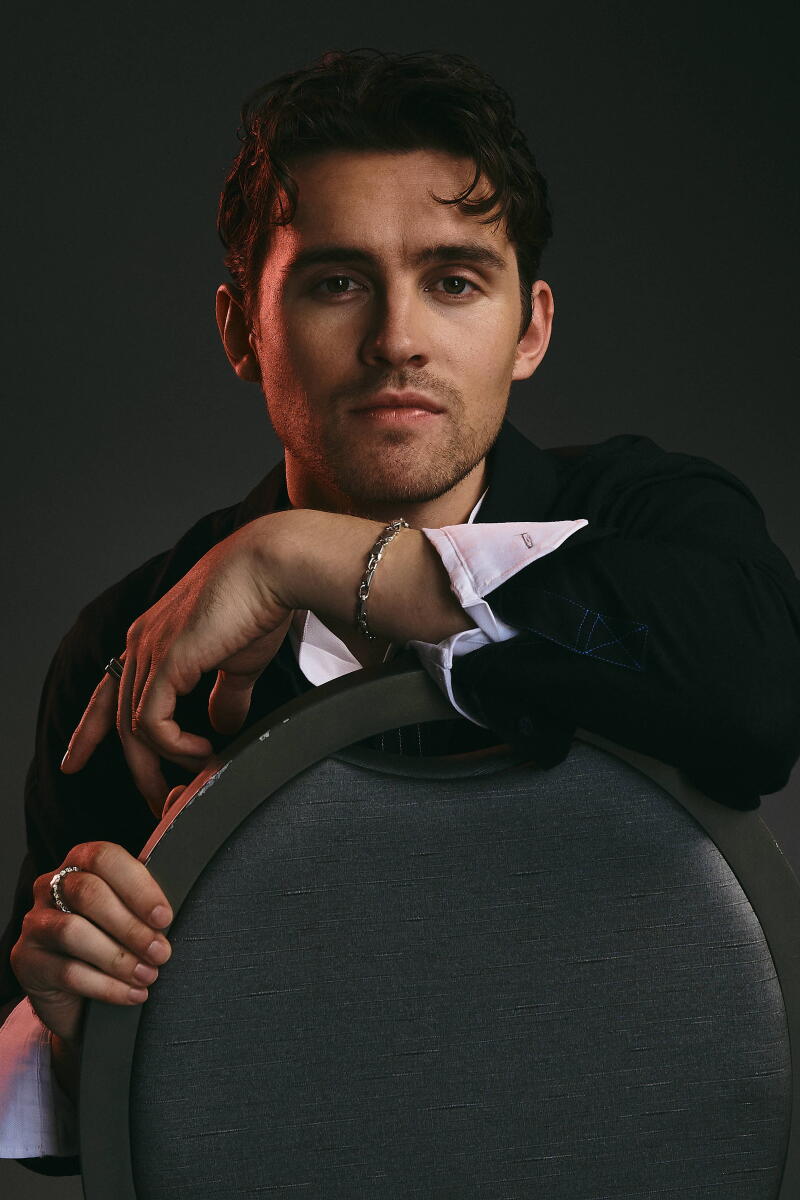
1. Michael Johnston. 2. Inde Navarrette. (Bexx Francois / For The Times)
“I knew they wanted a cookie-cutter version of the movie where Bear stands up and does the right thing and goes to the crystal shop and fixes it and they live happily ever after,” says Barker, 27, taking a swig from a can of Ghost Energy cherry limeade. “You know, the Hollywood version. And I was like, ‘I can’t do it. I just can’t.’” Johnston interjects: “Thank God you didn’t.”
So the last shot of the movie, I venture, would be a close-up of Nikki’s face and … “She’s still possessed,” Barker finishes the pitch. “Vomit. I’ll never do that. I’ll never compromise.”
Another change: Originally, “Obsession” ended with Nikki killing herself after Bear overdoses on pills. Bear’s death snapped Nikki back to reality. She saw the dead bodies of Bear and their friends Ian and Sarah and couldn’t handle what she had done while possessed. Again, Capstone suggested Barker at least shoot a version where Nikki survives. And again, Barker didn’t want to do it. But he decided to try one take and Navarrette burrowed into Nikki’s tragedy so convincingly that he had no choice but to go with it.
“You saved Nikki,” Barker tells Navarrette, who bursts out laughing at his declaration. She has a booming, infectious laugh. “And by Nikki surviving,” Barker continues, “there’s so much more to talk about. Now what does she do? What does her life look like versus her just ending things?”
Says Navarrette: “Having that ending solidifies what this story is, that none of this was Nikki’s fault. Yet she had to deal with it, which led to all those public conversations about her lack of autonomy. It’s the perfect ending. If she just died, what are we leaving the audience with? There’s nothing to think about.”
And the clever little twist of Bear taking the pills to kill himself and free Nikki only to change his mind and try to puke them up was Johnston’s idea, an addition that he begged Barker to try. They had just wrapped for the day. The lights were down. The camera had been taken away. And Johnston had the thought. “Dude, it’s too late,” Barker told him. “What is it?” Johnston took him aside, acted it out and Barker shook his head. “Oh, my God, that’s genius.” He called the crew back and they shot it.

Director Curry Barker.
(Bexx Francois / For The Times)
“I loved it for Bear, that here he is with the chance to do something that’s not redeeming, but at least moving in the morally right direction, and he still doesn’t do it,” Johnston says. “I thought it was a good button for the character.”
So what does become of Nikki after the credits roll? Barker made an offhand comment that his upcoming movie, “Anything But Ghosts,” would address the character’s fate. He grimaces when the subject is raised. “It’s really just an Easter egg,” he says. “I almost wish I didn’t say anything so that when it happened in the movie, people could be just like, ‘Whoa!’ Versus now they’re looking for it and people are probably going to be disappointed with how small it is.”
Does that mean you’re not in “Anything But Ghosts,” I ask Navarrette. “Not yet,” Johnston says, laughing, and of course she roars too. There’s still time for reshoots, he jokes.
But Navarrette still hasn’t shared her thoughts about Nikki’s destiny.
“Does the L.A. Times want the pretty answer or the non-pretty answer?” she replies, smiling. I tell her Nikki could be charged with a double homicide. “Yes!” she says. “I’ve seen some cool videos from lawyers saying how they’d defend her. But the non-pretty answer is that she starts to understand what the hell happened because, if you think about the story from Nikki’s perspective, it’s significantly more horrifying than what Bear went through. I think women are very resilient. She’s going to go on a journey and hopefully write a phenomenal book about it.”
“You know what would be absolutely insane, y’all?” Barker says — and then reels off an incredibly detailed outline about what might happen next that’s so ingenious, Johnston starts shouting, “Redact! Redact! Redact!” Barker says he has thought about a sequel. We’ll leave it at that for now.

Navarrette as Nikki and Johnston as Bear in “Obsession.”
(Focus Features)
As for why moviegoers became so obsessed with “Obsession,” Barker, who began his career directing horror and comedy shorts and posting them online, doesn’t have any deep thoughts. Young audiences, he believes, want to have fun at the movies and see something fresh. If they enjoy the ride, they’ll come back with their friends.
“Our generation went to the cinema and didn’t feel like they were being sold something,” Navarrette adds. “‘Obsession’ belongs to them. You saw conversations in parking lots, on social media. One person threw up in a theater. That’s something you’ll never forget.”
Two nights ago, Navarrette snuck into Halloween Horror Nights at Universal Studios, looking for the scare actor roaming around the park dressed as Nikki, covered in blood. Navarrette had seen her on social media and simply wanted to give her a high-five. But Halloween Horror Nikki wouldn’t break character. She looked at Navarrette and told her, “This is all seriously your fault, you motherf—.”
Barker went too, again just wanting to have a conversation. And the scare actor would not break.
“She was freaky,” Barker says. “She had the walk down. She could even walk backwards. She scared the s— out of me.”
Navarrette laughs. “Nikki belongs to everybody now. She’s no longer mine,” Navarrette says. “She’ll always be inside me though.”
“At least she’s not outside of you like she was in the movie,” Barker says.