Newsreaders in bitter row as ITV star Charlene White accuses BBC’s Jan Leeming of ‘disrespect’
22:06, 11 Aug 2026Updated 22:06, 11 Aug 2026
Charlene White has called out Jan Leeming(Image: Shutterstock)
Charlene White has hit back after veteran newsreader Jan Leeming described her presenting style as ‘condescending’, sparking a bizarre social media row.
Taking to Twitter earlier today, she penned: “Wish ITV’s Charlene would stop addressing us as if we were children. She has such a condescending style.
“Don’t know whether or not she is a an excellent journalist but don’t think she hacks it as a newsreader. It may look an easy job but not all are as good as @nightingaleitv [sic].”
Hitting back, Charlene quoted Jan’s tweet and added: “Very surprising to see a presenter I admired as a kid deciding to slate me on social media.
“In an industry where women, especially black women, have had to work incredibly hard to get ahead, this type of disrespect from a fellow female journo feels like s’thing from a bygone era.”
In response, the broadcaster added: “I said I didn’t know how good you are as a journalist but I find your delivery condescending. It has nothing to do with colour.
“Actually I believe it is far easier these days for BAME people to get ahead in all walks of life. It was only an opinion and my apologies to you.”
While the ITV panellist has yet to reply, many were quick to lash out at Jan’s post, branding her most recent comments ‘brain dead’.
“Double down Jan – this is a brain dead response. Assume you don’t have PR these days,” one said, as another agreed: “Jan you haven’t been a newsreader for 30yrs or more and styles have changed making this randomly b****y comment just makes you look bitter, very nasty.”
A commenter said: “OMG, Jan. No. Should have started with that “apology” and left it there rather than bury it under some truly questionable takes. Just a guess that @CharleneWhite is much more of an expert in the experiences of Black women in the industry than you. This is really disappointing.”
As an unimpressed fan added: “Actually I believe it is far easier these days for BAME people to get ahead in all walks of life.” Looooooooooooooool? [sic].”
Charlene has been a staple of our screens for decades, and began her broadcast career at BBC, with stints at BBC News, Look East and 5Live. In 2008, she made the move to ITN and worked at ITV News and GMTV.
In April 2014, she became the first Black woman to present ITV News At Ten, and went on to become a regular on Loose Women, following Andrea McLean’s exit.
She previously spoke to the Mirror about how important it is to champion diversity in society, and particularly at work.
“I talk a lot about diversity because I believe, working in broadcasting and the media, what happens in front of the camera and behind the camera should reflect society,” she told us.
“All views matter, all opinions matter. That’s the only way the industry can survive.”
The Civil Aviation Authority today said ‘more awareness’ was needed as travellers ‘not aware’
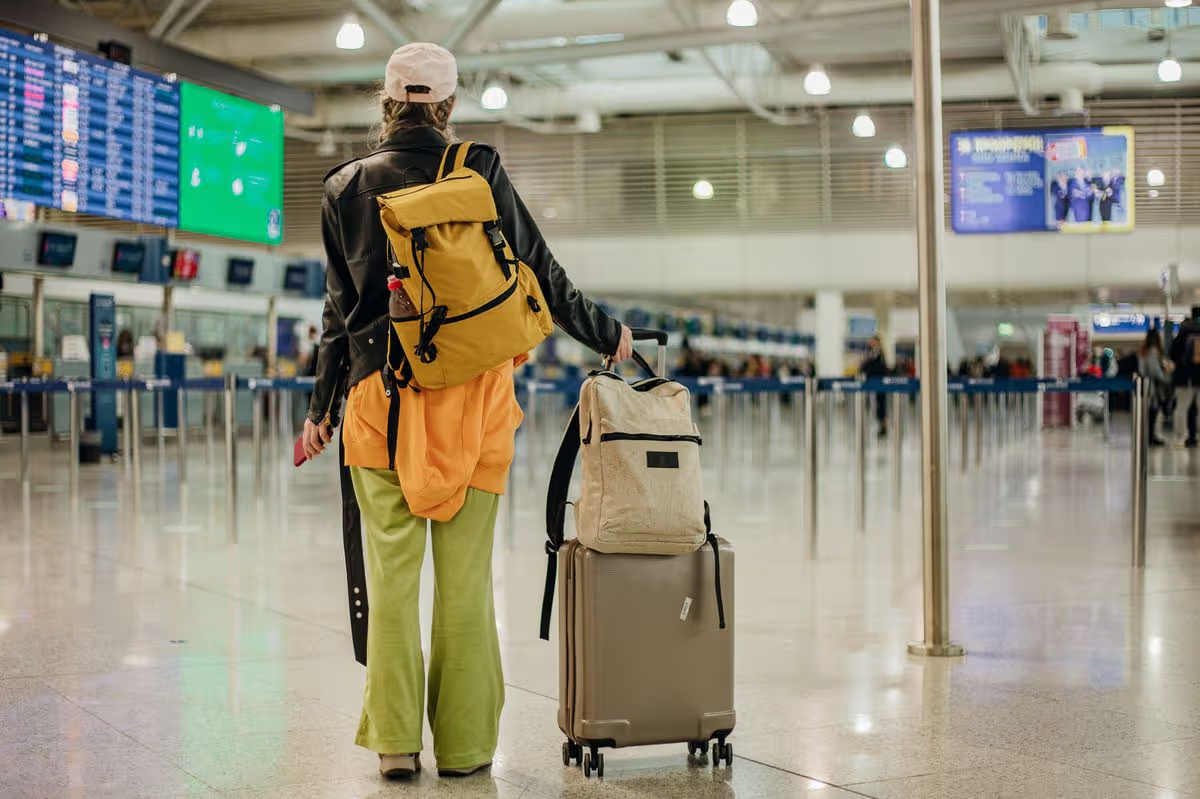
The Civil Aviation Authority said portable chargers carry ‘serious risks’ of overheating or catching fire in luggage(Image: Getty)
Airlines have banned very common electrical items from flights – as news emerged of a surge in problems on flights caused by the items. Some carriers have begun to completely ban power banks that people use to charge their phones and tablets due to safety concerns. Generally, power banks are only permitted in carry-on, not checked luggage, amid fears they could explode and catch fire mid-flight.
The Civil Aviation Authority (CAA) today said ‘more awareness’ was needed as portable chargers carry ‘serious risks’ of overheating or catching fire. Jonathan Nicholson from the CAA told BBC News that restrictions such as not putting the devices in checked luggage were not “somebody being pedantic” or “for the sake of it”, with passengers urged “to do the right thing”.
Concerns are rising that people are ignoring the bans and simply taking the devices on board. Power banks have become popular because they offer essential, portable, and fast-charging power for smartphones and other devices while on the move, easing battery anxiety. They are affordable, compact, and versatile, enabling users to remain connected without needing a wall outlet, making them perfect for travel.
It comes after a UK-bound easyJet flight was diverted to Rome last week because a passenger had packed a charging power bank in hold luggage. The airline said the captain had decided to divert “in line with safety regulations” after a passenger informed crew during the flight that the portable charger was in the hold of the aircraft. Many airlines have toughened rules on power banks, often requiring that they be stored in hand luggage because of the risk of lithium-ion batteries catching fire.
The flight touched down safely at Rome Fiumicino and was rescheduled to the next day. A survey by the CAA of 1,000 UK passengers in November 2025 suggested more than a third know what lithium batteries are and are aware rules exist, but are unsure what the rules involve. Over-55s typically knew the rules better.
Mr Nicholson said the “basic set of international rules” all passengers must follow on power banks are:
Take them with you on board the aircraft, not in checked luggage
A maximum of two power banks per passenger
When on board the aircraft, don’t use them and “absolutely do not charge the power bank itself because that’s when they become really hot and most susceptible to having an issue”
Mr Nicholson said incidents involving power banks were “certainly on the rise” as portable chargers grow in popularity, alongside vapes which are not allowed in checked luggage either.
Vietnam Airlines, Vietjet Air and now Emirates have banned the batteries. Emirates states, like many airlines, the devices cannot be used during flight. In certain circumstances, they will be permitted on planes provided they are switched off and stored under your seat – not in the overhead cabin – with these rules coming into effect in October.
According to UK Civil Aviation Authority (CAA) safety experts, lithium batteries pose a danger on planes primarily because of their potential to enter “thermal runaway,” a phenomenon where a battery undergoes a rapid, uncontrollable rise in temperature, leading to fire, explosion, and the release of toxic fumes. Ryanair, easyJet and TUI all have regulations in place concerning power banks, batteries and electrical devices.
Ryanair
You may carry up to 15 personal electronic devices (this includes but not limited to: smartphones, tablets, laptops, cameras, handheld game consoles, headphones, power banks). Spare lithium batteries (including power banks) must be individually protected to prevent short circuits by placement in the original retail packaging or by otherwise insulating terminals by taping over exposed terminals or placing each battery in a separate plastic bag or protective pouch and carried in carry-on luggage only.
You may also carry up to 20 spare lithium batteries, provided they do not exceed 100Wh each.
Spare lithium batteries including power banks brought into the cabin should not be used to charge or power other portable electronic devices during taxi, take-off, or landing, not exceed 100Wh. They should not be placed in the cabin baggage loaded in the overhead storage locker. Be placed in cabin baggage under the seat in front, or on your person. Devices or batteries over 100Wh are not permitted in the cabin or the hold with the exception of Electric Wheelchair batteries.
Spare batteries, including power banks are not permitted in checked baggage.
EasyJet strictly requires all lithium-ion batteries, spare batteries, and power banks to be carried in cabin hand luggage only, prohibited in hold luggage due to fire risks. Power banks under 100Wh (roughly 27,000mAh) are allowed without approval; items between 100-160Wh require airline approval. Batteries contained in portable electronic devices should be carried as carry-on baggage.
Should these items be packed in checked baggage, steps must be taken to prevent accidental activation and to safeguard the devices against damage; all devices must be completely switched off (not in sleep or hibernation mode). EasyJet imposes a limit of 15 portable electronic devices per passenger. Portable electronic devices containing non-spillable batteries must not exceed 12V or 100Wh, and passengers may carry no more than 2 spare batteries.
Where Smart Baggage is being brought into the cabin, the customer must be able to easily disconnect and remove the lithium battery / power bank, but it can remain in the bag. Smart baggage must not be accepted for travel if the lithium battery / power bank cannot be readily disconnected and removed by the customer. If smart luggage is to be checked in and placed in the hold, the lithium battery/power bank must be disconnected from the smart luggage at Bag Drop and taken into the cabin. Any exposed terminals should be protected from short circuit. The lithium battery/power bank needs to be disconnected, so if you are unable to remove it from your luggage, we won’t be able to accept the bag on board.
TUI’s regulations forbid passengers from carrying loose lithium batteries, power banks, or spare batteries in checked-in luggage. These items must be kept in hand luggage only. Power banks must generally not exceed 100Wh, and terminals must be shielded from short circuits. Devices should not be recharged while on board. Dry AA(A) batteries (type Alkaline, NiMh, NiC) for small personal items such as a pocket torch or a radio are permitted, provided they are inside the device or enclosed in sturdy packaging.
Where devices are stored in hold baggage, precautions must be taken to safeguard the device from damage and to prevent accidental activation; the device must also be completely switched off (not in sleep or hibernation mode). Loose batteries and power banks should be individually protected against short circuits by storing them in their original packaging, with terminals taped or placed in a plastic bag in hand luggage.
Airline permission is always required for medical devices. For further details, see section Baggage – Medical baggage. TUI fly requires all power banks to be carried in hand luggage, never in checked baggage. They must be packed to prevent short circuits (original packaging or taped terminals). Generally, capacity is limited to 100 Watt-hours (Wh) per battery, with power banks not permitted to be used for charging devices or recharged onboard.
Hand Luggage Only: Due to fire risk, all lithium-powered battery packs must be in the cabin. Capacity Limits: Power banks up to 100 Wh (roughly 27,000 mAh at 3.7V) are generally permitted.
Safety Requirements: Terminals must be protected against short circuits, such as by taping them or keeping them in individual plastic bags.
In-flight Usage: Power banks cannot be used to charge phones or laptops during flight, nor should they be recharged using aircraft power outlets.
Storage: Keep them in your seat pocket or under your seat, not in overhead bins
The airport is expected to welcome passenger flights again in 2028
13:24, 18 May 2026Updated 13:25, 18 May 2026
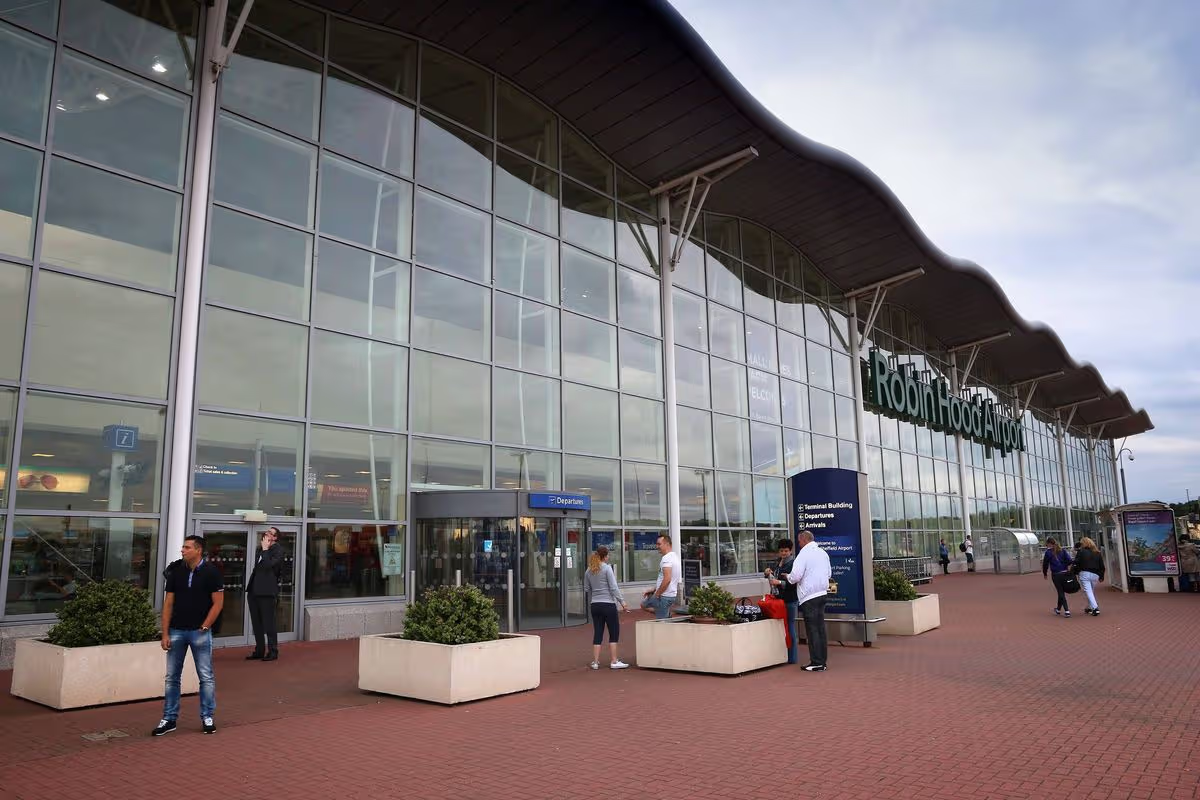
The airport was once a key regional flight hub known as Robin Hood Airport(Image: tupungato via Getty Images)
A UK airport that shut down three-and-a-half years ago is set to reopen following the resolution of a funding dispute this week. Doncaster Sheffield Airport (DSA) near Finningley in Doncaster was once a key regional flight hub known as Robin Hood Airport, operating from 2005 with flights to holiday destinations including Alicante, Majorca, Paris, and various other locations.
However, the airport was compelled to close in 2022 after its owners, Peel Group, declared it financially “unviable”. The closure left South Yorkshire without an international airport.
Yet, in September 2025, the South Yorkshire Mayoral Combined Authority (SYMCA) officially approved a £160million funding package based on previous commitments to reopen the airport as DSA in a significant boost for the region. Its resurrection followed campaigning by residents and local politicians, and received backing from the British Government.
Nevertheless, the scheme had been thrown into doubt in recent weeks during a deadlock over a £57million loan from Doncaster City Council to support the reopening plans, after Reform UK councillors expressed concerns about whether taxpayers would receive a return on investment.
The airport scheme was championed by the local authority’s Labour mayor, Ros Jones, who is believed to have been re-elected by a narrow margin largely owing to her commitment to delivering the potentially transformational scheme, despite a surge in support for Reform.
The structure of local Government in Doncaster means she retains executive authority as Mayor despite Reform securing a majority on the council at the last election, and now controlling the budget.
Nigel Farage’s party originally backed the airport scheme, but in April indicated they would contemplate voting to withdraw approval, as they requested additional details about how the funds would be allocated and benefit local people, reports the Express.
At the end of last month, Mr Farage attacked the terms of the lease agreement being negotiated with the current site owners, The Peel Group, arguing the council needed to secure the freehold to prevent it becoming a “massive drain” on taxpayers.
Ms Jones told the BBC News at the time: “Last week Reform said DSA should be privately funded and today they’re saying it should be acquired by the council or government, even if that means through a compulsory purchase order (CPO).
“It is important to remember we offered to buy the freehold back in 2022 and Peel refused, the offer of a lease effectively killed off any chance of a successful CPO.”
She added that a CPO application could take between five to seven years with minimal chance of succeeding. The standoff sparked concerns that the scheme would have to be scrapped, despite significant progress in attempts to prepare it for commercial air traffic once more.
However, at an extraordinary meeting of the council last week, Reform dropped its opposition to the loan on the condition that they are able to review copies of the new lease before it is approved, according to ITV News.
Ms Jones said she was “delighted to see Reform’s done the U-turn”, dismissing the threat from the hard-right party as a “political stunt”.
Freight services at the flight hub could get under way as early as next year, with passenger flights expected to launch in 2028, according to reports.
FlyDoncaster, a council-owned company established to reopen and run the airport, has teamed up with German operator Munich Airport International (MAI) on the venture.
In an update last month regarding preparatory work at the site, Christian Foster, Director of council-owned operator FlyDoncaster, said: “Over recent months we’ve been building the right team to take on this task. That has included individuals with experience at major airports such as Manchester, Gatwick and East Midlands, taking up roles like Head of Security, Head of Airfield Operations and Head of Health & Fire Safety.
“We’re also going through a critical Airspace Change Process, a regulatory hurdle that means we’ll have our own area of airspace around the airport to manage. This is critical to our plans.
“We’re due to hear the result of stages one and two imminently, and we’ll be asking the public for their views in the summer, with a view to being re-certified in spring 2027.”
He says preparations for reopening and welcoming passengers back have been well underway, which has involved acquiring “vital equipment such as a new radar and fire appliances, completely refurbishing the fire station and control tower, and making plans for renovating the terminal building”.
The terminal building is set for a “full makeover, giving passengers somewhere that feels really special at the start of their holidays”, alongside improvements to the site’s infrastructure “to make this one of the most accessible airports in the UK for those with a disability”.
On top of this, talks are ongoing with airlines and partner organisations.
Mr Foster says the airport is already equipped to handle hundreds of thousands of tonnes of freight, and is also in dialogue with firms at the forefront of aviation innovation – including sky taxis, vertiports, and alternative fuel technologies – about how these could be incorporated into the site.