Saudi Arabia says it intercepted missiles targeting Riyadh and Dhahran, with falling debris injuring at least four people, and damaging homes in the capital. Meanwhile, Yemen’s Saudi-backed government says its offensive to retake Houthi-held territory is advancing.
Movie stars are an endangered species. They still exist, sure. Their beautiful faces still fill 50-foot screens, beaming down on us. Yet, there is a shortage of, say, Michael Douglas. A man who, over the span of decades, played an American president, a troubled detective, and a Wall Street tycoon so convincingly that the FBI recruited the actor to do a PSA for investment bankers about the perils of financial fraud.
On the Shelf
One Helluva Ride
By Michael Douglas Grand Central Publishing: 496 pages, $35
If you buy books linked on our site, The Times may earn a commission from Bookshop.org, whose fees support independent bookstores.
The night before I meet Michael Douglas on Zoom, I have a hard time sleeping. I want to be well-rested before I meet the leading man — perhaps one of the last leading men from an era in Hollywood that felt limitless. What do I mean by that? He’ll tell you. His new memoir details his movie-making career as a prolific producer and actor, along with his affair with his “Romancing the Stone” co-star Kathleen Turner, mudslides in Mexico, snorting cocaine with O.J. Simpson, encounters with Princess Diana and screaming matches with Paul Verhoeven that end in blood. In short: the life of a movie star.
“People say to me: Michael Douglas. When I see your name, I don’t know what I’m going to get, but I know it’s going to be good,” Michael Douglas says.
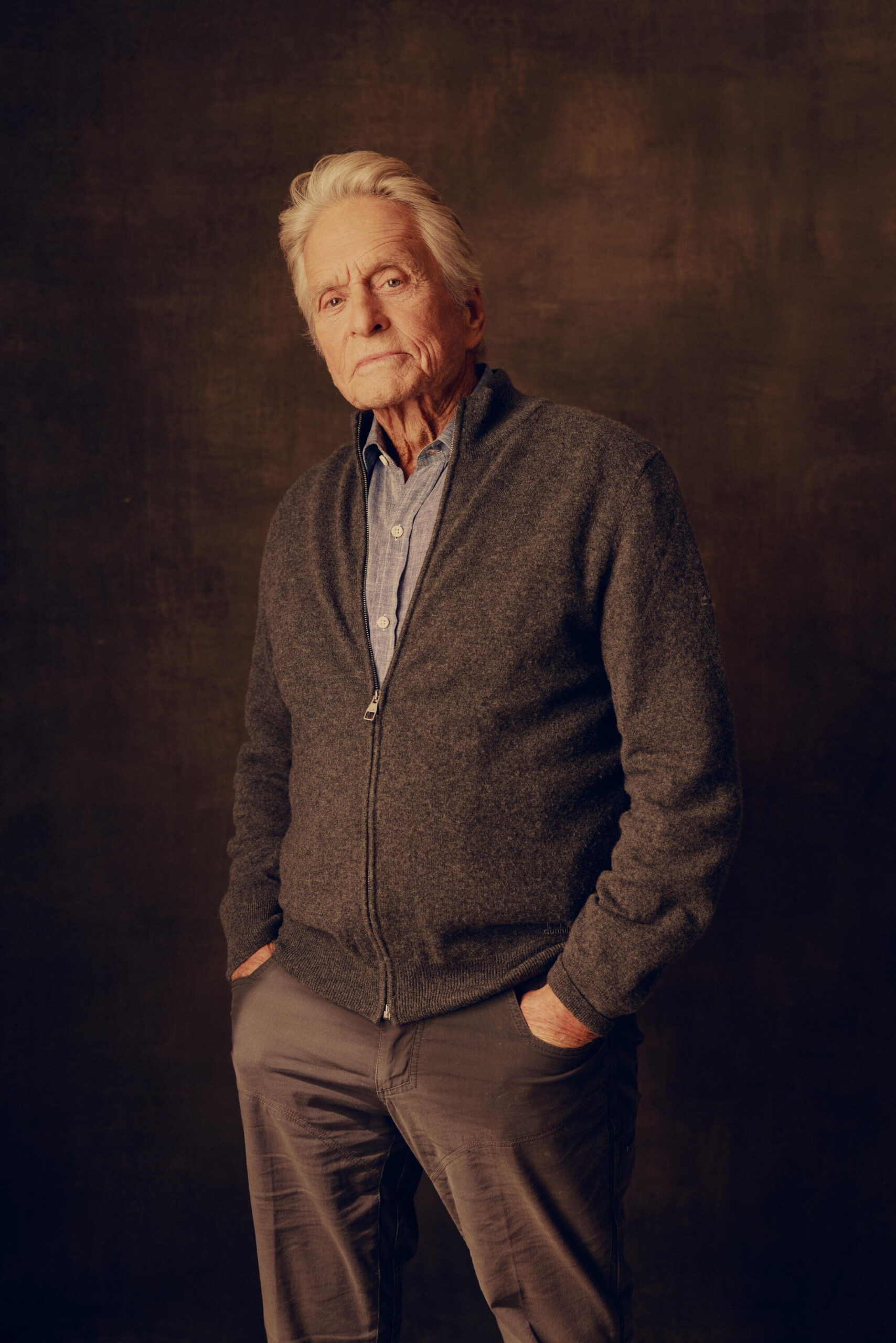
(David Urbanke / For The Times)
Halfway through our conversation, something unanticipated happens: Douglas reveals that he doesn’t quite see himself as a movie star. After gentle pushback, he elaborates. Instead, Douglas sees himself as a chameleon.
“People say to me: Michael Douglas. When I see your name, I don’t know what I’m going to get, but I know it’s going to be good,” he says.
He’s speaking from his home in New York. Behind him is a moody 18th-century Orientalist painting, its scene too indistinct for me to make out. His smiling face — which, like most American moviegoers, I had watched 50 feet tall in the dark — glows with warmth even on my laptop screen. It seems abnormal even to witness him in miniature.
To be clear: Michael Douglas is a movie star, whether or not he wants to cop to it over Zoom. It’s in his blood. His father, Kirk Douglas — born Issur Danielovitch to Russian Jewish immigrant parents — was a legendary actor whose shadow Douglas struggled to escape, as he details in the early chapters of his memoir. He spent his childhood on movie sets, watching his father spar with iconic directors like Stanley Kubrick. Michael Douglas was subject to violent and angry outbursts as well. “Dad’s volatility kept us on edge,” he writes. He felt suffocated by his father’s legacy, often hoping to shake the title of “Kirk Douglas’ son.”
Early in his career, Douglas left his starring role on TV’s “The Streets of San Francisco” after producing his first film, “One Flew Over the Cuckoo’s Nest,” which became a breakout success. On that film, he had to deliver the shattering news to his father that he was too old to play the lead — essentially, firing his father from his dream role. It was a betrayal. Instead, the role went to Jack Nicholson, who would later win an Academy Award for his humanizing portrayal of Randle McMurphy. The film won multiple Academy Awards, launching Douglas’ career as a heavyweight producer and later an actor. Escaping the shadow of being Kirk Douglas’ son has been a lifelong battle for the actor.
(Grand Central Publishing)
Occasionally, inheritance can be a burden. In his own life, Douglas details how he was a distracted father and husband who lost sight of his son, Cameron Douglas. During Cameron’s childhood, Douglas was elsewhere — on location in the Mexican jungle in “Romancing the Stone,” then a disastrous film production in Morocco for “Jewel of the Nile” that included a fatal plane crash that resulted in three crew members’ deaths. To cope with the breakneck pace of show business, Douglas sought refuge in women, cocaine and work.
Cameron’s troubled youth reached a crescendo when he was sentenced to five years in federal prison for drug smuggling, with an additional sentence for drug possession in prison — serving seven years in the end. It was enormously painful for Douglas, who also struggled with addiction, and had sought out treatment to provide an example to his son.
In a late chapter, he recalls confiding in Rob Reiner, who also had a son who struggled with addiction issues. In the memoir, Douglas addresses the killing of Rob and Michelle Reiner in December 2025; their son Nick has been charged with murder. “We both had sons with serious drug issues and we both, at times, had been at the end of our rope,” Douglas writes. “It was a heartbreaking confessional for us, but I know we gave each other some measure of comfort during the hard times.”
Why trudge through movie history, turning over every stone and every wound, in a nearly 500-page memoir? Because, according to Douglas, it’s time.
“Your 80s may be a good time to share,” the actor says, who recently turned 82. “People interested in movies, we give them a certain insight into the process, and maybe they could learn something. For others, it’s just gossip.” His battle with Stage 4 oral cancer brought the contours of his life into stark relief, sharpened by seven weeks of radiation and chemotherapy. His official diagnosis was tongue cancer, but he told the public he had throat cancer, hoping to stall speculation in the press about the possibility of disfigurement — and, more specifically, the prospect of losing his tongue. It was isolating, and Shane Salerno — the memoir’s co-author — stayed by Douglas’ side.
Michael Douglas.
(David Urbanke / For The Times)
As much as Douglas’ memoir, “One Helluva Ride,” is a revealing and delightful account of a life in show business, it is also a love letter to California — a place where Douglas spent much of his adult life, beginning at UC Santa Barbara. The college travel brochure read: campus by the sea. “I remember the cover of it was a guy walking down the beach with a surfboard, two girls in two-piece bathing suits. In 1963, I never saw a two-piece bathing suit back east.” He was sold.
The California years made an impression. Douglas is still, at heart, a hippie. Raised in stiff East Coast prep culture, he was reborn in the California sunshine. “I transferred into becoming a hippie, influenced by the Maharishi Mahesh Yogi, hallucinatory drugs, and the world that existed in the early ‘60s in San Francisco.”
Strangely, Douglas argued that some of the utopic sentiments of the 1960s are returning. “People are beginning to look back at that time, and realize how important family is — cooperation, sharing,” he says. “Socialism is not a four-letter word or something that’s terrible. There are other things to pursue in life other than just making money.”
“Your 80s may be a good time to share,” Michael Douglas says.
(David Urbanke / For The Times)
Like the characters he portrayed, Douglas is far from perfect. He admits that he struggled — in his first marriage, and later as a father. After marrying Diandra Luker, Douglas was unfaithful, having relationships with co-stars, most notably Turner on the set of “Romancing the Stone” in the Mexican jungle. The two denied the relationship for years. Now, with Turner’s blessing, Douglas writes about their involvement in his memoir.
Before Turner, there was Diane Thomas, the film’s waitress-turned-screenwriter, with whom Douglas had an affair. Thomas’ life was tragically cut short in a car accident involving a Porsche that Douglas had gifted her.
Then there were the rumors. On the set of “Basic Instinct,” some speculated that Douglas and Sharon Stone were having an affair. They weren’t, he explains. Douglas was instead locked in a power struggle with director Verhoeven, who, during one particularly heated argument with the actor, suffered a burst artery in his nose, turning the confrontation into a bloody scene. Douglas, meanwhile, was involved with another co-star, Jeanne Tripplehorn. “They were so focused on a possible relationship between Sharon and me, they missed the real relationship happening between me and Jeanne,” he writes.
When he and his current wife, actor Catherine Zeta-Jones, made it official, Douglas went to the other room to make breakup calls to five other women. (By this point in the memoir, Douglas has enough goodwill to pass this off as charming.) “From the moment I met Catherine, and we formed our family, I was a new man,” he writes.
The memoir enshrines Douglas’ petty show-business grievances too: a repaired grudge against David Letterman, a TV co-star who stole his longtime girlfriend, and a bouquet sent to Julia Roberts to apologize for his drunken buffoonery. In Douglas’ words: “There’s two or three people that I share my hostilities with.” He clashed with Brian De Palma, who was originally attached to direct “Fatal Attraction” and tried to have Douglas fired. De Palma underestimated Douglas and was replaced by Adrian Lyne. Years later, De Palma apologized, but Douglas rejected it.
It is impossible to tell the story of Douglas’ career without the women he encountered. The films he championed helped establish a new type of female lead — in all their powerful, morally ambiguous and deranged glory. “An actress was not allowed to play a villain,” he says. In “One Flew Over the Cuckoo’s Nest,” the actor struggled to cast Nurse Ratched. “A whole number of leading actresses turned that part down until we found Louise Fletcher, who went on to win an Oscar.”
For Glenn Close, Sharon Stone and Kathleen Turner, acting opposite Michael Douglas was transformative. After her role as a murderous, sex-crazed bisexual in “Basic Instinct,” Stone became one of the biggest stars of the 1990s and earned an Oscar nomination for Martin Scorsese’s “Casino.” Close‘s portrayal of the mistress-turned-lovesick psychopath in “Fatal Attraction” earned the actor her first lead Oscar nomination after three supporting nods. Turner went from being primarily known as the sexy femme fatale of “Body Heat” to a Golden Globe-winning star with box-office clout after her collaboration with Douglas. Sure, she sued him, too, but their friendship survived.
However, it wasn’t until his role as Gordon Gekko, the fast-talking, impulsive tycoon in 1987’s “Wall Street,” that Douglas was in full force, winning an Academy Award for lead actor. Directed by Vietnam veteran Oliver Stone, Douglas delivered an unforgettable performance about the dangers of unchecked capitalism and greed. At an early New York screening, Douglas recalls Wall Street traders being stunned by the film’s stinging accuracy. “A lot of the Wall Street characters were there, very cocky at the time; they all were shocked because we caught them.”
To his surprise, Wall Street financiers approached him on the street to praise Gekko — anointing him as their hero. “I said, ‘I was the villain.’ ‘No, no, no,’” he said. “So it showed me a lot.”
It speaks to Douglas’ gifts as an actor that he could transcend the caricature of white male entitlement he portrayed with such precision. In “Falling Down,” filmed during the 1992 uprising triggered by the Rodney King verdict, Douglas plays an unemployed defense worker, a man so consumed by disillusionment and blinded by his own sense of victimhood that he cannot recognize the harm he inflicts on others. The character would prove eerily prescient, anticipating an archetype that would take shape in the decades to come. An entire generation mistaking the actor’s brilliance as an invitation.
Perhaps that is the strange thing about being a movie star: Audiences decide who you are, and what you mean to them. For a chameleon, an actor who spent a lifetime resisting other people’s definitions of him, that might be the ultimate paradox.
As our conversation winds down, I remind him of his immense contributions to filmmaking, through producing and acting. It seems redundant, but I say it anyway. His response is polite.
“Quirky,” he said. “‘Falling Down,’ ‘The War of the Roses’ — I love those quirky films.”
“I’m proud of my movies,” he says. “I’m very proud of my movies.”
Connors is a culture journalist in L.A. She covers books, food, entertainment and offbeat Los Angeles. She’s currently at work on a book of essays about tourism in all its forms.
The newbies have a lot of work to do: The Lakers lost 50.8% of their points, 55.7% of their rebounds and 47% of their assists from last year. As coach JJ Redick acknowledged during his preseason press conference alongside Rob Pelinka, “There’s a lot of minutes … up for grabs.”
All things Lakers, all the time.
Get all the Lakers news you need in Thuc Nhi Nguyen’s weekly newsletter.
By continuing, you agree to our Terms of Service, which include arbitration and a class action waiver. You agree that we and our third-party vendors may collect and use your information, including through cookies, pixels and similar technologies, for the purposes set forth in our Privacy Policy such as personalizing your experience and ads.
We know three of the starters. We start with the biggest question mark in that rotation:
Position battle we’re watching most this preseason
Austin Reaves has tormented the NBA with his crafty finishes in the lane and step-back threes. In many of his new Lakers’ teammates, he has found equally frustrating counterparts, defenders that twist him into knots like he does to them.
It’s the best — and most important — problem for the Lakers to have. The Lakers’ deep group of perimeter defenders have the most to prove and could be the biggest X-factor in the season’s success.
The wing group felt so unsettled late into the offseason that the Lakers were among the final teams willing to wait out the Jonathan Kuminga sweepstakes. The 6-foot-7 forward did not make his decision until Aug. 26, spurning the Lakers for the Minnesota Timberwolves.
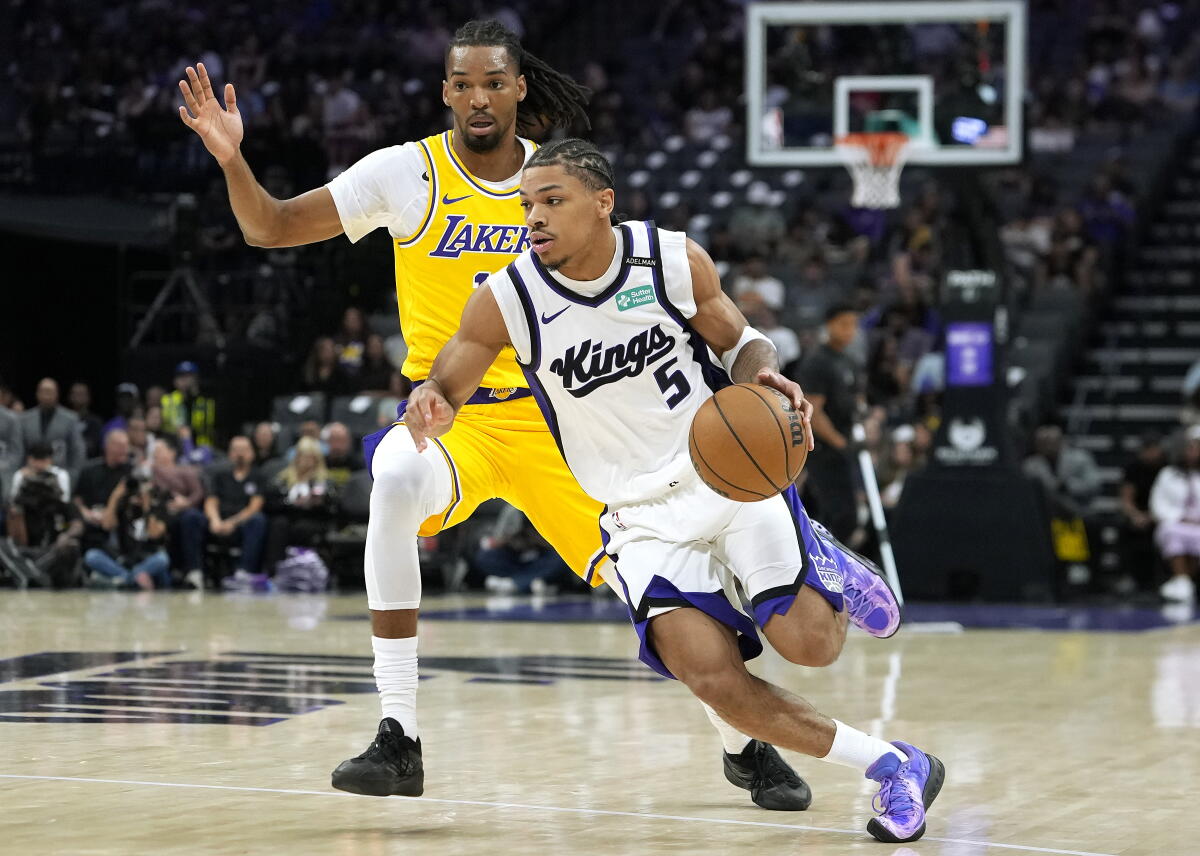
The Kings’ Darius Acuff Jr. dribbles under pressure from Laker Ziaire Williams during a preseason game in Sacramento on Monday.
(Thearon W. Henderson / Getty Images)
The only other offseason bandaids the Lakers could acquire were Williams and Thybulle. After signing minimum contracts, they were both in the starting lineup for the Lakers’ preseason opener Monday.
Williams, the 6-foot-9 forward from Sierra Canyon High, is relishing the chance to play for his hometown team. The former top-10 pick is on his third NBA team in six seasons, never finding solid footing with Memphis or Brooklyn. He is coming off a career-high 10.3 points per game for the tanking Nets. The expectations will be drastically different with the Lakers and the Lancaster native is ready to meet them.
“There’s not really anything I’m not comfortable with,” said Williams, who reported he currently weighs 215 pounds, up 30 from his previously listed weight with Brooklyn. “If it’s a smaller guy bringing the ball up, I pick up 94 [feet]. If it’s a bigger wing who likes to play off a live dribble and jab step, being more physical off the ball.”
Thybulle is listed at 6-foot-5, but renowned for a nearly 7-foot wingspan. Not only does he torment opponents with his length, his defensive anticipation is “top-tier,” Reaves gushed.
The Washington alumnus was a two-time second-team all-defensive honoree with the Philadelphia 76ers. The hope has always been that his three-point shot could match that defensive talent.
Thybulle is a 34.9% three-point shooter, averaging only 2.6 attempts per game during his career, although his attempts increased in Portland. Thybulle and Williams (32.2% on threes in his career, four attempts per game) are consistently shooting threes after every practice. Williams made all three of three-point attempts in Monday’s preseason game while Thybulle made two of four.
Lakers forward Sandro Mamukelashvili drives to the basket in front of Kings guard Daeqwon Plowden during a preseason game in Sacramento on Monday.
(Sara Nevis / Ap Photo/sara Nevis)
“For me personally, at this point, [it’s about] having the confidence in my shot to know that when it comes, I’m ready for it, as opposed to just hoping for the best,” Thybulle said. “I think it goes a long way as well.”
Mamukelashvili offers three-point shooting that stretches the floor. Redick described the 6-foot-9 forward as “an offensive connector” who can revive seemingly dead plays with a simple pass or a cut. After shooting 38.9% from three last season (115-of-296) with Toronto, he’s a potential starter at power forward, but the defensive matchups could be different when he and Walker Kessler share the floor compared to one of the other perimeter-oriented wings pairing with Kessler.
Young wing players including Adou Thiero and Cameron Carr have also impressed coaches and teammates with their athleticism and eagerness to learn. Reaves affectionately hailed Thiero, who was Reaves’ primary matchup during offseason pickup games, as a “freak of nature” and “one of the best athletes in the league.” That talent was obvious during his injury-plagued rookie season when Thiero scored his first NBA basket on a high-flying dunk last November.
Redick said Thiero’s development in the summer has been “unbelieveable.” The most critical part has been his health, said Thiero, who battled nagging injuries to both knees last season.
Between the veterans trying to prove themselves and the young players hoping to make an impact, the Lakers could go six or seven deep at the wing, Redick said. Depth is a critical ingredient of this era of the NBA. The Lakers are confident in theirs.
“We got some dogs on this team,” Williams said. “Everyone plays one through four. All the wings are great. There’s no slack; you see four or five wings out there playing hard, everybody else has to pick it up a notch.”
Position we should watch this preseason
Lakers center Kevon Looney drives to the basket under pressure from Kings Dylan Cardwell and Nique Clifford during a preseason game in Sacramento on Monday.
(Thearon W. Henderson / Getty Images)
There is no reason to panic about Kessler’s preseason absence. He jammed his left pinky finger on the backboard in practice last week and Redick said Kessler is “day-to-day.”
But the sight of the star center on the sideline is still an unnerving way to start preseason games, especially after the Lakers invested so much to get Kessler. The 7-foot-2 center, who cost the Lakers four first-round draft picks and a four-year, $130-million contract, is supposed to be a lynchpin of their defense. Without him, the Lakers’ entire plan could fall apart.
The only true center the Lakers have behind Kessler — who only played in five games last year because of a shoulder injury — is Kevon Looney. The former UCLA star started in Kessler’s place Monday, playing 18 minutes with nine rebounds, three assists and two points. Mamukelashvili, a power forward, can also rotate to center.
The Lakers have so much riding on the center position this year. Their backup options don’t feel strong enough to bear the weight of a possible Kessler injury. But Redick said the team’s wing players could shoulder some of that burden.
“Loon, Mamu, those guys, they’re not going to be Kessler,” Redick said. “Mamu is versatile enough that he can do different things, whether that’s a hedge or a switch or a drop, and we’ll figure out what works best for this team with that when we’re in man. Then with Loon, I think he’s smart enough and savvy enough that he can get the job done. But again, none of that matters if we’re not guarding the basketball.”
Looney, 30, is the unexpected veteran on a team of 20-somethings. Redick used the three-time champion’s experience with the Warriors for inspiration on the first day of practice, saying Looney faced plenty of adversity during those years. The Warriors fell behind in multiple series and still clawed back to win, Redick said. The Lakers expect Looney to stablize the team during the inevitable rocky periods of the season.
“What a great vet,” Kessler said. “He’s done it before. He knows what it takes to win a championship on and off the court.”
On tap
Tuesday at Warriors, 7 p.m. PDT
The Lakers open the preseason with a road back-to-back. Expect that while the Lakers have no pressing injury concerns, most of the key players will be on an early load management schedule.
Thursday vs. Kings, 7:30 p.m. PDT
The Lakers’ third game in four days – a workload that should be banned in the preseason – will be the debut of Lakers public address announcer Derrin Horton. The former KTLA broadcaster will take over for franchise legend Lawrence Tanter, who died last week at 76. Tanter retired from his game day role in June after 43 iconic years as the “Voice of the Lakers.”
Favorite thing I ate this week
From Broken Spanish Comedor, the ceviche (left) and the camote, a coal-roasted Japanese sweet potato served with pork rinds.
(Thuc Nhi Nguyen / Los Angeles Times)
I’d been reading great things about Broken Spanish Comedor, and after finally trying the new Culver City restaurant, I’m surprised to report that my favorite dish from a modern Mexican restaurant was a Japanese sweet potato. The camote was an ideal combination of textures thanks to the creamy coal roasted sweet potato and crunchy pork rinds and sweet, smokey and spicey flavors. We also ordered the ceviche, which came with a deserved heat warning, and the chicharron. The server insisted we get the hand-pressed tortillas and who’s saying no?
All things Lakers, all the time.
Get all the Lakers news you need in Thuc Nhi Nguyen’s weekly newsletter.
By continuing, you agree to our Terms of Service, which include arbitration and a class action waiver. You agree that we and our third-party vendors may collect and use your information, including through cookies, pixels and similar technologies, for the purposes set forth in our Privacy Policy such as personalizing your experience and ads.
WASHINGTON — California is sometimes described as the ATM of Democratic politics.
That’s certainly been the case in the most divisive Democratic races this year.
Donors from California have given more to far-left candidates and their moderate opponents in congressional races and U.S. Senate contests than donors from any other state — more than $17 million combined, according to a Times analysis of the most recently available campaign finance filings.
More of that money — nearly $11 million — went to more progressive candidates. That giving came from more than 95,000 individual donors, which was more than double the number of California donors who gave to their more moderate opponents. That includes 18,000 donors who gave to both progressive and moderate candidates.
There was a geographic divide in giving by Californians. The largest share of cash to progressive candidates came from donors in the Bay Area, while the largest share of financial backing to moderate candidates came from donors in the Los Angeles area.
The Times looked at competitive races outside California in which one of the candidates had been endorsed by either the Justice Democrats or the Democratic Socialists of America, or DSA, as well as key Senate races in Michigan, Minnesota, Florida and Maine that featured a stark ideological divide between top Democratic contenders.
Although these races represent a small fraction of the electoral contests across the country, they were the races in which the future ideological direction of the Democratic Party was most fiercely contested.
Progressive candidates fared better in the majority of these contests.
California donors helped fund the Senate primary victories of progressives Abdul El-Sayed in Michigan and Peggy Flanagan in Minnesota — second only to in-state donors in providing cash to each of those candidates.
Progressive House candidates such as Melat Kiros in Colorado and Darializa Avila Chevalier in New York were able to defeat more moderate incumbents with heavy support from California donors.
Their efforts weren’t always successful, however.
Former Rep. Cori Bush raked in more cash from California donors than in-state supporters in her bid to unseat incumbent Rep. Wesley Bell in Missouri’s 1st Congressional District, the seat she had held previously. But Bell easily cruised to victory in this year’s primary.
And then there was Graham Platner.
California donors gave nearly $2.5 million to his Senate campaign in Maine before he withdrew after he was accused of sexual assault by a former girlfriend. He has denied the accusation.
The Times analysis looked at direct contributions to campaigns, which are capped at $7,000 per election cycle. It did not include contributions to party committees or independent committees that could also be spending in these races. The analysis included both bigger contributions required to be disclosed by campaigns as well as small-dollar contributions through the Democratic fundraising platform ActBlue.
Flipping the script
Progressive donors said they were motivated to give to candidates who would shake up the Democratic Party’s status quo.
“The Democratic Party has to understand that they can’t keep doing the same thing,” said Rehan Alvi, a real estate investor in El Dorado Hills.
He gave the maximum allowable to support the campaigns of El-Sayed and Bush, and also supported Junaid Ahmed’s failed primary bid in the Illinois 8th Congressional District, as well as Platner’s campaign.
Harry Saddler, a retired designer who lives in San Francisco, said that the state of the party is “enraging.”
“That leads me to think about people who can actually flip the script,” he said.
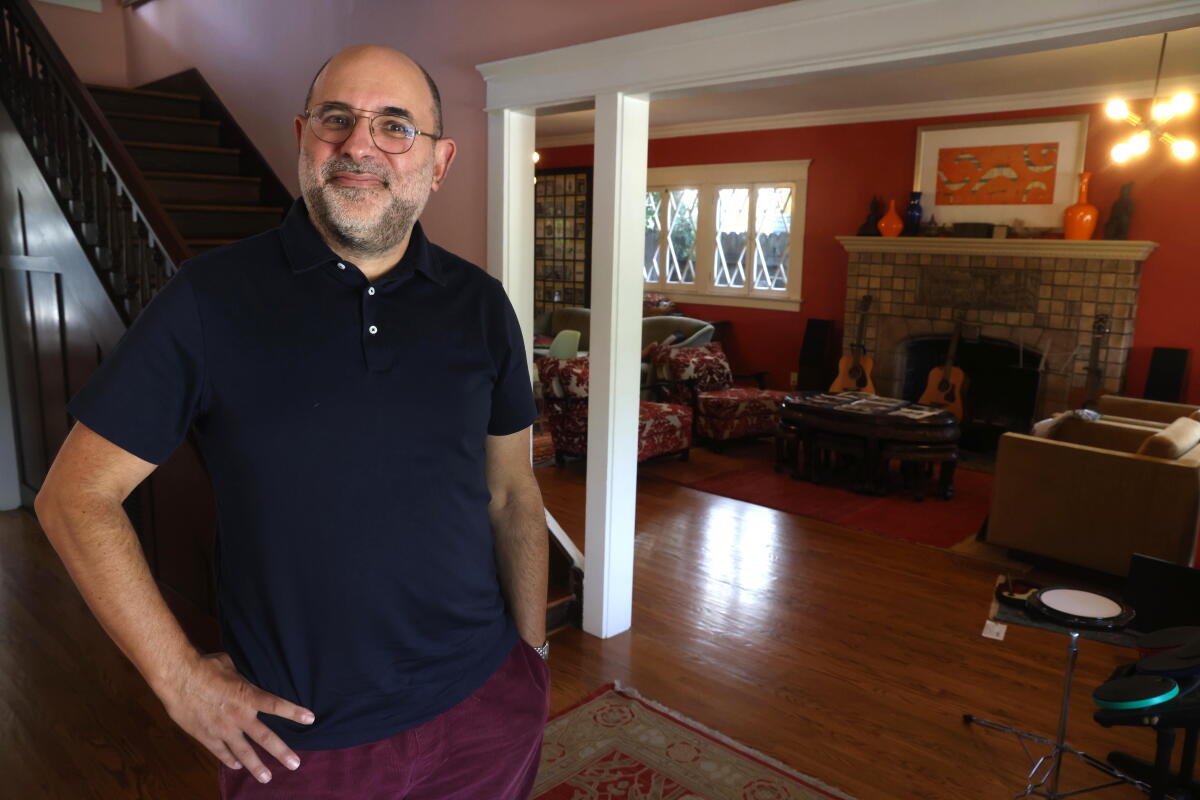
Joshua Saltman, shown in his Los Angeles home, is one of many Democratic donors from California who have given in divisive Democratic races across the country.
(Genaro Molina / Los Angeles Times)
Saddler has written checks to a number of more progressive candidates, including Flanagan, Chevalier, Ahmed and Nida Allam, who lost her primary bid to unseat incumbent Rep. Valerie Foushee in North Carolina’s 4th Congressional District, though he has also supported some moderate candidates in other races he sees as crucial to Democrats chances at retaking control of one or both chambers of Congress.
That pragmatic approach is part of the reason Joshua Saltman said he has supported a number of moderate candidates.
“The reality of the map is that if Democrats are going to retake the House, it’s not just winning super blue districts,” said Saltman, a former entertainment industry lawyer who now runs a Broadway music festival.
Saltman said that he considers himself to be a more moderate Democrat and is also inclined to give to moderate candidates who he believes “get a little less love” from other donors, particularly in California.
He has written checks to Rep. Haley Stevens, who lost to El-Sayed in Michigan; Rep. Angie Craig, who lost to Flanagan in Minnesota; Bell in Missouri and Gov. Janet Mills in Maine, who was Platner’s main competition in the Democratic primary before dropping out of the race.
Alan Burye, a retired accountant who lives just outside San Diego, said he prefers more moderate candidates because he thinks they are more productive politicians.
“The ones who are out on the edges, like Bernie Sanders, really don’t get much done,” Burye said.
He cut checks to Craig in Minnesota and Stevens in Michigan.
Israel’s impact
American support for Israel — in the wake of wars in Gaza and Iran — has been a major point of division among more progressive and moderate candidates and is a key fault line among many donors.
Progressive candidates have been increasingly critical of the actions and influence of the Israeli government as the public, broadly, has adopted a more negative view of the Israeli government.
Politicians who have drawn support in the past from the American Israel Public Affairs Committee, or AIPAC, have been a particular target of progressive challengers.
“The problem with the Democratic Party is that they’re all just beholden to AIPAC and to corporate interests,” said Alvi, the real estate investor in El Dorado Hills. “I want a candidate who has the courage to speak.”
In Michigan, El-Sayed described AIPAC’s support of Stevens, his moderate opponent, as “legalized bribery.”
El-Sayed has made no secret of his criticism of American foreign aid for Israel and said that he “doesn’t believe in ethno-states” in response to a question in the summer about whether he supports the right of Israel to exist.
El-Sayed’s comments and similar sentiments expressed by other more progressive candidates are part of the reason some donors have given to moderate candidates.
“I feel that people who fundamentally aren’t big fans of Israel aren’t necessarily people I want to give money to,” said Saltman, who gave to Stevens.
Saltman, who was born in Michigan, said that he would still vote for El-Sayed if he lived in the state.
Other donors said they were inspired to give to moderate candidates because of concern that anti-Israel rhetoric could veer into attacks on Jews more broadly.
Los Angeles investor Steve Emerson said his motivation in writing checks to moderate Democrats such as Stevens is “to fight antisemitism.”
El-Sayed, for his part, said in the summer that his criticism of Israel is about foreign policy, not Jewish people.
“Judaism and the Jewish people are a light onto the world,” he said.